

Introduction
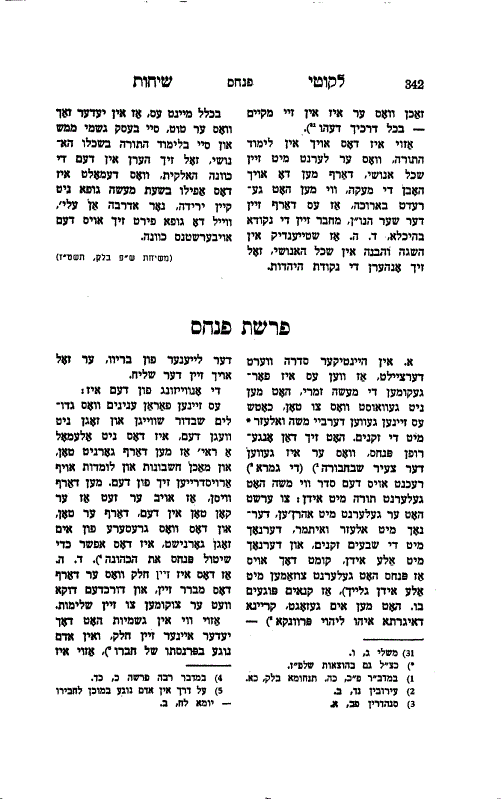
This sicha from Likutey Sichos, volume two, Parshas Pinchas, begins on page 342 and is the first sicha for this parsha. The Rebbe focuses on the story of Pinchas and Zimri, which is recounted in this week's Torah portion.
The Rebbe explains that from this episode, we learn a powerful lesson: there are times when a person must take a stand, even in situations where others present may seem greater or more learned than oneself. The story demonstrates that sometimes the responsibility—and indeed the opportunity—to act is given specifically to an individual who might not appear to be the most qualified by conventional standards.
Hashem sometimes expects and empowers a person to step forward precisely when it seems unexpected. This teaches us about personal responsibility and seizing moments when we are called upon to make a difference, regardless of how we compare to those around us.
Saif Aleph
The Torah expects from each individual that they should take action and do what is needed, even if there are others present who seem more important or qualified but are not acting. One should not look for excuses or reasons to avoid responsibility just because others, perhaps greater than oneself, are standing by and not taking initiative. The lesson is to step forward and act when necessary.
In this week’s Torah portion, we read the story of Zimri. Zimri, a leader from the tribe of Shimon, had a relationship with a Midianite woman, and the people did not know how to respond. At that time, Moshe Rabbeinu was present, as was Elazar, and also the elders whom Moshe had previously appointed to support him. Despite all these great leaders being there, no one knew what to do.
At that moment, Pinchas stood up. He was considered young and less prominent compared to those around him. The Midrash points out his youthfulness in this context. We see this also in the Gemara in Eruvin 54b, which discusses the order in which Moshe taught Torah to the Jewish people: first to his brother Aharon, then to Aharon's sons Elazar and Isamar (since Nadav and Avihu had already passed away), then to the seventy elders, and only afterwards to all of Israel.
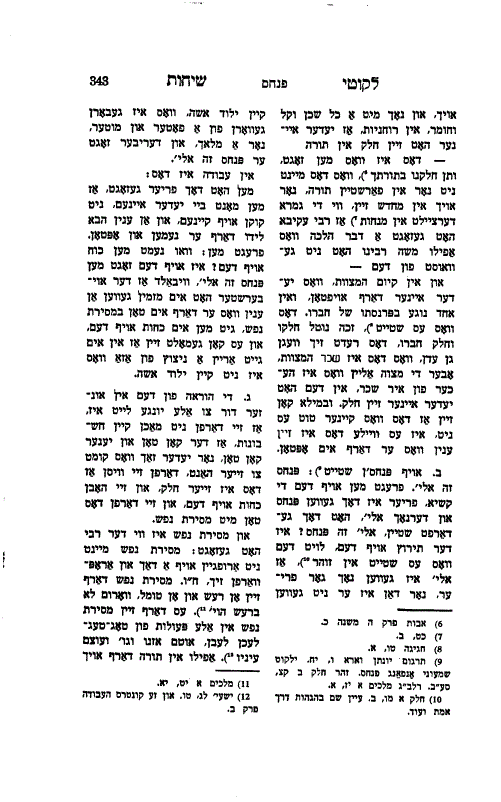
This means that Pinchas learned Torah together with the rest of the nation—he did not receive any special or earlier instruction. Only Elazar, Isamar, and the seventy elders learned before him. Nevertheless, Pinchas remembered a specific halacha: kanoi’im pog’im bo—that a zealot may take action against someone committing such an act.
When Pinchas brought up this halacha—that a zealot may strike—he was told: “The one who reads the letter should be its agent.” In other words, since he is the one who recalled and articulated this law, he should be the one to carry it out. Thus Pinchas took action himself against Zimri and Kozbi (the Midianite woman).
The lesson here is profound: even when great people in one's generation remain silent or do not act on an issue, it does not necessarily mean that nothing should be done. One might be tempted to rationalize inaction by thinking that if those greater than oneself are not acting, then surely there is no need for personal involvement.
However, if a person sees that they can accomplish something—that they can make a difference—they must act accordingly. The silence of those greater than oneself is not always an excuse for passivity or avoidance of responsibility.
This approach is further emphasized by what happened with Pinchas receiving the priesthood (Kehunah). The events were orchestrated so that Pinchas would be the one to take action—demonstrating that sometimes Hashem arranges matters specifically so an individual will step forward and fulfill their unique role.
Saif Beis
At this point, the Rebbe explains that Pinchas only became a Kohen after his unique act. This teaches us that sometimes a person is given an opportunity to do something that others are not doing. This means that each individual has a specific portion in the world that they are meant to purify—something Hashem wants them, specifically, to accomplish. By fulfilling this unique task, the person reaches their own spiritual completeness.
The fact that someone is presented with an opportunity, even when no one else is acting, may indicate that it is necessary for them to achieve their personal mission—their portion assigned by Hashem. Therefore, the absence of others should not deter a person from acting; rather, it may be a sign that this particular accomplishment is essential for their own spiritual wholeness.
The Rebbe draws a parallel between physical and spiritual portions. Just as in material matters each person has their own share—no one can take another’s livelihood—so too, and even more so, in spiritual matters. Every individual has their unique portion in Torah.
This idea is reflected in the prayer:
ותן חלקנו בתורתך
"And give us our portion in Your Torah."
This request means not only to grant us understanding of Torah but also the ability to innovate within it—to bring forth new insights and interpretations.The Gemara in Menachos (29b) relates how Rabbi Akiva taught halachic matters that even Moshe Rabbeinu did not know. When Moshe ascended Mount Sinai and saw Hashem attaching crowns to the letters of the Torah, Hashem explained that Rabbi Akiva would derive many laws from each crown. Moshe then asked to see Rabbi Akiva and was placed at the back of his classroom, unable to understand what was being taught until he heard something described as "a law given to Moshe at Sinai." This brought him comfort.
This story highlights how every Jew has a unique portion in Torah—not just in understanding but also in innovating within it. However, this concept extends beyond Torah study; it applies equally to mitzvos. Each person has specific mitzvos they are destined to fulfill—actions through which they accomplish their divine mission.
Although there are sources stating that if a person merits, he receives both his own portion and that of his friend, the Rebbe clarifies: this refers only to reward in heaven—the payment for mitzvos performed. The mitzvah itself, which is greater than its reward, belongs uniquely to each individual; no one else can perform another’s essential mitzvah for them.
Therefore, since every Jew has particular mitzvos assigned specifically to them, it is possible that when no one else is performing a certain act or mitzvah, it is because Hashem wants this individual alone to accomplish it. The argument "why aren’t others doing it?" does not apply; sometimes others refrain precisely because this task belongs uniquely to you.
The Rebbe further explains how a person can be empowered for such tasks—even if they do not stand out in other areas or are surrounded by people seemingly greater than themselves. How does one receive the strength needed for such unique missions?
The answer is that Hashem grants special power for these moments—just as He did with Pinchas. The Torah states regarding Pinchas: "Pinchas is Eliyahu." This raises a question: chronologically, Pinchas appears first (in our parsha), while Eliyahu lived generations later. If they share the same soul or spiritual connection, why say "Pinchas is Eliyahu" instead of "Eliyahu is Pinchas"?
The explanation lies in understanding that we are referring here not just to the physical Eliyahu who lived after Pinchas but also to a spiritual aspect of Eliyahu which preceded him. The spiritual energy of Eliyahu existed before Pinchas and was invested into him at his moment of action.
This idea finds support in the Zohar, which teaches that Eliyahu existed even earlier than Pinchas—in fact, at creation itself when reference is made allegorically to a bird (a symbol for Eliyahu). At that primordial stage, Eliyahu was not yet born from father and mother; he existed as a spiritual force destined later to be manifest through individuals like Pinchas.
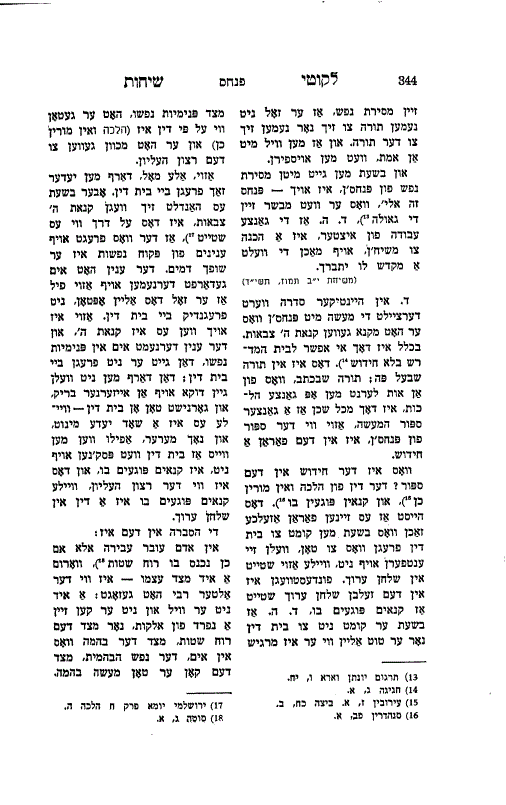
Saif Gimmel
The discussion here centers on the statement that Pinchas is Eliyahu. The reason for this identification is that, at the time of his courageous act, Pinchas was likened to an angel. Therefore, when we say "Pinchas is Eliyahu," we mean that Pinchas embodies the qualities of Eliyahu, who himself is described as an angelic figure.
This teaches us that Pinchas drew his strength from a source beyond ordinary human capacity—he received power akin to that of an angel. In practical terms, this means that when a person is faced with a challenge or a task that comes their way, they must not look to others or compare themselves. Instead, they should recognize that if a matter has come into their hands, it is their responsibility to accomplish it.
One might wonder: where does a person get the strength to fulfill such a mission? The answer lies in the idea that "Pinchas is Eliyahu." Just as Pinchas was empowered with an angelic spark to fulfill his role, so too every individual who faces a unique challenge or mitzvah receives special strength and inspiration—even from sources higher than human beings—to accomplish their task.
This concept applies especially in our times. When there is an opportunity to reach out and bring others closer to Judaism—to perform acts of outreach and inspire return to Yiddishkeit—even if there are other great people present who are not taking action, one must be ready to step forward with self-sacrifice and seize the opportunity.
The lesson for our generation, particularly for young people, is clear: do not make calculations about who else could do the job or whether someone else might be more qualified. If something comes your way, it is your portion—your chelik—and you have been given the power to fulfill it. It must be done with mesiras nefesh—self-sacrifice.
But what does self-sacrifice mean in this context? As explained by the Rebbe (referring to the previous Rebbe), self-sacrifice does not mean dramatic acts or risking one's life in a reckless manner. Rather, true self-sacrifice often happens quietly and without fanfare. The verse says that Hashem does not come with great noise; similarly, our dedication should be expressed in daily life through small but meaningful acts—closing one's ears from hearing negativity or one's eyes from seeing improper things.
Even enduring discomfort or hardship should be approached with self-sacrifice—not by seeking out suffering for its own sake, but by being willing to take on challenges for the sake of fulfilling one's mission. When one acts sincerely and wholeheartedly in this way, they can truly accomplish great things.
This was exemplified by Pinchas: despite facing opposition from an entire tribe and its leader, he acted with mesiras nefesh to do what needed to be done. When we emulate Pinchas's self-sacrifice in our own lives, we connect ourselves to the spirit of both Pinchas and Eliyahu—and ultimately prepare for redemption.
Eliyahu will herald the coming of Mashiach, which means that all our current efforts serve as preparation for making this world into a dwelling place—a sanctuary—for Hashem.
Although in this particular sicha the Rebbe did not elaborate extensively on outreach work or bringing others close, he emphasized that whatever comes into one's hands must be done with mesiras nefesh, even in daily activities. Still, when addressing young people and urging them to seize every opportunity, it can also be understood as encouragement to go out and make an impact on one's environment—helping others grow spiritually and preparing for Mashiach's arrival.
Key Points
1. The story of Pinchas teaches that one must sometimes take initiative and act, even when surrounded by people who seem more qualified or important. Personal responsibility is not diminished by the presence or inaction of others.
2. Pinchas was not among the foremost leaders or early recipients of Moshe’s teachings, yet he remembered and acted upon a crucial halacha. His willingness to step forward when others hesitated demonstrates that greatness can emerge from unexpected individuals.
3. The episode underscores that Hashem may orchestrate events so a specific person is given the opportunity—and responsibility—to fulfill a unique role, as seen in Pinchas receiving the priesthood only after his courageous deed.
4. Every individual has a unique spiritual mission and portion in Torah and mitzvos that only they can fulfill. When an opportunity arises that no one else is seizing, it may be a sign that it is meant specifically for that person to accomplish.
5. The uniqueness of each person’s mission is reflected in the prayer “And give us our portion in Your Torah,” which includes both understanding and innovating within Torah. Similarly, each Jew has mitzvos uniquely assigned to them, which cannot be performed by others on their behalf.
6. Even if someone does not stand out among their peers or feels less qualified, Hashem grants special strength for fulfilling one’s unique tasks—just as Pinchas was empowered with the spiritual energy associated with Eliyahu to accomplish his mission.
7. The identification of Pinchas with Eliyahu highlights how individuals can draw on higher, even angelic, sources of strength when called upon to act. This empowers every Jew to fulfill their divine mission regardless of external circumstances or perceived limitations.
8. In contemporary times, especially for young people, the lesson is to seize every opportunity for positive action without waiting for others or doubting one’s own qualifications. If a task comes your way, it is your portion and must be fulfilled with self-sacrifice—mesiras nefesh—even in small, everyday ways.
9. True self-sacrifice does not require dramatic gestures but is often expressed quietly through daily dedication—guarding one’s behavior and persevering through challenges for the sake of fulfilling one’s mission.
10. By emulating Pinchas’s example of courageous action and self-sacrifice, we connect ourselves to both Pinchas and Eliyahu, thereby preparing ourselves and the world for redemption and the coming of Mashiach.