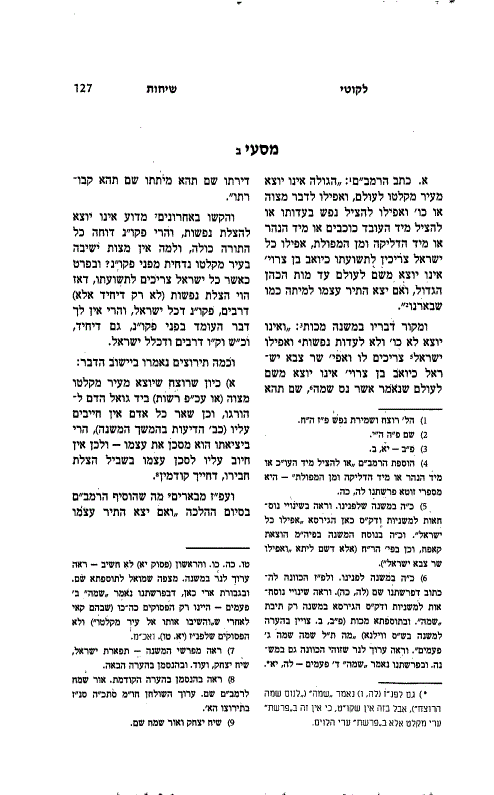


The Rambam writes: "The exile never leaves his city of refuge, not even for a mitzvah or similar reasons, nor to save a life with his testimony, nor to rescue from the hands of idolaters, from a river, from a fire, or from a collapse. Even if all of Israel needs his salvation, like Yoav ben Tzruya, he does not leave there ever until the death of the High Priest. If he leaves, he exposes himself to death, as we have explained."
The source of his words is in the Mishnah in Makkos: "He does not leave, not for... nor for capital testimony, even if Israel needs him, even if he is the army commander of Israel like Yoav ben Tzruya, he does not leave there ever, as it is stated, 'to which he has fled,' there shall be his dwelling, there shall be his death, there shall be his burial."
The Acharonim have questioned why he does not leave to save lives, given that pikuach nefesh (saving a life) overrides the entire Torah. Why is the mitzvah of residing in his city of refuge not overridden by pikuach nefesh? Especially when all of Israel needs his salvation, which constitutes saving lives (not just of an individual but) of the many, pikuach nefesh of all Israel, and there is nothing that stands in the way of pikuach nefesh, even of an individual, and certainly and all the more so of the many and of all Israel.
Several explanations have been offered to resolve this issue:
a) Since a murderer who leaves his city of refuge allows the blood avenger to kill him (or at least permits it), and others are not obligated to protect him, by leaving, he endangers himself. Therefore, he is not obligated to endanger himself to save another, as one's own life takes precedence.
Based on this, they explain the Rambam's addition at the end of the halacha, "If he leaves, he exposes himself to death," intending to clarify the reason for the law that he does not leave even to save lives — because he should not put himself in potential danger for the sake of saving another (even from certain danger).
This explanation has already been challenged, as the very law that there is no obligation to put oneself in potential danger to save another from certain danger is itself a matter of dispute, and according to many poskim, there is such an obligation. Moreover, when it concerns pikuach nefesh of all Israel, it seems that in our case, there is not even potential danger, as it is obvious that someone whom all Israel needs for salvation, like Yoav ben Tzruya, the army commander of Israel, can protect himself from the blood avenger. Furthermore, who says it is forbidden to close the door against the blood avenger until the exile saves all Israel?
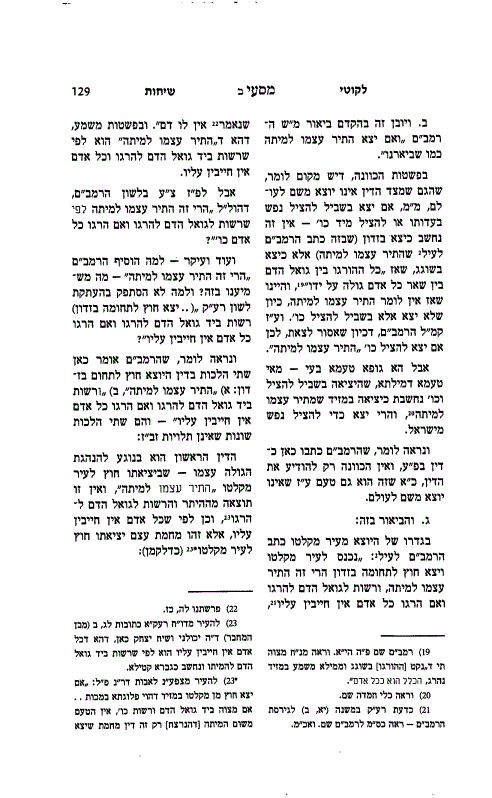
Additionally, the claim that the Rambam's concluding words serve as a reason for the previous statement is not so clear, because from the Rambam's wording, "If he leaves, he exposes himself to death," it does not imply that this is a reason for the law (that he does not leave). If it were, it should have stated, "He does not leave there ever... because if he leaves, he exposes himself to death," or something similar.
b) Some have written that since a death occurred through him, it is unlikely that merit will come through him. It is difficult to say that this is the reason for the law, as how can one rely on such reasoning to override the obligation of pikuach nefesh — which overrides the entire Torah, even in cases of doubt or multiple doubts.
c) Others say it is a scriptural decree, "there shall be his dwelling, etc.," that he does not leave for anything in the world, even for a great need like saving all Israel.
But this explanation also requires clarification — for it is a great principle that pikuach nefesh overrides the entire Torah. However we interpret this principle — whether that in the presence of pikuach nefesh, the obligations of the Torah do not apply at all (as derived from "and live by them, and not die by them"), or that pikuach nefesh overrides all the laws of the Torah, meaning that concerning the obligation to save lives, whether one's own or others', no law of the Torah overrides it — why should the scriptural decree of "there shall be" override the obligation of pikuach nefesh that overrides the entire Torah? (And in the teaching of "there shall be," it is not stated that this law applies even in the case of pikuach nefesh, and pikuach nefesh of all Israel).
This will be understood by first explaining what the Rambam writes, "If he leaves, he exposes himself to death, as we have explained."
Simply put, one might suggest that although by law he should never leave, nevertheless, if he leaves to save a life with his testimony or to rescue someone from danger, it is not considered as leaving intentionally but rather as leaving unintentionally. In such a case, "anyone who kills him, whether the avenger of blood or any other person, is exiled because of him," meaning that it cannot be said that he made himself liable to death, since he only left to save a life. To this, the Rambam informs us that since it is forbidden to leave, if he leaves to save a life, "he has made himself liable to death."
But this itself requires explanation — what is the reason that leaving to save a life is considered intentional, making him liable to death, when he left to save a Jewish life?
It seems that the Rambam writes this here as a law in its own right, not just to inform us of the law, but also as a reason why he should never leave.
The explanation is as follows:
Regarding the status of one who leaves his city of refuge, the Rambam previously wrote: "If he enters his city of refuge and leaves its boundary intentionally, he has made himself liable to death, and the avenger of blood is permitted to kill him, and if any person kills him, they are not liable, as it is stated, 'he has no blood.'" Simply put, it seems that "he has made himself liable to death" is because the avenger of blood is permitted to kill him, and any person is not liable for killing him.
However, according to this, the wording of the Rambam is puzzling. Why did he not say, "he has made himself liable to death because the avenger of blood is permitted to kill him, and if any person kills him, etc."?
Moreover, and primarily — why did the Rambam add "he has made himself liable to death" — what does this teach us? Why did he not suffice with quoting Rabbi Akiva's wording, "(if he leaves the boundary intentionally) the avenger of blood is permitted to kill him, and if any person kills him, they are not liable"?
It seems that the Rambam is stating two laws regarding one who intentionally leaves the boundary: a) "he has made himself liable to death," b) "the avenger of blood is permitted to kill him, and if any person kills him, they are not liable" — and these are two distinct laws that are not dependent on each other:
The first law concerns the conduct of the exile himself — by leaving the city of refuge, "he has made himself liable to death," and this is not a result of the permission and allowance for the avenger of blood to kill him, nor because any person is not liable for him, but rather due to his very act of leaving the city of refuge (as will be explained);
The second law pertains to the killing of the murderer by another (who finds him outside the city of refuge), and in this, there is a distinction between the avenger of blood and other people. The avenger of blood is permitted to kill him, while other people are only "not liable" (but are initially forbidden, even though he is "a dead man").
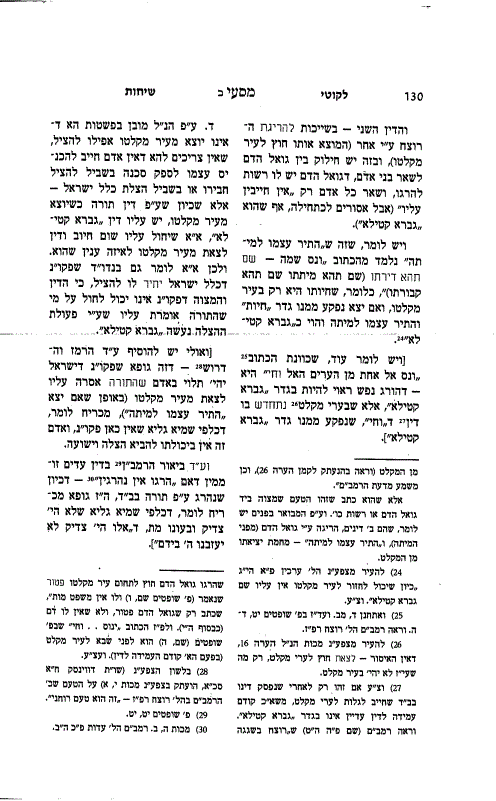
It can be said that "he has made himself liable to death" is derived from the verse "and he shall flee there — there shall be his dwelling (there shall be his death, there shall be his burial)," meaning that his life is only within the city of refuge, and if he leaves, he loses the status of "life" and makes himself liable to death, becoming like "a dead man."
[It can also be said that the intention of the verse "and he shall flee to one of these cities and live" is — that one who kills a person is deemed "a dead man," but in the cities of refuge, a new law of "and live" is established, removing from him the status of "a dead man."]
According to the above, it is simply understood why he does not leave the city of refuge even to save a life. There is no need for the reasoning that a person is not obligated to put himself in potential danger to save another or to save all of Israel — rather, since according to Torah law, when he leaves the city of refuge, he has the status of "a dead man," no obligation or law can apply to him to leave the city of refuge for any matter. Therefore, it cannot be said even in our case that the pikuach nefesh of all Israel permits him to save, because the law and commandment of pikuach nefesh cannot apply to someone whom the Torah says becomes "a dead man" through the act of saving.
Perhaps it can be added, in the way of hint and homiletics, that the very fact that the pikuach nefesh (saving of a life) of Israel would depend on a person whom the Torah forbids to leave his city of refuge (in such a way that if he leaves, "he permits himself to death") compels us to say that, from Heaven's perspective, there is no actual pikuach nefesh here, and this person is not capable of bringing salvation and deliverance.
This is similar to the explanation of the Ramban regarding the law of false witnesses, that if "they killed, they are not executed" — because since he was killed according to the Torah in a court, this itself compels us to say that, from Heaven's perspective, it was revealed that he was not righteous and died because of his sin, for "if he were righteous, G‑d would not abandon him to their hands."
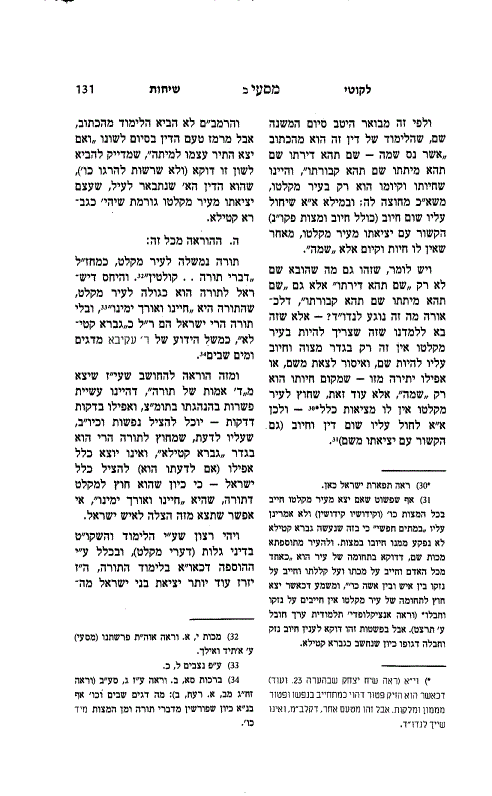
According to this, the conclusion of the Mishnah there is well explained, where the teaching of this law is derived from the verse "to which he fled — there shall be his dwelling, there shall be his death, there shall be his burial," meaning that his life and existence are only within his city of refuge, unlike outside of it. Consequently, no obligation (including the obligation and commandment of pikuach nefesh) can apply to him that involves leaving his city of refuge, since he has no life and existence except "there."
It can be said that this is also why it is mentioned there not only "there shall be his dwelling" but also "there shall be his death, there shall be his burial." Seemingly, what relevance does this have to our discussion? Rather, this comes to teach us that the requirement for him to be in his city of refuge is not merely a commandment and obligation for him to be there, and a prohibition to leave, or even more so — that his place of life is only "there," but furthermore, outside the city of refuge, he has no existence at all. Therefore, no law or obligation can apply to him (even those related to leaving there).
The Rambam does not bring the teaching from the verse, but he hints at the reason for the law at the end of his words, "and if he leaves, he permits himself to death," where he specifically chooses this expression (and not that it is permissible to kill him, etc.), which is the first law explained above, that his very departure from the city of refuge causes him to be like "a dead man."
The lesson from all this:
The Torah is compared to a city of refuge, as our sages say, "the words of Torah... provide refuge." The relationship of Israel to the Torah is like an exile to a city of refuge, for the Torah is "our life and the length of our days," and without the Torah, Israel is, G‑d forbid, like "a dead man," as in the well-known parable of Rabbi Akiva about fish and water in the sea.
From this, there is a lesson for one who thinks that by leaving the "four cubits of Torah," meaning making compromises in his conduct in Torah and mitzvos, even in the slightest degree, he can save lives and the like. He must know that outside the Torah, he is considered "a dead man," and he does not leave at all even (if in his opinion it is) to save all of Israel — because since he is outside the refuge of Torah, which is "our life and the length of our days," no salvation can come from this for any Jew.
May it be G‑d's will that through the study and discussion of the laws of exile (cities of refuge), and in general through the increase of each individual in Torah study, this will further hasten the redemption of the Jewish people from the exile we are in, and the prophecy "Zion shall be redeemed with justice and her captives with righteousness" will be fulfilled, and these days will be transformed into joy and gladness and good festivals, immediately and without delay.