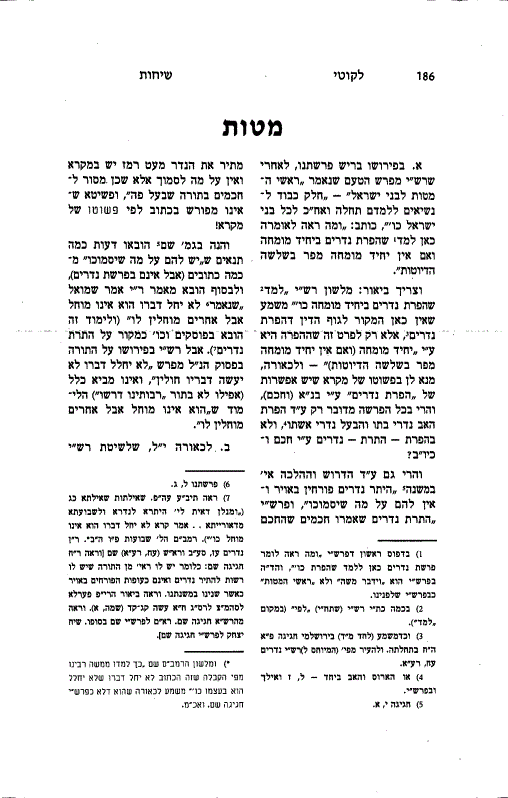
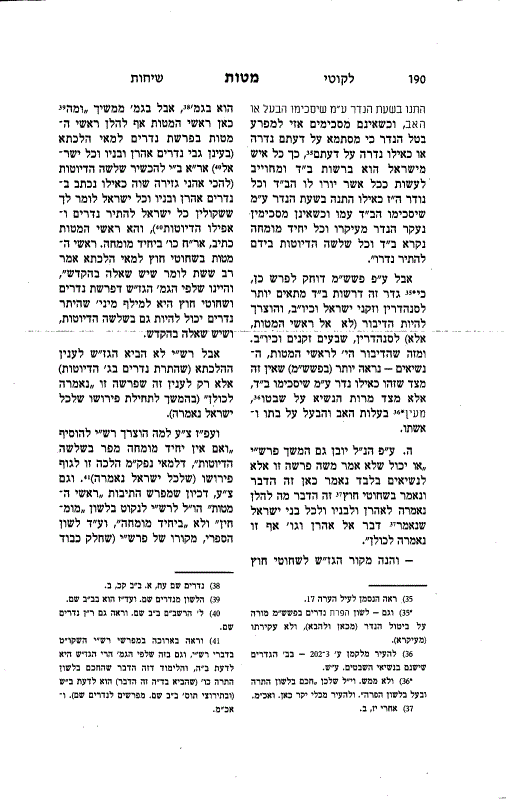
In his commentary at the beginning of our parsha, after Rashi explains the reason it says "the heads of the tribes of the children of Israel" — "to give honor to the leaders by teaching them first and then to all the children of Israel," he writes: "And what did he see to say it here? He learned that the annulment of vows is by a single expert, and if there is no single expert, it is annulled by three laymen."
This requires explanation: From Rashi's wording "he learned that the annulment of vows is by a single expert, etc.," it implies that this is not the source for the actual law of annulment of vows, but only for this detail that the annulment is by a "single expert (and if there is no single expert, it is annulled by three laymen)." However, where in the simple meaning of the text do we find the possibility of "annulment of vows" by people (and a sage), since the entire parsha only discusses the annulment of a father's vows for his daughter and a husband's vows for his wife, and not the annulment — the release — of vows by a sage or the like?
Even in terms of drush and halacha, it is stated in the Mishnah, "The release of vows flies in the air and has nothing to rely on," and Rashi explains, "The release of vows that the sages said, that a sage releases the vow, has a slight hint in the scripture and nothing to rely on except that it is entrusted to the sages in the Oral Torah," and it is obvious that it is not explicitly stated in the scripture according to its simple meaning!
In the Gemara there, opinions of several Tannaim are brought that "they have something to rely on" from several verses (but they are not in the parsha of vows), and finally, it brings the statement of Rabbi Yehuda in the name of Shmuel: "As it says, 'he shall not break his word' — he does not break, but others break for him" (and this teaching is brought in the poskim, etc., as a source for the release of vows). However, Rashi in his commentary on the Torah on the aforementioned verse explains "he shall not desecrate his word" as "he shall not make his words profane," and he does not bring at all (not even as "our Rabbis expounded") the teaching that "he does not break, but others break for him."
It seems that according to Rashi, the release of vows by a sage is a straightforward matter according to the simple meaning of the text, and does not require a special teaching for this, because the release of the vow according to its simple meaning is by opening a door for his vow, that if he had known initially that it would be so and so, he would not have vowed in the first place. Therefore, there is no need for a novel teaching that a sage can release the vow, since the sage only shows that there was an error in the vow and that he did not vow with this in mind.
This is also proven from Rashi's commentary on the Talmud, where he explains Rabbi Yochanan's statement, "A sage does not release anything except with regret" — "by opening a door for the one who vowed with matters that come to him through this vow, that if he had known initially that it would be so, he would not have vowed, it turns out that from the beginning it is not a vow."
From his words, we learn three things about the nature of the release of vows: a) The release of vows is fundamentally through a door of regret, for although it is stated in the Talmud that the release of a vow is in two ways, through regret or through a door, nevertheless, the essence of the release of vows (even when it depends on regret) is through a door for his vow. b) The release of the vow is not an action performed (now) by the sage, but rather through the door, whereby the vow is nullified on its own. c) Furthermore, the release is not in the category of nullification, but rather a revelation that it was not a vow from the beginning, and therefore Rashi specifies "it turns out that from the beginning it is not a vow."
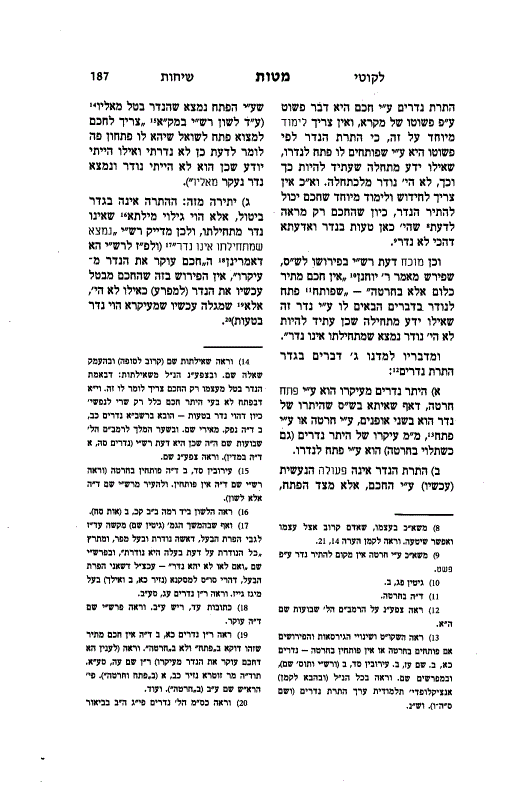
According to this, for Rashi, when it is said that "the sage uproots the vow from its root," it does not mean that the sage now nullifies the vow (retroactively) as if it never was, but rather that he now reveals that from the outset it was a vow made in error.
Therefore, Rashi does not need to explain from where we know the release of vows, because there is no need for a teaching on this. It is obvious that if it is revealed that the vow was made in error, the vow is nullified from its inception, and from the beginning, the obligation of "he shall not break his word" does not apply.
The novelty in the portion is only in the annulment of vows by the father and the husband, which is not through a door of regret, etc., and this is the main subject of the portion of vows here.
Based on this, it is understood why Rashi does not bring the interpretation "he cannot annul, but others can annul for him," because according to the simple meaning of the text, not only is there no need for this teaching, but this interpretation does not fit the concept of the release of vows — since the release is not dependent on others who effectuate the release of the vow.
Even the interpretation itself, "he shall not break his word... but others can annul for him," does not fit the concept of release according to the simple meaning, for Rashi explains "he shall not break his word" as "he shall not make his words profane."
Therefore, there is no place (at least according to the simple meaning) to interpret "but others make it profane" (meaning that he can profane his word) — because the nature of the release according to the simple meaning is a revelation that from the outset, it was not ("his word") a vow.
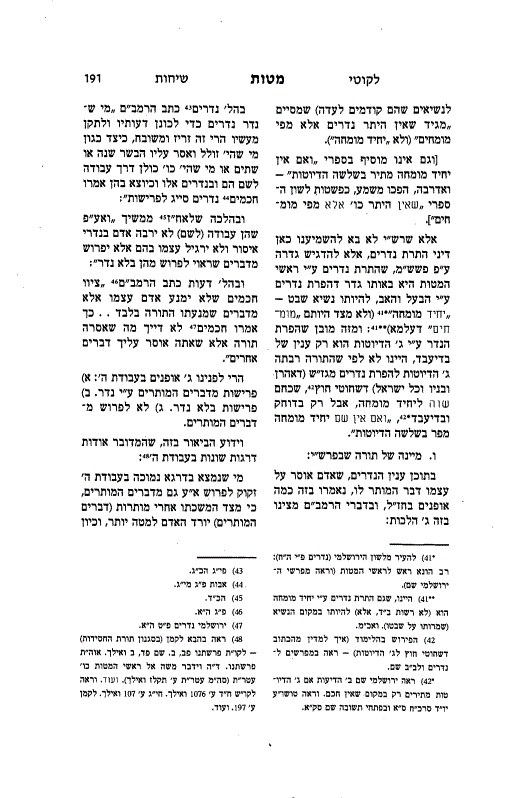
Even according to the explanation of the early commentators regarding the Talmudic expression "but others can annul for him" — "annulment and profaning are one concept, the expression 'he shall not break' means he shall not permit, and the matter is like untying a knot, so that it returns as if it never was... and this is what they said, that the sage uproots the vow from its root, and annulment also makes the debt or sin as if it never was" — which explains that the concept of annulment is like untying a knot, meaning that there was a knot and now it is untied (but after the release, it is (from now on) as if it never was) — since there is an action of nullification and release of the vow from now, it is not appropriate to use the expression "others can annul for him" according to the above explanation regarding the nature of release, as it is not that the nullification is newly established, in a way that now it is as if it never was, but it is a logical matter, meaning it is not like the annulment of a debt, but a revelation that there was never a vow here.
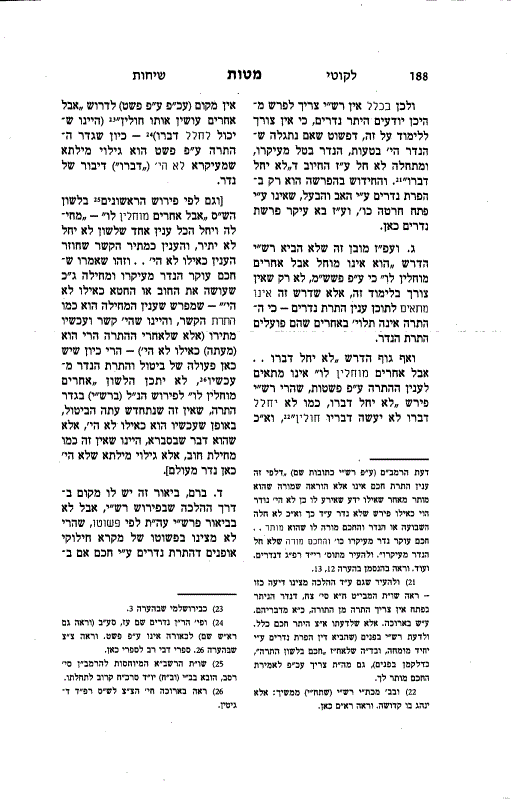
However, this explanation has a place in the halachic approach in Rashi's commentary, but not in Rashi's explanation on the Torah according to its simple meaning, for we do not find in the simple meaning of the verses different methods of the release of vows by a sage, whether through simple regret or through a door, etc., as there is no hint of this in the simple meaning of the text regarding the methods of releasing vows.
Moreover, in Rashi's commentary on the verse "This is the thing — it is a limitation to say that the sage uses the language of release and the husband (and father) uses the language of annulment as the language of the scripture here, and if they exchange, it is neither permitted nor annulled," and from the precision of his language [especially since Rashi changes here from the language of the Sifri "This is the thing which the L‑rd commanded, the husband annuls and the sage does not annul, the sage releases and the husband does not release", and emphasizes that the sage uses the language of release and the husband the language of annulment], it implies that there is no difference between the husband (and father) and the sage in the nature and method of nullifying the vow (and certainly not as previously mentioned that in the sage's release it is only a revelation that there was no vow from the outset, and it is not due to the sage's nullification) — rather, both the sage and the husband are equal in the manner and type of nullifying the vow, and the difference between them is only in the language.
Therefore, it must be said that the nature of the release of vows according to Rashi's commentary in the simple meaning of the text is different from its nature according to halacha, and with further precision in Rashi's language at the beginning of his words "learn that the annulment of vows is by an expert individual... annuls, etc.," which seemingly should have said "that the release of vows is by an expert individual, etc.," since the sage releases the vow unlike the husband (and father) who annuls the vow — and Rashi writes "that the annulment of vows."
Especially since this changes from the language of the Sifri here, "that there is no release of vows except by experts," where it is explained as "release" and not "annulment."
It can be said that Rashi's view in the simple meaning of the text is that the release of vows by a sage is of the same nature as the annulment of vows by the husband and father (as explained in the verse), just as the husband annuls his wife's vows and the father his daughter's vows without any reason or opening and regret, so too is the release by a sage, whose nature is annulment, without opening and regret.
Therefore, Rashi did not bring a special teaching on this, because it is similar to the annulment explained in the parsha. Since it is stated at the beginning of the parsha, "And Moses spoke to the heads of the tribes," it is understood that its nature is similar to the annulment by the husband and father. Just as the woman and daughter, when they are under the authority of the husband or father, their authority is upon them to annul their vows — so too with the "heads of the tribes," who, being the heads of their tribes, are given the power to annul the vows of the members of the tribe.
Furthermore, the Kli Yakar also connects the two matters and writes, "The reason for the release of vows by an expert individual or by three laymen who are called a court, we learn from the annulment by the father and husband. Just as the father and husband have the power to annul because every woman is under the authority of her husband or father and has no power to do anything significant without their consent, and it is as if they stipulated at the time of the vow that it is contingent upon the agreement of the husband or father, and if they do not agree, then retroactively the vow is nullified because presumably she vowed with their consent or as if she vowed with their consent."
So too, every Jew is under the authority of the court and is obligated to do as the court instructs him, and every vow is as if it was stipulated at the time of the vow that it is contingent upon the court's agreement with him, and if they do not agree, the vow is uprooted from its root, and every expert individual is called a court, and any three laymen have the power to release his vow."
However, according to the simple meaning of the text, it is difficult to interpret it this way, because this concept of the court's authority is more fitting for the Sanhedrin and the elders of Israel and similar, and the speech should have been (not to the heads of the tribes, but) to the Sanhedrin, the seventy elders, and similar. From the fact that the speech was to the heads of the tribes, the princes — it appears more (in the simple meaning of the text) that it is not because it is as if he vowed contingent upon the court's agreement, but because of the authority of the prince over his tribe, similar to the ownership of the father and husband over their daughter and wife.
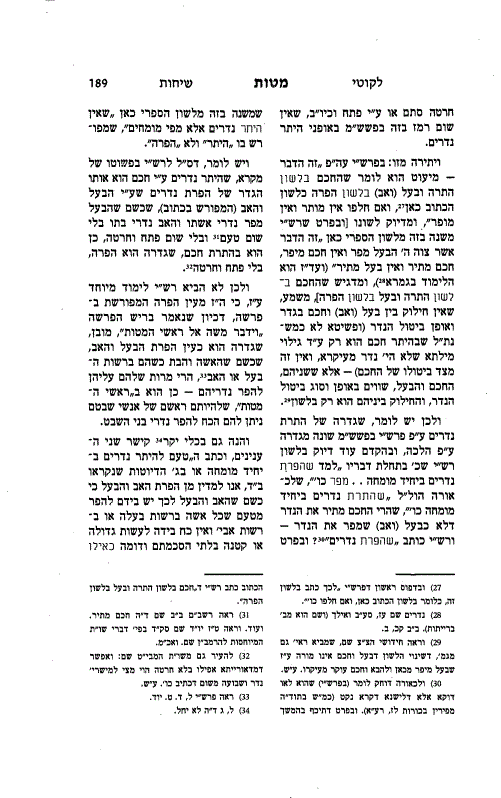
Based on the above, we can also understand the continuation of Rashi's commentary, "Or could it be that Moses only said this parsha to the princes? It says here 'this is the thing,' and it says regarding slaughter outside the Temple 'this is the thing,' just as there it was said to Aaron and his sons and all the children of Israel, as it says, 'Speak to Aaron, etc.,' so too here it was said to all."
The source of the gezeirah shavah to slaughtering outside the Temple is in the Talmud, but in the Talmud it continues, "And just as here it says the heads of the tribes, so too there it says the heads of the tribes in the parsha of vows, for what halacha do we need Aaron and his sons and all of Israel regarding vows?" Rabbi Elazar ben Yaakov says, "To qualify three laymen (therefore the gezeirah shavah is effective as if it was written in the parsha of vows Aaron and his sons and all of Israel, to tell you that all of Israel are qualified to release vows, even laymen), and it is written the heads of the tribes, Rabbi Chanina says, etc., by an expert individual. The heads of the tribes in slaughtering outside the Temple, for what halacha? Rav Sheshet says, to say that there is questioning in consecration."
This means that according to the Talmud, the gezeirah shavah of the parsha of vows and slaughtering outside the Temple is to learn from it that the release of vows can also be by three laymen, and that there is questioning in consecration. But Rashi did not bring the gezeirah shavah for the halachic matter (that the release of vows is by three laymen) but only for this matter that this parsha "was said to all" (continuing from the beginning of his commentary that it was said to all of Israel).
Accordingly, it is puzzling why Rashi needed to add, "And if there is no expert individual, he releases by three laymen," for what practical difference does this halacha make to the essence of his commentary (that it was said to all of Israel)?
It is also puzzling, since Rashi interprets the words "the heads of the tribes," he should have used the term "experts" rather than "an expert individual," similar to the language of the Sifri, which is Rashi's source (which gave honor to the leaders who precede the congregation) and concludes, "This teaches that the release of vows is only from experts" (and not "an expert individual").
Moreover, the Sifri does not add "and if there is no expert individual, he releases by three laymen" — on the contrary, the simple language of the Sifri implies "that there is no release, etc., except from experts."
However, Rashi is not here to teach us the laws of the release of vows, but to emphasize its definition according to the simple meaning of the text, that the release of vows by the heads of the tribes is of the same nature as the annulment of vows by the husband and father, being a leader of a tribe — "an expert individual" (and not because they are "general experts").
From this, it is understood that the annulment of the vow by three laymen is only a matter of necessity, meaning not because the Torah included three laymen for the annulment of vows from the gezeirah shavah (of Aaron and his sons and all of Israel) of slaughtering outside the Temple, whose power is equal to an expert individual, but only under pressure and as a last resort, "and if there is no expert individual, he releases by three laymen."
The essence of Torah in Rashi:
Regarding the concept of vows, where a person prohibits something permissible to himself, several approaches are mentioned in the words of our Sages, and in the writings of the Rambam, we find three laws on this matter:
In the laws of vows, the Rambam writes, "One who vows vows to establish his character and improve his deeds, this is praiseworthy and commendable. How so? For example, one who was a glutton and prohibited meat to himself for a year or two, or one who... all of these are a way of service to G‑d, and concerning these vows and similar ones, the Sages said, 'Vows are a fence for abstinence.'"
In the following law, he continues, "And even though they are a service (to G‑d), a person should not increase in vows of prohibition nor accustom himself to them, but should abstain from things that are appropriate to abstain from without a vow."
In the laws of character traits, the Rambam writes, "The Sages commanded that a person should not abstain from anything except what the Torah prohibited... as the Sages said, 'Is it not enough what the Torah prohibited, that you prohibit other things upon yourself?'"
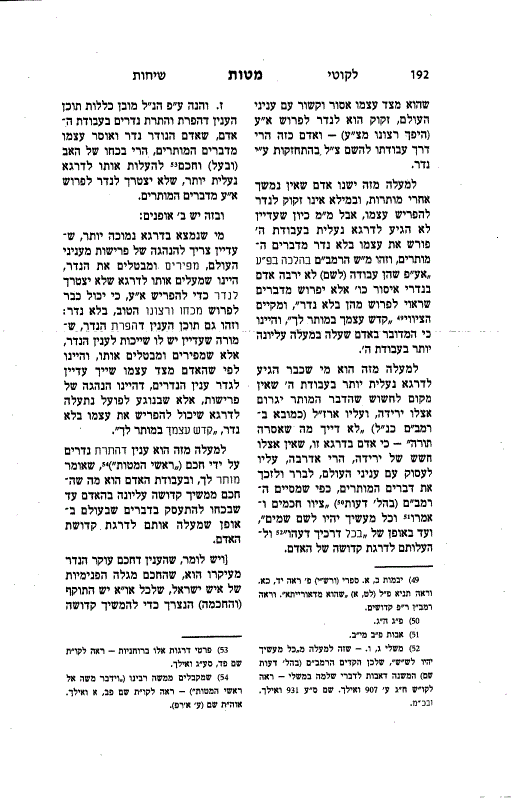
Here we have three approaches in the service of G‑d: a) Abstinence from permissible things through a vow. b) Abstinence without a vow. c) Not abstaining from permissible things.
It is known that the explanation for this is that it speaks about different levels in the service of G‑d:
One who is at a lower level in the service of G‑d needs to abstain even from permissible things, because due to his attraction to indulgences (permissible things), a person descends further, and since he is inherently forbidden and connected with worldly matters, he needs a vow to abstain (contrary to his own will) — and such a person's way of serving G‑d must be strengthened through a vow.
Higher than this is a person who is not drawn after indulgences, and therefore does not need a vow to separate himself, but nevertheless, since he has not yet reached a higher level in the service of G‑d, he abstains without a vow from permissible things. This is what the Rambam writes in a separate law, "Even though they are a service (to G‑d), a person should not increase in vows of prohibition, etc., but should abstain from things that are appropriate to abstain from without a vow," fulfilling the command "Sanctify yourself with what is permissible to you," meaning that the person has ascended to a higher level in the service of G‑d.
Higher than this is one who has already reached a higher level in the service of G‑d, where there is no concern that permissible things will cause him to descend. Concerning him, the Sages said, "Is it not enough what the Torah prohibited" — because a person at this level, where there is no concern of descent, on the contrary, he should engage with worldly matters, to refine and purify the permissible things, as the Rambam concludes (in the laws of character traits).
"And all your deeds should be for the sake of Heaven," and even in the manner of "In all your ways, know Him."
According to the above, we can understand the general concept of the annulment and release of vows in a person's service to G‑d. When a person makes a vow and prohibits himself from permissible things, the father (or husband) and a sage have the power to elevate him to a higher level, where he no longer needs a vow to separate himself from permissible things.
There are two approaches to this: one who is on a lower level, who still needs to practice abstinence from worldly matters, has his vow annulled. This means he is elevated to a level where he does not need a vow to separate himself, as he can already abstain through his own strength and good will, without a vow. This is also the content of the annulment of the vow, which indicates that he still has a connection to the concept of vows, but they are annulled and nullified. This is because the person, in essence, still belongs to the category of vows, which is a practice of abstinence, but in practice, he has been elevated to a level where he can separate himself without a vow, "Sanctify yourself with what is permissible to you."
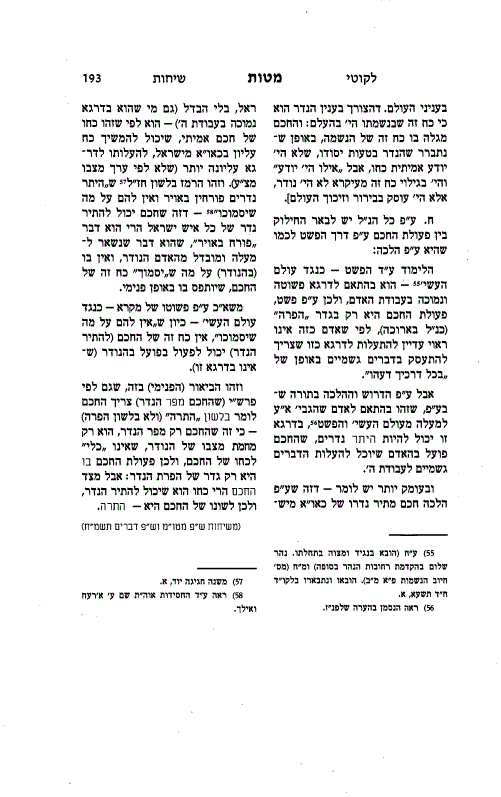
Higher than this is the concept of the release of vows by a sage ("heads of the tribes"), who declares, "It is permitted to you." In a person's service, this means that the sage draws down a higher holiness into the person, enabling him to engage with worldly matters in a way that elevates them to the level of the person's holiness. [It can be said that the sage uproots the vow from its root, revealing the inner essence of a Jew, that each one has the necessary strength (and wisdom) to draw holiness into worldly matters. The need for the vow arises because this power in his soul was concealed; the sage reveals this power of the soul, clarifying that the vow was based on a mistake, as he did not know his true strength. But "if he had known" and this power had been revealed from the outset, he would not have vowed, but would have engaged in refining and purifying the world.]
Based on all the above, we can explain the difference between the action of the sage according to the simple meaning and as it is according to halacha: The study according to the simple meaning — corresponding to the world of Asiyah — is appropriate for a simple and lower level in a person's service. Therefore, according to the simple meaning, the action of the sage is only in the category of "annulment" (as explained at length above), because such a person is not yet fit to be elevated to a level where he must engage with physical matters in the manner of "In all your ways, know Him."
However, according to the drush and halacha in the Oral Torah, which corresponds to a person who has elevated himself above the world of Asiyah and the simple meaning, at this level, there can be a release of vows. The sage acts upon the person so that he can elevate physical matters to the service of G‑d. On a deeper level, it can be said that according to halacha, a sage can release the vow of any Jew, without distinction (even one who is on a lower level in the service of G‑d). This is because it is the power of a true sage to draw down a higher power into every Jew, elevating him to a higher level (beyond his own state). This is hinted at in the language of the Sages that "the release of vows flies in the air and has nothing to support it."
This concept, that a sage can release the vow of any Jew, is described as "flying in the air," meaning it remains above and separate from the person who made the vow. There is nothing within the one who vowed upon which this power of the sage can internally rest.
In contrast, according to the simple meaning of the text — corresponding to the world of Asiyah — since "there is nothing to support them," the sage's power (to release the vow) cannot effectively act upon the one who vowed (who is not on this level).
This is the deeper explanation of why, even according to Rashi (who explains that the sage annuls the vow), the sage must use the language of "release" (and not "annulment"). The sage only annuls the vow due to the state of the one who vowed, who is not a "vessel" for the sage's power, and therefore the sage's action is only in the category of annulment. However, from the perspective of the sage, his power is such that he can release the vow, and thus the sage's language is "release."