
Video
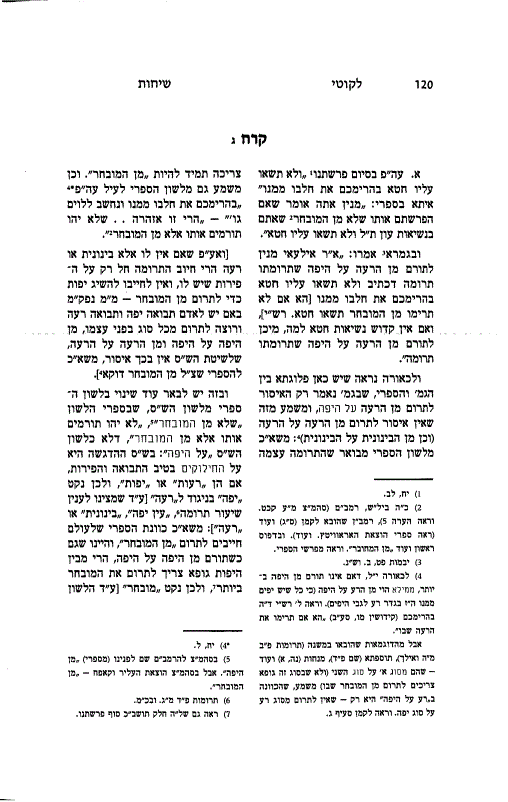
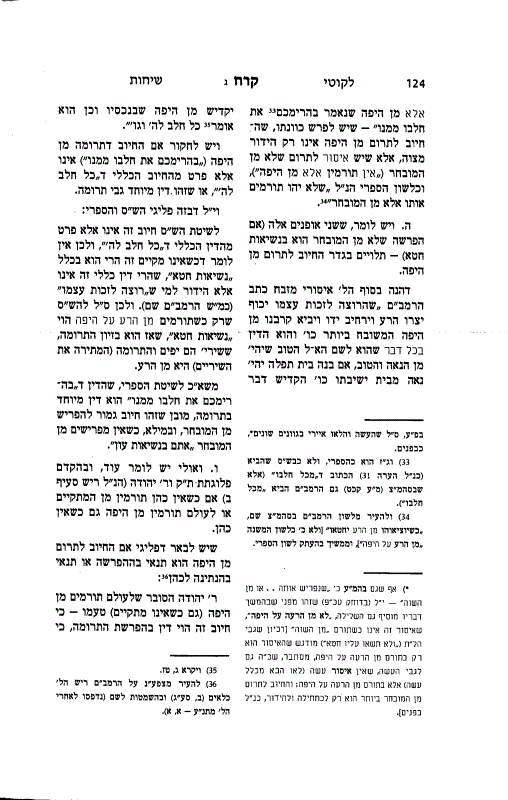
1. On the verse at the end of our parsha, "And you shall bear no sin by reason of it, when you have set apart from it its fat," it is stated in the Sifrei: "From where do you say that if you set it apart not from the best, you are bearing sin? Therefore, it says, 'And you shall bear no sin by reason of it.'
And in the Gemara, it is said: "Rabbi Ila'i said, from where do we know that if one separates from the inferior on the superior, his separation is valid? As it is written, 'And you shall bear no sin by reason of it, when you have set apart from it its fat' [implying that if you do not separate from the best, you will bear sin. Rashi]. And if it is not sanctified, why is there a bearing of sin? From here we learn that if one separates from the inferior on the superior, his separation is valid."
1. At first glance, it seems there is a dispute between the Gemara and the Sifrei. In the Gemara, it is stated only the prohibition of separating terumah from the inferior on behalf of the superior, implying that there is no prohibition to separate from the inferior on behalf of the inferior (and similarly from the average on behalf of the average). However, from the language of the Sifrei, it is explained that the terumah itself must always be "from the best." This is also implied from the language of the Sifrei earlier on the verse "When you lift its best from it, it shall be considered for the Levites, etc." — "This is a warning... that they should only separate it from the best."
2. [And even though if one only has average or inferior produce, the obligation of terumah applies only to the fruits he has, and he is not required to obtain superior ones to separate from the best — nevertheless, there is a practical difference if a person has both superior and inferior produce and wishes to separate from each type on its own, from the superior on the superior and from the inferior on the inferior. According to the Talmud, there is no prohibition in this, whereas according to the Sifrei, it must specifically be from the best.]
3. In this, we can further explain another difference in the language of the Sifrei compared to the language of the Talmud. In the Sifrei, the language is "not from the best," "they should only separate it from the best," unlike the Talmud's language "on the superior": In the Talmud, the emphasis is on the differences in the quality of the grain and fruits, whether they are "inferior" or "superior," and therefore it uses "superior" in contrast to "inferior" [similar to what we find regarding the measure of terumah, "a generous eye," "average," or "stingy"]; whereas the intention of the Sifrei is that one is always obligated to separate "from the best," meaning that even when separating from the superior on the superior, among the superior itself, one must separate the very best, and therefore it uses "best" [similar to the language...
Regarding sacrifices, it is necessary that they be "complete and choice," "from the best."
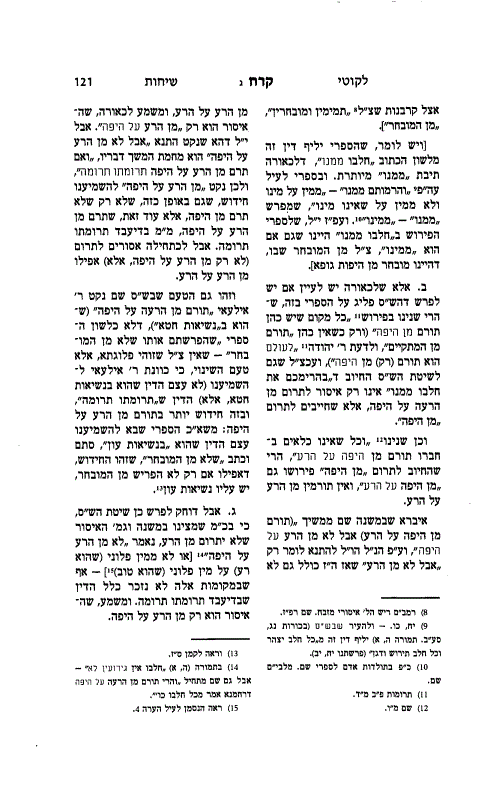
And it can be said that the Sifrei derives this law from the wording of the verse "its fat from it," for seemingly the word "from it" is superfluous. And in the Sifrei earlier on the verse "and you shall separate from it" — "from its kind and not from a different kind," which interprets "from it" as "from its kind." Based on this, it can be said that according to the Sifrei, the interpretation of "its fat from it" means that even if it is "from its kind," it must be from the best of it, meaning the best from the good itself.
2. However, it seems necessary to consider whether the Talmud disagrees with the Sifrei on this matter, for it is explicitly stated, "Wherever there is a priest, he separates from the best" (and only when there is no priest does he separate "from what lasts," and according to Rabbi Yehuda, "he always separates (only) from the best"), and it must be said that even according to the Talmud's opinion, the obligation of "when you separate its fat from it" is not only a prohibition against separating from the inferior on the superior, but that one is obligated to separate "from the best."
And so we have learned, "And anyone who does not have kilayim with his fellow, he separates from the good upon the bad," thus the obligation to separate "from the good" also means "from the good upon the bad," and one does not separate from the bad upon the bad.
Indeed, in the Mishnah there it continues "(he separates from the good upon the bad) but not from the bad upon the good," and according to the above, the Tanna should have only said "but not from the bad," which would also include not from the bad upon the bad. It seems, at first glance, that the prohibition is only "from the bad upon the good." But it can be said that the reason the Tanna stated "but not from the bad upon the good" is due to the continuation of his words, "and if he separated from the bad upon the good, his separation is valid," and therefore he stated "from the bad upon the good" to teach us a novelty, that even in such a case, not only did he not separate from the good, but furthermore, he separated from the bad upon the good, nevertheless, after the fact, his separation is valid. But initially, it is forbidden to separate (not only from the bad upon the good, but) even from the bad upon the bad.
And this is also the reason that in the Talmud there, Rabbi Ila'i stated "he separates from the bad upon the good" (which is in "bearing sin"), unlike the language of the Sifri "that you separated it not from the choice" — it does not need to be said that this is a dispute, but rather the reason for the change, because Rabbi Ila'i's intention is to inform us (not the very law that it is in bearing sin, but) the law that "his separation is valid," and in this there is more novelty in separating from the bad upon the good; whereas the Sifri, which comes to inform us of the very law that it is "in bearing sin," simply wrote "not from the choice," which is the novelty, that even if he only did not separate from the choice, he bears sin.
3. However, it is difficult to interpret the approach of the Talmud in this way, because wherever we find in the Mishnah and Gemara the prohibition against separating from the inferior, it is stated "not from the inferior upon the superior" [or not from one type (which is inferior) upon another type (which is superior)] — even though in these places the law that post facto his separation is valid is not mentioned at all. This implies that the prohibition is only from the inferior upon the superior.
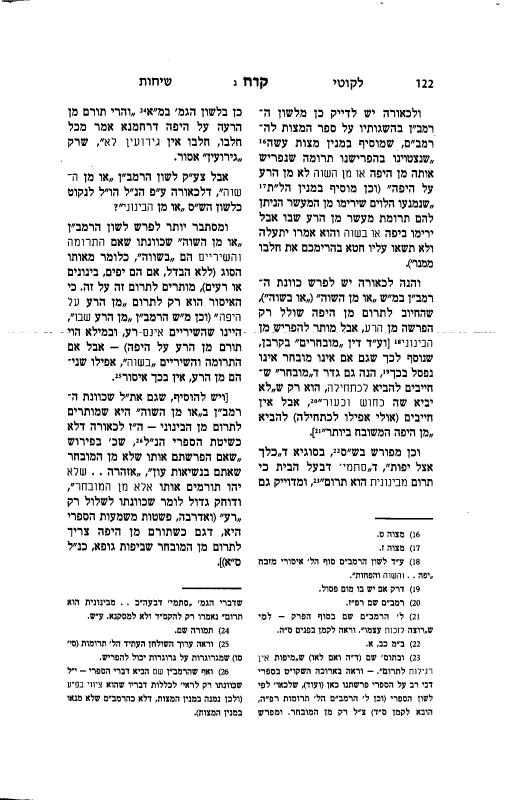
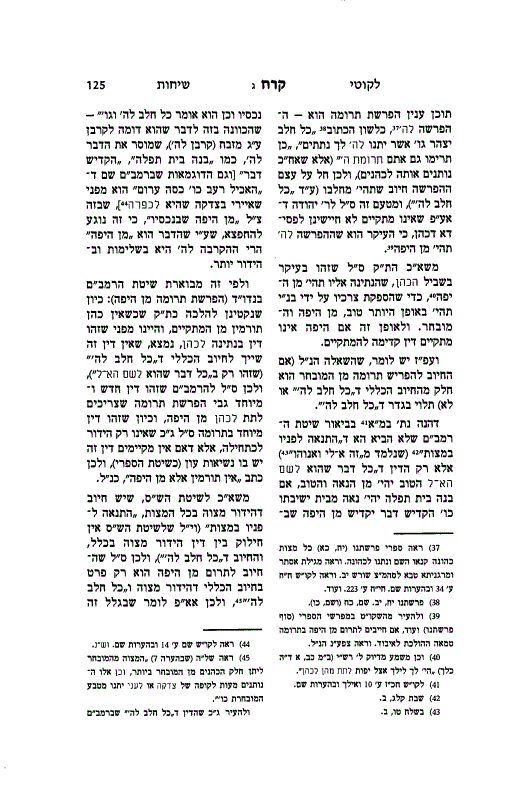
And seemingly, this can be inferred from the language of the Ramban in his critiques on the Sefer HaMitzvot of the Rambam, where he adds in the count of positive commandments "that we are commanded when separating terumah to separate it from the superior or from the equal, not from the inferior upon the superior" (and similarly, he adds in the count of negative commandments "that the Levites are prohibited from separating from the tithe given to them the terumat ma'aser from the inferior within it, but they should separate from the superior or the equal, as He, may He be exalted, said, 'And you shall bear no sin by reason of it, when you have set apart from it its best part').
And behold, seemingly the intention of the Ramban in what he wrote "or from the equal" ("or from the equal"), is that the obligation to separate from the superior only excludes separation from the inferior, but it is permissible to separate from the average [similar to the law of "choicest" in a sacrifice, where in addition to the fact that even if it is not the choicest it is not invalidated thereby, the definition of "choicest" that must be brought initially is only that "one should not bring a lean and blemished lamb," but one is not obligated (perhaps even initially) to bring "from the most superior choice"].
It is also explicitly stated in the Talmud, in the discussion of "Go to the beautiful ones," that "the default of the homeowner, when he separates, is from the average." This is also precise in the language of the Gemara elsewhere, "And behold, one who separates from the inferior on the superior, for the Merciful One said from all its fat, its fat and not its inferior," that only "inferior" is forbidden.
However, the language of the Ramban requires further examination, "or from the equal," for seemingly, according to the above, he should have used the language of the Talmud, "or from the average"?
It seems more reasonable to interpret the language of the Ramban, "or from the equal," to mean that if the terumah and the remainder are "equal," that is, of the same type (regardless of whether they are beautiful, average, or inferior), it is permissible to separate one from the other. For the prohibition is only to separate "from the inferior on the superior" (and similarly what the Ramban writes "from the inferior among them," meaning that the remainder is not inferior, and thus it is separating from the inferior on the superior) — but if the terumah and the remainder are "equal," even if both are inferior, there is no prohibition.
And it can be added that even if we say that the intention of the Ramban in "or from the equal" is that it is permissible to separate from the average — this seemingly contradicts the opinion of the Sifri mentioned above, which explicitly writes "that if you separate it not from the best, you are bearing sin," "a warning... that they should only separate from the best," and it is very difficult to say that his intention is only to exclude "bad" (and on the contrary, the simple meaning of the Sifri is that even when separating from the good, one must separate from the best among the good itself, as mentioned above in section 1).
According to the above, it can be said that the source of the Ramban is in the language of the Talmud mentioned above, that the prohibition is only to separate from the bad upon the good.
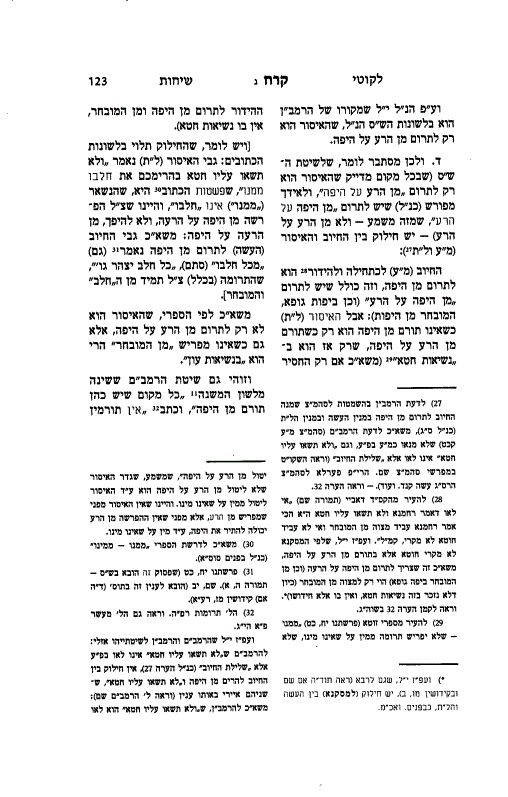
4. Therefore, it is reasonable to say that according to the Talmud (which in every place specifies that the prohibition is only to separate "from the bad upon the good," and on the other hand, it is explicitly stated (as above) that one should separate "from the good upon the bad," from which it implies — and not from the bad upon the bad) — there is a distinction between the obligation and the prohibition (positive commandment and negative commandment):
The obligation (a positive commandment) initially and for enhancement is to separate from the best, and this includes separating "from the best for the inferior" (and even among the best, the choicest of the best); however, the prohibition (a negative commandment) when not separating from the best is only when one separates from the inferior for the best, for only then is there "bearing sin" (whereas if one merely lacks the enhancement of separating from the best and the choicest, there is no bearing of sin).
And it can be said that the distinction depends on the language of the scriptures: regarding the prohibition (negative commandment), it is stated, "And you shall bear no sin by reason of it, when you have set apart from it the best thereof," the simple meaning of the verse is that what remains ("from it") is not "its best," meaning that the separation must be from the best for the inferior, and not the reverse, from the inferior for the best; whereas regarding the obligation (the positive commandment) to separate from the best, it is also stated, "from all its best" (simply), "all the best of the oil, etc.," that the separation (in general) must always be from the "best" and the choicest.
However, according to the Sifrei, the prohibition is not only to separate from the inferior for the best, but also when one does not separate "from the choicest," he is "bearing iniquity."
1. This is also the approach of the Rambam, who changed the language of the Mishnah "wherever there is a Kohen, one separates from the best" and wrote "one does not separate
2. except from the best, as it is stated 'when you separate its fat from it'." This implies that the intention is that the obligation to separate from the best is not merely an enhancement of the mitzvah, but that there is a prohibition against separating from anything other than the best ("one does not separate except from the best"), as expressed in the language of the Sifri mentioned above, "that they should only separate it from the best."
3. 5. It can be said that these two approaches (whether separating from anything other than the best is considered bearing a sin) depend on the definition of the obligation to separate from the best.
1. At the end of the laws of Isurei Mizbeach, the Rambam writes: "One who wishes to merit himself should subdue his evil inclination and open his hand generously, bringing his offering from the finest and most choice, etc. And the same applies to anything that is for the sake of the good G‑d, that it should be from the pleasant and the good. If he builds a house of prayer, it should be more beautiful than his dwelling house, etc. If he consecrates something, he should consecrate from the best of his possessions, as it says, 'All the fat is for the L‑rd,' etc."
2. There is room to investigate whether the obligation of terumah from the best ("when you lift its fat from it") is merely a detail of the general obligation of "all the fat is for the L‑rd," or if this is a specific law regarding terumah.
3. It can be said that in this, the Talmud and the Sifrei disagree:
According to the Talmud's approach, this obligation is merely a detail of the general rule that "all fat is to the L‑rd," and therefore, it cannot be said that when one does not fulfill this, he is included in "bearing sin," since this general rule is merely an enhancement for one who "wants to merit himself" (as the Rambam writes there). Therefore, the Talmud holds that only when one separates from the inferior on behalf of the superior is it considered "bearing sin," because then it is a disgrace to the terumah, as the remainder is superior and the terumah (which permits the remainder) is from the inferior.
In contrast, according to the Sifri's approach, the rule of "when you separate its fat from it" is a specific law regarding terumah, it is understood that this is a complete obligation to separate from the best, and consequently, when one does not separate from the best, "you are in bearing sin."
6. And perhaps one could say further, and by prefacing with the dispute between the Tanna Kamma and Rabbi Yehuda (mentioned above at the beginning of section 2) regarding whether, when there is no Kohen, one separates from what is preserved or always separates from the best even when there is no Kohen.
It is necessary to explain that they disagree whether the obligation to separate from the best is a condition in the separation or a condition in the giving to the Kohen.
Rabbi Yehuda, who holds that one always separates from the best (even when it is not fulfilled), reasons that this obligation is a law in the separation of the terumah, because
the essence of the matter of separating terumah is — the separation for G‑d, as the verse states, "All the best of the oil, etc., which they give to G‑d, I have given to you," "So shall you also raise the offering of G‑d" (although afterwards it is given to the Kohanim). Therefore, the obligation that it should be from the best applies to the very act of separation (similar to "all the best for G‑d"), and for this reason, Rabbi Yehuda holds that even though it is not fulfilled, we are not concerned about the loss to the Kohen, because the main thing is that the separation for G‑d should be from the best.
However, the Tanna Kamma holds that this is primarily for the benefit of the kohen, so that the giving to him should be from the best, in order that the provision of his needs by the children of Israel should be in the best manner, from the finest and most select. According to this view, if the finest is not available, the rule of precedence does not apply to what is available.
Based on this, it can be said that the aforementioned question (whether the obligation to separate terumah from the best is part of the general obligation of "all the best to the L‑rd" or not) depends on the definition of "all the best to the L‑rd."
For it is explained elsewhere in the explanation of the Rambam's view, who does not bring the concept of "beautify before Him in mitzvos" (which is learned from "this is my G‑d and I will glorify Him") except for the law of "everything that is for the sake of the good G‑d should be from the best and finest; if one builds a house of prayer, it should be more beautiful than his dwelling house, etc. If he dedicates something, he should dedicate from the best of his possessions, as it says, 'all the best to the L‑rd,' etc." — the intention here is for something that is similar to a sacrifice on the altar (a sacrifice to the L‑rd), where one gives the item to the L‑rd, like "building a house of prayer," "dedicating something" [and also the examples in the Rambam there of "feeding the hungry, etc., clothing the naked" is because it deals with charity which is for atonement], in which case it must be "from the best of his possessions," because this concerns the object itself, that by being "from the best," the offering to the L‑rd is more complete and enhanced.
1. According to this, the Rambam's approach in our case (separating terumah from the best) is explained: since we hold according to the first Tanna that when there is no Kohen, one separates from what is preserved, and this is because it is a law in giving to the Kohen, it turns out that this law is not related to the general obligation of "all the best to the L‑rd" (which applies only to "everything that is for the sake of the L‑rd"). Therefore, the Rambam holds that this is a new and special law regarding the separation of terumah, that one must give to the Kohen from the best. And since this is a special law in terumah, he also holds that it is not just an enhancement ideally, but if this law is not fulfilled, there is a bearing of sin (according to the Sifri's view). Therefore, he wrote "one separates only from the best," as mentioned above.
2. However, according to the Talmud's approach, there is an obligation of enhancing a mitzvah in all mitzvos, "beautify before Him with mitzvos" (and it can be said that according to the Talmud's approach, there is no distinction between the law of enhancing a mitzvah in general and the obligation of "all the best to the L‑rd"). Therefore, they hold that the obligation to separate from the best is only a detail in the general obligation of enhancing a mitzvah and "all the best to the L‑rd," and therefore it is impossible to say that because of this
3. that one who is not among those who enhance will have "bearing of sin" in this.
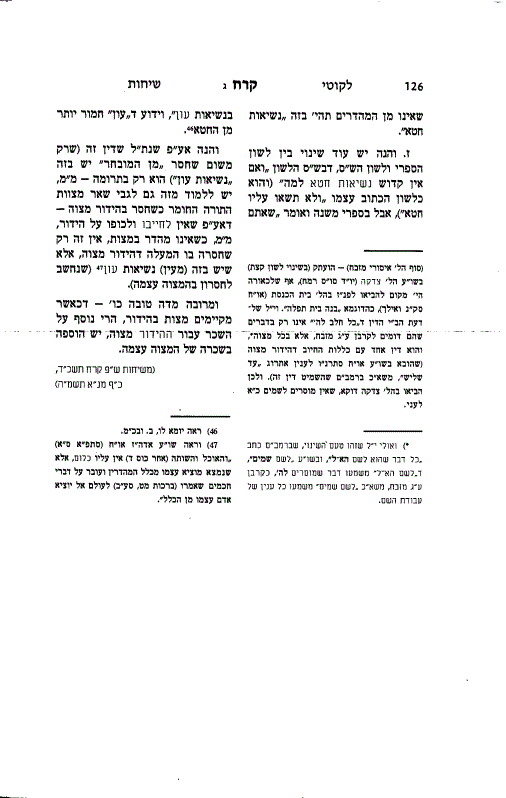
7. Behold, there is another difference between the language of the Sifrei and the language of the Talmud. In the Talmud, the language is "And if there is no sanctification, why is there a bearing of sin" (which is similar to the language of the verse itself "and you shall not bear sin because of it"), but in the Sifrei it changes and says "that you are in the bearing of iniquity," and it is known that "iniquity" is more severe than sin.
And behold, even though it was explained above that this law (that only because it lacks "the best" there is "bearing of iniquity") applies only to terumah — nevertheless, one can learn from this regarding other mitzvos of the Torah the severity when there is a lack of beautification of a mitzvah — that even though one is not obligated or forced to beautify, nevertheless, when one does not beautify the mitzvah, it is not only that the advantage of beautification is missing, but there is (a semblance of) bearing of iniquity (considered a deficiency in the mitzvah itself).
And the measure of goodness is greater, etc. — that when one fulfills mitzvos with beautification, in addition to the reward for the beautification of the mitzvah, there is an increase in the reward of the mitzvah itself.
(From the talks of Shabbat Parshat Korach 5724, 20th of Menachem Av 5745)