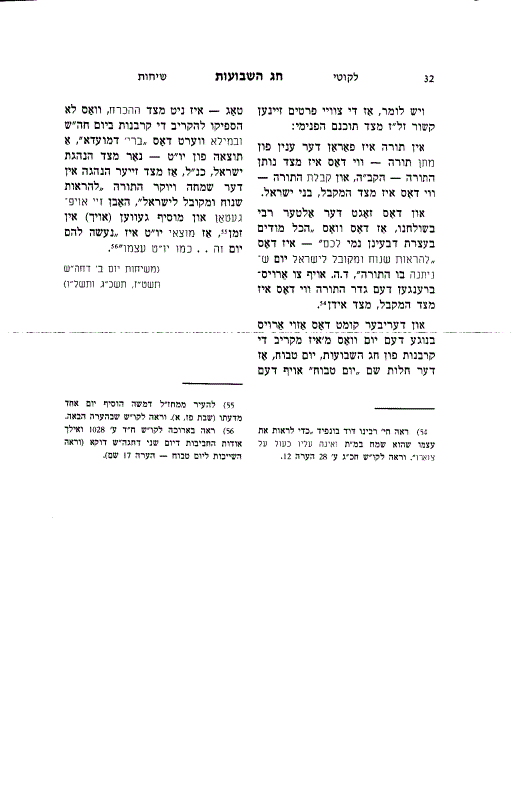
Likkutei Sichos Vol. 28 – Shavuos
Part 1
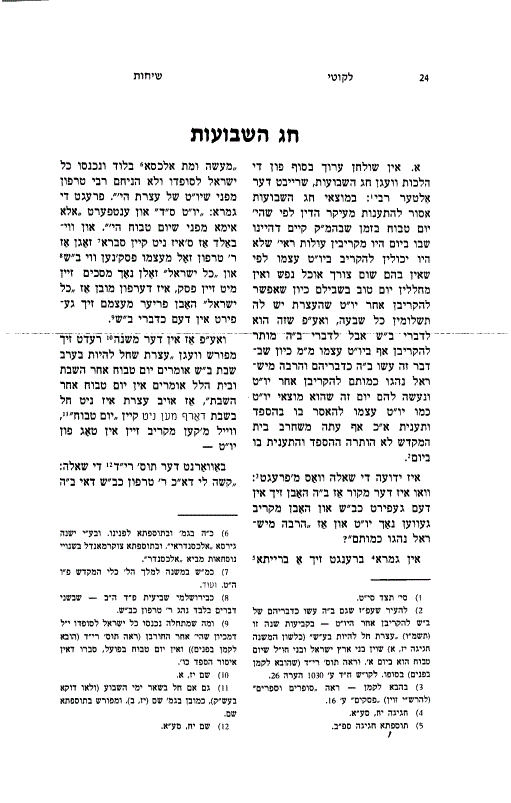
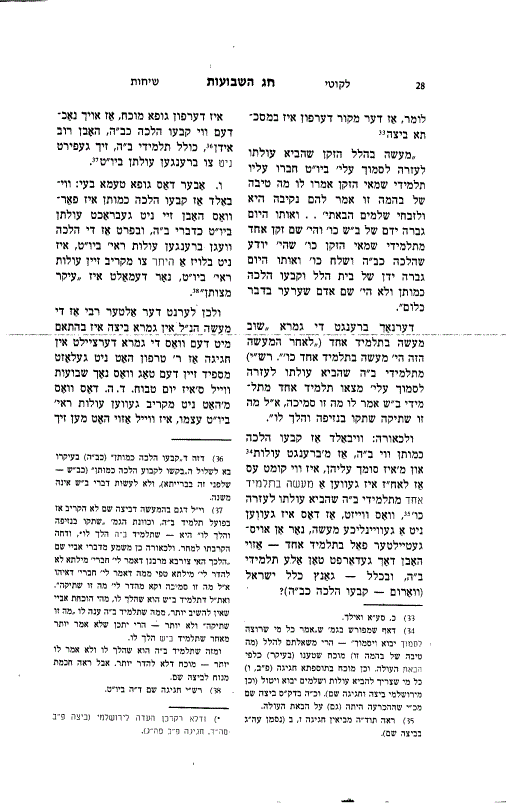
We will now review a sicha from Likkutei Sichos on the subject of חג השבועות, Shavuos. This is a deeply analytical and lomdishe discussion explaining the source for the Alter Rebbe’s ruling regarding the day after Shavuos.
The Alter Rebbe rules that the day following Shavuos — what we call Isru Chag, and in the times when Shavuos was observed for only one day, literally the next day after Yom Tov — carries a unique halachic status. Nowadays, outside Eretz Yisrael, the second day of Shavuos is observed because of ספק דיומא, but originally the discussion concerned the actual day after Shavuos.
The halachah is that one may not fast or deliver a eulogy on that day. The day after Shavuos possesses a greater degree of sanctity than the Isru Chag following other festivals.
What is unique about the day after Shavuos?
This is based on a Gemara discussing a major dispute between House of Shammai and House of Hillel concerning the Korban Olas Re’iyah. When Jews ascended to the Beis Hamikdash on the three pilgrimage festivals — Pesach, Shavuos, and Sukkos — they were obligated to bring offerings. One of these offerings was the Olas Re’iyah, an עולה completely consumed upon the mizbe’ach.
Beis Shammai maintain that since no human benefit is derived from this korban, it may not be offered on Yom Tov itself. Since the korban can still be brought during the days of tashlumin — the seven-day makeup period extending through the twelfth of Sivan — there is no necessity to bring it on Shavuos itself.
Accordingly, when was the Olas Re’iyah brought? According to Beis Shammai, it was brought the day after Shavuos.
Beis Hillel disagree. They hold that although the korban is entirely consumed on the mizbe’ach, it is nevertheless permitted to offer it on Yom Tov. Since a person is eating festive meals, it is fitting that the mizbe’ach likewise receive its portion. Thus, offering the korban is considered a צורך גבוה connected to the joy and sanctity of Yom Tov.
Therefore, according to Beis Hillel, the Olas Re’iyah may be brought on Shavuos itself.
Technically then, according to Beis Hillel — and the halachah generally follows Beis Hillel — there should be nothing unique about the day after Shavuos.
Yet the Alter Rebbe writes otherwise.
The Alter Rebbe explains that in practice, even Beis Hillel themselves conducted themselves like Beis Shammai in this matter, and many Jews followed this practice as well. Consequently, many people postponed bringing the Olos Re’iyah until the day after Shavuos. That day therefore became known as יום טבוח — the “day of slaughtering,” when the korbanos were brought in great numbers.
As a result, the day acquired the status of a festive day upon which fasting and eulogizing became prohibited.
The central question of the sicha is:
What is the source for the Alter Rebbe’s ruling?
Where do we find a clear source that Beis Hillel themselves followed the conduct of Beis Shammai in this matter, and that many Jews likewise postponed bringing their korbanos until the following day?
This is not stated explicitly in the Gemara.
Rabbi Zevin, in his sefer Sofrim U’Seforim discussing Pesachim, suggests that the Alter Rebbe’s source is the Tosafos Rid. However, the Rebbe challenges this explanation and develops an entirely different approach based upon another Gemara in Beitzah.
The sicha proceeds through many sugyos and detailed analyses step by step, revealing the extraordinary depth within the Alter Rebbe’s ruling in Shulchan Aruch.
Aleph
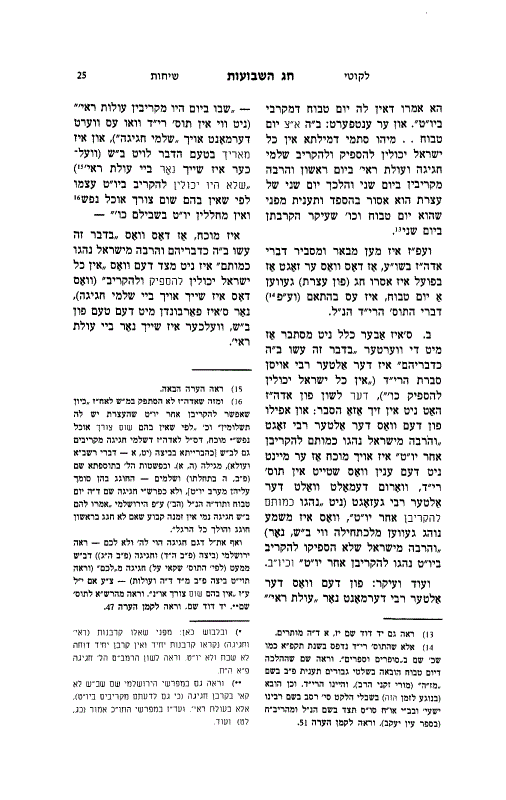
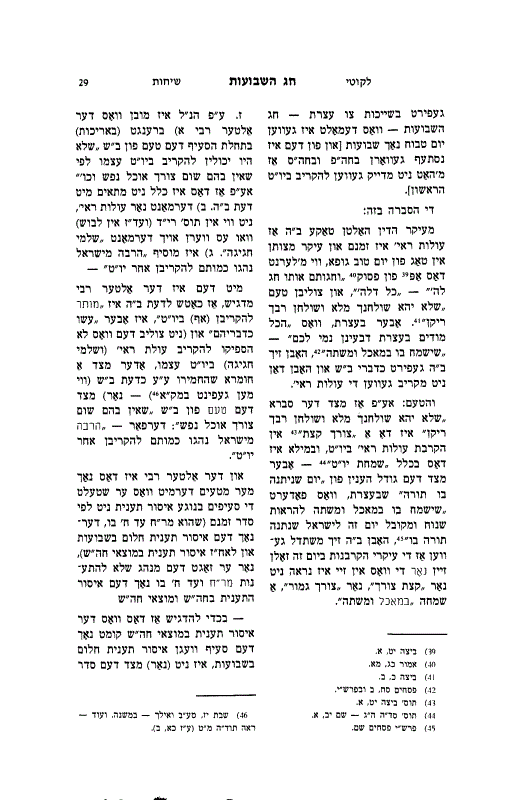
At the conclusion of the halachos of Shavuos in the Alter Rebbe’s Shulchan Aruch, the Alter Rebbe writes that on Motzaei Chag HaShavuos it is prohibited to fast מן עיקר הדין — by actual halachic law.
This is significant.
Regarding ordinary Isru Chag — the day following Pesach or Sukkos — there exists merely a custom not to fast. But regarding the day after Shavuos, the prohibition is not merely minhag; it is an actual halachic prohibition.
Why?
Because that day was known as יום טבוח during the era of the Beis Hamikdash.
What does יום טבוח mean?
Literally, “the day of slaughtering,” referring to the extensive offering of korbanos on that day.
The Alter Rebbe explains that during the time of the Beis Hamikdash, the Olos Re’iyah that could not be offered on Yom Tov itself were brought the following day.
Notice carefully: the Alter Rebbe here adopts the reasoning of Beis Shammai.
According to Beis Shammai, since the Olas Re’iyah provides no personal benefit and is entirely consumed on the mizbe’ach, one may not violate Yom Tov to slaughter it, especially since the korban can still be brought afterward during the tashlumin period.
Shavuos, although only one day in the Torah, nevertheless possesses seven days of tashlumin.
Accordingly, there was no need to bring the korban on Yom Tov itself, and therefore many people brought it afterward. This transformed the day after Shavuos into יום טבוח.
But this immediately raises a problem.
That position is the view of Beis Shammai — whereas the halachah generally follows Beis Hillel.
The Alter Rebbe therefore continues:
Although this is the opinion of Beis Shammai, according to Beis Hillel the Olos Re’iyah may indeed be brought on Yom Tov itself.
Nevertheless — and here lies the Alter Rebbe’s remarkable chiddush — in this particular matter, Beis Hillel themselves conducted themselves in accordance with Beis Shammai, and many Jews likewise followed this practice, postponing the korbanos until after Yom Tov.
As a result, the day after Shavuos became treated like a Yom Tov itself, prohibiting fasting and eulogizing.
Even after the destruction of the Beis Hamikdash, this status remained in force. Therefore, the day after Shavuos continues to retain the prohibition against fasting and eulogizing.
This is the Alter Rebbe’s ruling.
The difficulty, however, is obvious:
Where is the source that Beis Hillel actually conducted themselves like Beis Shammai?
And where is the source that many Jews followed this practice?
Rabbi Zevin points to a braisa brought in the Gemara in Chagigah.
The Gemara recounts that a certain prominent individual named Alexa died in Lod, and all the Jews came to eulogize him. רבי טרפון refused to permit the eulogy because it was יום טבוח.
Initially, the Gemara states that it was Yom Tov itself, but immediately challenges this formulation. Surely nobody would think eulogizing is permitted on Yom Tov. The Gemara therefore corrects itself: it was not Yom Tov itself, but יום טבוח — the day after Shavuos.
The implication appears striking.
Why would Rabbi Tarfon prohibit eulogizing on the day after Shavuos if, according to Beis Hillel, there is no unique status to that day?
This seems to indicate that the accepted practice indeed followed the conduct associated with Beis Shammai.
However, this itself requires explanation. Why would people conduct themselves this way if the halachah follows Beis Hillel?
The Tosafos Rid addresses this issue.
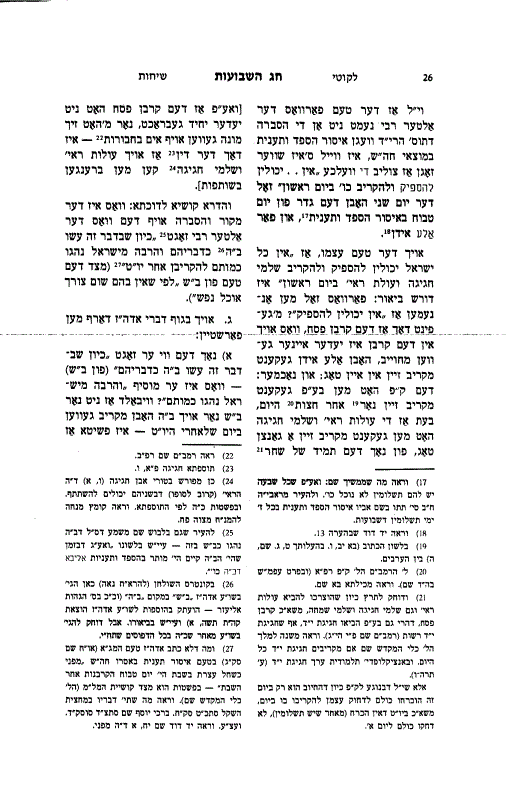
He explains that Beis Hillel certainly agreed that one may bring the korbanos on Yom Tov itself. Nevertheless, practically speaking, it was impossible for all the Jewish people to complete the bringing of both the Shalmei Chagigah and the Olos Re’iyah on the first day alone.
Consequently, many people inevitably brought their korbanos on the second day.
Therefore, the second day naturally became associated with extensive korbanos and acquired the status of יום טבוח, upon which fasting and eulogizing were prohibited.
According to this approach, the issue is not that people intentionally ruled like Beis Shammai against Beis Hillel. Rather, practical necessity created the reality that many korbanos were brought the next day.
Rabbi Zevin suggests that this is the Alter Rebbe’s source.
However, the Rebbe rejects this explanation.
The language of the Alter Rebbe indicates something much stronger: not merely that people happened to bring korbanos the next day, but that Beis Hillel themselves deliberately conducted themselves in accordance with Beis Shammai.
Accordingly, the Rebbe will proceed to develop an entirely different explanation and uncover a deeper source for the Alter Rebbe’s ruling.
Ois Beis
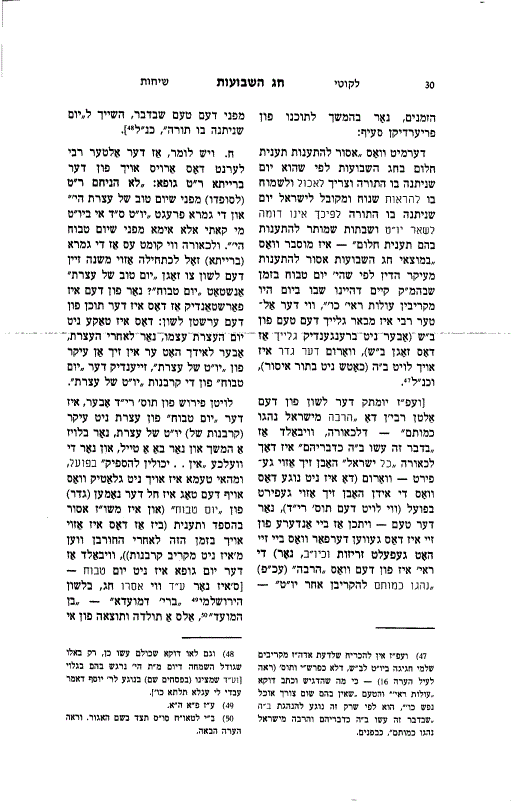
The Rebbe now explains that there is a fundamental difference between the explanation of the Isaiah di Trani and the language of the Alter Rebbe in Shulchan Aruch.
According to the Tosafos Rid, the reason the day after Shavuos became known as יום טבוח was purely practical. There simply was not enough time for everyone to bring all of their korbanos on Yom Tov itself. Since many people were unable to complete the offerings on the first day, they continued bringing them on the following day, and that day consequently assumed a festive character.
However, the Alter Rebbe’s wording indicates something entirely different.
The Alter Rebbe does not say that the people failed to manage in time. Rather, he emphasizes the reasoning of Beis Shammai — that the Olas Re’iyah could not be brought on Yom Tov because it involved no human צורך אוכל נפש.
That is not a practical limitation. It is a halachic one.
The Rebbe points this out carefully.
The Alter Rebbe writes that Beis Hillel “conducted themselves in this matter like Beis Shammai,” and that “many Jews likewise conducted themselves like them, bringing the korbanos after Yom Tov.”
This language does not resemble the explanation of the Tosafos Rid at all.
If the issue were merely practical — that people simply did not manage to bring their korbanos on the first day — then the Alter Rebbe should have written something entirely different. He should have said that many Jews who did not succeed in bringing their korbanos on Yom Tov ended up bringing them afterward.
But that is not what he says.
Instead, the Alter Rebbe uses the expression נהגו כמותם — they conducted themselves like Beis Shammai. This implies an intentional pattern of conduct, not an accidental consequence of overcrowding or lack of time.
The language indicates that this was the manner in which they chose to conduct themselves from the outset.
Furthermore, the Rebbe points out another major distinction.
The Tosafos Rid discusses both the Olas Re’iyah and the Shalmei Chagigah. His entire argument concerns the practical burden of bringing the many korbanos required during the festival. Since there were simply too many offerings to complete in one day, some were inevitably delayed until afterward.
If that were truly the Alter Rebbe’s reasoning, then the Alter Rebbe should also have mentioned the Shalmei Chagigah.
Yet he does not.
The Alter Rebbe refers specifically and exclusively to the Olas Re’iyah.
That omission is highly significant.
The entire reasoning the Alter Rebbe gives — that the korban lacks any human benefit and therefore should not be brought on Yom Tov — applies only to the Olas Re’iyah, which is completely consumed upon the mizbe’ach.
It does not apply to the Shalmei Chagigah, which contains portions eaten by the owners and therefore possesses an element of אוכל נפש.
This demonstrates clearly that the Alter Rebbe is not discussing a logistical problem of overcrowding or insufficient time. He is discussing the specific halachic reasoning of Beis Shammai regarding the Olas Re’iyah.
The Alter Rebbe explicitly writes that they “were unable to bring it on Yom Tov itself,” because it contained no human need and therefore one may not desecrate Yom Tov for it.
That wording reflects the precise logic of Beis Shammai.
Accordingly, when the Alter Rebbe says that Beis Hillel and many Jews conducted themselves in this manner, he means that they consciously adopted the conduct associated with Beis Shammai regarding the Olas Re’iyah.
It is not because they failed to find enough time.
The Rebbe therefore concludes that the explanation of the Tosafos Rid cannot possibly be what the Alter Rebbe intended.
But the Rebbe raises an additional difficulty as well.
Even on its own terms, the Tosafos Rid’s explanation is not entirely satisfying.
Why should the fact that some Jews were unable to bring their korbanos on the first day transform the following day into a festive day for all Jews, to the extent that fasting and eulogizing become prohibited?
It is difficult to understand why the inability of certain individuals to complete their korbanos on time would establish a universal Yom Tov-like status upon the following day.
Moreover, the very premise itself requires explanation.
Why indeed could the korbanos not all be brought on the first day?
After all, on Erev Pesach all of Israel was obligated in the Korban Pesach, and nevertheless the entire nation succeeded in bringing the korban within the required time.
In fact, the Korban Pesach involved even greater limitations. It could only be brought during the afternoon hours of Erev Pesach.
By contrast, the Olas Re’iyah and Shalmei Chagigah could be brought throughout the entire day following the Tamid shel Shachar. There was therefore considerably more available time than existed for the Korban Pesach.
One might argue that the Korban Pesach could be offered in groups and partnerships, reducing the total number of offerings required.
However, the same is true regarding the Olas Re’iyah and the Shalmei Chagigah, which may likewise be brought in partnership.
Accordingly, the Rebbe challenges the entire premise of the Tosafos Rid’s explanation.
Why assume that it was impossible for everyone to bring the korbanos on the first day?
The Alter Rebbe therefore avoids this entire approach.
And so the original question returns with full force:
What is the source for the Alter Rebbe’s statement that in this matter Beis Hillel conducted themselves like Beis Shammai, and that many Jews followed this conduct by bringing the Olas Re’iyah only after Yom Tov?
What is the basis and the logic for such conduct?
This is the issue the Rebbe will continue to address in the next section.
Ois Gimmel
The Rebbe now raises several additional questions on the actual wording of the Alter Rebbe. These questions will ultimately reveal a deeper understanding of what the Alter Rebbe truly intends. The issue is no longer merely identifying the source of the Alter Rebbe’s ruling, but understanding the precise meaning of his language itself.
The wording of the Alter Rebbe appears difficult and requires careful analysis.
First Question
The Alter Rebbe writes:
“Since in this matter Beis Hillel conducted themselves according to the view of Beis Shammai…”
He then immediately adds:
“And many Jews likewise conducted themselves in this manner.”
The Rebbe asks:
Why was this second statement necessary? House of Hillel and House of Shammai themselves were already bringing the korbanos on the day after Yom Tov. If Beis Hillel adopted this conduct, then naturally the people would follow their lead.
Once Beis Hillel acted this way, it should already be obvious that the Jewish people would do likewise.
Why then must the Alter Rebbe separately emphasize that “many Jews” conducted themselves this way?
Furthermore, the Rebbe asks, why does the Alter Rebbe use the word “many” — הרבה מישראל?
Why not say “all Jews”?
The wording implies that there is something significant in the fact that only “many” Jews followed this conduct. The expression appears deliberate and demands explanation.
Second Question
The Rebbe now turns to another striking feature in the Alter Rebbe’s presentation.
At the beginning of the סעיף, the Alter Rebbe elaborates at great length on the reasoning of Beis Shammai.
He explains that the day after Shavuos became known as יום טבוח because the Olos Re’iyah could not be brought on Yom Tov itself, since they contained no element of אוכל נפש and therefore Yom Tov could not be violated for them. Since the korbanos could be brought afterward during the seven days of tashlumin, there was no necessity to offer them on Yom Tov itself.
The Alter Rebbe develops this reasoning extensively and carefully.
But all of this is entirely the logic of Beis Shammai.
Why does the Alter Rebbe spend so much time elaborating upon the reasoning of Beis Shammai if, ultimately, the halachah follows Beis Hillel?
The language strongly implies that the later statement — that Beis Hillel conducted themselves like Beis Shammai and that many Jews followed them — is directly connected to this reasoning itself.
In other words, the Alter Rebbe seems to be suggesting not merely that Beis Hillel happened in practice to postpone the korbanos, but that somehow they accepted the actual reasoning of Beis Shammai in this matter.
And this becomes extremely difficult to understand.
According to Beis Hillel, there is no prohibition whatsoever against bringing the Olos Re’iyah on Yom Tov. On the contrary, Beis Hillel explicitly permit it.
So why would Beis Hillel nevertheless conduct themselves like Beis Shammai?
Why would they adopt a stricter practice rooted in reasoning they themselves fundamentally reject?
The Rebbe emphasizes that this is the real difficulty emerging from the Alter Rebbe’s wording.
The Alter Rebbe does not merely say that practically the korbanos were brought afterward. Rather, his language suggests that Beis Hillel intentionally followed the logic and conduct of Beis Shammai.
But why would they do so?
This is the deeper issue the Rebbe now begins to unravel.
Ois Daled
The Rebbe now raises another question, this time regarding the actual structure and sequence of the Alter Rebbe’s halachos at the conclusion of Hilchos Shavuos.
The order of the סעיפים appears difficult to understand.
And through analyzing this structure, the Rebbe explains, we will gain a deeper insight into what the Alter Rebbe truly intends in this entire discussion.
The Rebbe introduces:
“This will be understood through first explaining the order of the sections in the Alter Rebbe’s Shulchan Aruch at the conclusion of Hilchos Shavuos.”
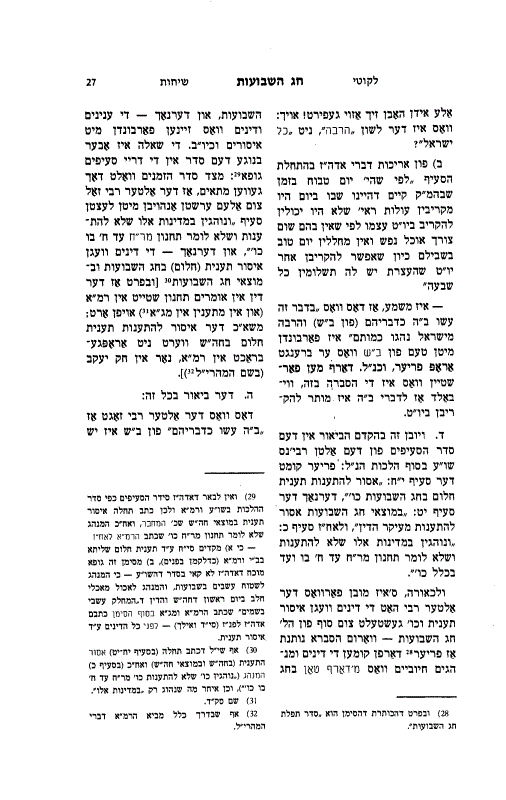
The Alter Rebbe concludes the halachos of Shavuos with three sections:
סעיף י״ח
First comes סעיף י״ח, where the Alter Rebbe rules that one may not fast a תענית חלום on Shavuos.
A taanis chalom is a fast undertaken because of a troubling dream which, under certain circumstances, halachah recognizes as requiring fasting. Nevertheless, on Shavuos such fasting is prohibited.
סעיף י״ט
Then comes סעיף י״ט, which discusses the halachah central to this entire sicha:
That on Motzaei Chag HaShavuos — the day after Shavuos — it is prohibited to fast מן עיקר הדין.
This is the דין of יום טבוח that the Rebbe has been analyzing throughout the sicha.
סעיף כ׳
Finally comes סעיף כ׳, where the Alter Rebbe writes that the custom in these countries is not to fast and not to recite Tachanun from Rosh Chodesh Sivan until after Shavuos.
The Alter Rebbe discusses the broader מנהגים of the Shavuos season extending from the beginning of the month.
At first glance, the Rebbe explains, it is understandable why these halachos are placed at the end of Hilchos Shavuos altogether.
Logic dictates that first the Alter Rebbe should discuss the positive obligations and practices of Yom Tov itself — what one must actively do during Shavuos — and only afterward discuss prohibitions and restrictions, such as fasting and omitting Tachanun.
That part is understandable.
The difficulty, however, concerns the order of these three sections themselves.
Chronologically, the arrangement seems backwards.
If the Alter Rebbe were following the natural order of time, he should first have begun with the customs starting from Rosh Chodesh Sivan — namely the minhag not to fast and not to recite Tachanun.
That would correspond to סעיף כ׳.
Only afterward should he have discussed the prohibition against fasting on Shavuos itself, namely the prohibition of a taanis chalom on Yom Tov.
And finally, afterward, he should have discussed the prohibition against fasting on the day after Shavuos.
That would have followed the natural chronological progression:
- Rosh Chodesh Sivan
- Shavuos itself
- Motzaei Shavuos
Yet the Alter Rebbe reverses the order.
Even more striking, the Rebbe points out, is the relative prominence of the sources involved.
The custom not to recite Tachanun is explicitly brought in the Moses Isserles.
Likewise, the prohibition against fasting during this period is discussed openly in the Magen Avraham.
These are major and central halachic sources.
By contrast, the prohibition against fasting a taanis chalom on Shavuos — which the Alter Rebbe places first — is not brought explicitly in the Rema or Magen Avraham. Rather, it is cited in the Chok Yaakov בשם המהריל.
Thus, from the standpoint of both chronology and prominence of source material, the order chosen by the Alter Rebbe appears difficult to understand.
Why would the Alter Rebbe begin specifically with the halachah of taanis chalom on Shavuos, a more limited דין with a less central source, before discussing the broader and more established customs beginning already from Rosh Chodesh?
The Rebbe emphasizes that this is clearly intentional.
There is something hidden within the structure itself.
The arrangement of these halachos is not incidental; it reflects a deeper conceptual progression through which the Alter Rebbe is revealing his true understanding of the entire subject.
Ois Hei
The Rebbe now begins developing the explanation.
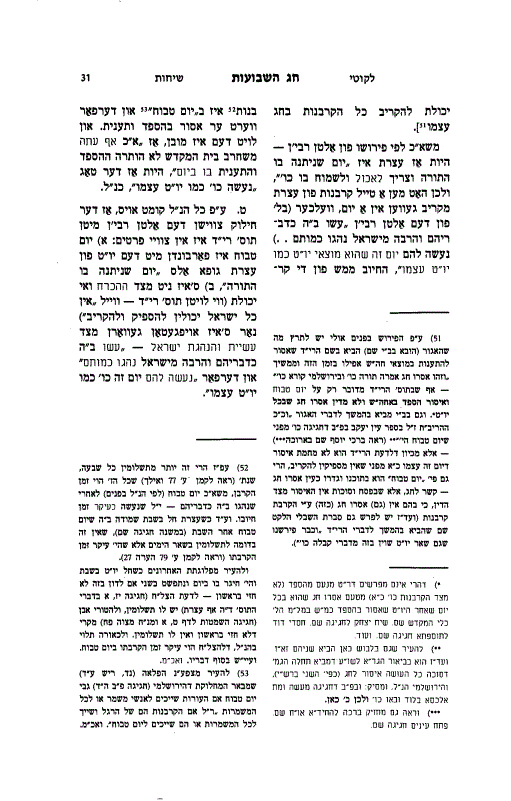
In order to understand the Alter Rebbe’s wording, the Rebbe brings proof from a Gemara in Beitzah demonstrating that even after the halachah was formally established like House of Hillel, it nevertheless was not common practice for people to bring Olos Re’iyah on Yom Tov itself.
This, the Rebbe explains, may be the source for the Alter Rebbe’s statement that Beis Hillel themselves conducted themselves like Beis Shammai.
The Gemara relates the following incident:
There was once a story involving Hillel the Elder, who brought his Olah into the Azarah on Yom Tov in order to perform סמיכה upon it.
Since the animal was an Olah, it was entirely designated for the mizbe’ach.
The students of Shammai the Elder confronted him and challenged him:
“What type of animal is this?”
Their implication was clear.
If this was an Olah, then Hillel was openly acting against the opinion of Beis Shammai by bringing it on Yom Tov and performing סמיכה upon it.
Hillel responded diplomatically.
Rashi explains that in order to preserve peace and avoid conflict, he altered the presentation of the matter and answered:
“It is a female, brought for a Shlamim.”
In other words, he avoided direct confrontation.
The Gemara then states that on that day the students of Beis Shammai held the upper hand. They sought to establish the halachah according to Beis Shammai — namely, that one may not perform סמיכה or bring Olos on Yom Tov.
At that point, however, there was present one elder among the disciples of Shammai named Bava ben Buta.
Although he was associated with the תלמידי בית שמאי, he knew that the halachah was truly like Beis Hillel.
He therefore brought numerous animals and publicly invited everyone to come perform סמיכה.
As a result, the influence of Beis Hillel prevailed, and the halachah was formally established like Beis Hillel.
The Gemara concludes:
“No one thereafter challenged the matter.”
At first glance, it appears the issue was now completely settled.
Yet immediately afterward, the Gemara records another incident.
There was once a student of Beis Hillel who brought his Olah into the Azarah to perform סמיכה upon it.
A student of Beis Shammai encountered him and challenged him:
“What is this סמיכה?”
In other words: Why are you performing סמיכה contrary to the view of Beis Shammai?
The student of Beis Hillel answered sharply:
“What is this silence?”
Meaning: Why don’t you remain silent?
The Gemara says that the other student was rebuked and withdrew.
The Rebbe now asks a powerful question.
If the halachah had already been conclusively established like Beis Hillel, why does the Gemara present this as an unusual “story” involving a single student?
This should have been completely normal behavior.
All students of Beis Hillel should routinely have been bringing their Olos on Yom Tov and performing סמיכה.
Indeed, not only תלמידי בית הלל, but all of Klal Yisrael should have acted this way, since the halachah had already been established like Beis Hillel.
Why then does the Gemara portray this as a noteworthy incident involving one individual?
From this itself, the Rebbe says, strong evidence emerges.
Even after the halachah was formally established like Beis Hillel, the majority of Jews — including many students of Beis Hillel themselves — nevertheless did not generally bring their Olos Re’iyah on Yom Tov.
Instead, the common practice remained to postpone the korbanos until afterward.
That is why the Gemara treats this as a special occurrence.
It was unusual enough that it generated confrontation and discussion.
Had it been the ordinary practice of everyone, the Gemara would never have presented it as an exceptional incident involving one particular student.
Thus, the Gemara itself supports the Alter Rebbe’s formulation:
Although the formal halachah followed Beis Hillel, in actual conduct the prevailing custom among the majority of Jews — including many associated with Beis Hillel — was nevertheless to refrain from bringing the Olos Re’iyah on Yom Tov itself and instead to postpone them until afterward.
Ois Vov
The Rebbe now explains the underlying reasoning.
True, we have established from the Gemara in Beitzah that even after the halachah was formally established like House of Hillel, nevertheless the common conduct remained not to bring the Olos Re’iyah on Yom Tov itself.
But this itself requires explanation.
If the halachah follows Beis Hillel, why did people not actually conduct themselves accordingly?
Especially since, according to Beis Hillel, bringing the Olos Re’iyah on Yom Tov is not merely permitted after the fact. It is the preferred and ideal fulfillment of the mitzvah.
As Rashi explains in Chagigah, the primary mitzvah is specifically to bring the korban on Yom Tov itself.
The Rebbe therefore explains that the Alter Rebbe understands the Gemara in Beitzah together with the Gemara in Chagigah.
The Gemara in Chagigah relates that Tarfon prohibited eulogizing on the day after Shavuos because it was יום טבוח — the day of offering the korbanos.
According to the Tosafos Rid, this developed merely because people practically ended up bringing korbanos then.
But the Alter Rebbe understands something deeper.
The day after Shavuos became intentionally established as יום טבוח.
Even according to Beis Hillel, there existed a special conduct specifically regarding Shavuos to postpone the Olos Re’iyah until after Yom Tov.
And from there, the practice later spread to the other festivals as well.
Once the custom developed on Shavuos to postpone the Olos Re’iyah, it influenced the broader attitude toward the other Yamim Tovim too, so that people were no longer particularly insistent on bringing the korbanos specifically on the first day.
But the root of the entire matter began specifically with Shavuos.
The Rebbe now explains why.
According to Beis Hillel, the primary time for bringing the Olos Re’iyah is indeed on Yom Tov itself.
This is learned from the verse:
“וחגותם אותו חג לה׳”
The korbanos brought for Hashem are themselves part of the חג לה׳ and therefore belong on Yom Tov itself.
Furthermore, Beis Hillel explain the reasoning beautifully:
“Should your table be full while the table of your Master remains empty?”
A person sits and rejoices on Yom Tov with eating and drinking. It is therefore appropriate that the mizbe’ach likewise receive korbanos for Hashem.
Accordingly, bringing the Olos Re’iyah on Yom Tov contributes to the simchas Yom Tov itself.
This reasoning applies generally to all festivals.
Shavuos, however, possesses a unique quality.
Regarding the other Yamim Tovim, the Gemara teaches that a person may divide the day between “לכם” and “לה׳” — part devoted to physical enjoyment and part devoted to Torah and prayer.
But regarding Shavuos, everyone agrees:
“בעינן נמי לכם”
On Shavuos there must specifically be “לכם” — physical rejoicing through eating and drinking.
Why?
Because Shavuos celebrates the giving of the Torah. The joy of Matan Torah must express itself visibly through physical simcha as well.
The rejoicing of Shavuos therefore possesses a uniquely physical dimension.
Now the Rebbe explains the key point.
Although Beis Hillel ordinarily permit bringing the Olos Re’iyah on Yom Tov because this too contributes somewhat to the simcha — since one does not want his own table full while Hashem’s table remains empty — nevertheless this is only a secondary or indirect צורך.
It is not actual אוכל נפש.
Therefore, specifically on Shavuos, because of the extraordinary emphasis upon “לכם,” Beis Hillel themselves chose to conduct themselves like Beis Shammai.
They preferred that the primary korbanos brought on Shavuos itself should be those directly connected to human rejoicing — korbanos associated openly and visibly with eating, drinking, and simchas Yom Tov.
In other words, they wanted the day of Matan Torah to emphasize complete and tangible rejoicing.
Shavuos was to be marked by visible celebration demonstrating how beloved and cherished the Torah is.
Therefore, although technically the Olos Re’iyah could be brought on Yom Tov according to Beis Hillel, they nevertheless preferred to postpone those korbanos that lacked direct human enjoyment.
Instead, the focus of the day would remain upon korbanos and celebrations tied fully and openly to simcha, eating, and drinking.
Thus, specifically because of the unique character of Shavuos as the festival of Matan Torah, Beis Hillel themselves conducted themselves in practice like Beis Shammai and postponed the Olos Re’iyah until the following day — thereby creating the special status of יום טבוח.
Ois Zayin
Based on all of the above, the Rebbe explains that we can now fully understand the precise wording of the Alter Rebbe and the structure of his halachos.
Several questions that previously appeared difficult now become perfectly clear.
The Three Distinctions in the Alter Rebbe
The Alter Rebbe differs sharply from the approach of the Tosafos Rid and other commentators in three important ways.
First, the Alter Rebbe elaborates extensively on the reasoning of House of Shammai — namely, that the Olos Re’iyah could not be brought on Yom Tov because they contain no element of אוכל נפש.
Second, unlike the Tosafos Rid and the Levush, the Alter Rebbe never mentions the Shalmei Chagigah together with the Olos Re’iyah.
And third, the Alter Rebbe specifically writes:
“Many Jews conducted themselves like them.”
All three points now become understandable.
The Alter Rebbe is emphasizing that even according to House of Hillel — who technically permit bringing the Olos Re’iyah on Yom Tov — nevertheless there existed a deliberate conduct to follow the approach of Beis Shammai specifically on Shavuos.
Not because people lacked time.
Not because they merely wished to act stringently.
And not because of some accidental practical reality.
Rather, because the reasoning of Beis Shammai itself possessed significance specifically on Shavuos.
Since the Olos Re’iyah lacked direct human enjoyment, Beis Hillel themselves preferred that on Shavuos the focus remain upon korbanos openly connected to physical simchas Yom Tov — korbanos involving genuine אוכל נפש.
Shavuos is the festival of Matan Torah.
The joy of that day must express itself visibly through rejoicing, eating, and drinking, demonstrating how beloved and cherished the Torah is to the Jewish people.
Therefore, on Shavuos specifically, they preferred that the korbanos of the day emphasize complete and direct human rejoicing.
This is why the Alter Rebbe carefully stresses the reasoning of Beis Shammai.
The point is not merely technical halachah. The point is the underlying concept.
The Order of the Halachos
With this, the Rebbe explains another major difficulty: the unusual order of the final halachos in Hilchos Shavuos.
Chronologically, the Alter Rebbe should first have discussed the customs beginning from Rosh Chodesh Sivan — namely not fasting and not reciting Tachanun.
Then he should have discussed the prohibition against fasting on Shavuos itself.
And only afterward should he have discussed the prohibition against fasting on the day after Shavuos.
Yet he deliberately reverses the order.
Why?
Because the arrangement is conceptual, not chronological.
The Alter Rebbe first brings the halachah that one may not fast on Shavuos itself — even a taanis chalom.
Why is fasting prohibited on Shavuos?
Because Shavuos is the day the Torah was given, and therefore one must rejoice physically through eating and drinking to demonstrate that Matan Torah is joyous, beloved, and fully accepted by the Jewish people.
This introduces the unique theme of Shavuos:
“בעינן נמי לכם”
Shavuos requires visible physical rejoicing.
Only after establishing this point does the Alter Rebbe proceed to the next halachah — the prohibition against fasting on the day after Shavuos.
Now the connection becomes clear.
The reason the day after Shavuos became יום טבוח is directly connected to the special nature of Shavuos itself.
Because Shavuos uniquely emphasizes “לכם,” Beis Hillel preferred that the korbanos brought on the day itself be those directly connected to physical simcha and eating.
Therefore, the Olos Re’iyah were postponed until afterward.
The prohibition against fasting on the day after Shavuos is thus a continuation of the same idea established in the previous סעיף.
This is why the Alter Rebbe arranged the halachos in this order.
Why the Alter Rebbe Uses the Reasoning of Beis Shammai
The Rebbe adds another beautiful point.
The Alter Rebbe brings the reasoning of Beis Shammai almost anonymously, without explicitly presenting it merely as the rejected opinion of Beis Shammai.
Why?
Because conceptually, even Beis Hillel agree with the underlying idea.
True, according to Beis Hillel the halachah permits bringing the Olos Re’iyah on Yom Tov through the principle:
“מתוך שהותר לצורך הותר נמי שלא לצורך”
Since melachah is permitted for אוכל נפש, it is permitted as well for other Yom Tov needs.
Nevertheless, the essential concept remains valid:
The Olos Re’iyah are not directly connected to human enjoyment in the same way as korbanos involving eating and drinking.
And therefore, specifically on Shavuos, Beis Hillel themselves preferred to emphasize korbanos visibly associated with simcha and physical celebration.
“Many Jews Conducted Themselves Like Them”
This also explains the precise wording:
“Many Jews conducted themselves like them.”
The Alter Rebbe intentionally says “many,” not “all.”
The point is not merely describing what practically occurred.
The Alter Rebbe is emphasizing that many Jews consciously accepted and followed this underlying concept.
Some individuals may have postponed korbanos for unrelated reasons — lack of alacrity, practical delay, or other circumstances.
That is irrelevant.
The proof lies specifically in those many Jews who intentionally adopted this conduct because they embraced the underlying idea:
That on Shavuos the korbanos of the day should emphasize complete and visible rejoicing connected directly to אוכל נפש and simchas Matan Torah.
Thus, the conduct of postponing the Olos Re’iyah was not merely accidental or practical.
It expressed the unique inner character of Shavuos itself.
Ois Ches
The Rebbe now arrives at a deeper understanding of the Alter Rebbe’s approach.
According to the explanation of the Isaiah di Trani, the day after Shavuos merely became the practical continuation of unfinished korbanos. People who did not manage to bring their korbanos on Yom Tov itself simply completed them the following day.
But according to the Alter Rebbe, something far more profound occurred.
The day after Shavuos actually assumed the character of Yom Tov itself.
Why?
Because the postponement of the Olos Re’iyah was not accidental. It was intentional and ideal from the outset.
Since Shavuos uniquely requires visible physical rejoicing — “לכם” — Beis Hillel themselves preferred that the korbanos brought on Shavuos proper should primarily be those directly associated with eating, drinking, and simchas Yom Tov.
Therefore, part of the korbanos of Atzeres were deliberately set aside for the following day.
That transformed the next day itself into יום טבוח — a continuation and extension of the Yom Tov.
This, the Rebbe explains, is proven from the Gemara itself in the story involving Tarfon.
The Gemara states:
“Rabbi Tarfon did not permit them to eulogize him because it was Yom Tov of Atzeres.”
Immediately afterward, however, the Gemara challenges this wording:
“Would it enter your mind that it was actually Yom Tov? If so, why would they even come to eulogize?”
The Gemara therefore corrects itself:
“Rather, it was יום טבוח.”
The Rebbe asks a penetrating question.
Why did the Baraisa initially phrase it as “Yom Tov shel Atzeres” at all?
If it was really יום טבוח, why not simply state that clearly from the beginning?
From this itself, the Rebbe explains, we see that the initial wording was not entirely mistaken.
The day after Shavuos indeed possessed an aspect of “Yom Tov shel Atzeres.”
Not that it literally was Shavuos itself — but that it carried within it an extension of the essence of Atzeres.
Why?
Because the korbanos of Atzeres themselves were intentionally assigned to that day.
Accordingly, יום טבוח was not merely a technical continuation for people who had failed to finish on time.
It became intrinsically connected to the Yom Tov itself.
This sharply distinguishes the Alter Rebbe from the Tosafos Rid.
According to the Tosafos Rid, the next day possesses no inherent sanctity or inner connection to the Yom Tov. It merely serves as a practical overflow day for unfinished korbanos.
If so, the term יום טבוח itself becomes difficult.
The day is not inherently a “day of korbanos.” It merely happens that some people who failed to complete their obligations earlier are bringing korbanos then.
That alone would hardly justify preserving a prohibition of fasting and eulogizing even nowadays after the destruction of the Beis Hamikdash.
At most, the day would resemble what the Yerushalmi calls:
“בריה דמועדא”
“בן המועד”
A secondary extension or offspring of the festival.
But not an actual continuation of the Yom Tov itself.
According to the Alter Rebbe, however, the matter is entirely different.
Since Shavuos is the festival of Matan Torah, and since the simcha of the day must visibly emphasize physical rejoicing and acceptance of the Torah through eating and drinking, Beis Hillel intentionally arranged that the korbanos lacking direct אוכל נפש — namely the Olos Re’iyah — be postponed until the following day.
Thus, the korbanos of Atzeres themselves became divided between the two days:
- The korbanos associated with direct simcha and eating remained on Shavuos itself.
- The Olos Re’iyah were intentionally designated for the following day.
As a result, the next day itself became integrated into the framework of Atzeres.
It was not merely an aftereffect.
It became part of the Yom Tov structure itself.
This is why the Alter Rebbe writes that Beis Hillel “conducted themselves according to their words,” and that many Jews followed this conduct.
And this is why fasting and eulogizing remain prohibited even today, after the destruction of the Beis Hamikdash.
Because the day itself was established as an extension of the Yom Tov of Atzeres.
Accordingly, the initial wording of the Gemara now becomes exact.
When the Baraisa first described the day as “Yom Tov shel Atzeres,” it reflected a real conceptual truth.
The day after Shavuos indeed carries an aspect of the Yom Tov itself, because the korbanos of Atzeres were intentionally structured to extend into that day.
Ois Tes
The Rebbe now strengthens the explanation further by returning to the Gemara in Beitzah and demonstrating that the Gemara itself clearly indicates that bringing Olos Re’iyah on Yom Tov was not the normal practice — even after the halachah had already been formally established like House of Hillel.
The Rebbe explains that this provides strong support for the Alter Rebbe’s interpretation.
The Gemara relates a famous story involving Hillel the Elder.
Hillel Hazaken once brought his Olah into the Azarah on Yom Tov in order to perform סמיכה upon it.
Since an Olah is entirely consumed upon the mizbe’ach, this directly reflected the dispute between Beis Hillel and House of Shammai regarding whether such offerings and סמיכה may be performed on Yom Tov.
The students of Shammai Hazaken confronted him and challenged him:
“What kind of animal is this?”
Their implication was obvious.
If this animal was an Olah, then Hillel was openly conducting himself against the view of Beis Shammai.
Rashi explains that in order to avoid conflict and preserve peace, Hillel altered the presentation of the matter and answered:
“It is a female, brought as a Shlamim.”
He deliberately avoided open confrontation.
The Gemara continues that on that day the influence of Beis Shammai became especially powerful. Their students sought to establish the halachah according to their position — namely, that one may not perform סמיכה or bring Olos on Yom Tov.
At that point, however, there was present one elder among the students of Shammai Hazaken named Bava ben Buta.
Although associated with Beis Shammai, he knew that the halachah truly followed Beis Hillel.
He therefore brought numerous animals and publicly invited everyone to perform סמיכה upon them.
As a result, the influence of Beis Hillel prevailed, and the halachah was firmly established according to their view.
The Gemara concludes:
“No one thereafter challenged the matter.”
At first glance, it would seem that from this point onward the issue was entirely settled.
Yet the Gemara immediately proceeds to relate another incident:
There was once a student of Beis Hillel who brought his Olah into the Azarah to perform סמיכה.
A student of Beis Shammai encountered him and challenged him:
“What is this סמיכה?”
Meaning: Why are you acting against the position of Beis Shammai?
The student of Beis Hillel answered sharply:
“What is this silence?”
Meaning: Be quiet.
The Gemara says that he rebuked him and the other student withdrew.
The Rebbe now focuses on the structure of the Gemara itself.
Why does the Gemara describe this as:
“A story involving one student”?
If the halachah had already been definitively established like Beis Hillel, this behavior should have been entirely ordinary.
All students of Beis Hillel — indeed all of Klal Yisrael — should routinely have been bringing Olos Re’iyah on Yom Tov and performing סמיכה upon them.
Why then does the Gemara present this as an unusual event involving one particular student?
The very formulation of the Gemara demonstrates that this was not common practice.
Had everyone regularly brought Olos Re’iyah on Yom Tov, there would be nothing noteworthy about this episode.
The Gemara’s language itself proves that even after the halachah was formally established according to Beis Hillel, nevertheless the prevailing conduct among most Jews — including many students of Beis Hillel themselves — remained not to bring the Olos Re’iyah on Yom Tov itself.
Instead, the common practice was to postpone them until afterward.
That is why the Gemara treats this incident as exceptional and worthy of narration.
This fits precisely with the Alter Rebbe’s understanding:
Although the formal halachah followed Beis Hillel, the accepted conduct on Shavuos became to postpone the Olos Re’iyah until the following day, thereby creating the special status of יום טבוח.