
Introduction
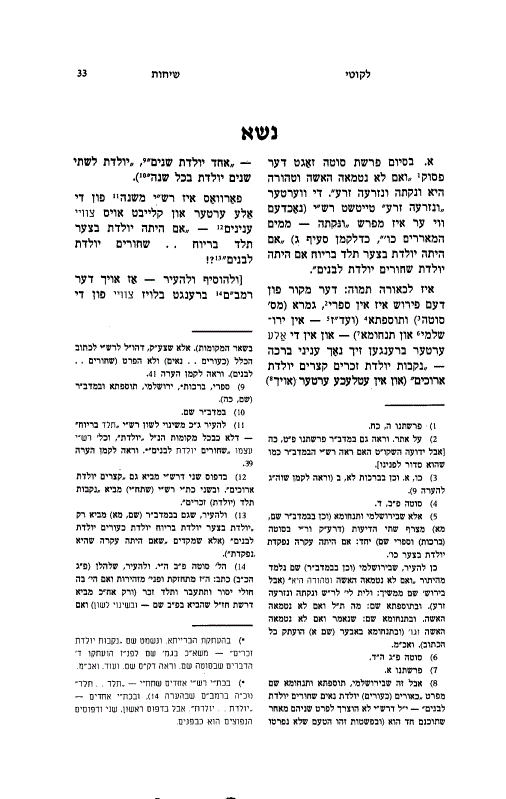
We will be studying a sicha from Likkutei Sichos, Parshas Naso, Volume 28. This is the first sicha of the parsha, and we are learning it as a merit for the soul of Rav Levi Yitzchak ben Rav Chaim Tzvi, a dedicated emissary. May this learning be an elevation for his soul.
This sicha begins with a discussion of Rashi’s commentary on the parsha, which at first glance appears quite difficult. Rashi tries to clarify what reward a woman receives if she is found innocent in the sotah process, but it seems that she did not do anything extraordinary—she simply proved her innocence. Rashi attempts to resolve two points: what exactly is the reward, and why does he choose specifically two possible rewards? The commentaries grapple with why Rashi decided on these particular options, and this itself is a fascinating question.
The Rebbe will guide us through this first Rashi of the parsha and address several related questions. We will see how these issues are interconnected as we proceed.
At the end of Parshas Sotah, there is a verse describing a woman who was suspected but ultimately proven innocent. The Torah says that if she did not commit any wrongdoing and was truly innocent, she would be cleared and able to bear children. The verse emphasizes her innocence and promises her a positive outcome as a result.
This raises several questions: What exactly is the nature of her reward? Is it simply that she returns to her previous status, or does she receive something additional? The sources—such as Sifrei, Gemara in Sotah, Bechoros, Tosefta, Yerushalmi, and Midrash Tanchuma—all discuss this topic in detail. Rashi draws from these sources when explaining the verse.
In some places, it is explained that if she previously had difficulty bearing children or had only suffered miscarriages, now she would be blessed with healthy children. In other versions, if she had previously given birth with pain or difficulty, now her experience would be easier. There are even opinions that specify whether she will have sons or daughters depending on her prior circumstances.
Each source brings its own nuance to what exactly changes for this woman after being cleared by the sotah process. Some focus on quantity—more children; others on quality—healthier or easier births; still others on gender—sons versus daughters. This diversity of opinions highlights why Rashi might have chosen to present specifically two options in his commentary.
After laying out these various approaches from across Torah literature—including Bavli, Yerushalmi, Tosefta, and Midrashim—the Rebbe sets up the central question: Why does Rashi select these particular explanations among so many possibilities? What principle guides his choice?
Saif Aleph
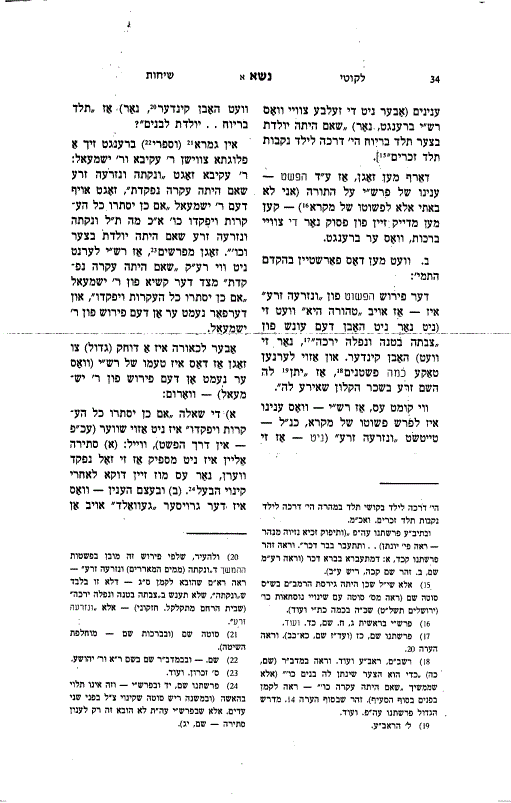
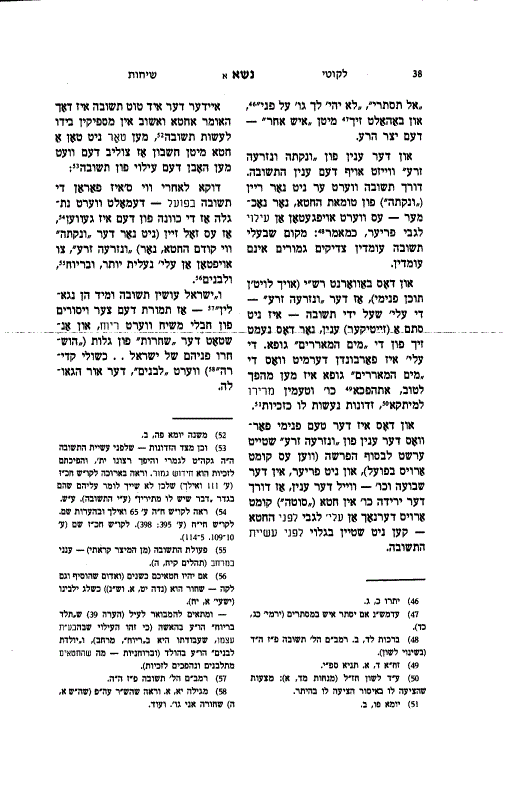
The discussion here centers on why Rashi, in his commentary, brings two explanations regarding the blessing given to a woman who is found innocent after undergoing the sotah process. The question is: if the blessing is simply that she will have children, why does Rashi feel compelled to offer another explanation? Rashi seems to suggest that one explanation is the straightforward meaning—she will have children—and another is a deeper or alternative interpretation.
This leads us to consider whether we can learn from the simple reading of the verse only what is explicitly stated. Rashi appears to be saying that we should only derive from the peshat—the plain meaning—those things that are directly given, and that's why he brings both explanations. Still, it's not entirely clear why Rashi doesn't just stick with the simple explanation that she will have children.
To clarify, if the verse says she will have children, then it would seem obvious that this is the blessing. Why introduce another interpretation? The Rebbe points out that if having children is indeed the straightforward meaning, then there should be no need for further explanation. Yet, Rashi feels compelled to add more.
The verse itself states:
ונקתה ונזרעה זרע
"She shall be acquitted and she shall conceive seed."
Rashi and other commentators debate whether this means she will simply have children or if it refers to something else—perhaps an easier childbirth or a different kind of blessing. The Gemara itself presents a dispute about this point: does it mean she will have children if she was previously barren, or does it mean something else entirely?
According to Rabbi Akiva, "she shall conceive seed" means that even if she had only one child before, now she will have more; her blessing will increase. But Rabbi Shimon challenges this: if that's so, then every barren woman could go through this process just to receive such a blessing. That doesn't seem reasonable.
The Sifrei brings out this dispute between Rabbi Akiva and Rabbi Shimon. Rabbi Akiva says her blessing increases—if she had one child before, now she'll have more. But Rabbi Shimon asks: what does it really mean for her to "conceive seed"? If it's just about having children, then any barren woman could try to become a sotah for this benefit.
Therefore, some commentators explain that Rashi prefers Rabbi Shimon's interpretation: the blessing is not simply about having children but about having an easier birth or healthy offspring. This fits better with the context and avoids problematic implications.
However, the Rebbe argues that it's difficult to say this is truly Rashi's reasoning for rejecting Rabbi Akiva's view in favor of Rabbi Shimon's. The supposed problem—that all barren women would try to become sotah just for a chance at children—is not as strong as it seems.
The Rebbe explains: first of all, becoming a sotah isn't something a woman can do on her own initiative. She can't simply seclude herself and receive the blessing; her husband must first warn her not to be alone with a certain man. Only after such a warning does seclusion make her a sotah and bring about the possibility of this blessing through drinking the water.
So it's not realistic to worry that every barren woman would manipulate circumstances just to get children by becoming a sotah—she can't control whether her husband gives such a warning in the first place.
Secondly, even if several women did manage to go through this process in hopes of receiving children as a reward for their innocence, what's so terrible about that? If righteous women who are unable to have children find themselves in such situations and are ultimately blessed with offspring as a result of their innocence, why should that be considered problematic?
The Rebbe concludes that these concerns are not strong enough reasons for Rashi to reject Rabbi Akiva's interpretation outright. Therefore, we must look deeper into why Rashi chooses his specific approach in explaining this verse.
Saif Beis
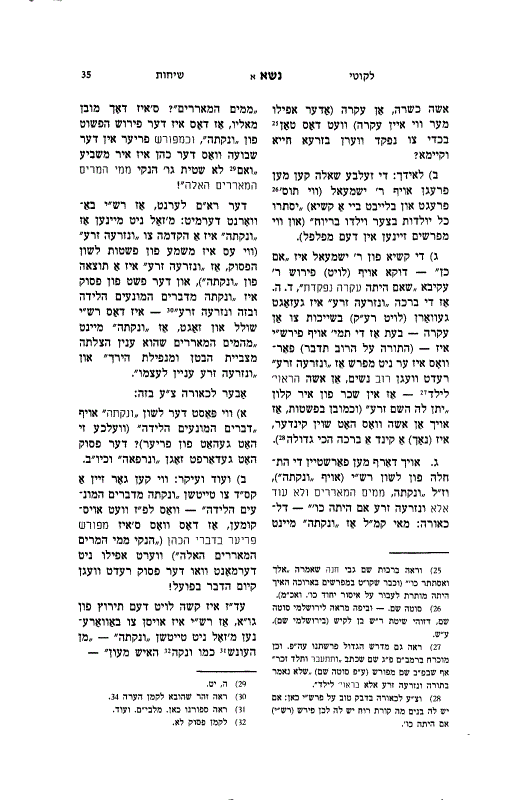
The discussion here revolves around the question of why Rashi does not interpret the verse according to Rabbi Akiva, who says that a barren woman—an akara—would change her status and begin to have children as a result of drinking the bitter waters. The argument is that a woman cannot bring about this situation on her own; she requires her husband to warn her, and the process happens quickly, so it is not entirely in her control.
However, if we are concerned that a woman might intentionally put herself in this situation to gain children, the same issue arises with Rabbi Yishmael’s interpretation. According to Rabbi Yishmael, if a woman previously gave birth in pain, she will now give birth comfortably after drinking the water. This raises the question: what would prevent all women who have experienced painful childbirth from secluding themselves and then drinking the water in order to receive this blessing?
The real challenge for Rabbi Yishmael is even greater regarding Rabbi Akiva’s view. If Rabbi Akiva holds that specifically a barren woman will now be able to have children, then all barren women might seek out this process intentionally—a problematic scenario. But for Rashi, this is less of an issue because he does not say that only barren women will have children; rather, he refers more generally to women who are already capable of giving birth.
Rashi’s approach is that the verse refers not only to barren women but to any woman fit for childbirth. As compensation for her shame, she will be blessed with additional children—not necessarily changing her status from barren to fertile. Even for a woman who already has children, receiving another child is considered a tremendous blessing.
This leads to the question: why doesn’t Rashi simply explain veniksah v'nizrah zera as meaning she will have more children? Why does he avoid interpreting it as an increase in offspring for any eligible woman?
To address this, we also need to examine the beginning of Rashi’s commentary. Rashi states that she will be cleansed from these cursing waters—not just protected from them but also blessed with offspring or with easier childbirth if she previously suffered pain. The question arises: why does Rashi need to specify “from these bitter waters”? Isn’t it self-evident that being cleansed means being saved from their harmful effects?
This phrase echoes an earlier part of the process when the kohen administers an oath to the suspected sotah, saying: “If you did not stray… be clean from these bitter waters.” The Torah itself uses this language explicitly.
Rashi first brings down an interpretation from Rebbe Eliyahu Mizrachi and others who explain that Rashi wants to caution us against thinking that cleansing from the bitter waters is merely an introduction or prerequisite for having children. One might read the verse as implying a two-step process: first, being cleansed from whatever prevents childbirth (the curse of the bitter waters), and then receiving the blessing of offspring.
According to this reading, veniksah would mean she is freed from whatever blocked her ability to bear children—perhaps some prior illness or condition—and only afterward does she merit offspring. However, Rashi rejects this interpretation and insists that these are two separate matters: being cleansed from the bitter waters is one thing (being saved from their physical harm), while receiving offspring or easier childbirth is another distinct blessing.
The Rebbe questions whether there was ever really room for such an interpretation—that veniksah means being cleansed from things preventing childbirth—since if so, it should have said “she was healed” rather than “cleansed.” If it referred to past issues blocking fertility, why use this particular language?
The Rebbe further points out that if we were meant to understand veniksah as referring to healing past conditions preventing childbirth, then our verse would not be speaking at all about what happened with the bitter waters—the very thing addressed by the kohen when he says “be clean from these bitter waters.” The implication is clear: veniksah here must refer directly back to what was discussed earlier—the cleansing or protection specifically from the effects of those cursed waters.
This analysis clarifies why Rashi insists on his particular wording and rejects alternative explanations. The phrase “be clean from these bitter waters” must be understood in its straightforward sense—as referring directly back to what was stated by the kohen—and not as introducing some new idea about healing prior infertility.
Saif Gimmel
There is no mention of these details. Even when the Torah discusses the process, it does not mention them. In our verse, when it says venikso, if we were to interpret it as referring to some preventative measure—meaning she will be cleared from the punishment of not having children—it does not fit with the context. When the event actually takes place, there is no mention of what the kohen included in his oath: that she should be cleared from the effects of the mayim ha-memarim—the bitter waters. The word venikso implies a connection to the mayim ha-memarim. Therefore, it is very difficult to understand the peshat of the Ramban here.
First, if it were talking about healing from a previous illness, it should have said venirpo, not venikso. Second, it should be discussing what was previously mentioned in the verse—the mayim ha-memarim. The verse says hinoki, and here venikso would mean something else entirely. Why would we even think to interpret it that way?
The Gur Aryeh offers another interpretation, but this too is difficult. According to Gur Aryeh, Rashi’s intention is to caution us: he explains venikso min ha-onesh, that she will be cleared from punishment. This is similar to another verse—veniko ish me-avon, where a man is cleared from sin for causing a woman to drink as a sotah. So here too, veniko means being cleared from sin or punishment.
The problem is that earlier in our passage, the Torah explicitly states what she is being cleansed from: “hinoki mimei ha-memarim ha-eleh”—she will be cleansed from these bitter waters. We already know what venikso means in this context. How could we suddenly interpret it as referring to being cleared from sin or punishment? It does not logically follow.
This brings us to a new point: The Rebbe explains that it seems as though the verse suddenly introduces something entirely new that was not mentioned before. Previously, the Torah discussed what happens if she did sin—the negative consequences—and then stated what happens if she did not sin. Now, all of a sudden, the verse says she will have children (v’nizra zara). Rashi wants us to understand that this is not introducing something new; rather, it is actually a result of drinking the mayim ha-memarim.
This explains why Rashi specifically chooses two areas for blessing: that she will give birth easily and that her children will be “white” (healthy and robust) instead of “black” (weak or sickly). Rashi wants us to see that this blessing comes directly as an effect of drinking those waters.
The explanation can be summarized as follows: When administering the oath to the woman suspected of being a sotah, all details are enumerated regarding what will happen as a result of drinking the cursed waters—both if she sinned and if she did not sin. So why does the Torah only now introduce this idea of her having children (v’nizra zara)—something not mentioned in the oath?
The answer is that Rashi quotes “not only,” indicating continuity—not only will she be cleared from harm by the bitter waters, but also there will be an added positive effect: if previously she gave birth with difficulty or had weak children (“black”), now she will give birth easily and have strong (“white”) children.
This shows that Torah is not simply adding another reward for her innocence; rather, this blessing flows directly from her drinking the waters—the same process intended for curse now becomes a source of blessing when she is innocent.
This also clarifies why Rashi emphasizes these two specific aspects: easy childbirth and healthy children. Since according to Rashi, v’nizra zara is an effect produced by drinking those same cursed waters—instead of their negative impact when guilty—they now bring about positive results when innocent.
The logic follows: just as on one side (if guilty), the bitter waters bring about severe consequences—not merely removing her from this world but more—so too on the other side (if innocent), they do more than simply spare her; they actively bring blessing and positive change into her life.
Saif Daled
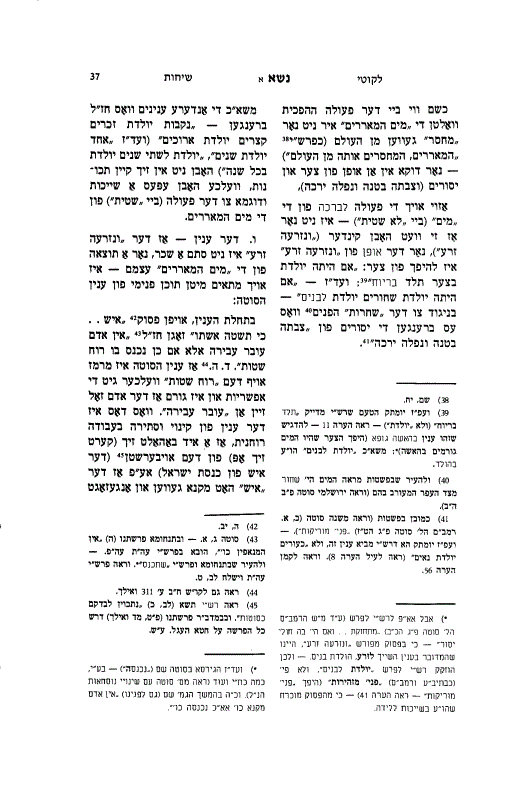
The curse for the woman suspected of being a sotah is not merely that she is taken from the world, but that it happens specifically through pain and affliction—great discomfort and suffering. As the verse describes, her stomach swells and her thigh falls. In contrast, the blessing given by the waters when she is found innocent is not just that she will have children—v’nizra zara—but that she will bear them without pain. Just as the curse brings suffering, the blessing brings ease; if she would have otherwise given birth in pain, now she will give birth easily and painlessly.
The Torah uses imagery of black and white to illustrate this. Black represents difficulty and suffering—the darkening of one’s face from pain, as caused by her stomach swelling and thigh falling. The blessing, on the other hand, is described as levonim, whiteness, which stands in direct opposition to that darkness. Our sages further explain that this blessing manifests in other ways: for example, a woman who would have had short pregnancies will now carry full term; one who would have had only one child at a time may now have twins; and so on. These positive changes are all connected to the reversal of what would have been the effects of the cursed waters.
Thus, there are two parallel transformations: painless childbirth instead of suffering, and whiteness instead of darkness—both direct reversals of what would have occurred had she been guilty.
The Rebbe explains that this idea also fits with the inner meaning of what a sotah represents. The transformation brought about by the mayim ha-me’ararim—the bitter waters—is not simply a reward but a direct result or consequence of their effect. This aligns with the deeper concept of what a sotah is.
At the beginning of this topic, on the verse “Ish ki tisteh ishto”—“If a man’s wife goes astray”—our sages teach: “A person does not commit a sin unless a spirit of folly enters him.” In other words, the very idea of sotah hints at this ruach shtus, spirit of foolishness. The sotah embodies this folly which enables a person to sin.
This spiritual dynamic is mirrored in our relationship with Hashem. The warning and seclusion described in the Torah correspond to spiritual service: when a Jew “hides” from Hashem—turns away from Him—it’s as if Knesses Yisrael (the collective Jewish people) turns away from their “husband,” Hashem Himself. Even though Hashem has warned us (“Do not have any other gods before Me”), sometimes a Jew goes into seclusion with another “man”—the yetzer hara (evil inclination).
The process described for the innocent sotah—venikseh v’nizra zara, “she shall be cleared and shall conceive seed”—alludes to teshuvah (repentance). Through teshuvah, not only does one become purified from sin’s impurity, but even more: there is an advantage gained over one’s previous state. As our sages say, “In the place where ba’alei teshuvah stand, even complete tzaddikim cannot stand.” Teshuvah brings about an elevation greater than before.
This deeper reading helps us understand Rashi’s comment here: v’nizra zara, this elevation through teshuvah, is not just incidental—it comes specifically from those very bitter waters themselves. The elevation is tied to transforming those cursed waters into something positive; bitterness becomes sweetness; intentional sins are transformed into merits.
This explains why v’nizra zara, this special accomplishment or elevation, appears only at the end of the parsha—when it actually comes into effect—and not earlier during the warning or oath administered by the kohen. The reason is that such an elevation can only be revealed after actual teshuvah has occurred.
Before doing teshuvah, it cannot be stated that there will be an advantage gained through sinning; as our sages warn: “If someone says ‘I will sin and then repent,’ he will not be given an opportunity to repent.” One cannot plan to sin in order to later achieve this higher level through teshuvah—it must come sincerely after repentance has already happened.
Only after real teshuvah does it become clear that even the descent—the experience of being a sotah—was ultimately intended for an even greater ascent: not just cleansing from sin (venikseh) but also achieving v’nizra zara, sowing new seed—a higher accomplishment than before.
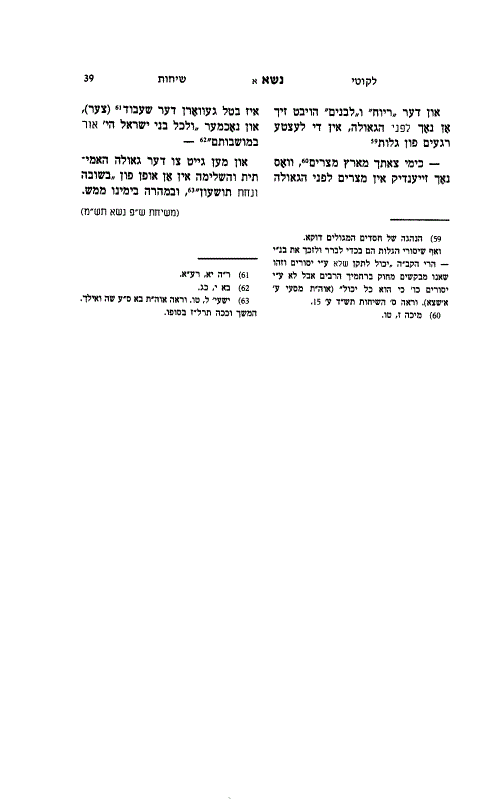
This leads to an even broader lesson: when Jews do teshuvah, they are immediately redeemed. Instead of suffering or affliction (like chevlei Mashiach—the birth pangs preceding redemption), there comes spaciousness (revach) and light (levonim). The darkness (shachrus) of exile gives way to redemption’s brightness—the faces once blackened by exile become radiant with geulah (redemption).
This transformation begins even before redemption itself arrives—just as before leaving Egypt there was already light for Bnei Yisrael while still in exile. So too now: even while we are still in galus (exile), we can merit some measure of light and relief ahead of Mashiach’s arrival.
The ultimate hope is that we should soon reach true and complete redemption—b’shuva v’nachas u’verevach, with repentance, tranquility, and spaciousness—in our own days speedily.
This concludes the sicha delivered on Shabbos Parshas Naso 5745 (1985).
Key Points
1. The sicha explores Rashi’s commentary on the reward for a woman found innocent in the sotah process, questioning why Rashi presents two specific explanations and how he selects among various opinions in Torah literature.
2. Rashi brings two interpretations regarding the blessing: one that she will have children, and another that she will experience easier childbirth or healthier offspring. The Rebbe examines why Rashi does not rely solely on the straightforward meaning of the verse.
3. The concern that women might manipulate circumstances to receive this blessing is addressed and dismissed, as the process depends on the husband’s warning and cannot be initiated by the woman alone. Thus, this is not a sufficient reason for Rashi to reject certain interpretations.
4. Rashi’s approach is clarified: he interprets the verse as referring to women already fit for childbirth, who are then blessed with additional children or easier births—not necessarily changing a barren woman’s status. This avoids problematic implications and aligns with the context of the verse.
5. The Rebbe analyzes why Rashi insists on interpreting “veniksah” as being cleansed from the effects of the bitter waters themselves, rather than healing from prior infertility or punishment. This reading fits best with both language and context.
6. The Torah’s use of “veniksah” directly connects to protection from the bitter waters, not to other forms of cleansing or healing. Rashi’s two blessings—easy childbirth and healthy children—are presented as direct positive effects resulting from drinking those same waters when innocent.
7. There is a parallel between curse and blessing: just as guilt brings suffering through the bitter waters, innocence transforms their effect into ease and health. This duality reflects both physical outcomes and spiritual dynamics within Torah thought.
8. On a deeper level, the sotah process alludes to teshuvah: just as repentance transforms past failings into merits, so too do the bitter waters become a source of blessing for an innocent woman. This transformation is only revealed after true teshuvah has occurred.
9. The lesson extends to Jewish experience in exile: sincere teshuvah can transform darkness into light even before redemption arrives, offering hope for relief and illumination ahead of Mashiach’s coming. The ultimate goal is redemption achieved through repentance, tranquility, and spaciousness in our own days.