
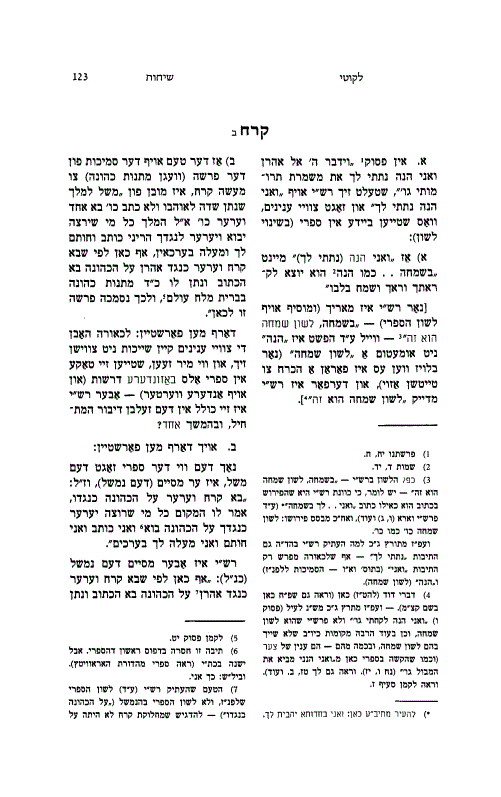
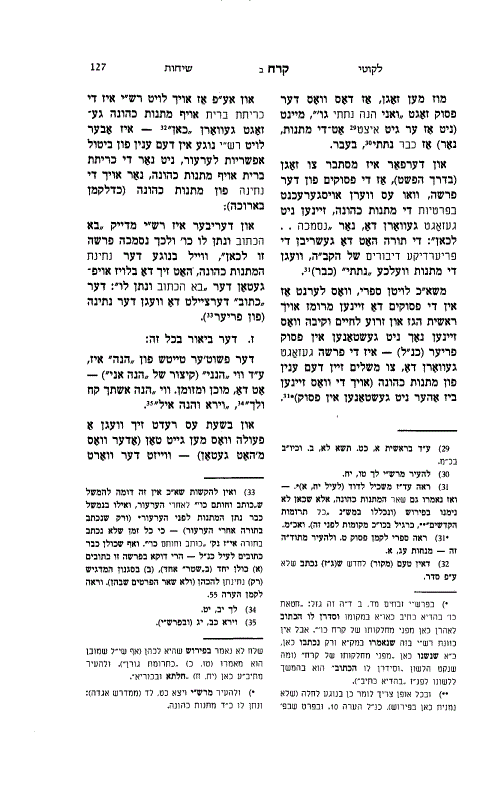
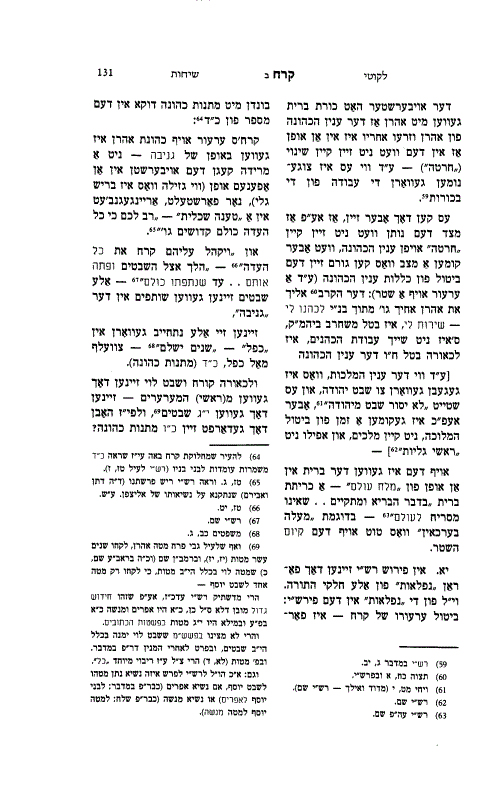
In the verses "And the L‑rd said to Aaron, 'And I, behold, I have given you the charge of My offerings...'" Rashi comments on the phrase "And I, behold" (אני הנה) by drawing from both the Sifrei and the Talmud Yerushalmi. The Sifrei explains that this phrase indicates that G‑d is giving the gifts to Aaron with joy, as it is written, "I give you with joy." Rashi elaborates on this joy, emphasizing that it is not merely a matter of giving, but there is a recognition of the significance of these gifts, which is why Rashi includes the notion of joy in his commentary.
Regarding the reason for the juxtaposition of the section about the gifts to the priests with the story of Korach, it is explained through a parable of a king who gave a field to his beloved friend. When someone came to contest the gift, the king declared that he would write and seal the gift in a document, making it indisputable. Similarly, when Korach contested Aaron's priesthood, the Torah responded by giving Aaron the twenty-four priestly gifts as an eternal covenant. This is why this section is placed here.
We need to understand why these two matters seem unrelated, as they are indeed presented separately in the Sifrei as distinct teachings. However, Rashi combines them in the same introductory comment and in a continuous explanation.
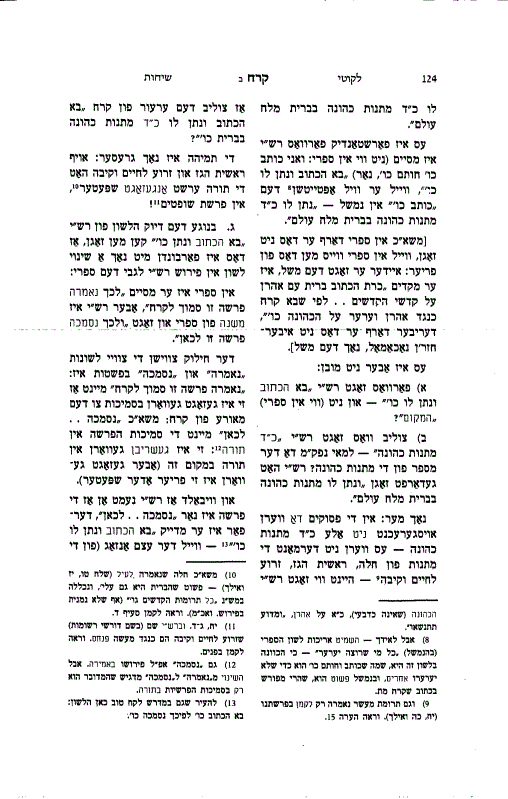
It is understandable why Rashi concludes with "the Torah came and gave him the twenty-four priestly gifts as an eternal covenant," rather than following the Sifrei's wording, which includes "I will write and seal." Rashi aims to avoid the metaphor of writing and sealing in the parable, focusing instead on the giving of the gifts as an eternal covenant. In the Sifrei, this is unnecessary because it is already introduced earlier with "the Torah made a covenant with Aaron regarding the holy offerings... because Korach contested Aaron's priesthood," so there is no need to repeat it after the parable.
This also explains why Rashi says "the Torah came and gave him..." instead of "the place," as in the Sifrei. Additionally, why does Rashi specify "twenty-four priestly gifts"? What is the significance of the number of gifts? Rashi's intent is to emphasize that due to Korach's challenge, the Torah responded by giving Aaron the twenty-four priestly gifts as an eternal covenant.
The question becomes even more pronounced: the Torah only later commands about the first shearing of the sheep and the foreleg, cheeks, and stomach in Parshas Shoftim!
Regarding the precise language of Rashi, "the Torah came and gave," it can be suggested that this is connected to another linguistic change in Rashi's commentary compared to the Sifrei. In the Sifrei, it concludes with "therefore this section was stated adjacent to Korach," but Rashi changes it to "therefore this section was placed here." The difference between these two expressions is that "was stated" implies it was said in proximity to the event of Korach, whereas "was placed here" refers to the placement of the section in the Torah, indicating it was written in this location, though not necessarily said at that time.
The gifts of the priesthood mentioned in this parsha did not come as a continuation of the incident with Korach. Rather, the Torah (as a written text) placed this section here to teach that the giving of the priestly gifts as an eternal covenant of salt nullifies any possibility of questioning the priesthood. However, this itself requires explanation: from where does Rashi derive this innovation (according to the simple meaning), that the parsha was not said and therefore also not written in proximity to the incident of Korach, as the Sifrei learns, but rather was only placed here?
It could be suggested that this is dependent on another distinction between the Sifrei and Rashi's commentary, as follows:
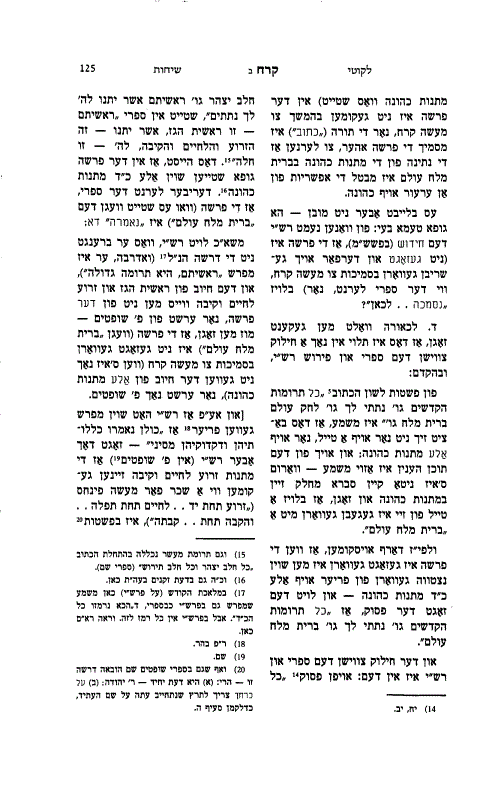
From the straightforward language of the verse, "All the sacred offerings... I have given to you as an eternal statute, a covenant of salt," it implies that this refers not only to a part but to all the priestly gifts. This is also evident from the content of the section, because in the Sifrei it states, "The first of your oil... which they shall give to the L‑rd, I have given to you," and it continues, "The first of the fleece, this is the first shearing, which they shall give, this is the foreleg, the cheeks, and the stomach, this is the challah." This means that in this parsha itself, all the priestly gifts are mentioned. Therefore, the Sifrei learns that this parsha (where it speaks about the 'eternal covenant of salt') was stated here.
However, according to Rashi, who brings a different interpretation (and moreover, he explains "the first of them" as "the great terumah"), we do not know the obligation of the first shearing and the foreleg, cheeks, and stomach from this parsha, but only later from Parshas Shoftim. Thus, one must say that this parsha (regarding the 'eternal covenant of salt') was not said in proximity to the incident of Korach (when not all the priestly gifts were yet obligatory, as they were only later in Parshas Shoftim).
And even though Rashi previously explained "all were stated in general and in detail from Sinai," he says in Parshas Shoftim that the obligation of the first shearing and the foreleg, cheeks, and stomach was only renewed later (after the incident of Pinchas).
Therefore, Rashi says, "Therefore this section was placed here."
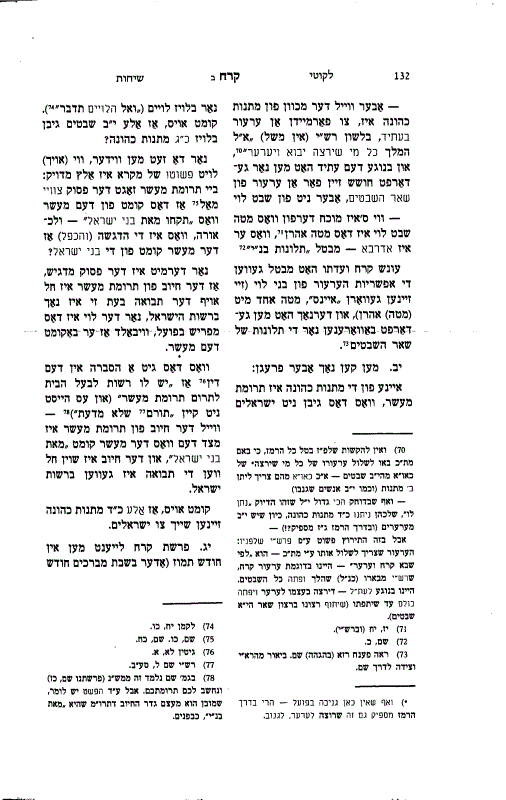
However, upon closer examination, one can say as follows:
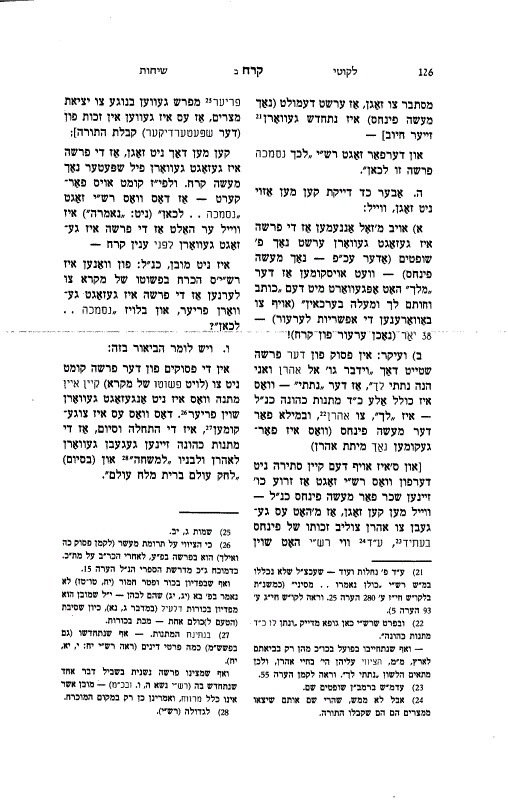
a) If we assume that the parsha was only said after Parshas Shoftim (or even later, after the incident of Pinchas), it would imply that the Torah waited with the writing and sealing of this section (to prevent the possibility of questioning).
Regarding the Exodus from Egypt, it was explained that it occurred in the merit of the (later) acceptance of the Torah. Therefore, one cannot say that this parsha was stated much later after the incident of Korach. On the contrary, it seems that what Rashi says, "It was juxtaposed here" (not "It was stated here"), is because he holds that the parsha was said before the matter of Korach. This is well understood, as mentioned earlier: from where does Rashi derive the necessity, according to the simple meaning of the text, to learn that the parsha was said earlier and only "juxtaposed here"?
One can explain this as follows: In the verses of this parsha, according to the simple meaning, there is no mention of any gift that was not already stated earlier. What is added here is the beginning and the end, that the priestly gifts were given to Aaron and his sons "as an anointment" and (in conclusion) "an eternal covenant of salt."
Thus, one must say that when the verse states, "And I, behold, have given," it does not mean that He is now giving these gifts for the future, but rather that they were already given in the past. Therefore, it is reasonable to say (in the way of peshat) that the verses of this parsha, where the priestly gifts are enumerated in detail, were not stated here, but rather "juxtaposed here." The Torah wrote here the previous words of the Holy One, blessed be He, regarding the gifts which "I have already given." According to the Sifrei, which learns that these verses hint at the first shearing and the foreleg, cheeks, and stomach, which were not mentioned in a verse earlier (as mentioned above), this parsha was stated here to complete the matter of the priestly gifts (including those that until now were not mentioned in a verse).
And even though, according to Rashi, the covenant regarding the priestly gifts was also stated "there," according to Rashi, the matter of preventing the possibility of questioning is not only about the covenant regarding the priestly gifts but also about the giving of the priestly gifts themselves (as will be explained at length later). Therefore, Rashi is precise in saying, "The verse came and gave it to him," and thus, "this parsha was juxtaposed here," because regarding the giving of the priestly gifts, it was only here that "the verse came and gave it to him." The "verse" tells here about the giving.
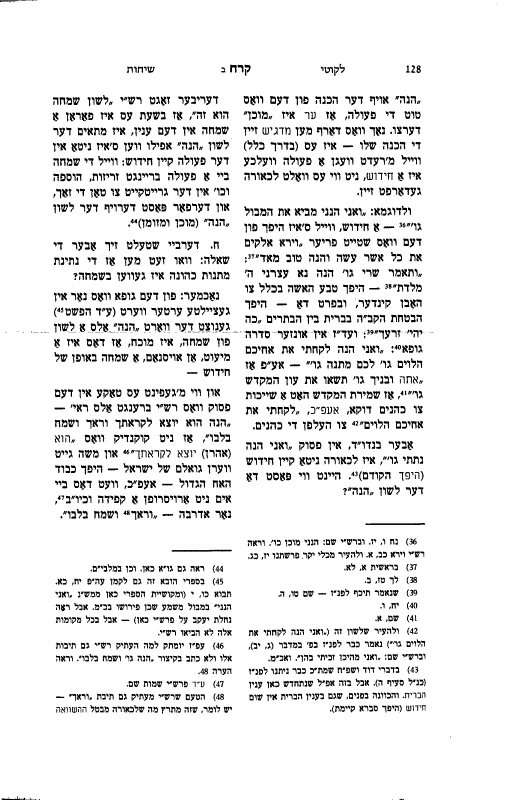
In preparation for the action that is being performed, or if it is an addition to it, why is there a need to emphasize the preparation? This is generally because we are discussing an action that is a novelty, something that seemingly should not have been. For example: "And behold, I am bringing the flood" — this is a novelty because it is contrary to what was stated earlier: "And G‑d saw everything that He had made, and behold, it was very good." Another example: "And Sarai said... behold, the L‑rd has restrained me from bearing" — the natural state of a woman is to have children, and specifically here, it is contrary to the promise of the Holy One, blessed be He, in the Covenant Between the Parts, "to your seed." Similarly, in our parsha itself: "And behold, I have taken your brethren the Levites... as a gift to you" — even though "you and your sons... shall bear the iniquity of the sanctuary," indicating that the guarding of the sanctuary is specifically related to the Kohanim, nevertheless, "I have taken your brethren the Levites" to assist the Kohanim. However, in our case, in the verse "And behold, I have given," there is seemingly no novelty.
Therefore, Rashi says, "It is an expression of joy," that when there is joy in the matter, the expression "behold" is appropriate, even when there is no novelty in the action. This is because joy in an action brings alacrity, addition, etc., in the readiness to do the thing, and therefore the expression "behold" (meaning ready and prepared) is fitting.
However, this raises the question: Where do we see that the giving of the priestly gifts was done with joy? Furthermore, from the fact that only in selected places (according to the simple meaning) is the word "behold" used as an expression of joy, it is evident that this is a minority, an exception, a joy in a novel manner. And where do we find this indeed in the verse that Rashi brings as proof: "Behold, he is coming out to meet you, and when he sees you, he will rejoice in his heart"? This is despite the fact that "he (Aaron) is coming out to meet you," and Moshe is going to be the redeemer of Israel — contrary to the honor...
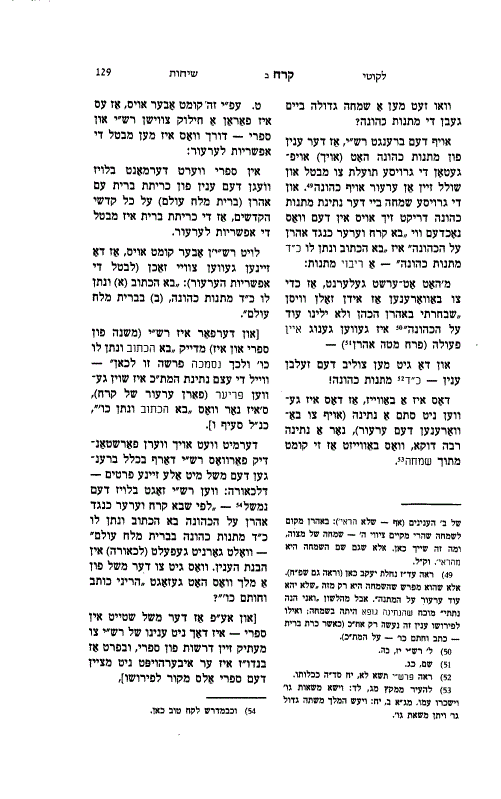
Where do we see a great joy in the giving of the priestly gifts? Why is there a distinction between Rashi and the Sifrei on this matter? Rashi brings the Sifrei to explain how the giving of the priestly gifts also serves to nullify any potential objections. The Sifrei mentions the great benefit of nullifying objections to the priesthood, and regarding the concept of a covenant, it speaks of the great blessing of the covenant of salt, which ensures that no one will challenge Aaron's priesthood. The Torah states, "And I have given to you," indicating a multitude of gifts. These are two separate matters: nullifying objections and ensuring that the Jewish people know about the priestly gifts, and the covenant of salt that I have chosen Aaron as the priest forever.
Rashi is precise in explaining why the Torah states, "And I have given to you," in connection with the priestly gifts. The act of giving the priestly gifts is not just a simple giving, but a giving with joy. This is why Rashi needs to bring a parable with all its details. Just as in the parable, three elements are required: a seal, a covenant, and an eternal covenant, so too in the analogy: the giving of the priestly gifts is like a seal, the covenant is like a signature, and the covenant is in a manner of "an eternal covenant" — a complete and eternal bond.
In the analogy, the purpose of a document ("written") is that the owner of the field has proof that the field belongs to him, even when he is far from the field. When he is near his field, it is not as necessary to prevent objections, but objections are mainly likely when he is distant from his field, and this is prevented by the document. Similarly, in the analogy: so that the Kohanim, wherever they are (not only when they perform the service in the Beis HaMikdash), can have proof that they are priests to G‑d — therefore, the giving of the priestly gifts, many of which are not specifically connected to the Beis HaMikdash and Jerusalem, and for some of them, the obligation is even outside of the Land of Israel.
However, the concept of "written" alone is not sufficient, because: (a) as long as the document is not signed, the matter is not completely finalized, and the giver can have a change of heart.
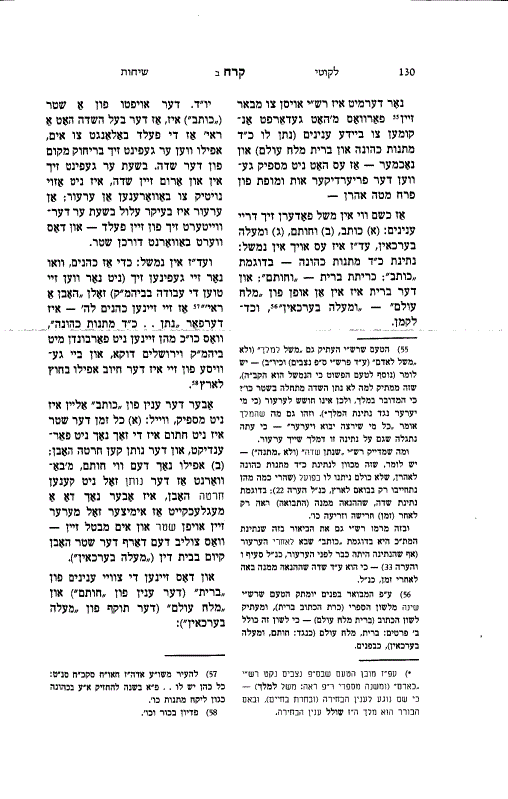
The Almighty made a covenant with Aaron that the matter of the priesthood of Aaron and his descendants after him is eternal and will not be subject to any change (regret), just as the service of the firstborns was taken away from them. However, one might think that even if there is no regret from the giver regarding the matter of the priesthood, a situation could arise that might cause the nullification of the entire concept of the priesthood (like an objection to a document): the service of "bring near to yourself Aaron your brother from among the children of Israel to serve Me" ceased when the Beis HaMikdash was destroyed. Since there is no longer the service of the Kohanim, it would seem, G‑d forbid, that the matter of the priesthood is nullified, similar to the matter of kingship, which was given to the tribe of Judah, and it is written "The scepter shall not depart from Judah," yet nevertheless, there came a time when the kingship was nullified, with no kings, and even the "heads of the exile" ceased to exist.
For this reason, the covenant is specifically connected with the priestly gifts, as explained in the number of gifts. Korach's challenge to Aaron's priesthood was in a manner of theft — not an open rebellion against the Almighty like theft in a blatant manner, but rather concealed, sneaky. It was a "rational argument" — "You take too much upon yourselves, for the entire congregation is holy." And "Korach gathered all the congregation against them" — he went to the tribes and persuaded them until they were all convinced — all the tribes were partners in this "theft." Therefore, they were all liable for "double payment" — twelve times double, as in the priestly gifts. However, it seems that Korach and the tribe of Levi were among the primary challengers — there were thirteen tribes, so there should have been twenty-six priestly gifts?
Since the purpose of the priestly gifts is to prevent future objections, in the words of Rashi (in the parable), "The king said, 'Whoever wishes may come and object,'" and regarding the future, there was indeed a need to be concerned about an objection from the other tribes, but not from the tribe of Levi — as is proven from the staff of the tribe of Levi, which was Aaron's staff, and it alone was able to nullify the complaints of the children of Israel. The punishment of Korach and his assembly removed the possibility of objection from the tribe of Levi, as they became "one," a single staff from (the staff of) Aaron, and thereafter, it was necessary to warn only about the complaints of the other tribes.
However, one might still ask: one of the priestly gifts is the terumah, which is given from the grain...
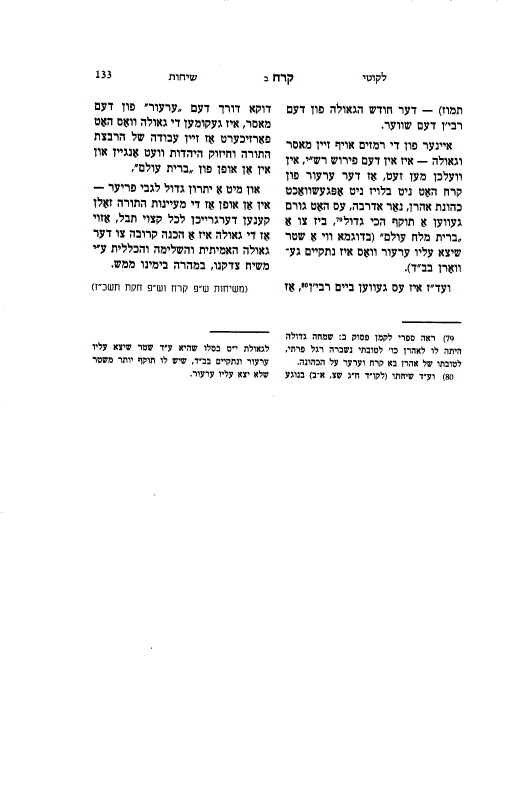
...only to the Levites — "And to the Levites you shall speak" — it turns out that all twelve tribes give only the twenty-four priestly gifts? Here again, we see how even according to the simple meaning of the text, everything is precise: regarding the terumat ma'aser, the verse mentions twice that it comes from the tithe — "You shall take from the children of Israel" — and emphasizes that the obligation of terumat ma'aser applies to the produce while it is still in the possession of the Israelite, but the Levite is the one who actually separates it, since he receives the tithe. This provides an explanation for the ruling that "the owner of the house has the right to separate terumat ma'aser" (and it is not considered theft if done without knowledge), because the obligation of terumat ma'aser is due to the fact that the tithe comes "from the children of Israel," and the obligation already applies while the produce is still in their possession.
This month of Tammuz is the month of redemption of the Rebbe Rayatz. One of the hints regarding his redemption and salvation is found in Rashi's commentary, where we see that Korach's challenge not only did not weaken Aaron's priesthood, but on the contrary, it caused it to be strengthened to the highest degree, to the point of an "eternal covenant of salt" (similar to a document that had an objection raised against it and was upheld with greater strength and validity).
Specifically through this "challenge" of the tithe, the redemption came, which ensured that his work of spreading Torah and strengthening Judaism would continue in a manner of an "eternal covenant," with a greater advantage than before, in such a way that the wellsprings of Torah would reach all corners of the world. Thus, this redemption is a close preparation for the true and complete redemption through our righteous Moshiach, speedily in our days, amen.