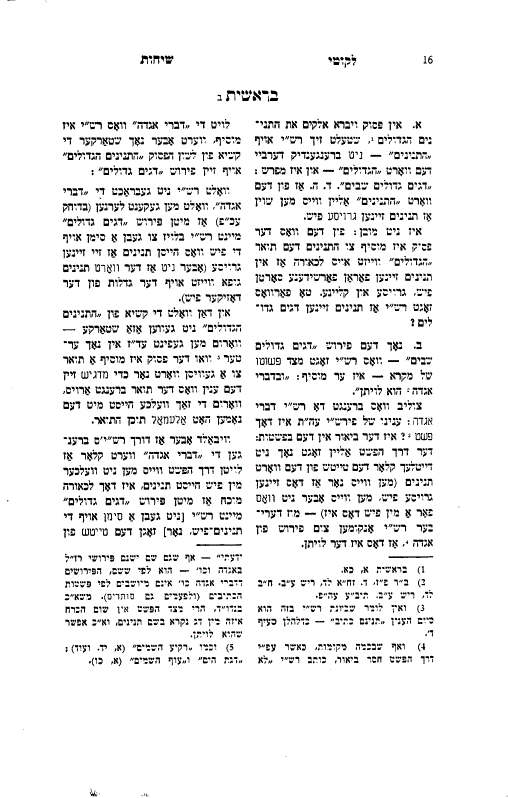
In the verse "And G‑d created the great sea creatures," Rashi comments on the word "sea creatures" without bringing the word "great" and explains that it refers to "the great fish of the sea." This implies that from the word "sea creatures" alone, one would already understand that these creatures are large. The question arises: since the verse adds the adjective "great" to "sea creatures," it seems that among the sea creatures there are different types—large and small. So why does Rashi say that "sea creatures" are specifically "great fish"?
After explaining "great fish" according to the simple meaning of the text, Rashi adds: "And in the words of the Aggadah," which Rashi brings here because his commentary on the Torah often includes explanations from the Aggadah. The simple meaning itself clearly indicates the interpretation of the word.
According to the words of the Aggadah that Rashi adds, the question becomes even stronger regarding the verse "the great sea creatures" and its interpretation as "great fish." If Rashi brings the words of the Aggadah, one might think (mistakenly) that by specifying "great fish," Rashi only intends to provide a sign for the creatures called "sea creatures," indicating that they are large.
In that case, the question of "the great sea creatures" would remain unanswered, because we find similar instances in other places in the Torah where the verse adds an adjective to a certain word just to emphasize the matter that the adjective brings out, since the thing called by that name already inherently contains that quality. However, since Rashi brings the words of the Aggadah, it becomes clear that according to the simple meaning, one does not know for certain.
Rashi brings the interpretation from the Aggadah that "sea creatures" refers to the Leviathan, and he adds: "and its mate," meaning that "sea creatures" refers not only to the male Leviathan but also to its mate. Therefore, he also quotes the further words of the Aggadah: "He created them male and female, and He killed the female and salted it for the righteous in the future, for if they were to multiply, the world could not endure before them." Rashi concludes: "It is written 'the sea creatures,'" explaining that this clarifies why it says "the sea creatures" in the plural, because after G‑d killed the female Leviathan, only one creature remained. It is not understood: to explain what kind of fish is meant by "sea creatures," it is enough to say "it is the Leviathan." Why does Rashi also quote the further words?
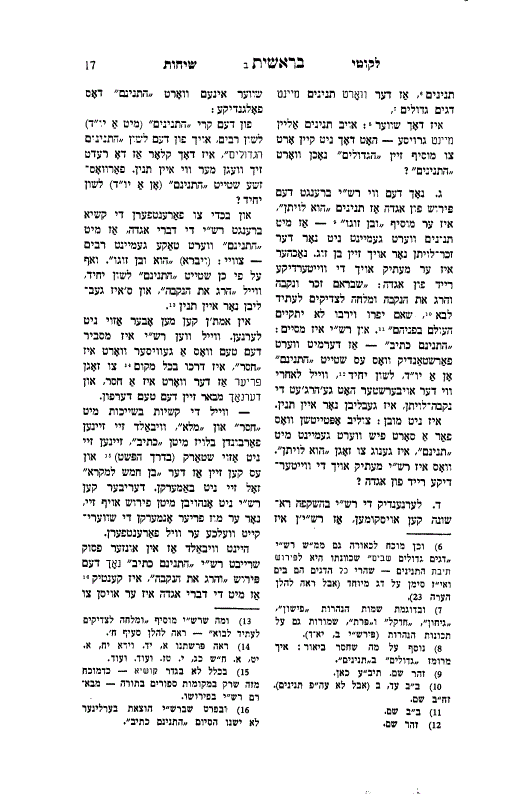
It is difficult to understand the word "התנינים". The issue is as follows: the term "התנינים" (with a yud) is in the plural form. It is clear that this refers to more than one creature. Why, then, is it written "התנינם" (without a yud), which is singular?
To address this question, Rashi brings the words of the Aggadah. According to the Aggadah, "התנינים" indeed refers to two: "He created them male and female." Nevertheless, it is written "התנינם" in the singular because "He killed the female," leaving only one creature.
In truth, one could explain it differently. When Rashi explains the reason why a certain word is written in a deficient form, he usually first states that the word is deficient and then explains the reason for it. However, these questions regarding "deficient" and "full" forms are only related to the script and do not provide a mark (in the simple meaning) for the explanation.
To answer a question that the child himself might ask, Rashi does not need to point out the question explicitly. However, since the word "התנינם" is also difficult because it is deficient, Rashi brings the words of the Aggadah. By doing so, he answers the obvious question and adds "התנינם כתיב" to explain why "התנינם" is written without a yud.
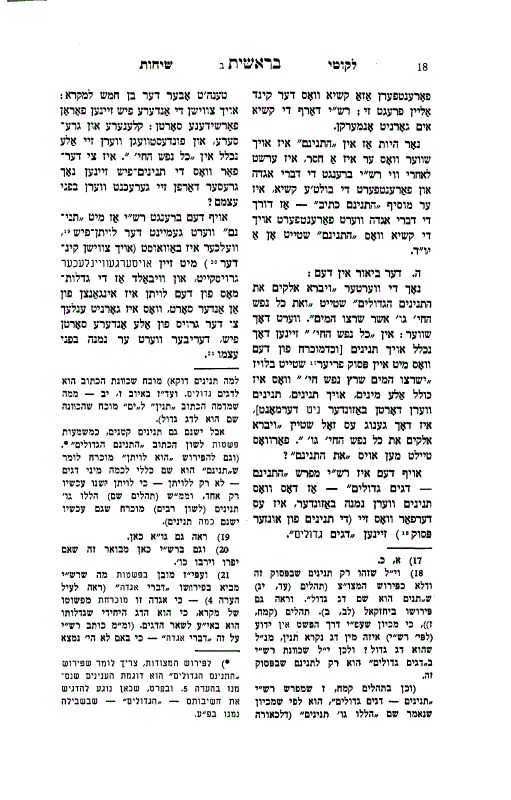
After the words "And G‑d created the great sea creatures," it says, "and every living creature that moves, which the waters brought forth." Here, a question arises: in "every living creature," sea creatures are also included. As is evident from the fact that in the verse it says only "which the waters brought forth living creatures," which includes all species, including sea creatures. Sea creatures are specifically mentioned there. It would have been sufficient to say, "And G‑d created every living creature." Why then is it necessary to mention "the sea creatures" separately?
Rashi explains this by saying that "התנינים" refers to the Leviathan, which is known (even among the nations) for its extraordinary size. Since the greatness of the Leviathan is of an entirely different kind, which is not at all similar to the size of all other types of fish, it is therefore counted separately.
With this, it also becomes understandable why "the great sea creatures" is mentioned before "every living creature." The reason is that the Leviathan is a unique species due to its exceptional size, which makes it more significant than all other living creatures.
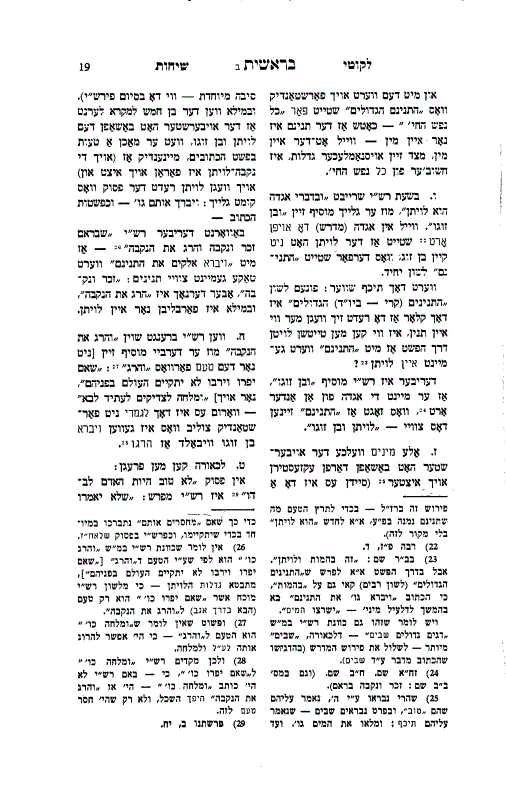
When Rashi writes "and in the words of the Aggadah, it is the Leviathan," he immediately adds "and its mate." In the Aggadah, it is stated that the Leviathan has no mate, as it is written, "You created them male and female." This immediately raises a question: if "the great sea creatures" refers to more than one, how can it be interpreted according to the peshat that "the sea creatures" refers to one Leviathan?
Therefore, Rashi adds "and its mate," meaning that the reference is to a pair of creatures. This explains why "the sea creatures" are mentioned in the plural form. The Leviathan and its mate were created together, as the verse states, "and G‑d blessed them." This is understood simply as referring to both.
Rashi's explanation is necessary so that the child learning the text will not be confused by the verses, thinking that the female Leviathan still exists now and that the verse is speaking about the Leviathan that will come in the future. Therefore, Rashi clarifies that they were created together, but the female was removed, as explained in the Midrash.
Rashi could have left it at that, but he adds further detail to prevent any misunderstanding. The child might think that the Leviathan's mate is still present, so Rashi specifies that it was removed to prevent any confusion.
Rashi explains that the Leviathan is destined to be a delicacy for the righteous in the future, indicating that there is something particularly delightful about it. This is why it was designated as a meal for the righteous in the future. In the Torah, there is also a "wine of Torah," which implies that the details Rashi provides regarding the Leviathan serve as lessons in the service of man.
The first lesson is that there must be a "male and female" — even when a Jew has reached a very high level in their service, to the point of "Leviathan," where they are in constant union and connection with the Almighty. As explained in Likkutei Torah, the term "Leviathan" implies connection, as in "this time my husband will be joined to me." Even then, one still needs a partner, a friend to assist in their service.
Even someone who still needs to battle with their animal soul understands that they need the help of a partner. However, when one is already on the level of "Leviathan" and has nothing to fear from the animal soul, they might think they can perform their service alone. Why, then, do they need a partner? Rashi addresses this by stating that "it is not good for man to be alone." This applies even to someone on the level of "Leviathan." Although being alone does not harm them personally, it is not beneficial for the world at large. Others, who are not on their level, can learn from them and see that they too need a partner. To prevent any disruption in the world, the "Leviathan" also needs a partner, and this is not merely for appearances, so that the outsider thinks they have a partner, but because it is essential.
Regarding the level of "Leviathan" and those who can achieve it, Rashi says, "Be fruitful and multiply, the world will not be sustained without them." The intention in the creation of the world is to make a dwelling place for the Divine in the lower realms, "in the lower realms," where even in the lowest levels, the Divine presence should have a dwelling. More precisely, one must have the service of the "Leviathan" — the higher unity — and also the service of those whose work is in the world (the hidden world). Through them, the world is sustained, and thus the purpose of making a dwelling place for the Divine in the lower realms is fulfilled.
Indeed, one must always strive to maintain the higher unity, but most people must engage in the work of "Be fruitful and multiply," which is the service of the lower unity. If one might think that most people should have no connection to the higher unity, Rashi clarifies that even at the level of "Be fruitful and multiply," where the focus is on sustaining the world (the hidden world), there is a killing of the female. In this context, there are two points: a) only the female was killed, but the male was left alive, indicating that one still needs it alive now. b) Even the female was "killed," meaning her soul and vitality were removed, but her body remained. Initially, even she was created for a purpose.
This concept is related to the idea of expansion. Just as in the matter of birth, the fetus develops from a small point into a fully formed being through the process of gestation in the mother's womb, so too does the concept of expansion apply here. This is also understood in relation to the service of the "Leviathan," which is the power of the higher unity. The expansion of the higher unity is necessary.
These are the two lessons for most people from the aforementioned details:
a) Even in the service of the lower unity, there must be a point of higher unity. This is required for their service now, even though its main focus is on the lower unity. For the service of the lower unity to be genuine, there must also be an illumination (a point) of the higher unity's nullification.
b) Since all future revelations depend on our actions and service, in order for there to be the revelation of the expansion of the higher unity, one must also, at all times — even now — engage in the service of the higher unity.
The practical result must be a living entity, a product of the service and expansion of the higher unity, as it will be in the future when "the righteous will feast on the Leviathan." This means that the "eating and enjoyment" will include the expansion of the higher unity, which will be internalized (like flesh and blood) and comprehended in understanding.
And although even now it is illuminated within them internally, they still perform the "feasting" — the Almighty sustains and maintains her, so she remains whole, "as if placed in a box." In the future, it will be internalized, and "the earth will be filled with the knowledge of the L‑rd as the waters cover the sea." Even the aspect of the sea — the higher unity — will be comprehended and grasped internally, in a manner of knowledge.