

Likkutei Sichos Vol. 4 – Yom Kippur – The Power of Teshuvah
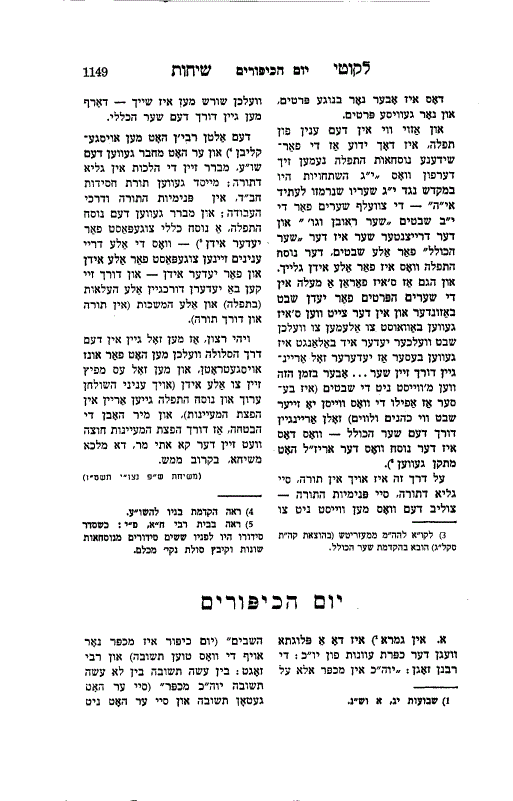
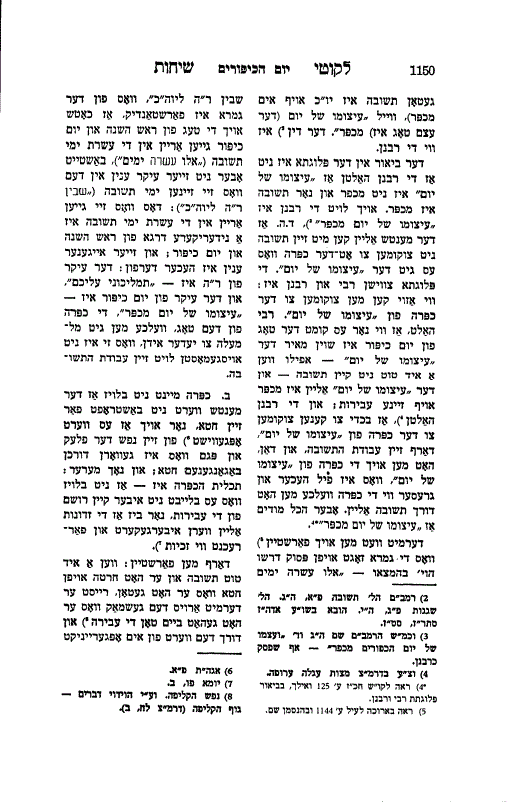
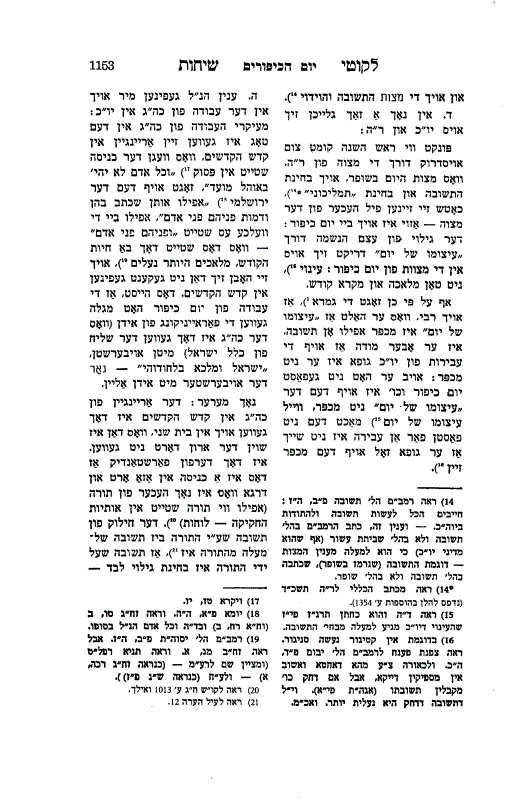
1. In the Gemara, there is a dispute regarding the atonement of Yom Kippur: The Rabbis say, "Yom Kippur atones only for those who repent," meaning that Yom Kippur provides atonement only for those who perform teshuvah (repentance). However, Rabbi says, "Whether he has repented or not, Yom Kippur atones," because "the essence of the day atones." The ruling follows the opinion of the Rabbis.
The explanation of this dispute is not that the Rabbis believe "the essence of the day" does not atone and only teshuvah does. Even according to the Rabbis, "the essence of the day atones," meaning that a person alone cannot achieve the atonement provided by "the essence of the day" through his teshuvah. The dispute between Rabbi and the Rabbis is about how one can attain the atonement of "the essence of the day." Rabbi holds that as soon as Yom Kippur arrives, "the essence of the day" illuminates—even if a Jew does not perform teshuvah—and "the essence of the day" itself atones for his transgressions. The Rabbis, however, maintain that in order to attain the atonement of "the essence of the day," there must be the work of teshuvah. Then, one also receives the atonement of "the essence of the day," which is much higher and greater than the atonement achieved through teshuvah alone. However, all agree that "the essence of the day atones."
This also helps us understand why the Gemara states regarding the verse "Seek the L‑rd while He may be found"—"these are the ten days between Rosh Hashanah and Yom Kippur." From the Gemara, it is understood that although the days of Rosh Hashanah and Yom Kippur are included in the Ten Days of Repentance ("these ten days"), their primary aspect is not that they are days of teshuvah ("between Rosh Hashanah and Yom Kippur"). The fact that they are part of the Ten Days of Repentance is a lower level compared to Rosh Hashanah and Yom Kippur themselves. Their unique aspect is higher than that: the main aspect of Rosh Hashanah is "Crown Me as your King," and the main aspect of Yom Kippur is "the essence of the day atones," the atonement of the day, which is granted from Above to every Jew and is not measured according to his work of teshuvah.
2. Atonement does not only mean that a person is not punished for his sin, but also that the stain and blemish caused by the committed sin are wiped away from his soul. Furthermore, the ultimate purpose of atonement is that not only is there no remaining trace of the transgressions, but even the intentional sins themselves are transformed and considered as merits.
3. We need to understand: When a Jew repents and regrets the sin he has committed, he thereby removes the pleasure he had when committing the transgression, and through this, the evil is cleansed and wiped away from him. (And because his previous sins have brought him to a greater thirst for G‑d, they are therefore considered as merits.) However, how is the evil within a person cleansed and wiped away through "the essence of the day" without him performing teshuvah? It can be understood that "the essence of the day" serves as an atonement so that he is not punished, for Yom Kippur removes the punishment for sins. But how, and with what, are the blemishes on the soul of a person removed? As mentioned, even according to the Rabbis who hold that teshuvah is required, the atonement of Yom Kippur is greater than the effect of the teshuvah performed by the person. This is especially true according to Rabbi, who maintains that Yom Kippur atones even without teshuvah.
The explanation is as follows:
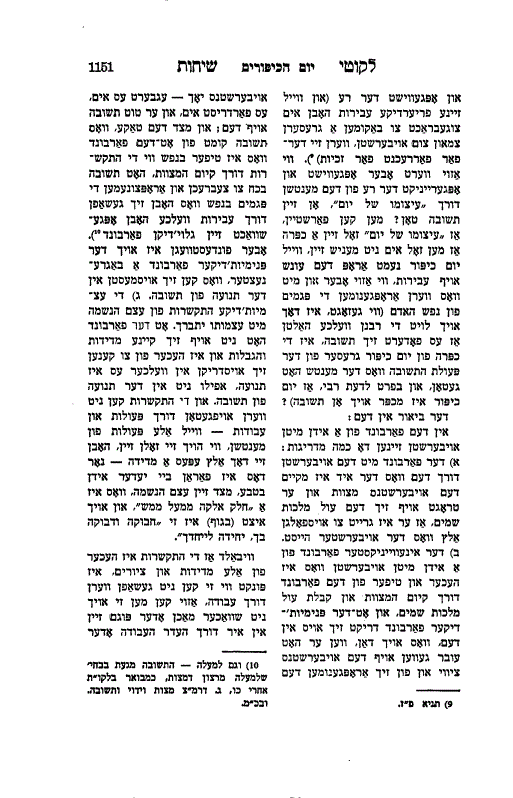
In the connection between a Jew and G‑d, there are several levels: a) The connection with G‑d through the Jew fulfilling G‑d's commandments and accepting upon himself the yoke of the Kingdom of Heaven, being ready to follow everything that G‑d commands. b) The innermost connection of a Jew with G‑d, which is higher and deeper than the connection through the fulfillment of mitzvos and acceptance of the yoke of Heaven. This inner connection is expressed in the fact that even when he has transgressed G‑d's command and removed the yoke of G‑d from himself, it bothers him, it distresses him, and he repents for it. And it is precisely because teshuvah comes from this connection, which is deeper in the soul than the connection through the fulfillment of mitzvos, that teshuvah has the power to break and remove the blemishes in the soul that have been created by sins, which have weakened his revealed connection. Nevertheless, even this innermost connection is limited and can be measured in the movement of teshuvah. c) The essential bond of the essence of the soul with the Essence of G‑d. This connection has no limitations and is beyond being expressed in any movement, not even in the movement of teshuvah. This connection cannot be achieved through actions and efforts, because all human actions, no matter how lofty, have some measure. Rather, it exists naturally in every Jew, due to the essence of his soul, which is a "veritable part of G‑d above," and even now (in the body) it is "embraced and bound with You, unique to unite with You."
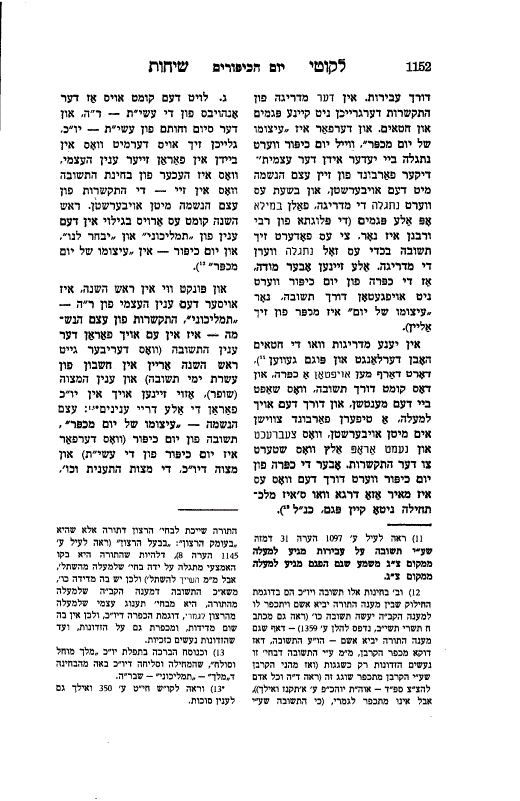
3. Since this connection is beyond all limitations and definitions, just as it cannot be created through effort, it also cannot be weakened or blemished by a lack of effort or by transgressions. At this level of connection, no blemishes or sins can reach. Therefore, "the essence of the day atones," because on Yom Kippur, the essential bond of every Jew's soul with the Almighty is revealed. When this level is revealed, all blemishes naturally fall away. (The dispute between Rabbi and the Sages is only whether teshuvah is required for this level to be revealed. However, all agree that the atonement of Yom Kippur is not achieved through teshuvah, but rather "the essence of the day" atones on its own.)
In those levels where sins have reached and caused blemishes, atonement is necessary. This is achieved through teshuvah, which creates within the person, and thereby also above, a deeper bond between him and the Almighty, breaking and removing all that hinders the connection. However, the atonement of Yom Kippur occurs because such a level is illuminated where there is no blemish to begin with, as mentioned above.
The beginning of the Ten Days of Repentance — Rosh Hashanah, and the conclusion and seal of the Ten Days of Repentance — Yom Kippur, are similar in that both contain their essential aspect, which is beyond the level of teshuvah within them — the connection of the essence of the soul with the Almighty. On Rosh Hashanah, this is revealed in the concept of "Crown Me" and "He chooses for us," and on Yom Kippur — in "the essence of the day atones."
Just as on Rosh Hashanah, besides the essential aspect of Rosh Hashanah — "Crown Me," the connection of the essence of the soul — there is also the aspect of teshuvah (which is why Rosh Hashanah is included in the count of the Ten Days of Repentance) and the aspect of the mitzvah (shofar), so too on Yom Kippur, all three aspects are present: the essence of the soul — "the essence of the day atones," the teshuvah of Yom Kippur (which is why Yom Kippur is part of the Ten Days of Repentance), and the mitzvah of Yom Kippur, the mitzvah of fasting, etc., and also the mitzvah of teshuvah and confession.
4. In another aspect, Yom Kippur and Rosh Hashanah are similar:
Just as Rosh Hashanah is expressed through the mitzvah of Rosh Hashanah, whose mitzvah of the day is the shofar, also the aspect of teshuvah and the aspect of "Crown Me," although they are far beyond the mitzvah — so too on Yom Kippur: the revelation of the essence of the soul through "the essence of the day" is expressed in the mitzvos of Yom Kippur: affliction, refraining from work, and sacred assembly. Nevertheless, the Gemara states that even Rabbi, who holds that "the essence of the day" atones even without teshuvah, agrees that for the transgressions of Yom Kippur itself, it does not atone; if one did not fast on Yom Kippur, etc., "the essence of the day" does not atone for this, because the essence of the day makes not fasting a transgression, and it is not possible for it to atone for itself.
5. We find the above concept also in the service of the Kohen Gadol on Yom Kippur: One of the primary services of the Kohen Gadol on this day was his entry into the Holy of Holies. Concerning this entry, the verse states, "And no man shall be in the Tent of Meeting," and the Jerusalem Talmud comments, "Even those about whom it is written, 'And the likeness of their faces was the face of a man,'" referring to the holy creatures, the highest angels, they too could not be present in the Holy of Holies at that time. This means that the service of Yom Kippur revealed the union of the Jewish people (for the Kohen Gadol was the emissary of the entire Jewish community) with the Almighty, "Israel and the King alone" — only the Almighty and the Jews themselves.
Furthermore, the entry of the Kohen Gadol into the Holy of Holies also occurred in the Second Temple, where the Ark was no longer present. This indicates that it was an entry into a place and level even higher than the Torah (even as the Torah exists in the engraved letters — the Tablets). The difference between repentance through the Torah and repentance above the Torah is that repentance through the Torah is only a revelation — although repentance is higher than the Torah, which is why it can rectify the blemishes of the 613 mitzvos of the Torah (including the mitzvah of Torah study), it is still in the realm of revelation. Repentance above the Torah is the union with the Essence, beyond revelation.
Just as in the time of the Temple, the essential connection between the souls of Israel and the Almighty was achieved through the Kohen Gadol's entry into the Holy of Holies on Yom Kippur, so too is this expressed now in the prayers of Yom Kippur, for prayer takes the place of the sacrificial service:
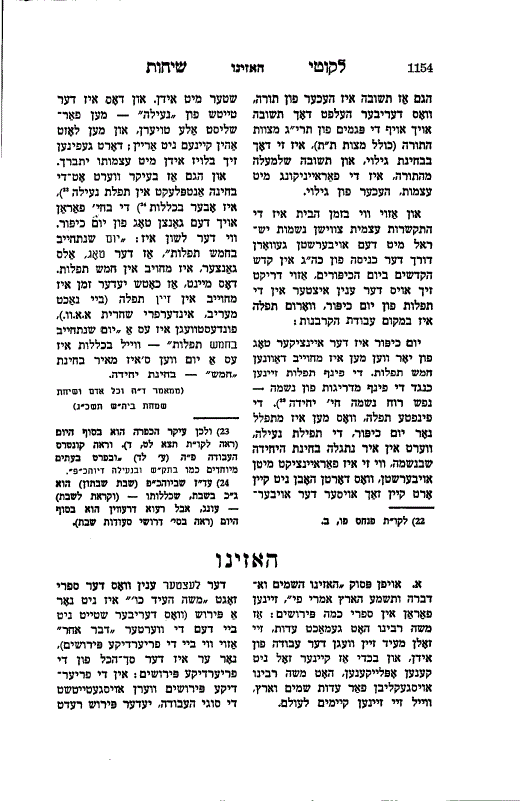
Yom Kippur is the only day of the year when one is obligated to pray five prayers. These five prayers correspond to the five levels of the soul — Nefesh, Ruach, Neshamah, Chayah, Yechidah. The fifth prayer, which is recited only on Yom Kippur, the Ne'ilah prayer, reveals the level of Yechidah in the soul, as it is united with the Almighty, where nothing else has a place except the Almighty and the Jews. This is the meaning of "Ne'ilah" — all gates are closed, and no one else is allowed in; only the Jews and His Essence are present there.
And although this level is primarily revealed in the Ne'ilah prayer, in general, this level is present throughout the entire day of Yom Kippur. As the expression goes: "A day obligated in five prayers," meaning that the day as a whole is obligated in five prayers. This means that although each time is obligated in its own prayer (at night, Maariv; in the morning, Shacharit, etc.), nevertheless, it is a "day obligated in five prayers" — because in general, it is a day when the aspect of "five" — the aspect of Yechidah — shines.
5. The essence of Yom Kippur itself atones, as the Rambam writes, "The essence of Yom Kippur atones" — even though he rules according to the Sages. This atonement is not dependent on the individual's actions, but rather it is an inherent quality of the day itself. The day of Yom Kippur is imbued with a unique holiness that has the power to atone for sins.
This concept is further elucidated by the distinction between the atonement achieved through repentance and the atonement of Yom Kippur. Repentance reaches a level beyond the will and commandments, as explained in Likkutei Torah, and it is connected to the essence of G‑d, which transcends all limitations. This is similar to the atonement of Yom Kippur, which is not bound by any limitations and can atone even for intentional sins, transforming them into merits.
The blessing in the Yom Kippur prayer, "King who pardons and forgives," indicates that the forgiveness of Yom Kippur comes from the aspect of "King" — "Crown Me" — which is beyond the regular order of the mitzvos. This is why the Rambam includes the obligation to repent and confess on Yom Kippur in the laws of repentance, rather than in the laws of the Day of Atonement, because it is above the realm of mitzvos, similar to the concept of repentance itself.
Thus, the primary atonement of Yom Kippur occurs at the end of the day, as explained in Likkutei Torah, and this is particularly emphasized during the Ne'ilah prayer, which is the culmination of the day's service. This is analogous to the concept that on Shabbat, which is also a "Shabbat Shabbaton," the ultimate delight, "the will of wills," is revealed at the end of the day.