

Likkutei Sichos Vol. 4 – Vayeilech – The Power of Teshuvah on Yom Kippur
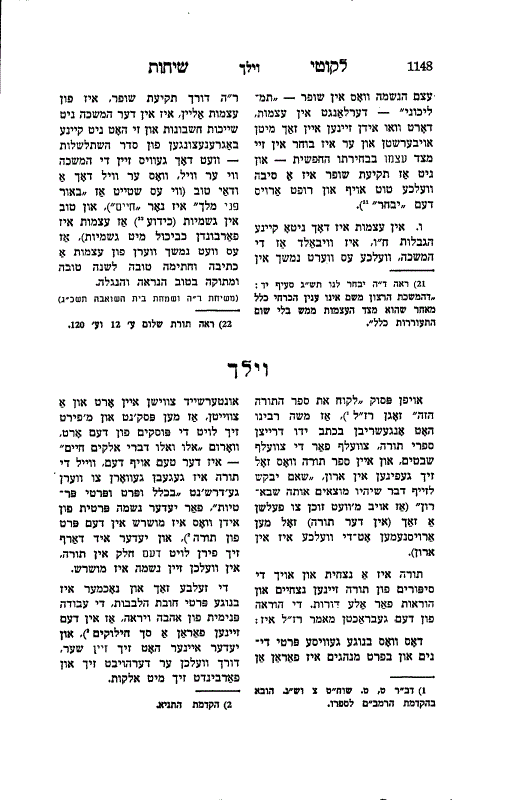
1. On the verse "Take this Torah scroll," our Sages say that Moses wrote thirteen Torah scrolls in his own handwriting: twelve for the twelve tribes, and one Torah scroll to be placed in the Ark, "so that if anyone seeks to falsify something, they can refer to the one in the Ark."
The Torah is eternal, and its stories are eternal and serve as lessons for all generations. The lesson from this teaching of our Sages is as follows:
Regarding certain specific laws and especially customs, there is a difference between one place and another, as decisions and practices follow the authorities of that place, because "these and those are the words of the living G‑d." The reason for this is that the Torah was given to be expounded "in general and in detail and in detailed particulars," for each individual soul of the Jewish people, which is rooted in a specific part of the Torah. Each Jew must conduct themselves according to the part of the Torah in which their soul is rooted.
The same, and even more so, applies to the particulars of the duties of the heart, the inner service of love and awe. In this, there are many differences, and each person has their own gate through which they elevate and connect with G‑dliness.
However, this is only regarding particulars, and only certain particulars.
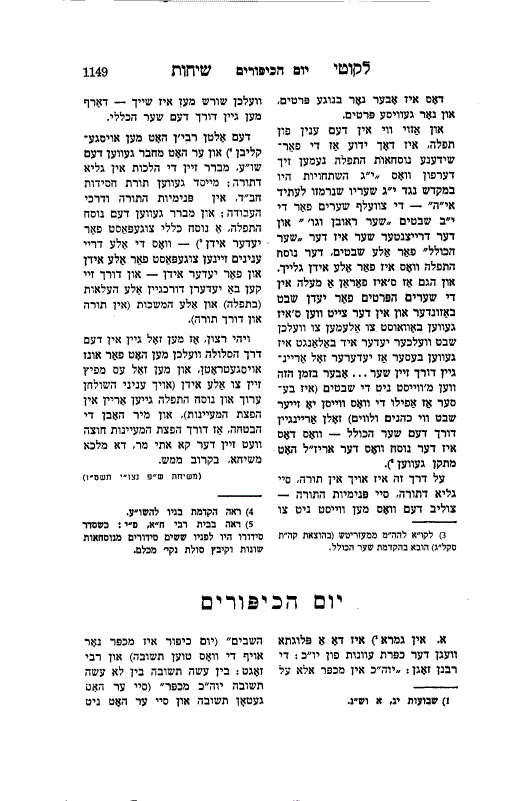
Just as in the matter of prayer, it is known that the different versions of the prayer originate from the fact that "there were thirteen prostrations in the Temple corresponding to its thirteen gates, which are alluded to in the future, G‑d willing" — the twelve gates for the twelve tribes, "the gate of Reuben, etc.," and the thirteenth gate is the "general gate" for all the tribes, the version of the prayer that is equal for all Jews. And although there is an advantage in the specific gates for each tribe individually, and in the time when it was known to everyone to which tribe each Jew belonged, it was better for each to enter through their gate... but in our time, when we do not know the tribes (it is better that even those who do know their tribe, like Kohanim and Levites) should enter through the general gate — which is the version that the Arizal established.
Similarly, in Torah, both the revealed aspects and the inner dimensions of the Torah — because we do not know to which root we belong — we must go through the general gate.
The Alter Rebbe was chosen, and he authored the Shulchan Aruch, clarifying the laws in the revealed aspects of the Torah; he founded the teachings of Chabad Chassidus, in the inner dimensions of the Torah and the ways of service; and he clarified the version of the prayer, a general version suited for every Jew — all three of these matters are suited for all Jews and for each Jew — and through them, everyone can achieve all elevations (in prayer) and all drawing down (in Torah and through Torah).
2. May it be G‑d's will that we follow the well-trodden path that has been paved for us, and that we disseminate it to all Jews. This includes the matters of the Shulchan Aruch and the version of the prayer, which are part of spreading the wellsprings. We have the promise that through spreading the wellsprings outward, "the master will come," this being King Moshiach, very soon indeed.
(From the talk of Shabbat Parshat Nitzavim-Vayelech, 5715)