
הוראה מענין דור הפלגה
Parshas Noach
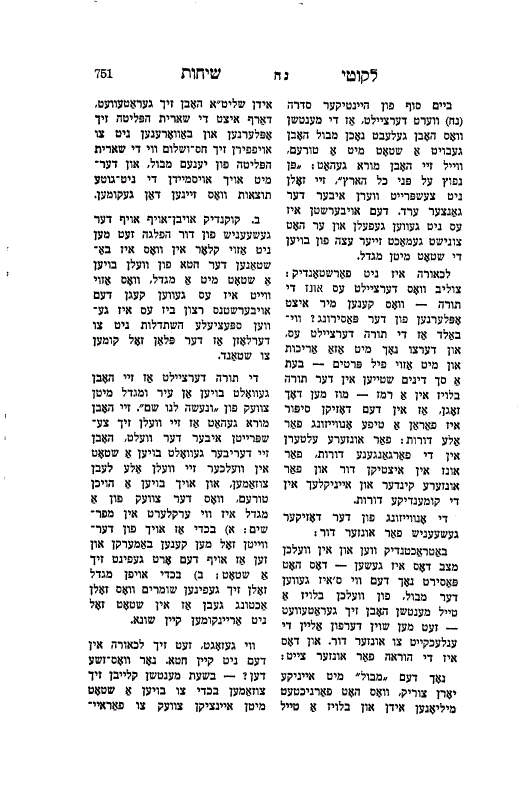
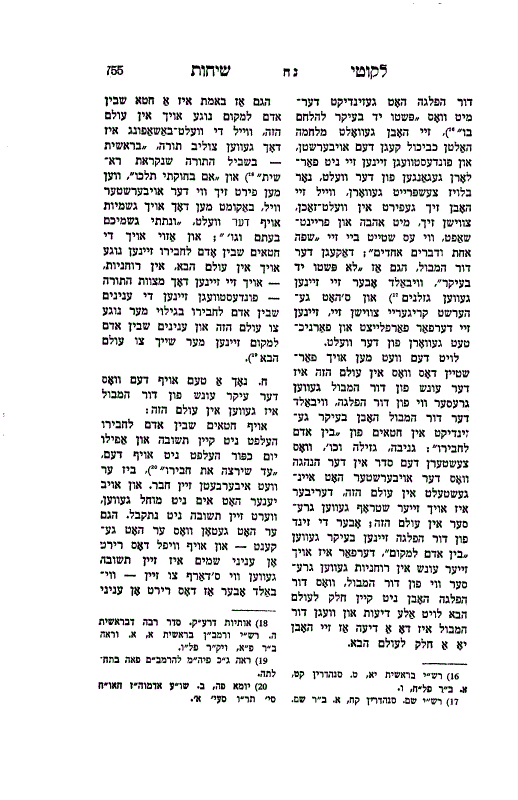
1. As is always customary at such an occasion, one begins with a matter of Torah and with the Sidrah read this week. For Torah and its instructions are eternal[1] — in every generation, at every time and in every place; and from the very fact that each week a different portion of the Torah is read, it is evident that the weekly portion alludes to, and contains, the instructions concerning the events of the week in which that Sidrah is read[2].
At the end of this week's Sidrah (Noach) it is related that the people who lived after the Flood built a city with a tower, because they were afraid "lest we be scattered over the face of the whole earth" — that they would be dispersed over the entire earth. This did not please G‑d, and He brought their plan of building the city with the tower to nothing.
At first glance it is not understood: why does the Torah tell us this — what can we learn now from this event? Since the Torah relates it, and moreover at such length and with so many details — while many laws are stated in the Torah only by allusion — we must say that this story contains a profound instruction for all generations: for our parents in the past generations, for us in the present generation, and for our children and grandchildren in the generations to come.
The instruction of this event for our generation: when we consider when and in what circumstances it took place — it happened after the Flood, from which only some of mankind were saved — we already see from this alone its resemblance to our generation. And this is the lesson for our time: after the "flood" of a few years ago, which annihilated millions of Jews, and from which only some Jews, may they live and be well, were saved, the surviving remnant must now learn and take care not to conduct itself, Heaven forbid, like the surviving remnant of that Flood, and thereby also avoid the unfortunate consequences that came about then.
2. Looking at the episode of the Generation of the Dispersion superficially, it is not so clear what the sin consisted of in wanting to build a city with a tower — so much so that it was against G‑d's will, to the point that there was a special effort not to allow the plan to be realized.
The Torah relates that they wanted to build a city and a tower for the purpose of "and let us make a name for ourselves." They were afraid they would be scattered over the world, and therefore wanted to build a city in which they would all live together, and also to build a tall tower — the purpose of a tower being, as explained in the commentaries: a) that even from afar one should be able to notice and know that a city stands in that place; b) that atop the tower there should be watchmen who would see to it that no enemy enter the city. As was said, in this there seems to be no sin.
What, then, was it? When people gather together to build a city with the sole purpose of immortalizing their name — "and let us make a name for ourselves"[3] — having in it no higher aim than to immortalize their own name, then apart from the inherent deficiency in thinking only about oneself, without any higher content in life[4], when this is the only purpose, one does not choose the means through which to realize and attain that purpose, and one may also make use of means that are the opposite of righteousness and honesty.
All the more so since this was after the Flood, when before the Flood Noach had explained[5] the reason the Flood would come: because of the wrongful conduct of the people of that generation. The survivors of the Flood should therefore first of all have seen to repairing the spiritual state by bringing a higher content into their lives. Of this they did not think at all; instead they, the survivors of the Flood, sought only a means to immortalize their name in history. In this their sin consisted, and therefore it did not find favor with G‑d.
3. The lesson from this is clear:
When one is saved from a flood, one must first of all take precautions and guard that the former state of affairs that brought the Flood should not repeat itself, Heaven forbid — that "trouble shall not arise twice," that the same trouble should not arise twice, Heaven forbid. And this is not guarded against by building just a city and just a tower, with no other content than that the city and the tower be ever bigger and taller. Such an approach does not improve the situation, for in order that the city and tower should endure, one must bring into it a higher content. Then the city is built successfully, and even the things that hinder the city are transformed, to the point that they actually help.
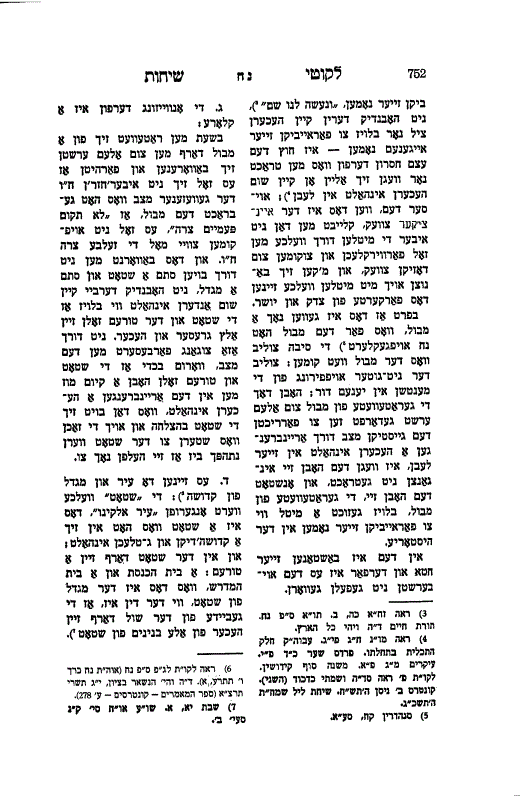
4. There is a city and a tower of holiness[6]: the "city" called "the city of our G‑d" — a city that has within it a holy and G‑dly content; and in that city there must be a tower: a synagogue and a house of study, which is the tower of the city, as the law states, that the building of the synagogue must be taller than all the buildings of the city[7].
In plainer words: in the city one must build the places in which people pray and learn — the synagogues, houses of study and yeshivos. Into them one must put the main strength and the chief energy, that they be as large and as tall as possible, because they are the tower of the city, the tower about which it is said[8], "The Name of G‑d is a tower of strength; the righteous runs into it and is set on high" — the tower that protects from all enemies, not only from an open enemy but also from a hidden one[9].
And when one conducts oneself in this way, one has both things. First, one has the principal reward: that one carries out G‑d's will and has great success in building the city and tower of holiness. And in addition one also receives the added reward of "and let us make a name for ourselves": the name of those who work at this is immortalized in the chronicles of Judaism and of Torah, in the history of righteousness and honesty; it is recorded forever that so-and-so helped build the eternal city and tower.
5. One must see to building the yeshivos in which children are educated to study Torah and to spread Torah throughout the entire world. The yeshivos are the tower of the city; one must therefore see to enlarging and expanding the yeshivos, so that they can open more divisions and take in more students. And, as said before, through building the tower of holiness one has both the principal reward — carrying out the Supreme Will — and also the secondary reward: it also helps one's personal affairs to be successful, and one is also immortalized in the history of Judaism, which is the eternal history.
May G‑d grant success in building the yeshivos many times over; and may it be that the next time we gather at such an occasion, we will think not about covering the deficit but about enlarging the tower more and more. And may G‑d grant success in this matter, and also in your personal affairs.
(From a talk to the activists of Yeshivos Tomchei Temimim Lubavitch, Thursday of Parshas Noach, 5722)
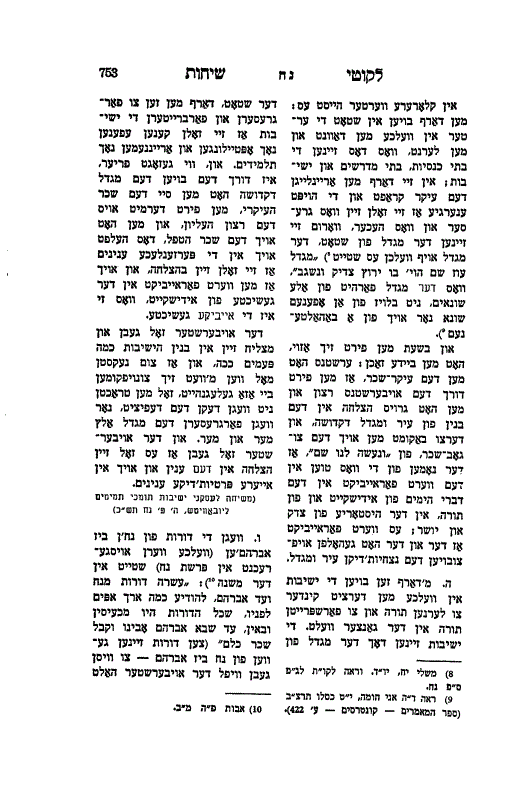
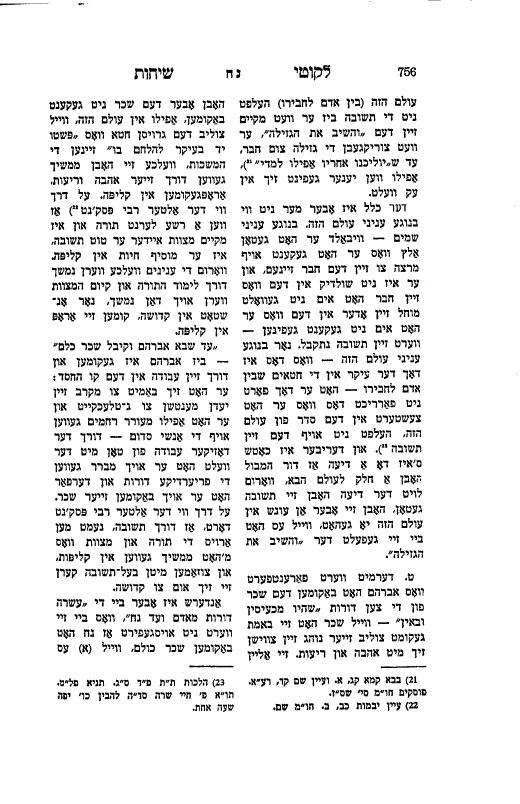
6. Concerning the generations from Noach to Avraham (which are enumerated in Parshas Noach), the Mishnah states[10]: "There were ten generations from Noach to Avraham, to make known how patient He is, for all the generations kept provoking Him, until Avraham our father came and received the reward of them all" (there were ten generations from Noach to Avraham — to know how greatly G‑d holds back His anger, for all those generations angered Him one after another, until Avraham our father came and received the reward of all of them).
This is not understood: what does it mean that Avraham received the reward of all ten generations? They were "provoking Him continually"; what reward, then, was due them, which Avraham took?
Earlier in the same Mishnah it is said: "There were ten generations from Adam to Noach, to make known etc., until He brought upon them the waters of the Flood." Regarding those ten generations the Mishnah does not conclude that Noach received the reward of all of them; and simply this is understood: since all ten generations from Adam to Noach "kept provoking Him," they naturally earned no reward. It is then all the more puzzling: why, regarding the ten generations from Noach to Avraham, who also angered G‑d, does the Mishnah conclude that Avraham our father received the reward of those generations?
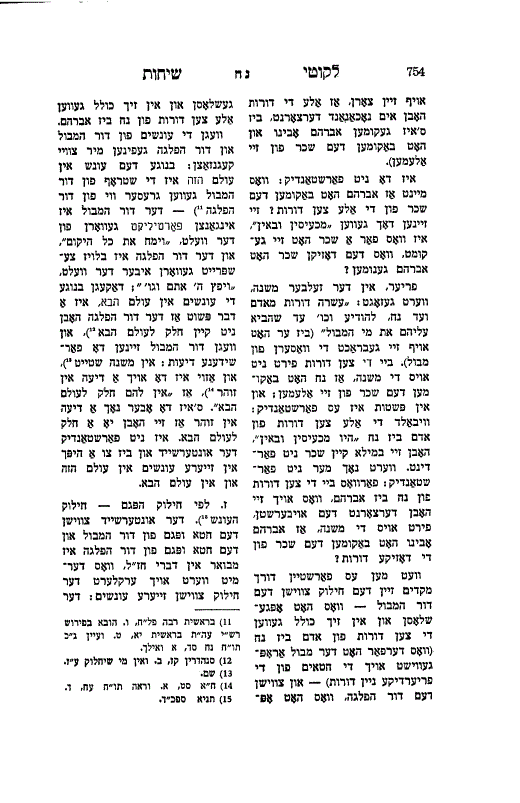
This will be understood by first explaining the difference between the Generation of the Flood — which concluded and comprised within itself the ten generations from Adam to Noach (which is why the Flood also wiped away the sins of the nine preceding generations) — and the Generation of the Dispersion, which concluded and comprised within itself all ten generations from Noach to Avraham.
Regarding the punishments of the Generation of the Flood and the Generation of the Dispersion, we find two opposites. With respect to the punishment in this world, the penalty of the Generation of the Flood was greater than that of the Generation of the Dispersion[11]: the Generation of the Flood was utterly wiped off the earth — "And He blotted out all existence" — whereas the Generation of the Dispersion was only scattered over the world — "And G‑d scattered them…." With respect to the punishments in the World to Come, on the other hand, it is a simple matter that the Generation of the Dispersion has no share in the World to Come[12], while regarding the Generation of the Flood there are various opinions: the Mishnah states[13], and so too there is an opinion in the Zohar[14], that "they have no share in the World to Come"; but there is another opinion in the Zohar that they do have a share in the World to Come.
The difference between them is not understood — to the point of a reversal in their punishments in this world and in the World to Come.
7. According to the difference in the blemish is the difference in the punishment[15]. The difference between the sin and blemish of the Generation of the Flood and the sin and blemish of the Generation of the Dispersion is explained in the words of our Sages, and this also explains the difference between their punishments:
The Generation of the Dispersion sinned in that "they stretched out a hand against the Root, to wage war against Him"[16] — they wanted, as it were, to wage war against G‑d. And nevertheless they were not lost from the world, but were only scattered, because among themselves, in worldly matters, they conducted themselves with love and friendship, as it says of them, "one language and uniform words." The Generation of the Flood, by contrast, although "they did not stretch out a hand against the Root," yet because they were robbers[17] and quarreling reigned among them, they were therefore flooded and destroyed from the world.
Accordingly we will also understand why, in this world, the punishment of the Generation of the Flood was greater than that of the Generation of the Dispersion. Since the Generation of the Flood sinned chiefly in sins "between man and his fellow" — theft, robbery and the like — which disrupt the order of conduct that G‑d established in this world, their penalty in this world was accordingly greater. The sins of the Generation of the Dispersion, however, were chiefly "between man and G‑d"; therefore their punishment in spiritual terms was also greater than that of the Generation of the Flood: the Generation of the Dispersion has no share in the World to Come according to all opinions, while regarding the Generation of the Flood there is an opinion that they do have a share in the World to Come.
Although in truth a sin between man and G‑d also affects this world — for the creation of the world was for the sake of Torah, "Bereishis: for the sake of the Torah, which is called reishis"[18], and "If you walk in My statutes" — when one conducts oneself as G‑d wishes, one also receives material blessing in the world: "I will give your rains in their season…"; and likewise sins between man and his fellow also affect the World to Come, the spiritual realm — for these too are commandments of the Torah — nevertheless, matters between man and his fellow relate more manifestly to this world, and matters between man and G‑d relate more to the World to Come[19].
8. A further reason why the main punishment of the Generation of the Flood was in this world:
For sins between man and his fellow, repentance does not help, and even Yom Kippur does not help for them, "until he appeases his fellow"[20] — until he asks his fellow's forgiveness. And if the other has not forgiven him, his repentance is not accepted. Although he has done what he could — and insofar as it touches on matters of Heaven his repentance was as it should be — since, however, it touches on matters of this world (between man and his fellow), repentance does not help until he fulfills "and he shall return the stolen object," giving the stolen property back to his fellow, and he must "carry it after him even to Media"[21], even if the other is at the end of the world.
This rule, however, applies only to matters of this world. With respect to matters of Heaven, since he did everything he could to appease his fellow, and he is not at fault that his fellow refused to forgive him or that he could not find him, his repentance is accepted. Only with respect to matters of this world — which are, after all, the main thing in sins between man and his fellow — since he has nevertheless not repaired what he disrupted in the order of this world, his repentance does not help for this[22].
Therefore, although there is an opinion that the Generation of the Flood have a share in the World to Come — for according to that opinion they repented — they nevertheless did suffer a punishment in this world, because they lacked the "and he shall return the stolen object."
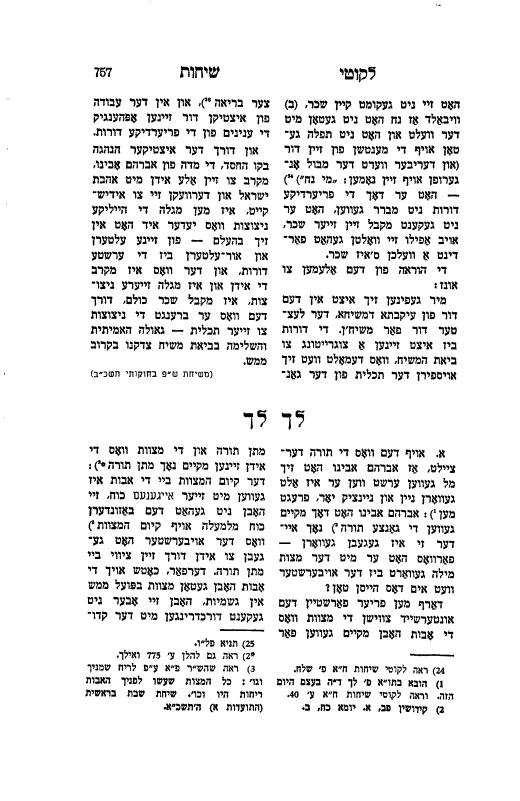
9. This resolves why Avraham received the reward of the ten generations "who kept provoking Him": a reward was in truth due them, for their conducting themselves among one another with love and friendship. They themselves, however, could not receive the reward, not even in this world, because on account of the great sin that "they stretched out a hand against the Root, to wage war against Him," the flows of Divine influence that they drew down through their love and friendship descended into kelipah — similar to what the Alter Rebbe rules[23], that when a wicked person studies Torah and fulfills mitzvos before he repents, he adds vitality to kelipah; for the matters drawn down through Torah study and the fulfillment of mitzvos are drawn down then too, but instead of into holiness they descend into kelipah.
"Until Avraham came and received the reward of them all" — until Avraham came, and through his service in the line of chesed, kindness — he strove to draw every person close to G‑dliness, and he even aroused mercy for the people of Sedom — through this service of dealing with the world he also refined the previous generations, and therefore he also received their reward; similar to what the Alter Rebbe rules there, that through repentance one extracts the Torah and mitzvos that one had drawn down into the kelipos, and together with the penitent they return to holiness.
It is different, however, with the "ten generations from Adam to Noach," regarding whom it is not concluded that Noach received the reward of them all, because (a) no reward was due them; (b) since Noach did not deal with the world and did not pray for the people of his generation (and therefore the Flood is called by his name, "the waters of Noach"[24]), he did not refine the previous generations, and so he could not receive their reward, even had they earned some reward.
The lesson from all this for us:
We now find ourselves in the generation of ikvesa diMeshicha, the "heels of Mashiach," the last generation before Mashiach. All the generations until now are a preparation for the coming of Mashiach, when the purpose of all of creation will be fulfilled[25]. And upon the service of the present generation depend the matters of the previous generations.
And through the present conduct in the line of chesed, the attribute of Avraham our father — drawing all Jews close with ahavas Yisrael and awakening them to Judaism — one reveals the holy sparks that every Jew has within him in a hidden way, from his parents and forebears back to the first generations. And one who draws Jews close and reveals their sparks receives the reward of them all, by bringing the sparks to their purpose — the true and complete Redemption with the coming of our righteous Mashiach, speedily and truly in our days.
(From a talk of Shabbos Parshas Bechukosai, 5722)
Key Lesson
The survivors of the Flood built a city and a tower only to make a name for themselves, and so failed to repair the moral failings that had brought the Flood in the first place. A generation that survives catastrophe must instead build the "tower of holiness" — synagogues, houses of study and yeshivos — and the lasting name then follows by itself. Just as Avraham, through his kindness, received the reward that the ten generations before him had earned but could not keep, each of us, by drawing Jews close with ahavas Yisrael, reveals the hidden sparks of all past generations and brings them to their purpose with the coming of Mashiach.