Introduction
In this review of Likkutei Sichos, we are studying from Chelek Beis, focusing on the second part of the sicha for Shavuos. This learning is dedicated as a merit for the soul of Harav Levi Yitzchok ben Chaim Tzvi, may his soul be bound in the bond of life.
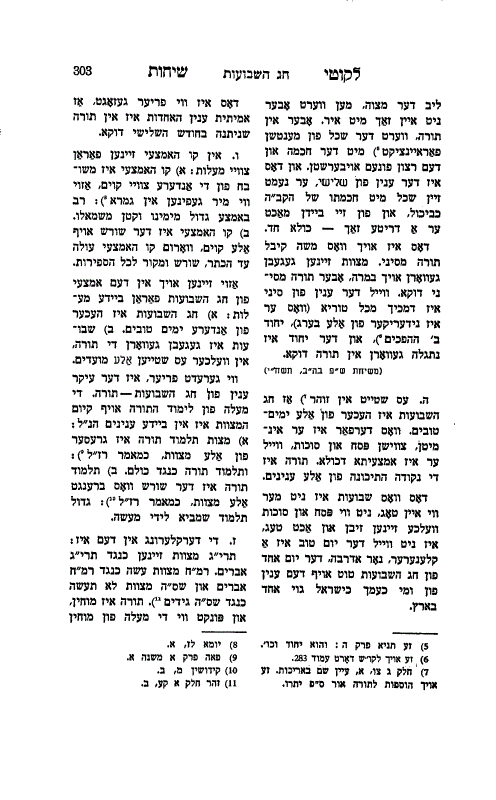
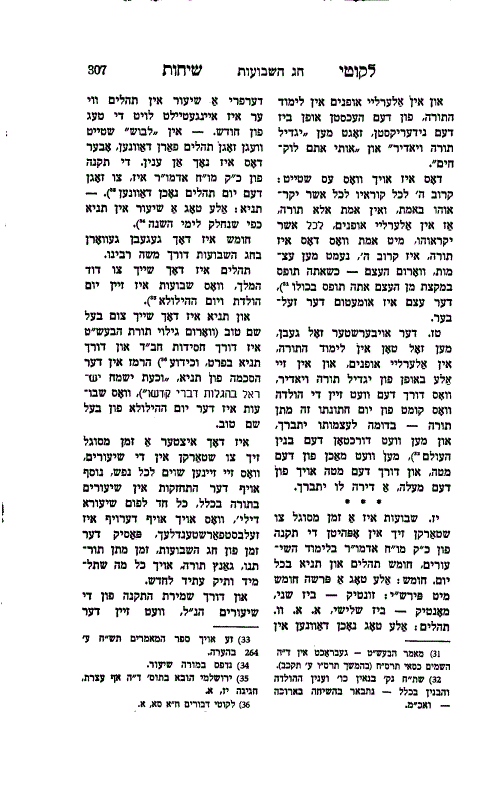
The sicha begins from section Hei, where the Rebbe discusses the unique quality of Shavuos compared to the other festivals, specifically Sukkos and Pesach. The Rebbe points out that Shavuos, being positioned in the middle, actually possesses a greater advantage—it serves as the source and central point among the three festivals.
The Rebbe will also address how Shavuos is primarily associated with Torah, and how Torah itself has an advantage even over mitzvos. He will explain the unique spiritual level that Torah draws down into the world, a concept that will be developed step by step throughout the sicha.
The discussion opens with a teaching from the Zohar: it states that Shavuos is higher than all other festivals. This is reflected in its placement—Shavuos stands between Pesach and Sukkos. Pesach is the first of the three pilgrimage festivals, Sukkos is the last, and Shavuos occupies the central position.
The Rebbe notes that being in between signifies a higher status than either end point. The middle represents not just balance but also a deeper source and connection that surpasses what comes before or after.
Saif Aleph
Shavuos stands at the very center of the Jewish calendar, positioned between Pesach and Sukkos. The Rebbe explains that this is not coincidental—Shavuos, the time when the Torah was given, represents the central point and essence of all matters. Torah is the core around which everything else revolves.
One might wonder: if Shavuos is so central and elevated, why is it celebrated for only one day, while Pesach and Sukkos last seven or eight days? The Rebbe addresses this by teaching that the single day of Shavuos reflects the concept of Goy echad ba’aretz—the unique oneness of Hashem manifest in the world. This “one” is not a deficiency but an advantage: Shavuos’s singularity expresses its power to draw down Hashem’s unity into creation.
This idea connects to a deeper theme: true unity is found in Torah itself. The Zohar describes Shavuos as “the middle,” and the Rebbe explores what makes “the middle” so significant. First, the middle is inherently important—it is often the source from which both sides emerge. In many places in Torah and Gemara, we see that the center holds a special status; for example, when a teacher walks with students, he goes in the middle, flanked by his senior and junior disciples.
The second advantage of the middle line is that it serves as the root or source for all other lines. In Kabbalah, we learn that within the structure of Sefiros, all flow originates from Kesser, but it is specifically through the middle line that this connection reaches its highest point. Thus, Shavuos as “the middle” possesses both superiority over other festivals and serves as their source.
On Shavuos we received Torah—the source from which all other holidays derive their meaning. All mitzvos are written in Torah; thus, Pesach and Sukkos ultimately stem from Matan Torah on Shavuos. This dual advantage—being both higher than and root of all else—belongs uniquely to Shavuos.
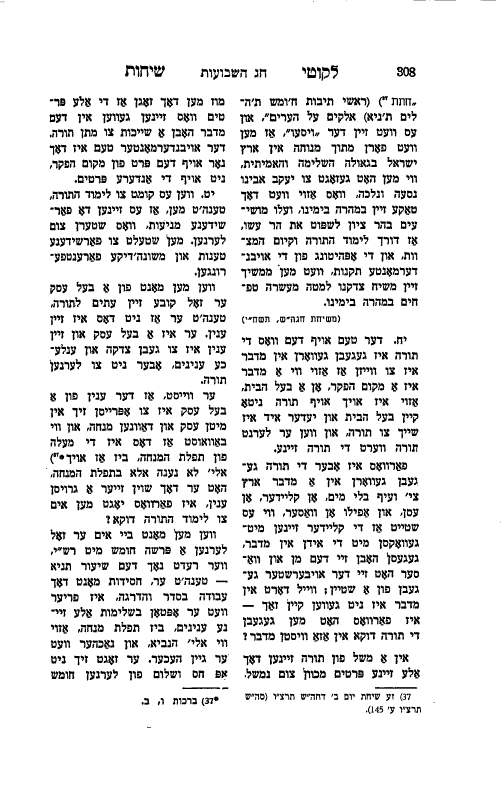
The main aspect of Shavuos is Torah itself. While mitzvos are essential, Torah study holds a special place: Talmud Torah is greater than all mitzvos, as our sages say, “The study of Torah equals them all.” Not only does learning lead to action (since you must study to know how to perform mitzvos), but Torah study itself stands above all other commandments.
Why is this so? Because Torah corresponds to intellect while mitzvos correspond to limbs. Just as intellect guides and encompasses all bodily functions—and contains within it vitality higher than any individual limb—so too does Torah surpass mitzvos both in quality and as their root source.
The 613 mitzvos parallel 613 limbs: 248 positive commandments correspond to 248 limbs; 365 prohibitions correspond to 365 sinews. Mitzvos are like body parts; Torah is like the mind—superior both because it contains greater vitality and because it includes within itself all that animates every limb.
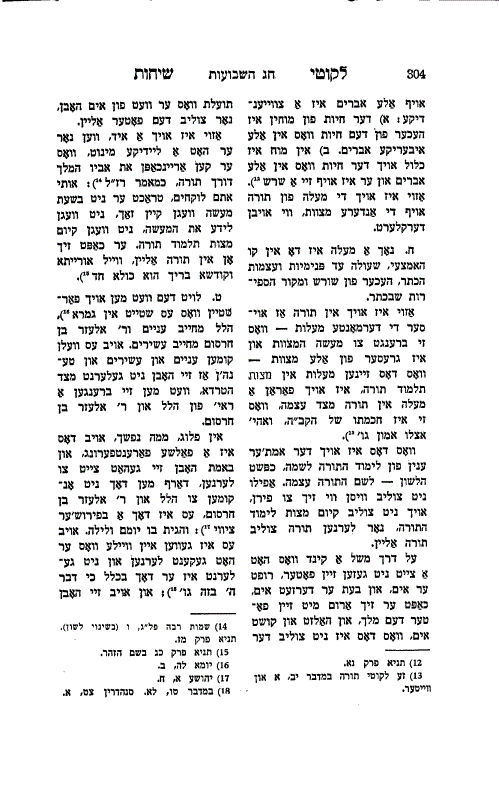
But there’s an even higher level: Torah reaches up to the very essence—the inner core of Kesser, even beyond where mitzvos originate. While mitzvos have their root in Kesser (the crown), Torah ascends even further—to its innermost point (Atik). Thus, besides being greater than mitzvos and their source, Torah connects us with Hashem’s very essence.
This leads to another profound point: studying Torah for its own sake (lishmah) means learning not for practical application or personal gain but simply because it is Hashem’s wisdom—His will revealed in creation. The Rebbe illustrates this with an analogy: just as a child runs to embrace his father out of pure love—not seeking any benefit but simply wanting closeness—so too should our relationship with Torah be motivated by love for Hashem Himself.
This approach applies even when there’s no practical need or obligation according to halacha; one should learn simply for the sake of connecting with Hashem through His wisdom. The Gemara says that when you study Torah you are grasping Hashem Himself—“when you take hold of My words you take hold of Me.”
The Rebbe then addresses a puzzling passage in Gemara about Hillel and Rabbi Elazar ben Charsom—individuals who overcame great poverty or wealth to immerse themselves in learning—and how they serve as proof against those who claim they cannot study due to life circumstances. If someone truly had no time or ability, why would these examples be necessary? The answer reveals a deeper truth: sometimes halacha exempts one from study due to circumstances—but there remains an ideal beyond obligation: striving always for more connection through learning.
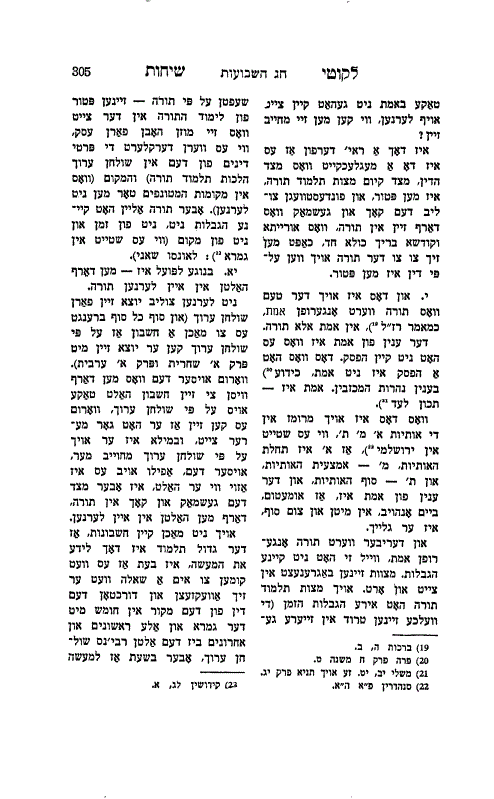
Mitzvos are limited by time and place—even Talmud Torah as a commandment has boundaries (for example, those occupied with earning a living may be exempt during work hours). There are also places where learning isn’t permitted (such as impure locations). But Torah itself—in its essence—is unlimited by time or space; its truth transcends all boundaries.
Practically speaking, one must fulfill halachic obligations regarding daily learning (such as reciting a chapter morning and evening), but beyond this minimum there remains an ongoing opportunity—and imperative—to increase one’s study out of love for Torah itself. Even if someone thinks they’ve fulfilled their duty according to halacha, they should strive for more—not out of calculation but out of passion for Hashem’s wisdom.
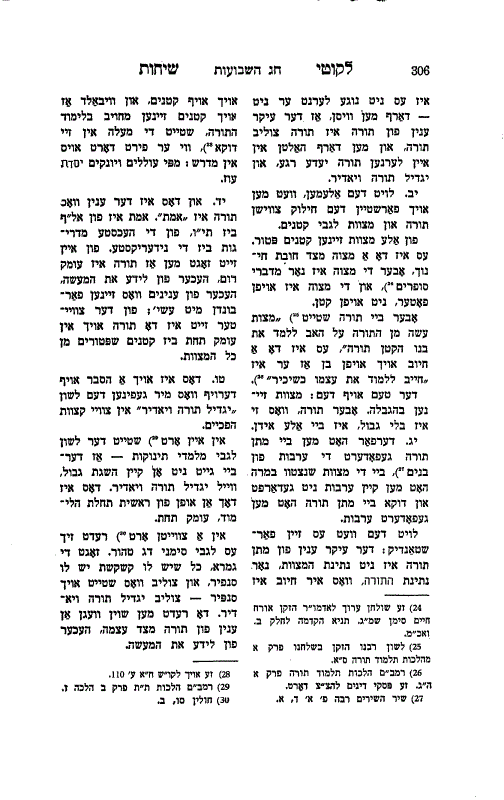
This explains why Talmud Torah differs from other mitzvos regarding children (ketanim). For most commandments minors are exempt; education falls on parents by rabbinic decree rather than biblical obligation. But with Talmud Torah there’s a unique biblical commandment obligating fathers to teach their sons—and even young children themselves have some measure of obligation once they reach understanding. This reflects how limitless Torah truly is—it applies equally across generations and ages.
This also clarifies why at Matan Torah Hashem demanded guarantees from children—their inclusion demonstrates that receiving Torah transcends ordinary limitations found in other commandments given before Sinai (such as at Marah). Only with something infinite like Torah could such universal inclusion make sense.
Torah encompasses every extreme—from highest heights (“depths above”) down to lowest lows (“depths below”). It reaches both those engaged in lofty spiritual pursuits and simple children just beginning their studies; it unites everyone under one banner because its truth spans all levels equally.
The phrase yagdil torah veyadir—“may the Torah be magnified and glorified”—appears both regarding teachers who expand children’s learning (even when competition would normally be forbidden) and regarding seemingly superfluous details in halacha (such as extra signs listed for kosher fish). In both cases we see that increasing engagement with every aspect of Torah—from simplest beginnings to deepest analysis—is always desirable; there are no limits or boundaries when it comes to expanding knowledge of Hashem’s wisdom.
This leads us back to our relationship with Hashem Himself:
קרוב השם לכל קוראיו לכל אשר יקראוהו באמת
"Hashem is close to all who call upon Him—to all who call upon Him in truth."
The sages explain that “truth” here refers specifically to calling out through engagement with authentic Torah study—whether at its most basic level or at its loftiest heights. When we connect with Hashem through His essence—the essence revealed within His wisdom—we access something unchanging and eternal regardless of our personal standing or stage in life.
The Rebbe encourages us therefore not only to fulfill our minimum obligations but also continually increase our involvement with Chumash (Torah), Tehillim (Psalms), and Tanya (Chassidus)—especially during Shavuos when these connections are especially powerful due to their association with Moshe Rabbeinu (Torah), King David (Tehillim), and Baal Shem Tov (Chassidus). Each day brings new opportunities for growth through these foundational texts.
This ongoing commitment ensures that we journey forward spiritually just as Yaakov did after leaving Shechem—with divine protection leading us toward redemption:
"Those who were saved will ascend Mount Zion…"
Through increased dedication to learning—and especially through observing these daily practices—we merit bringing down Mashiach speedily in our days, transforming ourselves and our world into a dwelling place for Hashem Himself.
Key Points
1. Shavuos holds a unique status among the three pilgrimage festivals, serving as their central point and spiritual source, which reflects its elevated role in the Jewish calendar and in the flow of divine energy.
2. The singular day of Shavuos expresses the concept of absolute unity—Goy echad ba’aretz—demonstrating that true oneness is not a limitation but a profound advantage, embodying Hashem’s unity within creation.
3. The centrality of Shavuos is mirrored in Torah’s role as the core and source of all mitzvos; just as the middle line in Kabbalistic structure channels the highest connection, so too does Torah serve as the root from which all other commandments derive meaning and vitality.
4. Torah study (Talmud Torah) surpasses all mitzvos both qualitatively and as their source, paralleling how intellect encompasses and animates all bodily limbs—Torah contains within it a higher vitality than any individual mitzvah.
5. Torah reaches to the innermost essence of Kesser (Atik), connecting us with Hashem’s very core, beyond even the spiritual source of mitzvos; this connection is accessed most purely through learning Torah for its own sake (lishmah).
6. Studying Torah lishmah means engaging with Hashem’s wisdom out of pure love and desire for closeness, not for practical gain or obligation—this relationship is likened to a child embracing a parent simply out of love.
7. Even when halacha exempts one from study due to life circumstances, there remains an ideal to strive for greater connection through learning; Torah itself is unlimited by time or space, transcending all boundaries imposed on other mitzvos.
8. The obligation to teach Torah uniquely extends to children, reflecting its limitless nature; at Matan Torah, children were accepted as guarantors, highlighting that Torah’s reach includes every Jew at every stage and age equally.
9. Torah unites all Jews—from those engaged in deep spiritual pursuits to simple children—because its truth encompasses every level without distinction, making it accessible and relevant to everyone at all times.
10. The imperative to continually increase engagement with Torah applies universally: expanding both basic study and advanced analysis is always desirable, as seen in halachic encouragements like yagdil torah veyadir (“may the Torah be magnified and glorified”).
11. True connection with Hashem comes through authentic engagement with His wisdom—Torah study at any level constitutes “calling upon Him in truth,” granting access to an unchanging divine closeness regardless of personal circumstance or achievement.
12. The Rebbe urges ongoing commitment to daily learning of Chumash, Tehillim, and Tanya—especially during Shavuos—as these practices connect us with foundational figures and prepare us spiritually for redemption and the coming of Mashiach by transforming ourselves and our world into a dwelling place for Hashem.