Likkutei Sichos vol. 2 - Shavuos 3
Introduction
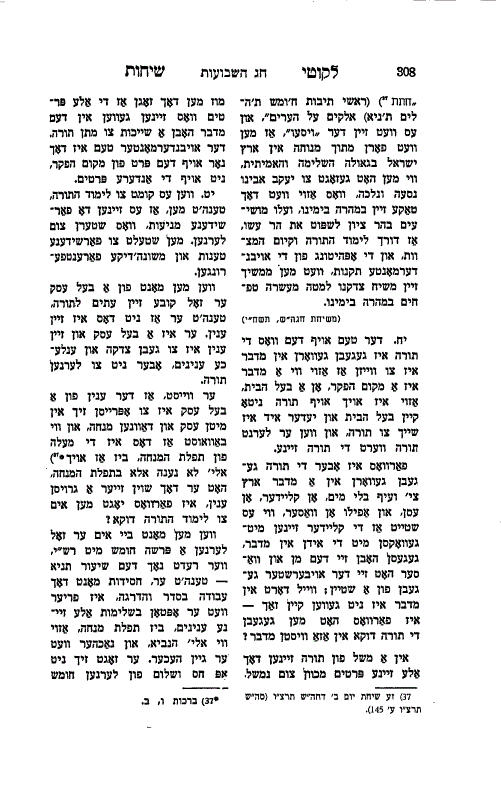
This is the third part of the sicha for Shavuos in Volume 2 of Likkutei Sichos, up to section Yudches (18). The Rebbe discusses the lessons we learn from the fact that the Torah was given in the Midbar, the desert. While it is generally explained that the Torah was given in a place that is hefker—ownerless and open to all, so that Torah belongs to everyone without limitation—this sicha explores a deeper aspect. The Midbar was not only ownerless, but also a place lacking all basic necessities: no food, no water, no clothing. The Jewish people had to rely on Moshe Rabbeinu for the mon (manna), on Miriam for water, and on Aaron for other needs. The question arises: what is the lesson for every Jew from receiving the Torah in such a place? The Rebbe explains that to truly learn Torah, one must put aside all calculations and worries about material needs and devote oneself fully to Torah, relying on Hashem as the Jews did in the desert.
Saif Aleph
The reason why the Torah was given in the Midbar is to teach us that just as a desert is hefker—ownerless and not controlled by anyone—so too, Torah does not belong exclusively to any individual or group. Every Jew can connect with Torah; when one learns Torah, it becomes his own. This aspect of hefker makes it possible for anyone to acquire Torah.
However, there is another detail: why was it specifically given in a desert—a place not only ownerless but also lacking food, water, and clothing? There are many places that are ownerless or open, but why choose a location so barren and inhospitable? In the desert there was nothing; even clothing had to miraculously grow with them, they ate mon from heaven, and their water came from a stone through Miriam’s merit.
The question then becomes: what is the significance of giving the Torah in such an environment? It’s more than just being ownerless; it’s about being devoid of all basic needs. What lesson does this teach us?
When Torah gives us a moshul—a parable—all its details must fit with its nimshul—the lesson or message. So if we say that giving the Torah in an ownerless place teaches us something about access to Torah, then all other details of the Midbar must also have relevance to Matan Torah.
The previously mentioned reason—that it was an ownerless place—only explains one detail. It does not explain why there was no food or water or clothing. We must therefore say that every detail of how things were in the Midbar has a connection to Matan Torah.
Saif Beis
The Rebbe now addresses various arguments people give as obstacles to learning Torah. Some people claim they are too busy with their business affairs; others who do learn claim they need ideal conditions before they can reach higher levels of learning.
When it comes to limud haTorah—studying Torah—people present many types of excuses and obstacles. For example, when you ask a businessman (baal eisek) to set aside time for learning Torah (kovea itim laTorah), he argues that this isn’t his main responsibility. He sees himself as someone whose main role is giving tzedakah (charity), not studying Torah.
This businessman knows he should tear himself away from his work at least for davening mincha—the afternoon prayer—which itself is considered a great achievement because mincha takes place during business hours. This idea is supported by Eliyahu HaNavi’s prayer at mincha time being answered by Hashem with fire from heaven.
The businessman feels he already accomplishes something significant by davening mincha during work hours. So why should he be pressured further specifically about learning Torah?
When asked even just to learn some Chumash with Rashi or Tanya daily, he responds that Chassidus teaches avodah beseder v’hadroga—service must be orderly and step-by-step. First he will perfect his davening mincha; only afterwards will he move on to higher levels like regular learning sessions.
He doesn’t deny that eventually he should study Chumash with Rashi or Tanya—but insists it will come later (“al tzvider tzayt”), once he has freed himself from other matters (“liksheyifneh”). This is his argument: he cannot immediately devote time to learning because his business obligations take precedence right now.
Saif Gimmel
The Rebbe continues: even those who are already involved in full-time learning—the yeshiva student or kollel scholar (“yoshev ohel”)—also have their own excuses when called upon for greater devotion.
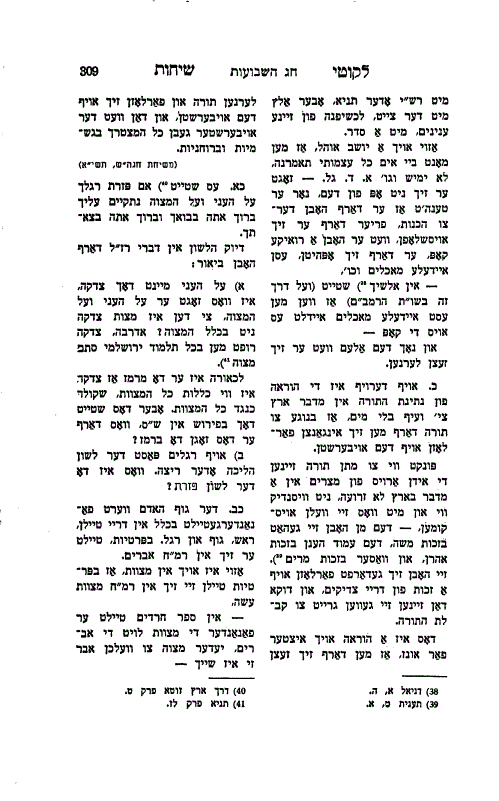
If you demand from him “kol atzmosai tomarna”—that all his bones should declare Hashem’s praise—or “lo yamush”—not stopping from learning at all times—he doesn’t reject these ideals outright. But he claims he first needs proper preparation: enough sleep so his mind will be clear; eating refined foods so his intellect will be sharp (as brought down by Auschich and mentioned by Rambam); only after these preparations will he sit down to learn properly.
This means even those dedicated entirely to learning find ways to delay reaching higher levels of devotion by insisting on ideal physical conditions first.
Saif Daled
This brings us back to the lesson of Matan Torah being given in a desert—a parched land without food or water. When it comes to receiving and studying Torah, one must rely completely on Hashem (“farlosen zich af dem Eibishter”), just as at Matan Torah when Bnei Yisrael left Egypt for an unsown land—a true desert—with no idea how they would survive materially.
Their sustenance came only through miracles: mon through Moshe’s merit; water through Miriam; clouds through Aaron. They had nothing else but trust in Hashem and reliance on these three tzadikim’s merits.
Only under these conditions were they truly prepared (“grey tsu kabolas haTorah”) for receiving the Torah—they went out into uncertainty without knowing how their needs would be met.
Saif Hei
This serves as an ongoing lesson for us today: when sitting down to study Torah, we must put aside all calculations about our material situation and rely on Hashem (“farlosen zich af dem Eibishter”). Then Hashem provides everything needed both physically and spiritually.
This means that just as our ancestors went out into the unknown solely focused on receiving the Torah—and were provided for miraculously—we too must approach our own study with complete trust in Hashem rather than waiting until everything seems perfectly arranged or justified by our own logic.
The excuses people give—whether due to business obligations or waiting for ideal circumstances—are ultimately distractions from this core lesson: true engagement with Torah requires letting go of preconditions and relying fully on Hashem’s providence.
Key Points
- The fact that the Torah was given in an ownerless desert teaches us that every Jew has equal access to acquire and make Torah their own; no one has exclusive ownership over it.
- The additional detail—that there was no food, water, or clothing available naturally in the Midbar—teaches us another crucial lesson: receiving and studying Torah requires putting aside concerns about material needs and trusting completely in Hashem’s provision.
- People often excuse themselves from serious engagement with learning by citing business obligations or waiting until circumstances are ideal; however, both businessmen and full-time learners are called upon by this lesson not to delay their commitment based on such calculations.
- Bnei Yisrael received the Torah only after venturing into total uncertainty regarding their physical survival; their willingness to rely solely on Hashem made them ready for Matan Torah—and this remains our model today when approaching our own study of Torah.
- The ultimate message is clear: excuses rooted in material concerns do not justify withholding oneself from engaging deeply with Torah study; instead, one must trust Hashem will provide both physical and spiritual needs when dedicating oneself fully to His wisdom.