Introduction
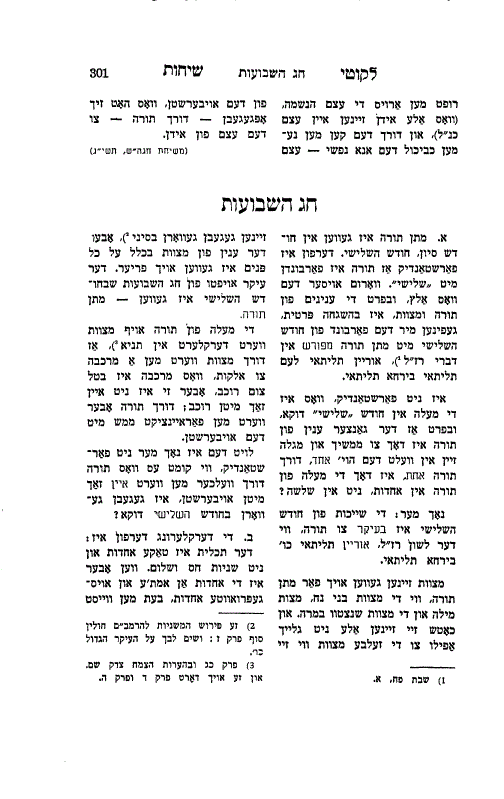
In this review of Likkutei Sichos, volume two, we begin with the first part of the sicha on Chag HaShavuos. The Rebbe discusses how Shavuos falls in the month of Sivan, which is counted as the third month from Nisan. This detail—that it is specifically the third month—is not coincidental or trivial.
The Gemara emphasizes this point, noting that the Torah itself is described as “Torah Tlisai”—a threefold Torah, consisting of Torah, Neviim, and Kesuvim. The Torah was given in the “month of three,” highlighting that the number three carries special significance in this context.
The Rebbe raises a question: If Matan Torah is about unity—about uniting a Jew with Hashem—wouldn’t the number one seem more appropriate to express this unity? After all, one represents absolute oneness and singularity. Why then does the Torah emphasize three?
The Rebbe explains that when you only have one, it does not yet represent true unity. One does not acknowledge the existence of anything else; it stands alone without opposition or relationship. Therefore, its unity is incomplete—it has never encountered anything outside itself that could challenge or oppose it.
When you have three, however, it means you have taken one and two—two distinct entities—and created something new: a third reality that unites them both. This synthesis represents a higher level of unity than simple oneness. True unity is achieved not by ignoring differences or opposition, but by bringing together separate elements and forging a deeper connection between them.
This idea will be further developed in the sicha. The Rebbe will show how Matan Torah’s association with “three” teaches us about a higher form of unity—one that emerges from diversity and even potential conflict, rather than from simple singularity.
With this introduction in mind, we are ready to look inside and explore how these themes play out in the details of Matan Torah and its connection to the month of Sivan—the third month.
Saif Aleph
Everything in Torah and mitzvos is by divine providence, so the fact that the giving of the Torah took place in the third month is significant. In general, everything in the world has meaning when it comes together with Torah and mitzvos, but here, the connection to the number three is made explicit by our sages.
As Chazal tell us, it was a Torah of three parts given to a nation of three, in the third month—meaning after Nisan and Iyar comes Sivan. The fact that this all happens with the number three is not incidental; it carries importance. The sequence is clear: first month, second month, then we reach the third month for matan Torah.
But this raises a question. Wouldn’t it make more sense for the Torah to be given in the first month? After all, Torah represents unity—Hashem’s oneness—even more than mitzvos do. If so, why is there an emphasis on “three” rather than “one”? The main idea of Torah is to reveal Hashem’s unity in the world; through one Torah we come to know the one Hashem. The greatness of Torah lies in its unity, not its division into three.
Even though our sages describe it as a “Torah of three,” referring to its three sections, ultimately it remains one Torah. So why do we highlight specifically that it was given in the third month? This question becomes even stronger when we consider that Torah creates a deeper unity with Hashem than mitzvos do—so shouldn’t matan Torah be associated with “one” rather than “three”?
The connection between the third month and matan Torah is primarily about Torah itself—not about mitzvos. It’s not that mitzvos were given on Shavuos; rather, what was unique about Shavuos was specifically the giving of the Torah. Our sages’ language emphasizes this: “Torah was given on the third month”—the focus is on Torah itself.
While mitzvos are certainly found within the Torah and are described there, many mitzvos were already performed before matan Torah. There were mitzvos for Bnei Noach (the Noahide laws), as well as specific commandments like milah (circumcision). Even before reaching Mount Sinai, when Hashem chose Bnei Yisrael as His people, they had already received some laws—such as Shabbos and honoring parents—at Marah.
This means that mitzvos existed before matan Torah. However, even though these same mitzvos were performed both before and after Sinai, their quality changed dramatically after matan Torah. The connection to Hashem through these commandments became much deeper once they were given at Sinai.
Still, at least conceptually, mitzvos as a category existed prior to matan Torah. Therefore, what was truly new at Sinai—the main innovation of Shavuos in the third month—was not simply receiving more mitzvos or even performing them at a higher level. Rather, it was specifically about receiving the Torah itself.
This leads us to ask: What is truly unique about Torah compared to mitzvos? Even though our forefathers studied some form of Torah before Sinai (“Avraham sat and learned”), what happened at matan Torah was an entirely new phenomenon—a complete renewal of what it means to have access to Hashem’s wisdom.
The learning and observance before Sinai came from human initiative or from specific divine commands but did not have the same power or depth as after matan Torah. Only after Sinai did both our study of Torah and performance of mitzvos become infused with an entirely new divine energy—the direct gift from Hashem Himself.
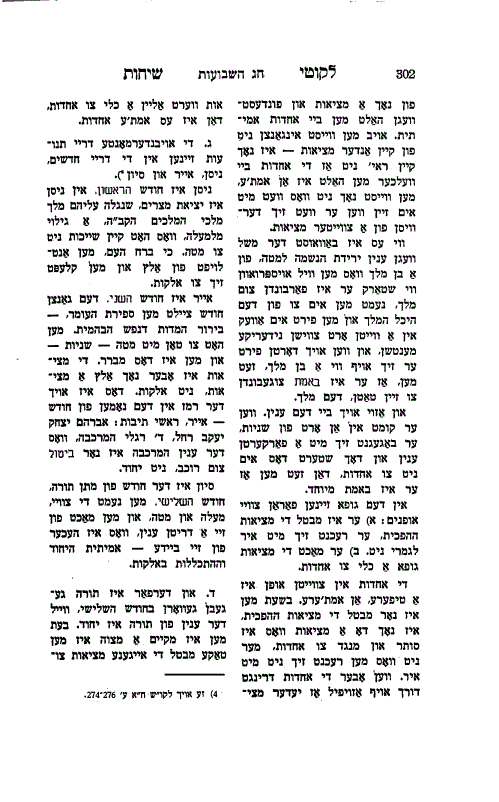
Saif Beis
The unity achieved through Torah is even greater than that of mitzvos. While a mitzvah makes a person into a chariot—merkavah—to the will of Hashem, subjugating oneself to Him, Torah study creates an even deeper bond. In Tanya, it is explained that through mitzvos, one becomes a chariot to godliness. A chariot is completely subservient to its driver; it has no will of its own and simply follows the one who leads it. So too, when performing mitzvos, a Jew is subjugated to Hashem’s will.
However, this relationship is not absolute oneness. The chariot and the rider remain two distinct entities—the chariot is merely controlled by the rider. This is the level of connection achieved through mitzvos: subjugation and obedience, but not complete unity.
With Torah study, though, a person becomes truly united with Hashem—ve’ein zach mamash im ha’Eibershter. Through learning Torah, one’s intellect merges with Hashem’s wisdom and will. It’s not just about being led or controlled; it’s about becoming one with the Divine.
This raises an even stronger question: If Torah brings such profound unity with Hashem—greater than what is accomplished through mitzvos—why was it given specifically in the third month? What does the number three signify in this context?
The Rebbe explains that true unity is only revealed when there are separate entities that become united. If there is only one thing, there’s no real test or demonstration of unity—it simply exists alone. But when there are two things, and they are brought together as one (making three), this expresses a higher form of unity: not just singularity, but harmony among distinct elements.
The ultimate goal is absolute oneness—achdus. There should be no division or duality at all; only one reality exists. However, genuine unity can only be demonstrated when there is awareness of something else—a potential for separation or opposition—and yet unity prevails despite that.
If someone has never encountered anything outside of oneness, their unity hasn’t been tested. Only when faced with another existence or an opposing force can we see if their commitment to unity holds strong. This idea is illustrated by the parable of a king who sends his son far from the palace among strangers to see if he remains loyal and conducts himself as royalty even in unfamiliar surroundings.
Similarly, Hashem sends the soul down into this world—a place where other realities seem to exist—to test whether it will remain connected to its Divine source despite encountering opposition and concealment.
The true measure of unity comes when a person faces something contrary to holiness and either ignores its influence entirely or transforms it so that it too becomes part of serving Hashem. There are two approaches here: One can negate and disregard the opposing existence (not letting it interfere), or one can elevate and transform it so that even what was once opposed now recognizes and serves Divine unity.
The second approach—transforming opposition into a vessel for holiness—is deeper and more authentic than merely ignoring it. When you simply reject something negative, it still exists as an opposing force; you’re just not giving it attention. But when you transform it so that everything becomes part of Divine service, then true unity has been achieved.
This concept plays out in the progression from Nisan to Iyar to Sivan—the three months leading up to Matan Torah:
Nisan represents pure revelation from above: Hashem reveals Himself in Egypt without any opposition; there’s nothing but G‑dliness. The Jewish people flee Egypt and cleave to Hashem without facing internal struggle—this is simple oneness from above.
Iyar represents work from below: During this month we count the Omer and refine our animal soul (nefesh ha’bahamis). Here we engage with our lower selves and worldly matters—we sort them out so they don’t interfere with our connection to G‑dliness. Yet these aspects still exist as separate entities; they haven’t been fully transformed.
This is hinted at by the acronym for Iyar: Avraham, Yitzchak, Yaakov, Rochel—the four legs of the chariot (merkavah). The idea here is subjugation (as in mitzvos): being led by Hashem but not yet fully united with Him.
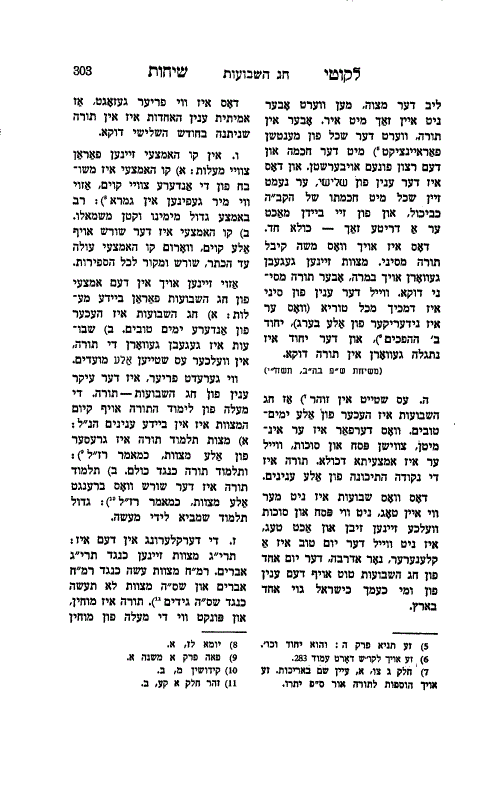
Sivan—the third month—is when Torah was given. Here we achieve true inclusion and fusion: both higher (Nisan) and lower (Iyar) levels are united into something new—a third dimension where everything becomes part of G‑dliness through Torah study. This isn’t just subjugation; it’s complete integration where all aspects become unified within holiness.
This explains why Torah was given specifically in Sivan—the third month—because Torah represents ultimate unity: intellect merging with Divine wisdom so thoroughly that no separation remains between self and G‑dliness.
This also clarifies why Sinai was chosen as the place for Matan Torah. Sinai was both a mountain (representing existence) yet also the lowest among mountains (representing humility). This fusion of opposites—being something yet embodying humility—is precisely what Torah accomplishes: uniting all aspects within Divine oneness.
Key Points
1. The timing of Shavuos in the third month, Sivan, is significant and intentional, as highlighted by the sages who connect the giving of the Torah to the number three—Torah Tlisai (threefold Torah), given to a nation of three, in the third month.
2. While one might expect the Torah, which represents unity with Hashem, to be associated with the number one, true unity is not achieved through singularity alone; rather, it emerges from bringing together distinct entities and forging a deeper connection between them.
3. The uniqueness of Matan Torah lies not in the giving of mitzvos—which existed in some form before Sinai—but in the unprecedented revelation and access to Hashem’s wisdom that Torah study provides after Sinai.
4. Mitzvos create a relationship of subjugation to Hashem, likened to a chariot that follows its driver’s will; however, Torah study achieves an even deeper unity by merging one’s intellect with Divine wisdom itself.
5. Genuine unity is only revealed when separate or even opposing entities are brought together; if there is only oneness without any otherness or opposition, unity has not truly been tested or demonstrated.
6. There are two approaches to dealing with opposition: either ignoring and negating it or transforming it into a vessel for holiness—the latter being a more profound expression of true unity within Divine service.
7. The spiritual progression from Nisan (pure Divine revelation), through Iyar (self-refinement and subjugation), to Sivan (integration and fusion) reflects the journey toward ultimate unity achieved through receiving the Torah in the third month.
8. The choice of Mount Sinai—a mountain representing existence yet characterized by humility—symbolizes how Torah unites opposites and integrates all aspects within Divine oneness, embodying the higher form of unity that Shavuos represents.