Likkutei Sichos Vol. 2 — Bamidbar 4
This sicha begins in section 14 and further explains why unity and Ahavas Yisrael are an essential preparation for receiving the Torah.
The Rebbe explains that receiving the Torah means receiving the very Essence of HaKadosh Baruch Hu, which is invested within the Torah itself. In order to receive this Essence, the Jewish people must reveal their own essence. The essence of a Jew finds its truest expression through Ahavas Yisrael.
The Rebbe develops this idea through three progressively deeper teachings: first from the Baal Shem Tov, then from the Maggid of Mezritch, and finally from the Alter Rebbe. Each level reveals a deeper dimension of the essential unity of the Jewish people, culminating in the ultimate preparation for Kabbalas HaTorah.
Section 14
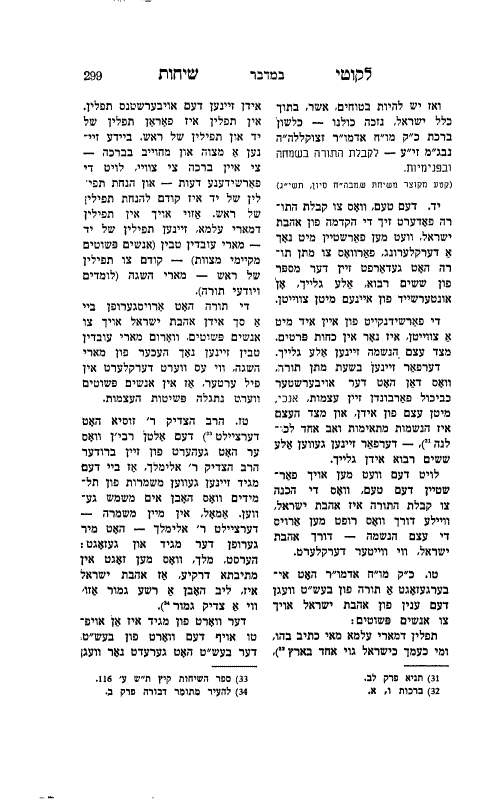
The reason why receiving the Torah requires the preparation of Ahavas Yisrael can be understood through another explanation regarding why Matan Torah required the precise number of six hundred thousand Jews, all together equally.
Every Jew had to be present, without distinction between one and another. It made no difference whether one was especially gifted, righteous, scholarly, or accomplished. Every Jew was equally necessary.
Why?
Because the differences between one Jew and another exist only in their individual faculties and abilities. However, from the perspective of the essence of the soul, all Jews are equal.
Therefore, at the time of Matan Torah, when Hashem כביכול connected His Essence — expressed in the word “Anochi” — with the essence of the Jewish people, all distinctions disappeared. At the level of essence, all souls are one.
As the Alter Rebbe writes in Tanya, Chapter 32, “The souls of Israel are truly united because they all share one Father.”
Thus, all six hundred thousand Jews stood equally at Sinai, because Matan Torah was not about individual qualities, but about essence.
Based on this, we can also understand why Ahavas Yisrael is the preparation for receiving the Torah.
Through Ahavas Yisrael, one reveals the essence of the soul. Love of another Jew brings the essential core of the Jew to the forefront, as will be explained further.
Section 15 — The Teaching of the Baal Shem Tov
The Previous Rebbe related a teaching from the Baal Shem Tov regarding Ahavas Yisrael, specifically toward simple Jews.
The Gemara asks: “What is written in Hashem’s tefillin?” The Gemara answers: “Who is like Your people Israel, one nation on earth.”
The Jewish people themselves are Hashem’s tefillin.
Now, tefillin consist of two parts: Tefillin shel Yad and Tefillin shel Rosh. Both are mitzvos requiring a blessing, whether according to the opinion that one recites one blessing or two.
Yet the Tefillin shel Yad is always put on before the Tefillin shel Rosh.
The Baal Shem Tov explained that this order also exists in Hashem’s “tefillin.”
The “Yad,” the hand, represents simple Jews who excel in practical mitzvos and good deeds. Action is associated with the hand.
The “Rosh,” the head, represents scholars, people of intellect and understanding, those who grasp and know Torah.
Yet the hand comes before the head.
This teaching of the Baal Shem Tov awakened profound Ahavas Yisrael even toward simple Jews, because it demonstrated that those who perform simple good deeds possess a greatness even beyond intellectual achievement.
As explained in many places, specifically within simple Jews there is revealed the simple essence of Hashem Himself.
The Teaching of the Maggid of Mezritch
The Rebbe now brings a deeper teaching from the Maggid.
Reb Zusha related to the Alter Rebbe something he had heard from his brother, Reb Elimelech.
At the Maggid’s court, the students served in rotating shifts. One time, during Reb Elimelech’s turn serving the Maggid, the Maggid called him and said:
“Hear, Melech, what they are saying in the Heavenly Academy: Ahavas Yisrael means loving a complete rasha just as one loves a complete tzaddik.”
This statement went far beyond the teaching of the Baal Shem Tov.
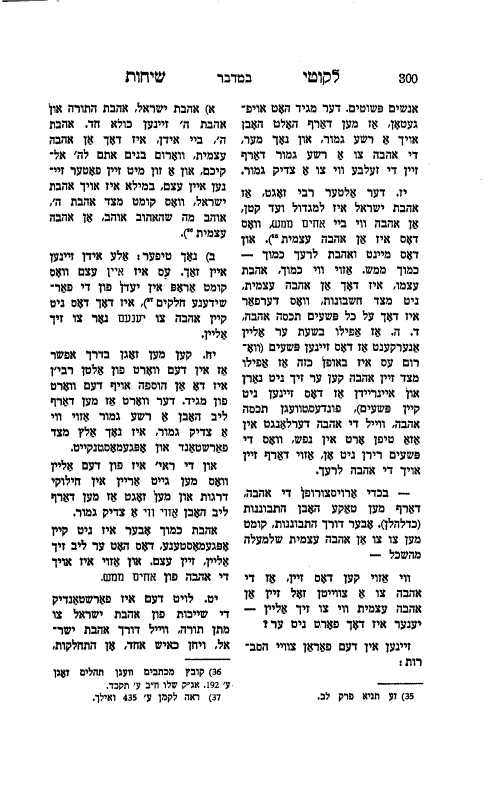
The Baal Shem Tov emphasized loving simple Jews. The Maggid introduced something even more radical: one must love even a complete rasha.
Moreover, the love toward the rasha must be exactly the same as the love toward a complete tzaddik.
Section 17 — The Teaching of the Alter Rebbe
The Alter Rebbe goes even deeper.
The Alter Rebbe says that Ahavas Yisrael applies “from the greatest to the smallest,” and that this love must be “like the love between actual brothers.”
This is not merely emotional affection. It is an essential love.
This is the meaning of “Love your fellow as yourself” — literally “like yourself.”
Self-love is not based on calculations or logic. A person loves himself essentially. Therefore, “love covers all shortcomings.”
Even when a person fully recognizes another’s faults and cannot deny that they are indeed faults, nevertheless the love remains intact.
Why?
Because true love reaches a place in the soul deeper than the faults themselves. The sins do not touch that inner essence.
So too, Ahavas Yisrael must reach the essence of the other Jew, beyond all external failings.
True, such love requires contemplation and reflection. But through that contemplation, one arrives at an essential love that transcends intellect entirely.
How can one possibly love another person exactly as oneself?
The Rebbe gives two explanations.
First Explanation
Ahavas Yisrael, Ahavas HaTorah, and Ahavas Hashem are all one.
A Jew’s love for Hashem is itself an essential love because Jews are children of Hashem. A child and father are essentially one.
Therefore, when one loves Hashem, he naturally loves whom Hashem loves. Since Hashem’s love for another Jew is essential, one’s love for another Jew likewise becomes essential.
Second Explanation — Even Deeper
All Jews are truly one essence.
It is one essence expressing itself through many different individuals.
Therefore, loving another Jew is not truly loving “someone else.” It is loving oneself.
Section 18
The Rebbe adds that the Alter Rebbe’s teaching goes even beyond the Maggid’s formulation.
The Maggid still described different categories: a tzaddik and a rasha, and instructed that one must love them equally.
But “Love your fellow as yourself” is beyond all measurement and categorization entirely.
A person’s love for himself is not measured or calculated. It is an intrinsic love of essence.
So too must be the love between Jews.
Section 19 — The Connection to Matan Torah
According to all this, we can understand the deep connection between Ahavas Yisrael and Matan Torah.
Through Ahavas Yisrael — standing together “as one person,” without distinctions — the Jewish people reveal the essence of the soul, where all Jews are truly one.
And through revealing that essence, the Jewish people become capable of receiving the “Ana Nafshi” — the Essence of Hashem Himself — which He invested into the Torah and gave over to the essence of every Jew.
Based on the sicha of Chag HaShavuos 5713.