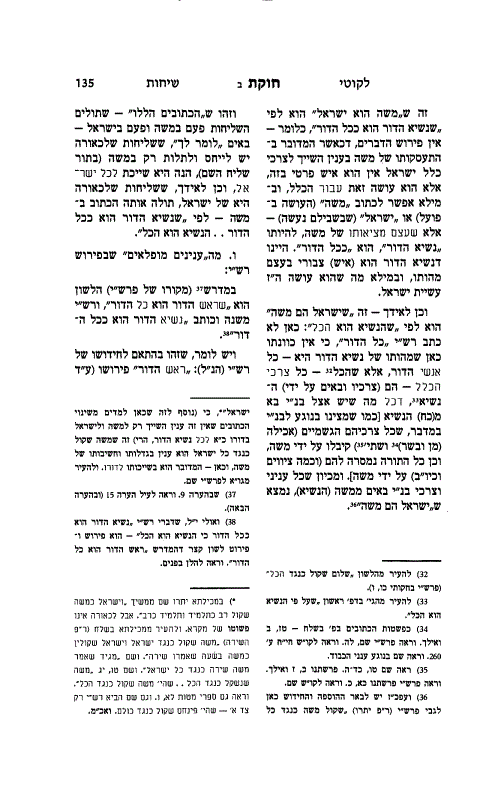
In his commentary on the verse "And Israel sent messengers to Sihon, king of the Amorites," Rashi quotes "And Israel sent messengers" and explains: In another place, the sending is attributed to Moses, as it is stated, "And I sent messengers from the wilderness of Kedemoth," and similarly, "And Moses sent messengers from Kadesh to the king of Edom." In the account of Jephthah, it says, "And Israel sent messengers to the king of Edom, etc." These verses require each other; one locks and the other unlocks, indicating that Moses is Israel and Israel is Moses, to teach that the leader of the generation is like the entire generation, for the leader is everything.
Now, even though the superficial meaning of Rashi's commentary seems to be to reconcile the contradictions between the verses (whether the sending to Sihon or to Edom was by Moses or by Israel), it has already been explained at length many times that it is not Rashi's method to resolve and reconcile contradictions and misunderstandings in the verses except in a place where the contradiction arises, and so forth. According to this, it must be said that Rashi's intention here is to explain a difficulty that arises in this verse, but for this purpose, he must explain all the verses he brings and resolves incidentally.
It can be said that the difficulty in this verse is the change between this verse regarding the sending to Sihon (where it says "And Israel sent messengers") and the previous verse (brought by Rashi here) regarding the sending to the king of Edom, "And Moses sent messengers." To explain this change, Rashi explains "In another place, etc.," which also resolves this change.
However, it seems necessary to understand the details of Rashi's language: "These verses require each other; one locks and the other unlocks, indicating that Moses is Israel and Israel is Moses, to teach that the leader of the generation is like the entire generation, for the leader is everything."
a) What is the content of the introduction "These verses require each other; one locks and the other unlocks"?
[And even though Rashi's language is sourced in the Midrash, it has already been explained many times that Rashi's purpose is to explain the simple meaning of the text and not to copy and inform the language of the Midrash. When he copies the words of our Sages in the Midrash and so forth, it is because this language is relevant to understanding the simple meaning of the verses. This is also when he writes explicitly "Our Rabbis expounded" and so forth, and certainly, it is so when he explains the verse without writing that the source of the explanation is in the words of the Sages. b) And mainly: In the Midrash, the exposition begins here "All the words of the Torah require each other; what this locks, that unlocks," meaning that the content of the Midrash's statement is a general explanation in the way "all the words of the Torah," but in Rashi's commentary, which intends only to explain the details of these verses, what is the practical difference of the introduction that "these verses require each other; one locks and the other unlocks"?]
b) What is the meaning of the double expression (and concept) "that Moses is Israel and Israel is Moses (to teach that the leader of the generation is like the entire generation)"?
c) Just as in the details of the matter he writes both sides, "that Moses is Israel and Israel is Moses," so it would seemingly be appropriate to detail in the summary of his explanation not only "that the leader of the generation is like the entire generation" but also "and the entire generation is like the leader" and so forth?
d) What is the content of the reason "for the leader is everything," and what is the addition in this over what was said before "that the leader of the generation is like the entire generation"? Moreover, this seems to be a contradiction in itself: initially, it implies that the leader of the generation is only like the entire generation (and not literally "the entire generation"), and subsequently, it writes "for the leader is everything," which is not just "like the entire generation" with the letter of comparison, but "everything" literally?
And it is necessary to preface the explanation of the precision in Rashi's language "In another place, the sending is attributed to Moses, as it is stated, 'And I sent, etc.,'" for seemingly, it should have been shortened to say "In another place, it is stated 'And I sent'" and so forth.
It can be said that in this language, the difficulty in this verse according to the simple meaning of the text is emphasized, which Rashi comes to resolve in his commentary.
The explanation of this is:
The fact that in our verse (regarding the mission to Sichon) it is written "And Israel sent messengers," while in the previous verse (regarding the mission to the king of Edom) it is stated "And Moses sent messengers" — cannot be explained to mean that Moses was the one who sent to the king of Edom and the people of Israel sent to Sichon. For it is clear that the sending of messengers to the king of Edom was on behalf of the people of Israel, as the continuation of the entire passage there states, "Thus says your brother Israel, etc., our fathers went down to Egypt, etc., and we cried out to the L‑rd, and He heard our voice, etc.," indicating that the entire content of the speech pertains to the people of Israel. The statement "And Moses sent" is understood simply because all the actions of the people of Israel were carried out through Moses, and he was the one who actually sent the messengers.
Conversely, even when it is stated "And Israel sent," it is clear that the actual sending was done by Moses. The reason it says "And Israel sent" is because the mission was for and from the entire people of Israel, and it was carried out in practice by Moses — as with all matters concerning the entirety of Israel, which were done through Moses.
Accordingly, there is no difference between the mission to Sichon and the mission to the king of Edom, except for a change in the wording of the verses.
This is what Rashi emphasizes — "In another place, the sending is attributed, etc.," meaning that the question regarding the change in the wording of the verses here is not about what actually happened (whether Moses sent the messengers or Israel), but rather about to whom the verse attributes the sending. In other words, what is the reason for the change in the wording of the verse — that regarding Edom, the verse attributes the sending to Moses, and here the verse attributes the sending to Israel.
Especially since, seemingly, the opposite would be expected: if in the mission to the king of Edom, where it is emphasized in the verses that the sender is the entirety of Israel ("Thus says your brother Israel"), it is stated there "And Moses sent," all the more so should it have said so in the mission to Sichon (where this emphasis is not present).
It might seem that there is room to explain that attributing the sending to Moses or to Israel is not merely a side matter (in the wording of the verse), but rather it explains who initiated the mission (since the mission came at his initiative, the sending is attributed to him).
This is the reason for the distinction that regarding Edom, the verse attributes the sending to Moses, and here — to Israel, because the mission to the king of Edom differs from the mission to the king of Sichon:
Regarding Edom, the mission was according to G‑d's command, and therefore the verse attributes the sending to Moses, who is the servant and emissary of G‑d, who hears the command of the Holy One, blessed be He, and fulfills it in practice (to the extent that the verse does not need to state that G‑d commanded him to do so, as it is self-evident, as we find in several places where the Torah does not state G‑d's command to Moses); whereas regarding Sichon, it is explicitly stated in Rashi here that G‑d did not command to open with peace, and therefore there is room to say that for this reason it is stated "And Israel sent," to teach us that the children of Israel were the ones who demanded this mission, and Moses agreed with them, and therefore it is stated "And Israel sent."
To negate this interpretation, Rashi begins his commentary — "In another place, the sending is attributed to Moses, as it is stated, 'And I sent messengers from the wilderness of Kedemoth,'" meaning that it is explicit that (also) this mission was Moses', and it should not be attributed and ascribed (only) to Israel; and then Rashi continues, "And similarly, 'And Moses sent messengers from Kadesh to the king of Edom,' and regarding Jephthah it says, 'And Israel sent messengers to the king of Edom, etc.'" — meaning, even in the mission to the king of Edom, the intention of the verse is not to attribute the sending only to Moses (and not to the children of Israel), for it is explicitly stated "And Israel sent."
This is why Rashi continues, "These verses need each other, one locks and one unlocks, for Moses is Israel and Israel is Moses":
If regarding the mission to Edom it was written only "And Moses sent," this would "lock," meaning it would lock (against the interpretation) and negate that the mission to Edom was (also) of the children of Israel, rather it would imply that Moses did this as a messenger of G‑d and the mission should not be attributed to Israel (even though the content of the mission is for them); and similarly, on the other hand — if regarding the mission to Sichon it was written only "And Israel sent," this would "lock" the interpretation of Moses' mission in this, because the mission to Sichon would be attributed only to Israel and not to Moses.
Therefore, the second verse comes and "opens" and reveals — "that Moses is Israel and Israel is Moses," that what is written "And Moses sent" is as if it is stated "And Israel sent" (because "Moses is Israel"), and what is written "And Israel sent" is as if it is stated "And Moses sent" (because "Israel is Moses").
However, it requires explanation — how is it possible to say "that Moses is Israel and Israel is Moses"? Rashi explains, "to tell you that the leader of the generation is like the entire generation because the leader is everything" —
It can be said that the two concepts in Rashi, "the leader of the generation is like the entire generation because the leader is everything," correspond to the two concepts mentioned earlier — "Moses is Israel and Israel is Moses":
The idea that "Moses is Israel" is because "the leader of the generation is like the entire generation," meaning — the explanation is not that when it comes to Moses' involvement in matters related to the needs of the entire Israel, he is not an individual in this, but he does it for the community, and therefore it can be written "Moses" (who acts in practice) or "Israel" (for whom it is done) — rather, the very existence of Moses, being the "leader of the generation," is "like the entire generation." That is, the leader of the generation is inherently a public figure, and therefore what he does is the action of Israel.
And similarly, on the other hand — the idea that "Israel is Moses" is because "the leader is everything": Here Rashi does not write "the entire generation," because his intention here is not that the essence of the leader of the generation is — all the people of the generation, but that everything — all the needs of the community — are (his needs and come through) the leader, for everything that the children of Israel have comes from (the power of) the leader [as we find regarding the children of Israel in the desert, that all their physical needs (food (manna and meat) and drink) they received through Moses, and likewise all the Torah was given to them (and many commandments and the like) through Moses]. And since all matters and needs of the children of Israel come from Moses (the leader), it turns out that "Israel is Moses."
And this is what "these verses" — that attribute the mission sometimes to Moses and sometimes to Israel — come "to tell you," that a mission which seemingly should be attributed and ascribed only to Moses (as a messenger of G‑d), is indeed related to all of Israel, and similarly on the other hand, that a mission which seemingly is of Israel, the verse attributes it to Moses — because "the leader of the generation is like the entire generation... the leader is everything."
Among the "wondrous matters" in Rashi's commentary:
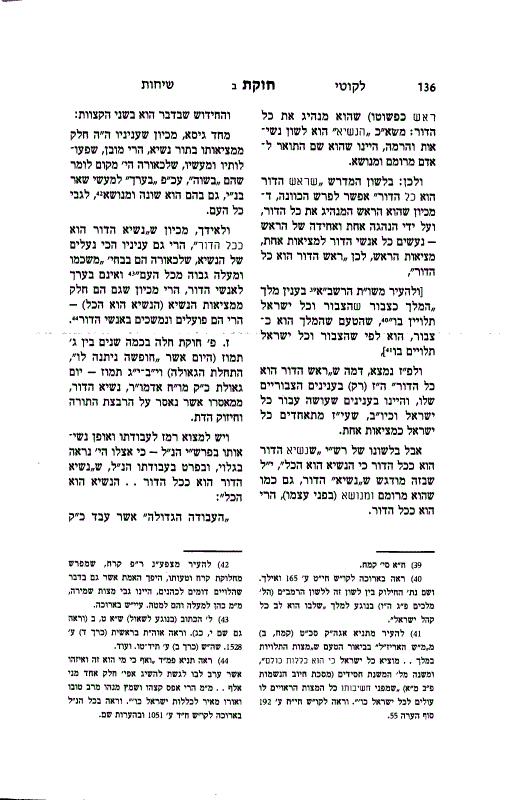
In the Midrash (the source of Rashi's commentary), the language is "the head of the generation is the entire generation," and Rashi changes it to "the leader of the generation is like the entire generation."
It can be said that this is in accordance with Rashi's innovation (mentioned above): "The head of the generation" means (like the head literally) that he leads the entire generation; whereas "the leader" is a term of elevation and exaltation, meaning it is a title for an elevated and exalted person.
Therefore: In the language of the Midrash "the head of the generation is the entire generation," it is possible to interpret the intention, that since he is the head leading the entire generation, and through a unified leadership of the head — all the people of the generation become one entity, the entity of the head, therefore "the head of the generation is the entire generation,"
[and note from the responsa of the Rashba regarding a king "the king is like the community that the community and all Israel depend on him," that the reason the king is like the community is because the community and all Israel depend on him],
And according to this, it turns out that what "the head of the generation is the entire generation" is (only) in his public matters, that is, in matters he does for all Israel and the like, through which all Israel are united as one entity.
However, in Rashi's language, "for the leader of the generation is like the entire generation, for the leader is everything," it can be said that this emphasizes that the "leader" of the generation, even as he is elevated and exalted (in his own right), is like the entire generation.
The novelty in this is in two extremes:
On one hand, since his matters are part of his existence as a leader, it is understood that his actions and deeds, which one might have thought are "equal," at least "relative" to the deeds of other Jews, are also different and exalted compared to the entire people.
On the other hand, since "the leader of the generation is like the entire generation," even the most elevated matters of the leader, which seemingly are "head and shoulders above all the people" and not comparable to the people of the generation, since they are also part of the leader's existence (the leader is everything) — they influence and extend to the people of the generation.
Parshas Chukas occurs in several years between the 3rd of Tammuz (the day on which "freedom was granted to him," the beginning of the redemption) and the 12th-13th of Tammuz — the day of the redemption of my revered father-in-law, the Rebbe, the leader of the generation, from his imprisonment for spreading Torah and strengthening religion.
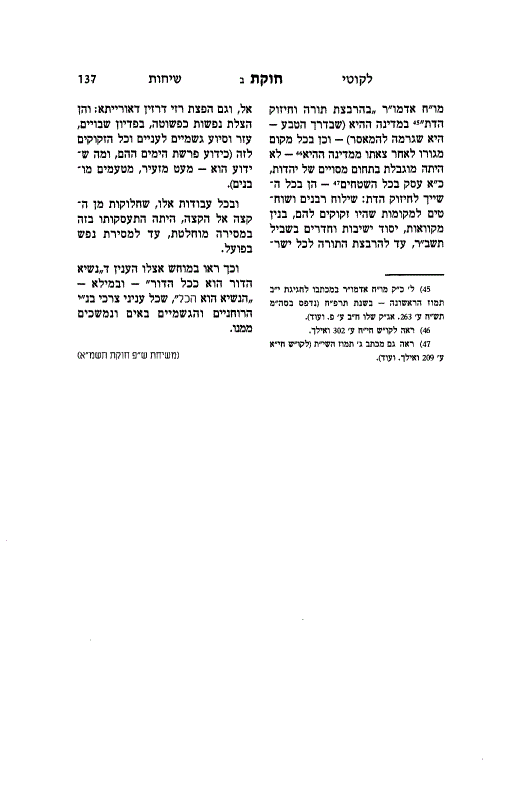
One can find a hint to his work and manner of leadership in the aforementioned Rashi — for with him it was openly visible, especially in his aforementioned work, that "the leader of the generation is like the entire generation... the leader is everything":
"The great work" which my revered father-in-law, the Rebbe, performed "in spreading Torah and strengthening religion" in that country (which naturally led to his imprisonment) — and likewise in every place he resided after leaving that country — was not limited to a specific area of Judaism, but he was involved in all areas — both in everything related to strengthening religion: sending rabbis and shochtim to places that needed them, building mikvahs, founding yeshivas and cheders for children, up to spreading Torah to all of Israel, and also disseminating the secrets of the Torah; and also in saving lives literally, in redeeming captives, providing material assistance to the poor and all those in need (as is known from the events of those days, and what is known is but a small fraction, for understandable reasons).
And in all these works, which are diverse from one extreme to the other, his involvement was with absolute dedication, up to actual self-sacrifice.
Thus, it was tangibly seen in him the concept of "the leader of the generation is like the entire generation" — and consequently — "the leader is everything," that all the spiritual and material needs of the Jewish people come and extend from him.
"(From the talk of Shabbos Parshas Chukas 5741)"