
Yud-Beis Sivan
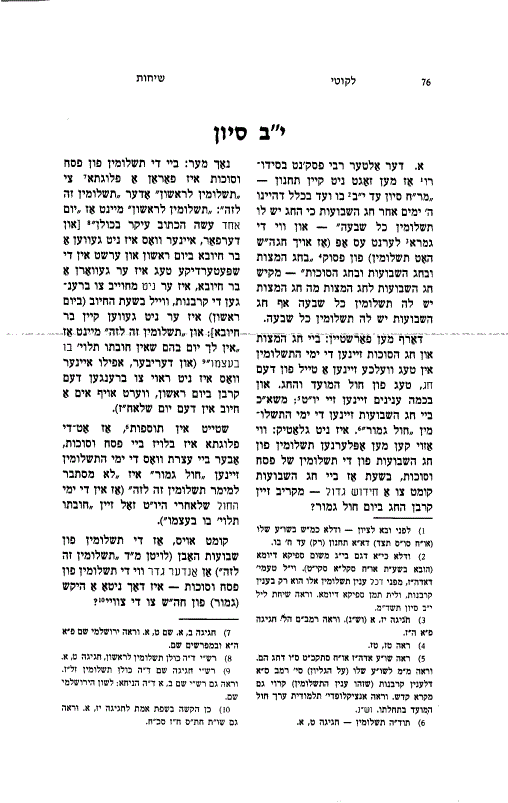
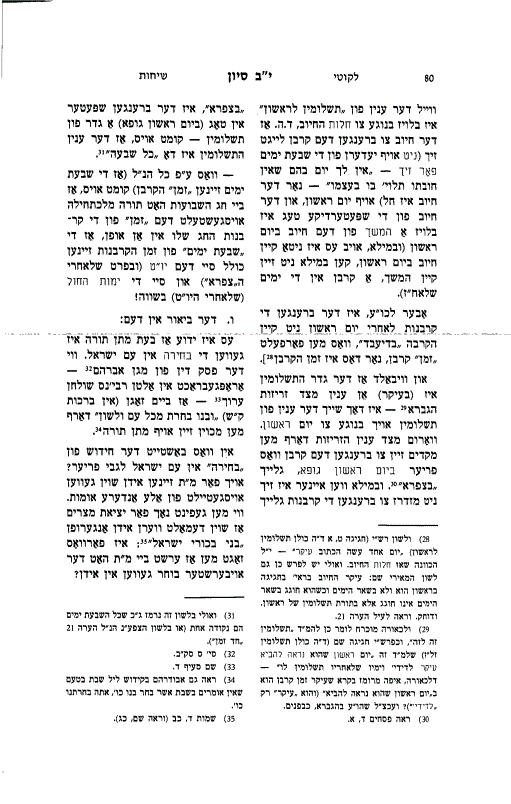
1. The Alter Rebbe rules in his Siddur1 that Tachanun is not said "מר״ח סיון עד י״ב בו ועד בכלל דהיינו ה׳ ימים אחר חג השבועות כי החג יש לו תשלומין כל שבעה" ("from Rosh Chodesh Sivan until the twelfth2 of the month inclusive, that is, five days after the festival of Shavuos, because the festival has tashlumin [days of compensation] all seven [days]") — and, as the Gemara3 derives it (that the festival of Shavuos too has tashlumin), from the verse4 "בחג המצות ובחג השבועות ובחג הסוכות" ("On the festival of Matzos, on the festival of Shavuos, and on the festival of Sukkos"): "מקיש חג השבועות לחג המצות מה חג המצות יש לה תשלומין כל שבעה אף חג השבועות יש לה תשלומין כל שבעה" ("It juxtaposes the festival of Shavuos to the festival of Matzos: just as the festival of Matzos has tashlumin all seven [days], so too the festival of Shavuos has tashlumin all seven [days]").
This needs to be understood: With the festival of Matzos and the festival of Sukkos, the days of tashlumin are days that are part of the festival itself — days of Chol HaMoed and of the festival — and in a number of respects they are Yom Tov.5 By contrast, with the festival of Shavuos the days of tashlumin are "חול גמור" ("complete weekdays").6 This is not straightforward: How can one derive tashlumin for the festival of Shavuos from the tashlumin of Pesach and Sukkos, when with the festival of Shavuos there is an additional great novelty — offering the festival sacrifice on a completely ordinary weekday?
Moreover: regarding the tashlumin of Pesach and Sukkos there is a dispute7 whether they are "תשלומין לראשון" ("compensation for the first [day]") or "תשלומין זה לזה" ("compensation for one another"). "Compensation for the first" means that "יום אחד עשה הכתוב עיקר בכולן" ("Scripture made one day the principal one of them all")8 [and therefore, someone who was not obligated on the first day and became obligated only on the later days is not obligated to bring the sacrifices, since at the time of the obligation (on the first day) he was not obligated]; while "compensation for one another" means that "אין לך יום בהם שאין חובתו תלוי' בו בעצמו" ("there is no day among them whose obligation does not depend on itself")9 (and therefore, even someone who was not fit to bring the sacrifice on the first day becomes obligated on the day after it).
Tosafos states that this dispute applies only to Pesach and Sukkos; but regarding Atzeres, whose days of tashlumin are "complete weekdays," "לא מסתבר למימר תשלומין זה לזה" ("it is not reasonable to say 'compensation for one another'") — that is, that on the weekdays after the Yom Tov there should be an obligation that "depends on itself."
It follows that the tashlumin of Shavuos have (according to the view of "compensation for one another") a different definition than the tashlumin of Pesach and Sukkos — so there is no (complete) analogy from the festival of Shavuos to the other two?10
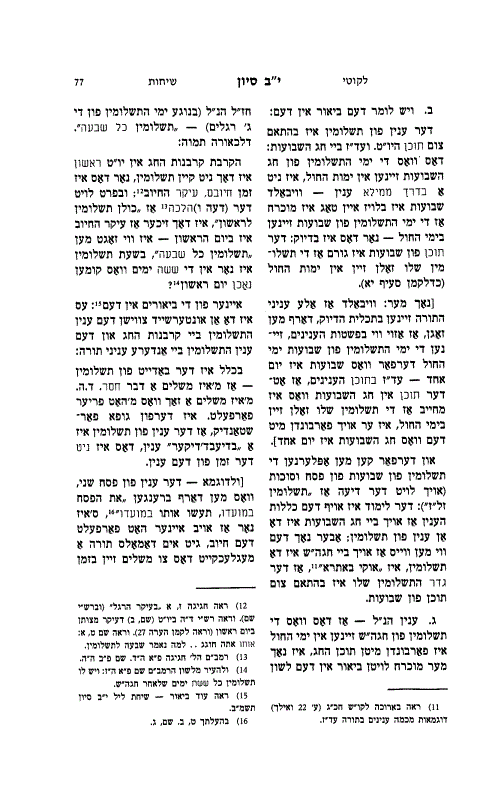
2. One may say that the explanation is as follows: The concept of tashlumin corresponds to the content of the Yom Tov. And so too with the festival of Shavuos: the fact that the days of tashlumin of the festival of Shavuos fall on weekdays is not something that happens by default — namely, that since Shavuos is only one day, its days of tashlumin must necessarily fall on weekdays — rather, it is precise: the content of Shavuos causes its tashlumin to be on weekdays (as will be explained below in section 11).
[Moreover: since all matters of Torah are utterly precise, one must say that just as in the plain sense of things the days of tashlumin of Shavuos are weekdays because Shavuos is one day — so too in the inner content of things: the very content of the festival of Shavuos that requires its tashlumin to be on weekdays is also connected with the fact that the festival of Shavuos is one day.]
Therefore one can derive the tashlumin of Shavuos from Pesach and Sukkos (even according to the view of "compensation for one another"): the derivation concerns the general concept that the festival of Shavuos too has tashlumin; but once we know that the festival of Shavuos also has tashlumin, then "אוקי באתרא" ("it is established in its own place"),11 meaning that the definition of its tashlumin corresponds to the content of Shavuos.
3. The above point — that the fact that the tashlumin of the festival of Shavuos are on weekdays is connected with the content of the festival — is even more compelling according to the explanation of the above-mentioned wording of our Sages (regarding the days of tashlumin of the three pilgrimage festivals): "תשלומין כל שבעה" ("tashlumin all seven [days]"). For seemingly this is puzzling:
Offering the festival sacrifices on the first day of Yom Tov is not tashlumin at all; rather, that is the time of its obligation, the principal obligation.12 Particularly according to the (view and) halachah13 that "כולן תשלומין לראשון" ("they are all compensation for the first [day]"), it is certain that the principal obligation is on the first day. So how can one say "tashlumin all seven," when tashlumin applies only to the six days that come after the first day?14
One of the explanations of this:15 there is a difference between tashlumin regarding the festival sacrifices and tashlumin regarding other matters of Torah:
In general, the meaning of tashlumin is that one completes something lacking, i.e., one makes up for something that was missed earlier. From this itself it is understood that tashlumin is a b'dieved (after-the-fact) matter; it is not the proper time for the thing.
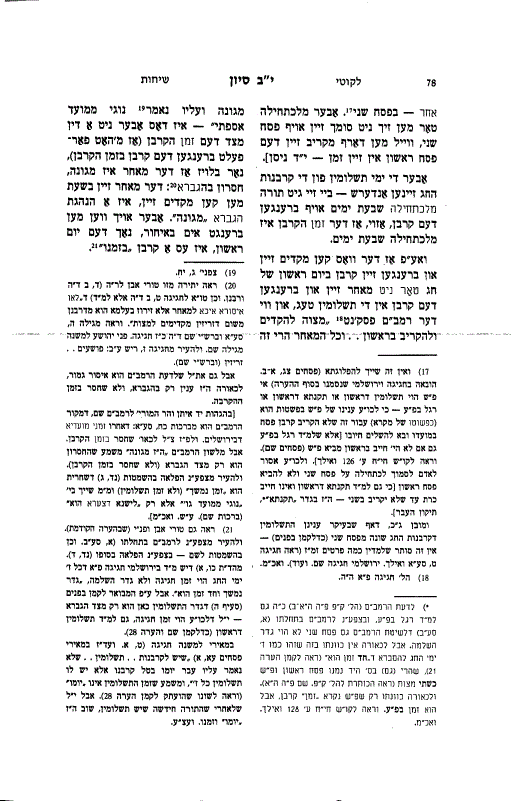
[For example, Pesach Sheni: one must bring "את הפסח במועדו, תעשו אותו במועדו" ("the Pesach offering at its appointed time; you shall make it at its appointed time"),16 and only if someone missed the obligation does the Torah then give him the opportunity to make it up at another time — on Pesach Sheni.17 But l'chatchilah (from the outset) one may not rely on Pesach Sheni, because one must offer the first Pesach at its time — the fourteenth of Nissan.]
But the days of tashlumin of the festival sacrifices are different: with them the Torah from the outset gives seven days in which to bring the sacrifice, such that the time of the sacrifice is, from the outset, seven days.
And even though one who is able to be early and bring his sacrifice on the first day of the festival may not delay and bring the sacrifice on the days of tashlumin — as the Rambam rules:18 "מצוה להקדים ולהקריב בראשון . . וכל המאחר הרי זה מגונה ועליו נאמר נוגי ממועד אספתי" ("It is a mitzvah to be early and offer on the first day . . and whoever delays is reprehensible, and of him it is said:19 'Those grieving from the appointed time I have gathered'") — this is not, however, a law stemming from the time of the sacrifice (that one missed bringing the sacrifice at the time of the sacrifice), but merely that the one who delays is reprehensible, a deficiency in the person:20 to delay when one could be early is reprehensible conduct on the part of the person. But even when one brings it late, after the first day, it is a sacrifice in its proper time.21
4. A proof of this:
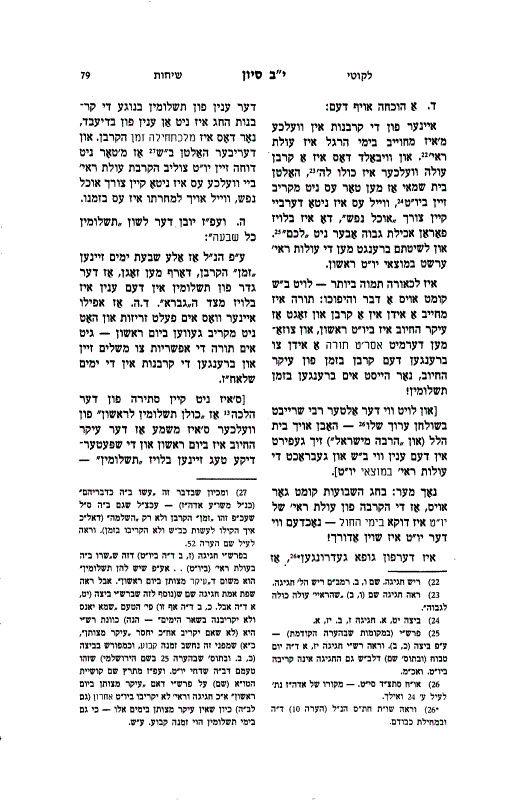
One of the sacrifices one is obligated in during the days of the festival is the olas re'iyah (the burnt offering of appearance).22 Since it is a burnt offering, which is entirely for G‑d,23 Beis Shammai hold that it may not be offered on Yom Tov,24 because no need of "אוכל נפש" ("food for a person") is involved; there is only consumption by the Most High, but not "לכם" ("for you").25 According to their view, the olos re'iyah are brought only at the conclusion of the first day of Yom Tov.
Seemingly this is most puzzling — according to Beis Shammai we arrive at a thing and its opposite: the Torah obligates a Jew in a sacrifice and says that the principal obligation is on the first day of Yom Tov, and together with this the Torah forbids a Jew to bring the sacrifice at the time of the principal obligation, and instead commands him to bring it at the time of tashlumin!
[And as the Alter Rebbe writes in his Shulchan Aruch,26 Beis Hillel too (and "הרבה מישראל" — "many of the Jewish people") conducted themselves in this matter like Beis Shammai, and brought the olos re'iyah at the conclusion of Yom Tov.]
Moreover: on the festival of Shavuos it actually turns out that the offering of the olas re'iyah of Yom Tov is specifically on weekdays — after the Yom Tov has already passed!
From this itself it necessarily follows*26 that the concept of tashlumin regarding the festival sacrifices is not a b'dieved matter; rather, it is l'chatchilah the time of the sacrifice. Therefore Beis Shammai hold27 that one may not override Yom Tov for the offering of the olas re'iyah, which involves no need of food for a person, since on the following day too it is in its proper time.
5. Based on this, the wording "tashlumin all seven" will be understood:
According to the above, that all seven days are the "time" of the sacrifice, one must say that the definition of tashlumin in this matter is solely from the standpoint of the "person." That is: even someone who lacks alacrity and did not offer on the first day — the Torah gives him the possibility to make it up and bring the sacrifices on the following days.
[This does not contradict the halachah28 that "they are all compensation for the first [day]," which implies that the principal obligation is on the first day and the later days are merely "tashlumin" — because "compensation for the first" relates only to when the obligation takes effect. That is, the obligation to bring the sacrifice rests (not on each of the seven days in its own right — "there is no day among them whose obligation does not depend on itself" — but rather the obligation takes effect) on the first day, and the obligation of the later days is merely a continuation of the obligation of the first day (and consequently, if there is no obligation on the first day, there can be no continuation — a sacrifice on the following days).
But according to all views, bringing the sacrifices after the first day is not a "b'dieved" offering, in which one has missed the "time" of the sacrifice; rather, it is the time of the sacrifice.28]
And since the definition of tashlumin is (primarily) a matter of the person's alacrity,29 the concept of tashlumin applies also to the first day itself. For from the standpoint of alacrity, one must hasten to bring the sacrifice as early as possible on the first day itself, right "בצפרא" ("in the morning").30 Consequently, when someone does not hasten to bring the sacrifices right "in the morning," bringing them later in the day (on the first day itself) has the status of tashlumin. It follows that tashlumin applies "all seven."31
— And based on all the above (that the seven days are the "time" of the sacrifice), it follows that with the festival of Shavuos the Torah from the outset established the "time" of its festival sacrifices in such a way that the "seven days" of the time of the sacrifices include both the Yom Tov (particularly after the "morning") and the weekdays (after the Yom Tov) equally!
6. The explanation of this:
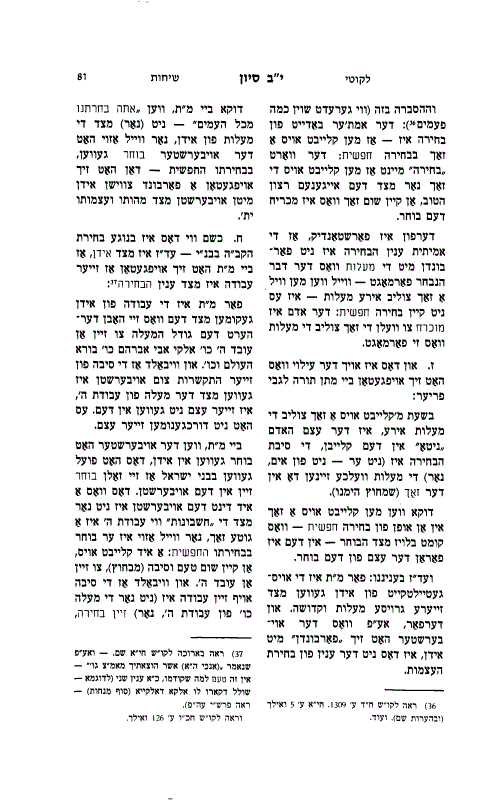
It is known that at the time of the Giving of the Torah the Jewish people were chosen. As the Magen Avraham rules32 — cited in the Alter Rebbe's Shulchan Aruch33 — when saying (in the blessings of the Shema) "ובנו בחרת מכל עם ולשון" ("and You have chosen us from every people and tongue") one should have in mind the Giving of the Torah.34
What is the novelty of the "choosing" of the Jewish people compared to before? Even before the Giving of the Torah, Jews were already distinguished from all other nations. As we find, even before the Exodus from Egypt Jews were already called "בני בכורי ישראל" ("My son, My firstborn, Israel").35 So why do we say that only at the Giving of the Torah did G‑d choose the Jews?
The explanation of this (as has already been discussed several times36): The true meaning of choice is that one selects something by free choice. The word "בחירה" ("choice") means that one selects the thing solely out of one's own good will, without anything compelling the chooser.
From this it is understood that the true essence of choice is not connected with the virtues that the chosen thing possesses — because when one wants something on account of its virtues, it is not a free choice: the person is compelled to want the thing because of the virtues it possesses.
7. And this is also the elevation that came about at the Giving of the Torah compared to before:
When one selects something because of its virtues, the essence of the person "is not present" in that selection; the cause of the choice is (not he — not from him, but rather) the virtues present in the thing (which are external to him).
Only when one selects something by way of free choice — which stems solely from the chooser — is the essence of the chooser present in it.
So too in our matter: before the Giving of the Torah, the distinctiveness of the Jews was due to their great virtues and holiness. Therefore, although G‑d "bound Himself" with the Jews, this was not the matter of the choice of the Essence.
Only at the Giving of the Torah, when "אתה בחרתנו מכל העמים" ("You have chosen us from all the nations") — not (only) because of the virtues of the Jews, but because that is how G‑d chose, by His free choice37 — was a bond formed between the Jews and G‑d from the standpoint of His very Being and Essence.
8. Just as this is with regard to the Holy One, blessed be He, choosing the Jewish people, so too from the standpoint of the Jews: at the Giving of the Torah it came about that their service is from the standpoint of choice:
Before the Giving of the Torah, the service of the Jews came about because they had perceived the great virtue of being a servant of G‑d, etc., the G‑d of our father Avraham, etc., the Creator of the world, and so on. And since the cause of their bond with G‑d was the virtue of serving G‑d, their essence was not in it. It did not permeate their essence.
At the Giving of the Torah, when G‑d chose the Jews, this brought about in the Jewish people that they should choose G‑d. The fact that a Jew serves G‑d is not only because of "calculations" of how serving G‑d is a good thing, but because that is what he chooses by his free choice: a Jew selects, without any (external) reason or cause, to be a servant of G‑d. And since the cause of his service is (not only the virtue, etc., of serving G‑d, but) his choice, therefore his entire essence is "engaged" in the service.
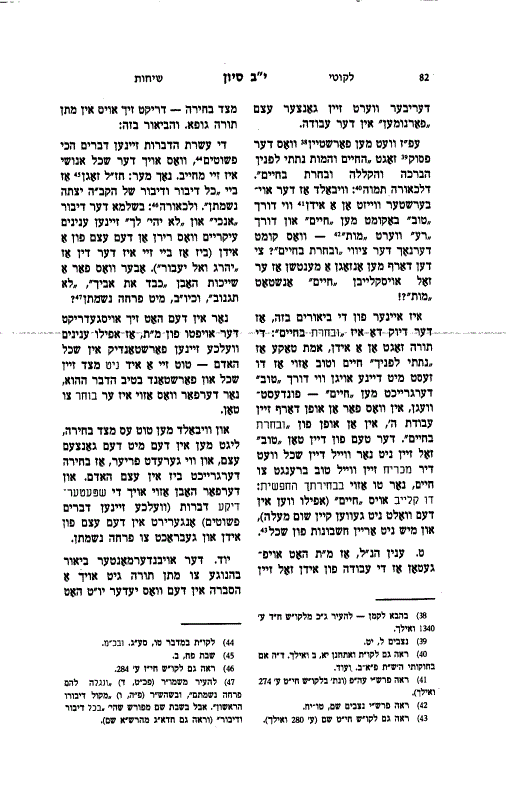
Based on this we will understand38 what the verse39 says: "החיים והמות נתתי לפניך הברכה והקללה ובחרת בחיים" ("Life and death I have set before you, the blessing and the curse — and you shall choose life"). For seemingly this is puzzling:40 since G‑d shows a Jew41 how through "good" one receives "life" and through "evil" comes "death"42 — why does the command "and you shall choose life" then follow? Does one need to tell a person to choose "life" instead of "death"?!
One of the explanations of this is that the precise point here is "and you shall choose life." The Torah tells a Jew: true, "I have set before you" life and good, such that you see with your own eyes how through "good" one attains "life" — nevertheless, the manner in which the service of G‑d must be is "and you shall choose life." The reason for your doing "good" should not be only because your intellect compels you, since good brings life; rather, do so by your free choice: choose "life" (even if there were no virtue in it at all), and do not mix in calculations of the intellect.43
9. The above point, that it was brought about that the service of Jews should be from the standpoint of choice, is expressed in the Giving of the Torah itself. The explanation of this:
The Ten Commandments are "the simplest of matters,"44 which even human intellect requires. Moreover: our Sages say45 that at "כל דיבור ודיבור של הקב"ה יצתה נשמתן" ("each and every utterance of the Holy One, blessed be He, their souls departed"). And seemingly:46 granted, the utterances "Anochi" ("I am") and "Lo yihyeh lecha" ("You shall have no [other gods]") are fundamental matters that touch the essence of a Jew (to the extent that the law regarding them is "יהרג ואל יעבור" — "be killed rather than transgress"). But what connection do "כבד את אביך" ("Honor your father"), "לא תגנוב" ("Do not steal"), and the like have with their souls flying out?47
Rather, in this was expressed what the Giving of the Torah accomplished: that even matters that are understandable to human intellect — a Jew does them not because of his intellect and his understanding of the merit of the matter, but because that is what he chooses to do.
And since one does it from choice, one is invested in it with one's entire essence — as discussed earlier, choice reaches the very essence of the person. Therefore, the later commandments too (which are simple matters) touched the essence of the Jews and brought about their souls flying out.
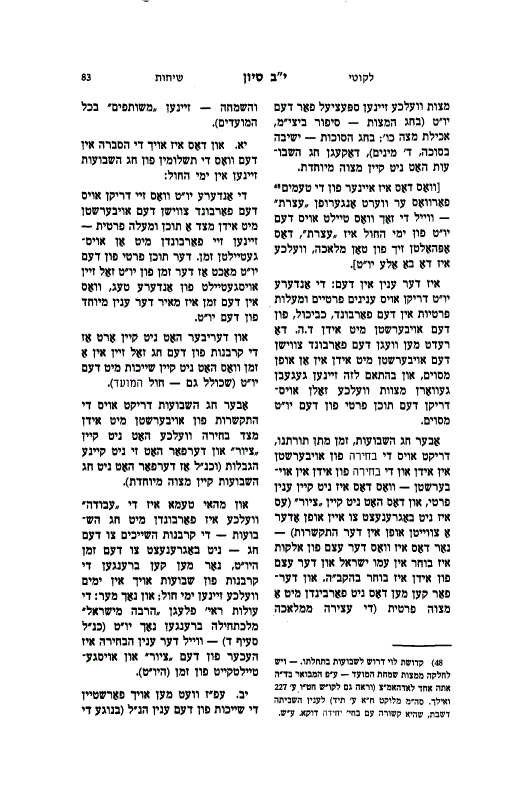
10. The above explanation concerning the Giving of the Torah also explains why each Yom Tov has mitzvos specific to that Yom Tov (on the festival of Matzos — recounting the Exodus from Egypt, eating matzah, etc.; on the festival of Sukkos — dwelling in the sukkah, the Four Kinds), whereas the festival of Shavuos has no special mitzvah.
[This is one of the reasons48 why it is called "Atzeres": because the thing that distinguishes this Yom Tov from weekdays is "atzeres," refraining from doing work, which applies to all Yamim Tovim.]
The point is this: the other Yamim Tovim express particular aspects and particular virtues in the bond, so to speak, of G‑d with the Jews. That is, there we speak of the bond between G‑d and the Jews in a specific manner, and accordingly mitzvos were given that express the particular content of that specific Yom Tov.
But the festival of Shavuos, the time of the Giving of our Torah, expresses G‑d's choice of the Jews and the Jews' choice of G‑d — which is not a particular matter and has no "form" (it is not limited to one manner or another of the bond). Rather, it is that the Essence of G‑dliness chooses His people Israel and the essence of the Jews chooses the Holy One, blessed be He. Therefore it cannot be connected with a particular mitzvah (refraining from work and rejoicing are "shared" by all the festivals).
11. And this is also the explanation of why the tashlumin of the festival of Shavuos are on weekdays:
The other Yamim Tovim, which express the bond between G‑d and the Jews from the standpoint of a particular content and virtue, are connected with a distinct time. The particular content of the Yom Tov causes the time of the Yom Tov to be distinct from other days, for in that time the special quality of that Yom Tov shines.
Therefore there is no place for the sacrifices of that festival to be at a time that has no connection with the Yom Tov (which includes Chol HaMoed as well).
But the festival of Shavuos expresses the bond of G‑d with the Jews from the standpoint of choice, which has no "form," and therefore it has no limitations (as mentioned above, this is why the festival of Shavuos has no special mitzvah).
For this reason, the "service" connected with the festival of Shavuos — the sacrifices belonging to the festival — is not limited to the time of the Yom Tov; rather, one can bring the sacrifices of Shavuos even on days that are weekdays. Moreover: "many of the Jewish people" would l'chatchilah bring the olos re'iyah after Yom Tov (as mentioned above in section 4) — because choice is higher than the "form" and distinctiveness of time (of the Yom Tov).
12. Based on this we will also understand the connection of the above (concerning the tashlumin of Shavuos) to the fact that Shavuos is one day:
The Alter Rebbe explains49 the reason why the festival of Shavuos "אינו אלא יום אחד בלבד משא״כ בפסח וסוכות שהן ז׳ ימים" ("is only one day, unlike Pesach and Sukkos, which are seven days"): Pesach and Sukkos are connected with the seven middos, and therefore they are drawn down into a time of seven days; whereas the festival of Shavuos, the time of receiving the Torah, "הוא בחי׳ יחידה שלמעלה מהתחלקות ז׳ מדות" ("is the level of yechidah, which is above the division of the seven middos"), and therefore it is drawn down into time in the manner of "one day" (the number as it is above division).
That is: Pesach and Sukkos are connected with the revelation of G‑dliness that is enclothed in the seven middos; the revelation is connected with a "form," so to speak, and with a particular content (Above, and likewise below in man). Whereas on the festival of Shavuos the bond is one that is above division Above, and is connected with the simplicity of yechidah, because Shavuos is the time of choice. Therefore it is "only one day,"50 "יחיד שלמעלה מאחד סתם" ("a singular One that is above a mere 'one'").51
It follows that in the "time" of Shavuos as well it is emphasized how Shavuos is essentially a matter that is above the division of time. Therefore this extends to the time of the festival sacrifices, such that it is above the division between Yom Tov and weekday: the seven days include both the day of Yom Tov and the weekdays (after the Yom Tov) — as one.
(From the sichos of the second day of Shavuos and Shabbos Parshas Naso, 5743)
Notes
1) Before "U'va LeTziyon" — unlike what he writes in his Shulchan Aruch (Orach Chaim, end of §494), that Tachanun is not said (only) until the 8th of the month.
2) Unlike some who hold that also on the 13th [Tachanun is omitted] because of doubt regarding the day (cited in Sha'arei Teshuvah, Orach Chaim §131, subsec. 19). The reason of the Alter Rebbe may be explained thus: the entire concept of these tashlumin relates only to sacrifices, and there, there is no doubt regarding the day. See also the sichah of the night of 12 Sivan 5744.
3) Chagigah 17a (and the sources cited there). See Rambam, Laws of Chagigah 1:7.
4) Re'eh 16:16.
5) See the Alter Rebbe's Shulchan Aruch, Orach Chaim 529:6, that they are [days of the] festival. See also the Mareh Mekomos to his Shulchan Aruch (in the margin), §242:1, that with regard to sacrifices (which is the subject of tashlumin) they are also called "mikra kodesh" (a holy convocation). See Encyclopedia Talmudis, entry "Chol HaMoed," at the beginning, and the sources cited there.
6) Tosafos s.v. "Tashlumin," Chagigah 9a.
7) Chagigah 2a; ibid. 9a. See Yerushalmi there, 1:1, and the commentators there.
8) Rashi s.v. "Kulan tashlumin l'rishon," Chagigah 9a.
9) Rashi, Chagigah ibid., s.v. "Kulan tashlumin zeh lazeh." See also Rashi there, 2a, s.v. "Hanicha": the wording of the Yerushalmi there.
10) This question is raised by the Sfas Emes on Chagigah 17a. See also Responsa Chasam Sofer, vol. 6, §28.
11) See at length Likkutei Sichos vol. 23 (p. 22ff.) for examples of this from several areas of Torah.
12) See Chagigah 7a, "on the principal [day] of the festival" (and Rashi there). See Rashi s.v. "B'Yom Tov" (ibid., 7b), that their principal mitzvah is on the first day (and see below, note 27). See also there, 9a: "[OCR unclear] you celebrate .. why is 'seven' stated? For tashlumin."
13) Rambam, Laws of Chagigah 1:4; ibid. 2:5.
14) Note the wording of the Rambam, ibid. 1:6: "and it has tashlumin all the six days after the festival of Shavuos."
15) See another explanation in the sichah of the night of 12 Sivan 5742.
16) Behaaloscha 9:2; ibid., 3.
17) This is unrelated to the dispute (Pesachim 93a-b; cited in Chagigah and in the Yerushalmi noted at the end of this note) whether Pesach Sheni is tashlumin for the first, a rectification (takanta) for the first, or a festival in its own right. For according to all views, the purpose of Pesach Sheni in its plain sense is (as in the plain meaning of the verse) for one who did not offer the Pesach sacrifice at its appointed time and comes to complete his obligation [except that according to the view that it is a festival in its own right, even one who was not obligated on the first brings Pesach Sheni (Pesachim ibid.). See Likkutei Sichos vol. 18, p. 126ff.]. And according to all views, a person may not rely l'chatchilah on Pesach Sheni and not bring the first Pesach [for even according to the view that it is a rectification for the first, and one is not liable to kares unless he fails to offer on the second — it is in the category of "rectification," repairing the past].
It is also understood that although in its essence the tashlumin of the festival sacrifices differs from Pesach Sheni (as will be explained in the text), this does not contradict the fact that several details are derived from one another (see Chagigah 9a, end, ff.; Yerushalmi Chagigah ibid.; and elsewhere). This is not the place to elaborate.
*) According to the Rambam (Laws of Korban Pesach 5:1-2) this is so even according to the view that it is a festival in its own right. In [OCR unclear] on the Rambam ([OCR unclear] 51, end of col. b), [it is stated] that according to the Rambam's view Pesach Sheni too is not in the category of completion. But seemingly his intent is not that it is like the seven days of the festival according to the reasoning that "it is one time" (see below, note 21), for (also) in the Yad [HaChazakah] the first Pesach and Pesach Sheni are counted as two mitzvos (see the heading to the Laws of Korban Pesach; ibid. 5:1). Seemingly his intent is only that Pesach Sheni is called a "time" for the sacrifice, but it is a time in its own right. See Likkutei Sichos vol. 18, p. 128ff. This is not the place to elaborate.
18) Laws of Chagigah 1:5.
19) Tzefaniah 3:18.
20) See [OCR unclear] Turei Even on Rosh Hashanah (4b, s.v. "V'Rabbanan"; and likewise the Turei Even on Chagigah 9b, s.v. "Ela l'man d'amar"), that there is no prohibition for one who delays; it is merely an encouragement of Rabbinic origin, because "the zealous hasten to [perform] mitzvos." See Megillah 5a, end, and Rashi there, s.v. [OCR unclear]; Pnei Yehoshua on the Mishnah, Megillah there. Note Chagigah 6b, beginning of col. b: "negligent . . zealous" (and Rashi there).
But even if one says that according to the Rambam it is an outright prohibition, seemingly it is a matter relating only to the person, and not a deficiency in the time of the offering.
[In the glosses Yad Eisan and Har HaMor on the Rambam there, [it is stated] that the Rambam's source is Berachos 28a, end: "for they delayed the appointed times in Jerusalem." Accordingly, it would seemingly have to be said that there is a deficiency in the time of the sacrifice. But from the Rambam's wording, "it is reprehensible," it is implied that the deficiency is only on the part of the person (and not that there is a deficiency in the time of the sacrifice). Note the Tzafnas Paneach on Hafla'ah, in the omissions (54c), that Shacharis is "a continuous time" (and not a time of tashlumin), and nevertheless "those grieving from the appointed time" applies to it — but that is only "an expression of distress" (Berachos ibid.). See there. This is not the place to elaborate.]
21) See also the Turei Even and Pnei Yehoshua (in the previous note). Note the Tzafnas Paneach on the Rambam, at the beginning (1, end of col. b; and likewise in the omissions there — Tzafnas Paneach on Hafla'ah, at the end (54d); Mahadura Tinyana 26a), that there is a view in the Yerushalmi, Chagigah ch. 1, that all seven days of the festival are the time of the Chagigah and not in the category of completion — "a continuous category, and it is one time." But based on what is explained below in the text (section 5), that the definition of tashlumin here is only from the standpoint of the person, one may say that according to all views it is the time of the Chagigah, even according to the view of "compensation for the first" (as explained below there and in note 28).
In the Meiri on the Mishnah, Chagigah (9a; and similarly in the Meiri on Pesachim 71a), [he writes] that "the sacrifices have . . tashlumin . . for it was not said of it 'its day has passed, its sacrifice is void,' but rather it has tashlumin all seven," which implies that the time of tashlumin is not "its day" (see his wording quoted below in note 28). But one may say that once the Torah introduced that there are tashlumin, it then becomes "its day" and its time. This requires further investigation.
22) Beginning of Chagigah; ibid. 6b. Rambam, beginning of Laws of Chagigah.
23) See Chagigah ibid. (6b): "for the re'iyah is a burnt offering entirely for the Most High."
24) Beitzah 19a; Chagigah 7b; 17a.
25) Rashi's explanation (in the places cited in the previous note), based on Beitzah (20b). See Rashi, Chagigah 17a, s.v. "Yom tevo'ach" (and Tosafos there), that according to Beis Shammai the Chagigah too is not offered on Yom Tov. This is not the place to elaborate.
26) Orach Chaim 494:19. — The Alter Rebbe's source is discussed above, p. 24ff.
*26) See Responsa Chasam Sofer, mentioned above (note 10), s.v. "U'vimchilas kevodam."
27) Since in this matter "Beis Hillel acted in accordance with their words" (as cited above from the Alter Rebbe's Shulchan Aruch), one must say that Beis Hillel too hold that at least this is the "time" of the sacrifice and not merely "tashlumin" (for otherwise, how could they be lenient and act like Beis Shammai and not offer at the proper time?). See above, there, note 52.
In Rashi's commentary on Chagigah (7b, s.v. "B'Yom Tov") [it is stated] that the reason "Beis Hillel permitted the olas re'iyah (on Yom Tov) . . even though they have tashlumin" is because "their principal mitzvah is on the first day." But see the Sfas Emes, Chagigah there, that (in addition to the fact that Rashi on Beitzah (19a, s.v. "Aval"; 20b, s.v. "Af zu") explains the reason as "lest he be prevented and not offer it on the other days") Rashi's intent is (not that if one offers later "their principal mitzvah" will be lacking, but rather) that because of this its time is considered fixed — as stated explicitly in Beitzah (20b; and in the Tosafos cited in note 25, in the name of the Yerushalmi) that this is the reason of Beis Hillel, who override Yom Tov. On this basis he resolves there the question of the Turei Even (there) on Rashi's explanation — that if "their principal mitzvah is on the first day," then the Chagigah and re'iyah should not be offered on the last day of Yom Tov (even according to Beis Hillel), since their principal mitzvah is not on those days — for even on the days of tashlumin its time is fixed. See there.
28) The wording of Rashi (Chagigah 9a, s.v. "Kulan tashlumin l'rishon"), "Scripture made one day the principal one" — one may say that the intent is that it is [the day on which] the obligation takes effect. Perhaps the wording of the Meiri there can also be explained this way: "The principal obligation of re'iyah and Chagigah is on the first [day] and not on the other days, and when he celebrates on the other days he celebrates only by way of tashlumin for the first." But this is forced. See above, note 12.
29) Seemingly one must say so according to the view of "compensation for one another," as Rashi explains in Chagigah there (s.v. "Kulan tashlumin zeh lazeh"), that according to this view "the first day on which he is fit to bring [it] is the principal [day] for him, and the days after it are tashlumin for him." For seemingly, where is it alluded to in the verse that the principal time of the sacrifice is on "the first day on which he is fit to bring" (and it is "principal" only "for him")? One must therefore say that it is a matter relating to the person, as in the text.
30) See Pesachim 4a.
31) Perhaps this wording also alludes to the fact that all seven days are one point (or, in the wording of the Tzafnas Paneach cited above, note 21, "one time").
32) §60, subsec. 2.
33) Ibid., par. 4.
34) See also Abudraham on Kiddush of Friday night, on the reason that on Shabbos one does not say "who has chosen us, etc." [but rather] "You have chosen us, etc."
35) Shemos 4:22 (and see there, 23).
36) See Likkutei Sichos vol. 4, p. 1309; vol. 1, p. 5ff. (and the notes there); and elsewhere.
37) See at length Likkutei Sichos vol. 1, ibid. — And although it says "(I am the L‑rd your G‑d) who took you out of the land of Egypt, etc.," this is not a reason for what precedes it, but a second matter (for example, it negates [the view of] those who called Him "G‑d of gods" (end of Menachos) — see Rashi on the verse). See also Likkutei Sichos vol. 26, p. 126ff.
38) Regarding what follows, note also Likkutei Sichos vol. 4, p. 1340ff.
39) Nitzavim 30:19.
40) See also Likkutei Torah, Va'eschanan 11b ff.; the maamar "Im Bechukosai" [OCR unclear], chs. 1-2; and elsewhere.
41) See Rashi on the verse (discussed in Likkutei Sichos vol. 9, p. 274ff.).
42) See Rashi, Nitzavim ibid., 15-18.
43) See also Likkutei Sichos vol. 9, ibid. (p. 280ff.).
44) Likkutei Torah, Bamidbar 15, end of col. c, and in many places.
45) Shabbos 88b.
46) See also Likkutei Sichos vol. 6, p. 284.
47) Note Shemos Rabbah (29:4), "He was revealed to them — their souls flew out," and Shir HaShirim Rabbah (5:6), "from the sound of His first utterance." But in Shabbos ibid. it is explicit that it was "at each and every utterance" (see also the Chiddushei Aggados of the Maharsha there).
48) Kedushas Levi, discourse for Shavuos, at the beginning. — One may [OCR unclear] it from the mitzvah of rejoicing on the festival, based on what is explained in the maamar "Atah Echad" of the Mitteler Rebbe (see also Likkutei Sichos vol. 15, p. 227ff.; Sefer HaMaamarim Melukat vol. 1, p. 414) regarding the cessation [from work] of Shabbos, that it is connected specifically with the level of yechidah. See there.
49) Torah Or, Yisro, in the additions, 109, end of col. d ff.
50) Based on this one can explain the connection of the sacrifices of Asher — "who offered his sacrifice on account of the choice with which the Holy One, blessed be He, chose Israel" (Bamidbar Rabbah 14:10; see there) — to the eleventh day (Naso 7:72): the number eleven indicates the level of Keser (which is above the [OCR unclear] sefiros). See [OCR unclear] there, [OCR unclear] relates to Keser.
*) Note Ibn Ezra, Naso there: "And it is a great secret." See also Sefer HaSichos 5749, vol. 1 (Kehot, 5750), p. 389ff.
51) Ohr HaTorah, Yisro, beginning of p. 873.
Key Lesson
Shavuos expresses G‑d's free choice of the Jewish people and their free choice of Him — an essential bond that has no particular form and is not confined to set times, which is why its sacrifices could be brought equally on the weekdays that follow it. Likewise, a Jew's service of G‑d should stem not only from what his intellect understands to be good, but from his own free choice, which engages his entire essence.