
Bechukosai – Giving Beyond a Fifth?
Introduction & Part 1 – Ois Aleph
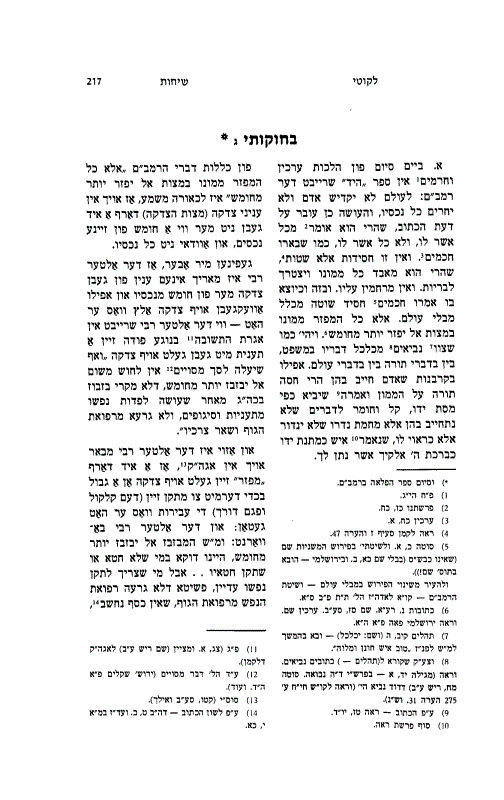
We will review a sichah from Likkutei Sichos, Chelek Kaf-Zayin, the third sichah on Parshas Bechukosai. This is also the final sichah in Volume 27, and as noted there, it serves as the Siyum on Sefer Hafla’ah in the Rambam.
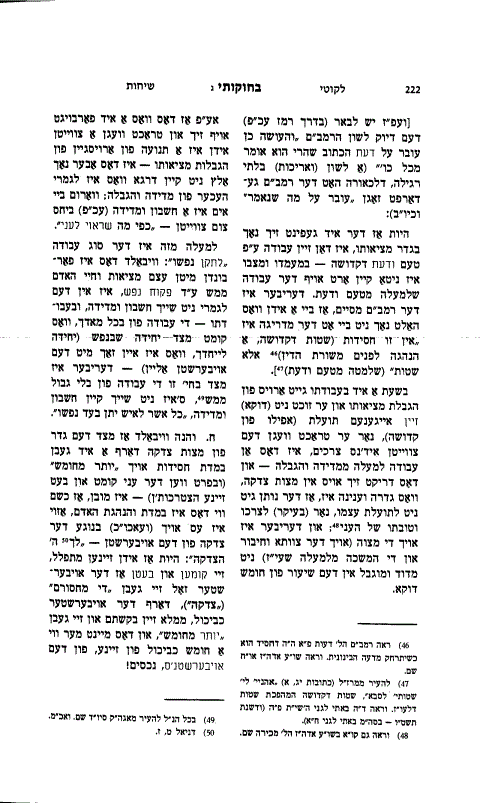
In our parshah, the Torah discusses the laws of Arachin and Cherem—forms of consecrating one’s possessions or assigning their value for sacred purposes. From these verses emerges an important halachic principle: how much of a person’s wealth may be given away for mitzvos and charity?
The Rambam rules that a person should not give away more than one-fifth of his assets. Yet the Alter Rebbe, in Tanya, appears to allow giving far more than that when the charity serves as atonement and healing for the soul.
How are these views reconciled?
The Rebbe explains that there are different categories of giving. Sometimes one is fulfilling the ordinary mitzvah of tzedakah, where limits apply. In other cases, when a person is responding to urgent need or seeking spiritual repair, the framework changes entirely.
We will go step by step.
The Rambam’s Ruling
At the conclusion of Hilchos Arachin V’Charamim in the Rambam, found in Sefer Hafla’ah of the Yad HaChazakah, the Rambam writes that a person should never consecrate all of his possessions.
Whether through Hekdesh, Cherem, or similar forms of dedication, one may not give everything away.
The Rambam goes even further. He says that one who does so violates the meaning of the verse in our parshah.
The Torah states “mikol asher lo”—from all that belongs to him. Chazal derive: from what is his, but not everything that is his.
The Torah therefore does not endorse total self-impoverishment in the name of generosity.
Not Piety, But Foolishness
The Rambam uses striking language.
One might think that although the Torah does not require such giving, it is still an act of extraordinary righteousness.
The Rambam rejects that idea.
He writes that this is not piety—it is foolishness.
Why?
Because the person gives away all his resources and then becomes dependent on others for support. Instead of helping the world wisely, he has made himself a burden upon the community.
The Rambam adds that one need not pity such a person afterward, because he created the problem through irresponsible behavior.
He then cites the concept of a chasid shoteh—a pious fool. A person may appear saintly, acting beyond the letter of the law, but if his actions are reckless and destructive, they are not true holiness.
Sometimes misguided righteousness can damage rather than build.
The Proper Measure
What, then, should a person do?
The Rambam writes that one who spends money on mitzvos should not spend more than one-fifth of his assets.
That means:
- not more than twenty percent,
- even for worthy causes,
- and even for mitzvos.
The remaining wealth should be managed responsibly.
This, says the Rambam, follows the verse in Tehillim:
“He conducts his affairs with judgment.”
A person should act with balance, wisdom, and foresight. This applies not only in business, but in all areas of life—including generosity.
Even in Korbanos
The Rambam strengthens his argument further.
Even when the Torah obligates a person to bring a korban, the Torah does not always require the most expensive offering. Instead, the Torah takes into account a person’s means and financial ability.
If so, then certainly in matters a person was not specifically obligated to undertake—such as voluntary vows or additional dedications—he must exercise judgment and restraint.
Giving should match one’s means and situation.
The Rebbe’s Question
From the Rambam’s wording, it appears that this rule includes tzedakah as well.
The Rambam speaks broadly about spending on mitzvos. Tzedakah is itself a mitzvah. Therefore, it would seem that one may not give more than one-fifth even for charity.
And certainly, one may not give away everything.
Yet this creates a major difficulty.
Because the Alter Rebbe appears to say otherwise.
The Alter Rebbe in Iggeres HaTeshuvah
In Iggeres HaTeshuvah, the Alter Rebbe discusses redeeming fasts through charity.
Instead of undergoing many physical fasts as a form of atonement, one may give tzedakah in their place.
This can amount to a very large sum of money.
The Alter Rebbe addresses the obvious concern: do Chazal not say that one should not spend more than one-fifth?
He answers:
That limitation applies to ordinary spending.
But this is not ordinary spending.
This is like paying for medicine.
Just as a person spends what is necessary to heal the body, so too one spends what is necessary to heal the soul. In such a case, the usual limits do not apply.
The Alter Rebbe in Iggeres HaKodesh
The same theme appears in Iggeres HaKodesh.
There, the Alter Rebbe writes that one should give abundantly to repair the spiritual damage caused by sin.
Again he explains:
The rule of one-fifth applies to someone who has no spiritual repair to make, or who has already completed that process.
But one who still needs healing of the soul is no different than one who needs healing of the body.
When life and health are at stake, money is not the deciding factor.
As the verse says:
A person will give all that he has for his life.
If one spends freely to preserve physical life, certainly one may do so to restore spiritual life.
A Practical Ruling
The Rebbe emphasizes that this is not merely philosophical.
The Alter Rebbe concludes practically that those who fear the word of Hashem are accustomed to increase greatly in charity.
This was not meant as abstract inspiration, but as practical guidance.
According to the Alter Rebbe, there are situations where a Jew should give generously, even far beyond one-fifth.
The Contradiction
So now we face a major question:
How do we reconcile the Rambam with the Alter Rebbe?
The Rambam says:
- do not give more than a fifth,
- total giving is foolishness,
- reckless generosity is condemned.
The Alter Rebbe says:
- for spiritual healing, the limit does not apply,
- one may give abundantly,
- even beyond a fifth.
And the Rebbe adds that the issue is even stronger, because elsewhere in the Rambam himself there are indications that greater giving may sometimes be appropriate.
So what are the categories?
When does the one-fifth limit apply?
When may it be exceeded?
When is giving holy—and when is it irresponsible?
The Rebbe will continue to clarify these distinctions in the next section.
Part 2 – Ois Beis
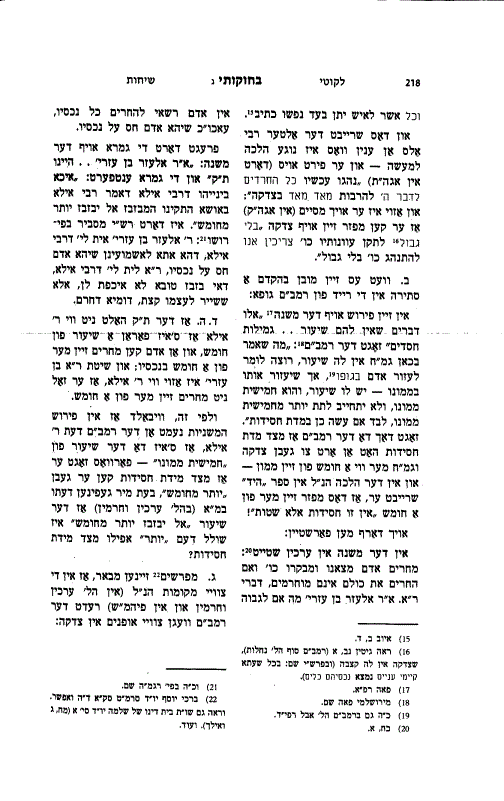
The Rambam Seems to Contradict Himself
To understand this issue more deeply, the Rebbe first introduces a contradiction within the Rambam himself.
In the previous section, we saw the Rambam’s ruling in Hilchos Arachin V’Charamim: a person should not give away more than one-fifth of his assets, and one who does so is not acting with piety but with foolishness.
Yet in another place, in the Rambam’s Pirush HaMishnayos, he appears to say something very different.
The Mishnah in Peah
The Mishnah in Peah teaches:
“Eilu devarim she’ein lahem shiur…”
“These are the things that have no fixed measure.”
Among the items listed is:
Gemilus Chasadim—acts of kindness.
The Rambam explains what this means.
When the Mishnah says that acts of kindness have no limit, it refers to helping another person physically and personally.
For example:
- assisting someone with their needs,
- visiting and caring for the sick,
- helping with labor,
- supporting another person through action and effort.
In such forms of kindness, there is no set boundary. A person should help as much as he can.
Monetary Giving Has a Measure
However, says the Rambam, when kindness is expressed through money, there is a limit.
How much must one give financially?
Up to one-fifth of his assets.
So although the Mishnah says Gemilus Chasadim has no measure, the Rambam explains that this applies to physical acts of kindness. Financial giving does have a standard measure.
So far, this is consistent with the Rambam’s ruling in Hilchos Arachin.
But Then the Rambam Adds an Exception
The Rambam then adds a crucial phrase:
This limit applies ordinarily—but if one gives more as an act of Middas Chasidus, a measure of piety, that is permitted.
Now we have a direct contradiction.
In Pirush HaMishnayos, giving more than one-fifth can be an act of piety.
But in Hilchos Arachin, the Rambam writes that giving beyond the proper measure is not piety at all—it is foolishness.
So which is it?
Is giving more than one-fifth an expression of righteousness, or is it irresponsible behavior?
A Further Question from the Mishnah in Arachin
The Rebbe deepens the difficulty by examining the source of the one-fifth rule itself.
The Mishnah in Arachin discusses a person who declares his possessions cherem or dedicated to sacred use.
It states that if someone attempted to give away all of his sheep, cattle, or possessions, the declaration does not fully take effect.
Rabbi Elazar ben Azariah comments:
If even to Hashem a person may not give away everything, certainly he must be careful with his own property.
At first glance, Rabbi Elazar ben Azariah seems merely to repeat the first opinion.
So what is he adding?
The Gemara’s Explanation
The Gemara asks exactly that question:
What difference is there between the first opinion and Rabbi Elazar ben Azariah?
The Gemara answers:
The difference is the ruling established in Usha:
“Hamevazvez al yevazvez yoser m’chomesh.”
One who gives generously should not give more than one-fifth.
Rashi explains:
Rabbi Elazar ben Azariah follows the ruling of Usha—that one must limit giving to a fifth.
But the first opinion, the Tanna Kamma, does not require that limitation. According to him, a person may give more than one-fifth, as long as he does not give away everything.
That is the disagreement.
The Problem for the Rambam
Now the difficulty becomes even stronger.
The Rambam rules like the opinion that accepts the one-fifth limit.
That means he sides with Rabbi Elazar ben Azariah, not with the Tanna Kamma.
If so, how can the Rambam later say that giving more than a fifth may be an act of piety?
That possibility seems to belong to the rejected view of the Tanna Kamma, who allows broader giving.
And beyond that, in Hilchos Arachin the Rambam explicitly says that such behavior is not piety at all.
So how can the Rambam hold both positions at once?
Two Questions in Ois Beis
The Rebbe now sharpens the issue into two distinct questions:
1. Internal Contradiction in the Rambam
Why does the Rambam in one place describe giving more than one-fifth as Middas Chasidus, while in another place he calls it foolishness?
2. Contradiction to the Source Itself
If the Rambam rules like Rabbi Elazar ben Azariah—that one must limit giving to a fifth—how can he then permit going beyond that measure as an act of piety?
That seems to revive the rejected position.
The Direction of the Answer
The Rebbe now prepares the reader for the resolution.
The key is that not all giving is the same.
There are different purposes, different obligations, and different categories of charity.
Sometimes restraint is the correct path.
Sometimes generosity beyond measure is the correct path.
The distinction depends on what the money is being used for, and why it is being given.
That is what the Rebbe will explain in Ois Gimel.
Two Kinds of Giving: Charity or Self-Refinement?
The Rebbe now presents the resolution offered by the commentators and then deepens it with a more fundamental explanation.
The apparent contradiction in the Rambam disappears once we recognize that the Rambam is speaking about two very different kinds of giving. Though both involve money and generosity, they are not the same mitzvah and not the same obligation.
When a Poor Person Stands Before You
In Pirush HaMishnayos, the Rambam is discussing the mitzvah of tzedakah in its classic form: the need of the poor person.
There, the central question is not the spiritual growth of the giver, but the suffering and lack of the recipient.
A poor person needs food.
A captive needs redemption.
A person without clothing needs covering.
A distressed person cries out for help.
The Rambam writes elsewhere that when one sees hungry people, captives, or those lacking basic necessities, one is obligated to assist them, as the Torah says:
“Dei machsoro asher yechsar lo”
“You shall provide what he lacks.”
In such a case, the mitzvah is defined by the other person’s need.
Therefore:
- up to one-fifth is the ordinary required measure,
- and beyond that, one may still give as an act of Middas Chasidus.
Why?
Because a real human need stands before you.
The one-fifth guideline remains meaningful, but when another person’s suffering is at stake, there is room for greater generosity.
When No Need Is Present
By contrast, in Hilchos Arachin V’Charamim, the Rambam is not speaking about poor people standing before you.
There is no urgent cry.
No captive asking to be redeemed.
No hungry family at the door.
Rather, the person decides on his own to distribute money for sacred causes, vows, dedications, or charitable giving initiated by himself.
This resembles Hekdesh and Cherem:
No one demanded it.
No one required it now.
The person himself chose to undertake it.
In that setting, the Rambam rules:
Do not give more than one-fifth.
And if one gives recklessly beyond that measure, it is not called piety.
Because there is no pressing need that justifies self-impoverishment.
First Distinction
So the first distinction is practical:
In Pirush HaMishnayos:
Giving in response to real need.
In Hilchos Arachin:
Voluntary giving initiated by the donor himself.
That alone explains much of the difference.
But the Rebbe now goes deeper.
Part 4 - Ois Daled
Two Different Definitions of Mitzvah
The Rebbe explains that the difference is not only circumstantial. It is conceptual.
These are two different mitzvah categories with two different purposes.
The Nature of Arachin, Cherem, and Hekdesh
The Rambam writes in the earlier halachos that vows such as Arachin, Cherem, and Hekdesh are mitzvos through which a person trains himself.
Why should a person engage in them?
To accustom himself not to be stingy.
To break selfishness.
To develop generosity.
To refine character.
The primary benefit here is for the giver.
The Temple treasury may receive funds, but the emphasis of the mitzvah is the donor’s inner growth.
He is becoming a more generous person.
If that is the goal, then there must be limits.
One does not refine oneself through irresponsibility.
If a person gives away too much and harms his own stability, he has not perfected generosity—he has distorted it.
Therefore, in this area the Rambam says:
Do not exceed one-fifth.
And in this context, going beyond the proper measure is not Middas Chasidus.
The Nature of Tzedakah
But ordinary tzedakah is defined differently.
Here the center of the mitzvah is not the giver’s character, but the recipient’s need.
The Rambam writes:
It is a positive commandment to give tzedakah to the poor according to what the poor person lacks.
The focus is:
What does this person need?
What suffering can be relieved?
What burden can be lifted?
When the mitzvah is defined by another person’s need, then there can be room to go beyond the standard measure.
Why?
Because the issue is no longer only your self-development.
It is another person’s life, dignity, hunger, or survival.
In such a case, Middas Chasidus may mean giving more.
The Rebbe’s Deeper Structure
The Rebbe has now transformed the discussion.
This is not simply:
One place says less, one place says more.
It is:
Giving for Self-Refinement
(Train yourself not to be stingy)
→ Measured giving.
→ One-fifth maximum.
→ More is not virtue.
Giving for Another Person’s Need
(Relieve lack and suffering)
→ Standard measure applies.
→ Yet beyond that may be true piety.
A Timeless Lesson
This distinction teaches an important principle in life.
Not every act of generosity is motivated by the same thing.
Sometimes we give because it helps us grow.
Sometimes we give because someone else truly needs help.
Those are both noble—but they are not identical.
And wisdom means knowing the difference.
There are times to be disciplined.
There are times to stretch beyond comfort.
There are times to protect your own stability.
There are times to give more than you planned.
Torah does not treat generosity as one flat category.
It teaches measured kindness and boundless kindness—each in its proper place.
What Comes Next
The Rebbe will continue by examining other rulings of the Rambam about tzedakah and show how they too fit perfectly into this framework.
Part 5 – Ois Hei
Why the Rambam Changes His Language
The Rebbe now applies the principle we have learned to two additional places in the Rambam. Once we understand that there are different categories of giving, the changing language of the Rambam becomes exact and fully consistent.
What appears to be contradiction is really precision.
1. Hilchos Matnos Aniyim
“Up to a Fifth Is the Best Way”
In Hilchos Matnos Aniyim—the laws of gifts to the poor—the Rambam discusses a case where a needy person stands before you and asks for what he lacks.
Ideally, the Torah standard is to provide:
“Dei machsoro asher yechsar lo”
Whatever he is lacking.
But what if the giver does not have enough means to fully supply the person’s needs?
The Rambam writes:
He gives according to what his hand can reach.
Then the Rambam adds:
Giving up to one-fifth of one’s assets is mitzvah min hamuvchar—the finest way to perform the mitzvah.
Now the Rebbe asks:
Why does the Rambam phrase this positively?
Why say:
“Up to a fifth is the best fulfillment”
instead of saying:
“Do not give more than a fifth”
as he said in Hilchos Arachin?
Because Here the Poor Person Is the Focus
The answer follows everything we explained earlier.
In Hilchos Matnos Aniyim, the Rambam is discussing tzedakah in its true definition: the needs of the poor person.
A real person stands before you.
He lacks food, clothing, dignity, or support.
Therefore the Rambam cannot write an absolute negative rule:
Do not give more than a fifth.
That would be inaccurate.
Because in certain cases, one may indeed give more than a fifth—as an act of Middas Chasidus, and at times because the need is pressing.
So instead, the Rambam states the standard positively:
Up to a fifth is the ideal measure.
That defines the preferred norm, while still leaving room for greater generosity when appropriate.
A Sweet Precision
The Rebbe adds an elegant point.
In Hilchos Arachin V’Charamim, where the Rambam speaks sharply about not giving more than a fifth, he is not discussing classic tzedakah to poor people.
He is discussing vows, dedications, and voluntary consecrations.
That is a different mitzvah category.
There, exceeding the measure is inappropriate.
But where poor people are concerned, the Rambam does not state such a prohibition.
Because the halachic framework is different.
2. Hilchos De’os
Why There the Rambam Says Only: Don’t Give Everything
The Rebbe now turns to another place in the Rambam: Hilchos De’os.
There the Rambam rules:
A person should not give away, declare ownerless, or consecrate all of his possessions and leave himself with nothing, becoming dependent on others.
Notice the wording.
Here the Rambam does not say:
Do not give more than one-fifth.
He says only:
Do not give away everything.
Why the softer boundary?
Because Hilchos De’os Discusses Proper Human Conduct
Hilchos De’os is not primarily defining one specific mitzvah. It teaches the proper path of human behavior, balanced character, and wise conduct.
In that broader context, the Rambam cannot establish a universal rule that one may never give more than a fifth.
Why not?
Because sometimes a person should give more than a fifth.
For example:
- a poor person stands before him in urgent need,
- a pressing communal necessity arises,
- a circumstance calls for exceptional generosity.
Therefore, in Hilchos De’os, the Rambam gives only the absolute boundary:
Do not give away everything and become a burden yourself.
That rule applies universally.
But more than one-fifth may sometimes be appropriate, depending on the situation.
Why Hilchos Arachin Is Different
By contrast, Hilchos Arachin V’Charamim is discussing a specific mitzvah category whose very purpose is self-discipline and measured generosity.
There, there is no circumstance within that mitzvah itself that justifies excess.
So there the Rambam writes clearly:
Do not give more than a fifth.
Because in that framework, the rule is fixed.
The Rebbe’s Larger Lesson
The Rebbe shows us how every phrase of the Rambam is exact.
The Rambam does not contradict himself.
He speaks differently because he is speaking about different realities:
In Arachin / Cherem:
Self-initiated sacred giving.
Goal: refine the giver.
Rule: do not exceed one-fifth.
In Matnos Aniyim:
Responding to the poor person’s need.
Goal: help the recipient.
Rule: one-fifth is ideal, but more may be possible.
In De’os:
General wise living.
Goal: balanced conduct.
Rule: never impoverish yourself completely.
A Practical Lesson
Many people search for one simple rule in life:
How much should I give?
How much should I hold back?
When is generosity noble, and when is it unwise?
The Rebbe teaches that Torah does not always give one number for every case.
It asks:
Why are you giving?
Who needs help?
What is the situation?
What are the consequences?
Sometimes holiness means restraint.
Sometimes holiness means going beyond the standard.
And wisdom is knowing which moment you are in.
Part 6 – Ois Vav
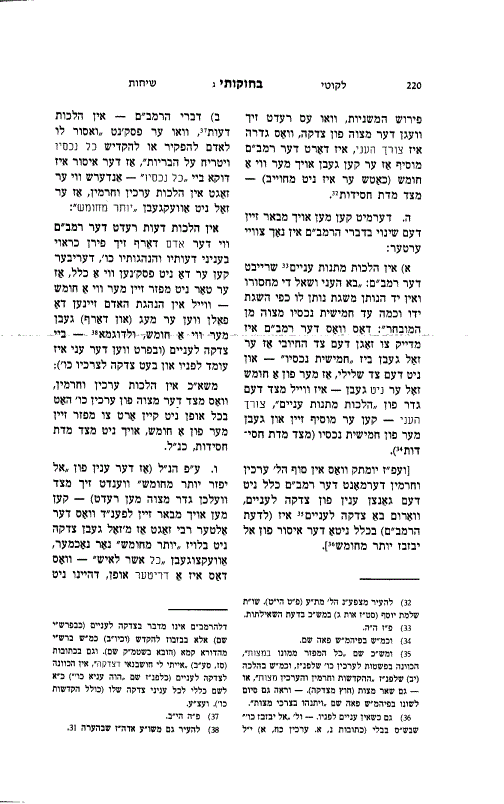
Why the Alter Rebbe Allows Giving Everything
Until now, the Rebbe explained the different rulings of the Rambam:
- In ordinary tzedakah, one may at times give more than a fifth if real need exists.
- In Arachin and voluntary consecrations, one should not give more than a fifth.
- In Hilchos De’os, the Rambam warns not to give away everything and become dependent on others.
Now the Rebbe returns to the words of the Alter Rebbe, who appears to go even further than all of these categories.
The Alter Rebbe speaks of a person giving not merely more than a fifth, but even all that he has—kol asher lo. How can that be reconciled with everything we learned until now?
Beyond a Fifth – and Beyond Every Limit
At first glance, the Alter Rebbe seems to challenge every earlier standard.
There were two accepted levels:
First Level:
Do not give more than a fifth.
Second Level:
At times one may give more than a fifth—but still not everything.
Even those who allow exceptional generosity still recognize some final boundary. A person may stretch greatly, but not reduce himself to nothing.
Yet the Alter Rebbe appears to introduce a third category entirely:
A person may give everything.
This requires explanation.
The Ragatchover’s Observation
The Rebbe cites the Rogatchover Gaon, who notes that from the Rambam in Pirush HaMishnayos it would seem that giving more than a fifth may be considered piety, but giving away all of one’s assets would still not be proper.
So even in the broadest reading of the Rambam, there remains a final limit.
One may exceed the standard measure.
But one still does not cross the line of total self-emptying.
Why the Alter Rebbe Is Different
The Rebbe explains that the key lies in understanding what kind of giving the Alter Rebbe is discussing.
Even when tzedakah allows more than a fifth, the essential definition of the mitzvah remains:
Helping the poor person.
That mitzvah is directed outward. Its purpose is to relieve another person’s need.
Since the goal is to help the recipient, the Torah does not demand that the giver destroy himself financially in the process.
Even generosity has boundaries.
But Here the Giving Is for the Soul
In Iggeres HaTeshuvah and Iggeres HaKodesh, however, the Alter Rebbe discusses a different type of giving altogether.
There, charity is not functioning only as assistance to the poor.
It is serving as:
- atonement,
- redemption from spiritual damage,
- replacement for fasting and self-affliction,
- healing of the soul.
The money becomes the means through which a person repairs himself.
This is no longer only a mitzvah between one person and another.
It is now a matter of the person’s own spiritual life.
And when one’s own soul is at stake, the rules change completely.
A Person Comes Before His Money
The Rebbe states the principle clearly:
A person comes before his possessions.
Money exists to serve the person.
The person does not exist to preserve the money.
If spending wealth can restore the soul, purify a life, or rescue spiritual existence, then it is understood that the person takes precedence over his assets.
One cannot say:
Keep your money, even if your soul remains wounded.
That would invert the true order of values.
Like Pikuach Nefesh
The Rebbe compares this to pikuach nefesh—saving a life.
When life is in danger, financial calculations fall away.
A person spends what is necessary:
- for medicine,
- for treatment,
- for rescue,
- for survival.
No one says:
Stop at twenty percent.
Because life overrides such limits.
So too here.
When the Alter Rebbe speaks of repairing the soul, he is dealing with spiritual life itself.
And for life, one gives whatever is needed.
As the verse says:
A person will give all that he has for his life.
Three Categories of Giving
The Rebbe has now outlined three distinct levels:
1. Measured Giving
Ordinary sacred spending or voluntary consecration.
Rule: do not exceed one-fifth.
2. Expanded Giving
Tzedakah for real human need.
At times one may give more than one-fifth.
3. Unlimited Giving
When one’s own spiritual life, atonement, or healing is at stake.
Then one may give even kol asher lo—all that he has.
A Practical Lesson
This teaching reaches far beyond money.
People often protect external things while neglecting inner life:
- wealth over character,
- comfort over growth,
- possessions over purpose,
- status over the soul.
The Rebbe reminds us:
The soul is worth more than the bank account.
Inner truth is worth more than stored resources.
A healed life is worth sacrifice.
Sometimes caution is holy.
Sometimes generosity is holy.
And sometimes saving the soul is holier than everything else.
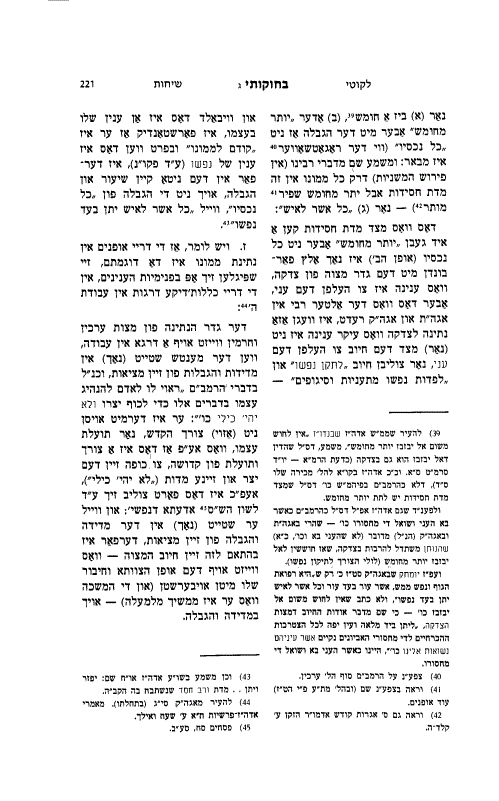
Three Levels of Giving in the Inner Service of Hashem
The Rebbe now takes everything we have learned in halachah and reveals its deeper inner meaning.
The three levels of giving money are not only legal categories. They reflect three general levels in Avodas Hashem—the inner service of a Jew in his relationship with the Eibeshter.
How a person gives outwardly mirrors how he serves inwardly.
Three Forms of Giving – Three Forms of Service
Until now, we saw three categories:
- Giving with limitation – not more than one-fifth.
- Giving beyond one-fifth – for the needs of another person.
- Giving everything – when one’s soul itself is at stake.
Now the Rebbe explains that these same three stages exist in spiritual life.
First Level
Serving Hashem Within the Limits of Self
The mitzvah of Arachin, Charamim, and similar forms of giving represents a level of service where the person is still centered within his own identity.
He serves Hashem.
He gives.
He improves himself.
But he still remains a distinct metzius—a self-aware entity working on himself.
The Rambam’s language reflects this:
A person uses these mitzvos in order to bend his inclination, refine his traits, and not be stingy.
That is noble and holy. But the focus is still:
My growth.
My discipline.
My character.
Even holiness can still revolve around the self.
Therefore the Giving Is Measured
Because the person is still functioning within the boundaries of self, his service is also measured.
His connection to Hashem comes through reason, order, and proportion.
Accordingly, what he gives is also limited:
Up to one-fifth.
The Rebbe explains that this is why the Rambam uses the unusual phrase:
“Over al daas hakasuv”
He goes against the intent of the verse.
Why say daas hakasuv?
Because this level of service is one of daas—understanding, structure, measured awareness.
When a person is still within that framework, acting beyond all boundaries is not yet true holiness.
For him, exaggerated behavior is not chasidus.
It is not sacred transcendence.
It is simply imbalance.
That is why the Rambam says such conduct, at this stage, is not piety but foolishness.
A Powerful Lesson
A person must know where he is holding.
Not every extreme is spiritual.
Not every dramatic act is holy.
If one has not yet refined the self, trying to leap beyond all limits may be illusion rather than elevation.
Second Level
Going Beyond Self for Another Jew
Then comes a higher stage.
A person begins to move beyond his own self-interest. He is no longer occupied mainly with fixing himself—even spiritually.
Now he thinks about another Jew.
What does the other person need?
How can I help him?
How can I relieve his burden?
This is expressed through the mitzvah of tzedakah.
The essence of tzedakah is not self-perfection. It is concern for another person.
The giver steps outside himself.
That itself is already a movement beyond limitation.
Therefore One May Give More
Because the person has gone beyond self, his giving also rises beyond the first measure.
He may now give more than one-fifth.
His spiritual connection draws from a deeper place than before.
Yet even here, there is still some measure.
Why?
Because the giving is still defined by the need of the recipient:
What does the poor person require?
What is appropriate for him?
So although this stage is higher than the first, it is not yet totally infinite.
There is still calculation, proportion, and measure.
Therefore one may give more—but not necessarily everything.
Third Level
The Essence of the Soul – Beyond All Measure
Higher than both is the service of repairing and awakening the soul itself.
This is not merely helping another.
It is not merely improving character.
It touches the essence of life.
The Rebbe compares this to pikuach nefesh—saving a life.
When life itself is at stake, there is no room for calculations.
No one asks:
How much should I spend?
What percentage is appropriate?
Life overrides such limits.
The Level of Yechidah
In the soul, this corresponds to the level of Yechidah—the deepest point of the soul, utterly one with Hashem.
At that level:
There is no ego.
There is no measurement.
There is no boundary.
There is only oneness with the Eibeshter.
From that place emerges the service of:
“B’chol me’odecha”
With all your might.
Not partial devotion.
Not measured devotion.
Total devotion.
Therefore, from this level one can give:
Kol asher lo—all that he has.
Because when the essence awakens, finite calculations fall away.
As the verse says:
A person gives everything for his life.
The Three Stages Summarized
1. Measured Service
I serve Hashem while still centered in myself.
Result: measured giving.
2. Expansive Service
I move beyond myself for another Jew.
Result: greater giving.
3. Essential Service
I touch the core of my soul united with Hashem.
Result: unlimited giving.
A Living Lesson
Every Jew experiences these stages.
Sometimes we serve Hashem carefully and responsibly.
Sometimes we rise higher and care deeply for others.
And sometimes the soul itself awakens, and we discover powers beyond all limits.
The Rebbe teaches that growth means moving through all three:
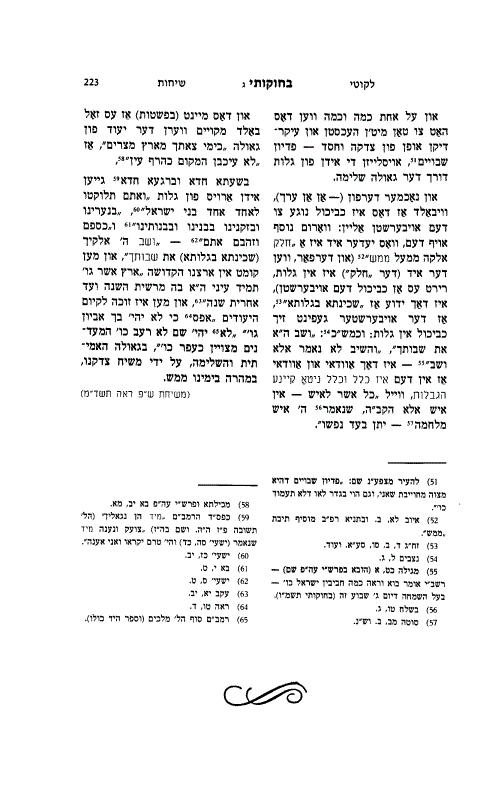
From self-discipline,
to selflessness,
to soul-essence.
And when the deepest point of the soul shines, there is no measure to what a Jew can give.
If We Must Give Beyond Measure, How Much More So Must Hashem
The Rebbe now turns the entire discussion into a powerful lesson in prayer, redemption, and the coming of Moshiach.
Until now, we learned the different levels of giving:
- measured giving,
- giving beyond a fifth,
- and giving everything when life itself is at stake.
Now the Rebbe applies this to the greatest giver of all—the Eibeshter Himself.
If a Jew Must Give Beyond a Fifth
We learned earlier that when a poor person comes and asks for what he truly needs, a Jew may be required to give beyond the ordinary measure.
Not only the standard amount.
Not only one-fifth.
But even more, when the need is real and urgent.
If this is true in the conduct of a human being, then certainly it is true—how much more so—regarding the tzedakah of the Eibeshter.
As we say:
“Lecha Hashem hatzedakah.”
“To You, Hashem, belongs righteousness.”
Hashem is the ultimate source of kindness, compassion, and giving.
When Jews Come and Ask
When Yidden stand in prayer, asking Hashem for their needs, we come like poor people before the door of the Merciful One.
We ask for:
- health,
- livelihood,
- peace,
- children,
- healing,
- blessing,
- salvation.
The Rebbe says: just as a person must answer the poor person’s plea, so too, so to speak, Hashem fulfills the requests of His children.
And not in a limited way.
He gives beyond the ordinary measure.
He gives more than a fifth.
Of course, speaking figuratively, what would it mean to speak of “a fifth” of Hashem’s treasures?
It means that Divine blessing is never constrained. When Hashem gives, He can give in abundance beyond all measure.
The Highest Form of Tzedakah – Pidyon Shevuyim
But then the Rebbe rises to an even greater level.
There is a form of charity considered among the greatest of all:
Pidyon Shevuyim—redeeming captives.
If saving an ordinary captive is one of the highest forms of tzedakah, then what about the entire Jewish people in exile?
The Jewish nation cries out from Golus.
We ask Hashem to redeem us from dispersion, pain, concealment, and suffering through the complete Geulah.
Surely this is the highest possible act of Divine kindness.
And therefore the giving must be immeasurable.
Why Redemption Touches Hashem Himself
The Rebbe explains that Geulah is not only our need—it touches Hashem Himself.
Every Jew Is a Part of Hashem
Every Jew possesses a Divine soul, a cheilek Elokah mimaal mamash—an actual portion of G‑dliness from above.
When a Jew suffers in exile, that pain touches Heaven itself.
The Shechinah Is in Exile
Beyond that, Chazal teach:
“Shechinta b’golusa.”
The Divine Presence is in exile.
Hashem, so to speak, accompanies His people into Golus.
Therefore redemption is not only bringing us home.
It is also the revelation of Hashem’s own Presence.
That is why the verse says:
“Veshav Hashem Elokecha es shvusecha.”
It does not merely say He will bring back your captivity. It says He Himself will return together with your return.
Therefore There Is No Limitation
Now the Rebbe connects this to the verse discussed in the sichah:
“Kol asher la’ish yitein b’ad nafsho.”
A person gives everything for his life.
The term ish can also refer to Hashem, as in the verse:
“Hashem ish milchamah.”
“Hashem is a man of war.”
So too here:
Hashem gives everything, so to speak, for this redemption.
There is no limitation.
No measure.
No boundary.
No delay.
The Redemption Must Come Immediately
Therefore, the Rebbe says, the promise of Geulah should be fulfilled immediately.
As in the days of the Exodus from Egypt:
Hashem did not delay even the blink of an eye.
So too now, in one instant and one moment, the Jewish people should leave exile.
“K’heref ayin”—in the blink of an eye.
Gathered One by One
The prophets promise:
“Va’atem teluktu l’echad echad Bnei Yisrael.”
“You will be gathered one by one, Children of Israel.”
No Jew forgotten.
No Jew left behind.
With:
- our youth,
- our elders,
- our sons,
- our daughters.
With our possessions as well:
- silver,
- gold,
- blessing,
- dignity.
And together with us, the Shechinah returns from exile.
Coming to the Holy Land
We will enter Artzeinu HaKedoshah—our holy land, the land about which the Torah says:
“Tamid einei Hashem Elokecha bah.”
“The eyes of Hashem your G‑d are always upon it.”
From the beginning of the year until the end of the year.
A land of revealed blessing and Divine care.
The World of Redemption
Then all the promises of Torah will be fulfilled:
“Efes ki lo yihyeh becha evyon.”
There will be no poor among you.
There will be no hunger.
No suffering.
No exile.
And as the Rambam writes:
All delights will be as common as dust.
The world itself will become open goodness.
The Final Message
The Rebbe began with the laws of giving money.
He ends with the greatest giving of all:
Hashem giving the world its redemption.
If we are commanded to give with compassion, how much more so does the Eibeshter give with infinite compassion.
May it be fulfilled speedily:
The true and complete Geulah
through Moshiach Tzidkeinu
immediately, in our days ממש.