We will review a sicha from Likkutei Sichos, Chelek Chaf-Zayin (Volume 27). This is the second sicha on Parshas Metzora.
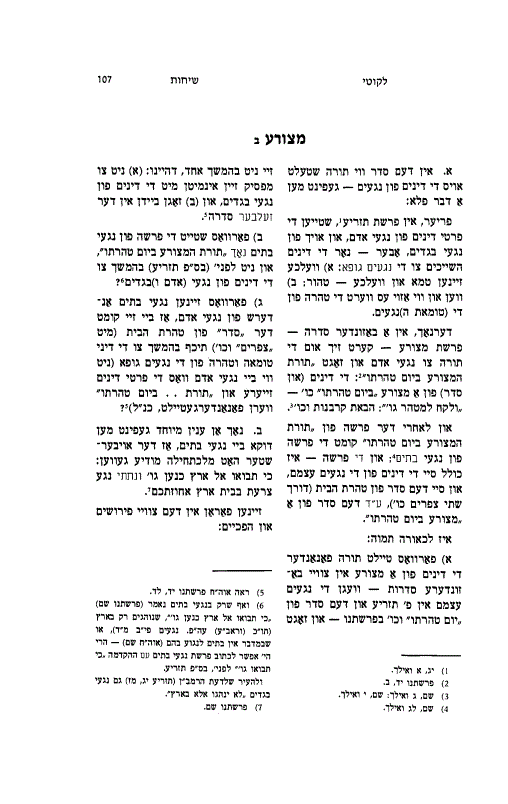
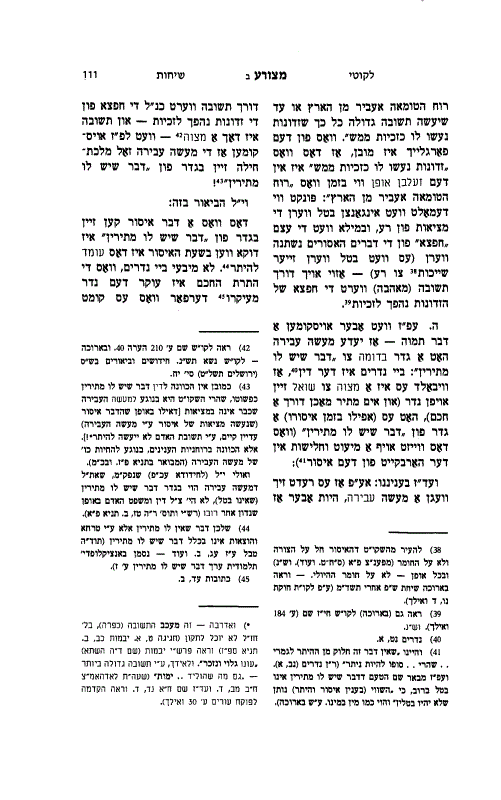
In this sicha, the Rebbe discusses a very fascinating idea regarding the different types of nega’im—plagues or afflictions. We find nega’im on a person, on garments, and on homes. The Rebbe analyzes how the Torah presents these categories and raises a fundamental question about the structure and order in which they appear.
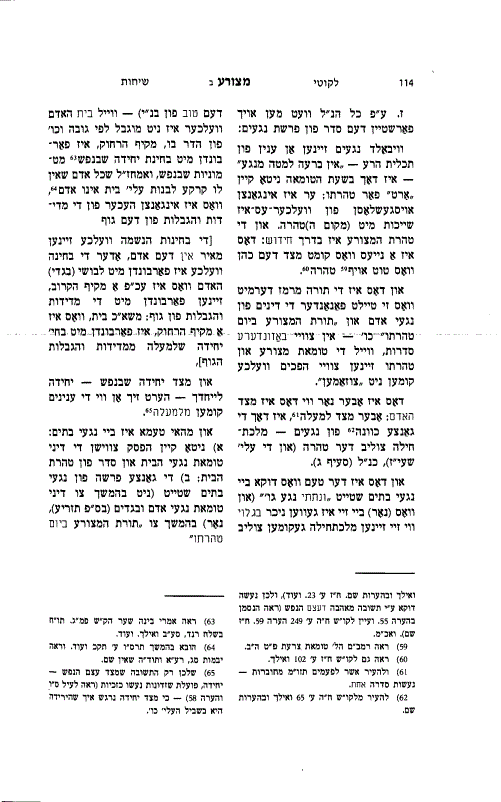
In Parshas Tazria, the Torah discusses the plagues affecting a person and garments. It describes their appearance, their status—whether they are tamei or tahor—and how long the tumah lasts. However, it does not describe the process by which a person becomes tahor after being tamei.
Then, in Parshas Metzora, the Torah returns to the subject of the metzora and provides the procedure of purification: “Toras HaMetzora beyom taharaso”—the laws governing the metzora on the day he becomes purified. This includes the process involving the birds, the offerings, and all the steps necessary for his purification.
After that, at the end of Parshas Metzora, the Torah introduces the plagues of homes (nigei batim). There, everything is presented together—the laws of the plague itself and the process of purification, including the procedure involving the two birds.
This structure raises several questions.
First: Why does the Torah split the laws of the metzora into two separate sections?
The laws of the nega itself are in Parshas Tazria, while the process of purification is in Parshas Metzora. Why are they not presented together in a single continuous section, as is done with the plagues of homes?
Additionally, why is there an interruption in between with the laws of nigei begadim (plagues on garments)? Why not present all aspects of human nega’im—both the affliction and its purification—in one sequence?
Second: Why are the plagues of homes discussed only after the section of Toras HaMetzora beyom taharaso?
Seemingly, they should have been included earlier, at the end of Parshas Tazria, alongside the plagues of a person and garments. Instead, the Torah delays their discussion until after the purification process of the metzora.
Third: What is fundamentally different about nigei batim compared to nigei adam?
By nigei batim, the Torah immediately presents both the affliction and its purification in one continuous flow. By contrast, for a person, the process is divided—first the affliction, then later the purification.
The Rebbe explains that this structure is precise and meaningful, reflecting deeper inner concepts (pnimiyus ha’inyanim), which we will come to understand.
There is another unique aspect regarding nigei batim.
The Torah introduces them with the words:
"Ki tavo’u el eretz Canaan… v’nasati nega tzara’as b’veis eretz achuzaschem"—
“When you come to the land of Canaan… I will place a plague of tzara’as in the houses of your possession.”
This sounds like an announcement from Hashem—almost as if it is something intentional, even positive.
In fact, there are two completely opposite interpretations of this phenomenon.
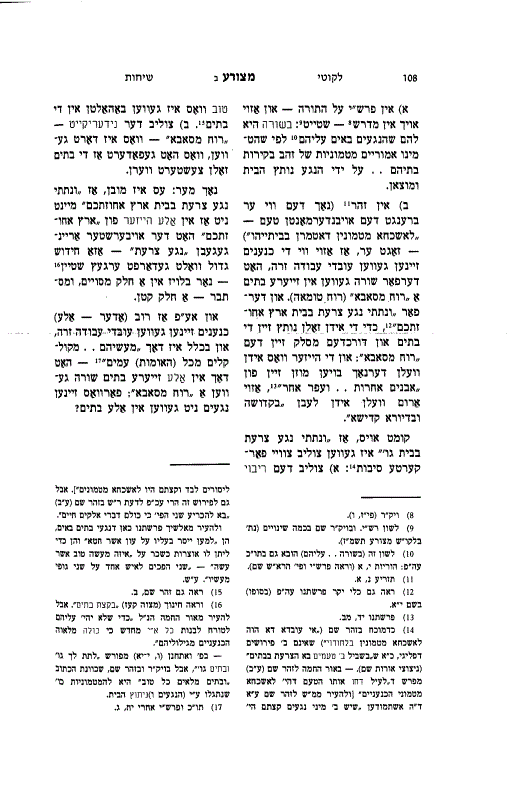
According to Rashi (and similarly in the Midrash), this is actually good news—“besora lahem.”
The reason is that the Amorites had hidden treasures of gold within the walls of their homes. When the plague appears, the house must be broken down, and through this process, the hidden treasures are discovered.
Thus, the plague ultimately leads to great benefit.
However, the Zohar presents a different perspective.
While it also acknowledges the presence of hidden treasures, it explains that the homes of the Canaanites were steeped in impurity. Since they were idol worshippers, their homes absorbed a corrupt and impure spiritual influence—a ruach mesavah, a repugnant and defiling spirit.
Therefore, the purpose of the plague is to destroy these homes and remove that impurity. The Jewish people would then rebuild their homes using new materials—avanim acheros and afar acher—creating a dwelling rooted in holiness.
Thus, we have two opposite explanations:
- The plague comes because of the hidden good—the treasures within the home.
- The plague comes because of the deep impurity—the need to eliminate the defiled structure.
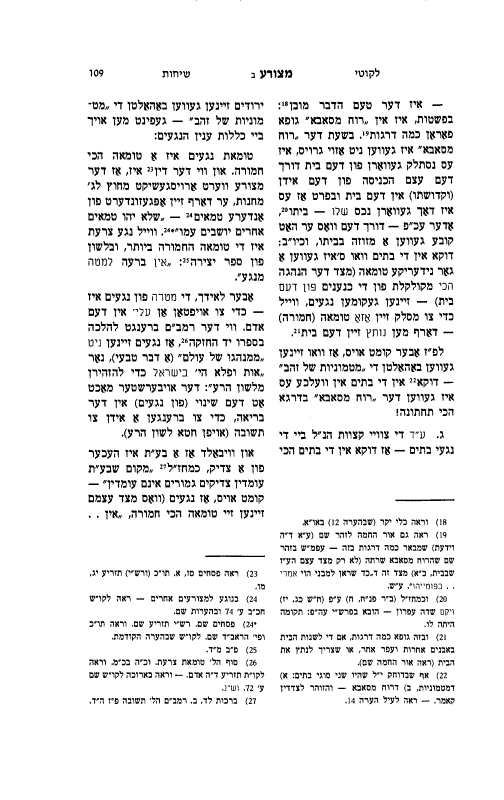
The Rebbe adds a further insight.
Not all homes in Eretz Yisrael were affected by these plagues. If that were the case, the Torah would have explicitly stated such a remarkable occurrence.
Rather, only a specific portion—likely a small number of homes—were afflicted.
Why those homes?
Because even within impurity, there are levels. Some homes had a lesser degree of impurity, which could be removed simply by a Jew entering the home, living there, and especially by affixing a mezuzah. The holiness of a Jew was sufficient to transform those environments.
However, in homes where the impurity was particularly severe—due to the extreme corruption of their inhabitants—the only solution was complete destruction.
Here lies a striking paradox:
It is דווקא in those most impure homes—the ones requiring destruction—that the greatest treasures were hidden.
This paradox reflects a broader principle found in nega’im in general.
On one hand, tzara’as represents one of the most severe forms of impurity. The metzora is sent outside all three camps and must remain isolated—even from other impure individuals. As the Sefer Yetzirah expresses: “Ein ra lematah mi’nega”—there is nothing lower than a nega.
On the other hand, the Rambam explains that nega’im are not a natural phenomenon, but a miraculous sign given to guide a person toward teshuvah, particularly from the sin of lashon hara.
Thus, the very affliction that represents the lowest level serves as a catalyst for reaching the highest level.
As our Sages say:
"Makom sheba’alei teshuvah omdim, tzaddikim gemurim einam omdim"—
“In the place where ba’alei teshuvah stand, even completely righteous individuals cannot stand.”
The Rebbe highlights this idea through the words nega and oneg.
They consist of the same letters—נ, ג, ע—but in different order.
- Nega represents the lowest state.
- Oneg represents the highest—divine pleasure and spiritual elevation.
Through teshuvah, one transforms nega into oneg—from the lowest to the highest.
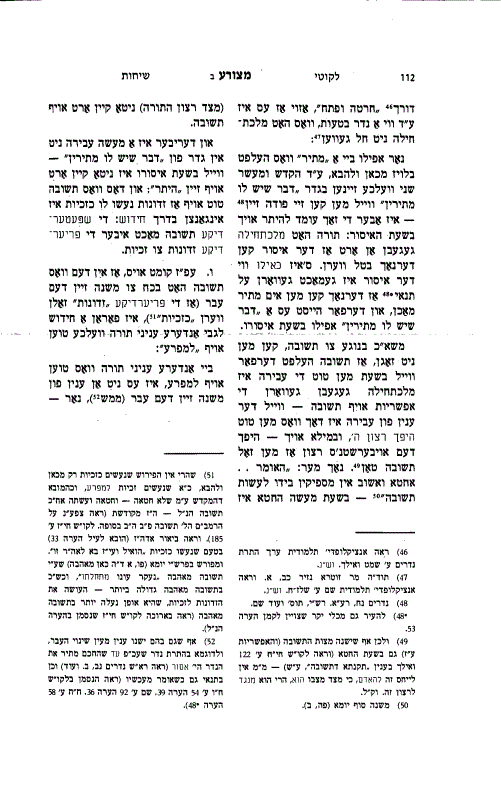
This also explains the structure of the Torah’s presentation.
By a person, the process involves transformation. It takes time for the individual to internalize the experience, repent, and grow. Therefore, the Torah separates the affliction and the purification into different sections.
But by a house, there is no process of inner transformation—only removal of impurity. Therefore, the affliction and purification are presented together.
Finally, the Rebbe connects this idea to the broader concept of exile.
Just as the Jewish people entered Egypt—the lowest of places—to extract the hidden sparks of holiness, so too in exile we encounter spiritual concealment in order to elevate it.
Through this process, we ultimately reach the highest level—the level of ba’al teshuvah—and prepare for the coming of Mashiach.
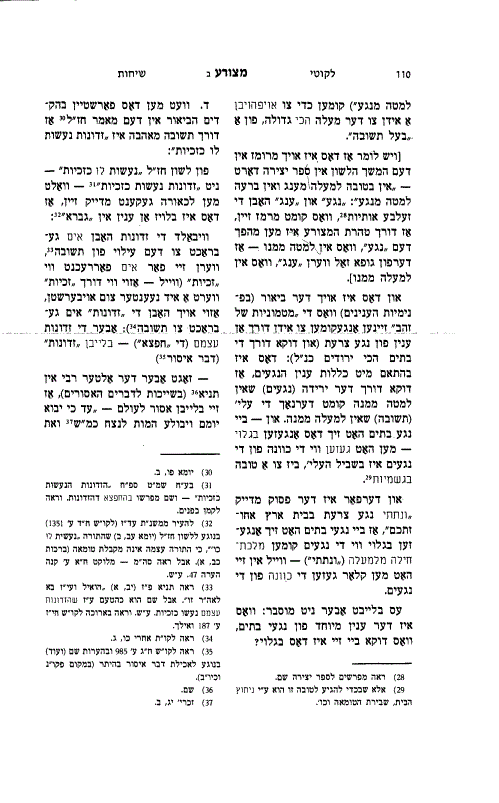
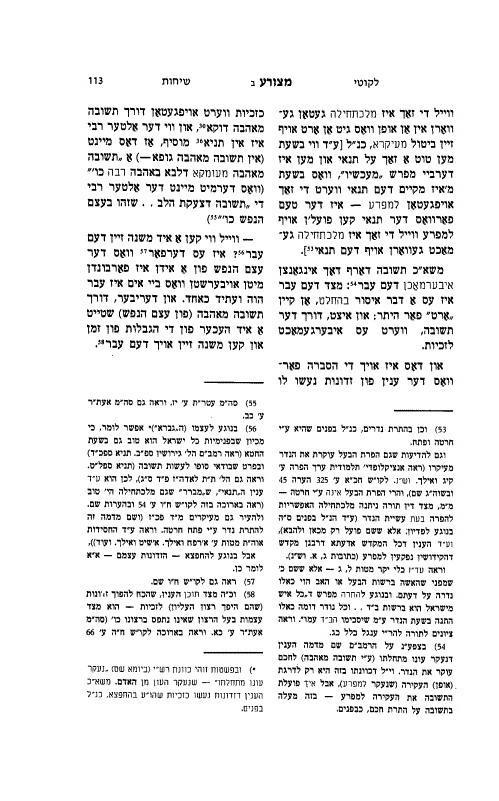
The Rebbe now deepens the explanation of the concept that nega and oneg share the same letters.
The Rebbe explains that this is not merely a linguistic coincidence, but a profound allusion: through nega, one reaches the level of oneg.
As the Sefer Yetzirah states:
"Ein b’tovah l’ma’alah me’oneg, v’ein b’ra l’matah mi’nega"—
There is nothing higher than oneg on the side of good, and nothing lower than nega on the side of evil.
Both words contain the same letters—נ, ג, ע—but in different order. This hints that the lowest level can be transformed into the highest.
Through the purification of the metzora, the nega—which represents the lowest level—can be transformed into oneg, the highest level.
This transformation reflects the power of teshuvah: from the lowest descent emerges the greatest elevation.
This helps explain the earlier paradox regarding the homes.
Specifically in the most defiled homes—those that had to be destroyed—were hidden the greatest treasures.
This is not only a physical reality but also a spiritual one.
The treasures represent the elevation that comes precisely through the descent. It is specifically through reaching the lowest point—“ein l’matah mimeno”—that one can ascend to the highest level—“ein l’ma’alah mimeno.”
By nigei batim, this dynamic is revealed openly.
One can clearly see that the purpose of the nega is for the sake of elevation—even in a tangible, physical way, through the discovery of treasures.
This is why the Torah uses the expression “v’nasati”—“I will give.” The nega itself is presented as a gift, because its purpose is ultimately positive and beneficial.
However, the Rebbe now asks:
Why is this transformation so openly visible specifically in nigei batim?
What is unique about a house that allows this idea to be revealed so clearly?
The Rebbe explains that a bayis represents a higher, encompassing level—a makif.
In terms of the soul, this corresponds to the level of yechidah, the deepest essence of the soul.
At this level, transformation can occur in its most complete form. The deepest impurity can be overturned into the greatest good, because the essence of the soul is always connected to Hashem.
The Rebbe now turns to a deeper discussion of teshuvah itself.
What does it mean that through teshuvah me’ahavah, intentional sins (zdonos) become merits (zechuyos)?
At first glance, one might think this only means that for the person, the sins are considered merits—because they led him to teshuvah. In other words, the benefit lies in the result, not in the transformation of the act itself.
However, the Rebbe explains that this is not sufficient.
The Alter Rebbe in Tanya makes it clear that the sins themselves are transformed into merits—not just in how they are counted for the person.
This is evident from the comparison made in Tanya between teshuvah and the future time of redemption (le’asid lavo), when the spirit of impurity will be entirely removed from the world—“v’es ruach hatumah a’avir min ha’aretz.”
Just as in that future state, evil itself will cease to exist, so too through teshuvah me’ahavah, the very substance of the sin is transformed into good.
This raises a powerful question.
If every sin can ultimately be transformed into merit through teshuvah, does that mean that sin is not so severe—since it can be “fixed”?
Would this make every sin comparable to a davar sheyesh lo matirin—something that can eventually be permitted?
The Rebbe explains that this is not the case.
A davar sheyesh lo matirin is something that, even at the time of prohibition, already has a built-in path to becoming permitted.
For example, a vow (neder) can be annulled, or consecrated items (hekdesh) can be redeemed. In such cases, the possibility of change is inherent from the outset.
However, this is not true of sin.
At the moment a person commits an aveirah, there is no allowance for it. It is a direct violation of Hashem’s will.
One cannot say: “I will sin and then repent,” because such a person is not granted the opportunity to repent—“ha’omer echta v’ashuv, ein maspikim b’yado la’asos teshuvah.”
Therefore, teshuvah is not a built-in feature of the sin.
Rather, it is a complete chiddush—a radical transformation that occurs afterward.
Through teshuvah, the past itself is changed. The sins are not merely reinterpreted—they are actually transformed into merits.
This reveals the extraordinary power of teshuvah.
Unlike other halachic mechanisms that can retroactively affect a situation, teshuvah does not merely redefine the past—it transforms its very essence.
This ability to transform the past requires access to a deeper level of the soul—the etzem hanefesh.
It is from this essential level, represented by the concept of a bayis, that such a profound transformation becomes possible.
Thus, the Rebbe shows that the themes of nigei batim, nega and oneg, and teshuvah are all interconnected.
From the lowest descent emerges the highest ascent.
From nega comes oneg.
From sin comes transformation.
And through this process, a person reaches the deepest connection with Hashem.