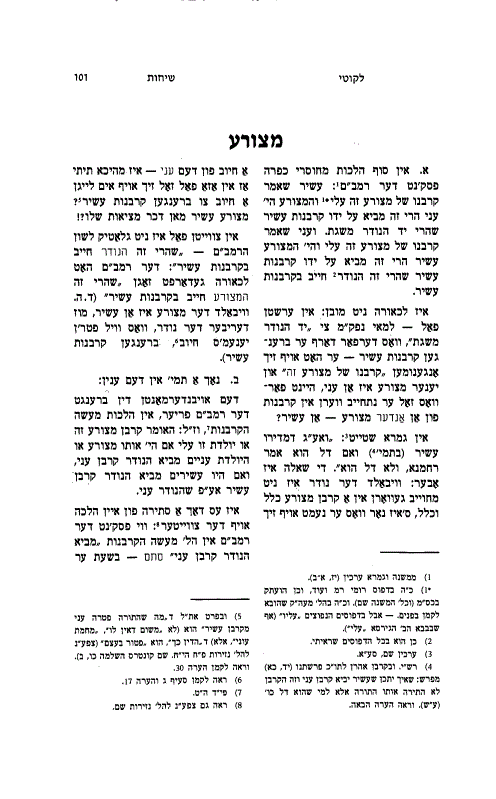
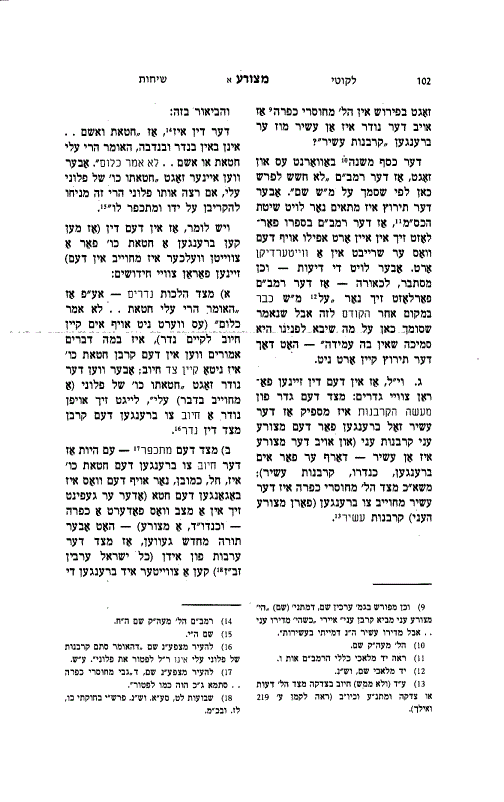
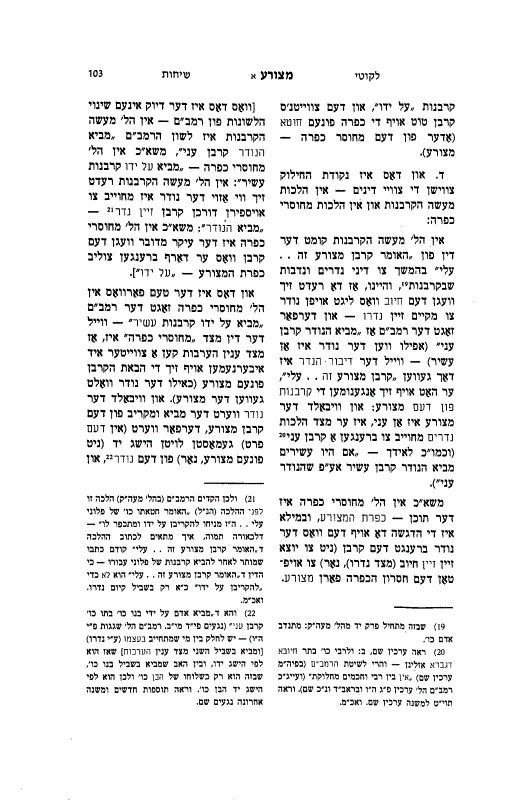
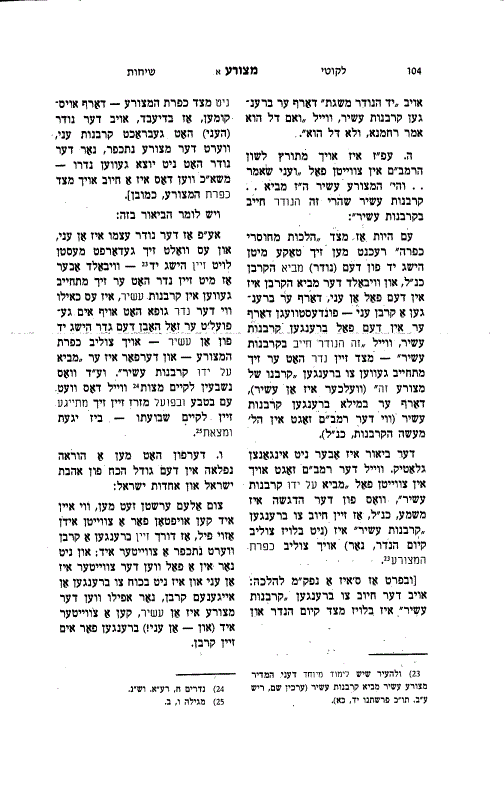
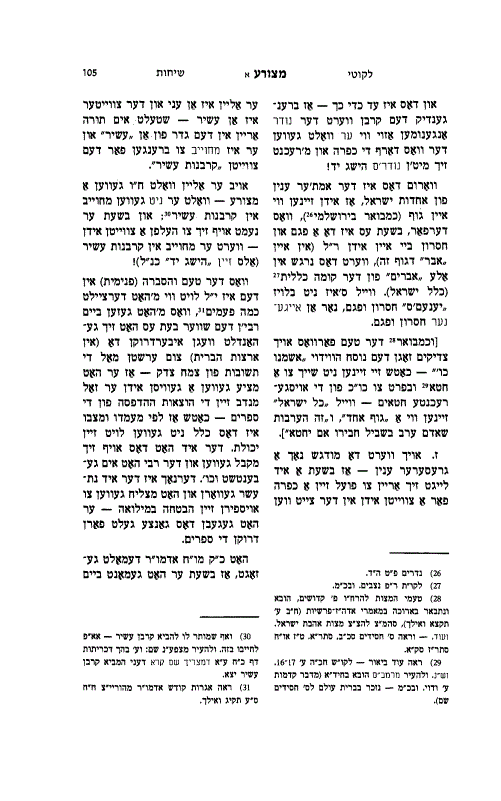

We are going to learn a sicha from Likkutei Sichos, Volume 27, the first sicha on Parshas Metzora.
In this sicha, the Rebbe explains a difficult Rambam that deals with the different korbanos that a metzora—someone afflicted with tzaraas—must bring when he becomes purified. The Torah distinguishes between a wealthy metzora and a poor one. A wealthy metzora must bring a more expensive offering—an animal—whereas a poor metzora may bring a bird. So there is a clear difference between the korban of a poor person and that of a wealthy person.
There is, however, another halacha: if someone says, “I will take upon myself to bring the korban of this metzora,” meaning he assumes the obligation on behalf of the metzora, the question arises—what korban must he bring? Does it depend on his own financial status, or on the status of the metzora? Must he bring the korban of a wealthy person or of a poor person?
The Rambam seems to present a contradiction, and the Rebbe will explain that there are actually two separate obligations here. One obligation stems from the neder (the vow) that the person made—he obligated himself, and for that obligation he only needs to bring what he accepted upon himself. However, if he is bringing the korban in place of the metzora, so that the metzora no longer needs to bring anything, then he must bring whatever the metzora himself would have been obligated to bring.
We will go step by step, because this is a complex sugya.
Step One: The Rambam’s Ruling
At the end of Hilchos Mechusrei Kaparah, the Rambam rules:
A wealthy person says, “The korban of this metzora is upon me.” The metzora himself is poor. If the metzora had brought the korban, he would only need to bring a poor person’s korban—a bird.
However, the one taking it upon himself is wealthy.
The Rambam rules:
He must bring the korban of a wealthy person.
Why?
Because “the one who made the vow has the means”—he is wealthy.
Similarly, in the reverse case: if the metzora is wealthy, and the one who takes it upon himself is poor, it does not help—the one who takes it upon himself must still bring the korban of a wealthy person, because that is what the metzora is obligated in.
The Rambam continues:
A poor person says, “The korban of this metzora is upon me,” and the metzora is wealthy—he must bring the korban of a wealthy person.
And the Rambam’s wording is:
“Because the one who made the vow is obligated in the korban of a wealthy person.”
The Rebbe’s Question
The Rebbe asks:
Why does the Rambam say that the one who made the vow is obligated in a wealthy korban?
Seemingly, he should have said:
“Because the metzora is obligated in a wealthy korban.”
After all, the obligation originates with the metzora, not with the one making the vow.
The First Major Question
Let’s analyze the first case.
A wealthy person takes upon himself the korban of a poor metzora.
Why should it matter that the one making the vow is wealthy?
He accepted upon himself the korban of this metzora—who is poor. That metzora only needs to bring a poor person’s korban. So why should the one taking it upon himself have to bring more than what the metzora himself would have brought?
He never accepted more than that.
So why obligate him in a wealthy korban?
The Gemara’s Approach
The Gemara seems to treat this as obvious:
The Torah says, “If he is poor”—only a poor person can bring the reduced korban.
Here, the one bringing the korban is not poor—so he cannot bring a poor korban.
But the Rebbe challenges this:
This person is not obligated in a korban at all! He is not a metzora. His only obligation comes from taking upon himself the place of the poor metzora.
So why should we suddenly impose upon him the obligation of a wealthy metzora?
Where does that come from?
We are not dealing with a wealthy metzora at all—only with a poor one!
The Second Question (Reverse Case)
In the reverse case, the logic seems more understandable:
If the metzora is wealthy, then even if the one taking his place is poor, he must bring the wealthy korban—because he is stepping into the metzora’s obligation.
However, even here the Rambam’s wording is problematic:
He says:
“The one who made the vow is obligated in the korban of a wealthy person.”
Why say that?
It should say:
“The metzora is obligated.”
The Contradiction in Rambam
There is an even stronger question.
In Hilchos Maaseh HaKorbanos, the Rambam writes:
If someone says, “The korban of this metzora or this woman (after childbirth) is upon me,” and that person is poor—
the one making the vow brings a poor person’s korban.
No distinction is made whether the one taking it upon himself is wealthy or poor.
So there, it seems clear:
You bring the korban of the person you are replacing—nothing more.
But in Hilchos Mechusrei Kaparah, the Rambam says:
If the one making the vow is wealthy, he must bring a wealthy korban—even if the metzora is poor.
This is a clear contradiction.
The Kesef Mishneh’s Answer
The Kesef Mishneh explains:
The Rambam relies on what he writes later in Hilchos Mechusrei Kaparah, and therefore does not repeat the condition earlier.
But the Rebbe rejects this:
Hilchos Mechusrei Kaparah comes after Hilchos Maaseh HaKorbanos.
How can the Rambam rely on something he hasn’t yet written?
Many commentators disagree with the Kesef Mishneh on this principle.
So the contradiction remains.
The Rebbe’s Approach
The Rebbe explains:
There are two perspectives here—two definitions of what is happening when someone takes upon himself another person’s korban.
- From the perspective of the act of bringing the korban (Maaseh HaKorbanos):
The person is fulfilling his neder.
He only needs to bring what he accepted—i.e., the korban of the poor metzora. - From the perspective of fulfilling the obligation of the metzora (Mechusrei Kaparah):
He is stepping into the metzora’s obligation.
In that case, the korban must meet the standards of the one bringing it.
And here is the key point:
You can make a neder to bring a gift—but you cannot create or redefine a halachic obligation (like a korban chatas). When fulfilling someone else’s obligation, you must meet the halachic criteria of that obligation.
Conclusion of This Section
Therefore:
From the standpoint of the act of korban—
a wealthy person could bring a poor korban for a poor metzora.
But from the standpoint of fulfilling the obligation properly—
the one bringing it must qualify, and therefore must bring a korban that fits his own status.
And that is why, in Hilchos Mechusrei Kaparah, the Rambam requires a wealthy korban when the one bringing it is wealthy.
From the perspective of the halachos as they are in Hilchos Ma’aseh HaKorbanos, all you need to bring is what you accepted upon yourself.
That is why the Rambam rules there:
If the metzora is poor, you bring a korban oni.
If the metzora is wealthy, you bring korbanos ashir.
This is all from the perspective of Ma’aseh HaKorbanos—the act of bringing the korban.
In that framework, as the Rebbe explains, everything follows your neder:
You must bring exactly what you committed yourself to.
However, when we shift to the perspective of Mechusarei Kapparah—those who require atonement—this is no longer about your vow. It is about the korban that the other person needs for kapparah.
So if you are wealthy, and you are bringing a korban on behalf of a poor metzora, you must bring a korban ashir.
Why?
Because now the issue is not fulfilling your neder—it is ensuring that the other person receives proper kapparah. And kapparah cannot be determined by your preference. It must follow halachic standards.
If you are stepping in as the one bringing the korban, then the kapparah must correspond to your status. If you are an ashir, the korban must be one that qualifies as a korban ashir.
The Rambam explains an important principle:
A chatas or asham—the types of korbanos brought by a metzora or a yoledes—cannot be brought as a neder or nedavah.
You cannot say, “I want to bring a chatas as a gift.”
Such a statement has no halachic validity.
However, there is an exception:
If someone already owes a chatas, and you say,
“His chatas is upon me,”
then your vow takes effect.
And if the person agrees, you can bring the korban on his behalf—and he is atoned through your offering.
This introduces two major novelties:
- Normally, you cannot make a neder for a chatas—but here, you can, because it is tied to an existing obligation.
- The person who is obligated receives kapparah through someone else’s korban.
This is a tremendous chiddush.
Even though the one bringing the korban is not the one who sinned or who requires atonement, nevertheless, through responsibility for one another, one Jew can bring a korban and effect kapparah for another.
The Core Distinction
This now explains the difference between the two halachos:
In Hilchos Ma’aseh HaKorbanos:
- The discussion is about your neder.
- You only need to fulfill what you committed.
- Therefore, if the metzora is poor, you bring a korban oni—even if you are wealthy.
In Hilchos Mechusarei Kapparah:
- The discussion is about kapparah.
- You are now acting as the one bringing the korban for atonement.
- Therefore, the korban must match you—the one bringing it.
If you are an ashir, you must bring a korban ashir.
This also explains the Rambam’s language:
In Ma’aseh HaKorbanos, the focus is on the one who made the vow, because the issue is fulfilling his neder.
In Mechusarei Kapparah, the focus shifts to the korban itself and its role in kapparah—and therefore the one bringing it must meet the required standard.
Resolving the Earlier Question
We asked:
Why does the Rambam say that the noider (the one who vowed) is obligated in a korban ashir?
Now it is understood:
Because once he undertakes the obligation, he becomes the one bringing the korban. We evaluate him. If he is wealthy, he must bring a korban ashir.
And in the reverse case—when a poor person takes upon himself the korban of a wealthy metzora—he must bring a korban ashir not because of his own status, but because of the neder he made.
He obligated himself to bring that korban—and therefore he must fulfill it.
Final Clarification
So we now have a perfect balance:
- From the perspective of korban (kapparah) → we evaluate the person bringing it.
- From the perspective of neder (commitment) → we evaluate what was accepted.
The Rebbe’s Powerful Lesson
From this halacha, the Rebbe derives an incredible lesson about Ahavas Yisroel and unity.
One Jew can do so much for another.
A person can bring a korban, and another Jew receives kapparah through it.
This applies not only when the other person lacks the ability—but even when both are poor or both are wealthy. The very fact that one Jew can step in for another shows the depth of responsibility we have for each other.
More than that:
When you take responsibility for another Jew, you don’t just help him—you actually become elevated.
If a poor person takes upon himself the obligation of a wealthy person, he must bring a korban ashir. In a certain sense, he becomes like an ashir.
Helping another Jew lifts you to a higher level.
The Unity of the Jewish People
As explained in the Yerushalmi, all Jews are like one body.
If one limb is lacking, the entire body feels it.
So too, if one Jew is lacking, it is not “his problem”—it becomes our problem.
This is why even tzaddikim say “Ashamnu”—we have sinned—even though they themselves did not sin.
Because all Jews are one.
A Story from the Rebbe Rayatz
The Rebbe shared:
When they were preparing to print the responsa of the Tzemach Tzedek in the United States, the Rebbe Rayatz approached a certain individual and asked him to cover the printing costs.
At the time, this was completely beyond his financial ability.
Yet he accepted the responsibility.
The Rebbe blessed him.
In the end, he became wealthy and was able to fully fund the printing.
The Rebbe Rayatz later explained:
When he asked him, it was indeed beyond his means—even as decreed from Above.
But because he took on this responsibility, new channels of parnassah were opened for him.
The Final Message
So too in our case:
When Hashem sees that a Jew goes beyond his limitations—especially to help another Jew—Hashem opens new channels and grants him the ability to fulfill what he took upon himself.
This is the depth of the sicha:
Not only are we responsible for each other—but through that responsibility, we ourselves are elevated beyond our natural limitations.