מבוא
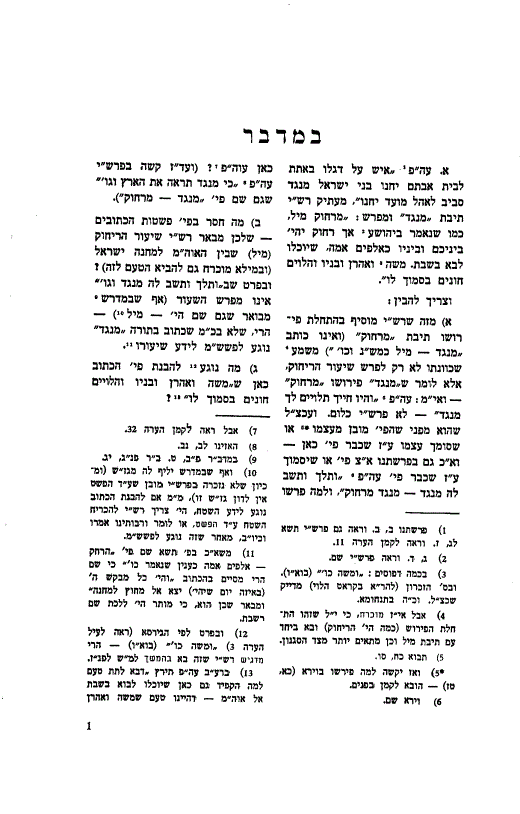
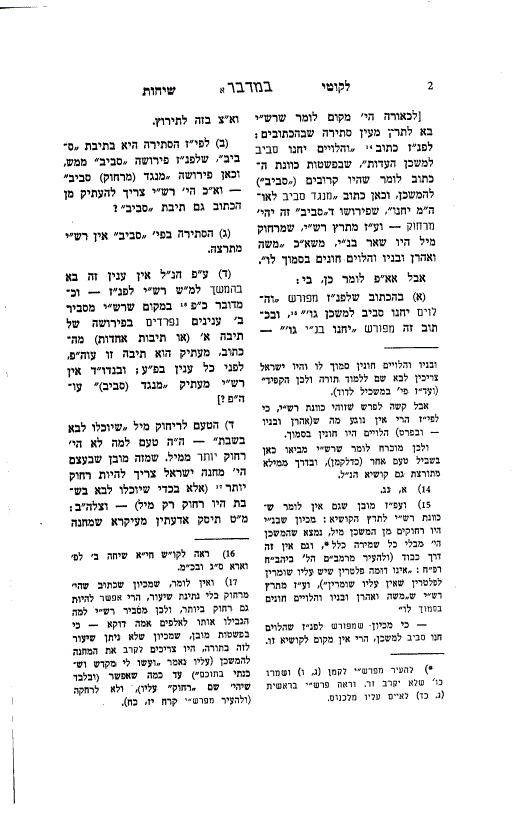
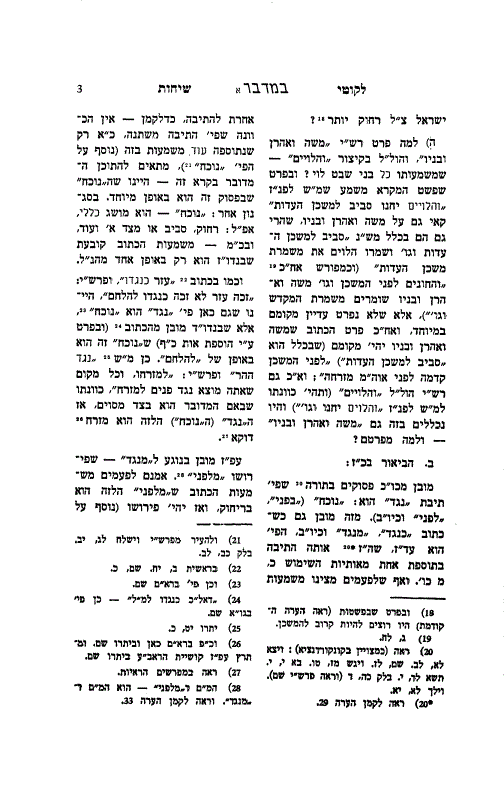
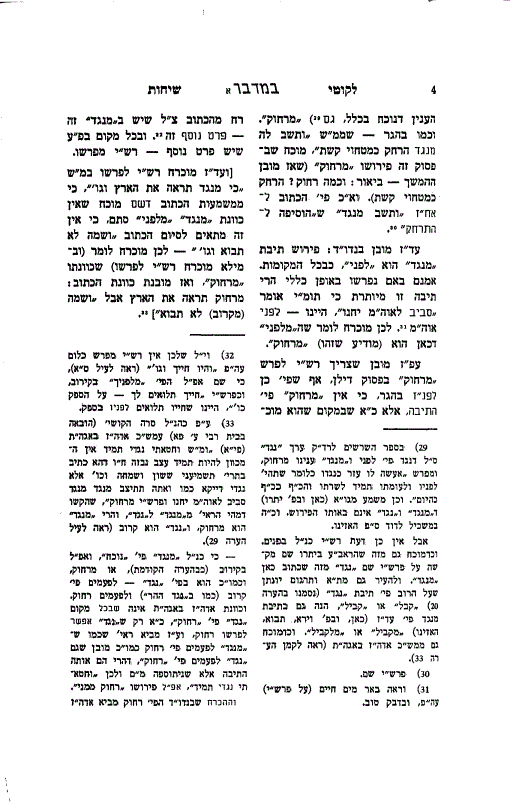
In this sicha from Likkutei Sichos Chelek Yud Gimel, the Rebbe analyzes a Rashi on Parshas Bamidbar. The focus is on the verse where Rashi translates the word מנגד (mi-neged). The Rebbe explores various verses that use the words נגד and מנגד, clarifying their precise meanings and how Rashi interprets them.
The discussion begins with the second chapter of Parshas Bamidbar. The Torah describes how the Jewish people camped around the Ohel Moed—the Tent of Meeting—and how they positioned themselves in relation to it. The verse states that each person should camp by his flag: איש על דגלו.
Each tribe had its own flag, and people would identify their place by looking for their tribe’s flag. According to one explanation in Rashi, the color of each flag matched the color of that tribe’s stone in the Choshen—the breastplate worn by the Kohen Gadol. These flags served as signs (osiyos) for each tribe, with colored cloths corresponding to their unique identity.
The verse also mentions לבית אבותם—each person followed his father’s house, meaning tribal affiliation was determined by paternal lineage. Everyone went to their father’s tribe and camped under that flag.
Thus, בני ישראל camped in this organized way whenever the Mishkan remained stationary. Later verses describe how they traveled when the cloud lifted, but here the focus is on their encampment.
The Torah uses the word מנגד—translated as “in front”—to describe their position relative to the Ohel Moed. As we’ll see, this term has a specific meaning that will be clarified through Rashi’s commentary and further analysis.
Finally, it says: סביב לאהל מועד יחנו—all around, surrounding the Ohel Moed, they would camp. This sets up the discussion for understanding exactly what מנגד means in this context and how it fits into the overall arrangement of the tribes around the Mishkan.
סעיף א׳
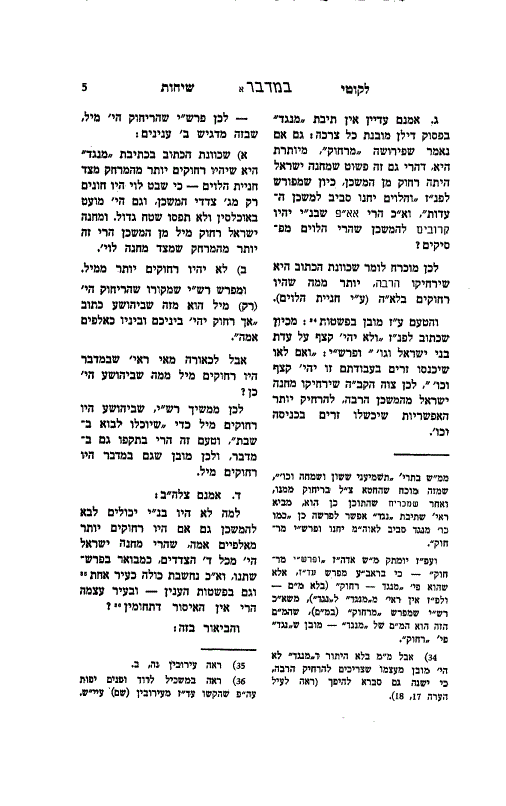
The Torah describes the encampment of Bnei Yisrael as being “min neged”—in front of, or opposite—the Mishkan, all around. The word “min neged” is generally translated as “in front,” but here Rashi explains its specific meaning in this context.
Rashi quotes the word “min neged” from the verse and explains: “me’rochek mil”—they were at a distance of a mil (which is 2,000 amos). Rashi then brings a proof from the verse in Yehoshua (chapter 3, verse 4):
אך רחוק יהיה ביניכם ובינו כאלפים אמה במידה.
This teaches that there should be a distance of 2,000 amos between you and the Aron. Since a mil equals 2,000 amos, we see that Bnei Yisrael camped at this distance from the Mishkan. Rashi further explains the reason for this arrangement: so that they would be able to come to the Mishkan on Shabbos without violating the prohibition of techum Shabbos—walking more than 2,000 amos outside one’s place on Shabbos.
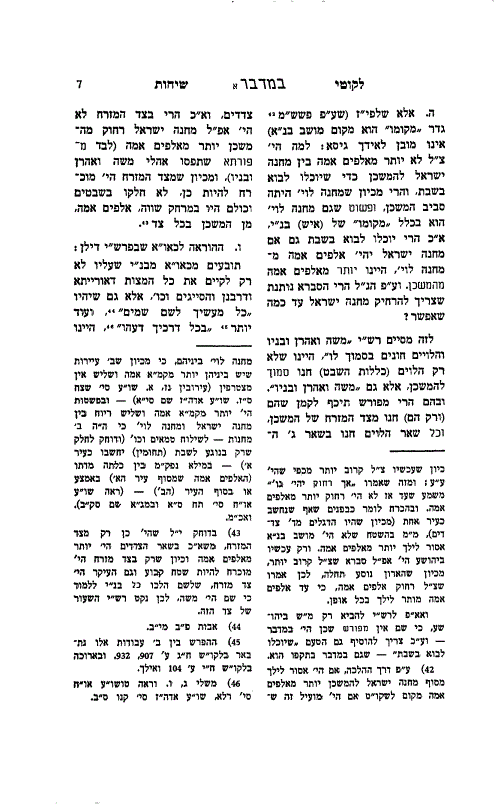
Rashi adds that Moshe, Aharon, their sons, and the Levi’im camped close to the Mishkan. The Rebbe notes that these details mean that while Moshe and Aharon were on one side, other families of Levi’im surrounded the other three sides—all next to the Mishkan—essentially forming an inner ring around it. The rest of Bnei Yisrael formed an outer ring at a distance of a mil.
The Rebbe now raises several questions on Rashi’s commentary. He points out that if one answer can resolve all these difficulties, it demonstrates that this explanation is correct. Otherwise, if each question requires its own answer, it weakens the overall interpretation. The Rebbe will present five main questions.
The first question concerns Rashi’s choice of words. When Rashi begins his comment by saying “me’rochek mil,” it seems he is explaining not only how far Bnei Yisrael camped but also what “min neged” means—that it implies distance (“far away”). Otherwise, Rashi could have simply written “min neged mil,” indicating only the measurement without defining “min neged.” From this wording, it appears Rashi intends to clarify both the meaning (“distance”) and the measurement (“mil”).
But why does Rashi need to explain what “min neged” means? In Parshas Ki Savo (Devarim 28:66), we find:
והיו חייך תלויים לך מנגד.
There, Rashi does not comment on the meaning of “min neged.” This suggests either that its meaning is self-evident or that he relies on his earlier explanations elsewhere. For example, in Parshas Vayeira (Bereishis 21:16), regarding Hagar:
ותלך ותשב לה מנגד.
Rashi explains there that “min neged” means “from a distance”—she sat far from Yishmael because she could not bear to see him suffer. If so, why does Rashi need to explain it again here? Similarly, in Parshas Ha’azinu (Devarim 32:52):
כי מנגד תראה את הארץ.
There too, Rashi explains “min neged” as meaning from afar. Why repeat this explanation when he has already clarified it previously?
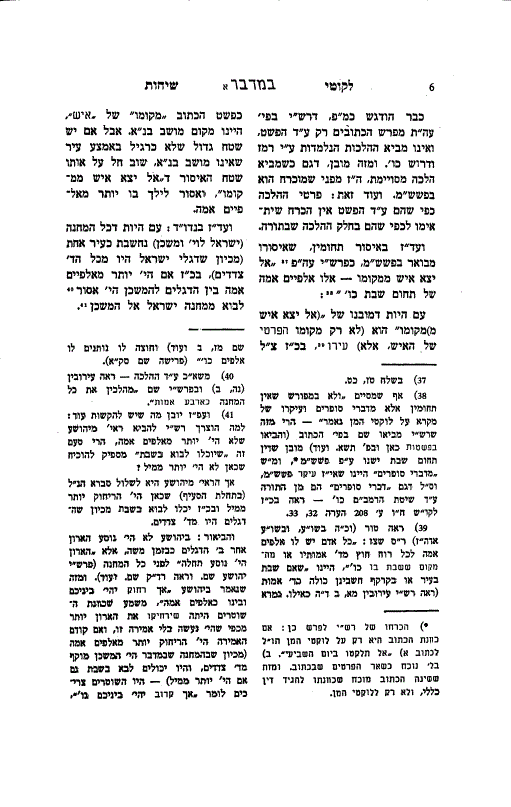
The second question: Why does Rashi need to specify exactly how far Bnei Yisrael camped? The verse simply says they were at a distance; why must we know it was specifically a mil? What is lacking in our understanding of the verse without this detail?
This question becomes stronger when considering Hagar’s story—there too she sat “from a distance,” but neither Torah nor Rashi specifies how far. Although Midrash says she was a mil away, Rashi does not mention this in his commentary there. This shows that not every use of “min neged” requires us to know or define an exact measurement according to peshat—the plain meaning.
The third question concerns why Rashi adds that Moshe, Aharon and their sons, and Levi’im camped next to the Mishkan. How is this detail relevant to understanding our verse about Bnei Yisrael’s encampment?
The Rebbe attempts an answer: perhaps Rashi seeks to resolve an apparent contradiction between two verses. In Bamidbar 1:53 (the previous chapter), it says:
והלוים יחנו סביב למשכן העדות.
This implies Levi’im camped close around the Mishkan. Yet here it says Bnei Yisrael camped “min neged”—from afar—around it. Is there a contradiction about who surrounded and how?
If so, perhaps Rashi clarifies: Bnei Yisrael camped at a distance (a mil), while Moshe, Aharon and Levi’im were next to the Mishkan itself—thus resolving any confusion about who was where.
However, the Rebbe rejects this answer for four reasons. First: It is obvious from both verses whom they refer to—the earlier verse explicitly mentions Levi’im surrounding closely; our verse refers specifically to Bnei Yisrael camping farther away. There is no real contradiction requiring resolution.
Second: If there were any ambiguity about what “soviv”—“around”—means (close or far), then Rashi should have quoted and explained that word instead of focusing on “min neged.” The supposed contradiction would be about whether surrounding means adjacent or distant—but since each verse clearly identifies its subject group (Levi’im or Yisrael), no such confusion exists.
סעיף ב׳
The Rebbe begins by analyzing why Rashi does not simply quote the word סביב (“around”) when explaining the verse, and why he doesn’t clarify its meaning in this context. If Rashi’s intent was to address the meaning of סביב, he should have cited it explicitly. Furthermore, if Rashi’s purpose was merely to inform us of the arrangement—where the Leviim and Yisrael camped—he still leaves unexplained how סביב here could mean “next to,” which does not fit the context. Rashi does not state that סביב can mean both “around” and “next to.”
Another issue is that the question of what סביב really means—does it imply “around,” or “far away”—seems like a separate discussion. If so, Rashi should have addressed it in a separate comment, rather than as a continuation of his explanation about מרחק מיל (the distance of a mil). The Rebbe points out that when Rashi explains two distinct matters regarding one word or phrase, he usually repeats the heading for each subject. Yet here, Rashi does not bring down the word מִנֶּגֶד (“opposite” or “from before”) again when discussing סביב.
This leads to a central question: What is Rashi teaching by specifying Moshe, Aharon, their sons, and then the Leviim? Why not just say Leviim? The term includes everyone who camped around the Mishkan—including Moshe and Aharon. The Torah itself first mentions all Leviim as surrounding the Mishkan, only later specifying where Moshe and Aharon camped. So why does Rashi enumerate them separately?
The Rebbe summarizes five questions up to this point: What is unique about מִנֶּגֶד in our verse? Why does Rashi sometimes explain it and sometimes not? What is its precise meaning here? Why specify Moshe and Aharon separately from Leviim? And what is gained by stating that Bnei Yisrael camped at a distance of a mil?
The Rebbe now clarifies that מִנֶּגֶד derives from נֶגֶד (“before,” “in front of,” or “present”). The prefixes כ- (as) and מ- (from) are grammatical tools indicating similarity or proximity. While נֶגֶד generally means present or facing, sometimes—depending on context—it implies additional nuance such as distance or opposition.
For example:
וְאֵזֶר כְּנֶגְדּוֹ
The Torah says Hashem made Chava as an ezer k’negdo for Adam—a help opposite him. Chazal explain: if he merits, she is a help; if not, she opposes him. Still, נֶגֶד always means present—just that presence can be supportive or adversarial depending on context.
Another example:
וַיִּחַן שָׁם יִשְׂרָאֵל נֶגֶד הָהָר
Bnei Yisrael camped opposite Har Sinai. Rashi explains this meant on the east side—so נֶגֶד here means facing a specific direction.
In some cases, such as with Hagar:
וַתֵּשֶׁב לָהּ מִנֶּגֶד
Hagar sat down mineged her son Yishmael—a bowshot away. Here, mineged clearly means at a distance; she was present but far off.
The same applies in our parsha: if mineged simply meant “in front of,” it would be redundant since the verse already says they camped around (soviv) the Mishkan. Thus, mineged must add something—it indicates distance: they were present but at some remove from the Mishkan.
This raises another question: If Bnei Yisrael had to be distant because Leviim surrounded the Mishkan anyway, why specify an additional distance? The answer is that Torah wants them even farther—to minimize any chance of accidental entry into sacred space by non-Leviim.
This is why Rashi emphasizes both that there was a significant distance (a mil) and also that it should not be more than a mil—so people could reach the Mishkan on Shabbos.
But how do we know this distance applied in the desert as well as later in Eretz Yisrael? The answer lies in logic: just as Yehoshua set a mil so people could come on Shabbos without violating techum Shabbos (the boundary one may walk outside one’s place), so too in the midbar this logic applied.
This leads to another technical issue: In halacha, within a city there is no techum restriction; you may walk anywhere within city limits plus 2,000 amos beyond. Since all Bnei Yisrael camped together around the Mishkan, wasn’t this like one city? Why limit their distance from the Mishkan?
The Rebbe explains that according to pshat—the simple reading—Rashi treats techum Shabbos as applying only where people actually dwell. The area between camps (such as between Machaneh Yisrael and Machaneh Levi) was empty desert—not considered part of their settlement—and thus subject to techum restrictions.
This also clarifies why Rashi specifies Moshe and Aharon separately from Leviim: On three sides of the Mishkan were large camps of Leviim; but on one side (the east), only Moshe and Aharon with their sons camped—a very small group. Thus, on that side there was little buffer between Bnei Yisrael and the Mishkan itself; therefore, 2,000 amos had to be measured from the Mishkan proper rather than from where most Leviim camped.
This detail ensures that everywhere around—the east included—the minimum distance was maintained for techum Shabbos purposes.
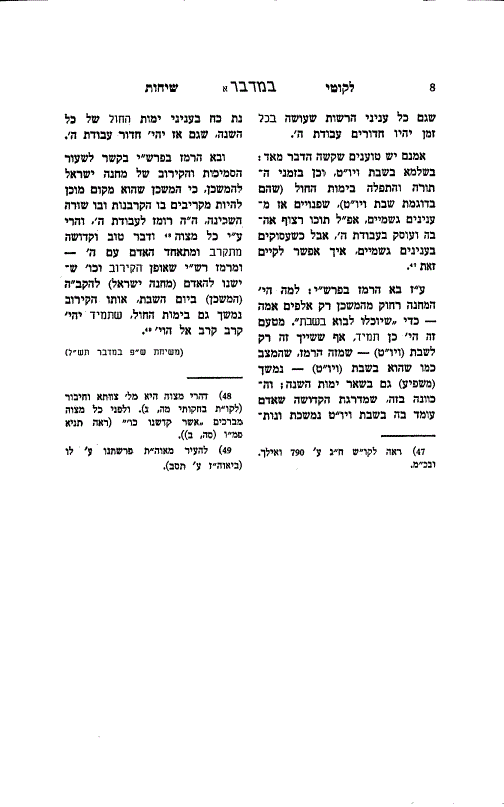
The Rebbe then draws an important lesson for daily life: Just as Bnei Yisrael were never allowed to be too far from the Mishkan so they could approach it on Shabbos, so too every Jew must ensure that even during mundane weekdays he remains within spiritual reach of holiness. All our actions—even those not directly mitzvah-related—should be permeated with service of Hashem (L’shem Shamayim, “for Heaven’s sake”), and ideally with b’chol derachecha da’eihu, knowing Hashem in all your ways.
This may seem difficult during busy weekdays filled with worldly concerns—but just as Shabbos proximity shapes weekday reality for Bnei Yisrael in the desert, so too our connection to holiness on Shabbos empowers us throughout all days of the week.
The Mishkan represents closeness to Hashem—the place where korbanos are brought and unity with G‑d achieved. By ensuring we are never spiritually too distant—even amidst weekday pursuits—we fulfill this message hinted by Rashi: maintain your connection so you can always return to holiness when needed.
Key points
1. In this sicha, the Rebbe examines Rashi’s commentary on the word "mineged" in Parshas Bamidbar, focusing on its precise meaning as it appears in the Torah’s description of the encampment of Bnei Yisrael around the Ohel Moed. The analysis explores how each tribe camped by its flag, with colors corresponding to their stones in the Choshen, and how tribal affiliation was determined by paternal lineage. The term "mineged" is highlighted as denoting their position relative to the Mishkan, setting the stage for a detailed clarification of its meaning through Rashi’s interpretation.
2. The Torah describes Bnei Yisrael as camping "mineged"—opposite or at a distance from—the Mishkan. Rashi explains that "mineged" here means "from a distance of a mil," which is 2,000 amos, citing a verse from Yehoshua as proof. This arrangement allowed Bnei Yisrael to approach the Mishkan on Shabbos without violating techum Shabbos. Rashi adds that Moshe, Aharon, their sons, and the Levi’im camped adjacent to the Mishkan, forming an inner ring, while Bnei Yisrael formed an outer ring at a mil’s distance. The Rebbe raises five main questions on Rashi: why he defines "mineged" as distance here but not elsewhere; why he specifies the exact measurement; why he mentions Moshe and Aharon separately; and whether there is any contradiction between verses regarding who surrounded the Mishkan.
3. The Rebbe analyzes why Rashi does not address the word "soviv" ("around") directly if his intent was to clarify its meaning. He notes that if Rashi wished only to explain the arrangement of camps, he would need to clarify how "soviv" could mean both “around” and “next to,” which he does not do. The enumeration of Moshe, Aharon, their sons, and then Levi’im is questioned—why specify them separately when Levi’im includes all? The Rebbe summarizes five central questions: what is unique about "mineged" here; why does Rashi sometimes explain it and sometimes not; what is its precise meaning in this context; why specify Moshe and Aharon separately; and what is gained by stating Bnei Yisrael camped at a mil’s distance.
4. The Rebbe clarifies that "mineged" derives from "neged," which generally means present or facing but can imply distance or opposition depending on context. Examples are brought from Torah: Chava as an "ezer k’negdo," Bnei Yisrael camping "neged ha’har," and Hagar sitting "mineged" her son—all illustrating nuances of presence or distance. In Bamidbar, since the verse already says they camped around ("soviv") the Mishkan, "mineged" must add something—namely, that they were present but at a specific remove (a mil) from it. This additional distance serves to prevent accidental entry into sacred space by non-Levi’im.
5. The necessity for this specific distance is explained: even though Levi’im surrounded the Mishkan closely, Torah requires Bnei Yisrael to be even farther away—to minimize risk of improper entry. Rashi emphasizes both that there was a significant distance (a mil) and that it should not be more than a mil so people could reach the Mishkan on Shabbos without violating techum Shabbos. This logic applies both in the desert and later in Eretz Yisrael.
6. Addressing a technical question: within city limits there is no techum restriction according to halacha—so why limit Bnei Yisrael’s distance from the Mishkan? The Rebbe explains that according to pshat, Rashi considers techum Shabbos applicable only where people actually dwell; empty areas between camps are not considered part of their settlement and thus are subject to techum restrictions. This also clarifies why Moshe and Aharon are specified separately: on three sides large groups of Levi’im camped close by; on one side (the east), only Moshe and Aharon with their sons were present—a small group—so 2,000 amos had to be measured from the Mishkan itself on that side to maintain uniformity for techum Shabbos everywhere around.
7. Finally, the Rebbe draws a lesson for daily life: just as Bnei Yisrael were required never to be too far from the Mishkan so they could approach it on Shabbos, every Jew must ensure spiritual proximity to holiness even during mundane weekdays. All actions—even those not directly mitzvah-related—should be permeated with service of Hashem ("l’shem shamayim") and ideally with "b’chol derachecha da’eihu." Though weekday concerns may seem distant from holiness, connection to Shabbos empowers us throughout all days; maintaining closeness ensures we can always return to holiness when needed—fulfilling Rashi’s message through our ongoing relationship with Hashem’s presence.