

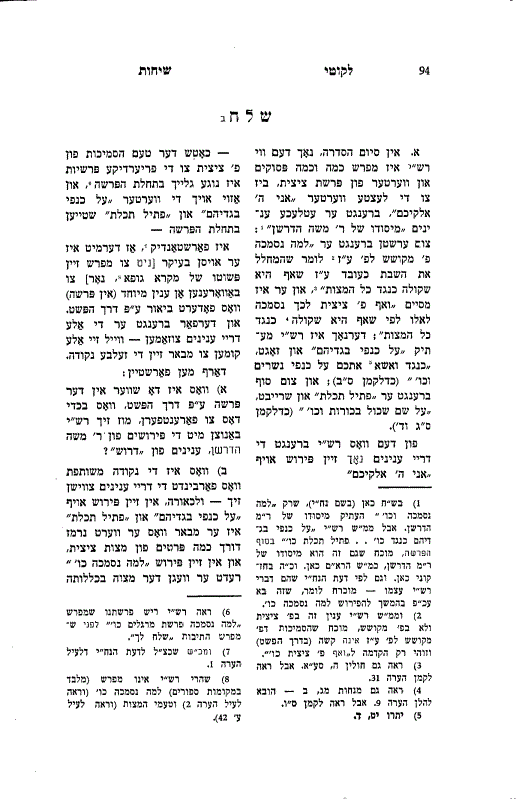
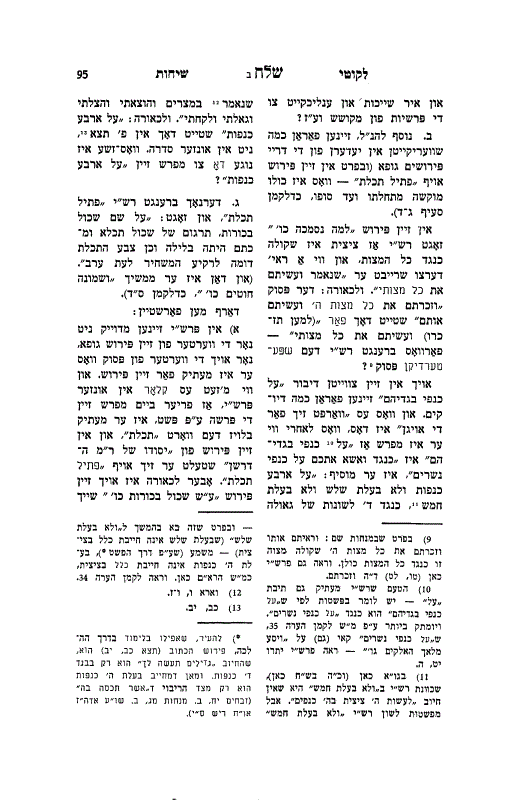
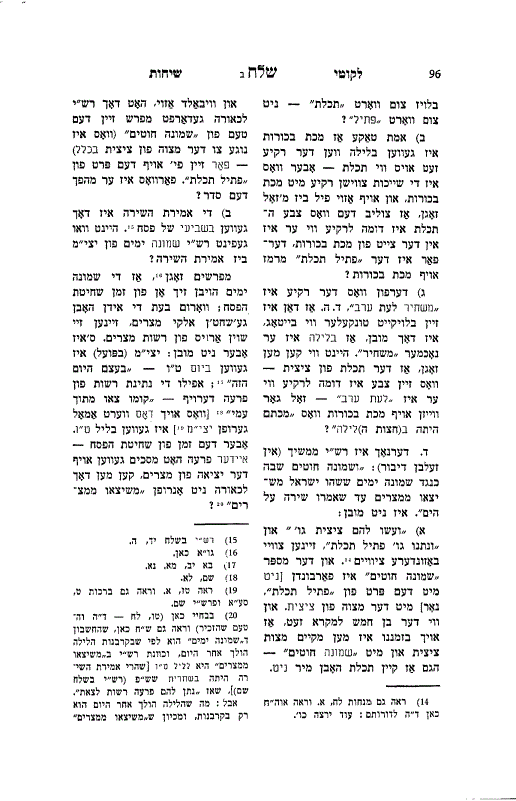
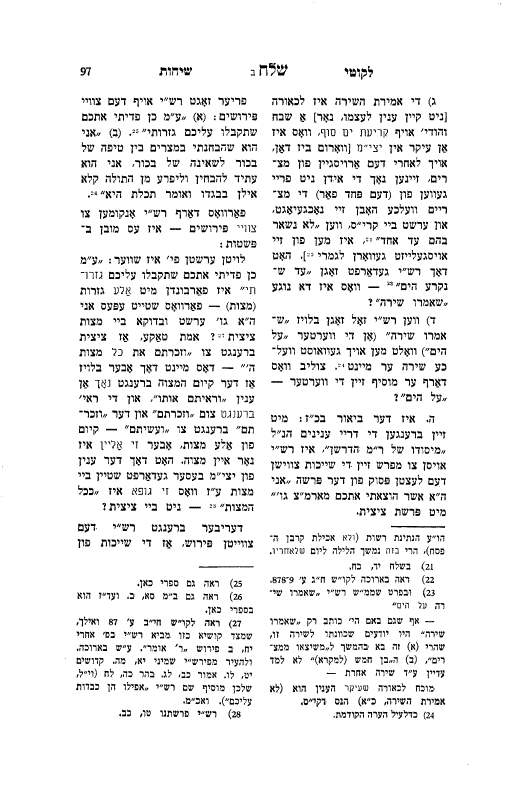
“Who brought you out of the land of Egypt” is stated specifically in connection with the mitzvah of tzitzis because G‑d redeemed us from Egypt on condition that we keep His commandments. Since tzitzis serves as a reminder of all the mitzvos, the connection is understandable. Rashi then adds an explanation from Rabbi Moshe HaDarshan: tzitzis does not merely remind one of all the mitzvos; it is considered equivalent to the fulfillment of all the mitzvos. Furthermore, the details of the mitzvah of tzitzis themselves are connected to the Exodus from Egypt.
At the end of the parshah, Rashi comments:
“Who brought you out [of Egypt]” — For this purpose I redeemed you: that you should accept My decrees upon yourselves.
“I am the L‑rd your G‑d” — Why is this stated again? Another explanation: Why is the Exodus from Egypt mentioned here? I am the One who distinguished in Egypt between a firstborn drop and a non-firstborn drop; likewise, I will distinguish and exact punishment from one who hangs indigo-dyed threads on his garment and claims they are techeiles.
From the teachings of Rabbi Moshe HaDarshan I have copied: Why is the section of the wood-gatherer placed next to the section of idolatry? To teach that one who desecrates Shabbos is like one who worships idols, for Shabbos is equivalent to all the mitzvos.
Likewise, the section of tzitzis is placed next to these because it too is equivalent to all the mitzvos, as it says, “And you shall perform all My commandments.”
“On the corners of their garments” — corresponding to “I carried you on eagles’ wings.”
“On the four corners” — not a three-cornered garment nor a five-cornered garment; corresponding to the four expressions of redemption stated regarding Egypt: “I will bring you out,” “I will save you,” “I will redeem you,” and “I will take you.”
“A thread of techeiles” — alluding to the death of the firstborn, for the Aramaic translation of shikul (bereavement) is techala. The plague occurred at night, and the color of techeiles resembles the sky as it darkens toward evening.
“Its eight threads” correspond to the eight days from the time Israel left Egypt until they sang at the Sea.
Explanation
Rashi is bothered by why the verse says, “I am the L‑rd your G‑d Who brought you out of the land of Egypt” specifically in connection with tzitzis.
He therefore explains:
“For this purpose I redeemed you — that you should accept My decrees.”
Since tzitzis leads to “remembering all the commandments of G‑d,” it represents acceptance of all His decrees.
However, this explanation is not entirely sufficient. Tzitzis only brings one to remember the mitzvos, which in turn leads to their observance; it is not itself all of G‑d’s decrees. Therefore Rashi adds a second explanation:
“I am the One who distinguished in Egypt between a firstborn drop and a non-firstborn drop…”
Just as G‑d distinguished in Egypt, so too He can distinguish between genuine techeiles and counterfeit dye.
Yet this explanation has its own difficulty: it connects tzitzis to the plague of the firstborn, but not directly to the Exodus itself.
Therefore Rashi brings the teaching of Rabbi Moshe HaDarshan as a further elaboration of the first explanation.
According to the homiletic interpretation, tzitzis fulfills the verse:
“And you shall perform all My commandments.”
Meaning, through tzitzis it is considered as if one has fulfilled all the mitzvos—not merely that tzitzis leads to their fulfillment.
This is why Rashi cites this verse rather than the earlier verse:
“And you shall remember all the commandments of G‑d.”
Why Mention the Details of Tzitzis?
Even so, a question remains. Shabbos and idolatry are also considered equivalent to all the mitzvos, and in a more obvious way.
Therefore Rashi continues with the drashah showing that not only the general mitzvah of tzitzis is connected to the Exodus, but even its individual details:
- “On the corners of their garments” corresponds to “I carried you on eagles’ wings.”
- “On the four corners” corresponds to the four expressions of redemption.
The Meaning of Techeiles
Rashi explains:
“Techeiles” alludes to the bereavement of the firstborn, for the Aramaic translation of shikul (bereavement) is techala.
Although the physical departure from Egypt took place on the fifteenth of Nissan, the redemption was already effected Above on the fourteenth, through the offering of the Pesach sacrifice and the blood of circumcision.
Therefore, techeiles resembles:
“the sky darkening toward evening,”
for evening was the time of the Pesach offering, when the redemption was already accomplished in the heavenly realms.
Rashi also quotes the word “thread” (petil) to teach that just as the thread extends downward from the garment, so too tzitzis symbolizes the drawing down of the redemption from the heavenly realm into the physical world below.
The Eight Threads
Rashi continues that the eight threads correspond to the eight days from the Exodus until the Song at the Sea.
Just as the counting begins from the beginning of the redemption as it existed Above (on the fourteenth of Nissan), so too the completion of the redemption came when the Jewish people saw that:
“Not one of them remained.”
This revelation brought them to sing the Song at the Sea.
Deeper Lesson (Meynah Shel Torah)
The white threads symbolize love of G‑d, while techeiles symbolizes fear and awe of G‑d.
The beginning of spiritual service is “turning away from evil” (sur me-ra), which corresponds to awe and fear. Therefore Rashi discusses techeiles before white, even though techeiles is only one detail of the mitzvah, while the white threads constitute the main body of the mitzvah.
Today, when we do not have techeiles, the principle is:
“For us, everything depends on belovedness (chavivus).”
Accordingly, the primary focus of our Divine service in our era is the service of love.