

Likkutei Sichos Vol. 2 – Shmini Atzeres / Simchas Torah – Unity and Joy
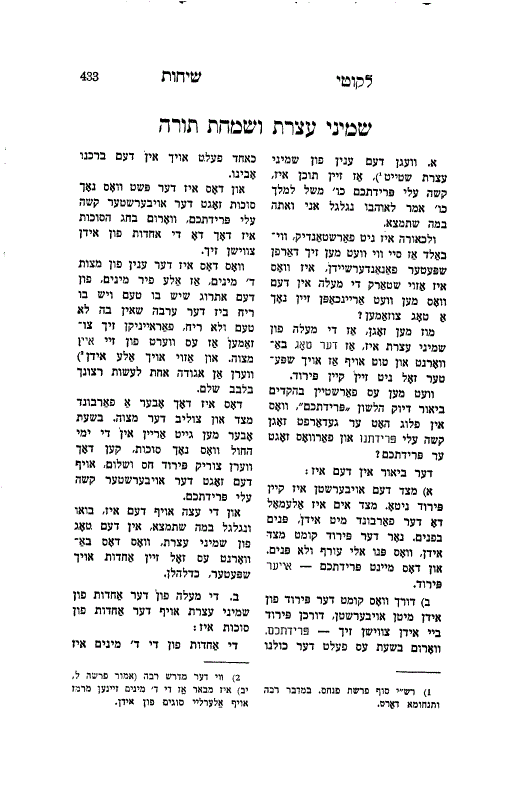
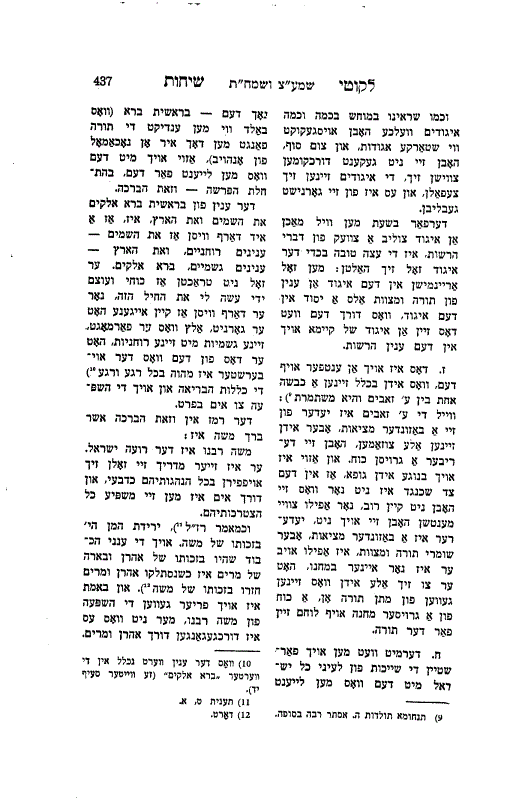
1. Regarding the concept of Shemini Atzeres, it is stated that its essence is expressed in the phrase, "It is difficult for Me to part from you," likened to a king who says to his beloved, "Let us spend time together with whatever you find." At first glance, this is puzzling. Since eventually, they will have to part ways, what is the significant advantage in capturing one more day together?
We must say that the advantage of Shemini Atzeres is that this day ensures and effects that even later, there should not be any separation. This can be understood by first explaining the precise wording "your separation." Logically, it should have said, "our separation," so why does it say "your separation"?
The explanation is as follows: (a) From the perspective of the Almighty, there is no separation. From His perspective, there is always a connection with the Jews, face to face. The separation comes from the Jews, who turn their backs to Him and not their faces. This is the meaning of "your separation" — your separation.
(b) How does the separation between the Jews and the Almighty occur? Through the separation among the Jews themselves — "your separation." For when there is a lack of unity among us, there is also a deficiency in "Bless us, our Father."
This is the explanation of why, after Sukkos, the Almighty says, "It is difficult for Me to part from you," because during the festival of Sukkos, there is unity among the Jews. This is the essence of the mitzvah of the four species, where all four species, from the esrog, which has taste and fragrance, to the willow, which has neither taste nor fragrance, unite together to form one mitzvah. Similarly, all Jews become one group to fulfill Your will with a complete heart.
However, this unity is due to and because of the mitzvah. But when entering the weekdays after Sukkos, there can be a return to separation, G‑d forbid. Therefore, the Almighty says, "It is difficult for Me to part from you." The solution to this is, "Come, let us spend time together with whatever you find," on the day of Shemini Atzeres, which ensures that there will be unity even later, as will be explained.
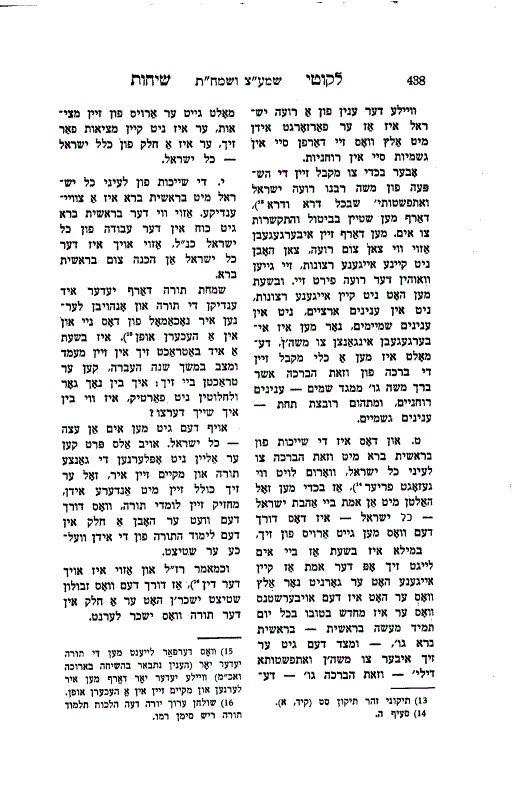
2. The advantage of the unity of Shemini Atzeres over the unity of Sukkos is as follows: The unity of the four species is not in their essential existence. That is, even at the time of their unification, each of them is a distinct type and remains in its existence. It is only that in this aspect of existence, they unite. Moreover, the mitzvah is to take specifically four distinct species, which means that even in the aspect of the mitzvah itself, their division is heard. It is only that these distinct things unite together in one mitzvah.
However, the unity of Shemini Atzeres is like one bull, one ram; it is not a union of details but in essence, they are one entity.
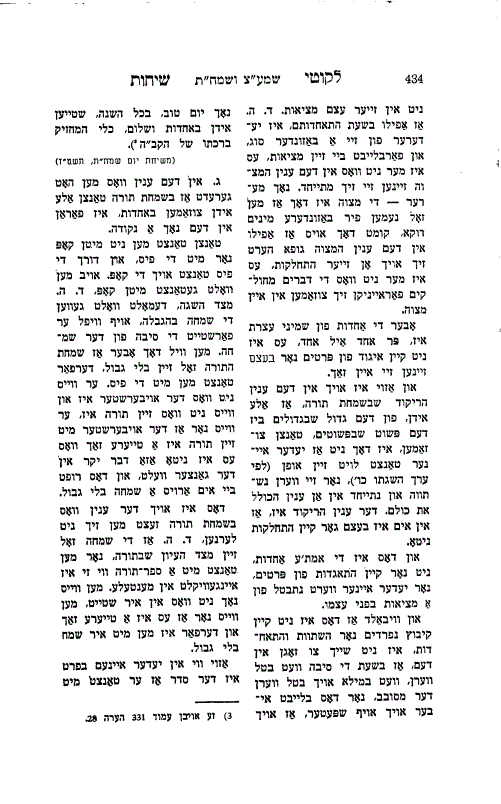
3. Similarly, in the matter of the dancing on Simchas Torah, all Jews, from the greatest of the great to the simplest of the simple, dance together. It is not that each one dances according to his own manner (relative to his understanding, etc.), but rather they become equal and united in a matter that includes everyone. The essence of the dance is that there is no division within it.
This is the true unity, not merely an assembly of individuals, but each one nullifies his own separate existence.
And since this is not a gathering of separate entities but rather an equality and unification, it cannot be said that when the cause ceases, the effect will also cease. Rather, it remains forever, so that even after the festival, throughout the year, Jews stand in unity and peace, which is the vessel that holds the blessing of the Holy One, blessed be He.
4. In the matter that was discussed, that on Simchas Torah all Jews dance together in unity, there is another point. Dancing is not done with the head but with the feet, and through the feet, the head also dances. If one were to dance with the head, that is, based on understanding, then the joy would be limited to how much one understands the reason for the joy. However, the desire is for the joy of the Torah to be without limit, and therefore one dances with the feet. He does not know what the Almighty is, nor what His Torah is; he only knows that the Almighty and His Torah are precious things, unparalleled in the entire world, and this evokes in him a boundless joy.
This is also the reason why on Simchas Torah one does not sit down to learn, meaning that the joy should not come from the study of Torah, but rather one dances with a Torah scroll as it is wrapped in its mantle. One does not yet know what is written inside it; one only knows that it is a precious thing, and therefore he rejoices with it without limit.
Just as in each individual, the order is that he dances with his feet and through this, the head also dances, so too in the complete stature of the Jewish people, the joy of the simple people who rejoice with the Torah, whose joy is without limit, causes an increase in joy even among the scholars who know and understand the greatness of the Torah and the reason for the joy, so that they too experience a simple and boundless joy.
And through the joy of Shemini Atzeres and Simchas Torah, one reaches the level of one bull, unlike Sukkos where seventy bulls are offered corresponding to the seventy nations, because then they also have a place. But one reaches a level where they have no place at all, where only the Almighty and the Jews are present, "They shall be yours alone, and no strangers with you."
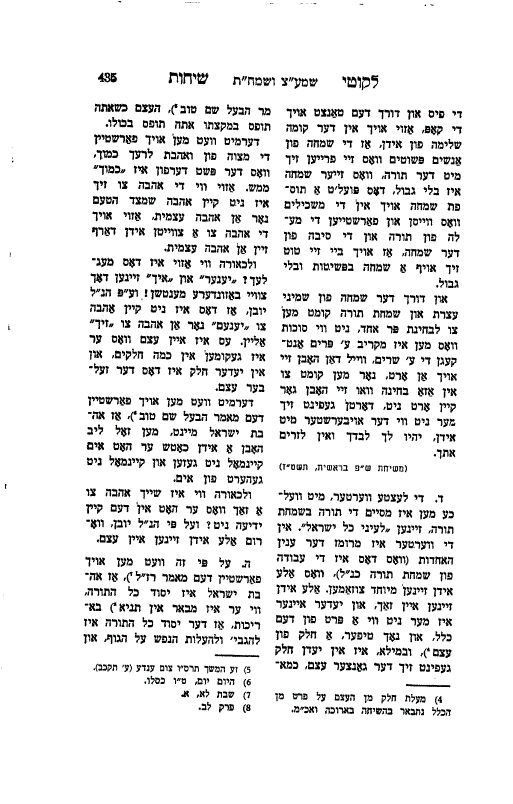
4. The final words with which we conclude the Torah on Simchas Torah are "before the eyes of all Israel." These words hint at the concept of unity (which is the service of Simchas Torah, as mentioned above), where all Jews are united together. All Jews are one entity, and each individual is nothing more than a part of the whole, and even deeper, a part of the essence. Therefore, in every part, the entire essence is found, as the Baal Shem Tov explains: when you grasp part of the essence, you grasp it all. This also helps us understand the mitzvah of "Love your fellow as yourself," which means literally "as yourself." Just as one's love for oneself is not a love based on reason but an intrinsic love, so too, the love for another Jew should be an intrinsic love.
At first glance, how is this possible? "He" and "I" are two separate people! According to the above, it is understood that this is not love for "him" but love for "yourself." It is one essence that has come into several parts, and in each part, it is the same essence. This also helps us understand the teaching of the Baal Shem Tov that Ahavas Yisrael means to love a Jew even if you have never seen him and never heard of him. At first glance, how is it possible to love something about which one has no knowledge? According to the above, it is understood because all Jews are one essence.
5. Based on this, we can also understand the teaching of our Sages that Ahavas Yisrael is the foundation of the entire Torah, as explained at length in Tanya, that the foundation of the entire Torah is to elevate and uplift the soul over the body, and this is expressed in Ahavas Yisrael. For if one considers oneself and feels oneself as an independent entity, then it is impossible for him to have love for another "as yourself." In order for him to have "Love your fellow as yourself," he must transcend his own existence; his existence is not "him" but a part of the essence of Jews, and then he has true Ahavas Yisrael.
This is also the content of the story that the Rebbe told about a certain great person, that once when his child was unwell, he cried very much. Afterwards, he lamented that for another Jewish child he would not cry so much, which is proof that he is still at the beginning of his service. For if he had true service, the Torah and mitzvos would reveal the essence of the soul, where all Jews are indeed one entity.
[TRANSLATION FAILED — chunk 4/7: NotFoundError: Error code: 404]
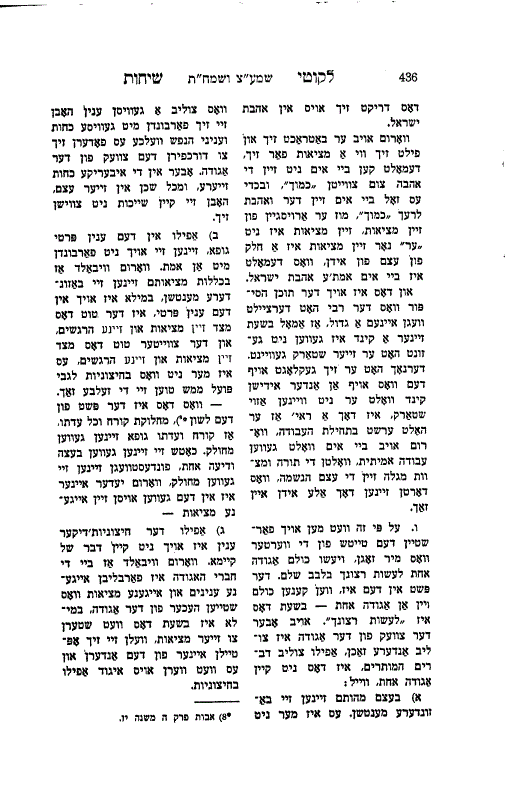
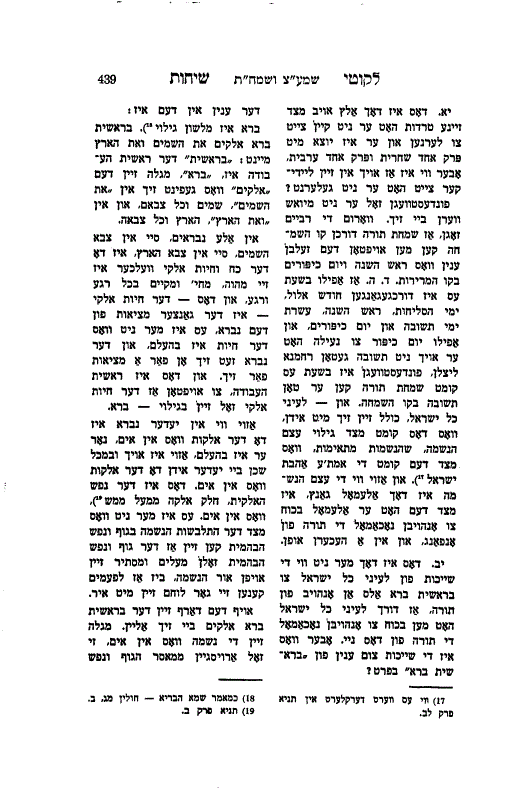
6. After this — "In the beginning, G‑d created" (since as soon as we finish the Torah, we immediately begin it again from the start), so too with what we read before this, at the beginning of the parsha — "And this is the blessing." The idea of "In the beginning, G‑d created the heavens and the earth" is that a Jew must know that "the heavens" — spiritual matters, and "the earth" — physical matters, were created by G‑d. He should not think that "my strength and the might of my hand have made me this wealth," but rather he must know that he possesses nothing of his own. Everything he has, his physical and spiritual possessions, he has from the fact that the Creator continuously brings into being the entire creation and also provides sustenance to him specifically.
The hint in "And this is the blessing which Moses blessed" is: Moses our teacher is the shepherd of Israel, guiding them to conduct themselves properly in all their ways, and through him, they receive all their needs. As our Sages say, the descent of the manna was in the merit of Moses. Even the clouds of glory, which were in the merit of Aaron, and the well of Miriam, when Aaron and Miriam passed away, returned in the merit of Moses. In truth, the influence was always from Moses our teacher, only it passed through Aaron and Miriam.
The role of a shepherd of Israel is to provide Jews with everything they need, both materially and spiritually. However, to receive the influence from Moses our teacher, the shepherd of Israel, and his extension in every generation, one must stand in self-nullification and connection to him. One must be devoted like sheep to a shepherd; sheep have no personal desires, they go where the shepherd leads them. When one has no personal desires, neither in earthly matters nor in heavenly matters, but is entirely devoted to Moses, then one becomes a vessel to receive the blessing of "And this is the blessing which Moses blessed" — from the bounty of the heavens — spiritual matters, and from the depths crouching beneath — physical matters.
9. And this is the connection of "In the beginning, G‑d created" with "And this is the blessing" to "before the eyes of all Israel," because as stated earlier, in order to truly achieve Ahavas Yisrael — the love of all Israel — one must transcend oneself. Therefore, when one truly realizes that he possesses nothing of his own, but everything he has is from the Creator, who renews in His goodness every day the work of creation — "In the beginning, G‑d created," — and because of this, he devotes himself to Moses and his extension — "And this is the blessing" — then he transcends his own existence, he is not an independent entity, but a part of the collective of Israel — all Israel.
10. The connection of "before the eyes of all Israel" with "In the beginning, G‑d created" is twofold. Just as "In the beginning, G‑d created" empowers the service of all Israel as mentioned above, so too, "all Israel" serves as a preparation for "In the beginning, G‑d created."
[TRANSLATION FAILED — chunk 6/7: NotFoundError: Error code: 404]
11. Just as in every creation there exists the G‑dliness within it, albeit concealed, so too, and even more so, within every Jew there is the G‑dliness within him. This is the divine soul, a literal part of G‑d above, which is within him. It is only due to the soul's investment in the body and the animal soul that the body and animal soul can sometimes conceal and obscure the light of the soul, to the extent that at times they can even oppose it.
Therefore, one must have the "In the beginning, G‑d created" within oneself, to reveal the soul that is within him, so that it may be freed from the imprisonment of the body and the animal soul, and be revealed as it truly is. Not only its revealed powers, but also the essence of the soul, which is connected to the Essence. The sign of the revelation of the essence of the soul is the love for one's fellow as oneself, "before the eyes of all Israel," as mentioned above. And through this "In the beginning, G‑d created" within oneself, one can reveal the G‑dliness also in the world at large, in the hosts of the heavens and the hosts of the earth, so that in every thing it will be openly perceived that its entire existence is only G‑dliness, and there is nothing besides Him.
(From a talk on the night of Simchas Torah, 5718)