

Likkutei Sichos Vol. 2 – Sukkos – Unity and Completeness on Sukkos
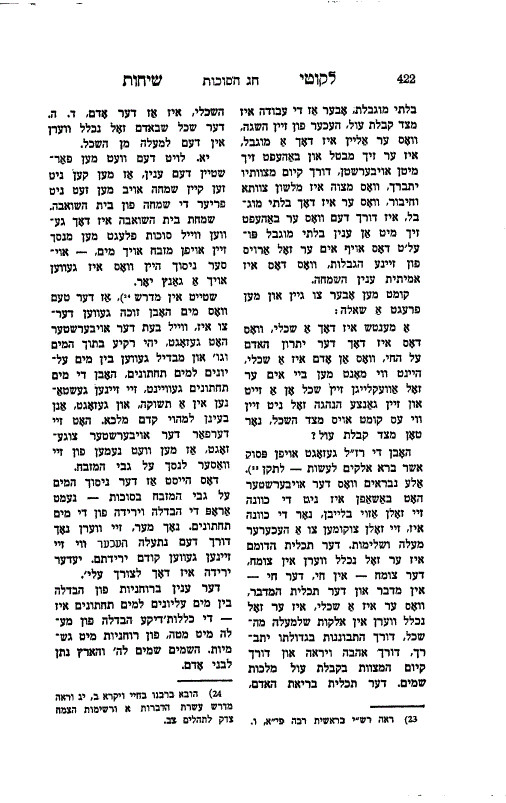
1. On the festival of Sukkos, there are several mitzvos aside from the mitzvah of dwelling in the sukkah. Nevertheless, the festival is named after the sukkah and not after the other mitzvos, such as the mitzvah of taking the four species, etc.
One of the reasons for this is that there is a special quality in the mitzvah of dwelling in the sukkah compared to the taking of the four species. The mitzvah of sukkah is connected with all the days of the festival; from the very first moment that the festival is sanctified, the mitzvah of dwelling in the sukkah is already present. However, with the taking of the four species, even in the Beis Hamikdash, the obligation only begins in the morning.
Furthermore, the mitzvah of dwelling in the sukkah not only begins from the first moment the festival is sanctified, but it also requires preparation before Sukkos. This is because it involves the construction of three walls, or according to our custom, four walls. And specifically, it must be constructed in a manner of "not from that which is already made," meaning it cannot be done on Yom Tov itself but must be prepared before Yom Tov. In the making of the sukkah, there is already a mitzvah. However, with the four species, the entire action can take place on Yom Tov.
Another distinction between the sukkah and the four species is that the four species have a limitation; once the mitzvah is performed, one is exempt from it. But the mitzvah of dwelling in the sukkah, which is "you shall dwell as you live," does not have a concept of having completed the mitzvah; rather, it extends throughout all the days of the festival. The mitzvah of dwelling in the sukkah begins from the sanctification of the festival until the conclusion of all the days of the festival.
2. Another advantage of the mitzvah of sukkah over all other mitzvos, including the mitzvah of taking the four species:
All mitzvos are individual matters,
2. They encompass the person in specific matters. The mitzvah is performed with this limb or with another limb, but it does not encompass all of his matters. However, the mitzvah of sukkah, "you shall dwell as you live," means that all the matters he does, even his personal needs, the same activities he did a week ago, when he now does them in the sukkah, he fulfills a mitzvah with them.
Even more so: It is known the saying of our Sages, "Any person who does not have a home is not a person," meaning he lacks the completeness of a person, for a person must have a dwelling to reside in. Thus, the advantage of having a dwelling does not only mean when he is physically in the dwelling, but even when he is in the marketplace, the fact that he has a dwelling to return to makes him a person. Therefore, when Sukkos arrives, and the mitzvah is "you shall dwell as you live," during the seven days, his dwelling is the sukkah, which completes his status as a person. It is thus understood that even when he is not physically in the sukkah, since he has established the sukkah as his dwelling, he is still connected to the mitzvah of sukkah.
3. The month of Tishrei is a general month for the entire year, and therefore it is understood that all the mitzvos of this month serve as a directive for service throughout the year. The directive from the mitzvah of sukkah is:
It is demanded of a Jew that "in all your ways, know Him," that all his matters should be connected with the Almighty. Not only during the study of Torah and the service of prayer should he serve the Almighty, but even when he is involved in mundane activities, he must connect these mundane activities themselves with the Almighty.
And the strength and power for this is derived from the mitzvah of sukkah.
In the mitzvah of sukkah, even when he sleeps in the sukkah, he fulfills a mitzvah of the Almighty, and even when he is not in the sukkah, he is still connected to the mitzvah. From this, he should draw strength and power for the entire year, so that in all his matters, he should be subjugated to G‑dliness.
4. The Gemara refers to the mitzvah of sukkah as a "light mitzvah."
For when a Jew stands firm, no matter what may come, saying, "I am a servant to the King of kings, the Holy One, blessed be He," it becomes easy for him to ensure that even his physical needs are conducted in a manner of holiness, and he makes a dwelling for Him, blessed be He, in the lower realms.
And when he makes all his matters a dwelling for the Almighty,
then all his matters are drawn from His generous hand, providing him with all that he needs in children, life, and sustenance in abundance.
5. Regarding the joy of the Simchas Beis HaShoeivah, it is stated, "And you shall draw water with joy from the wells of salvation." This means that the water drawn for the libation on the altar had to be from springs. According to the revealed aspect of Torah, this is not understood: for the Rambam rules that if one could not obtain water from the Shiloach spring, they would take water from the kiyor (laver), which did not have the status of spring water. Moreover, mikveh water is valid for the kiyor, and consequently, also for the libation.
We must say that the explanation is that it does not matter from where the water was drawn, whether from springs or another source. The main point is that it should be "and you shall draw water with joy," and through this, it naturally becomes "from the wells of salvation."
6. The advantage of spring water over other water is: a) A spring purifies with any amount. Other waters require a specific measure, a certain quantity of water, but spring water, since it is connected to the source, does not require a quantitative measure. Here, the quality is what matters, and it purifies with any amount. b) It purifies while flowing. Other waters need to be in a specific place, which holds them and measures them, but spring water, if it is connected to the source, does not require this.
In spiritual terms, this means: if one wants to proceed with their own strength and calculations, disconnected from the source, then several conditions are required. There must be a measure, he must have enough intellect and strength, a measure that his entire being is encompassed by them, and this must be held and measured by something external to him, so that from another's perspective, it is also evident that his measure is sufficient. And if he lacks these conditions, there can be no talk of purifying another; there might even be a concern that the waters themselves could become impure.
However, when one is connected to the source, to the spring, he purifies with any amount and while flowing. There are no conditions. Whether he has many personal strengths or few, whether it is more than a minimal amount, and even if it is flowing, since he is connected to the source, he proceeds with broad shoulders. Not only does he not become impure, but on the contrary, he purifies all impurities, even the most severe impurity (like the waters of purification), because in this lies...
[TRANSLATION FAILED — chunk 4/15: NotFoundError: Error code: 404]
5. Matters that are beyond the measure and limitation of his intellect. The reason that brings about joy is also something beyond his limitations. For it is a general rule that an effect corresponds to its cause. Since the effect, the joy, is beyond limitations, it indicates that the cause of the joy is also something beyond limitations. This means that he has received something he did not expect, which is beyond his intellectual estimation. Because of this boundless gift he received, it elicits a boundless effect, which is the concept of joy. This is also the reason why joy breaks through barriers.
And it is like the reflection of the heart of man (the higher) to man, as the Baal Shem Tov explains the verse, "G‑d is your shadow," just as a shadow mimics everything a person does, so too, G‑d, as it were, is your shadow. This is the concept of "in the measure that a person measures, it is measured to him." Therefore, when a person below is in a state of joy, and "man" is from the expression "I will resemble the Most High," as it is stated in the Shlah, that is why a person is called "man" because he resembles the Most High, there is also joy above. And the kingdom of heaven is like the kingdom on earth, so just as below joy breaks through barriers, so too above, during joy, all measures and limitations are removed.
In the service of man, the microcosm, there are three pillars: Torah, service, and acts of kindness, and all of them must be with joy, as the Gemara states, "One should not stand to pray out of sadness or laziness, but out of joy of a mitzvah." Thus, prayer, which is the line of service — "What is the service of the heart? This is prayer" — must be with joy. Similarly, the line of Torah must be with joy, as the Gemara states there: "And so too when speaking of halacha." Likewise, the line of acts of kindness, which is charity, it is stated in the Torah, "And your heart shall not be grieved," and from a negative you hear a positive, and as our sages say: "And he who appeases him is blessed with eleven blessings." Thus, in all three pillars, the service of G‑d must be done with joy and gladness of heart.
10. We have discussed that the reason for true joy is something beyond intellectual estimation, so it is understood that for the service of G‑d to be with joy, the service must be from a place of acceptance of the yoke. For when the service is from his understanding and comprehension, it is a limited matter, and true, unlimited joy cannot come from it. However, when the service is from acceptance of the yoke, beyond his comprehension, since he himself is limited, he nullifies himself and connects with the Almighty through the fulfillment of His blessed commandments. A mitzvah is from the expression of companionship and connection, which is unlimited. By connecting with an unlimited matter, it causes him to break out of his limitations, which is the true concept of joy.
However, one might come to ask a question:
11. A person is, after all, an intellectual being. This is indeed the advantage of man over the animal, as a human is a rational creature. So why is it demanded of him to set aside his intellect and conduct himself not according to what emerges from his intellect, but rather to act from acceptance of the yoke?
Our sages have said regarding the verse "which G‑d created to do" — to rectify. All creations that the Almighty has made are not intended to remain as they are, but rather the intention is for them to reach a higher level and perfection. The purpose of the inanimate is to be included in the vegetative, the vegetative in the animal, the animal in the speaking being, and the purpose of the speaking being, who is rational, is to be included in G‑dliness, which is beyond intellect, through contemplation of His greatness, through love and awe, and through the fulfillment of the mitzvos with acceptance of the yoke of the kingdom of heaven. The purpose of the creation of man,
the rational being, is that the intellect of man should be included in that which is beyond intellect.
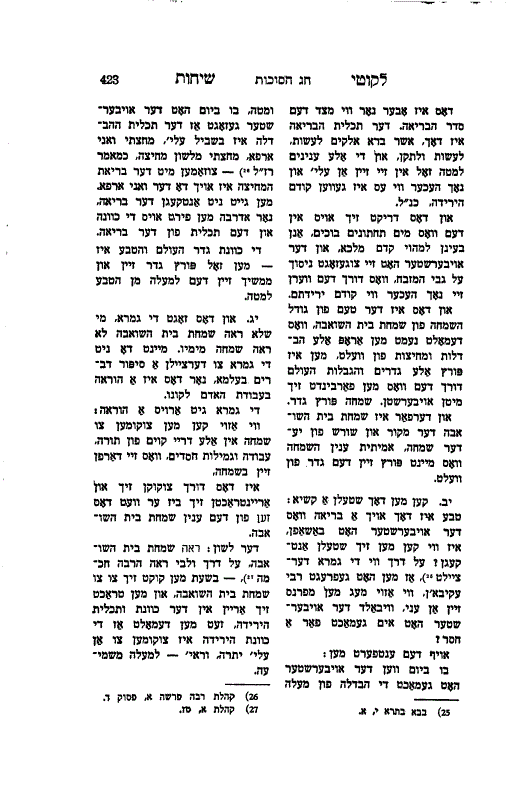
12. According to this, we will understand the matter that one cannot see joy unless one first sees the joy of the Beis Hashoevah. The joy of the Beis Hashoevah was because on Sukkos, they would also pour water on the altar, in addition to the wine libation that occurred throughout the year. The Midrash states that the reason water merited this is because when the Almighty said, "Let there be a firmament in the midst of the waters," and separated between the upper waters and the lower waters, the lower waters wept, standing in longing, and said, "We wish to be before the King." Therefore, the Almighty promised them that water would be taken from them to pour on the altar.
This means that the water libation on the altar during Sukkos removes the separation and descent of the lower waters. Moreover, through this, they are elevated even higher than they were before their descent. Every descent is for the purpose of an ascent. The spiritual aspect of the separation between the upper and lower waters is the general separation between above and below, between spirituality and physicality. "The heavens are the L‑rd's heavens, but the earth He has given to the children of man."
However, this is only according to the order of creation. The purpose of creation is, "which G‑d created to do," to do and to rectify, and all matters below should have an ascent, even higher than it was before the descent, as mentioned above. This is expressed in the fact that the lower waters cry, "We wish to be before the King," and the Almighty promised them a libation on the altar, through which they become even higher than before their descent. This is the reason for the great joy of the Beis Hashoevah, for at that time all separations and partitions of the world are removed, all boundaries and limitations of the world are broken through connecting with the Almighty, as joy breaks through barriers. Therefore, the joy of the Beis Hashoevah is the source and root of all joy, the true concept of joy which means breaking through the boundaries of the world.
12. One might pose a question: Nature is also a creation that the Almighty has made, so how can one stand against it? This is similar to the story in the Gemara where Rabbi Akiva was asked how one is allowed to support a poor person, given that the Almighty has made him lacking.
The answer given is: On the very day that the Almighty made the separation between above and below, He also declared that the purpose of this separation is for an ascent. "I have smitten, and I will heal," where "smitten" is from the word "partition," as our Sages say. Together with the creation of the partition, there is also "I will heal." One does not oppose creation; on the contrary, one fulfills the intention and purpose of creation. The intention of the world's boundaries and nature is that one should break through these boundaries and draw down the supernatural into the natural.
13. The Gemara states, "Whoever has not seen the joy of the Beis Hashoevah has never seen joy in his life." The Gemara is not merely telling a story, but rather providing guidance in a person's service to his Creator. The Gemara offers a directive: How can one achieve joy in all three pillars of Torah, service, and acts of kindness, which must be performed with joy? This is achieved by contemplating and immersing oneself until one sees the concept of the joy of the Beis Hashoevah.
The phrase "saw the joy of the Beis Hashoevah" is similar to "and my heart saw much wisdom." When one observes the joy of the Beis Hashoevah and reflects on the intention and purpose of the descent, one then sees that the purpose of the descent is to reach an even greater ascent, certainly above the heavens.
14. Specifically, in a person's service: When one reflects on the purpose of the creation of intellect, one sees that the purpose is for the intellect itself to be included in that which is beyond intellect. This gives the power to remove the limitations and boundaries of the body, the limitations and boundaries of the animal soul, and the limitations and boundaries of the G‑dly soul, and to accept upon oneself the yoke of the Kingdom of Heaven. Through this, one draws joy into his soul and, consequently, into the entire world.
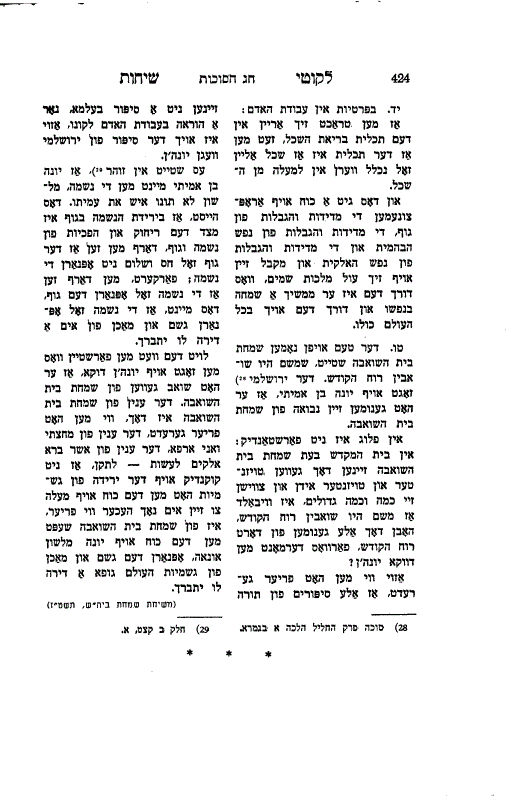
15. The reason for the name "the joy of the Beis Hashoevah" is explained as "from there they drew the Holy Spirit." The Jerusalem Talmud states about Yonah ben Amitai that he received his prophecy from the joy of the Beis Hashoevah. However, this is not understood: In the Beis Hamikdash during the joy of the Beis Hashoevah, there were thousands and thousands of Jews, including many great individuals. Since "from there they drew the Holy Spirit," all must have drawn from there the Holy Spirit, so why is Yonah specifically mentioned?
As mentioned earlier, all stories of the Torah...
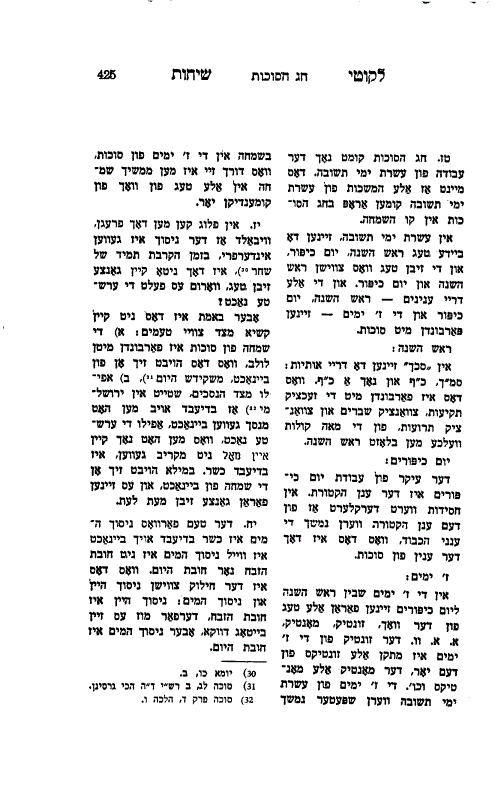
16. The festival of Sukkos follows the service of the Ten Days of Repentance. This means that all the spiritual influences drawn down during the Ten Days of Repentance descend into the festival of Sukkos in the aspect of joy.
During the Ten Days of Repentance, there are both the days of Rosh Hashanah, Yom Kippur, and the seven days between Rosh Hashanah and Yom Kippur. All three of these elements—Rosh Hashanah, Yom Kippur, and the seven days—are connected with Sukkos.
Rosh Hashanah: In the word "s'chach" (the covering of the sukkah), there are three letters: Samech, Kaf, and another Kaf. This is connected with the sixty blasts, twenty shevarim, and twenty teruos, from the one hundred sounds that are blown on Rosh Hashanah.
Yom Kippur: The primary service of Yom Kippur is the cloud of the incense. In Chassidus, it is explained that from the cloud of the incense, the clouds of glory are drawn, which is the concept of Sukkos.
The seven days: In the seven days between Rosh Hashanah and Yom Kippur, all the days of the week are present—Sunday, Monday, etc. The Sunday of these seven days rectifies all the Sundays of the year, the Monday rectifies all the Mondays, and so on. The seven days of the Ten Days of Repentance later extend with joy into the seven days of Sukkos, through which joy is drawn into all the days of the week of the coming year.
17. At first glance, one might ask, since the libation was performed in the morning, at the time of the daily morning offering, how can there be a complete seven days, since the first night is missing?
However, in truth, this is not a question for two reasons: a) The joy of Sukkos is connected with the lulav, which begins at night, from the sanctification of the day. b) Even regarding the libations, it is stated in the Jerusalem Talmud that if, after the fact, the libation was performed at night, even on the first night when no offering had yet been made, it is valid after the fact. Consequently, the joy begins at night, and there are indeed a full seven 24-hour periods.
18. The reason why the water libation is valid after the fact even at night is because the water libation is not an obligation of the altar, but an obligation of the day. This is the difference between the wine libation and the water libation: the wine libation is an obligation of the altar, and therefore must specifically be during the day. However, the water libation is an obligation of the day.
Although the water libation is also connected to the sacrifice, as the Tosefta states that the concept of pigul applies to the water libation, it is nevertheless not bound by the time of the altar. In truth, we must understand why there is a difference between the wine libation and the water libation. Both are derived from the same verse, "and its libations" in the plural form. Why then should wine be an obligation of the altar and its mitzvah be specifically during the day, while the water libation is an obligation of the day and valid even at night?
19. The matter is as follows: Regarding Torah, it is stated, "This is the Torah of man," meaning that the Torah is compared to a person. Just as a person has a body and a soul, which resides in all parts of the body and animates them, so too in Torah, there is the body of Torah—its revealed aspects, and the soul of Torah—its hidden and inner dimensions. The inner dimension is present in all parts of the revealed Torah, in every law and topic, and this inner dimension is the life-force of the revealed Torah.
Therefore, there are many matters in the revealed Torah where their soul is openly visible, and they can only be understood through the inner dimension within them. The above-mentioned matter will also be understood through its inner dimension and soul.
20. The difference between wine and water is as follows: Wine has a taste and a pleasantness, whereas water on its own has no taste. Therefore, we find that one must always make a blessing over wine, because since it has a taste, whenever one drinks it, one feels its pleasantness. However, one does not need to make a blessing over water unless one drinks it specifically to quench thirst, at which point it has a taste.
Just as in the life of the body there is wine and water, so too there are both approaches in the life of the soul. Service based on reason and understanding is called wine, because there is a pleasantness in it; and service based on acceptance of the yoke is called water, because in itself it has no pleasantness.
Although acceptance of the yoke is a matter that in itself has no delight or pleasantness, nevertheless, just as it is stated regarding water, "one who drinks water to quench thirst makes a blessing," because from the thirst one derives a pleasantness even in water, so too in acceptance of the yoke. When one contemplates the descent of the soul below, that it descended from a high peak to a deep pit, then one realizes that despite being great in understanding, a "great" in wisdom, what value does it have compared to the state where the soul was originally placed?
21. Before its descent, and it is hoped that its departure from the world will be at least as pure as its arrival, and from this arises a thirst for G‑dliness. This thirst evokes within a person a nullification through acceptance of the yoke, and at that moment, due to this thirst, even the acceptance of the yoke is filled with much delight and vitality. This is akin to "one who drinks water to quench thirst makes a blessing," for when one is in a state of thirst and acceptance of the yoke, one hears in "everything," in every matter, even in this physical and material world, how it is "created by His word." As the Alter Rebbe once said, he sees only the power of the Creator within the creation. This can be perceived even during the time of exile. On the contrary, the delight and joy found in acceptance of the yoke is even greater than the joy derived from comprehension. For the joy from comprehension is limited according to the nature of the understanding, but the joy from acceptance of the yoke is boundless. Therefore, we see that the primary joy was specifically during the water libation, and the joy was so great that "one who has not seen the rejoicing of the water drawing has never seen joy in his life."
22. This is the reason why the wine libation is an obligation of the altar, while the water libation is an obligation of the day. The difference between an offering and a day is as follows: An offering is an aspect of human service, where a person brings a sacrifice. Therefore, in offerings, there are many different levels, as women, etc., are exempt from the half-shekel, which was used for communal offerings. A festival, however, is something that comes from above; it is sanctified and established. The sanctification of the month indeed depends on the court, but once the court has established the new month, when the fifteenth day arrives, it automatically becomes Sukkos. Therefore, there are no differences in levels; all are equal in this regard. Hence, wine, which represents taste and understanding, is an obligation of the altar, while water, representing acceptance of the yoke, is an obligation of the day. Service based on taste and understanding is according to the value of the person who comprehends, and there are differences in levels, just like in offerings. However, service through acceptance of the yoke is not according to one's value; here, the state of the person is irrelevant, for he does not consider his understanding or feeling, whether he understands or not, whether he feels or not. He does not consider himself at all and accepts upon himself the yoke of the kingdom of Heaven. In this, there are no differences in levels, and it is akin to a festival, where the state of the person is irrelevant; once the day is sanctified, it becomes holy.
23. This is also the reason why the wine libation had to be during the day, while the water libation could also be at night. Service based on comprehension can only occur when one's intellect is illuminated, when he understands and feels; only then can he serve the Almighty through intellect. However, the service of acceptance of the yoke can also be at night, when it is not illuminated for him. Nevertheless, he does not consider anything and accepts upon himself the yoke of His blessed kingdom.
23. According to this, it emerges that the water libation precedes the wine libation. For the water libation is relevant from the very first night of Sukkos, while the wine libation only begins the next morning.
The spiritual concept is as follows: Acceptance of the yoke alone is insufficient; one must strive to also understand intellectually that one must serve the Almighty. For indeed, "all the best should be given to G‑d," and what is better and more delightful for a person than intellect? Therefore, one must also subjugate the intellect to G‑dliness.
However, this does not mean that the fulfillment of mitzvos should be based on or according to intellect. On the contrary, the foundation of service is specifically acceptance of the yoke. Through the preface of acceptance of the yoke, comprehension can then follow.
For it is said, "If the Holy One, blessed be He, did not help him, he could not overcome it." Thus, one must rely on the help of the Holy One, blessed be He, and this can be achieved specifically through acceptance of the yoke. Without acceptance of the yoke, one does not have the help of the Holy One, blessed be He, and consequently, due to the evil inclination, one also lacks comprehension.
As we find at the time of the Giving of the Torah, the beginning was the precedence of "we will do" to "we will hear," which is indeed acceptance of the yoke. For since they did not yet know at all what it was about, it is understood that they could not have any taste or delight in it; rather, they accepted the Torah through acceptance of the yoke.
And so too in the personal service of each individual, it is stated: "Why does the section of Shema precede 'And it shall come to pass if you listen'?" So that one first accepts upon himself the yoke of the kingdom of Heaven, and afterwards the yoke of the commandments. The precision in the language is specifically "yoke," a matter in which one does not have any delight. And as the Alter Rebbe brings in Tanya at length, like an ox that is first given a yoke, etc., and if this is not found in him, he cannot even have the service of comprehension.
With this, we can understand what Rava answered the Sadducee regarding his claim: "A hasty nation that put their mouths before their ears," Rava answered him, "The integrity of the upright shall guide them"—this refers to the sincerity of the Jews who preceded "we will do" to "we will hear"—"shall guide them," meaning that ultimately it also comes down to comprehension. But "the perverseness of the treacherous"—when one wishes to proceed solely according to intellect—"shall destroy them," meaning that ultimately one loses even the comprehension.
The foundation of service is acceptance of the yoke. However, as mentioned earlier, one must also subjugate the intellect to G‑dliness, but the service of comprehension can only come after the preface of acceptance of the yoke, as stated above. Therefore, the law is that the first thing is the water libation, which begins immediately once the day is sanctified. Thereafter, one can and must proceed to the service of comprehension, the wine libation.
24. The Rambam explains in his commentary on the Mishnah a reason for the statement "one may make an eruv with anything except water," because for an eruv, one needs something that is nourishing, and water does not nourish; it merely facilitates the distribution of food throughout the body.
Similarly, acceptance of the yoke, which is likened to water, does not have any inherent delight; it is not nourishing. However, through it, one can also reach comprehension, as mentioned above.
25. Just as the essence of acceptance of the yoke leads to comprehension, so too does the joy that stems from acceptance of the yoke add an additional joy to comprehension. Therefore, the joy was present throughout the entire time of Sukkos, as the Talmud states, "we did not taste the taste of sleep," even during the time of the wine libation. During sleep, a person is like an animal, but the service of acceptance of the yoke drives away sleep, even during the time of the wine libation, throughout the entire seven days of Sukkos, and through them, also during the seven days of the week throughout the year, so that in all times and in all manners, there should not be sleep, and there should be the service of "serve the L‑rd your G‑d with joy and gladness of heart for the abundance of all things."
26. With this, we can also understand what is stated in the Talmud, that they would tell the Kohen who was pouring the water, "Raise your hand." This was because once there was an incident with a Sadducee who poured the water on his feet. The Sadducees did not acknowledge the water libation, as the Rambam explains the reason, because the water libation is not explicitly mentioned in the Torah; it is merely hinted at, from which our Sages derived the mitzvah of the water libation, and the Sadducees did not acknowledge the Oral Torah. Therefore, all the people stoned him with their etrogim. From then on, it was instituted to tell the one pouring, "Raise your hand," so that he would pour the water into the basin.
There are several aspects in this that are not understood: a) Since the Sadducees did not acknowledge the water libation, he should not have poured at all; why did he pour on his feet? b) Why did all the people stone him? For a change in service, there is either death by the hands of Heaven or it is related to zealots, as in the law of "zealots strike him," so why did all the people stone him? c) What is the specific emphasis on "with their etrogim"?
However, according to what was explained above regarding the matter of the water libation, all these details will be clarified.
26. The approach of the Sadducees was that one must take the Torah according to intellect. Therefore, they did not acknowledge the tradition of our Sages. The truth is that "Moshe received the Torah from Sinai and transmitted it to Yehoshua," and so on, until every halacha that is decided in the Shulchan Aruch and other books accepted by Jews should not be questioned. One must indeed strive to understand as much as possible, but even that which one does not understand should be done as it is written. However, the Sadducees argued that since "the Torah is not in heaven," everyone can interpret the Torah according to their own intellect.
Therefore, regarding the wine libation, which is a matter of understanding and comprehension, they agreed. But concerning the water libation, which is a matter of accepting the yoke, they opposed it.
Women and unlearned people, as well as businessmen whose intellect is occupied with business and not with Torah, must indeed follow the instructions given to them. But those who issue the instructions, since they are immersed in Torah, according to the Sadducees' view, should not be subservient to the tradition of the Sages, because they themselves are also immersed in Torah. "Yiftach in his generation is like Shmuel in his generation," and the scripture equates three lightweights with three heavyweights, and "the Torah is not in heaven." This is why the Sadducee poured on his feet: he himself, since he is a kohen in the Temple and serves G‑d, does not need to resort to accepting the yoke. However, he poured on his feet so that from him would come instructions in the manner of accepting the yoke to the six hundred thousand foot soldiers of the people. Thus, there is also the matter concerning oneself, that the matters of the feet should be with acceptance of the yoke, but the matters of the mind and heart should be from feeling and not from acceptance of the yoke.
27. And this is also why all the people stoned him, not the kohanim but specifically the simple people. Because those with understanding, even though the foundation of their service is acceptance of the yoke, nevertheless, since they have intellect, when someone comes and argues that there is no need for acceptance of the yoke and intellect is sufficient, it is difficult to respond to this, because for them it does not resonate as much that intellect alone is insufficient. However, the simple people, when they heard such an argument that there is no need for acceptance of the yoke, immediately felt that it is contrary to the Divine will.
And similar to what is explained elsewhere, that during the time of exile, the power of mesiras nefesh (self-sacrifice) shines more than during the time of the Temple. Because due to the revelation of G‑dliness that was present during the time of the Temple, "If you walk in My statutes and I will give your rains," there was not as much need for mesiras nefesh. Similarly, during the time of the Temple and even during the time of exile itself, the power of mesiras nefesh shines more among simple people than among those with intellect.
29. The emphasis on "with their esrogim" is as follows: Among the four species—esrog, lulav, hadas, and aravah—the esrog holds the highest status because it possesses both taste and fragrance. In terms of the faculties of the soul, this corresponds to intellect, as the power of intellect is the highest faculty. This is the meaning of "and all the people stoned him with their esrogim," indicating that they responded to the Sadducee with their esrogim, meaning with their intellect and pleasure. They understood and responded to the Sadducee that his approach was contrary to the Divine will. For even one who accepts the yoke of Heaven, his intellect and pleasure align with this acceptance. The Previous Rebbe recounted that once in Lubavitch there was a fire, and someone fled from the fire and entered a very narrow place from which he could not later exit. Seemingly, since the place was small, which is why he could not exit, how did he initially enter? It is said, "As it absorbs, so it expels." The matter is that earlier, due to the great desire to live, it caused a contraction in the flesh of the body. If so, since will can affect the body, how much more so can will affect the intellect. Just as we find regarding bribery, that due to will, there is also a bias in intellect.
30. With this, we can also understand what is stated in the Gemara, "And on that day, the horn of the altar was damaged, and they brought a block of salt and sealed it." The concept of the altar is that upon it, the fat and blood of the offerings were sacrificed, meaning the choicest parts. It is known that during the offering of the sacrifice, one had to think that all matters done with the animal should be done with the person. It is thus understandable that the concept of the altar in the service of the soul is the subjugation of one's higher faculties, such as intellect, to G‑dliness. Just as a knife for shechita, which makes the meat fit for consumption, must not have any blemish, so too an altar, upon which even the highest matters are elevated, must not have any blemishes. If there is a blemish, it is a deficiency in the altar and consequently also in the offerings. This was the response to the Sadducee who argued that there is no need for acceptance of the yoke and that understanding is sufficient. They showed him a blemish in the altar—a blemish in the acceptance of the yoke—which, as a result, is a deficiency in the offerings—understanding.
31. How was the blemish in the altar repaired? With salt. Its spiritual significance is as follows: In the Mishnah, it is stated that one may mix everything except for water, as mentioned earlier. It also states, "except for salt." The reason for this is the same as for water, because salt does not nourish. In the service of G‑d, this corresponds to the study of the inner dimensions of the Torah with faith in the sages, even if one does not understand it as one must understand the revealed aspects of the Torah. As is known regarding the concept of a "measure of earth and a salty land," it is specifically this that provides strength in all six orders of the Mishnah. This rectifies and helps to remove the concealments and obscurities of the intellect, allowing it to present the truth, leading to a good and blessed year in Torah and mitzvos, which will naturally result in "I will give your rains in their season."
32. On Yom Tov, it is stated, "And you shall rejoice in your festival," meaning that the joy should not only be spiritual but should also reach the physical heart, so that the physical flesh feels joy. Therefore, "there is no joy except with meat and no joy except with wine," physical things, because the joy must also be felt physically. In the time of the Temple, the primary joy was through meat, through the meat of the peace offerings. Today, in the time of exile, when this joy is lacking, the joy has been transferred to wine. In the Shulchan Aruch of the Alter Rebbe, in the laws of Yom Tov, it is implied that in our times, the joy of "there is no joy except with wine" is a biblical commandment, because there is no meat of the peace offerings. That is, in addition to the obligation of Kiddush, which also exists on Shabbos and Rosh Hashanah, there is an obligation to drink wine, because in our times, the rejoicing in your festival is specifically through wine, even on Chol Hamoed.