

Likkutei Sichos Vol. 2 – Chai Elul - Chai Elul Brings Vitality and Joy into the Avodah of Elul
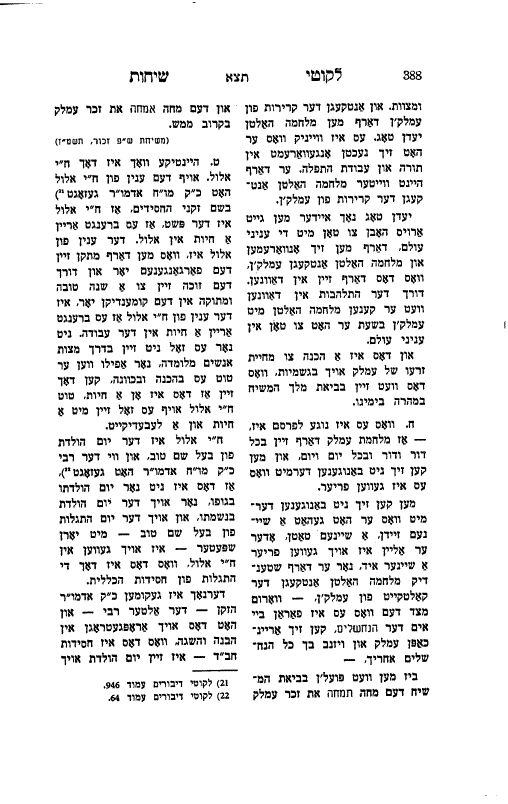
8. The battle against the coldness of Amalek must be waged every day. It is not enough that one was warmed yesterday through Torah and the service of prayer; today, too, one must continue to battle against the coldness of Amalek.
Every day, before one goes out to engage with worldly matters, one must warm oneself and wage war against Amalek, which should be done through prayer. Through the enthusiasm in prayer, one will be able to wage war against Amalek while dealing with worldly matters.
This serves as a preparation for the eradication of the seed of Amalek even in the physical sense, which will occur with the coming of King Moshiach, may it be speedily in our days.
9. What is important to publicize is that the war against Amalek must be in every generation and every day, and one cannot be satisfied with what was done previously.
One cannot be content with having had a distinguished grandfather, a distinguished father, or even if he himself was previously a distinguished Jew. Rather, he must constantly wage war against the coldness of Amalek, because due to the presence of the weak among him, Amalek can seize the opportunity and attack all the stragglers behind you, until we will achieve, with the coming of Moshiach, the complete obliteration of the memory of Amalek.
And the obliteration of the memory of Amalek will happen very soon.
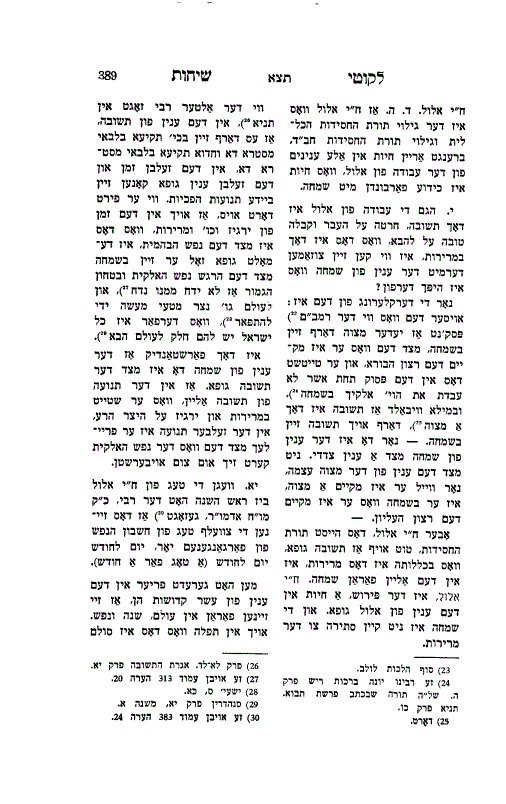
10. This week is the eighteenth of Elul. Regarding the eighteenth of Elul, my revered father-in-law, the Rebbe, said in the name of the elder chassidim that the eighteenth of Elul means it brings vitality into Elul. The concept of Elul is to rectify the past year and through this merit a good and sweet year in the coming year. The idea of the eighteenth of Elul is that it brings vitality into the service, not only that it should not be performed by rote, but even when done with preparation and intention, it can still lack vitality. The eighteenth of Elul ensures it is done with vitality and liveliness.
The eighteenth of Elul is the birthday of the Baal Shem Tov, and as the Rebbe, my revered father-in-law, said, it is not only his physical birthday but also the birthday of his soul. Additionally, the revelation of the Baal Shem Tov, which occurred years later, was also on the eighteenth of Elul, marking the revelation of general Chassidus.
Then came the Rebbe, the Alter Rebbe, who brought it down into understanding and comprehension, which is Chabad Chassidus. His birthday is also...
11. The eighteenth of Elul, which is the revelation of the teachings of general Chassidus and the revelation of Chabad Chassidus, infuses vitality into all aspects of the service of Elul. It is known that vitality is connected with joy.
12. Although the service of Elul is repentance, which involves regret for the past and a good resolution for the future, and this is typically associated with bitterness, how can this be reconciled with the concept of joy, which seems to be its opposite? The explanation is as follows: Besides the fact that, as the Rambam rules, every mitzvah should be performed with joy because one is fulfilling the will of the Creator, and he interprets this in the verse "because you did not serve the L‑rd your G‑d with joy," and since repentance is a mitzvah, it too must be done with joy. However, here the joy is due to an external factor, not from the essence of the mitzvah itself, but because one is fulfilling a mitzvah, he is joyful in fulfilling the supreme will.
However, the eighteenth of Elul, meaning the teachings of Chassidus, accomplishes that repentance itself, which in general is bitterness, contains joy within it. The eighteenth of Elul means vitality in the very concept of Elul itself. And the joy is not a contradiction to the bitterness.
As the Alter Rebbe states in Tanya, regarding the concept of repentance, that there must be "weeping lodged in one side of the heart and joy lodged in the other side," at the same time and in the same matter, both opposite movements can exist. As he explains there, even at the time of "provoking" and bitterness, which comes from the animal soul, at that very moment, one should be joyful due to the feeling of the divine soul and complete trust that "not one of them will be cast away," and "your people... the work of My hands to be glorified," for this reason, "all Israel have a share in the World to Come."
It is thus understood that the joy here is from the repentance itself. That in the movement of repentance itself, where he stands in bitterness and provokes the evil inclination, in that same movement, he is joyful because the divine soul is returning to the Almighty.
13. Regarding the days from the eighteenth of Elul until Rosh Hashanah, the Rebbe, my revered father-in-law, said that these are the twelve days of introspection for the past year, a day for each month.
We previously spoke about the concept of the ten sanctities, that they exist in the world, time, and soul. Also in prayer, which is a ladder...
14. "Set on the earth, and its top reaches the heavens," there are levels. In general, this is the distinction between weekday prayer, where there is a request for one's needs, and Shabbat prayer, which is solely the praise of the Creator. Similarly, in Torah, there is the distinction between the revealed aspects of Torah, which is the "Tree of Knowledge of Good and Evil," because in the revealed Torah, it discusses physical matters, which is the concept of refinement, and the inner aspects of Torah, which speak only of G‑dliness.
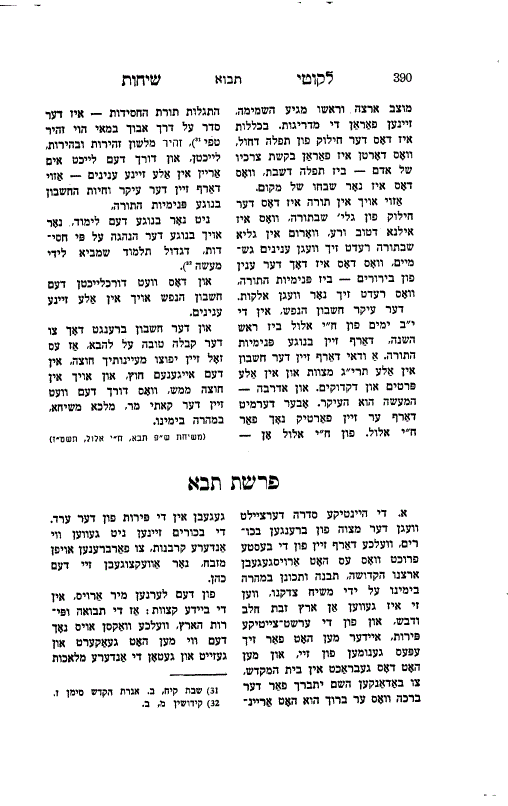
The primary introspection during the twelve days from the eighteenth of Elul until Rosh Hashanah should concern the inner aspects of Torah. Certainly, there must be an accounting in all 613 mitzvos and in all their details and nuances. On the contrary, the action is the main thing. However, this should be completed before the eighteenth of Elul. From the eighteenth of Elul onward—
1. This week's Torah portion tells of the mitzvah of bringing the first fruits, which must be from the best produce that our holy land, may it be rebuilt and established speedily in our days through our righteous Moshiach, has yielded when it was a land flowing with milk and honey, and from the first fruits, before taking anything for oneself, and bringing them to the Holy Temple to thank the L‑rd, blessed be He, for the blessing He has placed in the fruits of the land. The first fruits were not like other offerings, to be burned on the altar, but rather to be given to the Kohen.
From this, we learn in both extremes: that the grain and fruits of the land, which grow after plowing, sowing, and performing other labors, are to be given to the Kohen.