
Introduction
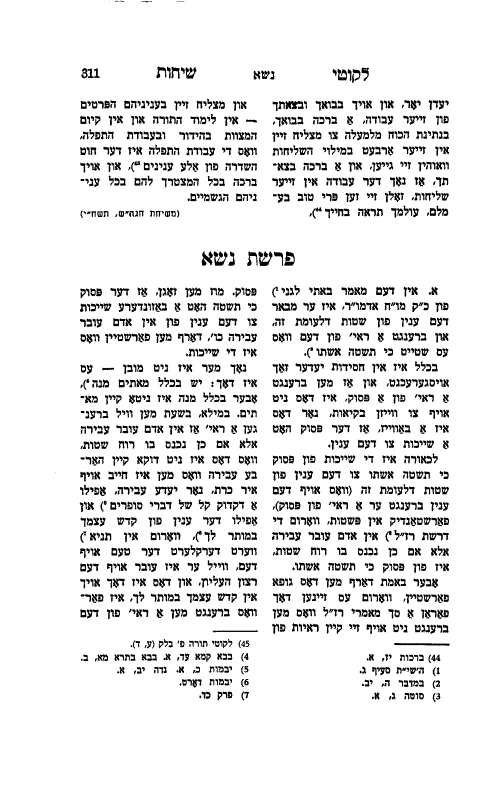
This sicha is from Likkutei Sichos volume 2, for Parshas Naso. The Rebbe discusses a teaching from the Frierdiker Rebbe in Basi Legani, where he explains that to violate Hashem’s will is an act of foolishness. To illustrate this, the Frierdiker Rebbe brings a verse about a woman who goes into seclusion with another man—referring to the laws of sotah.
The verse describes this act as foolishness. However, the Rebbe points out that this case is not just any ordinary wrongdoing; it’s a very serious transgression. If the woman actually sinned, it would be considered adultery—a severe aveirah. The question arises: if we want to show that every sin separates a person from Hashem and is an act of foolishness, why bring proof specifically from such an extreme case?
Although the Gemara itself uses this example, there still needs to be an explanation for why this particular scenario was chosen as the source. The Rebbe will explain that the reason is connected to our unique relationship with Hashem—we are described as Hashem’s wives. This means that even our physical body and animal soul are bound to Hashem in a relationship similar to marriage.
Because of this connection, everything we do matters deeply. Just as in a marriage, even seemingly minor actions can have great significance, so too with our actions toward Hashem. The Gemara says that a kosher wife does what her husband wants; similarly, we are expected to fulfill Hashem’s will in all areas.
This extra responsibility comes from being “married” to Hashem. Even when there is only suspicion—without certainty of wrongdoing—the Torah teaches us lessons from this case of sotah. The mere possibility already carries weight because of the closeness of our relationship with Hashem.
In this sicha, we will go step by step through these ideas and see how they apply to our lives and service of Hashem.
Saif Aleph
The Gemara discusses the concept of "tilting away"—when a person's wife strays and goes into seclusion—and describes this as an act of foolishness, or shtus. The Rebbe points out that in Chassidus, every source brought is intentional and meaningful; it's not just about showing off knowledge or quoting verses for their own sake. If a verse is cited as proof, it means there is a real connection between that verse and the subject at hand.
Here, the verse about a wife straying is used to illustrate the idea of shtus de-kedushah—the foolishness of the other side, or acting against Hashem's will. The question arises: why specifically use this verse, which deals with such an extreme case, to teach about all forms of spiritual foolishness?
The sages teach that "a person does not commit a sin unless a spirit of foolishness enters him." This entire concept of a "spirit of foolishness" is derived from the verse about the wife who strays. The connection seems clear: her act is described as foolishness, so we learn from here about the general idea that sin stems from folly.
However, there is a deeper question. Why do we derive this principle—that any sin involves a spirit of foolishness—from such an extreme example? The case in the verse is a severe transgression. How can we apply this lesson to every kind of sin, even minor ones?
There are many teachings from our sages that are accepted without direct scriptural proof. So why does this teaching require a verse? And why specifically this verse? It must be that there is something unique about this example that sheds light on all cases where someone acts against Hashem's will.
The Rebbe explains further with an analogy: if you have 200, it includes 100; but if you have 100, it doesn't include 200. In other words, if something applies in a more severe case (200), it certainly applies in lesser cases (100). But here, we're trying to prove that even minor sins—or even failing to sanctify oneself in permissible matters—are also due to a spirit of foolishness. How do we know this from such a serious offense?
When we say "a person does not violate any sin unless there is a spirit of foolishness," we mean literally any sin—not just major ones like adultery or those punishable by kares, but even minor infractions or rabbinic prohibitions. Even when someone fails to sanctify themselves in what is permitted (kadish atzmecha b’mutar lach), which isn't technically a sin at all, it's still considered acting with a spirit of foolishness.
This idea is explained in Tanya: why is it considered foolishness to transgress? Because one is going against the will of Hashem. This logic applies equally whether it's an explicit prohibition or simply failing to go beyond the letter of the law and sanctify oneself in permissible matters—the underlying issue is disregarding Hashem's will.
So why bring proof for all these cases from such an extreme example—a wife straying—which represents one of the gravest sins? Perhaps only such serious offenses are called ruach shtus, but how do we know lesser actions fall under this category as well?
The Rebbe answers that there is something specific about the case of "his wife will stray" that makes it relevant for all Jews and all levels of wrongdoing. First, because metaphorically, the Jewish people are considered Hashem's wife—so every misstep matters deeply in our relationship with Him.
Later on (in section Gimel), the Rebbe will explain another point: even if it turns out no actual sin was committed—as when the woman was innocent—the very process shouldn't have happened at all. This too reflects how even seemingly small deviations are significant.
The connection between any Jew's wrongdoing and the story of "his wife will stray" has two aspects. The first aspect will be discussed next: how our relationship with Hashem parallels that described in this verse.
Saif Beis
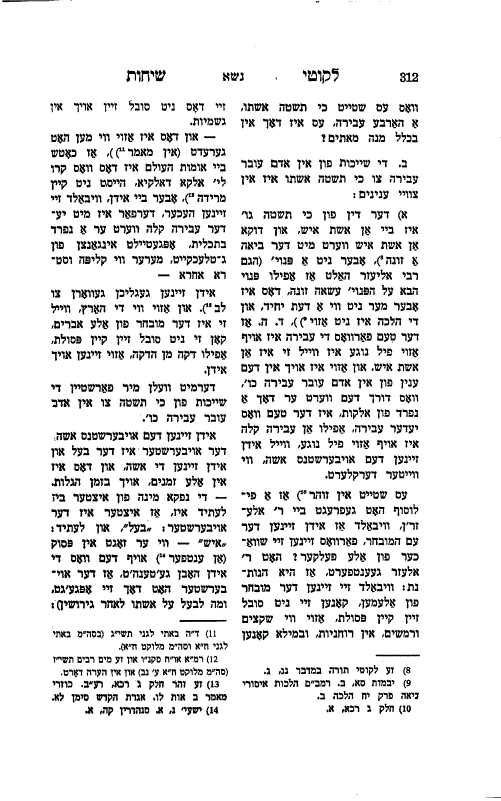
The concept of a woman straying, as discussed here, applies specifically to an eshes ish—a married woman. Only when she is married does her act of infidelity give her the status of a zoyne, a harlot. If the woman is not married, then such an act does not render her a zoyne. While there are opinions that disagree, such as Rabbi Eliezer who holds that even an unmarried woman who has relations outside of marriage becomes a zoyne, this is not the accepted halacha.
The Rebbe emphasizes that the reason she becomes a zoyne is precisely because she is married. The significance of the sin lies in her status as a wife; it is the marriage bond that makes this transgression so severe. This parallels the broader idea that when a Jew sins, it is particularly grave because of their unique relationship with Hashem.
When a Jew commits an aveira, even a seemingly minor one, he becomes separated from Godliness. The question arises: why does every sin, even the lightest, matter so much? What makes it so intolerable? The answer is rooted in our closeness to Hashem—the more connected we are, the more sensitive we become to anything contrary to His will.
The Zohar brings an analogy: A philosopher asked Rabbi Elazar why Jews are physically weaker than other nations and cannot tolerate things others can. Rabbi Elazar explained that because Jews are chosen by Hashem, they have a heightened sensitivity and cannot tolerate even small impurities—like insects or creeping things—that other nations can eat without issue. Their spiritual refinement makes them physically unable to bear these things.
This sensitivity extends beyond physical matters. Spiritually, Jews cannot tolerate non-kosher foods or actions because of their elevated status as Hashem’s chosen people. What might be insignificant for other nations becomes intolerable for Jews due to their unique role and closeness to God.
The Rebbe brings another example from his earlier discourse: Among the nations of the world, some refer to God as “the God of gods,” implying belief in multiple powers. For them, acknowledging another deity alongside God is not considered rebellion. But for Jews, even the slightest deviation from pure monotheism constitutes total rebellion and separation from Hashem.
This means that for a Jew, even a minor transgression causes complete detachment from Godliness—more so than for someone outside this special relationship. The analogy given compares Jews to the heart among all limbs: just as the heart cannot tolerate even minute impurities because of its central role in sustaining life, so too Jews cannot tolerate even small spiritual blemishes.
This understanding sheds light on why the Torah uses the example of a wife straying from her husband when discussing spiritual infidelity. The Jewish people are likened to Hashem’s eternal wife; He is our husband at all times. This relationship persists forever—as expressed in verses where Hashem declares Himself our husband both now and in the future.
There may be arguments or claims that Hashem has “divorced” us due to our sins or exile, but Hashem responds: “Where is your mother’s bill of divorce?” In truth, He never divorced us; we remain His wife eternally.
Therefore, just as a proper wife fulfills her husband’s wishes, so too must we strive to fulfill Hashem’s will in every detail. Even what seems like a minor wish or instruction from Hashem carries great weight because it affects our relationship with Him as His beloved spouse.
If one fails to fulfill even these small wishes, one falls short of being that “kosher woman”—the ideal Jewish soul who does her Husband’s will completely. This explains why every mitzvah and every prohibition matters deeply for us: our entire being (our godly soul, animal soul, and natural soul) is bound up with Hashem like a wife with her husband.
This also clarifies why the Torah chooses this particular example (a wife straying) rather than any random proof text: it isn’t just evidence but an explanation for why even seemingly minor sins are so significant for us. Our identity as Hashem’s eternal wife means that every detail matters in maintaining this sacred bond.
Saif Gimmel
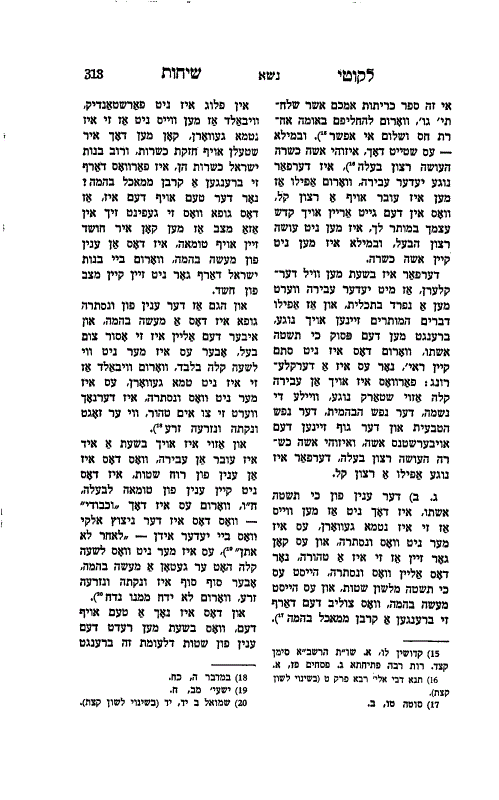
The Rebbe adds a second idea here, beyond what was discussed earlier. In the case of the sotah, we do not even know for certain that she committed a sin. Despite this uncertainty, we still treat her as if she is guilty of something, simply because she placed herself in a situation of suspicion. The very act of entering into seclusion with another man—without any proof of wrongdoing—is already considered a fault for a Jew.
It is not that we know she became defiled; all that happened is that she went into seclusion. It is entirely possible that she is innocent. Yet, the mere fact that she put herself in such a position is already called a shtus—a foolishness. This behavior is described as an act of an animal, even though no actual sin was committed. Just being under suspicion is enough to warrant this comparison.
This explains why her offering is brought from barley rather than wheat. The Gemara says her korban comes from barley because she acted like a beheimah—an animal. But there is a question: did she really behave like an animal? After all, she did not actually do anything forbidden; she only secluded herself.
In the world of animals, there are no restraints or laws—they do not have to remain loyal to one mate. So why do we compare her to an animal just for being in seclusion? Superficially, it seems difficult to understand: since we do not know that she has been defiled, why don’t we assume she is innocent? Most Jewish women are indeed pure and faithful.
Why then must she bring an offering from animal food—barley—as if we are treating her like an animal already? The reason is that for a Jewish woman to find herself in such a situation where suspicion of impurity arises, that itself is considered an act akin to animal behavior. Among Jewish women, there should not even be grounds for suspicion.
This teaches us how important it is not to place oneself in situations where one’s actions could be interpreted as sinful. Even if nothing actually happened, just creating the possibility for doubt reflects a lack of proper judgment—a form of foolishness.
On the other hand, while this alone prohibits her temporarily from being with her husband, there remains an easy path to return and restore purity. Although we say that just this seclusion constitutes an act similar to that of an animal and renders her forbidden to her husband for now, it does not mean she has truly become impure.
Since nothing more than seclusion occurred, once the process concludes and it becomes clear that she did not become defiled, she returns to her husband and regains her status of purity. Metaphorically, this represents how the Jewish people can return to Hashem after being in a state of suspicion or distance—it was only temporary.
The verse says:
ונקתה ונזרעה זרע
"She shall be cleared and shall conceive seed."
This means that after passing through this ordeal and being found innocent, not only does she return to purity but receives additional blessing—she will have children and see goodness as a result.
The same applies spiritually: when a Jew transgresses—even repeatedly—it stems from a spirit of foolishness (shtus). But this does not mean true defilement or permanent separation from Hashem occurs. Every Jew possesses a spark of Godliness—Hashem’s honor—which He never gives away or removes from any Jew.
The verse states:
כבודי לאחר לא אתן
"My honor I will not give to another."
This divine spark remains within every Jew at all times; Hashem never takes it away. Any violation or distance caused by sin is only temporary—a fleeting moment when one acts out of foolishness or like an animal.
But ultimately:
ונקתה ונזרעה זרע
"She shall be cleared and shall conceive seed."
No Jew will ever be completely cast aside; everyone will eventually return. Even during exile or periods when Jews commit transgressions—even if only suspicion exists—the separation from Hashem is never permanent; it lasts only for a short while.
This provides another reason why even discussing the concept of foolishness (shtus) on the side of impurity brings us back to these verses and their deeper meaning: the essential connection between every Jew and Hashem can never truly be broken.
Saif Daled
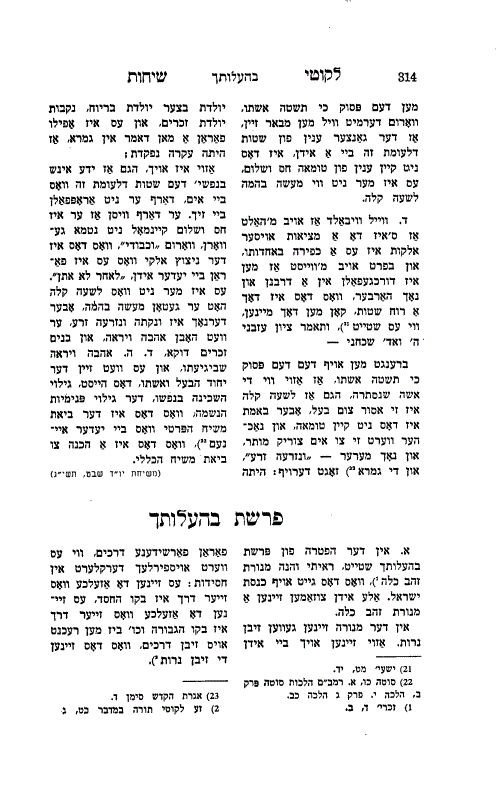
We bring the verse of siste ishte here because we want to clarify that the entire concept of the “foolishness of the other side” as it applies to a Jew is not, God forbid, an issue of impurity. It is not, Heaven forbid, true defilement. Rather, it is only a temporary act—like an animal acting out for a moment. The Torah brings this verse to show that even when there is a sin, it is only a temporary separation. Ultimately, there will be v’niksa zera—purification and offspring—and as the verse says, “no one will be pushed away.”
The Rebbe teaches two points here. First, we must recognize that because we are compared to a wife (the Jewish people as Hashem’s bride), everything about our relationship with Hashem is significant. Second, even when there is suspicion or failure, it should encourage us to remember that this state is only temporary. The suspicion itself should not exist—since even entertaining such thoughts is already an animalistic act—but nevertheless, it does not define us permanently.
The Rebbe explains further: If someone considers that there could be any entity besides godliness—even just in thought—that itself constitutes a denial of Hashem’s unity. This separation from Hashem’s oneness is especially severe if one knows they have failed in matters that are rabbinically forbidden or even more serious prohibitions. This attitude stems from the “spirit of foolishness.”
One might think, as stated in the verse, that “God has left us and Hashem has forgotten us.” But this is precisely what the Torah comes to negate by bringing the verse ki sishte ishte.
אך את מטה לוי לא תפקוד ואת ראשם לא תשא בתוך בני ישראל.
"But the tribe of Levi you shall not count, nor lift up their head among the children of Israel."
Just as with a woman who has gone into seclusion—even though she becomes temporarily prohibited to her husband—this does not constitute true defilement. Eventually she becomes permitted again and even more so: she will have seed (zera). The Gemara explains that this “seed” represents great blessing: if previously she would give birth with pain, now it will be easy; if she would bear daughters before, now she will bear sons; and in some cases where she could not have children at all, now she will be able to.
This teaches us that no Jew should ever feel dejected or lost due to temporary distance from Hashem. God forbid one should think they have truly become impure or lost their connection—the divine spark within every Jew remains untouched. Hashem declares He will never give away that spark; it belongs only to each individual Jew.
The entire episode is only a temporary lapse—a momentary act like an animal—but ultimately it leads to purification and new spiritual offspring (nisera zora). After this brief separation from Godliness, there comes renewal: spiritual children are born—here described as male offspring—which symbolizes strength and continuity in divine service.
This union between husband and wife alludes to revealing the Shekhinah—the Divine Presence—within one’s own soul. When a person reveals their innermost soul (the “husband” within), this is their personal redemption—their own coming of Mashiach. This inner transformation prepares each individual for the collective redemption with Mashiach Ben David.
This idea connects directly with Yud Shvat—the day marking leadership of the Rebbe—and its message for every Jew: no matter how far one may seem from holiness at times, these moments are only temporary lapses. The essential bond with Hashem remains intact and leads ultimately to greater revelation and blessing.
Key Points
1. The Rebbe examines why the Torah uses the extreme case of a wife straying (sotah) to illustrate that all sin stems from a spirit of foolishness, emphasizing that every source in Torah is intentional and deeply connected to its lesson.
2. The analogy of a married woman’s infidelity is chosen because the Jewish people are likened to Hashem’s eternal wife; our unique relationship with Hashem means even minor transgressions are significant and create separation from Godliness.
3. The heightened spiritual sensitivity of Jews, compared to other nations, makes even small impurities or deviations intolerable—just as the heart cannot bear even slight blemishes, so too Jews cannot tolerate minor spiritual failings due to their closeness to Hashem.
4. The case of sotah teaches that even suspicion or the appearance of wrongdoing—without actual sin—carries weight for a Jew; placing oneself in questionable situations is itself considered an act of foolishness and animal-like behavior, though it does not cause permanent separation from Hashem.
5. Despite temporary lapses or moments of distance caused by sin or suspicion, the essential divine spark within every Jew remains untouched; Hashem never removes His honor from any Jew, and all separation is only momentary.
6. The process described in the sotah narrative demonstrates that after passing through suspicion and being found innocent, not only is purity restored but additional blessings follow—symbolizing how every Jew can return to Hashem and experience renewed spiritual growth after moments of distance.
7. The lesson for daily life is that no matter how far one may feel from holiness—even if one has failed in serious matters—the connection with Hashem is never truly broken; these are only temporary lapses, and ultimate renewal and redemption are always possible through returning to one’s inner divine bond.
8. This message is especially relevant in connection with Yud Shvat and the leadership of the Rebbe: every Jew possesses an unbreakable relationship with Hashem, and even brief separations serve as opportunities for greater revelation, blessing, and personal redemption leading toward the collective geulah.