
Introduction
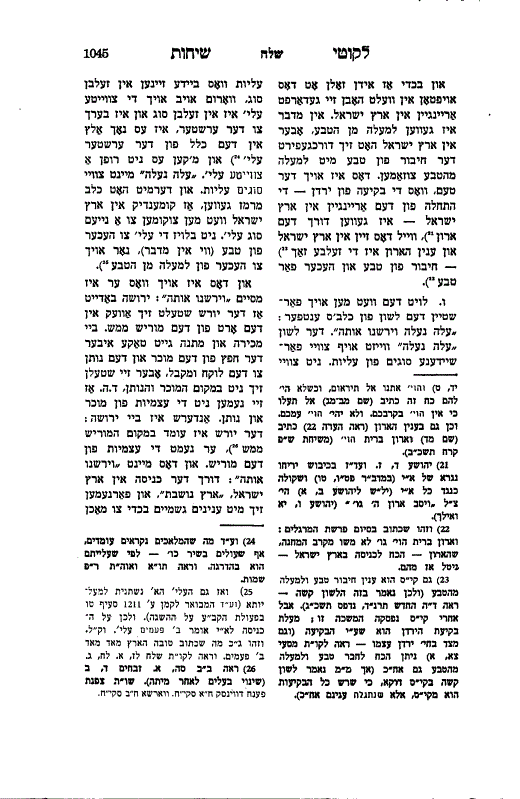
This sicha from Likkutei Sichos, volume four, Parshas Shelach, presents a unique and powerful lesson that we can apply in our own lives today, drawn from the story of the spies—the meraglim. The Rebbe highlights how we can use the episode of the meraglim to guide our own service of Hashem, especially when we are engaged with the physical world and its challenges.
The Rebbe explains that even as we work within the physical realm, if we have the right perspective and Hashem desires us, if we believe in Hashem and dedicate our efforts to Him, then we can utilize all aspects of the world for a higher purpose. The world and everything in it are not inherently opposed to spirituality or to Hashem; rather, they can be harnessed and elevated to serve Hashem’s will.
Another theme discussed is the importance of self-confidence—not just in spiritual matters but also in our practical lives and relationships with others. The Rebbe emphasizes that it is crucial to reach out and ensure that others are included as well, helping them learn about Torah and mitzvos so they too can be uplifted.
The Rebbe also addresses a concern some may have: that becoming a leader or influencer might lead to arrogance or self-importance, which could cause one to lose their authenticity or connection to truth. On the contrary, he teaches that when Torah and mitzvos are used properly—to positively influence others—this does not detract from one’s spiritual standing. In fact, it makes a person even greater. This stands in direct contrast to the mistake of the meraglim, who thought it was impossible to combine both worlds.
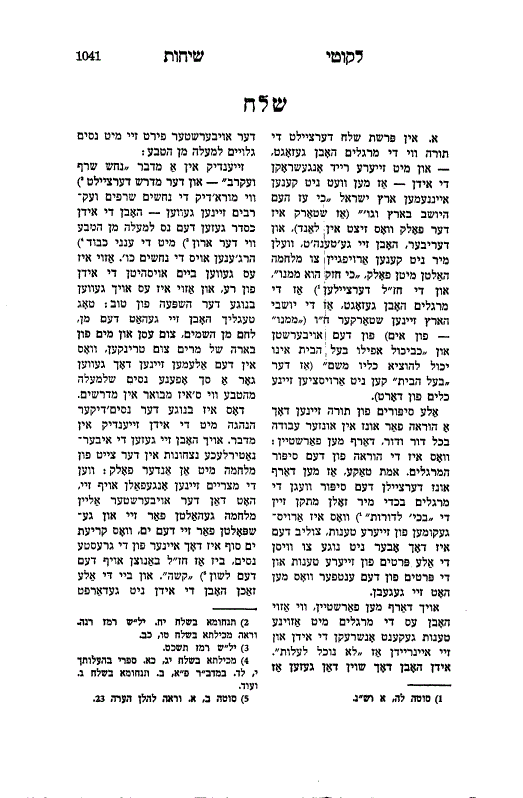
The Rebbe begins by raising a simple question about the mindset of the meraglim. He notes that on a surface level, it is difficult to understand why they felt unable to enter Eretz Yisrael. It is hard to see how Calev’s attempts at reassurance did not convince them—after all, they had witnessed so many miracles from Hashem while in the desert. How could they doubt Hashem’s ability? Why did Calev not simply point out all these wonders as proof?
The answer is that there is a deeper meaning here—their hesitation was not merely due to practical fears or external challenges. Rather, there was an underlying spiritual reason for their reluctance. This deeper motivation will be explored further as the sicha unfolds.
Saif Aleph
The Rebbe begins by addressing the core mistake of the spies—the meraglim—who did not want to enter the Land of Israel. Their error, as the Rebbe explains, was rooted in their belief that they could not remain properly connected to Hashem in Eretz Yisrael. They thought that Hashem’s presence could not dwell in a place like Israel, where nature operates according to its own rules, as opposed to the miraculous existence they experienced in the desert.
The spies argued that it would be impossible for them to conquer Eretz Yisrael because the inhabitants were too powerful. The Torah records their words: “They are stronger than us.” The Rebbe notes that the Hebrew word mimenu—“than us”—can also mean “than Him,” implying that even Hashem could not overcome the strength of those living in the land.
This was not just a statement about their own abilities; it was a claim about Hashem Himself. The spies suggested that even Hashem, so to speak, could not bring them into Eretz Yisrael or enable them to live there as Jews connected to Him. They believed that once inside the land, under natural circumstances, Hashem’s power would no longer be able to uplift or transform them.
The Rebbe explains that this reflects a broader spiritual misconception: thinking that worldly matters and nature are so powerful and entrenched that even Hashem cannot elevate or redeem them. This is a fundamental error in how one views Divine involvement in the world.
Every story in Torah is meant as a lesson for our own lives and Divine service. The Rebbe asks: what is the message for us from this episode with the meraglim? It is clear that we must rectify their mistake and learn from their failure—not simply criticize them, but understand how their story applies to every generation.
On the night when the spies returned and delivered their negative report, it became a night of weeping for generations—the origin of Tisha B’Av and many subsequent tragedies. This shows how deeply consequential their mistake was for all Jews throughout history.
The Rebbe emphasizes that while it is important to know this story’s impact on our people, we do not need all its details merely for historical knowledge. Instead, we must extract its practical lesson—what led to their error and what response is required from us today.
This need becomes even more pressing when considering how puzzling this episode is on a simple level. How could the spies have succeeded in frightening the Jewish people after all they had witnessed? The Jews saw open miracles daily—their entire existence in the desert was supernatural protection and sustenance.
In the desert, there were dangerous creatures like snakes and scorpions, yet nothing harmed them because of constant miracles. Their food—the mann—descended from heaven; water came from Miriam’s well; everything about their lives was miraculous. They were protected from harm and provided for beyond natural means.
Furthermore, they witnessed miraculous victories over enemies such as Egypt at the Red Sea—events described as “supernatural great miracles.” These were not stories they heard secondhand; they experienced these wonders themselves.
Given all this, it seems incomprehensible how anyone could convince them otherwise or make them fear entering Eretz Yisrael. If Hashem performed such miracles before, why would He not do so again when conquering the land?
The Rebbe points out that even when later generations recalled these events—such as Yehoshua and Kalev—they did not focus on reminding everyone about these miracles during war. Instead, they addressed other aspects of faith and trust in Hashem.
Saif Beis
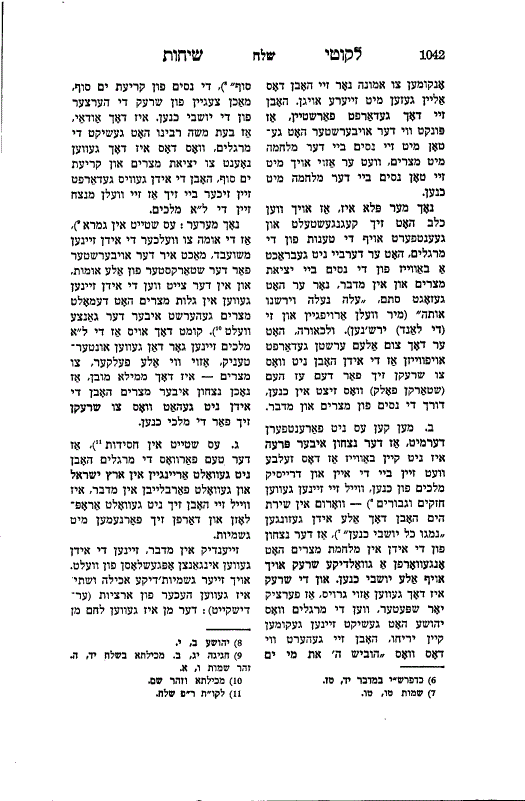
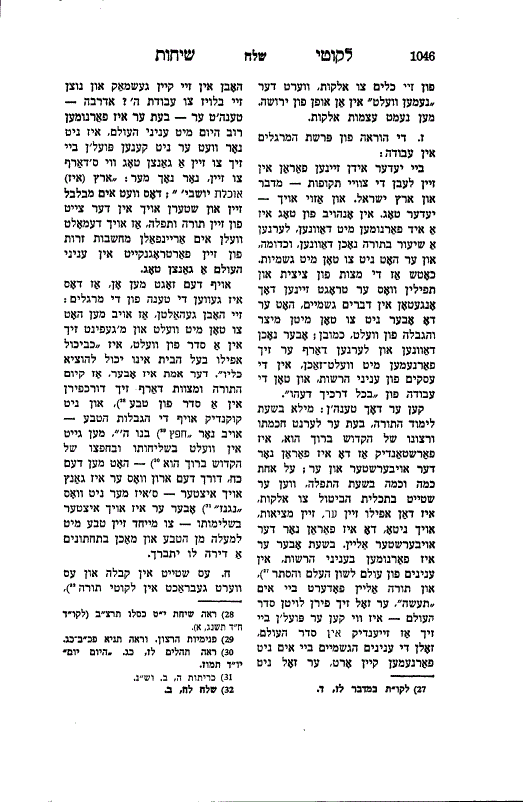
At first glance, when we read the words of the spies—“Let us go up and inherit the land”—it seems that they did not share all their doubts with the people. They simply said, “Let us go up,” which implies that perhaps they themselves needed to be convinced, but did not reveal every detail to the nation. This suggests that the spies’ hesitation was not just about whether miracles would occur in battle, but rather about something deeper.
It is not so difficult to believe in miracles when one is living in a miraculous environment, such as the desert. However, the real challenge arises when transitioning to a more natural lifestyle, like life in Eretz Yisrael, where one must engage with the world and work for sustenance. In such a setting, miracles are not as apparent. The question then becomes: how does one maintain faith and connection to Hashem when living within nature?
The Rebbe explains that this issue is at the heart of the story of the spies and Kalev’s response. Spiritually, there are two modes: life in the desert—where everything is miraculous—and life in Eretz Yisrael—where everything appears natural. The spies were concerned about entering a world governed by nature and losing their spiritual clarity.
One might argue that perhaps Hashem could perform miracles even against thirty-one powerful nations ruling over Eretz Yisrael, just as He did against Egypt or Amalek. But this was not their real fear. The Torah itself tells us that after witnessing Hashem’s miracles in Egypt, all the nations of Canaan were filled with dread and awe of Bnei Yisrael. This fear persisted for forty years, as seen later when Yehoshua sent spies to Yericho and heard from its inhabitants how their hearts melted because of what Hashem had done for Israel at Yam Suf.
Given this context, Bnei Yisrael should have been confident that they would be able to conquer these nations with Hashem’s help. The fact that all of Canaan trembled before them meant there was no rational reason for fear or doubt about victory.
The deeper issue was not military might or fear of defeat; it was a spiritual concern. The spies could not imagine serving Hashem within a natural framework—living off bread from the earth rather than manna from heaven—and still experiencing miracles and closeness to God.
The Rebbe notes that in Chassidus it is explained: while in the desert, Bnei Yisrael lived on food and drink provided miraculously—manna from heaven and water from Miriam’s well. Even their clothing was supernatural; it did not wear out or require replacement. Everything about their existence was elevated above nature.
However, upon entering Eretz Yisrael, all this changed. They would need to eat bread grown from the earth through hard work—plowing, planting, harvesting—and drink water drawn from wells or rain. Their sustenance would come through natural means rather than open miracles.
This transition meant becoming more physically involved with the material world. The phrase “the land consumes its inhabitants” can be understood spiritually: by living off physical food from the land, one becomes more materialistic; one’s body becomes more enmeshed with physicality rather than spirituality.
When a person is sustained by miraculous food like manna—which is completely absorbed into the body without waste—it refines him spiritually and makes him a fitting vessel for Torah. That is why only those who ate manna were able to truly expound Torah at its deepest level; their bodies were nurtured by spirituality itself.
If Bnei Yisrael were to enter Eretz Yisrael and live off earthly bread instead of heavenly manna, they feared losing this spiritual refinement and becoming too grounded in materiality.
Yet here lies their mistake: Hashem’s ultimate desire is for there to be a dwelling place for Him within this lower world—a relationship with creation itself, elevating even physicality into holiness. The time spent in the desert was only preparation for this mission; true fulfillment comes through engaging with nature and sanctifying it.
The mistake of the spies was thinking that spirituality could only be achieved by remaining separate from worldly involvement—in an environment of constant miracles—rather than bringing holiness into everyday life within Eretz Yisrael.
This sets up what will be explained further: why despite all their miraculous experiences until now, the spies still resisted entering Eretz Yisrael. Their error lay in misunderstanding Hashem’s purpose—that holiness must permeate even natural existence—not just remain above it.
Saif Gimmel
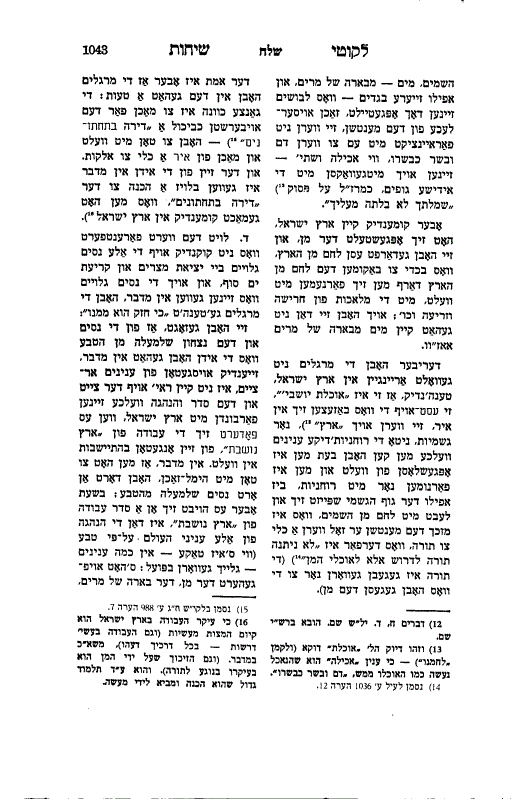
The spies, the meraglim, had a particular argument regarding the miracles and victories that took place in the desert. They observed that while in the desert, the Jewish people experienced open miracles and lived in a way that was disconnected from material concerns. Their lives were not bound by the natural order or the regular conduct associated with living in Eretz Yisrael.
The meraglim claimed that these supernatural victories and miracles were possible only because the Jews were removed from worldly matters. In their view, there was no evidence that such miracles could continue once the Jews entered Eretz Yisrael and began living a settled, natural life. The service required in Eretz Yisrael—avodah of a settled land—demands engagement with nature and daily affairs, unlike the miraculous existence in the desert.
They argued that as soon as the Jewish people would transition from this miraculous mode of living to a natural one, many of those supernatural phenomena would cease. Indeed, after entering Eretz Yisrael, the manna stopped falling, Miriam’s well ceased, and only the clouds of glory continued for a time. According to their logic, under these natural conditions it would be impossible to defeat nations like the descendants of giants who were physically stronger than Israel. In other words, within nature’s limitations, conquering Canaan seemed unattainable.
Their analogy was that even a master cannot always retrieve his own vessels—meaning even Hashem Himself could not extract the divine sparks from within physicality unless one is living above nature. They believed that elevating these sparks to holiness could only occur when one is not truly part of the world—when living in a miraculous state like in the desert.
However, if Hashem desires for the world to remain as it is—with all its natural laws—and still become a vehicle for godliness, how could miracles occur within nature? The meraglim thought that if Hashem established nature in Eretz Yisrael and wanted it to run according to its own rules, then miracles would contradict His will for nature there.
This was precisely where Kalev and Yehoshua responded differently. They declared: If Hashem desires us—if it is His will that we fulfill His intent by making a dwelling place for Him in this lower world—then “they are our bread.” We can consume them like bread; Hashem is with us; do not fear them. There is no reason to be intimidated by worldly limitations or obstacles.
Kalev and Yehoshua emphasized that even though nature remains with all its boundaries and limitations, Hashem is always with Israel. Within nature itself He grants them success beyond what nature would dictate—enabling them to transform the world into “our bread,” making it a place for Hashem’s presence.
This transformation means taking physicality—the most material aspects of existence—and turning them into something holy and connected to Godliness. Just as Hashem provided manna from heaven (a supernatural food), now we are tasked with taking earthly things and elevating them through our service—even while remaining within natural constraints.
In summary, according to the Rebbe’s explanation here, the meraglim believed spirituality could conquer but physicality would drag one down into nature; they doubted their ability to draw down Godliness into natural life. Yehoshua countered: If it is Hashem’s desire (cheifetz Hashem), then we can bring Godliness into nature itself—we can make even worldly existence into a dwelling place for Him.
The Rebbe notes further (as will be explained in section 5) that it is actually an even greater miracle when nature itself becomes a vessel for holiness than when open miracles override nature entirely. When Godliness shines through within natural law—not just above or outside it—it demonstrates an even deeper unity between Creator and creation.
Saif Daled
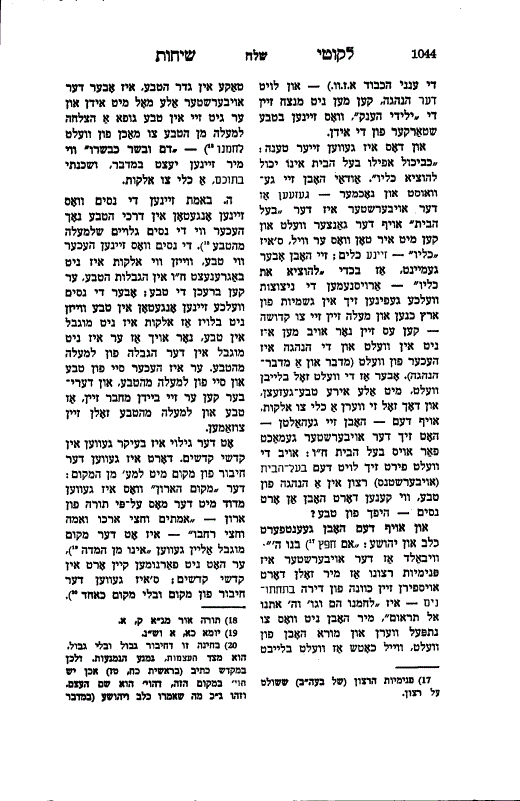
The aron in the Beis Hamikdash had a defined measurement, yet when measured from the walls of the Kodesh HaKodashim, it did not occupy any space. This means that the aron connected both the concept of space and that which is beyond space within one area. It was a physical object with dimensions, but it did not take up measurable space in its holy location.
In order for the Jewish people to accomplish this same idea in the world—to connect nature with what is above nature—they needed to enter Eretz Yisroel. While they were in the desert, their existence was entirely beyond nature. But entering Eretz Yisroel meant bringing together both aspects: living within nature while still being connected to what is above it.
This is also why the splitting of the Jordan River, which marked their entry into Eretz Yisroel, was accomplished through the aron. As described in Sefer Yehoshua, the aron went ahead of them and caused the waters to split. The same principle applied: just as in the desert, so too in Eretz Yisroel—the Jewish people are bound up with the aron, and the aron represents this fusion of natural and supernatural realities.
The Rebbe points out (in Ha’orah 20) that this connection between finite and infinite—gvul and bligvul—as seen by the aron’s unique property (mokom aron eino min hamidah) comes from Atzmus itself, which is described as nimna hanimno’os, capable of uniting opposites. That’s why regarding the Beis Hamikdash it says: אכן יש ה׳ במקום הזה—“Indeed Hashem is in this place”—because Havaye (the essential Divine Name) is present there.
This also explains why Kalev and Yehoshua declared: וה׳ איתנו אל תיראם—“Hashem is with us; do not fear them.” They were invoking the power of Atzmus. Conversely, when that power was lacking—as described by the verse כי אין ה׳ בקרבכם, “for Hashem is not among you”—the people could not succeed in entering Eretz Yisroel. Without Havaye—the Shem HaEtzem—the ability to conquer or dwell in Eretz Yisroel was absent.
The same theme recurs regarding the aron’s role at various critical moments: it led before them at Krias Yam Suf (the splitting of the sea), at Kibush Yericho (the conquest of Jericho), and whenever a miraculous crossing or conquest was required. The Rebbe notes (Ha’orah 21) that just as at Yam Suf, so too at Yericho—the key to all of Eretz Yisroel—the aron preceded them.
The Rebbe further cites (Ha’orah 22) that after the sin of the spies, when some tried to ascend to Eretz Yisroel without Divine sanction, it says: וארון ברית ה׳ לא מש מקרב המחנה. The power to enter Eretz Yisroel comes specifically through the aron; without it, success is impossible. The aron embodies this essential connection between above-nature and within-nature realities.
This sets up what will be explained further: how Kalev’s response to the spies’ argument—his language in his answer—reflects this concept. Kalev said: “Aloh na’aleh veyarashnu osah”—“We shall surely go up and inherit it.” The double expression “aloh na’aleh” (“go up we shall go up”) alludes to two distinct types of elevation.
This duplication does not refer simply to two levels within one category but rather two fundamentally different categories of ascent. If both were relative steps within one realm, they would be considered part of a single ascent; only when they are qualitatively different can they be counted as separate elevations.
Kalev was hinting that upon entering Eretz Yisroel, there would be a new kind of elevation—not only rising above nature as experienced in the desert but also reaching higher than even beyond-nature itself. This refers to Atzmus—the Divine Essence—being drawn down into nature itself.
Kalev concluded with “veyarashnu osah”—“and we will inherit it.” Inheritance implies taking full possession—not merely acquiring something as a purchase or gift but actually standing in place of one’s predecessor. When you buy or receive an object as a gift, you acquire ownership but do not take over the very position or essence of its previous owner.
Inheritance means stepping into their very place—you assume their essence and role completely. This is what Kalev meant by saying “we will inherit it”: through entering Eretz Yisroel with this connection to Atzmus (as embodied by the aron), we don’t just acquire land—we become true inheritors who embody its essence fully.
Saif Hei
The concept of inheriting Eretz Yisrael—Yerusha—means entering a settled land and engaging with physical matters, transforming them into vessels and gardens for godliness. When a Jew inherits the land, he is not just taking possession of physical territory; he is drawing down the essence of godliness itself. This level is even greater than the miraculous, as it brings the essence—Atsmus—into the realm of nature, uniting miracle and natural order.
This was Koleiv’s answer to the spies. His words, “Oli Naleh,” represent a unique kind of ascent—an aliyah that draws down Atsmus, which is beyond both miracle and nature. The true innovation is that miracles can be drawn into nature itself, and this happens specifically through Yerusha, inheriting and settling in Eretz Yisrael.
The spies argued that Eretz Yisrael—a settled land—was incompatible with receiving godliness. They saw involvement in worldly matters as a contradiction to spiritual connection. Koleiv responded that precisely within Eretz Yisrael, within engagement with the world, one reaches an even higher level of connection to Hashem.
In the next sections (Zayin and Ches), the Rebbe will explain how this idea applies to our daily service of Hashem. Every Jew experiences two periods: times like being in the desert, and times like being in Eretz Yisrael. Each day begins with prayer and Torah study—a time removed from worldly concerns. Even though mitzvos like tzitzis and tefillin involve physical objects, during these moments a Jew is not truly engaged with the limitations of the world; his focus is entirely on Hashem.
After davening and learning, however, a Jew must engage with worldly matters—his business or other permissible activities that are not directly mitzvos but are part of daily life. Here he must fulfill “know Him in all your ways,” turning even optional activities into service of Hashem.
One might argue that it makes sense to feel close to Hashem while learning Torah or davening—when immersed in His wisdom or standing before Him in prayer, there is nothing but Hashem. But when occupied with mundane matters—the world (olam) whose very name implies concealment (helem)—and when Torah itself instructs him to act according to the order of the world, how can he ensure that these physical matters do not distract him or take up space in his heart?
The concern grows: if most of his day is spent on worldly matters, not only might he fail to elevate them for Hashem’s sake, but they could actually consume him—a “land which consumes its inhabitants.” These distractions could even intrude upon his times of davening and learning, filling his mind with foreign thoughts rooted in his daily preoccupations.
This was precisely the argument of the spies: if one must be involved with the world and live according to its order, then even Hashem Himself cannot transform these vessels—the materiality remains as it was. They believed true devotion was impossible amidst worldly involvement; worse still, such involvement would detract from spiritual pursuits altogether.
But as will be explained further, this perspective misses the deeper truth about our mission in this world.
Saif Vov
The Rebbe explains that the ultimate purpose is not just to achieve spiritual accomplishments through miraculous means, but rather to fulfill Hashem’s will within the framework of nature. Even though there are natural limitations, if a Jew goes about his life as an agent of Hashem—carrying out the mission of the Holy One, blessed be He—then he is empowered by the Orin (the Ark), which remains spiritually present and whole even now, despite being physically hidden.
Conceptually, the Orin is still with us. Although it was concealed, its essence remains intact. This means that even in our current state, we have the ability to unite nature with that which is above nature—to make a dwelling place for Hashem in this lowly world.
In this section, the Rebbe further develops the lesson regarding a person’s relationship not only with himself but also with his environment and those around him. Impacting others is an essential part of entering Eretz Yisroel and reaching the highest levels of divine service.
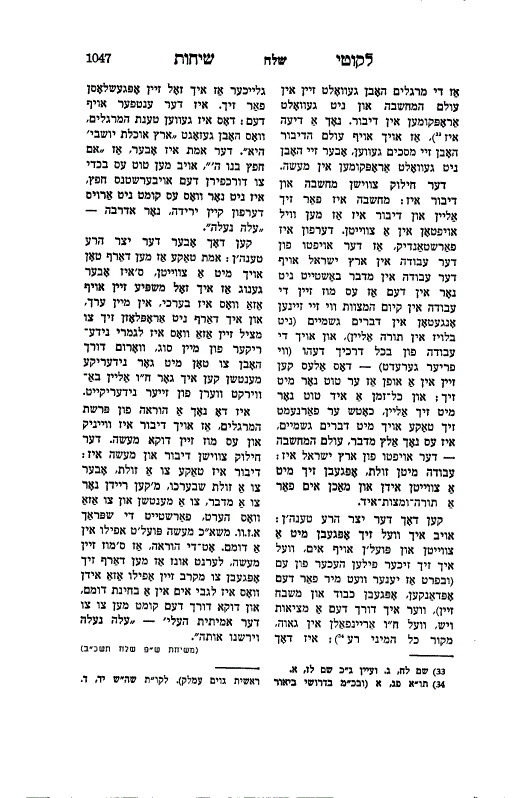
It is written in Kabbalah and brought down in Likkutei Torah that the Meraglim (the spies) desired to remain in the “world of thought”—Oylem HaMachshovah. In Chassidus, we learn about three garments of the soul: thought, speech, and action. The Meraglim wanted to stay at the level of thought and did not wish to descend into speech—a further step down from pure contemplation. There is another opinion that they were willing to descend as far as speech (dibur), but not all the way into action (maaseh).
The difference between thought and speech is significant. Thought remains internal; no one else knows what a person is thinking—it is entirely personal. Speech, however, is directed outward; it exists for communication with others and for influencing them.
From this distinction, we understand that the true innovation and accomplishment of serving Hashem in Eretz Yisroel—over serving Him in the desert—is not only about fulfilling mitzvos as they relate to physical matters or bringing godliness into all aspects of life (“in all your ways know Him”). Rather, it’s about moving beyond self-occupation. A Jew’s service cannot remain limited to his own spiritual growth or personal fulfillment.
If a person’s divine service remains only within himself—if he focuses solely on his own connection with Hashem—he has not yet reached the full intent of entering Eretz Yisroel. The higher goal is to influence others as well, bringing godliness into their lives and into every aspect of one’s surroundings.
Saif Zayin
The Rebbe explains that when a person is involved with physical matters—even if he is still in the “Midbar,” the desert, which represents the world of thought—he remains somewhat insulated. The true accomplishment of entering Eretz Yisrael is that one goes beyond himself and works with others. The “Midbar” is outside of you, but Eretz Yisrael means devoting yourself to another Jew, helping him become a Jew of Torah and mitzvos.
However, a person might argue: if I devote myself to another and influence him, I will inevitably feel superior. Especially if the other person thanks me, gives me honor, and praises me for my help—this could lead to arrogance. Through this process, I might become self-important and arrogant, which is the root of all negative traits. As the Rebbe often points out from Torah sources, arrogance leads to all sorts of undesirable outcomes.
Given this concern, it might seem more appropriate to close oneself off and focus only on personal growth. Is it not safer to avoid interacting with others in order to prevent falling into arrogance?
This was essentially the argument of the Meraglim—the spies. They said about Eretz Yisrael: it is “a land that eats its inhabitants.” In other words, they feared that engaging with the world would consume them spiritually.
But the truth is that when we act in order to fulfill Hashem’s will—not for our own honor or ego—then not only will there be no spiritual descent from working with others, but on the contrary, we will ascend even higher.
Still, a Jew might argue: even if I must engage with others, perhaps I should only influence those who are on my level—people who are similar to me spiritually or intellectually. Maybe then I can avoid these pitfalls.
Saif Ches
The Rebbe explains that one should not isolate themselves or focus solely on their own spiritual growth. At the same time, it is not necessary to descend to a level beneath one’s own in order to save others. The question arises: what does it mean to deal with someone who is truly lower than oneself? This refers to someone who is completely outside of your spiritual category.
There is a concern that if we only engage with people who are on a much lower level, we might be negatively influenced by their shortcomings. Therefore, the Rebbe cautions against exclusively dealing with those who are very distant from our own spiritual standing.
From the episode of the spies (meraglim), we learn another important lesson: speech alone is not sufficient—it must be accompanied by action. The distinction between speech and action is significant. Speech is directed toward another person, but only someone who can hear and understand you—someone who shares your frame of reference or language.
What one person comprehends, many others may not. Action, however, has a broader impact; it can affect even something inanimate. Through action, you can influence those who are otherwise unreachable through words alone.
This teaches us that our efforts must be focused on concrete deeds—devoting ourselves to bringing many others closer, even those Jews who seem as distant as an inanimate object, unable to understand or relate to spiritual matters at all.
It is specifically through this approach—reaching out through action even to those on the lowest level—that we achieve true elevation. As the verse says: “Upwards we will go up, and we will inherit it.”
This teaching comes from the sichos of Shabbos Parshas Shlach, 5722 (1962).
Key Points
1. The story of the spies (meraglim) teaches that Hashem desires us to engage with the physical world and elevate it, rather than avoid it; the world is not inherently opposed to spirituality but can be transformed for a higher purpose.
2. The core mistake of the spies was believing that connection to Hashem could only be maintained in a miraculous, supernatural environment like the desert, and not within the natural order of Eretz Yisrael; they doubted Hashem’s ability to dwell within nature itself.
3. The spies’ fear was not about military defeat but about losing spiritual refinement when living a natural life in Eretz Yisrael; they failed to recognize that Hashem’s ultimate desire is for holiness to permeate even the most mundane aspects of existence.
4. Kalev and Yehoshua countered that if it is Hashem’s will, then even within nature’s limitations, we can succeed and transform physicality into holiness; this is a greater accomplishment than miracles that override nature.
5. The aron (Ark) in the Beis Hamikdash embodied the fusion of finite and infinite—existing with measurement yet not occupying space—symbolizing how Jews are empowered to unite nature and what is above nature, especially through entering Eretz Yisrael.
6. Inheriting Eretz Yisrael means drawing down Atzmus—the Divine Essence—into the world, achieving an even higher level than miracles by making godliness manifest within natural existence through daily engagement with physical matters.
7. Every Jew experiences both “desert” times (spiritual focus) and “Eretz Yisrael” times (worldly involvement); our mission is to bring holiness into all aspects of life, not just during prayer or Torah study but also through mundane activities done for Hashem’s sake.
8. The lesson extends beyond personal growth: true fulfillment comes from influencing others and bringing godliness into their lives as well, moving from self-contained service to outward impact on one’s environment and community.
9. Concerns about arrogance or spiritual decline from engaging with others are misplaced if one acts solely to fulfill Hashem’s will; such involvement actually leads to greater spiritual ascent rather than descent.
10. While caution is advised when interacting with those on much lower spiritual levels, action—concrete deeds—has the power to reach and uplift even those who seem completely distant from Torah and mitzvos, more so than speech alone can achieve.
11. The ultimate message is that by embracing our mission in this world—engaging both ourselves and others in elevating physicality—we fulfill Hashem’s purpose for creation, uniting miracle and nature through our daily lives in Eretz Yisrael and beyond.