Introduction
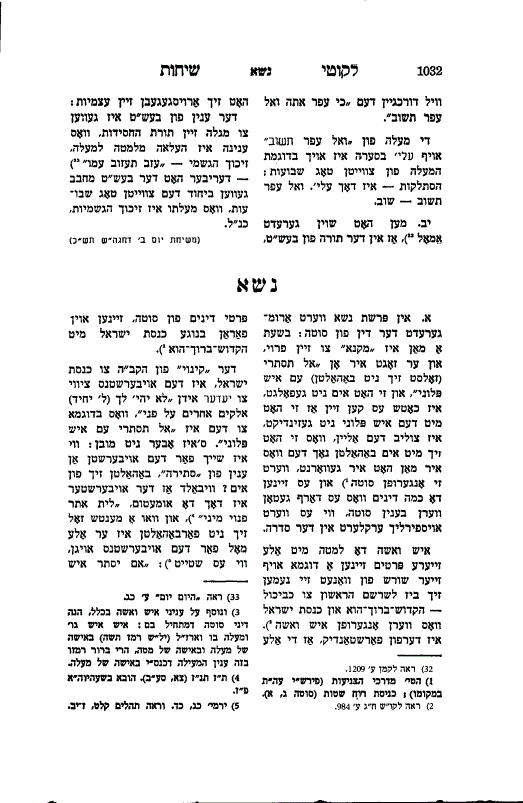
In Likkutei Sichos, volume four, the sicha for Parshas Naso, the Rebbe explores the halacha discussed at length in this parsha—the law of the din of a sotah. The Rebbe takes this concept and applies it on a spiritual level to our relationship with Hashem.
The central idea is that when a person possesses the negative trait of arrogance, it is as if they are going into hiding from Hashem. Hashem does not wish to dwell where there is an entity that is not subjugated to Him—where there is arrogance and a sense of independent existence. Such a state is considered “hiding” from Hashem, because His presence does not rest there.
However, drawing on the words of the Rogatchover Gaon, the Rebbe explains that even though a person may have been in such a state of hiding, it is still possible to return and transform oneself. If a person repents and comes back, Hashem can forgive them.
The Rebbe will also highlight how this idea is reflected in the halacha regarding the writing of the Megillah for the sotah, showing how even after a period of separation or concealment, there remains an opportunity for return and forgiveness.
Saif Aleph
The Rebbe begins by outlining the halacha of Sota as it appears in Parshas Naso. The Torah describes a scenario where a husband warns his wife not to go into seclusion with a particular individual. If she disregards this warning and does enter into seclusion, even if there is no evidence that she actually sinned, the very act of seclusion after such a warning already gives her the status of a Sota.
The term Sota itself implies that she has strayed from the path of modesty and has been overtaken by a spirit of folly. Thus, even without proof of an actual transgression, her behavior is already considered undesirable and triggers a series of halachic procedures detailed in the Torah.
The Rebbe explains that the relationship between man and woman in this world serves as a reflection of their spiritual roots. The dynamics we observe here are modeled after their source above—specifically, the relationship between Hashem and Knesses Yisrael, which is often described as that of a husband and wife.
Because of this parallel, all the details found in the laws of Sota also exist on a spiritual level between Hashem and the Jewish people. The Torah’s description is not just about individuals; it also hints at deeper truths about our collective relationship with Hashem.
In this context, the “warning” given by Hashem to Knesses Yisrael is understood as His commandment to every Jew: “You shall have no other gods before Me.” This mitzvah functions like a personal warning from a husband to his wife—Hashem instructs each Jew individually not to turn to other powers or forms of worship.
Just as in the case of Sota, where there is a specific warning not to go into seclusion with another man, so too Hashem warns us not to seek connection or intimacy with any force other than Him. This sets up the spiritual framework for understanding how these laws apply beyond their literal meaning.
Saif Beis
The Torah warns us not to worship other gods, but there is a difficulty in the metaphor used here. When it comes to Hashem, what does it mean to speak of “seclusion” or “hiding” from God? Since Hashem is everywhere and there is no place devoid of Him, how could anyone hide from Him? No matter where a person goes, he is always before Hashem.
This is expressed in the verse in Yirmiyahu (Jeremiah) 23:24:
הֲאֵתֵּחָבֵא אִישׁ בְּמִסְתָּרִים וַאֲנִי לֹא אֶרְאֶנּוּ נְאֻם־ה׳
"Can a man hide himself in secret places so that I will not see him? says Hashem."
So what does it mean for Knesses Yisroel—the Jewish people—to be “in seclusion,” hiding from Hashem? How can such a thing be possible?
The answer lies in the concept of arrogance. The sages teach that Hashem says regarding an arrogant person: “I and he cannot dwell together.” In other words, when someone is filled with self-importance—when he sees himself as an independent “I”—Hashem does not dwell with him. The Baal Shem Tov interprets the verse above as a real question: if someone hides himself through arrogance, then Hashem does not see him. Arrogance creates a barrier between the person and God.
Thus, when the Torah warns us not to have any relationship with other gods, it also alludes to not entering into “seclusion”—not becoming arrogant. Arrogance is itself a form of seclusion from Hashem, because He cannot dwell with someone who is arrogant.
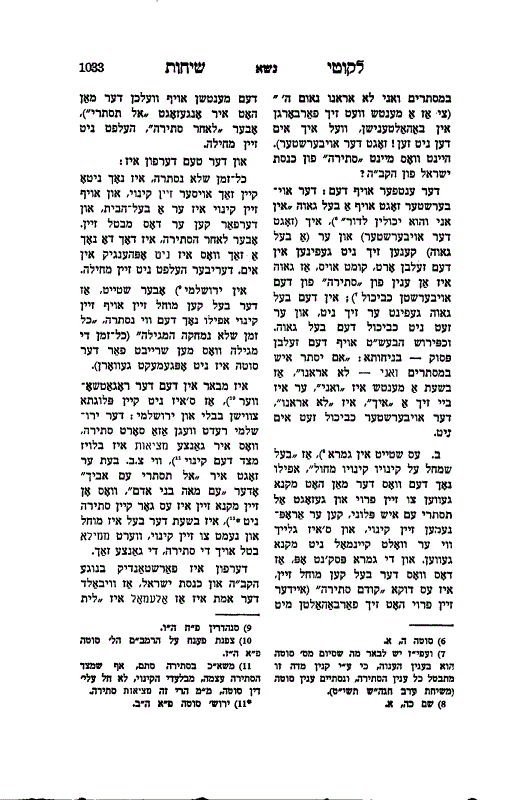
In the next part of the sicha, the Rebbe brings down an idea from the Rogatchover Gaon: even if someone has become arrogant and thus distanced himself from Hashem, once he turns back to God, Hashem can forgive him and restore their closeness. This parallels a discussion in halacha about whether a husband can retract his warning (kinui) to his wife regarding seclusion with another man—a law discussed in both Talmud Bavli and Yerushalmi.
The Talmud Bavli rules that if a husband forgives his warning before his wife actually goes into seclusion, then it’s as if there was never any warning at all. If she later goes into seclusion with that man, she is not considered a sotah (suspected adulteress), because there was no longer any warning in effect. However, if she already went into seclusion and only afterward does her husband forgive his warning, it’s too late—the act of seclusion has already taken place and cannot be undone by his forgiveness.
The reason for this distinction is that before any act of seclusion occurs, everything depends on the husband’s warning—he can nullify it at will. But once an actual act of seclusion has occurred, something new has happened that is beyond his control; his forgiveness no longer helps.
In contrast, the Yerushalmi seems to say that even after the wife has gone into seclusion, as long as the parchment (Megillah) containing the sotah passage has not yet been erased in preparation for her drinking the bitter waters, the husband can still forgive his warning and stop the process.
This appears to be a contradiction between Bavli and Yerushalmi. The Rogatchover explains that they are discussing different cases. The Yerushalmi refers to situations where the entire status of “seclusion” exists only because of the husband’s specific warning—for example, if he tells her not to be alone with her father or with 100 people (which normally would not constitute yichud or forbidden seclusion). In such cases, since only his warning created this status, he can nullify it even after she entered into seclusion—because without his warning there would be nothing problematic about her actions.
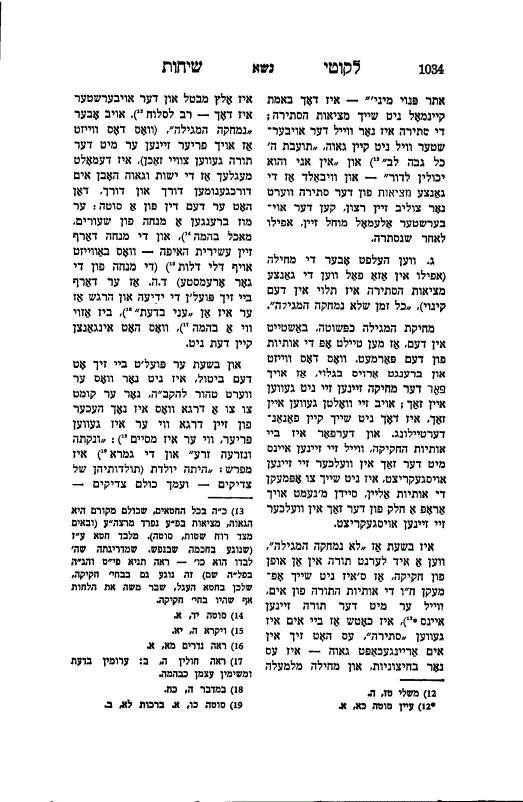
Therefore, whenever the entire issue arises solely due to the husband's declaration—as in these unusual cases—he retains full power to remove it at any stage before erasure of the Megillah. But if her act was objectively problematic regardless of his warning (such as being alone with another man where yichud applies), then once she enters into seclusion he cannot retract it anymore.
This analogy teaches us something profound about our relationship with Hashem. Since there truly is no place devoid of Him—there is no real possibility for separation—the only reason we experience “separation” or distance from God is because He Himself established that arrogance creates such distance. Thus, just as in those special cases discussed above where everything depends on one party’s declaration and can be forgiven at will, so too Hashem can always forgive our arrogance and restore closeness—unless something irreversible has occurred.
What constitutes this point of no return? In halacha, it's when the Megillah—the parchment—is erased; after that point forgiveness cannot help anymore. Spiritually speaking, erasing the parchment represents separating oneself so completely from Torah and holiness that one’s connection was never truly internalized—it was never engraved within him.
If one’s Torah learning was like engraved letters—completely united with him—then even if he stumbles into arrogance or distance from Hashem, forgiveness can restore everything; nothing essential was lost. But if one's connection was superficial—like ink on parchment rather than engraving—then arrogance may penetrate deeply enough that true separation occurs (“the Megillah was erased”), requiring much greater effort for repair.
In such cases—where separation has become total—the only way back is through deep humility: recognizing one’s spiritual poverty and lowliness (“bringing an offering like barley—the food of animals”). By humbling oneself completely before God and acknowledging how far one has fallen, one can achieve purification—and even reach higher than before.
The Gemara explains that after this process she will be clean and give birth to children—a metaphor for renewed spiritual productivity. For tzaddikim (the righteous), children represent mitzvos and good deeds; after sincere teshuvah (repentance), these are produced easily rather than through pain or struggle. In fact, those who return through teshuvah reach levels unattainable even by perfect tzaddikim who never sinned.
The Rebbe notes (in Ha’aretz 13) that when one's Torah learning remains engraved within him—even if he stumbles—all sins except idol worship can be forgiven through teshuvah. Idol worship touches such a deep level of soul (chochmah) that even engraved Torah may not protect against its effects; this explains why Moshe broke even the luchos (tablets) after the sin of the Golden Calf—they were engraved but could still be shattered by such a fundamental breach.
Key Points
1. The halacha of sotah in Parshas Naso is not only a legal discussion but also serves as a metaphor for the relationship between Hashem and the Jewish people, with the dynamics of husband and wife reflecting spiritual truths about our connection to God.
2. The Torah’s warning against idolatry is likened to a husband’s warning to his wife, establishing that Hashem’s command “You shall have no other gods before Me” functions as a personal directive to each Jew, paralleling the sotah process on a spiritual level.
3. Although Hashem is everywhere and there is no true possibility of hiding from Him, arrogance creates a spiritual barrier; when a person is filled with self-importance, Hashem does not dwell with him, making arrogance itself a form of “seclusion” from God.
4. The Talmudic discussion about whether a husband can retract his warning to his wife before or after seclusion serves as an analogy for teshuvah: just as forgiveness is possible before an irreversible act, so too can Hashem forgive arrogance and restore closeness if true separation has not yet occurred.
5. According to the Rogatchover Gaon, in cases where the entire status of “seclusion” depends solely on the husband’s declaration (such as unusual warnings), he can nullify it even after seclusion—teaching that when separation from Hashem exists only by His decree, forgiveness remains possible until a certain point.
6. The erasure of the Megillah in the sotah process symbolizes reaching a point of no return—when one’s connection to Torah and holiness was never internalized; if Torah learning was only superficial, arrogance can cause true separation that requires deeper repair.
7. True restoration after such separation comes through humility and recognizing one’s spiritual poverty; this process leads not only to purification but also to renewed spiritual productivity, with teshuvah enabling one to reach even higher levels than before.
8. When Torah learning is truly engraved within a person, even serious failings can be forgiven through teshuvah—except for idol worship, which affects such a deep level of soul that even engraved Torah may not protect against its consequences, as seen in Moshe breaking the luchos after the sin of the Golden Calf.