

Likkutei Sichos Vol. 2 – Nitzavim – The Essence of Teshuvah in Parshas Nitzavim
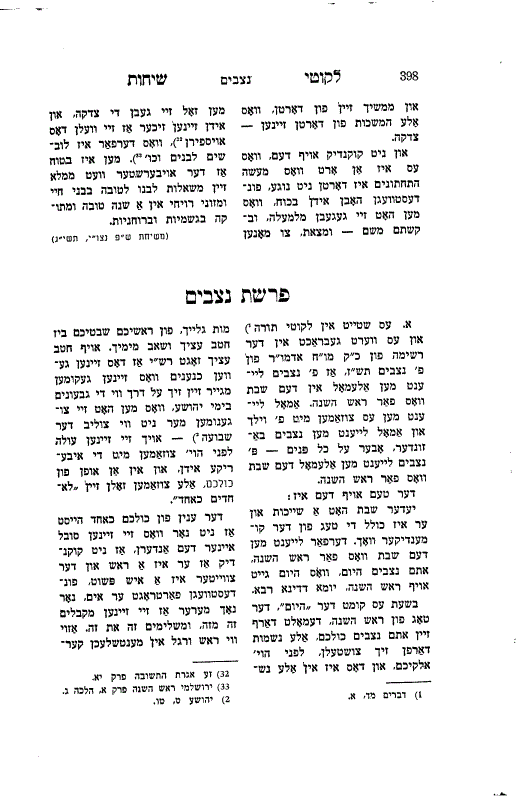
1. It is stated in Likutei Torah and is brought in the writings of my revered father-in-law, the Rebbe, from Parshas Nitzavim 5707, that Parshas Nitzavim is always read on the Shabbos before Rosh Hashanah. Sometimes it is read together with Parshas Vayelech, and sometimes Nitzavim is read separately, but in any case — Parshas Nitzavim is always read on the Shabbos before Rosh Hashanah.
The reason for this is: Every Shabbos has a connection and includes the days of the coming week. Therefore, on the Shabbos before Rosh Hashanah, we read "You are standing today," where "today" refers to Rosh Hashanah, the great day of judgment. When "today" comes, the day of Rosh Hashanah, then it must be "You are all standing," all souls must present themselves before the L‑rd your G‑d. And this is in all souls Immediately, from your heads, your tribes, to your woodcutters and water drawers. On "your woodcutters," Rashi says that these were Canaanites who came to convert, similar to the Gibeonites in the days of Joshua, who were accepted not more than because of the oath — they too ascend before the L‑rd together with the rest of the Jews, and in a manner of "all of you," all together should unite as one.
The concept of "all of you as one" means not only that they tolerate one another, that despite one being a leader and another a simple person, they still bear with each other, but even more so, that they receive from one another and complete each other. Just like the head and the foot in a human body, which complement — complete one another. Each of them — whether the head or the foot — is not complete without the other.
This is the service required on Rosh Hashanah — "today." And in order to be able to carry this out, we read on the Shabbos before Rosh Hashanah in the Torah, "You are standing today, all of you, your heads, your tribes, your woodcutters, and your water drawers," for the Torah reading gives the strength that it should indeed be so in actuality.
As explained in Chassidus, the reason we recite the verses of Kingship, Remembrances, and Shofros on Rosh Hashanah is that by bringing proof from the Torah that the Almighty must be a King and must remember, and through what means — the shofar — we effect that it indeed becomes so in actuality.
2. After stating "You are standing today, all of you, from you heads to your woodcutters and water drawers," it continues with "to enter into the covenant of the L‑rd your G‑d." This means that the service of "You are standing today, all of you" is a preparation for entering into the covenant, for the covenant between the Almighty and the Jewish people on the day of Rosh Hashanah.
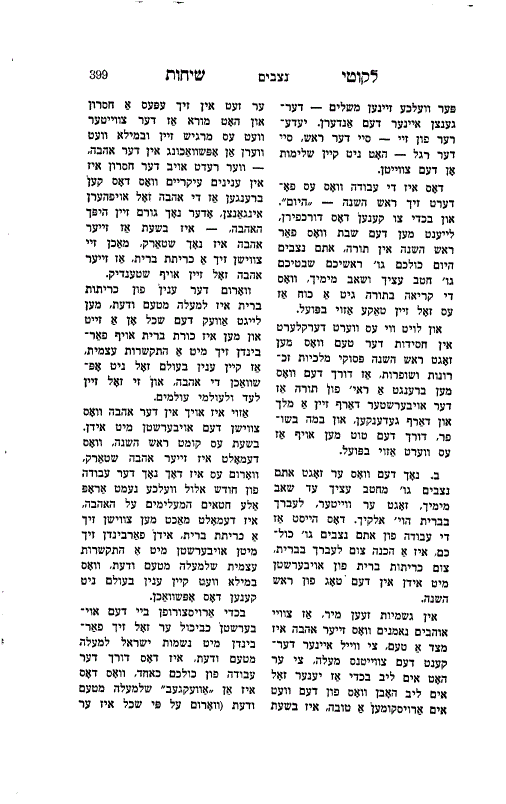
In the physical realm, we observe that two faithful friends whose love is based on a reason — whether because one recognizes the other's virtue or because he loves him so that the other will love him back, from which he will derive benefit — when one sees a deficiency in himself and fears that the other will perceive it, potentially weakening the love, especially if the deficiency is in essential matters that could cause the love to cease entirely or even result in the opposite of love, they make a covenant between themselves while their love is still strong, so that their love will be everlasting. For the concept of a covenant is beyond reason and understanding; one sets aside intellect and makes a covenant to bind themselves with an essential connection, so that no matter in the world can weaken the love, and it will last forever and ever.
This is also true of the love between the Almighty and the Jewish people. When Rosh Hashanah arrives, their love is strong, for it follows the service of the month of Elul, which removes all sins that conceal the love. At that time, they make a covenant between themselves; the Jewish people bind themselves with the Almighty with an essential connection beyond reason and understanding, so that no matter in the world can weaken it.
To evoke, as it were, the Almighty to bind Himself with the souls of Israel beyond reason and understanding, this is achieved through the service of "all of you as one," which is a self-nullification beyond reason and understanding (for according to intellect, one is a leader and the other a water drawer, so what connection does he have with the other?). As explained in the concept of "with all your might," that through one's own "might," even though it is only one's own might, he draws down the essential might.
3. However, the concept of "all of you as one" must be genuine. One must truly understand that this is indeed the case. Even though he considers himself among the leaders and the other as a simple person, aside from the fact that one cannot truly know who is the head and who is the foot—since, generally, one tends to underestimate the other and overestimate oneself—aside from this, even if it were indeed the case that he is the head, there is still an advantage in the foot over the head, for the perfection of the head comes specifically through the foot, as mentioned earlier. This also explains why the Gibeonites were made woodcutters for the Tabernacle and the Temple specifically. Not all Jews were present in the Temple; not all lived in Jerusalem. Only the representatives, the "men of the standing," were there on behalf of all Jews. However, the service of the Gibeonites was in the Temple. The reason for this is because the true perfection of the advantage is specifically in the foot.
This is also related to the concept of an oath in this context—the oath that was made with the Gibeonites. An oath transcends reason and understanding; it touches the essence of the soul, and the essence of the soul is expressed specifically in the foot.
4. When a Jew contemplates, before the sounding of the shofar on Rosh Hashanah, he will pray, "He will choose for us our inheritance, the pride of Jacob whom He loved forever." The meaning of "He will choose for us" is: in this way and not another. Reflecting on the fact that the concept of choice comes specifically from the Essence, for only He—His blessed Essence—is beyond all measures, beyond all limitations, free. And he will also contemplate the incomparable nature of himself in relation to the Essence, more so than the incomparability of Asiyah to Atzilus—the incomparability of Atzilus to the Infinite, blessed be He. All comparisons that one might imagine are not at all a metaphor for the incomparability of the Creator to the creations. How, then, does he come to request from the Essence, "He will choose for us"?
When he contemplates this and evaluates himself, he will naturally not have time to evaluate the other.
Reb Hillel Paritcher wanted to see the Alter Rebbe, but every time he would come...
...in the town where the Alter Rebbe had arrived, he would not find him, as the Alter Rebbe had already departed from there. So he resolved to travel earlier, and when he heard that the Alter Rebbe was to travel to a certain place, he would arrive there before the Alter Rebbe. Yet, he was still not satisfied, because every time he encountered various obstacles in seeing the Alter Rebbe. He feared that this time too he would not be allowed in, so he devised a plan. He went to the residence where the Alter Rebbe was supposed to stay and hid under the bed.
Reb Hillel had prepared a question from Tractate Erchin to ask the Alter Rebbe in learning. As soon as the Alter Rebbe entered the room, before Reb Hillel could emerge from his hiding place, he heard the Alter Rebbe saying in the well-known melody: "When a young man has a question in Erchin, he must first evaluate himself." Upon hearing this, Reb Hillel fainted. By the time they found him and revived him, the Alter Rebbe had already left.
Reb Hillel never again had the opportunity to be with the Alter Rebbe. He traveled to the Mitteler Rebbe and the Tzemach Tzedek, but with the Alter Rebbe, this was the only time he was there, and even then, he did not see him.
The explanation of this story in terms of avodah—regarding us who have heard this story: Erchin is a matter that is not based on intellect. The law in Erchin is that one calculates according to the years, but not according to the qualities of people. All people who are in the same years have the same value. One might question, "I have spent my years engaged in Torah and avodah, matters that please the Almighty, that the heavenly entourage is pleased with, and even according to human intellect, it is something worthy of appreciation. My years have great value; another's years have been wasted on nothing, and it would have been better had he not been created. How can it be that both have the same value?" To this, it is said that when one has a question in Erchin, one must first evaluate oneself properly, and then the question will dissipate.
5. The month of Elul—besides the general acronym "Ani L'dodi V'dodi Li" (I am my beloved's, and my beloved is mine), there are also several specific acronyms (in what manner is "Ani L'dodi"). In general, they correspond to the three pillars of Torah, avodah, and acts of kindness.
The acts of kindness: a) "He will cause it to happen to him, and I will appoint for you"—this corresponds to the line of Torah, as the words of Torah provide refuge. b) "A man to his friend and gifts to the poor"—this corresponds to the line of acts of kindness (charity). c) "And the L‑rd your G‑d will circumcise your heart and the heart of your offspring"—this corresponds to the line of avodah (prayer and repentance in general), as it concludes with "to love, etc." It is explained in the Kuntres HaAvodah that the primary aspect of the avodah of prayer is (not fear but) love.
The matter of Torah and avodah has been discussed elsewhere.
Regarding the matter of charity, it is not understood why the acronym is from "a man to his friend, etc." which is actually an aspect of sending portions and not charity. It is also not understood why the acronym is only from the last words, "a man to his friend, etc." and not from the words "sending portions."
The phrase is "and gifts to the poor." The difference between the poor and the destitute is that a poor person is one who is not wealthy and not even average, but nevertheless has something. However, a destitute person, as Rashi says, is one who desires everything. He longs for everything, even the smallest thing, because he has nothing. The interpretation of "desires everything" also applies to the opposite extreme; he desires everything, even the greatest thing, because he was accustomed to it. Even a horse to ride, etc., since he desires it and without it, he cannot fulfill his mission in the world, you must give it to him.
He might think that he is the wealthy one, and when he gives, whether large things or small things, to his friend the destitute, he gives it from his own. Therefore, for the words "and gifts to the poor," the verse says "a man to his friend." The gifts to the poor that he gives are "a man to his friend," the other is his friend, in the same situation as he is. One does not need to come to the other, because he is not giving his own; he is returning to the other what is with him as a deposit. As the saying of the early Chassidim (in the days of the Alter Rebbe): The piece of bread that I have is yours as much as it is mine. They would precede the word "yours"—yours as mine. And as our Sages said, more than the homeowner does with the poor, the poor does with the homeowner. And our Sages said, "You have revived the soul of the poor; tomorrow your children or your daughter, etc., and I will save them."
6. Just as a person is composed of a body and a soul, the concept of tzedakah (charity) exists also in a spiritual sense. Just as in physical tzedakah, the law is that every individual, even the poorest Jew, is obligated in tzedakah, so too in spiritual tzedakah, every Jew, even one who is spiritually impoverished, is obligated in tzedakah. Because every Jew has something to give. The very fact that he has encountered another person is an indication that he must help and give to that person. Since everything is by Divine Providence and the Holy One, blessed be He, did not create anything in vain, it is certain that there is an intention for him to give something to the other person.
And just as in the physical realm, he is not merely giving to the other person but is actually doing a favor for himself, as mentioned earlier, so too in the spiritual realm, by influencing the other person, he actually receives from them. For true completeness is achieved specifically through the integration of head and foot, as mentioned earlier.
7. Once, the Rebbe Tzemach Tzedek spoke about the greatness of tzedakah, how significant it is to help a Jew with livelihood and how it aids in the service of opening the mind and heart to receive the revelations from above. The Rebbe Tzemach Tzedek recounted to his son, the Rebbe Maharash, that he had a personal experience:
When I traveled from Dobromysl to Lubavitch, I was very uplifted by the inner closeness of my grandfather—the Alter Rebbe—and hoped that upon arriving in Lubavitch, I would have the merit to see my grandfather with a radiant face (in a vision, as it was many years after the passing of the Alter Rebbe). Meanwhile, certain questions arose within me regarding matters of revealed Torah and Chassidus, and I organized these matters in my thoughts.
Upon arriving in Lubavitch, I immediately went to the place about which my grandfather had told us while traveling in Liozna, that in the synagogue that stood there, he had studied. As I mentioned, the place was then empty after a fire had occurred there. My father-in-law, the Mitteler Rebbe, recounted at that place that fifty-seven years earlier, the Great Rebbe had made Lubavitch a suitable place for the leadership of Chabad Chassidim with longevity and eternal existence until the coming of our righteous Mashiach.
From this story that when I cam in Lubavitch, the Rebbe seemed distant from me — says the Rebbe Tzemach Tzedek — and I was very broken and downcast. I felt as if, G‑d forbid, I had fallen from a great height to a deep pit. I had prepared myself for an inner closeness, and instead, I experienced such a distance. I was very distressed and examined my actions to understand what could have caused this distance, so that I could repent and merit to see the holy face of my grandfather and hear matters of Torah and service.
On Wednesday, the 20th of Elul, the Rebbe Tzemach Tzedek went to the synagogue to pray. On his way, he encountered the Lubavitcher householder Pinchas, who asked him for a loan of three rubles as an act of kindness.
When he needed to buy something in the market and sell it, he would have money for Shabbos expenses. The Tzemach Tzedek told him to come to his house after davening, and he would give him the money.
As the Tzemach Tzedek was preparing for davening and had placed the tallis on his shoulder, he remembered what Reb Pinchas had told him—that today was a market day, the market opens early, and surely Pinchas needed the money immediately. The Tzemach Tzedek took off the tallis, went home, took five silver rubles, and gave them to Pinchas so he could engage in business and earn a living.
When the Tzemach Tzedek returned to the minyan and washed his hands at the hand basin to begin davening, the Alter Rebbe appeared to him and resolved all his doubts, and his holy face shone.
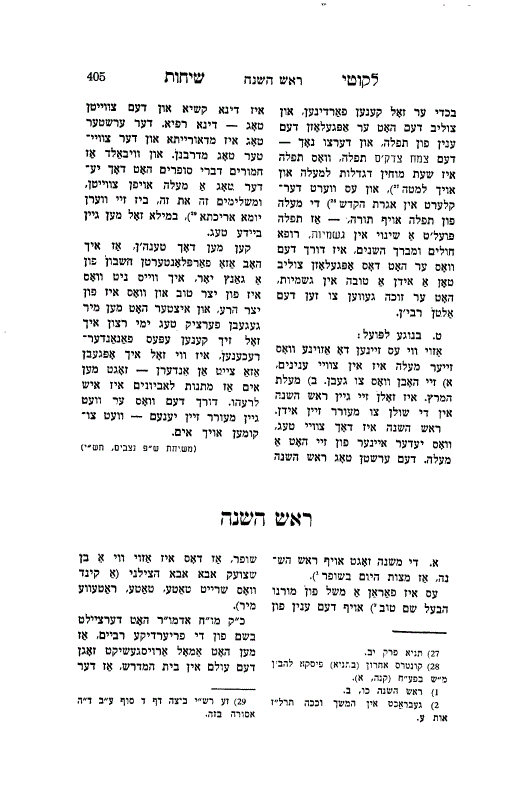
5. We learn from this story that tzedakah also has an effect in the spiritual realm. The Tzemach Tzedek, with all his matters, especially the closeness he had during the time of the Alter Rebbe's passing—when he was alone with the Alter Rebbe, as the Mitteler Rebbe was in Kremenchug, Reb Chaim Avraham was unwell, and Reb Moshe was on the other side of the front and could not come due to the war—had many connections with the Alter Rebbe. Despite this, he did various things to see the Alter Rebbe, and all this did not help.
Only when he encountered a Jew in the street, not in the Tzemach Tzedek's domain (meaning, not that the Jew came to the Tzemach Tzedek) but in Reb Pinchas's domain, and found him not saying Tehillim or the like, but thinking about an act of kindness, did he merit to see the Alter Rebbe.
In order for him to earn a living, he postponed the matter of prayer, and moreover—the Tzemach Tzedek's prayer, which is a time of expanded consciousness above and also below. It is explained in Iggeres HaKodesh the superiority of prayer over Torah, that prayer effects a change in the physical world, healing the sick and blessing the years. By postponing this to do a favor for a Jew in the physical realm, he merited to see the Alter Rebbe.
9. Regarding practical application: There are those whose virtue lies in two areas: a) they have something to give, b) the virtue of zeal. They should go on Rosh Hashanah to the synagogues to awaken the Jews. Rosh Hashanah is two days, each of which has its own virtue. The first day of Rosh Hashanah
The first day [of Rosh Hashanah] is “dina kashya” — severe judgment, while the second day is “dina rafya” — a milder judgment. The first day is from the Torah, while the second day is Rabbinic. And since “the words of the Sages are more stringent”, each day possesses an advantage over the other. They complement one another, until they become “yoma arichta” — one long day. Therefore, one should go [to inspire Jews in the synagogues] on both days.
A person may argue:
“I have a complicated accounting to make of an entire year. I do not know what came from the Yetzer Tov and what came from the Yetzer Hara. And now I have been given the forty days of Divine favor so that I can somehow work out my own accounting. How, then, can I give away this time to someone else?”
The answer given to him is: “A man to his fellow, and gifts to the poor” — even the “gifts to the poor” are part of “a man to his fellow.” By going and arousing another Jew, he himself will also gain and be elevated through it.
The main point of the last paragraph is very beautiful: even when a person feels that Elul is the time he desperately needs for his own spiritual accounting, spending some of that time helping awaken another Jew does not detract from his own avodah—it actually adds to it. This is from the Rebbe’s farbrengen of Shabbos Parshas Nitzavim, 27 Elul 5710 (1950).