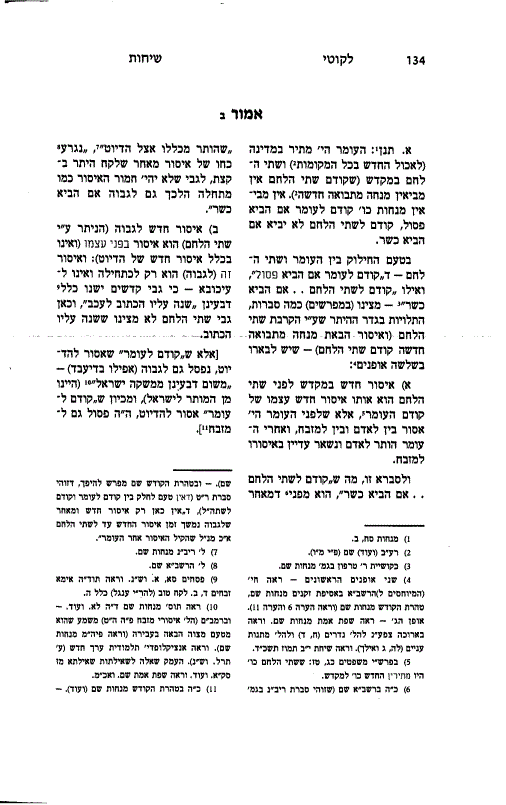
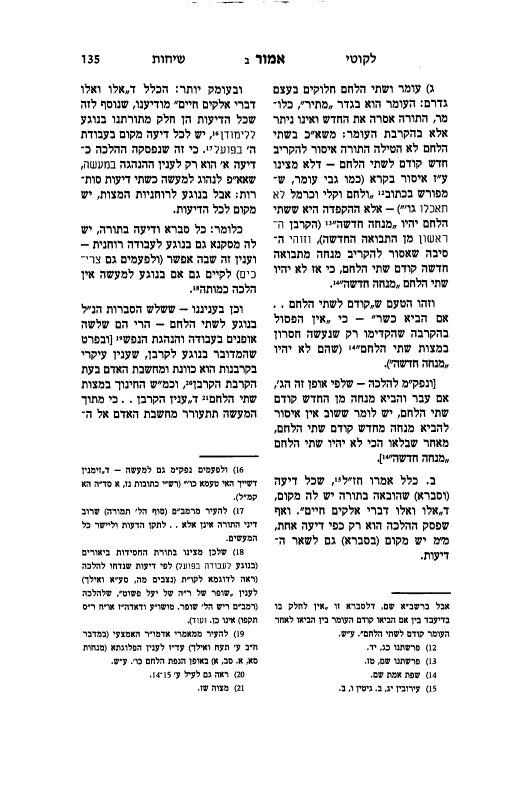
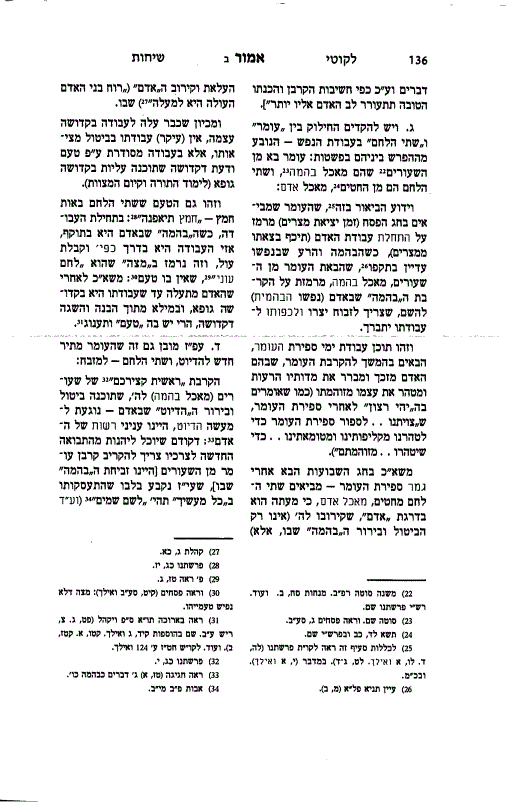
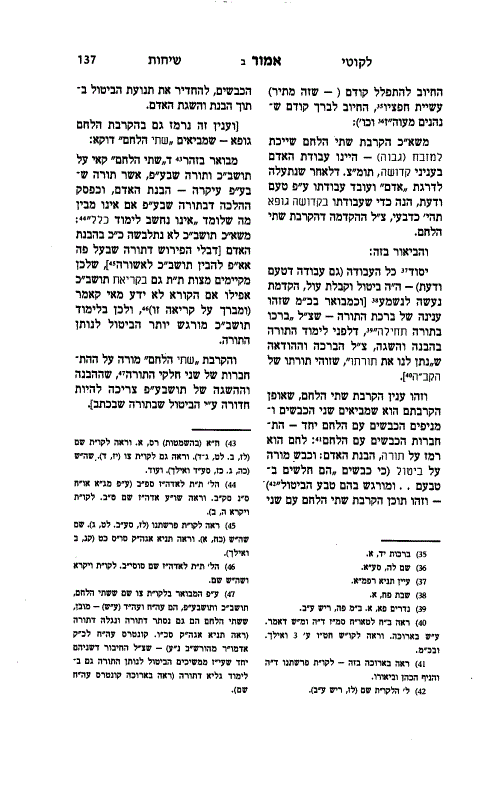
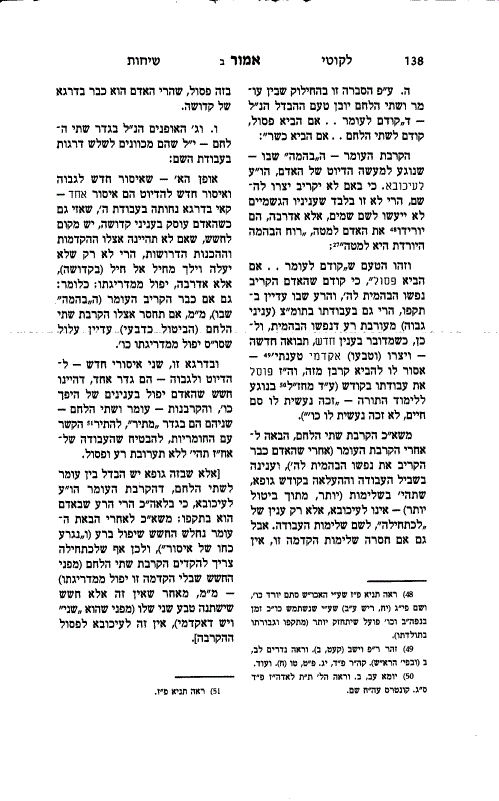
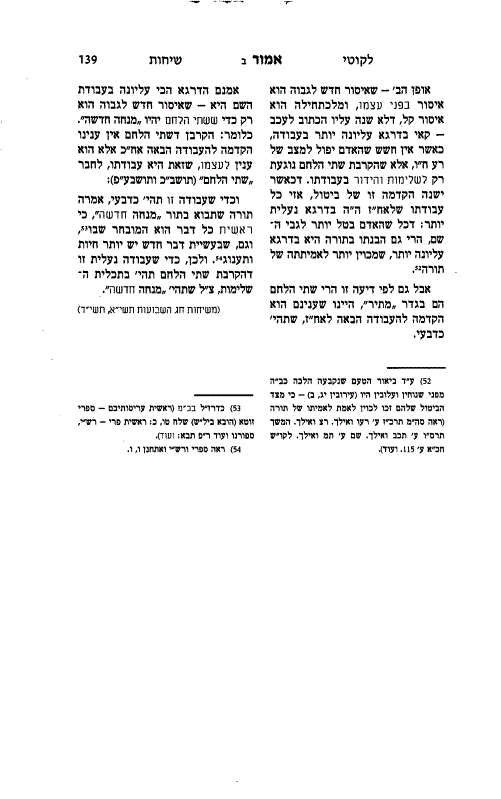
We’ll review a Sicha from Likkutei Sichos, Chelek Lamed-Beis, volume 32, the second Sicha on Parshas Emor.
In this Sicha, the Rebbe draws out, in Avodas Hashem, a lesson from a halachah in the Mishnah in Maseches Menachos.
The דין is as follows: on ממחרת הפסח, the Korban Omer was brought. Before the Korban Omer was brought, which was made from barley and offered on the Mizbeach, it was forbidden to eat any of the new grain, known as chadash. Any newly grown grain, whether wheat or barley, could not be eaten until after the Omer was brought on ממחרת הפסח.
Later, there was another offering brought from the new grain, this time from wheat: the שתי הלחם, the two loaves offered on Shavuos. That offering served a different purpose. The Omer permitted the people to eat the new grain. Once the Omer, the barley minchah, was brought, the new grain of that year became permitted for personal consumption.
However, with regard to the Mizbeach, the new grain still could not be brought as a korban minchah before the שתי הלחם. A minchah, which was generally made from wheat, could not be brought from the new grain until after the שתי הלחם were offered. So the Omer is the מתיר for people to eat chadash, while the שתי הלחם are the מתיר for the Mizbeach, allowing new grain to be used for korbanos minchah.
Up until the שתי הלחם, one could not bring a minchah from the new grain, because the required מתיר had not yet been brought.
But then the Mishnah states an interesting halachah: if someone brought a minchah from the new grain before the Omer, it is invalid; it is פסול. That minchah does not count at all. If, however, the korban minchah was brought after the Omer but before the שתי הלחם, even though the שתי הלחם are technically the מתיר for bringing new grain on the Mizbeach, the minchah is not פסול.
The question is: what is the rationale for this distinction?
The Rebbe brings three explanations, and then explains each of them in terms of Avodas Hashem. But let us go step by step and learn the Sicha inside.
The Mishnah in Menachos teaches:
HaOmer hayah matir bamedinah — when the Korban Omer was brought, it permitted the new grain throughout the land. Once the Omer was offered, all of Eretz Yisrael was allowed to eat from the newly grown grain of that year. Until the Korban Omer was brought, one could not eat from the new crop.
U’Shtei Halechem bamikdash — when the Shtei Halechem were brought on Shavuos, they permitted the new grain for use in the Beis HaMikdash. From that point onward, korbanos minchah could be brought from the new grain.
Before the Shtei Halechem, however, a minchah could not be brought from the new crop. Only grain from the previous year could be used. So for ordinary consumption, the new grain becomes permitted through the Omer on the sixteenth of Nissan. For the Mizbeach, it becomes permitted only through the Shtei Halechem on Shavuos.
The Mishnah then makes a distinction:
If someone brought a minchah from the new grain before the Omer, it is pasul.
But if someone brought a minchah after the Omer, yet before the Shtei Halechem, then although it should not have been brought, if it was brought, it is kosher.
This requires explanation.
Seemingly, the Omer relates to permitting grain for people to eat, while the Shtei Halechem relate to permitting grain for the Mizbeach. If so, why should bringing a minchah before the Omer make it invalid, while bringing it after the Omer but before the Shtei Halechem leaves it valid after the fact?
The Rebbe explains that there are three approaches among the מפרשים to understand this distinction. Each approach will later become a lesson in Avodas Hashem.
The Rebbe will discuss the symbolism of the Omer, which comes from barley — animal food — and the Shtei Halechem, which come from wheat — human food. These represent different levels of spiritual service. He will also explain why bringing the minchah before the Omer is entirely invalid, while bringing it after the Omer but before the Shtei Halechem is valid בדיעבד.
But first, the Rebbe explains the halachic reasoning behind the difference.
First Explanation – One Prohibition, Gradually Relaxed
The first approach understands that the prohibition of chadash for people and for the Mizbeach is fundamentally one and the same prohibition.
Before the Omer, the new grain is forbidden both:
- for human consumption
- and for use on the Mizbeach
After the Omer, the prohibition is partially lifted. It becomes permitted for people to eat, but remains forbidden for the Mizbeach until the Shtei Halechem.
According to this view, once the Torah has already relaxed the prohibition in one area, its force has weakened. Since people may already eat the grain, the restriction is no longer as absolute as it was before. Therefore, if one brought a minchah from the new grain after the Omer but before the Shtei Halechem, it is still kosher after the fact.
Before the Omer, however, when the prohibition still stands in full force for everyone and for everything, a minchah brought from the new grain is completely invalid.
So according to the first explanation:
- Before the Omer: full prohibition → pasul
- After the Omer: partial היתר already exists → kosher בדיעבד
Second Explanation – Two Separate Prohibitions
The second approach says these are not one prohibition at all, but two separate prohibitions:
- A prohibition against people eating chadash before the Omer
- A prohibition against bringing chadash on the Mizbeach before the Shtei Halechem
According to this view, the prohibition regarding the Mizbeach applies only לכתחילה. One should not bring a minchah from the new grain before the Shtei Halechem, but if it was brought, it is not automatically invalid.
Why not?
Because in the laws of korbanos, not every prohibition invalidates after the fact. For something to be invalid בדיעבד, the Torah must explicitly repeat the prohibition in a way that teaches it prevents fulfillment even after it was done. Regarding the Shtei Halechem, we do not find such an expression.
So why is a minchah brought before the Omer pasul?
That is for a different reason entirely: Mimashkeh Yisrael — a korban must come from something permitted for a Jew to use.
Before the Omer, the grain is still forbidden for people to eat. Since it is not fit for a Jew, it is not fit for the Mizbeach either.
So according to the second explanation:
- Before the Omer: not fit for Jewish use → pasul
- Before Shtei Halechem: separate restriction, but only לכתחילה → kosher בדיעבד
Third Explanation – No Prohibition at All
The third approach says that the Omer and the Shtei Halechem are fundamentally different in nature.
The Omer is truly a matir — it removes a prohibition. The Torah explicitly forbids eating the new grain until the Omer is brought.
But the Shtei Halechem are not a matir in that sense. The Torah never says there is an actual prohibition against bringing new grain on the Mizbeach before the Shtei Halechem.
Rather, the Torah’s requirement is that the Shtei Halechem must be the first minchah brought from the new grain.
That is why one should not bring a minchah beforehand — not because the earlier minchah is invalid, but because doing so prevents the Shtei Halechem from being the first offering of the new grain.
So if someone did bring a minchah beforehand, that minchah itself remains kosher. The only loss is that the Shtei Halechem can no longer be called the first minchah of the new grain.
According to this view, there is even a practical difference:
If someone already brought one minchah from the new grain before Shtei Halechem, then there is no further issue in bringing another one. Once the Shtei Halechem have already lost their status as the first offering, nothing additional is changed.
So according to the third explanation:
- No prohibition on the earlier minchah itself
- The issue is only the missed quality of the Shtei Halechem being first
- Therefore the minchah is kosher, and additional offerings could also be brought
Summary of the Three Views
1. One prohibition, partially lifted
After the Omer the prohibition weakens, so the minchah is kosher בדיעבד.
2. Two separate prohibitions
Before the Omer it is pasul because the grain is forbidden to Jews. Before Shtei Halechem it is only an initial restriction.
3. No prohibition on the minchah
The only requirement is that Shtei Halechem be first. If brought earlier, the minchah is still kosher.
Now the Rebbe moves on to explain how all three approaches are true in Avodas Hashem. Even if practical halachah follows one view, in spiritual service all three perspectives contain eternal lessons.
Part 2 – Ois Beis
Chazal established a fundamental principle:
Every opinion—and, as the Rebbe adds in parentheses, even every sevarah, every line of reasoning—that appears in Torah has a place and significance. No Torah view is dismissed as meaningless, because:
אלו ואלו דברי אלקים חיים — “These and those are the words of the living Hashem.”
Even though practical halachah can follow only one opinion, the other views still retain truth and value.
Why? Because while actual practice must choose one path when opinions conflict, the inner content of Torah includes depth and meaning in every authentic Torah perspective.
The Rebbe explains further:
This principle of Elu Ve’elu Divrei Elokim Chayim teaches more than the fact that all opinions are worthy of study. It also means that every Torah opinion has relevance in Avodas Hashem.
In practice, halachah must be decided one way, because a person cannot act in two contradictory ways at once. But in the realm of the inner meaning of mitzvos, spiritual growth, and the service of the soul, there is room for multiple dimensions of truth.
In other words:
Every Torah approach contains a lesson that can guide a person’s spiritual life. Sometimes, one may even need to apply in Avodas Hashem an approach that is not the accepted halachic ruling in practical law.
Applying This to Our Sicha
The Rebbe says the same is true in our case.
The three explanations regarding the Shtei Halechem are not merely technical interpretations in halachah. They represent three distinct paths in the service of the soul, three ways a person can approach inner growth and serving Hashem.
This is especially true here because the discussion concerns korbanos.
With korbanos, the essence is not only the external act of offering an animal or a meal-offering. A central component is the person’s kavanah and machshavah—the intention, awareness, and inner movement of the heart during the offering.
As the Sefer HaChinuch writes regarding the mitzvah of the Shtei Halechem:
The purpose of a korban is that through the physical act, a person’s thoughts are awakened and stirred. The action of bringing the korban arouses the heart and directs the person toward Hashem.
The more significant the korban and the more proper the preparation, the deeper the emotional awakening and inner transformation it creates.
So the korban is not merely a ritual act—it is a conduit through which a person becomes spiritually elevated.
The Main Point of Ois Beis
The Rebbe’s central message here is:
- In halachah, only one ruling can be followed in action.
- But in Torah truth, multiple views contain meaning.
- In Avodas Hashem, each authentic Torah perspective can become a practical guide for spiritual growth.
Therefore, the three explanations of the Mishnah are not just legal interpretations—they are three living models of how a Jew serves Hashem.
Transition to the Next Section
To understand these three spiritual models, the Rebbe next explains the symbolism of the two offerings:
- The Omer, made from barley — generally associated with animal food
- The Shtei Halechem, made from wheat — associated with human food
These reflect two different states within a person:
- one still struggling with the animal side of the self
- and one who has already refined himself to a more elevated human level
This becomes the foundation for the next part of the Sicha.
Part 3 – Ois Gimmel
The Rebbe now introduces the spiritual meaning of the difference between the Omer and the Shtei Halechem in Avodas HaNefesh.
This is based on their most basic distinction:
- The Omer comes from barley
- The Shtei Halechem come from wheat
Barley is generally considered animal food, while wheat is associated with human food.
This difference reflects two stages in a person’s service of Hashem.
The Omer – Beginning the Work
The Omer is brought during Pesach, the time of Yetzias Mitzrayim.
This represents the beginning of a person’s spiritual journey—when one has just left his own “Mitzrayim,” his inner limitations and bondage.
At that stage, the animal side of the person is still strong. The impulses, habits, selfishness, and negative tendencies of the נפש הבהמית have not yet been refined. The inner struggle is still intense.
That is why the Omer is brought from barley, animal food.
It symbolizes offering the “animal” within the person to Hashem.
The avodah at this point is one of battle and discipline:
- restraining the yetzer hara
- redirecting one’s instincts
- forcing oneself to do what is right
- accepting the yoke of serving Hashem even before one fully feels it
This is the deeper meaning of bringing the Omer.
The person takes the unrefined energy of the animal soul and places it on the Mizbeach.
The Days of Sefirah – Refinement
The days that follow, the days of Sefiras HaOmer, continue this process.
These are days of inner עבודה in which a person works through his character, purifies his emotions, and removes spiritual coarseness.
As we say in the Yehi Ratzon after counting Sefirah, the counting was given in order to cleanse us from our impurity and refine us from inner contamination.
So the Omer is not only one offering—it begins a whole journey of transformation.
Shavuos – The Human Level
After completing the counting of the Omer comes Shavuos.
Now we bring the Shtei Halechem, made from wheat—human food.
At this point, the person has moved beyond the primary struggle with the animal self. He has refined himself and entered a higher mode of avodah.
Now the focus is no longer merely controlling negativity.
Now it is the elevation of the adam within him.
As the verse says in Koheles:
“Ruach bnei ha’adam hi ha’olah lemaalah”
“The spirit of man rises upward.”
The person is now serving Hashem not only by resisting what is low, but by developing what is lofty.
Two Forms of Service
These two offerings represent two distinct forms of avodah:
1. Omer – Breaking and Restraining
At first, the work is to overcome resistance:
- to discipline oneself
- to fight harmful impulses
- to do what is right even when one does not yet feel inspired
- to serve through kabalas ol
This is the stage of barley.
2. Shtei Halechem – Growth Within Holiness
Later, the work becomes one of inner growth:
- learning Torah with understanding
- doing mitzvos with feeling
- rising from level to level
- deepening one’s relationship with Hashem
This is the stage of wheat.
The person is no longer occupied mainly with battle. He is building, growing, and ascending.
Why the Shtei Halechem Were Chametz
The Rebbe explains that this is also why the Shtei Halechem were unique in being brought as chametz.
Most meal offerings in the Beis HaMikdash were matzah, not leavened.
But the Shtei Halechem had to be chametz.
Why?
Because matzah represents the early stage of avodah:
- simplicity
- submission
- obedience
- serving because one must
Matzah is “poor bread,” plain and unexpanded. It reflects service through self-restraint and humility.
But once a person has refined himself and entered the realm of kedushah itself, his service changes.
Now there is:
- understanding
- appreciation
- inner pleasure
- emotional richness
- delight in holiness
That is symbolized by chametz—bread that has risen and developed.
The avodah now has depth, taste, and expansion.
Summary of Ois Gimmel
The Rebbe teaches that the Omer and the Shtei Halechem are not only agricultural offerings. They describe the journey of the soul.
The Omer:
- barley
- animal food
- struggle
- discipline
- refining the self
- kabalas ol
The Shtei Halechem:
- wheat
- human food
- growth in holiness
- understanding
- joy and pleasure in serving Hashem
- ascent from level to level
A Jew begins by conquering the animal within, but the goal is to become fully human in holiness—to serve Hashem with mind, heart, and delight.
Part 4 – Ois Daled
The Rebbe now explains, based on the earlier ideas, why the Omer permits the new grain for ordinary use, while the Shtei Halechem permit it for the Mizbeach.
These two permissions reflect two different dimensions in a person’s avodah.
The Omer – Preparing Ordinary Life
The Omer is brought from barley, animal food.
Its inner meaning is the subjugation and refinement of the ordinary side of the person—the part involved in everyday life, physical needs, work, and worldly activity.
Before a person can properly benefit from the “new produce” of life, he must first bring the Omer within himself. He must first refine the animal within, redirect his instincts, and establish that his daily activities will be for the sake of Heaven.
Only then can he go out and use the world properly.
This is similar to other daily foundations in avodas Hashem:
- A person davens before beginning the day
- A person makes a brachah before eating
- One first connects to Hashem, and only afterward engages the world
The Omer represents that preparation.
Before one enters worldly life, one must first “shecht the animal” within and dedicate oneself to Hashem.
The Shtei Halechem – Preparing Holy Service
The Shtei Halechem, by contrast, are connected to the Mizbeach.
This represents not ordinary worldly activity, but a person’s higher avodah—Torah, mitzvos, and direct service of Hashem.
Even when a person has already risen to the level of adam, serving Hashem with understanding, feeling, and inner refinement, there is still a necessary preparation.
Even elevated avodah requires a korban beforehand.
That preparation is the Shtei Halechem.
The Foundation of All Service – Kabbalas Ol
Although this higher stage involves reason, understanding, and enjoyment in holiness, the foundation must still be kabbalas ol—accepting the yoke of Hashem.
Even service based on intellect must rest on submission.
This is the meaning of saying:
Naaseh before Nishma
“We will do” before “we will understand.”
The core relationship with Hashem is not built only on comprehension. It begins with surrender, commitment, and obedience to His will.
Torah Learning Also Begins with Bitul
The Rebbe brings a proof from Torah study itself.
Before learning Torah, we make a brachah:
We thank Hashem for giving us His Torah.
Only afterward do we begin to analyze, understand, and learn.
Why?
Because before Torah becomes an intellectual exercise, we first acknowledge that it is Hashem’s Torah.
The brachah establishes humility and recognition before comprehension begins.
So even in the highest realm of understanding, the first step is bitul.
Why the Shtei Halechem Were Brought with Sheep
The Shtei Halechem were brought together with two sheep, and they were waved together.
This too carries deep meaning.
Bread
Bread represents understanding, intellect, and Torah grasp.
Sheep
Sheep represent softness, humility, and submission. Their nature reflects bitul.
The message is that intellect must be lifted together with humility.
One’s understanding of Torah should not become self-centered or ego-driven. It must remain joined with surrender to Hashem.
The bread and the sheep rise together.
Why Two Loaves?
The Rebbe explains that the two loaves themselves hint to the two dimensions of Torah:
Torah Shebiksav
The Written Torah is less clothed in human understanding. Without the Oral Torah, it cannot be fully grasped.
Therefore, one fulfills the mitzvah of learning Torah Shebiksav even by simply reading the words, even without full understanding.
This highlights submission to the Divine word.
Torah Shebaal Peh
The Oral Torah is deeply bound with human understanding and analysis.
To fulfill the mitzvah of learning it, one must understand what one is learning.
This emphasizes intellect.
Joining the Two Forms of Torah
The two loaves teach that these two dimensions must be united.
The understanding and analysis of Torah Shebaal Peh must be permeated with the humility and surrender represented by Torah Shebiksav.
Even when using the mind fully, a person must remember that Torah is not merely his wisdom—it is Hashem’s wisdom.
Summary of Ois Hey
The Rebbe explains two stages of preparation:
The Omer
Needed before engaging the world.
It teaches:
- self-discipline
- refining the animal soul
- directing ordinary life toward Hashem
The Shtei Halechem
Needed before elevated spiritual service.
They teach:
- even intellect needs humility
- even holiness needs kabbalas ol
- Torah understanding must be joined with bitul
The lesson is powerful:
A Jew must begin worldly life with refinement, and must begin holy life with humility. Even the highest understanding stands upon surrender to Hashem.
Part 5 – Ois Hei
Now that we understand the inner meaning of the Omer and the Shtei Halechem, we can also understand why:
- If a minchah was brought before the Omer, it is pasul
- If it was brought before the Shtei Halechem, it is not pasul
This distinction reflects two very different stages in Avodas Hashem.
Why Before the Omer It Is Pasul
The Omer, which comes from barley—animal food—represents the first and most basic avodah: offering one’s animal soul to Hashem.
This is the work of:
- subduing the yetzer hara
- redirecting natural impulses
- accepting discipline
- beginning with kabbalas ol
This stage is not merely an added perfection. It is essential.
If a person has not yet brought his inner Omer—if the animal within him remains unrefined and the negative forces in the soul are still in full strength—then even his spiritual activities are in danger.
Not only will his ordinary physical matters fail to become holy, but they may actually pull him downward.
As the verse says, the spirit of the animal descends downward.
If a person enters avodah while still dominated by ego, instinct, and inner resistance, then even Torah and mitzvos can become distorted.
That is why bringing a minchah before the Omer is pasul.
The person is trying to introduce something new in holiness—tevuah chadashah—but the first voice still belongs to the old habits and the yetzer hara, which claim priority.
If the foundation has not been corrected, the new avodah cannot stand properly.
Torah Itself Can Be Affected
The Rebbe compares this to the statement of Chazal regarding Torah:
If one merits, Torah becomes an elixir of life.
If not, it can become the opposite.
Even holy things require the proper inner preparation.
Without humility, discipline, and refinement, a person can approach Torah and mitzvos in a way that feeds ego rather than holiness.
So before the Omer, the avodah is invalid—not because Torah and mitzvos are lacking, but because the person himself has not yet prepared the vessel.
Why Before the Shtei Halechem It Is Kosher
The Shtei Halechem come later.
They represent a higher level of avodah: growth within holiness itself.
This is the stage where a person has already refined the animal soul and now seeks:
- deeper bitul
- greater elevation
- fuller understanding
- more complete service within kedushah
This level is certainly important—but it is not the absolute foundation.
Once a person has already brought the Omer, once he has already entered the world of kedushah through discipline and self-refinement, then even if he has not yet reached the fuller perfection of the Shtei Halechem, his avodah still has validity.
There may be something missing in completeness, but there is no disqualification.
That is why if the minchah was brought before the Shtei Halechem, it remains kosher after the fact.
The Difference Between Foundation and Completion
The Rebbe is teaching a profound distinction:
The Omer
Represents the foundation of avodah.
Without it, everything is unstable.
The Shtei Halechem
Represent completion and elevation.
Without them, something is missing—but the core avodah remains valid.
Practical Lesson
A person cannot skip the basic work of self-discipline and expect higher spiritual growth to succeed.
First must come:
- kabbalas ol
- refinement
- discipline
- overcoming the animal self
After that comes the more elevated service:
- inner understanding
- delight in holiness
- refined bitul
- growth within kedushah
If the first step is missing, the structure collapses.
If the second step is missing, the structure stands—but is incomplete.
Summary of Ois Hei
Why is before the Omer pasul, but before the Shtei Halechem kosher?
Because:
- The Omer is the indispensable beginning of avodah. Without it, even holy service can be corrupted.
- The Shtei Halechem are the higher perfection of avodah. Without them, the service lacks fullness, but it remains genuine.
The lesson: never skip the foundations—but always continue striving for completion.
Part 6 – Ois Vav
The Rebbe now explains how the three halachic definitions of the Shtei Halechem correspond to three different levels in Avodas Hashem.
The earlier discussion was not only about legal categories. Each explanation reflects a different spiritual state and a different kind of inner work.
First Level – The Person Is Still Vulnerable
According to the first explanation, the prohibition of chadash for ordinary use and for the Mizbeach is one and the same prohibition.
Spiritually, this describes a person on a lower level of avodah.
Even when such a person is involved in holy matters—Torah, mitzvos, spiritual growth—there is still real concern that if he lacks the proper preparation, he may fall.
Not only might he fail to grow, he could actually lose the level he already reached.
Even if he has already brought the Omer—meaning he has begun refining the animal soul—if he still lacks the deeper bitul represented by the Shtei Halechem, he remains vulnerable.
He can still be pulled downward.
At this stage, worldly life and holy life are not yet so different. In both cases, the same danger exists: the person may be overtaken by negativity.
That is why both the Omer and the Shtei Halechem are viewed as matirim—they both “untie” the person from materiality and secure the avodah that follows.
They ensure that what comes next will not be mixed with רע or spiritual distortion.
Why Then Is It Not Pasul After the Omer?
Even at this level, there is still a distinction.
Without the Omer, the negative side of the person is in full force. Therefore, the Omer is absolutely indispensable.
But after the Omer has already been brought, the danger is weakened. The person has already begun inner refinement.
Now, lacking the Shtei Halechem is still a concern, and ideally it must come first—but the concern is no longer strong enough to invalidate everything after the fact.
So:
- Without Omer → full danger → invalid
- Without Shtei Halechem → reduced danger → lacking, but still valid
Second Level – No Fear of Falling, But Need for Perfection
According to the second explanation, the prohibition for the Mizbeach is a separate and lighter prohibition.
This corresponds to a higher level of avodah.
Here, the person is no longer in danger of falling into negativity. He is stable in kedushah.
So why does he need the Shtei Halechem?
Not as protection from failure, but for the sake of greater perfection and refinement.
When a person begins with deeper bitul, everything that follows becomes elevated.
The more surrendered a person is before Hashem, the purer and truer his Torah understanding becomes.
He becomes more aligned with the truth of Torah.
So at this level, the Shtei Halechem are still called a matir—they still prepare what comes afterward—but not because something is dangerous without them.
Rather, they raise the quality of the avodah that follows.
They transform good avodah into higher avodah.
Third Level – The Shtei Halechem Are the Avodah Itself
The third explanation reflects the highest level of all.
Here, the Shtei Halechem are not merely preparation for something else.
They are the avodah itself.
The issue is not whether later service will fail, nor even whether it will be more refined.
Rather, the service of bringing the Shtei Halechem is itself a complete spiritual accomplishment.
This is the work of uniting the two loaves—the two dimensions of Torah, the two modes of serving Hashem, the harmony of intellect and bitul.
Why must they be a minchah chadashah, a new offering?
Because the beginning of anything carries special freshness and excellence.
The first is often the choicest.
And whenever something is new, it is accompanied by added vitality, enthusiasm, and delight.
Therefore, for this highest avodah to be complete, the Torah requires that the Shtei Halechem come as a new offering.
Not to prevent failure.
Not only to improve what comes next.
But because this avodah deserves the greatest freshness and beauty in its own right.
The Three Levels Summarized
1. Protection From Falling
The person is still vulnerable.
The Shtei Halechem help ensure he does not decline.
2. Elevation and Perfection
The person is already stable.
The Shtei Halechem enhance and deepen his avodah.
3. Avodah for Its Own Sake
The person reaches the highest level.
The Shtei Halechem are themselves a complete and lofty form of service.
Practical Message
A Jew’s service of Hashem develops in stages:
- First, one needs protection and discipline.
- Then one seeks refinement and deeper truth.
- Finally, one serves Hashem not only to fix oneself or improve oneself, but because the avodah itself is precious and joyful.
The same mitzvah can function differently depending on the level of the person.
That is the depth of the Rebbe’s teaching in Ois Vav.
Sicha Quiz: From Barley to Wheat
1. According to the Mishnah, what was the primary purpose of the Korban Omer brought on the 16th of Nissan? A) To permit the use of new grain (Chadash) for the Mizbeach. B) To permit the eating of new grain throughout the land (Bamedinah). C) To celebrate the beginning of the fruit harvest. D) To serve as the first Mincha offering of the year.
2. What is the halachic status of a Mincha brought from new grain after the Omer but before the Shtei Halechem? A) It is Pasul (invalid) and must be brought again. B) It is Kosher Lechatchilah (the ideal way to do it). C) It is Kosher B'dieved (valid after the fact). D) it is only Kosher if it was made of barley.
3. In the "Second Explanation" of the halachah, why is a Mincha brought before the Omer considered Pasul? A) Because the Torah explicitly repeats the prohibition twice. B) Because of the principle of Mimashkeh Yisrael—it must be permitted for a Jew to eat before it can be offered. C) Because the Shtei Halechem must always be the first offering. D) Because barley is animal food and cannot be brought as a Mincha.
4. Spiritually, what does the transition from Barley (Omer) to Wheat (Shtei Halechem) represent? A) Moving from a state of poverty to a state of wealth. B) Moving from refining the animal soul to the elevated service of the "Adam" (human soul). C) The difference between the Written Torah and the Oral Torah. D) The physical growth of the crops during the 49 days of Sefirah.
5. Why were the Shtei Halechem uniquely brought as Chametz (leavened bread)? A) To symbolize the haste with which the Jews left Egypt. B) To represent the stage of service involving understanding, delight, and emotional expansion. C) Because wheat cannot be made into Matzah. D) To show that the animal soul has been completely destroyed.
6. The Rebbe explains that the Shtei Halechem were waved together with two sheep. What is the spiritual lesson of this? A) Intellect (bread) must always be joined with humility and submission (sheep). B) Human food is superior to animal food. C) One must be as soft as wool when learning Torah. D) Sacrifice is more important than understanding.
7. According to "Ois Hei," why is skipping the "Omer" stage of service dangerous? A) Because without basic self-discipline, even holy activities can feed the ego and "descend downward." B) Because one cannot understand the Oral Torah without the Written Torah. C) Because the Mizbeach will not accept any offerings. D) Because the person will not receive the reward for the mitzvah.
8. In the "Third Explanation," what is the primary issue with bringing a Mincha before the Shtei Halechem? A) It is a direct violation of a negative commandment. B) It prevents the Shtei Halechem from fulfilling its role as the "first" (Mincha Chadashah). C) It makes the grain forbidden to eat again. D) There is no issue at all, even Lechatchilah.
9. The Rebbe discusses two loaves to represent two dimensions of Torah. Which loaf emphasizes the need for understanding to fulfill the mitzvah? A) Torah Shebiksav (The Written Torah). B) The Korban Omer. C) Torah Shebaal Peh (The Oral Torah). D) The Mincha of Barley.
10. What is the "Highest Level" of service (Level 3) described in Ois Vav regarding the Shtei Halechem? A) Serving Hashem purely to protect oneself from falling. B) Serving Hashem to refine and perfect one's existing service. C) Serving Hashem where the avodah itself is a complete, joyful accomplishment for its own sake. D) Serving Hashem only through physical actions without kavanah.
Answer Key
-
B
-
C
-
B
-
B
-
B
-
A
-
A
-
B
-
C
-
C