Introduction
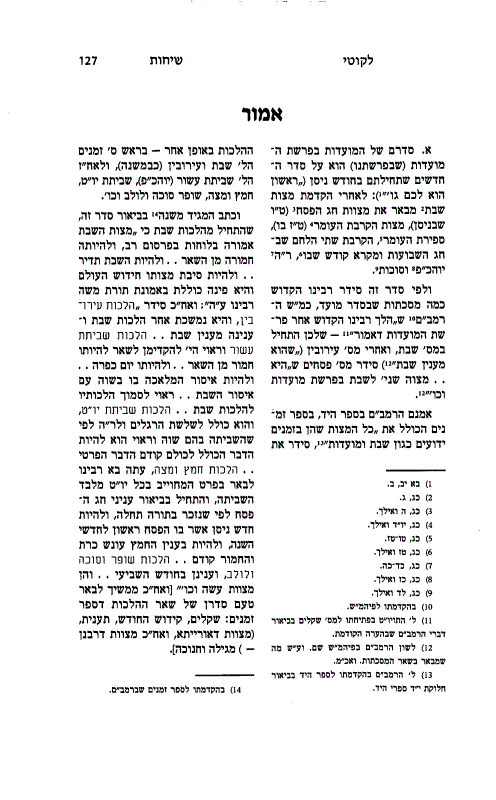
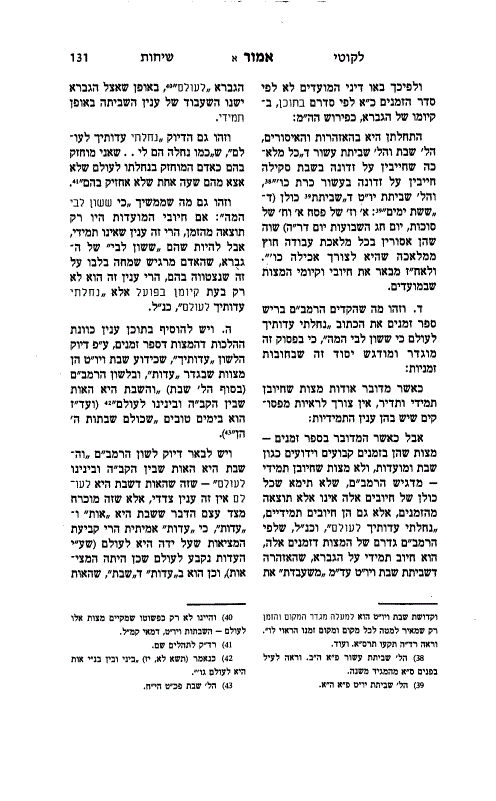
We are going to review Likkutei Sichos, Chelek Lamed-Beis, volume 32, the first sicha on Parshas Emor. In this parsha, the Torah lists all the Yomim Tovim, beginning with Rosh Chodesh and then following the order of the year: starting with Pesach and Sefiras HaOmer, continuing to Shavuos and the Shtei HaLechem, and then going on to Rosh Hashanah, Yom Kippur, and Sukkos.
This is also the order used by Rabbi Yehudah HaNasi, Rebbi, when he authored the Mishnah. He follows the progression of the year as it unfolds chronologically, and that is how the order of the masechtos is arranged. In the Rambam, however, the order appears to be different, and the Rebbe explains the reason for that change.
The Rebbe brings the Maggid Mishnah, who explains that in the Rambam the arrangement follows the order of importance. Because of that, it differs somewhat from the way it appears in the Torah and from the way it appears in the Mishnayos. But the Rebbe asks: why should that be so? Even if the Maggid Mishnah gives reasons based on importance, the posuk presents the Yomim Tovim in one order, and the Mishnah follows that same order. Why, then, would the Rambam change it?
The Rebbe explains this in a very interesting way through the posuk that the Rambam places at the beginning. Before each chelek, the Rambam writes a special posuk. The Rebbe points out that before Seder Zmanim, the Rambam uses the posuk, “Nachalti Eidvosecha Le’olam, Ki Sasson Libi Heimah” — “I have inherited Your testimonies forever, for they are the rejoicing of my heart.” The Rebbe asks: how does this posuk fit with halachos that deal with zman, with time? The posuk speaks about “Le’olam” — forever.
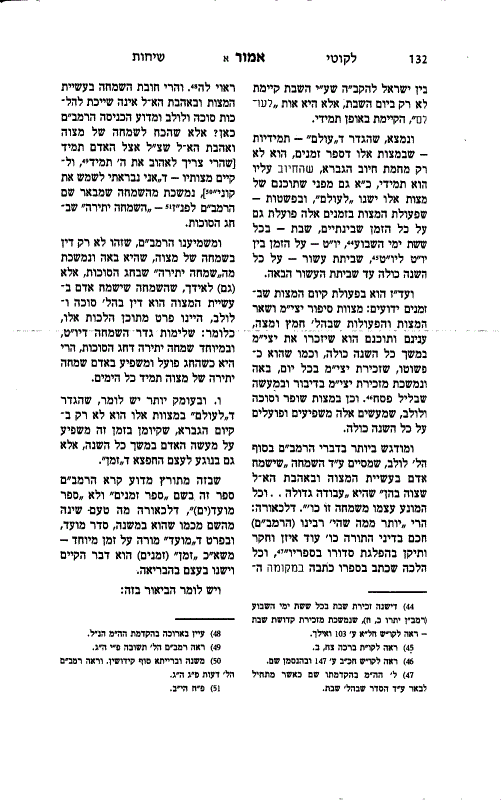
The Rebbe explains that there are really two ideas here. One is the holiday itself, meaning the actual time when the Yom Tov takes place. But then there is also the person who celebrates the holiday. The person is not bound by time in the same way. With the person, the main point is the person’s state and how the person stands. The Rebbe later explains the deeper connection to why it is still called Zmanim, even though the focus shifts to the person: because the person has the power to impact and transform zman itself. As the Rebbe develops the sicha, he explains this step by step.
Part 1
The Rebbe’s First Question: Why Does the Rambam Rearrange the Order of the Festivals?
The Rebbe begins by examining the סדר of the מועדים in Parshas HaMo’adim, in our parsha, Parshas Emor.
There, the festivals are listed according to the order of the months. The first month is Nissan, as the verse says: “Hachodesh hazeh lachem rosh chodashim.” First, the Torah discusses Shabbos. After introducing the mitzvah of Shabbos, the סדר continues according to the calendar year.
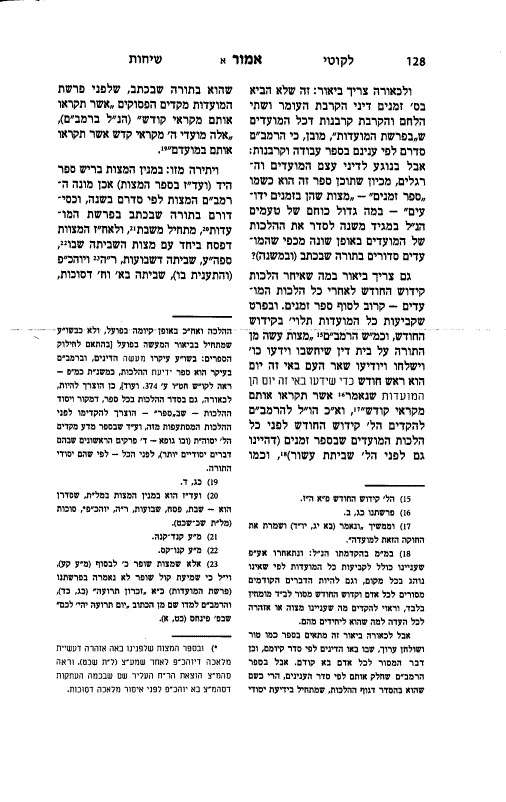
It then moves to the mitzvos of Pesach, which begins on the fifteenth of Nissan, followed by the bringing of the Omer on the sixteenth of Nissan, the day after the first day of Pesach. Chronologically, this comes directly after Pesach. Then comes Sefiras HaOmer, which spans the entire period from Pesach until Shavuos. After that comes the bringing of the Shtei HaLechem on Shavuos, in the month of Sivan.
Shavuos is also a Mikra Kodesh, a holy day, with both the korban and the Yom Tov itself.
From there, the Torah proceeds to Rosh Hashanah, the first of Tishrei; Yom HaKippurim, the tenth of Tishrei; and Sukkos, the fifteenth of Tishrei.
Everything follows the order of the months.
According to this סדר, Rabbeinu HaKadosh, Rabbi Yehudah HaNasi, organized the tractates in Seder Moed.
As the Rambam writes, Rabbeinu HaKadosh followed the portion of the festivals in Parshas Emor. That is why he began with Maseches Shabbos, since Shabbos appears first in Parshas HaMo’adim. Then comes Maseches Eruvin, because the laws of Eruvin are an extension of Shabbos: on Shabbos one may not carry, and through an Eruv that issue is addressed. After that comes Maseches Pesachim, because Pesach is the next mitzvah mentioned after Shabbos in Parshas HaMo’adim.
So the Rambam explains that the Mishnah follows the order of the verses in Parshas Emor.
However, in Sefer HaYad, the Mishneh Torah, specifically in Sefer Zmanim—which includes all mitzvos connected to specific times, such as Shabbos and the festivals—the Rambam arranges the halachos differently.
He begins Sefer Zmanim with Hilchos Shabbos and Hilchos Eruvin, just as in the Mishnah and in Parshas Emor.
But after that, instead of moving to Pesach, the Rambam goes to Hilchos Shevisas Asor, the laws of Yom Kippur.
The Rebbe notes that he is not asking here about Sefiras HaOmer or the Korban Omer, since those are connected with korbanos. The question concerns the festival days themselves.
Why does the Rambam depart from the Torah’s order? Why, instead of Pesach or the other festivals, does he place Yom Kippur next?
After that, the Rambam includes Hilchos Shevisas Yom Tov, which contains the general laws of the holidays.
Then he proceeds to the specific mitzvos:
- Chametz U’Matzah for Pesach
- Shofar for Rosh Hashanah
- Sukkah and Lulav for Sukkos
It is clearly a deliberate and distinct arrangement.
The question is: why did the Rambam choose this order?
The Explanation of the Maggid Mishneh
The Maggid Mishneh explains that the Rambam arranged these halachos according to importance and frequency.
He begins with Hilchos Shabbos not merely because Shabbos appears first in the verses, but because Shabbos was given with great publicity at Sinai. It is a central and public mitzvah.
In addition:
- Its severity is greater than the other festivals, since desecration of Shabbos carries the penalty of sekilah.
- It is more frequent, occurring every week.
- It testifies that Hashem created the world in six days and rested on the seventh, making it a foundation of faith.
Therefore, Shabbos comes first.
Next come the laws of Eruvin, since Eruvin are directly connected to Shabbos.
Then the Rambam places Yom Kippur.
Why?
Because Yom Kippur is more stringent than ordinary Yom Tov. Violation of Yom Kippur carries kares, whereas ordinary Yom Tov involves a negative commandment. It is also the Day of Atonement.
Furthermore, the prohibition of labor on Yom Kippur resembles Shabbos, because unlike Yom Tov, even food preparation is forbidden.
Therefore, Yom Kippur fittingly follows Shabbos.
After that comes Hilchos Shevisas Yom Tov, which contains the general laws that apply to all the festivals—Pesach, Shavuos, Sukkos, and also Rosh Hashanah.
Since these halachos apply broadly, the Rambam first gives the general framework and only afterward turns to the specific details.
He begins those details with Hilchos Chametz U’Matzah, because Pesach is first in the Torah, Nissan is the first month, and the prohibition of eating chametz carries kares.
Then come the laws of Shofar, followed by Sukkah and Lulav, all of which belong to the seventh month and follow that order.
The Rambam then continues with the remaining halachos in Sefer Zmanim:
- Shekalim
- Kiddush HaChodesh
- Ta’aniyos
These are followed by rabbinic mitzvos such as:
- Megillah
- Chanukah
So the Maggid Mishneh explains the logic and importance behind the Rambam’s arrangement.
The Rebbe’s Question Remains
But the Rebbe asks:
Why should these considerations outweigh the order found in the Torah itself and in the Mishnah?
We understand that in Sefer Zmanim the Rambam is not dealing with korbanos. But regarding the festivals themselves, since this sefer is specifically called Sefer Zmanim—the Book of Appointed Times—why should the Rambam’s own reasoning override the chronological order of the Torah and Mishnah?
Why did he change the order?
A Second Question: Kiddush HaChodesh
The Rebbe adds another question.
Why did the Rambam delay Hilchos Kiddush HaChodesh until near the end of the book?
The sanctification of the new moon determines all the dates of the festivals.
As the Rambam himself writes, it is a mitzvas asei מן התורה for Beis Din to calculate and proclaim the new month so that the people know when Rosh Chodesh is, and therefore know when the festivals occur.
It would seem that Kiddush HaChodesh should appear first in Sefer Zmanim—before the festivals.
A Further Proof
If one compares this to the way the Rambam lists the mitzvos in the Minyan HaMitzvos at the beginning of the Yad, there he follows the order of the verses.
He counts the mitzvos according to the flow of the year:
- Shabbos
- Pesach
- Sefiras HaOmer
- Shavuos
- Rosh Hashanah
- Yom Kippur
- Sukkah
- Lulav
There, the mitzvah of Kiddush HaChodesh appears before the festivals.
So in the Minyan HaMitzvos and in Sefer HaMitzvos, the Rambam places Kiddush HaChodesh before the festivals, fully consistent with the verses and with logic itself.
Why then, in the body of Mishneh Torah, does he change the order of the halochos and places Kiddush HaChodesh near the end?
That is the Rebbe’s question in Ois Aleph.
Part 2 – Ois Beis
The Opening Verse of Sefer Zmanim: Why Does the Rambam Choose a Verse About “Forever” for Mitzvos of Specific Times?
The Rebbe begins by examining the introductory verse the Rambam chose for Sefer Zmanim.
The verse speaks about zmanim, appointed times, yet the Rambam selects a posuk that emphasizes “Le’olam”—forever.
Clearly, the verses that the Rambam places at the beginning of each of the fourteen books of the Yad are not random selections. They serve as introductions, opening themes that express the inner content and essence of each sefer.
At first glance, however, this particular verse seems not only unrelated to Sefer Zmanim, but almost the opposite of it.
The Apparent Contradiction
Sefer Zmanim contains the mitzvos that apply at fixed and designated times.
These are obligations that do not apply constantly, but only at specific moments:
- Shabbos — once each week
- Yom Kippur — once each year
- Pesach, Shavuos, and Sukkos
- Shofar
- Sukkah
- Lulav
- and similar mitzvos
Their defining feature is that they are bound to time.
Yet the verse the Rambam chooses says:
“Nachalti Eidvosecha Le’olam”
“I have inherited Your testimonies forever.”
The emphasis of the verse is continuity, permanence, and inheritance that remains at all times.
That appears to be the very opposite of mitzvos whose nature is that they apply only at certain times.
The Contrast With Sefer Ahavah
The Rebbe adds that the Rambam himself highlights this distinction when he describes the difference between Sefer Ahavah and Sefer Zmanim.
In Sefer Ahavah, the Rambam includes mitzvos that are constant or frequent—mitzvos through which a person is commanded to love Hashem and remember Him תמיד.
These include:
- Krias Shema
- Tefillah
- Tefillin
- Birchas Kohanim
- Milah
Even though Milah is performed only once, it remains permanently as a sign in the body, serving as an ongoing reminder even when one is not wearing Tefillin or Tzitzis.
So Sefer Ahavah naturally relates to constancy and continuity.
By contrast, Sefer Zmanim is specifically the book of mitzvos that apply only at designated times.
That makes the Rambam’s choice of verse even more striking.
Why would the introduction to time-bound mitzvos emphasize Le’olam?
The Rebbe’s Explanation
The Rebbe explains that with this very posuk, the Rambam is revealing the true essence of Sefer Zmanim.
This also becomes the key to understanding the Rambam’s arrangement of the halachos throughout the sefer.
What first appears to be a contradiction is actually the central insight.
Part 3 – Ois Gimmel
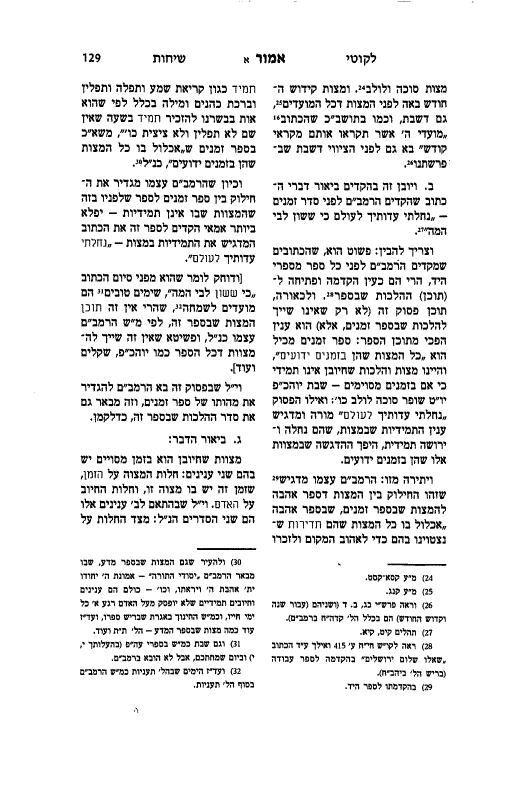
Two Aspects of Every Yom Tov: The Holiness of the Day and the Obligation of the Person
Mitzvos that apply at specific times contain two distinct dimensions.
1. Chalois HaMitzvah al HaZman
The mitzvah rests upon the time.
A certain date or period is defined as the זמן for that mitzvah. The day itself carries a unique status, and because that time has arrived, the mitzvah now applies.
2. Chalois HaChiyuv al HaGavra
The obligation rests upon the person.
The individual is commanded to fulfill the mitzvah. The focus here is not only that the day is holy, but that the person must respond to that holiness through action.
Two Orders: Torah and Mishnah vs. Rambam
The Rebbe explains that these two dimensions correspond to the two different orders we find:
- the order of the Torah and the Mishnah
- the order of the Rambam
The Order of the Torah and Mishnah – The Time Itself
From the perspective of the mitzvah as it rests upon the time, it is natural to arrange the obligations according to the calendar year, following the order in which the sacred days arrive.
That is why in the verses and in the Mishnah the סדר follows the months:
- Pesach
- Sefiras HaOmer
- Shavuos
- Rosh Hashanah
- Yom Kippur
- Sukkos
The focus is the sequence of holy times.
Each date arrives in turn, and with each date comes its mitzvah.
The Order of the Rambam – The Person’s Obligation
But from the perspective of the obligation resting upon the person, the matter is different.
A Jew’s responsibility is not limited to the moment when the day arrives.
A person must always be prepared to fulfill every mitzvah at its proper time. One must arrange in advance whatever is needed so that when the זמן arrives, the mitzvah can be observed correctly.
In that sense, the obligation upon the person is ongoing. It exists constantly.
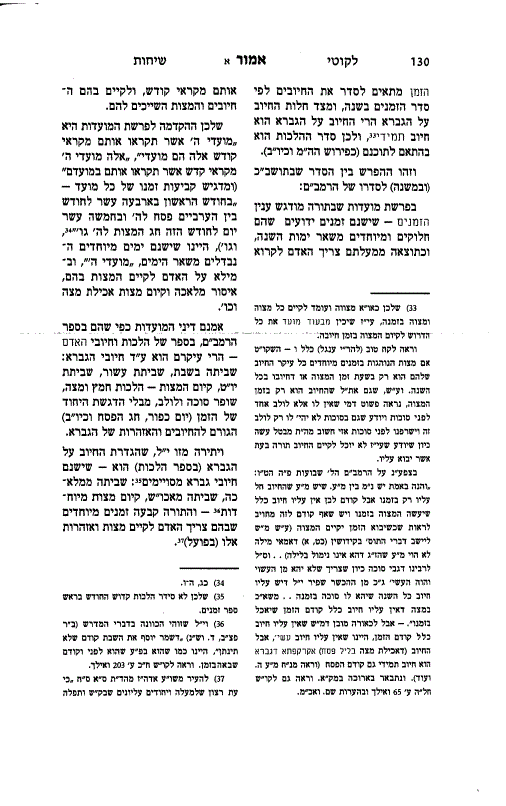
Therefore, the order of the halachos in the Rambam fits the purpose of Mishneh Torah.
The Rambam is primarily discussing the chiyuv ha-gavra—the obligations of the individual.
This is the basis of the Maggid Mishneh’s explanation.
The Focus of Parshas HaMo’adim
In Parshas HaMo’adim, the emphasis is on the days themselves.
There are appointed times in the year that are distinct, elevated, and holy.
Because those days possess special sanctity, the Torah commands the person to proclaim them Mikraei Kodesh and fulfill the mitzvos connected to them.
The Torah first defines the sacred times, and then tells us what is to be done on those times.
The Focus of the Rambam
But in the Rambam, in a sefer of halachah that instructs a person how to live, the main focus is the person’s obligations.
The Rambam does not merely describe the calendar as “Yom Kippur” or “Chag HaPesach.”
He addresses the individual:
- Rest on Shabbos
- Rest on Yom Kippur
- Rest on Yom Tov
- Perform the mitzvah
The emphasis is not primarily the uniqueness of the day itself, but what the person must do because of that day.
A Deeper Point
The Rebbe adds that perhaps the matter goes even deeper.
It is not merely that there are two valid perspectives—the day and the person.
Rather, in halachah itself, the central emphasis begins with the person, who must conduct himself in a certain way during those sacred times.
Therefore, the laws of the festivals are not arranged simply by chronology, but according to the structure of the person’s fulfillment.
How the Rambam Organizes the Halachos
As the Maggid Mishneh explains, the Rambam begins with warnings and prohibitions.
First come:
- Hilchos Shabbos
- Hilchos Shevisas Asor
The melachos forbidden on Shabbos are likewise forbidden on Yom Kippur.
On Shabbos the punishment is sekilah.
On Yom Kippur the punishment is kares.
The discussion centers on what the person must not do.
Then come the positive obligations:
Hilchos Shevisas Yom Tov
The command to rest on the festivals:
- first and seventh days of Pesach
- Shavuos
- Rosh Hashanah
- first and eighth days of Sukkos
These are days when melachah is restricted, aside from Ochel Nefesh.
Again, the focus is on the person:
- you may not do melachah
- you must rest
After that, the Rambam proceeds to the specific mitzvos of each festival and how they are fulfilled.
First he teaches the prohibitions that apply to the person, and then the positive commandments the person must perform.
Summary of Ois Gimmel
Every Yom Tov has two dimensions:
The Day
A sacred time arrives.
The Person
A Jew is obligated to act in response.
The Torah and Mishnah emphasize the holiness of the days, so they follow the calendar order.
The Rambam emphasizes the person’s halachic responsibilities, so he arranges the halachos according to the structure of obligation rather than chronology.
Part 4 – Ois Daled
Why the Rambam Opens Sefer Zmanim With a Verse About Everlasting Obligation and Lasting Joy
This is why the Rambam introduces Sefer Zmanim with the posuk:
“Nachalti Eidvosecha Le’olam.”
Through this verse, he defines and emphasizes the true foundation of these time-bound mitzvos.
Why This Must Be Stated Here
When speaking about mitzvos that are constant by their very nature, as in Sefer Ahavah, there is no need to prove that they are everlasting. Their continuous character is self-evident.
But when we come to Sefer Zmanim—mitzvos that apply only at designated times and are not performed every moment—the Rambam must teach that one should not think their entire existence depends only on the arrival of the date itself.
That would be a superficial understanding.
Rather, these mitzvos also create a continuous obligation upon the person.
The Person’s Bond Is Constant
Every Yom Tov may come only in its proper season, but the Jew’s relationship and responsibility to that mitzvah exists at all times.
That is the meaning of:
“Nachalti Eidvosecha Le’olam.”
Even mitzvos connected to specific times contain an element of Le’olam—forever.
Example: Preparing for Shabbos
The command to rest on Shabbos and Yom Tov is not relevant only once the day begins.
Even during the week, a person remains obligated to be ready for Shabbos when it arrives.
He must prepare, plan, and orient himself toward the coming holiness of the day.
In that sense, he is continuously connected to the mitzvah, even before the moment of fulfillment.
Why the Verse Uses the Word “Inheritance”
The wording of the verse is exact:
“Nachalti Eidvosecha Le’olam”
“I have inherited Your testimonies forever.”
An inheritance is not temporary.
It belongs to a person constantly. Even when he is not actively using it, it remains his possession at all times.
So too, these mitzvos belong to a Jew continuously.
Even when the specific time for fulfillment has not yet arrived, they remain part of his enduring spiritual inheritance.
The Joy That Never Ends
The verse continues:
“Ki Sasson Libi Heimah”
“For they are the rejoicing of my heart.”
If the obligation of the festivals existed only when the calendar date arrived, then the relationship would be occasional and limited.
But since these mitzvos are an inheritance that belongs to the person always, they generate an ongoing joy.
A Jew rejoices not only in the moment of performing the mitzvah, but in the very fact that he has been commanded in these mitzvos and connected to them forever.
A Deeper Joy
This creates a deeper kind of happiness:
Not only the joy of doing the mitzvah when the time comes, but the lasting joy of living with the privilege, identity, and eternal bond of being commanded in them תמיד.
Summary of Ois Daled
The Rambam opens Sefer Zmanim with this verse to teach that even mitzvos tied to specific dates are not temporary obligations.
They become a permanent inheritance in the life of a Jew.
The time of fulfillment may come and go, but the connection remains forever.
And because that bond is constant, the joy it creates is constant as well.
Part 5 – Ois Hei
The Yom Tov Itself Continues Beyond the Day and Leaves an Ongoing Impact Throughout the Year
The Rebbe adds a deeper dimension.
It is not only that the person remains constantly obligated through these mitzvos. The Yomim Tovim themselves are specifically called:
Eidvosecha — Your testimonies.
Why “Testimonies”?
A testimony is something enduring.
A witness may testify only once, but what he establishes through that testimony remains afterward. Once the truth has been affirmed, the effect of that testimony continues.
So too with Shabbos and Yom Tov.
They testify to:
- Hashem’s creation of the world
- the bond between Hashem and the Jewish people
These truths are not limited to the moment when the testimony is expressed. Their message and impact continue long afterward.
The inspiration of Shabbos extends into the weekdays.
The purification of Yom Kippur carries forward until the next Yom Kippur.
What takes place on those sacred days leaves an enduring imprint.
Why Does the Verse Say “Eidvosecha” and Not “Mitzvosecha”?
The Rebbe asks:
Why does the verse say:
“Nachalti Eidvosecha”
and not:
“Nachalti Mitzvosecha”?
The answer is that Shabbos and Yom Tov are mitzvos whose very nature is testimony.
As the Rambam writes in Hilchos Shabbos, Shabbos is an os, a sign between Hashem and us forever.
That eternal connection is not incidental. It flows from the meaning of testimony itself.
A true testimony establishes a reality in a lasting way.
Once something has been testified to, that fact stands permanently.
Therefore, if Shabbos is testimony to our connection with Hashem, then it must be a testimony that continues forever—not only during the hours of Shabbos itself.
The Lasting Effect of Every Moed
The same applies to all the appointed times.
The sign created between Hashem and the Jewish people through Shabbos and Yom Tov exists not only during the sacred day itself, but continues afterward in an ongoing way.
So Le’olam in Sefer Zmanim means more than a constant obligation upon the person.
It means that the Yom Tov itself has an enduring effect.
Its holiness and accomplishments continue during the period between one occasion and the next.
- Shabbos influences all six weekdays
- Each Yom Tov shapes the months that follow until the next Yom Tov arrives
The Same Is True of the Specific Mitzvos
This applies not only to the day itself, but also to the mitzvos performed on those days.
Pesach
The mitzvah of telling the story of Yetzias Mitzrayim, together with the mitzvos of Chametz U’Matzah, is not confined to the Seder night.
Its purpose is that the Exodus should accompany a Jew throughout the year, just as we mention Yetzias Mitzrayim every day.
What is spoken and experienced on Pesach extends into all the days that follow.
Other Yomim Tovim
The same is true of:
- Shofar
- Sukkah
- Lulav
When fulfilled properly, their influence reaches far beyond the festival itself and impacts the entire year.
Why the Rambam Ends Hilchos Lulav With Joy
The Rebbe points to a striking example.
At the end of Hilchos Lulav, the Rambam writes at length about simchah shel mitzvah.
He concludes that a person should rejoice in performing mitzvos and in the love of Hashem who commanded them, for this is a great form of divine service. One who holds himself back from such joy is lacking in avodah.
The Rebbe asks:
Why did the Rambam place this teaching specifically in Hilchos Lulav?
If he is teaching a general principle—that one must rejoice in every mitzvah and in loving Hashem—why place it here, in the laws of Sukkah and Lulav?
Because the Joy of Sukkos Powers the Whole Year
The answer is that this teaching belongs precisely here.
The joy discussed there is a continuation of the joy of Sukkos.
The power for a Jew to live with joy in mitzvos throughout the entire year comes from the joy of Yom Tov—especially the heightened joy of Sukkos and Simchas Beis HaSho’eivah.
That festival joy becomes the source from which one draws lasting joy in serving Hashem every day.
An Even Deeper Point
The Rebbe adds an even deeper insight.
It is not only that joy extends from Sukkos into the year.
Rather, bringing joy into the entire year is itself part of the definition of Sukkos.
The mitzvos of Sukkah and Lulav are not complete merely when performed during the festival days.
Their full purpose is realized when the joy of the chag continues afterward and transforms the rest of the year.
Especially regarding Sukkos, about which the Torah says:
“Vesamachta Bechagecha”
The complete meaning of the Yom Tov is that it leaves a Jew living with joy long after the days of the festival have passed.
Part 6
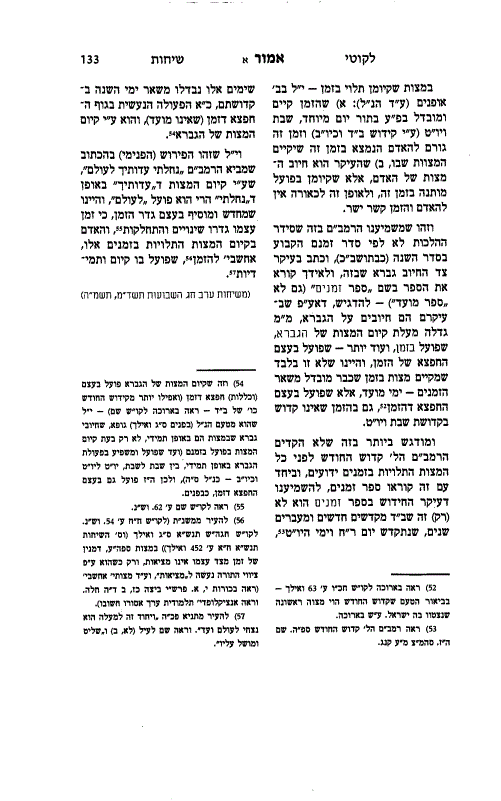
The Deepest Point: A Jew Does Not Only Keep Mitzvos in Time—He Transforms Time Itself
The Rebbe now develops the idea even further.
Until this point, the explanation was that the Torah and Mishnah emphasize the zman itself, while the Rambam emphasizes the obligation upon the person—the gavra. That is why the Rambam’s order differs from the order found in the Torah and in the Mishnah.
The Earlier Question: Kiddush HaChodesh
The earlier question regarding Kiddush HaChodesh was that if Sefer Zmanim is about the festivals as times, then Kiddush HaChodesh should seemingly appear first, since the sanctification of the month determines when the festivals occur.
But once we understand that the Rambam’s arrangement is centered on the person’s obligations, the focus is no longer simply the calendar itself.
The structure of the sefer follows what the person must do, not merely how the dates are established.
A Deeper Dimension
Now the Rebbe adds an even deeper point.
It is not only that these mitzvos affect the person beyond the moment in which they are performed.
It is not only that when one fulfills Lulav, Shofar, Shabbos, or Yom Tov properly, the inspiration continues throughout the year.
Rather, through the mitzvah, the person actually transforms time itself.
A New Meaning of “Le’olam”
This gives new meaning to the word Le’olam.
The everlasting quality is not only in the lasting effect upon the individual.
It reaches into the very framework of time.
The mitzvah leaves a permanent mark not only on the person, but on the reality of time within creation.
Why “Sefer Zmanim” and Not “Sefer HaMoadim”?
This also explains why the Rambam calls this book Sefer Zmanim—the Book of Times—and not Sefer HaMoadim.
Seemingly, if the subject is the festivals, it would have been more fitting to call it the Book of Festivals, just as the Mishnah calls that section Seder Moed.
Especially since the word moed refers to an appointed and holy occasion, a designated sacred time.
By contrast, zman means time in the broader sense—time as it exists within creation.
So why does the Rambam choose the broader term, Zmanim, rather than Moadim?
Two Ways to Understand Time-Bound Mitzvos
The Rebbe explains that mitzvos dependent on time can be understood in two ways.
1. The Time Is Primary
The day itself becomes elevated and distinct—Shabbos or Yom Tov.
Because that holy time now exists, the person who enters that day must fulfill the mitzvah connected with it.
The time is primary, and the person responds to it.
2. The Person Is Primary
The main element is the obligation upon the individual.
The mitzvah rests upon the person, but its fulfillment is assigned to a particular time.
According to this approach, the time is the setting in which the person carries out his obligation.
Why the Rambam Combines Both Ideas
If so, the Rambam is teaching something remarkable.
On one hand, he arranges the halachos according to the obligations of the person rather than according to the calendar sequence.
This shows that the gavra is central.
On the other hand, he names the sefer Sefer Zmanim, emphasizing time itself.
Why combine both ideas?
Because the fulfillment of the mitzvah by the person does not remain only a personal act.
The avodah of the person is so significant that it affects the very time in which it is performed.
It elevates and transforms the cheftza of time itself.
The Jew Changes Time
The point is not merely that a person happens to perform a mitzvah on a certain date.
Rather, through a Jew’s fulfillment of Hashem’s will, that time itself becomes uplifted, defined, and transformed.
The mitzvah does not only occur in time—it changes time.
Summary of Part 6
The Rambam calls the book Sefer Zmanim to teach that although these halachos focus on the person’s obligations, the result of that avodah is the sanctification and refinement of time itself.
A Jew does not merely live within time.
Through Torah and mitzvos, he reveals holiness within time and transforms it forever.
Short Summary
In Parshas Emor, the Torah lists the festivals in chronological order, and the Mishnah follows that same pattern. The Rambam, however, arranges the halachos differently. The Rebbe explains that the Torah emphasizes the holiness of the times themselves, while the Rambam focuses on the person’s obligation—what a Jew must do.
This is why the Rambam introduces Sefer Zmanim with the verse “Nachalti Eidvosecha Le’olam.” Even mitzvos tied to specific dates create an ongoing connection and responsibility. Their influence continues long after the day has passed.
The Rebbe adds a deeper point: mitzvos do not only affect the person—they transform time itself. Through a Jew’s avodah, the appointed times become elevated and sanctified.
Quiz on Likkutei Sichos Vol. 32 – Parshat Emor 1
1. According to the Torah in Parshat Emor and Rabbi Yehudah HaNasi in the Mishnah, what is the primary order of the holidays?
A. Order of importance and severity of punishment
B. Chronological order according to the months of the year
C. Alphabetical order of the Masechtos
D. Based on whether the holiday is from the Torah or Rabbinic
2. How does the Rambam’s arrangement in Sefer Zmanim differ from the order in the Torah?
A. He starts with Pesach instead of Shabbos
B. He places Yom Kippur immediately after Shabbos and Eruvin
C. He omits the laws of Hanukkah and Purim
D. He follows the order of the agricultural harvest
3. What explanation does the Maggid Mishneh give for why the Rambam starts with Hilchos Shabbos?
A. Because it is the first holiday mentioned in the Torah
B. Because it is connected to the moon’s cycle
C. Because of its publicity at Sinai, its frequency, and its severity (Sekilah)
D. Because the laws of Eruvin must come first
4. Why does the Rambam place Hilchos Kiddush HaChodesh near the end of Sefer Zmanim despite its role in determining the calendar?
A. Because he considers it a Rabbinic obligation
B. Because he focuses on the individual's obligations (Gavra) rather than the calendar setup
C. Because the laws are too complex for the beginning of the book
D. Because the sanctification of the moon only applies to the Beit Din
5. What is the significance of the verse the Rambam chooses to open Sefer Zmanim: "Nachalti Eidvosecha Le’olam" ("I have inherited Your testimonies forever")?
A. It highlights that the holidays only matter while the Temple is standing
B. It emphasizes that even time-bound mitzvos create an everlasting obligation on the person
C. It suggests that time-bound mitzvos are more important than constant mitzvos
D. It refers specifically to the inheritance of the Land of Israel
6. The Rebbe explains that every holiday has two dimensions. What are they?
A. The holiness of the day (Zman) and the obligation of the person (Gavra)
B. The daytime prayers and the nighttime meals
C. The Torah laws and the custom of the ancestors
D. The physical joy and the spiritual study
7. Why does the Rambam place the general principle of "Joy in Mitzvos" (Simcha Shel Mitzvah) specifically at the end of Hilchos Lulav?
A. Because Sukkos is the only holiday where one is required to be happy
B. Because the joy of Sukkos serves as the source of joy for serving Hashem throughout the entire year
C. Because Lulav is the most expensive mitzvah to perform
D. Because it is the last mitzvah mentioned in the Torah
8. According to the Sicha, what is the difference between the terms "Moed" and "Zman"?
A. There is no difference; they are interchangeable
B. "Moed" refers to the person, and "Zman" refers to the holiday
C. "Moed" refers to a designated holy occasion, while "Zman" refers to time as it exists within creation
D. "Moed" is a Rabbinic term, while "Zman" is a Torah term
9. What "testimony" (Eidvosecha) is shared by Shabbos and the festivals?
A. They establish a permanent reality and bond with Hashem that continues even after the day ends
B. They testify that the Jewish people are the "Inheritors of the Land"
C. They serve as a legal testimony in a Beit Din regarding the new moon
D. They testify that the person has completed the harvest
10. What is the "deepest point" the Rebbe makes regarding a Jew’s relationship with time?
A. A Jew is a slave to the clock and must follow it strictly
B. Time is an illusion and does not actually exist in Halacha
C. Through the fulfillment of mitzvos, a Jew actually transforms and sanctifies time itself
D. Only the Beit Din has the power to change the status of time