Introduction
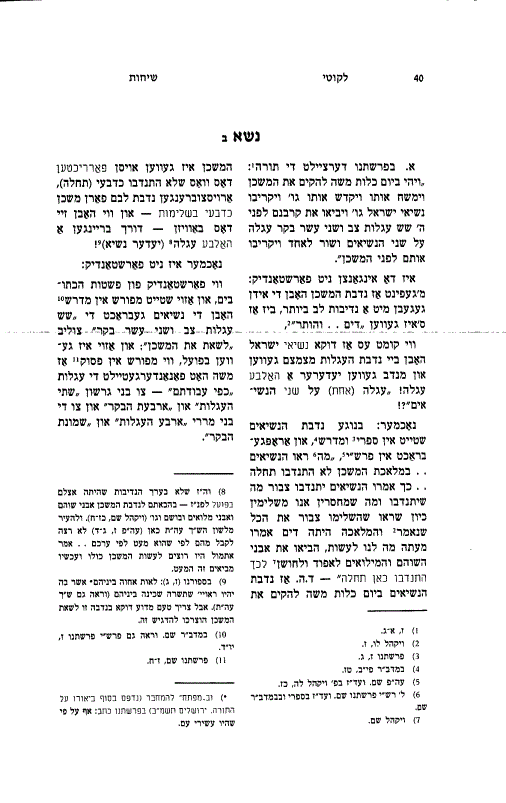
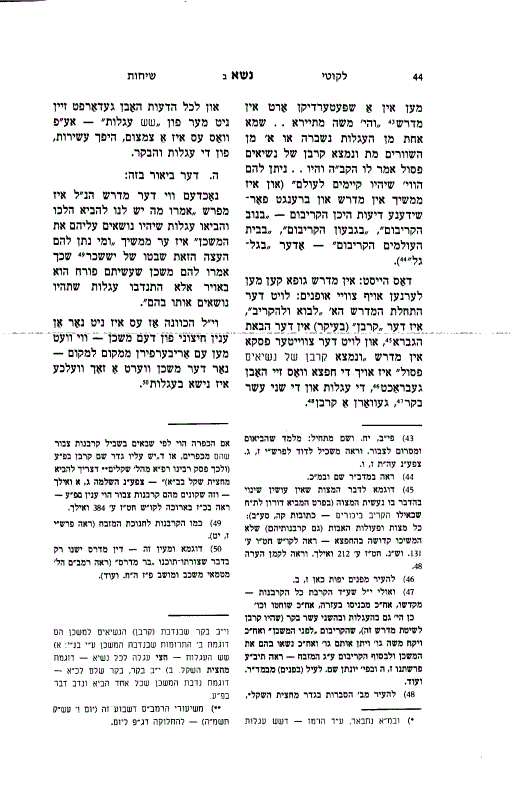
In this sicha from Likkutei Sichos, Volume 28, we are studying the second sicha on Parshas Naso. The Rebbe focuses on the gifts brought by the leaders of the tribes—the Nesiim—and raises a question about their contribution of wagons. The Torah describes how twelve Nesiim brought offerings, and specifically mentions that they gave six wagons in total, meaning that two Nesiim shared one wagon.
The Rebbe points out that this arrangement seems to have required a lot of precision and calculation. It was not simply a matter of each Nasi bringing his own wagon; instead, they had to coordinate so that two would share one. This required careful planning and agreement among all the Nesiim, which makes it seem like an unnecessarily complicated process.
The question is: why did the Nesiim choose to give their gift in such a precise and limited way? Why not just have each Nasi bring his own wagon, or simply provide as many as were needed without all this exactness? The Rebbe notes that it appears as if they went out of their way to make things difficult for themselves by insisting on this specific arrangement.
One possible explanation is that there was some practical difficulty in acquiring the wagons. Perhaps it was hard to obtain enough materials—maybe there was a shortage of cedar wood (atzei shittim) with which to build them. This idea is based on Rashi’s commentary, which mentions that Yaakov Avinu had planted cedar trees in Egypt in anticipation of the Jewish people’s future needs for building the Mishkan.
However, the Rebbe challenges this explanation. He argues that there was no requirement for the wagons to be made specifically from cedar wood. Even if there had been a shortage of atzei shittim, other types of wood could have been used, or more could have been purchased if necessary. The limitation does not seem to be due to material constraints.
This leads us into the main discussion of the sicha: if there was no technical reason for limiting the number of wagons, what deeper reason motivated the Nesiim to give their gift in such an exact and measured way? The Rebbe will explore this question further as we continue through the sicha.
Saif Aleph
The discussion begins with the question of why there was such a limited number of wagons—Agolos—donated for the service of the Mishkan, especially considering the great wealth the Jewish people had accumulated from Egypt and at the sea. One might think that with all this abundance, there would be no shortage in making more wagons. Furthermore, Rashi does not raise the question of why only half an Agola was given, which suggests that perhaps there is a simple explanation.
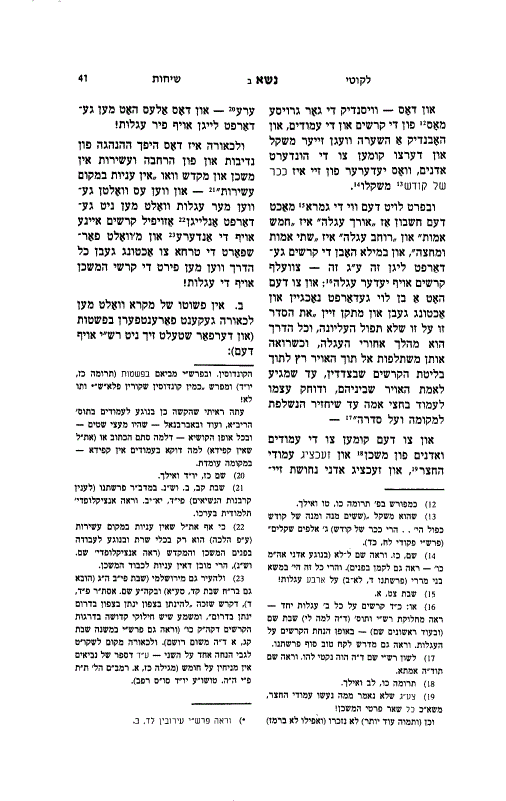
Looking back to Parshas Terumah, Rashi explains how the Jews obtained cedar wood in the desert. Rabbi Tanchuma says that Yaakov Avinu foresaw the need for a Mishkan and brought cedar trees to Egypt, instructing his children to take them when they left. This shows that while the Jews had plenty of gold and silver, cedar wood was only available because it was specifically brought from Egypt and planted for this purpose.
Therefore, one might suggest that the limited number of wagons was due to a shortage of cedar wood—the essential material for both the Mishkan’s beams and its vessels. Since they only had as much cedar as Yaakov had provided, they could only make a minimal number of wagons.
However, the Rebbe challenges this explanation. Who says that the wagons needed to be made specifically from cedar wood? They could have used other types of strong wood, which were available from merchants or could have been brought up from Egypt. The Torah only required cedar for certain parts of the Mishkan; for wagons, there was no such explicit requirement.
Moreover, since these wagons were a gift from the Nesiim—the tribal leaders—it was their decision what to give. There was no divine limitation on what material or how many wagons they could donate. If so, why did they choose to give so few?
The Rebbe further points out that our sages say certain items were purchased from merchants among other nations. This means there was access to various materials beyond what they brought out of Egypt. The only unique limitation applied to cedar wood for specific uses in the Mishkan itself—not necessarily for making wagons.
This leads back to the question: Why did the Nesiim limit their donation to such a small number? It seems logical that if it were up to them alone, they would have given more.
The Rebbe suggests that although it appears these gifts came solely from the Nesiim’s initiative, ultimately their offering required and received Hashem’s approval. As we see in Sifri and other midrashim on the verse “take from them,” Moshe Rabbeinu initially refused to accept their gifts until Hashem explicitly told him to do so.
This means that what the Nesiim intended matched Hashem’s will—He agreed with their plan and instructed Moshe to accept it. Thus, everything about these gifts—including their quantity—was ultimately by divine approval.
This is similar to their offerings at the inauguration of the Mizbeach (altar). These korbanos were not standard sacrifices; many details were unique and not found elsewhere in Torah law. For example, each Nasi brought a special incense offering (ketores) on an altar where ketores is not usually offered. Such innovations could only be done with Hashem’s explicit agreement.
Therefore, even though these actions began as initiatives by the Nesiim, they became mitzvos—divine commands—once Hashem approved them through Moshe Rabbeinu.
This resolves part of our question: The reason so few wagons were given is because that is what Hashem wanted and approved—not merely what seemed logical or generous from a human perspective.
However, this raises another issue: Is it reasonable to say that something as practical as how many wagons are needed should be purely a divine decree without any logical basis? Especially since initially it was based on human initiative—the Nesiim’s own idea—and only later received Hashem’s approval.
Thus, we are left with an unresolved point: Why did the Nesiim themselves choose such a minimal number? Even if Hashem agreed with their choice, what motivated them to offer so little when logic would suggest giving more?
The Rebbe notes that even though some aspects of these offerings were unique and seemingly without precedent—such as certain types of korbanos—we still find reasons behind them in Chazal (the sages), even if ultimately they were done by divine instruction alone.
Saif Beis
When it comes to the gifts of the wagons—nidvas ha’agolos—we must understand why their number was so limited and precise. This seems to contradict a general principle regarding matters of the Beis Hamikdash: there is no place for stinginess or acting poor when dealing with something so holy. In the Temple, everything should be done generously and with abundance.
Even if we say that this was Hashem’s will, it’s important to note that the initiative for these gifts came from the Nesi’im themselves, and only afterward did Hashem agree. Even when Hashem agrees to something exceptional, it doesn’t mean we simply accept it as a decree that defies logic. On the contrary, Chazal always seek reasons for such actions. Therefore, we must conclude there is a logical explanation for why only two Nesi’im brought one wagon each, even though this meant everything was packed tightly and seemed somewhat stingy or uncomfortable. There must have been a special intent behind this arrangement.
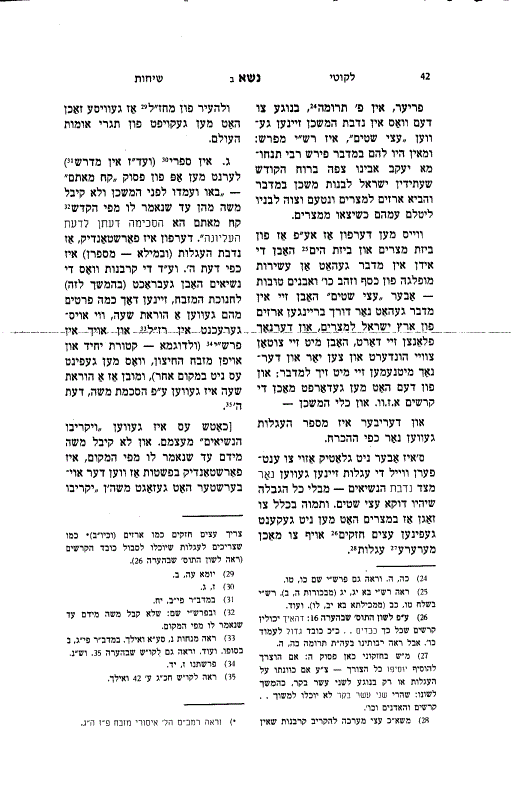
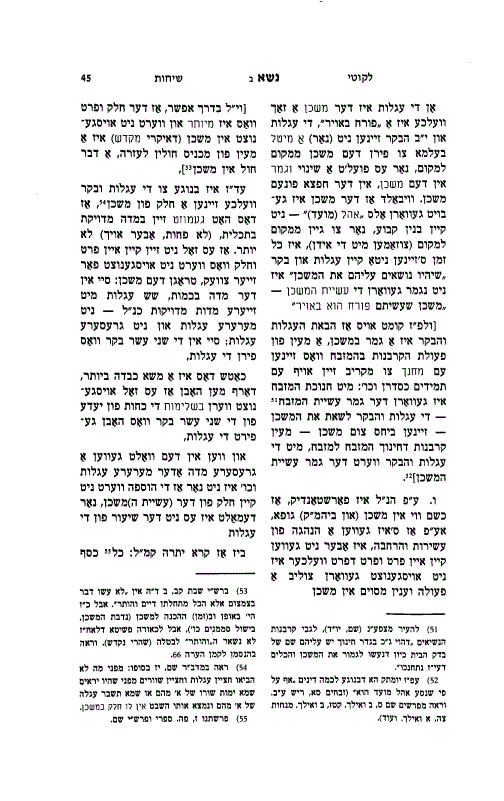
The Gemara makes it clear that precision was crucial here: the wagons had to be exactly as long and as wide as necessary—no longer, no wider—than what was needed for the kerashim (the boards of the Mishkan). There should be no extra space beyond what was required for their function. Every aspect of the wagon’s dimensions was utilized; nothing was superfluous.
The Gemara analyzes this in detail: The length of each wagon was five amos. If you placed three rows of boards on their backs (each board being an amah and a half wide), that totals four and a half amos. The Gemara asks: Why make the wagon five amos? Four and a half would suffice! The answer given is that you need an extra half amah so that the boards wouldn’t be squashed together—just enough space for them to fit comfortably, but not more.
The same applies to the width: The wagon’s width was two and a half amos. The Gemara questions this as well—why not just one and a half? The answer is that you need enough width so that the boards don’t move around or shake; again, just enough space for stability, but nothing extra.
This analysis shows us that every effort was made to minimize excess. The wagons were designed with exactness in mind—not out of stinginess, but because there was a deeper reason for such precision. The Rebbe seeks to uncover why this approach was taken, especially since it appears contrary to our usual attitude toward holy matters where abundance is encouraged.
The Rebbe then introduces two perspectives found in our sources—the Midrash on one hand, and Rashi together with Sifri on the other—regarding how we view these wagons. Were they simply utilitarian vehicles used to transport Mishkan components? Or were they actually part of the Mishkan’s dedication itself?
The Midrash holds that these wagons were indeed part of the Mishkan—they were included in its dedication as actual offerings (korbanos). If so, then just like any other offering or sacred object in the Mishkan, everything about them had to be precise; there could be no excess or unnecessary elements.
This idea is reflected in how both Sifri and Rashi describe what happened: The Nesi’im brought these gifts because they had missed out on contributing at an earlier stage. They now hastened to bring something special—the wagons—as their offering. But while Sifri describes them simply as gifts, the Midrash uses language indicating they were actual korbanos.
The verse itself supports this reading: “They brought their korban”—referring specifically to these carriages and cattle—which means they were considered offerings according to the Midrash’s interpretation.
The Midrash elaborates further: When construction of the Mishkan concluded, the Nesi’im rushed forward “to bring a korban,” emphasizing their eagerness and framing their contribution as an offering rather than just a gift. This terminology suggests that even though these items served a practical purpose (transporting parts of the Mishkan), they also possessed intrinsic sanctity as part of its dedication.
The Midrash continues by describing Moshe’s initial hesitation: He worried about using cattle as offerings—what if one died or became unfit? Wouldn’t this invalidate their korban? Hashem reassured him by promising that these offerings would remain intact throughout their use.
This discussion leads us to see two approaches: According to Sifri (and Rashi), these were simply gifts—not technically korbanos—but according to Midrash, they were actual offerings incorporated into the Mishkan’s service. Regardless of which view we follow, all agree there were only six wagons; even if not defined as korbanos per se, their number remained fixed by divine instruction or communal consensus.
The Midrash also records how Bnei Yisrael came up with this idea: It was suggested by Shevet Yissachar—the tribe renowned for wisdom—who advised gifting wagons so that transporting the Mishkan would be possible. Without them, it would be as if “the Mishkan flies in midair”—an impossibility! Thus, providing wagons wasn’t merely an external technicality; it became essential for making the Mishkan functional wherever Bnei Yisrael traveled.
This means that through giving these wagons (and cattle), Bnei Yisrael didn’t just solve a logistical problem—they transformed transportation into an integral part of serving Hashem through His dwelling place among them. The wagons weren’t just tools; they became sanctified vessels connected directly with the holiness of the Mishkan itself.
Saif Gimmel
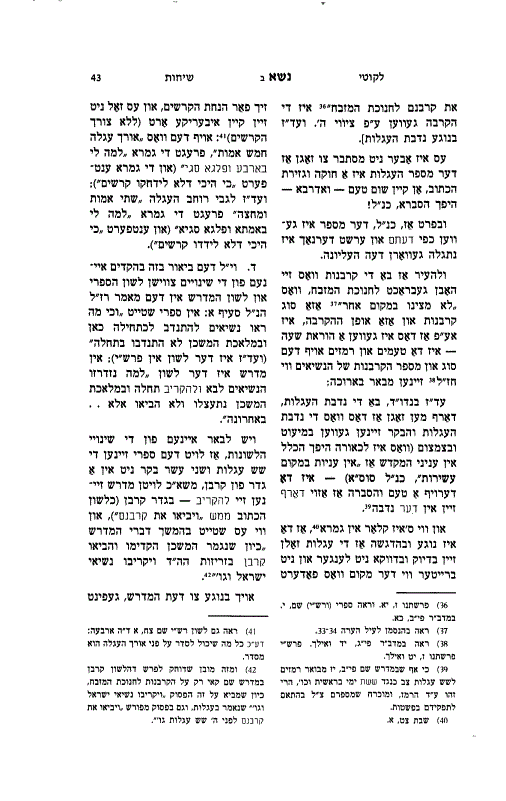
The Rebbe explains that transporting the Mishkan from place to place—moving it ממוקם למוקם—was not just a logistical necessity, but actually brought about a change and completion in the Mishkan itself. The Mishkan, as an object, is not truly established until there is a way to move it; otherwise, it remains a “flying Mishkan,” lacking its intended function.
Even though the Mishkan was constructed as an ohel—a tent, which by definition is temporary and not a fixed structure—it still required a means of transportation. Without wagons and cattle to carry it, the Mishkan could not be considered complete. Its very identity as a portable sanctuary depended on this ability to travel with the Jewish people.
Therefore, bringing the wagons and cattle was not merely an accessory or afterthought; it was an integral part of completing the Mishkan. This is similar to how bringing korbanos on the mizbeach serves to dedicate and inaugurate the altar. Just as the dedication offerings mark the completion of the mizbeach’s construction, so too do the wagons and cattle mark the conclusion of making the Mishkan fully functional.
In this sense, the wagons and cattle are like korbanos for the inauguration of the Mishkan itself. They serve as its dedication, making it possible for all its parts to be used as intended. The process of transporting the Mishkan becomes part of its essential avodah—its service and purpose.
The Rebbe emphasizes that in every aspect of constructing the Mishkan, nothing was wasted or superfluous. Every detail had a specific use; there were no unnecessary components or materials. If something brought into the Mishkan was not utilized for its holy purpose, it would be considered like bringing mundane food into a sacred space—which is forbidden except under certain conditions.
This principle applies equally to the wagons and cattle: their number and size had to be exact—no more and no less than necessary. There could not be any extra animals or larger wagons beyond what was required for carrying each part of the Mishkan. The Torah even provides an extra verse—kol kesev hakeylem ve goymer—to teach that all vessels were precisely measured so that nothing was left unused or redundant.
Rashi and Sifri explain that this precision was so important that each vessel’s weight was checked individually and then collectively, ensuring there was neither surplus nor deficiency. This meticulousness extended even to halacha: klei shares—the sacred vessels—can only sanctify their contents when they are completely full, demonstrating that every aspect must be fully utilized for its intended purpose.
This idea further clarifies why everything related to carrying and serving in the Mishkan had to be exact—not only because these items served as a kind of korban (as explained in Midrash), but also because their role was to relieve some burden from those who carried them without removing too much responsibility from them. The system was designed so that every animal’s strength would be fully used, but never wasted or exceeded.
Thus, both according to peshat—the straightforward meaning—and according to Midrashic interpretation, we see that completeness in avodas Hashem requires precision: every detail must serve its purpose without excess or lack. This approach ensures that all elements of holiness are maximally utilized in fulfilling their divine mission.
Saif Daled
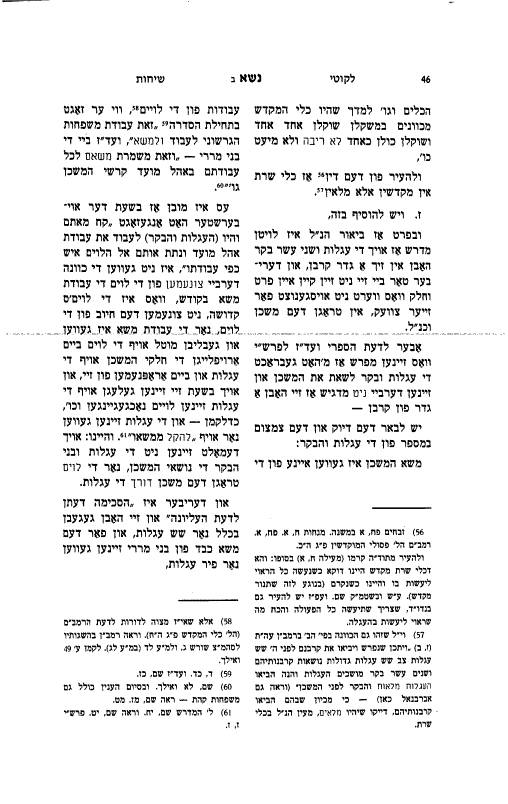
The wagons and cattle that the Nesiim brought are defined as a korban, and therefore, every detail and part of them must be used for their intended purpose. Carrying the Mishkan is their full function. While we can add that they were brought to help carry the Mishkan, as mentioned earlier, this is based on the Sifri’s opinion, not Rashi’s. According to the Sifri, this explanation alone is not sufficient.
Some explain that the Nesiim brought the wagons and cattle not as a korban, but simply to transport the Mishkan. They do not emphasize that these items have a status like a korban. However, we need to clarify why there was such an exact and limited number—six wagons and twelve cattle—used for carrying the Mishkan.
The Torah describes in the beginning of the parsha: “zoys avidus mishpukhes ha-gershuni lavedu le-masa”—this was the service of the Gershuni family: to serve and to carry. Similarly, for bnei Merari: “v’zoys mishmeres masom”—this was their charge regarding what they carried. The bnei Merari were responsible for transporting the beams of the Mishkan. In summary, carrying was a responsibility placed upon the Leviim.
It is understood that when Hashem said “kach me’itam”—take from them—the intent was not to remove from the Leviim their holy service of carrying. The kedusha (holiness) of this avodah remained with them; it was still their obligation to carry out this sacred task.
Even when parts of the Mishkan were placed onto or taken down from the wagons, or while they were being transported on these wagons, it was still considered as if the Leviim themselves were carrying them. The wagons merely made it easier—they did not replace or diminish the Leviim’s role in carrying out their holy service.
The wagons and cattle served only as tools to ease their burden; they did not take over the mitzvah itself. That is why Hashem gave only six wagons in total—four specifically for heavier loads like those of bnei Merari—and no more than necessary. If there had been more or larger wagons, it would have lessened the involvement of the Leviim in fulfilling their duty.
This precise limitation teaches us that nothing should detract from one’s personal involvement in avodas hakodesh—holy service. The Leviim had to follow after and supervise their loads even while they were on the wagons; it was never meant to be a hands-off process.
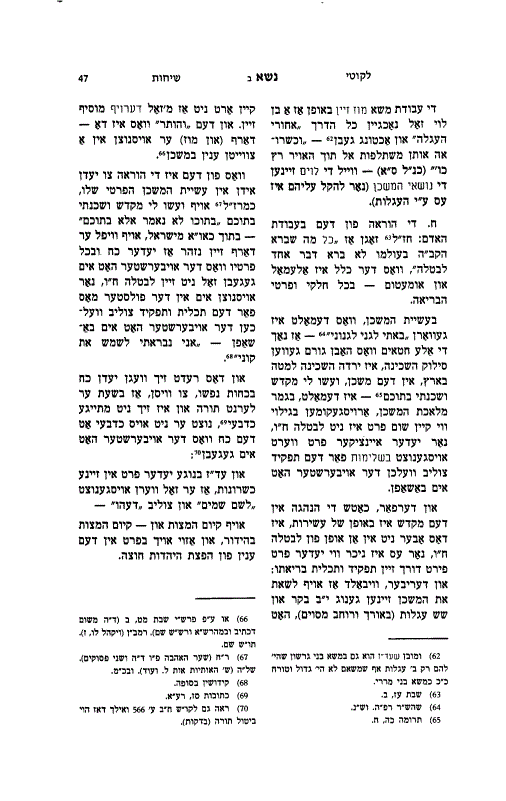
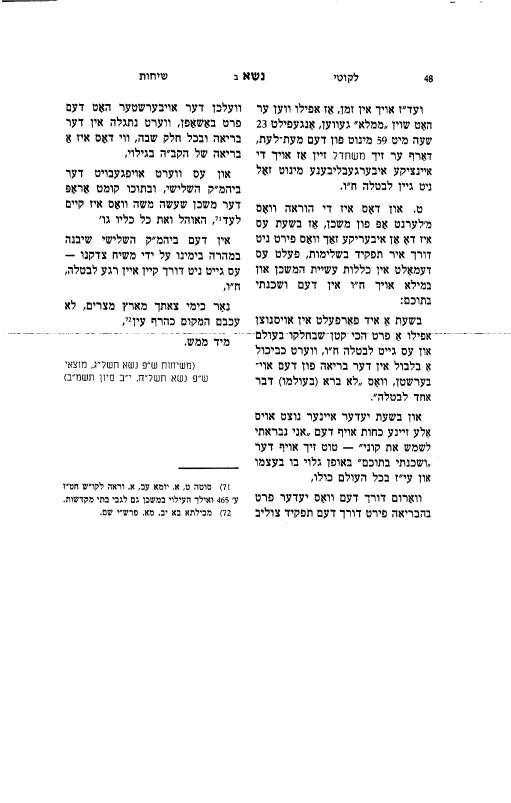
What lesson does this teach us in our own divine service? The rule that “nothing is created in vain” applies everywhere and at all times. Every detail in creation has its purpose; nothing exists without reason or use.
When Hashem commanded “make for Me a sanctuary,” He said He would dwell among us—not just within a physical Mikdash but within every Jew. This means each person must make his own life into a dwelling place for Hashem’s presence.
Therefore, every detail and every ability we possess must be fully utilized for its intended purpose—to serve Hashem. Nothing should go unused or wasted; everything must be directed toward fulfilling our mission in creation.
If someone studies Torah but does not put forth his full effort, he is not utilizing his G‑d-given abilities as he should. The same applies to all talents and resources—we must use them all for mitzvos and serving Hashem with perfection.
This principle also applies specifically in spreading Yiddishkeit outward—every moment counts. Even if one has already devoted 23 hours and 59 minutes of his day to serving Hashem, he must ensure that even one remaining minute is not wasted but used for its true purpose.
The lesson from how precisely everything was measured in building and transporting the Mishkan is clear: when something extra exists that does not fulfill its mission, there is something lacking both in building a dwelling place for Hashem and in bringing His presence into our lives.
If even a small detail goes unused or wasted, it creates confusion within creation itself—for Hashem did not create anything without purpose. When something becomes wasted, so to speak, it disrupts this order.
When a person uses all his strength for his true purpose—to serve Hashem—he brings about “I will dwell among you” both within himself and throughout creation. Every part of creation then reveals openly that it belongs to Hashem because it is being used as He intended.
This will ultimately lead to building the third Beis Hamikdash speedily in our days—a sanctuary where nothing will be wasted or delayed even for an instant—and may we merit this with Moshiach now.
Key Points
1. The Nesiim’s decision to donate only six wagons—requiring two leaders to share each wagon—was not due to material shortage or practical constraints, but was a deliberate and precise choice that required careful coordination among all the tribal leaders.
2. Although it might seem logical for each Nasi to bring his own wagon, the Rebbe demonstrates that there was no technical limitation on materials or divine command restricting the number or type of wagons; rather, the arrangement was ultimately approved by Hashem, indicating a deeper reasoning behind their exactness.
3. The Torah and Chazal emphasize that in matters of holiness, especially regarding the Mishkan, there is generally no place for stinginess or minimalism. Nevertheless, here the precision in the number and size of wagons was intentional, with every detail calculated to avoid any excess or waste.
4. The Midrash views the wagons as actual offerings—korbanos—integral to the dedication of the Mishkan itself. Even according to opinions that see them as gifts rather than korbanos, their number and function were fixed by divine instruction or communal consensus, reflecting their sanctity and necessity.
5. Transporting the Mishkan was not merely a logistical matter but an essential aspect of its completion and function. The ability to move it defined its identity as a portable sanctuary, making the wagons and cattle part of its core avodah and dedication.
6. Every element involved in building and transporting the Mishkan was measured with exactness; nothing was superfluous or left unused. This meticulousness ensured that all resources were fully utilized for their holy purpose, embodying a principle of maximal efficiency in avodas Hashem.
7. The limitation on wagons also preserved the Leviim’s personal involvement in carrying out their sacred duty. The wagons served only to ease their burden without replacing their active participation in transporting the Mishkan’s components.
8. This approach teaches a broader lesson: every detail in creation has a purpose and must be used for its intended mission. In our own lives, we are called upon to utilize all our abilities and resources fully in serving Hashem, ensuring nothing is wasted or left idle.
9. By applying this lesson—using every moment and every talent for Torah, mitzvos, and spreading Yiddishkeit—we help build a dwelling place for Hashem within ourselves and throughout creation, paving the way for the ultimate redemption with the building of the third Beis Hamikdash speedily in our days.