Review of Likkutei Sichos, Chelek כ״ז, Volume 27
Parshas Vayikra, Sicha 3
A Rashi Sicha
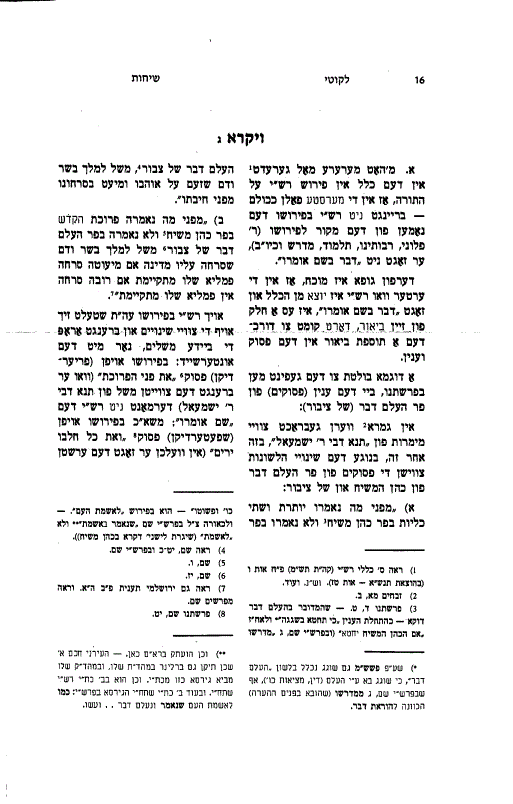
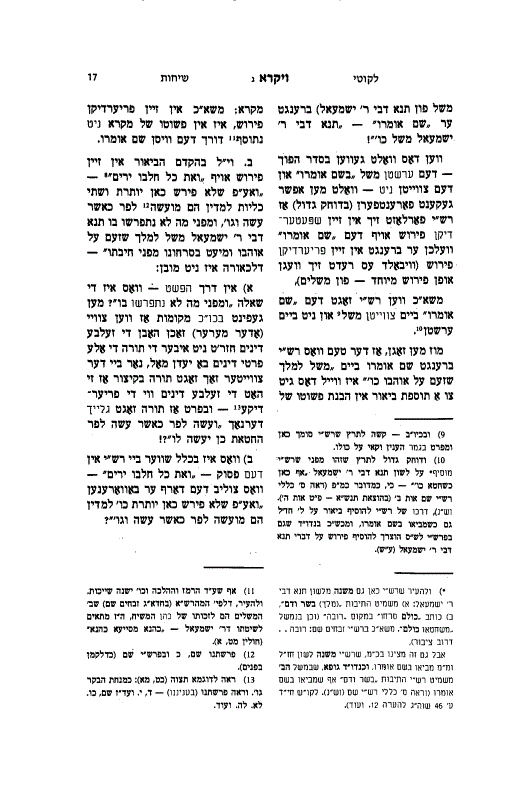
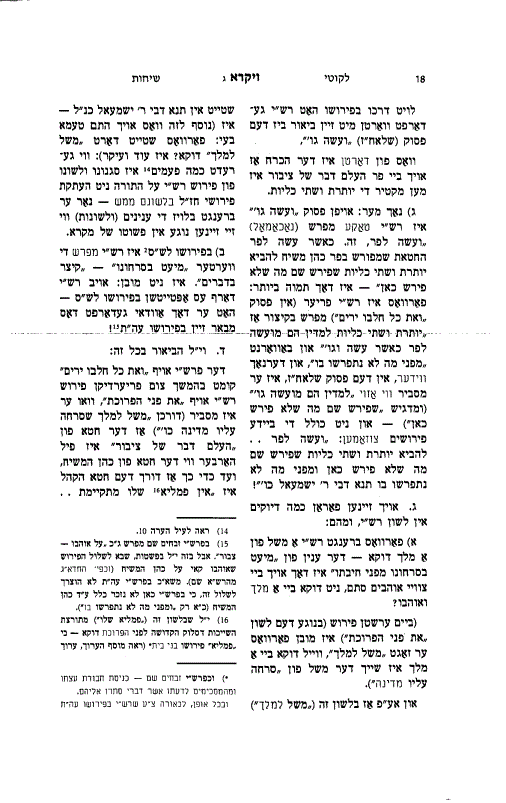
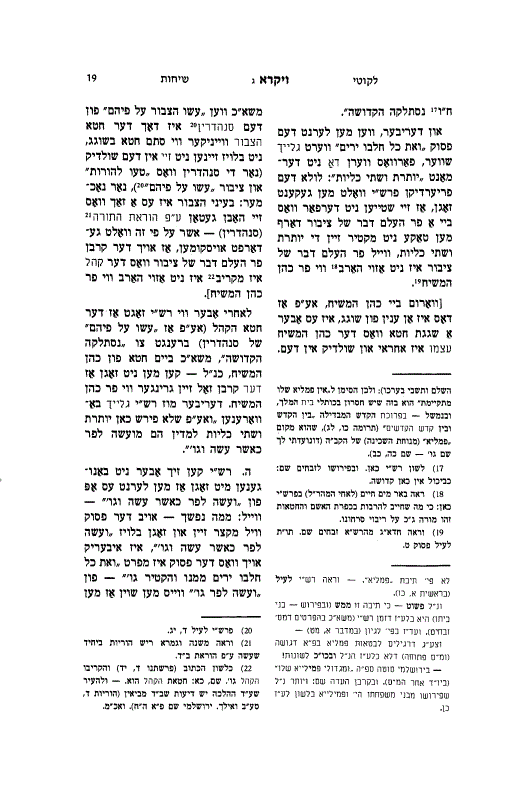
We will review Likkutei Sichos, Chelek כ״ז, Volume 27, the third sicha on Parshas Vayikra. This is a Rashi sicha.
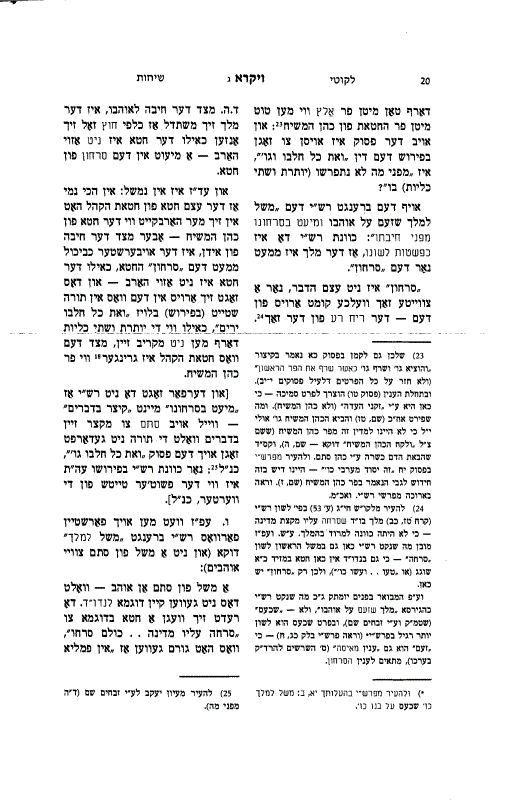
The Rebbe begins by pointing out an important principle in Rashi: when Rashi quotes the name of the author of a teaching, it is always precise. That itself is part of the explanation. The Rebbe will first establish this point from our parsha, and then go on to explain the Rashi itself.
The discussion is in Perek Daled of Vayikra. The Torah speaks there about two korbanos brought for certain accidental violations. First, the Torah discusses the case of the Kohen HaMashiach, the Kohen Gadol, who sinned inadvertently and must bring a par ben bakar. Then the Torah discusses the Par He’elam Davar Shel Tzibbur, when the community acted mistakenly based on an erroneous ruling of Beis Din, and they too bring a par ben bakar.
Although the basic korban is the same, there are differences in the wording of the pesukim. There is a change in the language regarding the sprinkling of the blood, and there is also a difference in how the Torah describes the parts of the innards that are offered on the Mizbe’ach. In practice, the procedure is the same in both cases, but the Torah expresses it differently. This leads to a key question in Rashi: in one place Rashi quotes the source, Tanna d’Vei Rabbi Yishmael, and in another place he does not. The Rebbe explains that this is exact, and that the second Rashi must be understood in light of the first.
Aleph
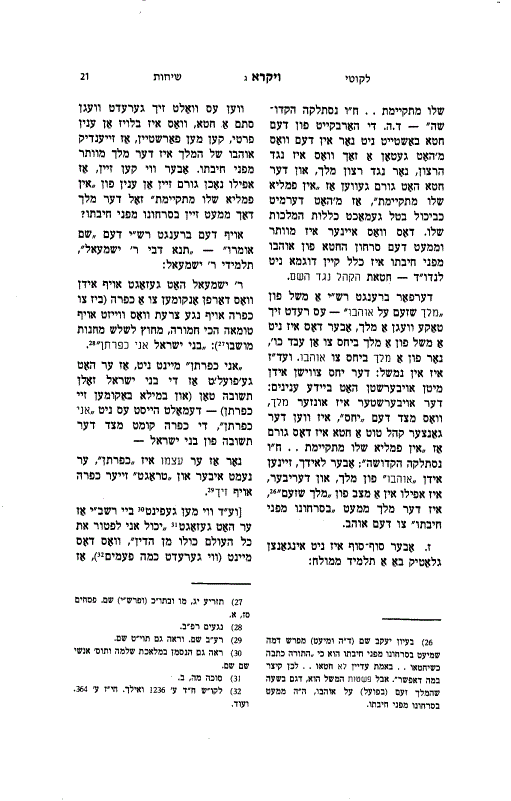
We have already discussed many times the rule in Rashi’s commentary on the Torah: generally, Rashi does not cite the source of his explanation. He does not usually say, “Rabbi so-and-so said,” or “our Rabbis taught,” or “this comes from the Gemara” or “from Midrash.” Rather, Rashi simply gives the explanation itself. That is his normal style.
From this it is evident that when Rashi does mention the name of the author, this is not incidental. It is part of the explanation. If Rashi usually omits the source, then when he includes it, that must mean the source itself adds something to the understanding of the pasuk.
Someone might argue that perhaps sometimes Rashi simply does cite a source. But the Rebbe says that since this is not Rashi’s style, the exception must have a reason. And our parsha gives a particularly clear example of this.
In our parsha, on the topic of the Par He’elam Davar Shel Tzibbur, the Gemara brings two statements in the name of Tanna d’Vei Rabbi Yishmael, one after the other, addressing two differences between the pesukim of the Par Kohen HaMashiach and the Par He’elam Davar Shel Tzibbur.
The first issue concerns the yoseres and the shtei klayos. By the bull of the Kohen HaMashiach, the Torah explicitly states that together with the fats, the yoseres and the two kidneys are also brought on the Mizbe’ach. But by the Par He’elam Davar Shel Tzibbur, the Torah does not spell that out.
The Gemara explains this with a mashal from Tanna d’Vei Rabbi Yishmael: it is comparable to a king of flesh and blood who became angry at someone he loves. Because he loves him, he minimizes the exposure of his fault. So too here: although the community does in fact bring those same parts, the Torah does not want to spell out their disgrace.
The second issue concerns the expression “Paroches HaKodesh.” By the Kohen HaMashiach, when the Torah speaks of sprinkling the blood, it refers to the curtain as “Paroches HaKodesh.” But by the Par He’elam Davar Shel Tzibbur, it says only “Paroches”, without the word “HaKodesh.”
Again, the Gemara explains with a mashal. If only an individual or minority sinned, the king’s entourage and glory remain intact. But if the whole country sinned, then his royal presence is not sustained in the same way. So too here: when the community sins, the pasuk does not say “Paroches HaKodesh.”
Beis
Now let us see how Rashi handles these two points.
Rashi comments on both of them, but there is a striking difference. On the earlier pasuk, where the Torah says “el p’nei ha-paroches” and omits “HaKodesh,” Rashi gives the explanation, but he does not mention the source. He does not say that it comes from Tanna d’Vei Rabbi Yishmael.
However, on the later pasuk, “v’es kol chelbo yarim,” where the Torah mentions only the fats and omits the explicit mention of the yoseres and klayos, Rashi does bring the source and says: “Tanna d’Vei Rabbi Yishmael.”
This is the first major point of the sicha. If it were arbitrary, Rashi should have behaved consistently. If anything, had the order been reversed, one might have suggested that once Rashi named the source the first time, he did not need to repeat it the second time. But here the opposite happens: first he omits the source, and only later he mentions it.
That shows clearly that mentioning the source in the second Rashi is itself significant. It adds to the understanding of the pasuk.
So before even entering the details of the Rashi, the Rebbe has already established one point: whenever Rashi cites the source, it has meaning. Here too, when Rashi says Tanna d’Vei Rabbi Yishmael, that is part of the explanation.
The question now becomes: what does that add?
Gimel
Now we turn to the Rashi itself.
Rashi is commenting on the pasuk “v’es kol chelbo yarim.” This is the second Rashi. The first Rashi explained why the Torah does not say “Paroches HaKodesh.” Here Rashi addresses the fact that by the Par He’elam Davar Shel Tzibbur, the Torah mentions only the fats and does not explicitly mention the yoseres and the kidneys.
Rashi says: even though the pasuk here does not specify the yoseres and the shtei klayos, we know that they are included, because the next pasuk says “v’asah la-par ka’asher asah”—that one does to this bull as was done to the previous bull. Since by the Par Kohen HaMashiach the Torah explicitly says that the yoseres and kidneys are brought, we learn that here too they are brought.
So if that is the case, asks Rashi, why does the Torah not spell it out here?
Rashi answers: “Tanna d’Vei Rabbi Yishmael: mashal l’melech sheza’am al ohavo u-mi’et b’sirchono mipnei chibaso.” It is comparable to a king who became angry at someone he loves, and because of his love he minimizes the exposure of the fault.
In other words, the Torah is not saying that fewer things are brought. Rather, the Torah chooses not to articulate all the details, in order not to highlight the failure of the community.
Daled
The Rebbe now raises several questions.
First: what is the question altogether? Why does Rashi ask, “u’mipnei mah lo nisparesh bo?” Why was it not specified here? We find many times in Torah that when two cases share the same halachah, the Torah spells out the details once and then later says briefly that the second case follows the first. Why should the Torah have to repeat every פרט every time?
Especially here, where the Torah itself immediately says “v’asah la-par ka’asher asah.” If so, why is there any question why the Torah did not explicitly mention the yoseres and klayos a second time?
Second: if the only reason we know they are included is because of the next pasuk, then why is Rashi explaining the matter here already? At this point in the pesukim, one could still have thought that perhaps here they are not brought at all. Only when the next pasuk says “v’asah la-par ka’asher asah” do we know that they are indeed included. So why not wait until there?
Third: Rashi later, on the next pasuk, explains again that “ka’asher asah” means that the same things brought there are brought here as well. So why does Rashi already introduce that point here, and then repeat it later? Why does he split the explanation between two places?
These questions show that something deeper is happening in the structure of Rashi.
Hei
The Rebbe then asks further questions on Rashi’s wording.
Why does Rashi use the mashal of a king? The idea that a person who loves another will minimize that person’s disgrace is not limited to a king. It could apply between any two people. So why specifically a king?
You cannot simply answer that this is the language of Chazal, because Rashi does not quote Chazal verbatim unless that wording is needed for peshuto shel mikra. If the detail of a king were unnecessary, Rashi would have omitted it. That means it must be adding something.
Also, in his commentary on the Gemara, Rashi explains “mi’et b’sirchono” to mean that he shortened his words and did not elaborate. But here in Rashi on Torah, that explanation is not given. Why not? What exactly does “mi’et b’sirchono” mean here?
Vov
The Rebbe explains that this Rashi is a direct continuation of the previous Rashi.
In the previous Rashi, on “el p’nei ha-paroches,” Rashi explained that when the pasuk omits the word “HaKodesh,” this shows that the sin of the Par He’elam Davar Shel Tzibbur is more severe than that of the Kohen HaMashiach. The communal sin causes a greater blemish—“ein pamalya shelo miskayemes.” The word “HaKodesh” falls away.
Once Rashi has told us that, the next pasuk immediately becomes difficult. If the communal sin is more severe, then why does the Torah seem to describe its korban in a less elaborate way? Why are the yoseres and klayos not explicitly mentioned?
Had we not had the previous Rashi, we might have assumed the opposite. Since the community acted based on the mistaken ruling of Beis Din, perhaps their guilt is less direct than that of the Kohen HaMashiach, who himself erred. If so, perhaps their korban is also less severe, and that would explain the omission.
But once Rashi has already taught us that the communal sin is actually more severe—to the extent that the pasuk omits “HaKodesh”—we can no longer say that the korban is lighter. Therefore the omission of the yoseres and klayos immediately becomes a question.
That is why Rashi comments here already. The question is created not by this pasuk alone, but by this pasuk as read in light of the previous Rashi.
Zayin
That also explains why Rashi first tells us that the yoseres and klayos are indeed brought here as well, based on the next pasuk. Rashi is making sure we do not draw the wrong conclusion.
Without that clarification, one might have assumed that since the pasuk does not mention them, they are not brought. But that cannot be, because from “v’asah la-par ka’asher asah” we know that they are brought.
So the question is not whether they are brought. The question is: if they are brought, why are they not spelled out?
But then another question follows. If the Torah wanted simply to be brief, it could have omitted everything here and written only “v’asah la-par ka’asher asah.” And if it wanted to give details here, then why mention the fats and omit the kidneys and the yoseres?
This is why Rashi brings the mashal.
The Torah is not merely being brief. Nor is it saying that the communal korban is lighter. Rather, because of Hashem’s love for the Jewish people, the Torah deliberately minimizes the outward exposure of their fault. The korban is the same, but the Torah does not articulate all the details.
This is the meaning of “mi’et b’sirchono.”
And this also explains why Rashi here does not define it the way he does in Shas. If the point were merely that the Torah used fewer words, then it should have omitted even the fats and relied entirely on the next pasuk. Rather, here the point is not brevity of wording, but reduction of exposure. Hashem does not want the disgrace to be expressed in full.
The sin is still serious. The atonement is still complete. But the Torah presents it in a softened way, because of Hashem’s love.
Ches
Now we can understand why the mashal specifically has to be from a king.
A mashal from two ordinary friends would not fit the case. Here we are speaking about a communal sin against Hashem, a sin so serious that, as the previous Rashi explained, it affects the very standing of the pamalya, so to speak. This is not just a personal offense. It is a sin against the King.
Therefore the mashal must also involve a king.
At the same time, the mashal is not of a king and an ordinary servant, but of a king and one whom he loves. That is also essential. Because in the nimshal, both dimensions are true. Hashem is the King, and therefore the sin has tremendous gravity. But the Jewish people are also His beloved, and therefore even when He is angry, He still minimizes the outward expression of their fault.
A mashal from ordinary friendship would capture the love, but not the gravity. A mashal from a king alone would capture the gravity, but not the intimacy. The mashal of a king angry at one he loves captures both.
Tes
Now the Rebbe returns to the opening question: why does Rashi specifically say “Tanna d’Vei Rabbi Yishmael” here?
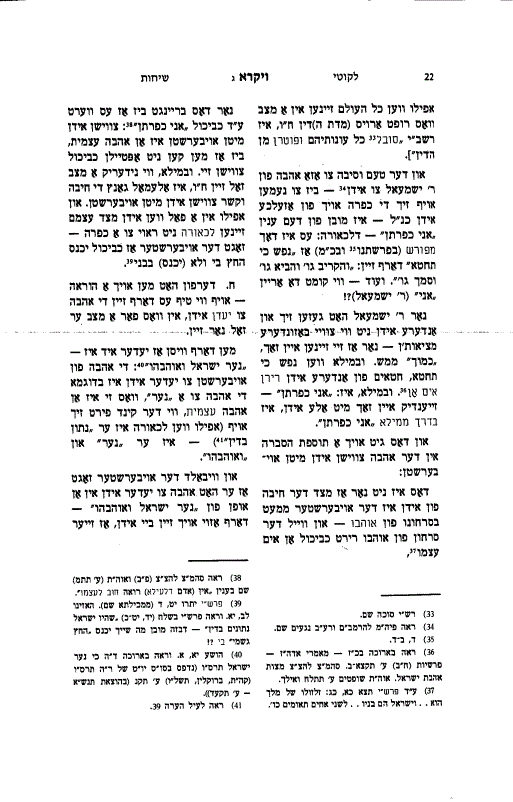
The answer is that a sharp student may still be bothered. It is understandable that love can soften the expression of a personal failing. But here we are speaking about something much more severe—something that causes “ein pamalya shelo miskayemes.” How can love go so far as to soften even that?
That is why Rashi mentions the source.
Rabbi Yishmael is associated with the remarkable statement regarding the Jewish people: “Bnei Yisrael, ani kaparasan”—I am their atonement. This does not merely mean that he teaches them how to repent. It means that his bond with them is so deep that he can identify with them and say, “I myself am their kaparah.”
Similarly, Rabbi Shimon bar Yochai says, “Yachol ani liftor es kol ha’olam kulo min ha-din.” He can exempt the entire world from judgment. That means that even where the world stands in a condition deserving judgment, there is a level of identification and love that can shield them.
This is the significance of Tanna d’Vei Rabbi Yishmael. Rabbi Yishmael represents a mode of love and unity with the Jewish people that is so essential that their shortcomings are not external to him. They touch him himself.
So when Rashi says this teaching comes from Tanna d’Vei Rabbi Yishmael, that is not merely a citation. It adds to the explanation. It tells us what kind of relationship we are dealing with: not just affection, but essential oneness.
Hashem’s love for the Jewish people is so intrinsic that even when their state is low, the bond remains whole. Even when they are not fitting מצד עצמם for forgiveness, Hashem still protects them.
That is what the source adds to peshat.
Yud
From all this comes a practical lesson.
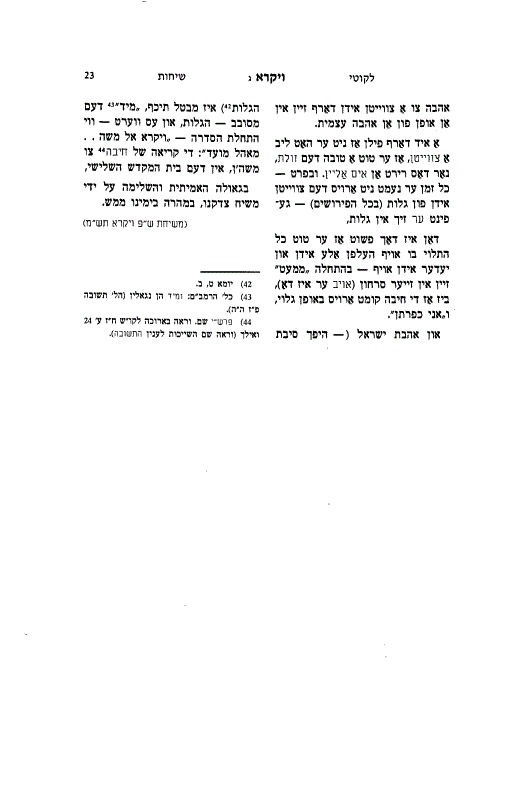
A Jew must know how deep אהבת ישראל has to be. No matter what condition another Jew is in, Hashem says, “Ki na’ar Yisrael va’ohaveihu.” The Jewish people are loved like a child. This is an essential love, not one dependent on conduct.
And since this is how Hashem loves every Jew, this is how a Jew must love another Jew. It should not feel as though one is merely doing a favor for someone else. Another Jew’s state should touch him personally.
As long as another Jew remains in exile—in whatever sense—then one’s own avodah is still incomplete as well. If one truly feels that connection, he will do whatever he can to help another Jew, and to reduce any sirchon, any outward blemish or disgrace, rather than expose it.
This is the model of Rabbi Yishmael: “Ani kaparasan.”
And since אהבת ישראל is the opposite of the cause of galus, it also negates the result of galus and brings the Geulah.
This connects to the opening of the sedra, “Vayikra”—a call of love. And may we merit the true and complete Geulah through Mashiach, speedily in our days.