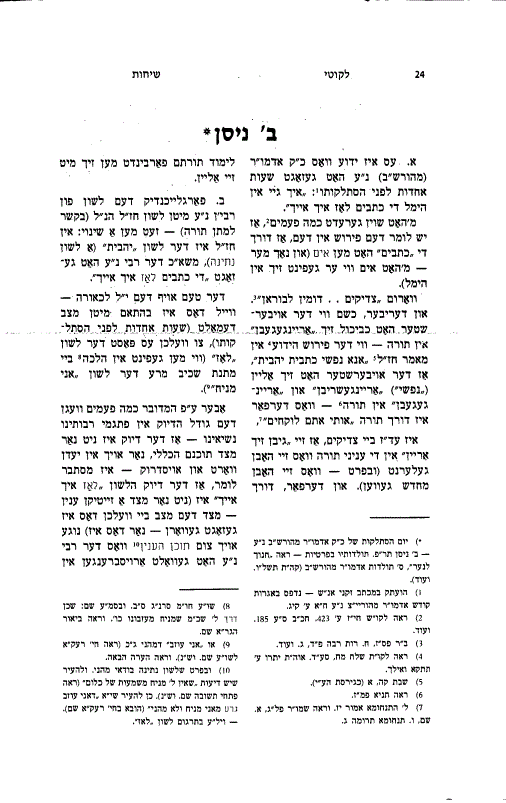
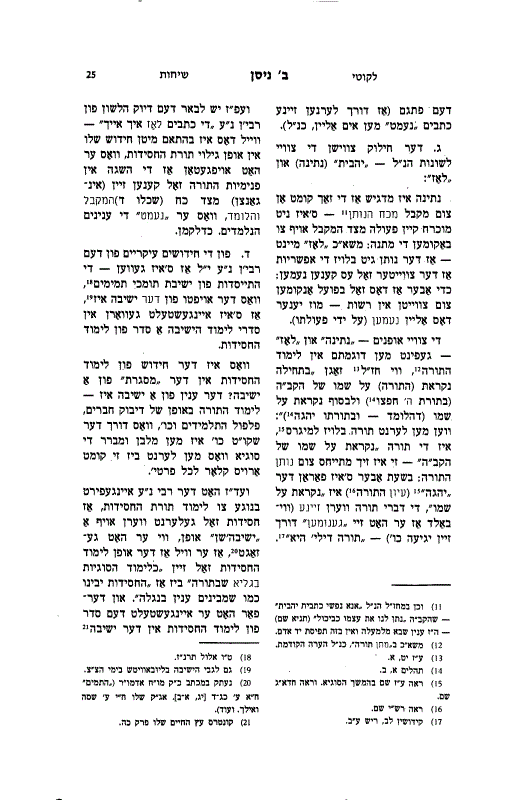
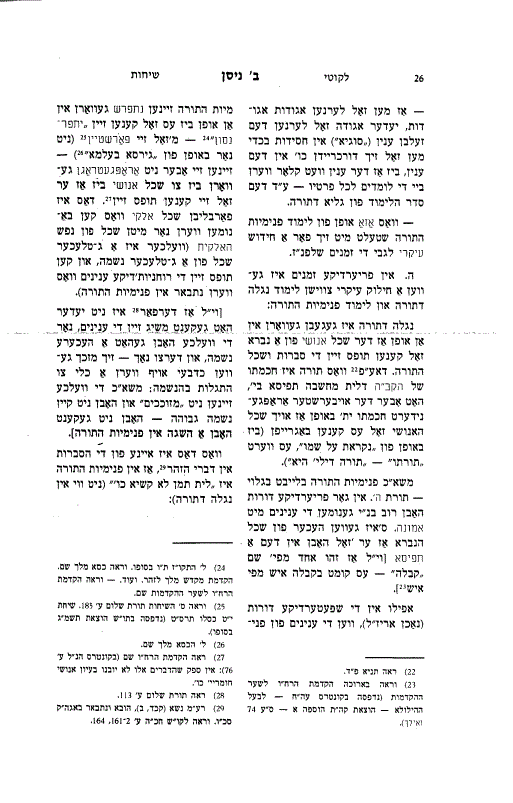
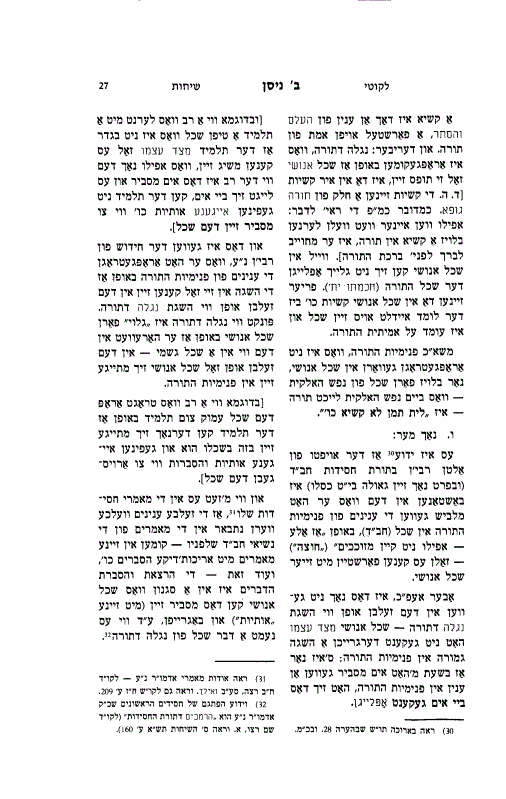
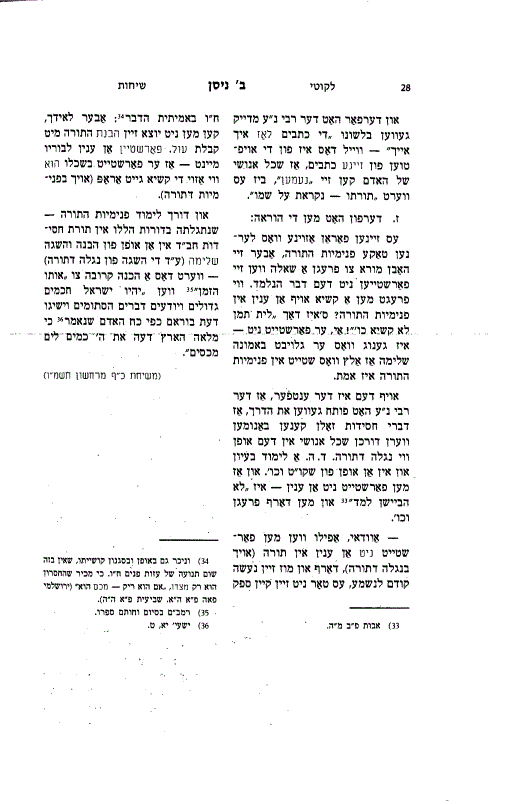
We will review the sicha in Likkutei Sichos, Chelek Chof-Zayin, Volume 27, for Beis Nissan.
As noted in the heading of the sicha, Beis Nissan is the day of the histalkus of the Rebbe Rashab, nishmaso Eden, in the year תר"ף. For a fuller biography, the Rebbe refers to Chanoch LaNa’ar and Sefer Toldos Admor Rashab.
In this sicha, the Rebbe explains the unique accomplishment and innovation of the Rebbe Rashab in the study of Chassidus.
The Rebbe Rashab established that Chassidus should be learned in the same serious and analytical manner that we are accustomed to in the study of Nigleh in yeshivah: with a chavrusa, with discussion and debate, with questions, and with a demand for real understanding.
The Rebbe traces the historical development. In the earliest stages, people did not study or understand the inner part of Torah in an intellectual way at all. Later, it became somewhat more accessible. Then it became more developed. But the true breakthrough came with the Rebbe Rashab, who brought Chassidus down in such a way that it could be learned with the same type of rigorous comprehension with which one learns Nigleh.
The Rebbe explains the well-known statement of the Rebbe Rashab shortly before his passing, when he said:
“Ich gey in himmel, un di ksovim loz ich aych.”
“I am going to heaven, and the writings I am leaving to you.”
The Rebbe explains that this was not just a practical statement—“I am leaving, and you will have the writings.” On the contrary, the meaning is that through the ksovim you continue to have the Rebbe himself. Even though he is going to heaven, you are still able to connect to him through his writings.
Not only do you have him through the ksovim, but you have him as he is in heaven. Through the writings, you are connected to the Rebbe on the level where he now stands.
This is based on the principle that “tzaddikim domim l’bor’am”—tzaddikim are comparable, in a certain sense, to their Creator.
Just as we say with regard to Hashem that He, כביכול, put Himself into the Torah—“Anochi, Ana Nafshi Ksovis Yehovis”—so too, tzaddikim invest themselves into their Torah teachings. Therefore, when one studies the Torah of a tzaddik, one connects not only to his teachings, but to the tzaddik himself.
So too here: through learning the writings of the Rebbe Rashab, one binds himself to the Rebbe himself.
However, the Rebbe points out an important difference in language.
By Matan Torah, Chazal use the language of “Yehovis”—“I have given.” Hashem says, as it were, “I have written Myself into the Torah and given it to you.”
But the Rebbe Rashab did not say, “I am giving you the ksovim.” He said, “I am leaving you the ksovim.”
At first glance, one might explain simply that this is the style appropriate to someone speaking shortly before passing away. In halachah too, when a person gives instructions before passing, one finds the language of leaving behind.
But the Rebbe explains that every expression of our Rabbeim is precise. Therefore, this wording is not merely incidental. The fact that the Rebbe Rashab said “I am leaving” rather than “I am giving” is itself part of the message.
This brings us to the key distinction between these two expressions.
Aleph
When something is given, that emphasizes that it reaches the recipient through the power of the giver. The giver gives, and the receiver receives.
But when something is left behind, that means the giver has made it available, but the recipient must now take it. The possibility is there, but the recipient must act and acquire it for himself.
The Rebbe connects this to the verse:
“B’Soras Hashem cheftzo… u’v’soraso yehgeh yomam valaylah.”
At first, it is called Hashem’s Torah. But after a person toils in Torah and truly grasps it, it becomes called his Torah.
That is the difference between something merely being presented to you and something becoming truly yours. At first, the Torah belongs to Hashem; through effort and deep study, it becomes Torah d’lei—the learner’s Torah.
So too with the wording of the Rebbe Rashab.
He said, “I am leaving you the ksovim.” That means: I have made them available to you, but now you must take them. You must work on them, toil in them, internalize them, and make them yours.
And this is exactly the novelty of the Rebbe Rashab: that Chassidus should not remain something merely accepted from above, but should become something grasped, digested, and fully acquired by the human intellect of the student.
Beis
The Rebbe explains that one of the great innovations of the Rebbe Rashab was the founding of Yeshivas Tomchei Tmimim.
What was the great novelty of this yeshivah?
Not merely that it was another yeshivah, but that Chassidus became part of the structured order of learning in a yeshivah framework.
A yeshivah means that students learn in an organized way, often on the same subject, with give-and-take, discussion, questioning, analysis, and explanation. Students clarify a sugya together until it becomes clear in all its details.
That style of לימוד had always existed in the study of Nigleh.
The Rebbe Rashab’s breakthrough was that he wanted Chassidus to be learned in exactly that manner.
He wanted students to learn Chassidus in a yeshivishe way—with chavrusas, group learning, discussion, probing questions, and a demand that the ideas become intellectually clear.
The Rebbe Rashab said that he wanted the students to understand Chassidus just as they understand an ענין in Nigleh.
This was revolutionary.
Gimel
The Rebbe then explains the historical progression.
In earlier generations, there was a major difference between the study of Nigleh and the study of Pnimiyus HaTorah.
The revealed part of Torah was given in a way that human intellect could grasp it. Although Torah is the wisdom of Hashem, Hashem brought His wisdom down into a form that the human mind could engage with. To such an extent, it can become “his Torah.”
But the inner part of Torah was different.
Originally, people approached it primarily through Emunah and Kabbalah—receiving it as a tradition, not fully grasping it intellectually.
This itself explains one meaning of the word Kabbalah: it is something received, not something independently comprehended.
Later, especially from the time of the Arizal, the inner part of Torah became more revealed and accessible. It was no longer only a matter of mystical tradition beyond comprehension. It became something that could nourish a person, something that could be partially understood.
But even then, it had still not descended to the level where ordinary human intellect could fully grasp it.
It remained primarily G‑dly wisdom, apprehended through the sensitivity of the G‑dly soul, not yet fully processed in the ordinary human mode of reasoning.
The Rebbe notes that even after the revelation of the Arizal, this understanding was not for everyone. Only individuals with especially refined souls and proper preparation could really grasp these matters.
This is also related to the teaching of the Zohar that in the inner part of Torah, there are no kushyos, no questions.
Why not?
Because a question implies an obstacle, a blockage, a point where the human mind cannot yet align with the truth.
In Nigleh, which descends into the realm of human intellect, questions are natural and necessary. The human mind encounters difficulty, asks, challenges, and eventually reaches clarity. That process is itself Torah.
Indeed, even if one is learning only a question in Torah, one still recites Birchas HaTorah, because the question itself is part of Torah.
But the inner Torah, in its earlier forms of revelation, remained above the ordinary human framework where questions arise.
It was shining truth, grasped by the Neshama, rather than struggled through by the ordinary human intellect.
Daled
The Rebbe then explains the innovation of the Alter Rebbe.
The Alter Rebbe, especially through Chabad Chassidus, revealed the inner Torah in a way that it could be clothed in Chochmah, Binah, and Daas—in human intellectual faculties.
This was a tremendous revolution.
Yet even then, says the Rebbe, it was still not fully comparable to Nigleh.
A person could understand Chassidus when it was explained to him, but not necessarily generate or reconstruct the explanation on his own in the full way that one does in Nigleh.
The Rebbe gives the example of a teacher explaining a very profound concept to a student. Once the teacher explains it well, the student understands it. But the student may still be unable to rephrase it in his own words, expand it, or explain it independently. He understands it as received, but it has not yet fully become his own.
This was still different from the study of Nigleh, where the learner wrestles with the material, develops his own formulations, asks questions, resolves them, and makes the Torah his own.
Hei
This is the special novelty of the Rebbe Rashab.
The Rebbe Rashab brought the teachings of Chassidus down in such a way that they could be studied with the same depth of personal intellectual acquisition as Nigleh.
Not only that one could understand Chassidus when taught, but that one could work through it, analyze it, question it, discuss it, and arrive at clarity through one’s own effort.
This is why the maamorim of the Rebbe Rashab are characterized by such extensive, detailed, carefully structured explanation.
The same concepts that existed earlier are unpacked with length, precision, and intellectual development so that the human intellect itself can grasp them.
That is why he said:
“The writings I am leaving you.”
He did not say, “I am giving them to you,” because his whole innovation was that the student must now take them.
He opened the path, set the material before us, and left it for us—but we must toil in it until it becomes our own.
That is the meaning of “loz ich aych.”
Vov
From this comes a practical lesson.
There are those who study the inner part of Torah and are afraid to ask a question when they do not understand. They think that since this is Pnimiyus HaTorah, they must simply accept it with faith, and perhaps it is improper to ask.
But the Rebbe says that after the path opened by the Rebbe Rashab, this is not the correct approach.
One must study Chassidus the way one studies Nigleh—with seriousness, effort, questions, answers, and genuine striving for understanding.
Of course, this does not mean that if one does not understand, one doubts the truth of what is written. Heaven forbid. The truth of Torah is absolute.
Just as in Nigleh, a person may not yet understand and still knows the Torah is true, so too in Chassidus.
But at the same time, one cannot say that faith alone fulfills the obligation of learning.
To truly learn means to understand—to clarify until the intellect sees how the matter is resolved.
Therefore, one must not be embarrassed to ask.
As the Mishnah teaches:
“A bashful person cannot learn.”
If one does not understand Chassidus, one should ask, probe, discuss, and continue learning until the matter becomes clear.
This too is part of the Rebbe Rashab’s legacy.
Zayin
The Rebbe concludes that learning the inner part of Torah in this way is a preparation for the future redemption.
In the days of Moshiach, the Jewish people will be great sages who will know hidden matters and understand the wisdom of their Creator to the fullest extent possible for human beings.
As the Rambam writes:
“For the earth shall be filled with the knowledge of Hashem as the waters cover the sea.”
The way to prepare for that future is to learn Pnimiyus HaTorah now in a way of real grasp and understanding.
And that is the great accomplishment of the Rebbe Rashab: he made it possible for Chassidus to be learned not only with faith and reverence, but with the full force of the human intellect—until it becomes truly Toraso.
Summary / Takeaway Points
• Through a tzaddik’s Torah, one connects to the tzaddik himself.
• “I leave you the ksovim” means the writings must be taken through personal effort.
• Giving and leaving are different: leaving requires the recipient to acquire it.
• The Rebbe Rashab’s great innovation was learning Chassidus in a yeshivah style.
• Chassidus should be learned with chavrusa, questions, discussion, and depth.
• Earlier Pnimiyus HaTorah was primarily received through Emunah/Kabbalah.
• The Alter Rebbe made Chassidus intellectually accessible; the Rebbe Rashab brought it further, like Nigleh.
• One should not be embarrassed to ask questions in Chassidus.
• Learning Chassidus with full understanding prepares the world for “umalah ha’aretz de’ah es Hashem.”