Introduction
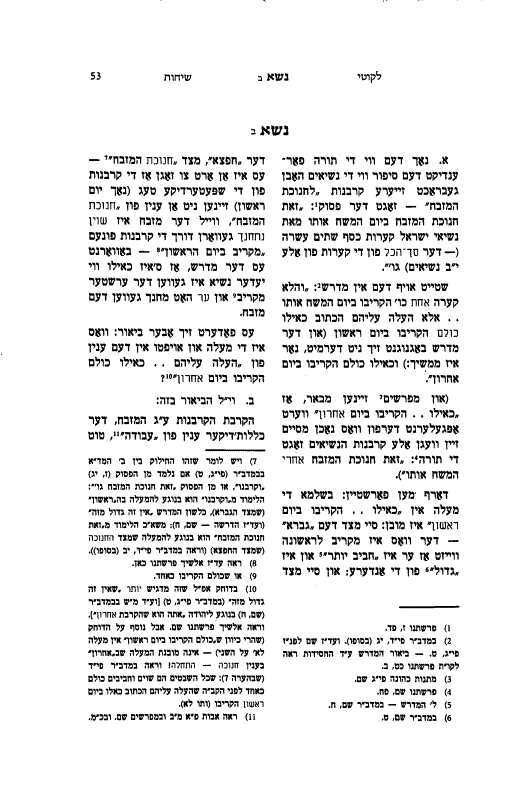
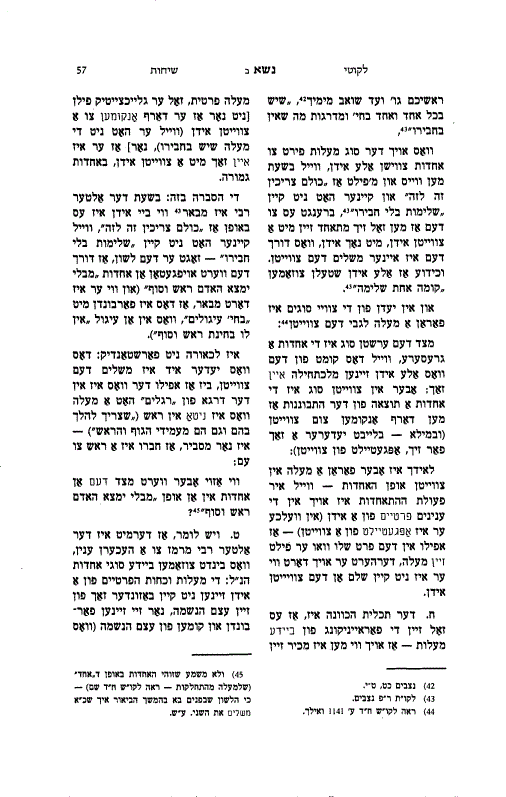
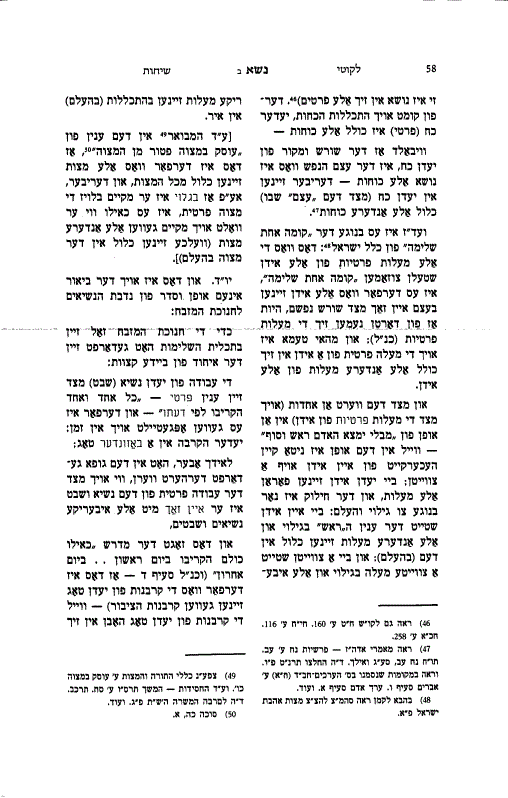
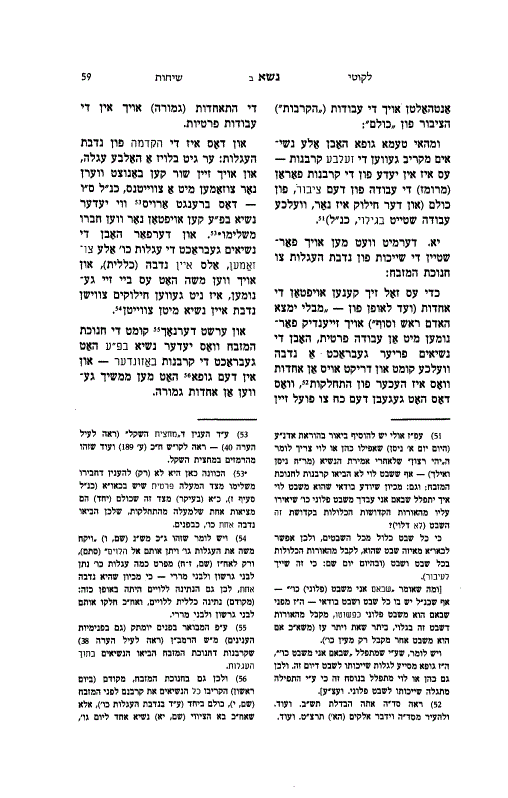
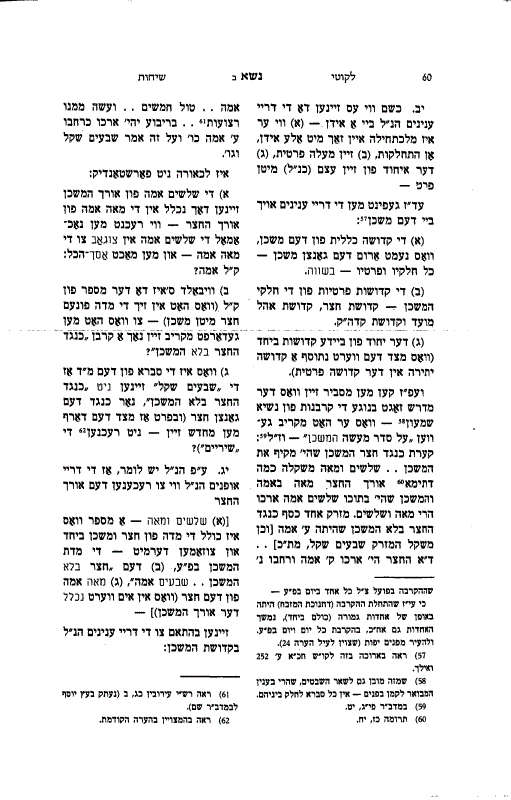
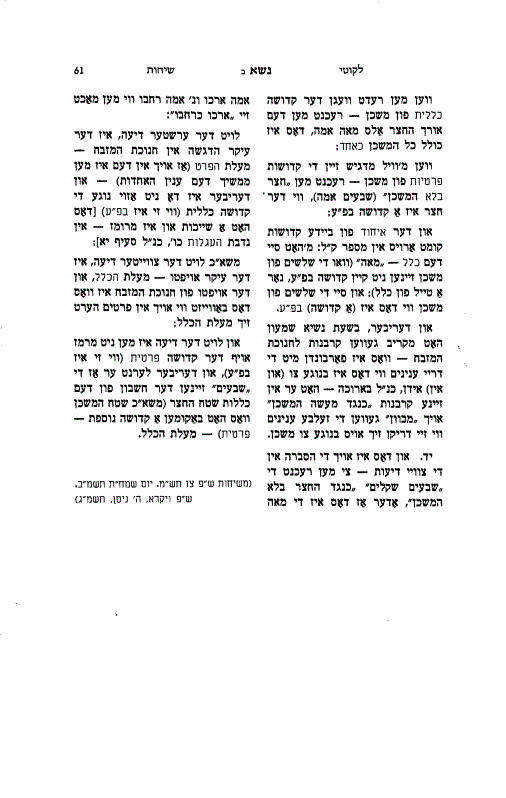
In this review, we will study a sicha from Likkutei Sichos, Chelek Cיhof Gimmel (volume 23), the second sicha on Parshas Naso. In this sicha, the Rebbe analyzes a midrash which teaches that it is as if all the leaders who brought offerings during the twelve days of the inauguration of the altar—each nasi on his respective day—had all brought their offerings together on the first day and again on the last day.
The Rebbe explores what is unique about the last day. Why does the midrash consider it as though all of them brought their offerings on that final day? He delves into a detailed explanation about these special offerings: although each was technically an individual offering, they also had a communal aspect.
This dual nature is significant. The offerings were personal to each tribe and leader, yet at the same time, they represented all of Israel collectively. The Rebbe points out that this communal element was so strong that these offerings even overrode Shabbos when necessary—for example, when a nasi’s turn to bring his korban fell on Shabbos.
The Rebbe uses this discussion to highlight a broader theme: the unity between different levels among Jews. On one hand, every Jew comes from one source; on the other hand, each person has unique qualities and strengths. Both aspects are essential—we need each other’s individual greatnesses, but we are also fundamentally united as one people.
Throughout this sicha, the Rebbe will explain how these two dimensions—the individual and the communal—are both present in these offerings and how they come together in harmony. He will guide us step by step through this idea.
After describing how each tribal leader brought his offering for the dedication of the altar (chanukas hamizbeach), the Torah summarizes with a verse stating that these were the offerings brought by the leaders of Israel on the day that they anointed and inaugurated the altar. The verse then counts twelve plates in total—one for each tribe—brought over twelve days.
Saif Aleph
The Torah describes the dedication of the Mizbeach by listing the totals of all the gifts brought by the twelve Nesiim. It states, “And this was the dedication of the Mizbeach,” summarizing all the offerings: twelve plates, and so on. However, the verse also says, “on the day that it was anointed.” The anointing took place on Rosh Chodesh Nisan—the first day—while the dedication through the princes’ offerings spanned twelve days, from Rosh Chodesh Nisan through the twelfth of Nisan.
This raises a question: Why does the Torah refer to “the dedication of the Mizbeach on the day it was anointed,” when only one offering was brought on that first day? There were not yet twelve plates; only one prince brought his gift on Rosh Chodesh Nisan. The Medrash addresses this issue, noting that on Rosh Chodesh Nisan there was only one plate from one Nasi. How can it be described as if all twelve participated on that day?
The Medrash answers that even though the offerings were actually brought over twelve days, the Torah considers it as if all of them had already brought their gifts on that very first day. In other words, “on the day he was anointed”—Rosh Chodesh Nisan—it is counted as if there were already twelve plates, as if all princes had participated together. The verse counts it for them as if they all brought their sacrifices at once.
But the Medrash goes further. It adds that not only is it considered as if they all brought their offerings on the first day, but also as if they all brought them on the last day. The Medrash is not satisfied with just saying it’s as if they all participated at the beginning; it continues and says it’s also as if they all participated at the end.
Where do we see this idea about the last day? The Rebbe brings down from various Meforshim who explain that after listing all of the sacrifices of the princes, the Torah again states, “this was the Chanukas HaMizbeach after its anointment.” At this point, all of their offerings have been completed—none are left to bring—and yet, after everything is finished, it still refers to this as “the dedication of the Mizbeach.” This implies that it is considered as if they all brought their offerings together even on that final twelfth day.
The Rebbe now asks: What is gained by saying it’s as if they all brought their korbanos on the last day? With regard to bringing them on the first day, we can understand there’s a special advantage—everyone participated at once in dedicating something new. If only one prince had gone first, he would seem more beloved or important than those who followed. By considering everyone as having offered together at first opportunity, we emphasize their equal status and importance.
There’s also an advantage regarding what is being dedicated: If only one offering came first, perhaps only that sacrifice truly dedicated the Mizbeach; those who followed would merely be continuing what had already been accomplished. By saying everyone’s offering counts as a first-day dedication, we show each prince’s korban played a full role in inaugurating the altar.
But what about counting them all as having offered together on the last day? What unique accomplishment or advantage does this provide? Why does the Medrash insist not just on unity at the beginning but also at completion?
The Rebbe explains that each prince’s korban expressed a unique aspect of service to Hashem—each tribe contributed something distinct through its offering. Therefore, when was the Mizbeach truly and fully dedicated? Only after every single tribe had participated and every unique contribution had been made could we say that its dedication was complete.
Saif Beis
The dedication of the Mizbeach was not just for one tribe or one leader, but for all of Klal Yisrael. Even the last Nasi, on the final day, was dedicating it on behalf of his tribe and for the collective. The idea is that all the Nesi’im had a share in the complete dedication, because by the end, the Mizbeach was dedicated for all twelve tribes.
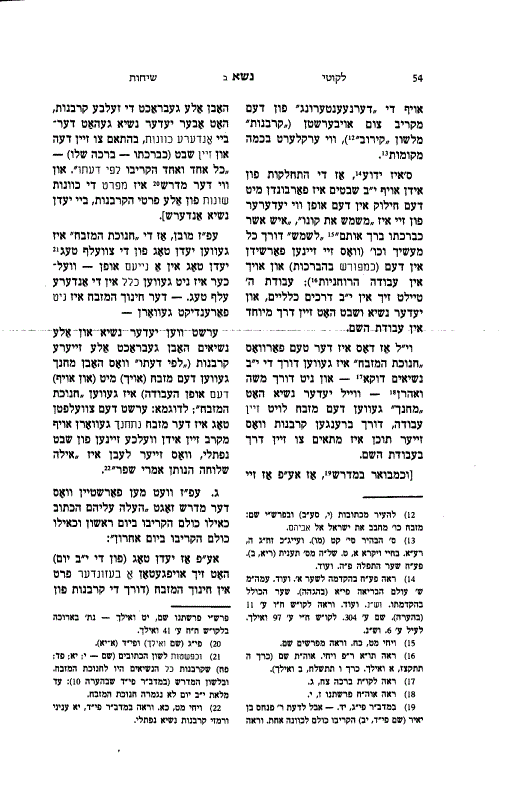
We can explain this further: When offerings are brought on the Mizbeach, this represents the general service—avodah—of Hashem through korbanos. The act of bringing a korban accomplishes closeness between the one offering and Hashem. The word korban itself comes from “kiruv”—closeness—as explained in many places.
It is well known that the division of Bnei Yisrael into twelve tribes is connected to differences in how each tribe serves Hashem. As Yaakov blessed each of his sons, every tribe received its own unique blessing and mission. This means each tribe has its own path and style in serving Hashem.
The service of Hashem is divided into twelve general pathways. Each leader and each tribe has a unique approach to avodas Hashem. This helps us understand why it was specifically through the twelve Nesi’im—the leaders of each tribe—that the dedication of the Mizbeach took place, rather than through Moshe or Aharon alone.
Each Nasi dedicated the Mizbeach according to his own way of serving Hashem. By bringing their specific offerings, each leader expressed his individual path in avodah. It was necessary for every Nasi to participate so that all these different approaches would be represented; it would not have been enough for Moshe or Aharon to do it on behalf of everyone.
This raises a question: If every Nasi brought exactly the same offering, what difference did their individuality make? If they had brought different items, we could say each one’s unique contribution was obvious—but here they all brought identical korbanos.
The answer is found in the Midrash: Although they all brought physically identical offerings, each Nasi had different intentions and meanings behind his korban. Each leader’s thoughts and kavanos reflected his own perspective and that of his tribe—his unique blessing and mission. The Midrash even details how each aspect of their offerings corresponded to something particular about their shevet.
So while externally their korbanos were identical, internally—spiritually—they were entirely different. Each Nasi’s intention infused his offering with a distinct meaning tied to his shevet’s role in avodas Hashem.
This explains why every day of those twelve days represented a new stage in dedicating the Mizbeach. Each day introduced a new path—a new style—of service as expressed by that day’s Nasi. Until all twelve had participated, the dedication was incomplete; only when every leader had brought his korban with his unique intent did the full Hanukkas HaMizbeach take place.
For example, on the twelfth day, when Naftali’s leader brought his offering, only then was the Mizbeach dedicated according to Naftali’s particular approach—his “swiftness like an ayal” (deer), as described in Yaakov’s blessings and hinted at in both pesukim and Midrashim about Naftali’s korban.
This means that something new was added with each day’s offering; only on day twelve did every possible style and path become included in the dedication. That is why we say Hallel on these days—because with each new contribution, there is a new reason for praise.
This also clarifies what the Midrash says: The Torah counts it as if all Nesi’im brought their offerings both on the first day and on the last day. Even though every day accomplished something unique in dedicating the Mizbeach through that day's leader's korban, there is still a special advantage to both first and last days.
The first day marked not only the beginning but also established a general status—the existence of a dedicated Mizbeach—even though it was specifically Yehudah who brought then. The main point is that from that moment onward there existed a Mizbeach set aside for holy service; this foundational step belonged to Yehudah but benefited everyone.
Saif Gimmel
There is a unique advantage to the dedication of the altar that took place on the last day, when the tribe of Naftali brought their offering. With this final act, the dedication of the Mizbeach was completed for all of Israel in a tangible way. Although each tribe brought its own offering on its designated day, it was only after the twelfth day—after Naftali’s contribution—that the dedication became a reality for all Jews as a collective.
This is what the Midrash means when it says that it is considered as if all of Israel brought their offerings both on the first and on the last day. Every nasi—the leader of each tribe—not only accomplished something specific with his own korban, representing his shevet, but also participated in both the initial and final stages of the general dedication. Each nasi thus shares in both aspects: it is as if he took part in the beginning (the first day) and in the completion (the last day) of the Mizbeach’s dedication.
The meforshim explain that since Torah—Torah emes—states that it is “as if they all offered on the first and last days,” this reflects a deeper truth: every nasi truly contains within himself a portion of all, participating in both advantages—the beginning and completion. This is why Torah attributes to each nasi both qualities: being part of the opening and part of the culmination.
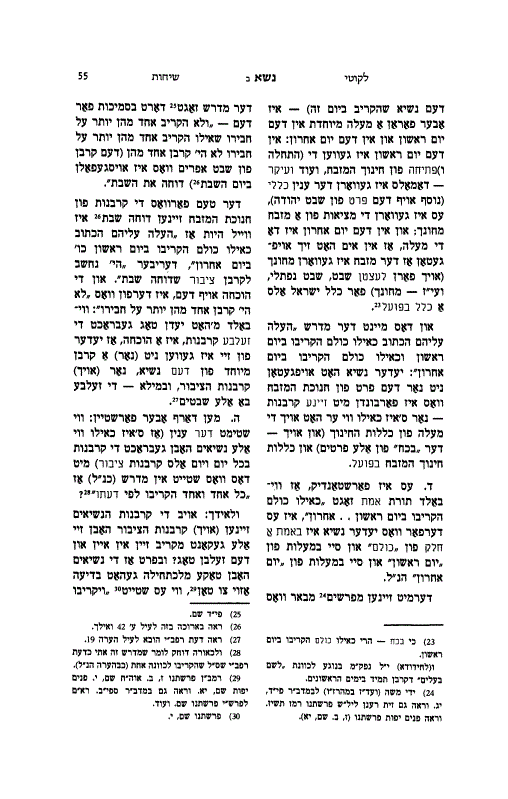
The commentators further clarify what the Midrash says nearby: “No one among them brought more than his fellow.” The Midrash explains that had even one nasi brought more than another, then his korban would not have overridden Shabbos. Specifically, regarding Shevet Ephraim—whose offering fell out on Shabbos—their korban would not have been permitted to override Shabbos if it were considered an individual offering (korban yachid). Only communal offerings (korban tzibbur) can override Shabbos.
Therefore, since all their offerings are counted as if they were brought together—on both the first and last days—they are considered communal sacrifices. This status allows them to override Shabbos, as was necessary for Shevet Ephraim’s korban.
The proof for this communal status lies in the fact that none of them brought more than another; every day saw identical offerings. If these were personal sacrifices, there would have been differences between them. Their uniformity demonstrates their communal nature.
This perspective means that each tribe’s sacrifice is attributed not only to its individual nasi but also to all twelve tribes collectively. The general opening (psich) and conclusion (poel) of the Mizbeach’s dedication are credited to every nasi.
However, this raises a question: On one hand, we say these are communal sacrifices (korban tzibbur) that override Shabbos because they are identical and attributed to all tribes together. On the other hand, we see from earlier sources that each nasi had his own intention (kavanah) and brought his own unique korban for his shevet. How can these offerings be both communal and individual?
If they are truly communal sacrifices, why did each nasi bring his offering on a separate day? Why not bring them all together at once? The answer given earlier was that they are individual offerings; hence, each required its own day. But here we’re saying they’re like communal offerings!
The Rebbe notes that initially, the nesim actually intended to bring all their korbanos together on one day—the very first day after anointing the Mizbeach—as indicated by verses describing how they approached with their offerings at once. Nevertheless, Hashem instructed Moshe that only one leader should bring his korban per day.
This leads us to conclude that these sacrifices possess both aspects: they are simultaneously korban tzibbur (communal) and korban yachid (individual). Each leader’s offering is counted as part of a collective act for all Israel while still retaining its individuality—brought by him personally for his tribe.
This duality is further emphasized by Torah itself: although there was no requirement to mix or combine their gifts into one unified offering (as sometimes happens with other communal gifts), each sacrifice remained distinct—mesholoy, “his own.” In fact, Torah specifically highlights whose korban it was—for example, “the offering of Nachshon ben Aminadav”—underscoring its personal character even within its communal context.
Saif Daled
The Rebbe begins by analyzing the nature of the offerings brought by the nesiim—the leaders of the tribes. Each nasi brought his own korban, but the actual bringing of each offering was separated according to that leader’s intention and on a different day. This highlights both a communal aspect and an individual aspect, which will be explained further.
The Rebbe then raises another question regarding the gifts that were brought: six wagons were donated, with each pair of tribes contributing one wagon. Why did they not each bring their own wagon? Additionally, twelve cattle were brought—two for each wagon—so that one without the other would not suffice. Why was it arranged in such a way that required participation from others?
Another issue is raised concerning what connection these wagons and cattle have to the dedication of the mizbeach (altar). The Torah tells us that before bringing their korbanos for the dedication, the nesiim first brought six beautiful wagons and twelve cattle. Hashem instructed Moshe to give these gifts to the sons of Levi for carrying the Mishkan. The question is: what does this gift have to do with avodah in the Mishkan or with chanukas hamizbeach? Why did they bring these gifts at the same time as their offerings for dedicating the altar?
Furthermore, it is puzzling why each nasi did not bring a complete item on his own. Instead, one wagon was shared between two nesiim, and even regarding the cattle, each nasi brought only one ox—which by itself is not useful, since every wagon requires two oxen. Why was it set up so that no single gift was complete without another’s contribution?
The Rebbe explains that all this can be understood through a deeper perspective—both in its inner meaning and its hint—based on two ways in which Jews unite with one another. As taught by the Alter Rebbe in Tanya, there are two types of unity among Jews: one is rooted in our essential oneness at our source, where we are truly not separate; the other is based on our individual qualities and differences, where we recognize that despite our distinctions, we need one another.
Every Jew possesses two general advantages. First is the quality in which he is equal with all other Jews—because we all share one Father. On an even deeper level, at our soul’s root, all Jews are truly one entity; there isn’t even separation between us at that point.
The second advantage is individual greatness—each Jew has unique qualities and spiritual levels that others do not possess. As described in the verse listing ten categories among Bnei Yisrael (from leaders down to water carriers), every Jew has aspects his friend lacks.
This second category also leads to unity: when we recognize that everyone needs each other and no one is complete without his fellow, it brings us together. By uniting, each person complements what others lack; together we form a complete whole.
Both types of unity have their own advantages. The first type—rooted in essential oneness—is greater in terms of absolute unity because it stems from our inherent sameness as Jews. In this mode, all Jews are fundamentally united from their very essence.
However, there is also an advantage to the second type of unity—the unity achieved through recognizing our differences and coming together despite them. Here, everyone remains distinct but chooses to unite because we realize how much we need each other’s unique contributions.
Saif Hei
The Rebbe explains that the unity among Jews is not only in general terms, but also extends to the most detailed aspects of each individual. Even in those areas where a Jew feels distinct or senses his own unique greatness, he must recognize that he is not complete without another Jew. This means that even when a person is aware of his own strengths, he should still feel a deep connection and unity with others, understanding that his completeness depends on them as well.
The ultimate goal is to combine both levels of unity: the general unity that comes from being part of the collective, and the specific unity that acknowledges each individual's unique qualities. The Rebbe points out that this idea is hinted at in the precise language used by the Alter Rebbe, which alludes to a higher level of unity achieved through both categories.
This higher intention is that even when someone recognizes his own individual greatness, he should not just feel dependent on others for what he lacks. Rather, he should experience a complete oneness with every other Jew—so much so that their differences do not separate them at all. The sense of self and the sense of unity are not in conflict; they are intertwined.
The Alter Rebbe explains this concept by referencing the idea of a circle—igulim. In a circle, there is no beginning or end; everything is equally connected. This metaphor teaches us that true Jewish unity means there is no one who stands above or below another. Each person’s unique quality does not make him separate or superior; instead, it becomes part of an indivisible whole.
To illustrate this, consider how different parts of the body serve different functions. The feet have an advantage over the head because you need feet to walk, even though the head is generally considered more important. Similarly, every Jew has a unique strength or advantage that complements and completes others. But the deeper point is not just about complementing each other’s strengths—it’s about recognizing that all these qualities are rooted in one essence.
This essence—the core soul of every Jew—contains within it all possible strengths and qualities. Each individual power or koach stems from this essence and therefore includes all other powers within itself at its root. When one quality emerges in a revealed way for one person and another quality for someone else, it’s only a matter of what is manifest versus what remains hidden; at their source, they are all united.
Thus, when Jews come together—each bringing their own unique advantage—they form one complete entity because their souls are truly one at their root. Even an individual’s specific strength contains within it all other strengths by virtue of its connection to this shared essence.
This leads to a profound kind of unity: not only does each Jew need others to be complete, but every individual advantage inherently includes all others. When someone fulfills his particular role or mitzvah, he is also fulfilling all other roles in a hidden way because they are interconnected at their source.
This concept also sheds light on how the gifts brought by the tribal leaders—the Nesi’im—for the dedication of the altar were organized. For the dedication to be truly complete and perfect (shleimus), it was necessary for both sides—the individuality of each tribe and their collective unity—to be expressed together. Each leader brought his offering according to his tribe’s unique qualities, yet all offerings combined into one unified service.
Saif Vov
The Rebbe explains that each nasi brought his offering on a separate day, emphasizing the individuality of each leader and tribe. However, even within this individualized service, it is essential to sense the unity—that every nasi, in his unique way, is still one with all the other leaders and tribes.
The Midrash teaches that all the nesi’im are written together in the Torah as if they all brought their offerings on both the first and last days. This highlights that, although each korban was brought on a different day, there is a communal aspect to these offerings. The reason is that these korbanos were communal sacrifices—korbanos tzibur—and thus, it is as if everyone participated together on every day.
Each day's sacrifices included not only the individual service of that tribe but also encompassed the collective service of all of Israel. That is why all the nesi’im brought identical offerings; within each korban lies the essence of communal service. The only difference between them is which aspect is revealed openly—sometimes it appears individualized, but at its core, each offering represents the entire community.
With this understanding, we can also appreciate the connection between the gifts of the wagons (nidvas agolos) and the dedication of the altar (chanukas hamizbeach). In order to achieve true unity—a unity so complete that no beginning or end can be found—even when engaging in specific individual tasks, it must be clear that these acts are not unique to one person but include everyone.
To accomplish this level of unity, first the nesi’im brought a joint gift—the wagons—which expressed a unity higher than division. This act empowered them to later draw down complete unity even within their individual services. The gift of the wagons was an introduction: each nasi contributed only half a wagon and his ox could only be used together with another’s. This demonstrated that no leader could accomplish his task alone; only by joining with others could they fulfill their mission.
This is why all the nesi’im brought their wagon gifts together as one collective offering—not spread out over several days like their individual korbanos. When Moshe received these gifts from them, there was no distinction between one nasi and another; it was a single unified act. Only after this joint contribution did they proceed to bring their individual offerings for chanukas hamizbeach, where each nasi brought his own korban separately. Yet even then, within their individuality, they maintained complete unity as part of klal Yisrael.
The Rebbe now explains that these three levels of unity are also found in relation to the Mishkan itself. Just as among Jews there are three aspects—firstly, being united with all Jews without division; secondly, possessing one's own unique quality; and thirdly, uniting one's essence with one's particular detail—so too do we find three parallel aspects in the Mishkan.
The first aspect is the general sanctity (kedusha kelalis) of the Mishkan: when we refer simply to "the Mishkan," encompassing all its parts equally—there is one Mishkan for everyone.
The second aspect is the specific sanctity (kedusha protis) of each part: for example, there is a distinct holiness for the courtyard (chatzer), for the tent of meeting (Ohel Moed), and for the Holy of Holies (Kodesh HaKodashim). Each area has its own unique level.
The third aspect is uniting both types of sanctity—the general and specific—together. When these two levels are joined, an additional sanctity emerges within each specific area because it now contains both its own uniqueness and its connection to the whole.
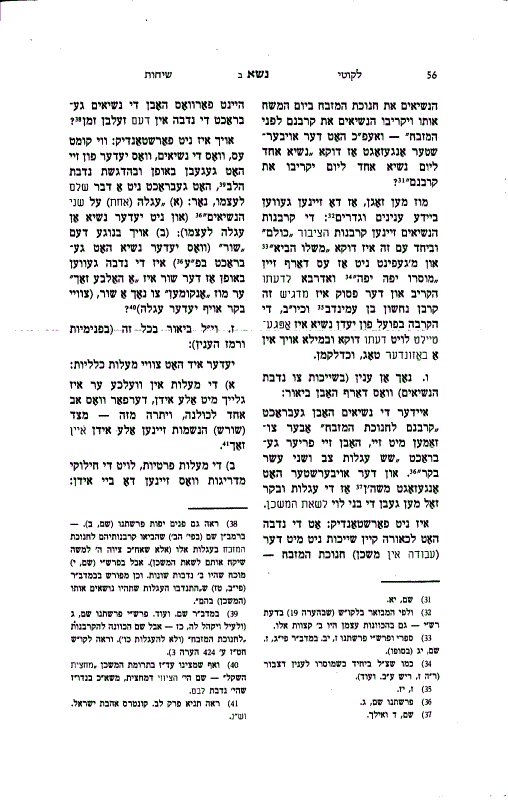
This framework helps explain what the Midrash says about Nossi Shimon’s offerings. The verse describes his korban as corresponding to “the order of building” (seder ma’aseh haMishkan). The Midrash elaborates: for example, Shimon’s silver plate (ka’arat kesef) represents the courtyard surrounding the Mishkan.
The weight of this plate was 130 shekels—corresponding to dimensions in cubits: 100 cubits for the length of the courtyard plus 30 cubits for the Mishkan itself inside it (totaling 130). The silver bowl (mizrak kesef) represented just the courtyard without including space taken up by the Mishkan—thus 70 cubits (since subtracting 30 from 100 leaves 70).
Saif Zayin
The Rebbe discusses the symbolism behind the seventy shekel weight of the mizrak, the bowl used in the service. He explains that this number corresponds to the courtyard—chotzer—without including the Mishkan itself. There is a deeper calculation here: the courtyard was 100 amos long and 50 amos wide. If you take those 50 and break them into strips across the 100, and then make it into a square, you end up with a space of seventy by seventy amos. This is hinted at by the seventy shekel weight.
The Rebbe raises several questions about this calculation. First, he asks: The thirty amos of the length of the Mishkan are already included within the hundred amos of the courtyard’s length. How can we count those thirty again as if they are separate from the hundred? When we say there are 130 amos, adding thirty for the Mishkan to one hundred for the courtyard, it seems redundant because those thirty are already part of the hundred.
This leads to another question: Since we already have a total of 130 amos, which includes both courtyard and Mishkan, why do we need to bring another measure corresponding to just the courtyard without the Mishkan? Why does one opinion say that seventy shekel is for just the courtyard without including the Mishkan?
The Rebbe also asks: What is behind the opinion that says these seventy shekels do not correspond to just the courtyard without the Mishkan, but rather to something else? Especially since when you square out these measurements, you don’t get exactly seventy—there are always some leftovers or discrepancies. Why not just follow the first opinion that says seventy represents only what’s left after removing space for the Mishkan?
The Rebbe answers that these three approaches to counting—the combined measurement (thirty plus one hundred), just the courtyard (seventy), and then squaring out to include both—reflect three different aspects of holiness in relation to the Mishkan.
When discussing general sanctity—the overall holiness of Mishkan—we count everything together as one hundred amos, which includes both courtyard and Mishkan as a single unit. When emphasizing individual sanctities, we count only what is unique—the courtyard without including space for the Mishkan—which gives us seventy amos.
This distinction shows that sometimes we focus on unity—all parts together—and sometimes on individuality—each part’s unique sanctity. That’s why both counts are needed: one reflects unity (everything together), while one reflects individuality (each part on its own).
The union of these two aspects—the general and individual sanctities—results in a combined number, 130. In some contexts, we count everything together; in others, we highlight each part’s distinct role.
This idea also connects with how offerings were brought during Chanukas HaMizbeach (the dedication of the altar). The leader of Shevet Shimon brought offerings that reflected all three aspects: unity among Jews, individuality within each tribe, and how each individual contributes to communal holiness.
The Rebbe notes how brilliantly all these ideas fit together: every detail in Torah reflects deeper spiritual truths about unity and individuality within holiness.
This also explains two opinions regarding whether we count seventy shekels for just the courtyard or for everything squared out. According to one view, emphasis is placed on individuality—but even then, unity is present since all parts ultimately combine into one whole. According to another view, emphasis is on communal unity—the greatness lies in what everyone accomplishes together rather than highlighting individual distinctions.
This distinction is reflected in how gifts were brought by leaders: sometimes as a collective act (unity), sometimes highlighting each tribe’s unique contribution (individuality).
The Rebbe concludes by noting that these themes were discussed at various occasions—Shabbos Parshas Tzav 5740, Simchas Torah 5742, Shabbos Parshas Vayikra Hei Nisan 5743—showing their enduring relevance throughout Jewish life and history.
Key Points
1. The offerings of the tribal leaders during the dedication of the altar are considered by the Midrash as if all leaders brought their sacrifices together both on the first and last days, highlighting a dual aspect of unity—at the beginning and at the completion of the process.
2. Each tribe’s offering, while identical in form, was infused with unique intentions and meanings by each nasi, reflecting the distinct spiritual path and mission of every shevet in serving Hashem.
3. The full dedication of the Mizbeach was only achieved after all twelve tribes participated, demonstrating that every individual contribution was essential for true communal completeness.
4. The korbanos of the nesi’im possessed both communal and individual qualities: they were brought by individuals for their respective tribes, yet counted as communal offerings that could even override Shabbos due to their collective nature.
5. The gifts of wagons and cattle, given jointly by pairs of nesi’im, symbolize two forms of Jewish unity: essential oneness at our soul-root and unity achieved through mutual dependence on each other’s unique strengths.
6. True Jewish unity requires integrating both general oneness and appreciation for individual greatness; even when recognizing one’s own strengths, a Jew must feel complete only together with others, as all souls are rooted in a single essence.
7. The structure of the Mishkan itself reflects these three levels: general sanctity (the Mishkan as a whole), specific sanctity (each part’s unique holiness), and a synthesis where each detail contains both its individuality and its connection to the whole.
8. The symbolism behind the weights and measurements in the nesi’im’s offerings (such as 130 shekels or 70 shekels) further illustrates how Torah encodes lessons about unity versus individuality within holiness, paralleling how Jews serve Hashem both collectively and uniquely.
9. Ultimately, every act—whether joint or individual—should express both dimensions: personal contribution rooted in communal unity. This ideal is modeled by the nesi’im’s offerings and serves as a paradigm for Jewish life and service throughout history.