Introduction
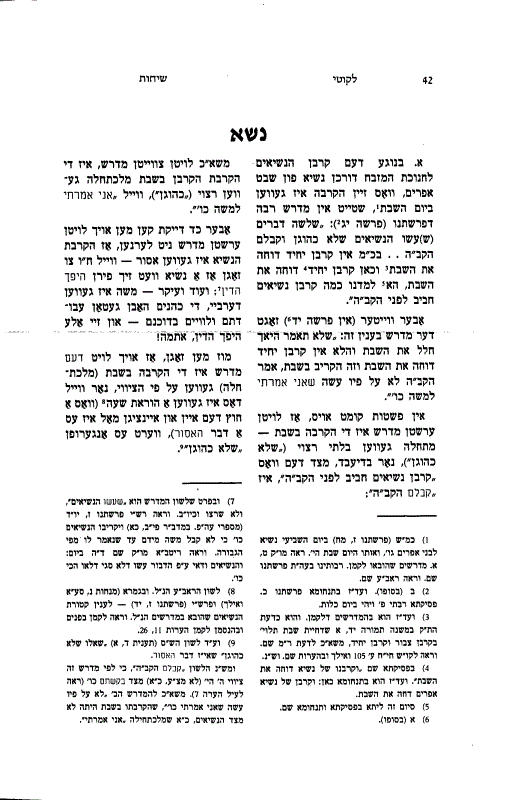
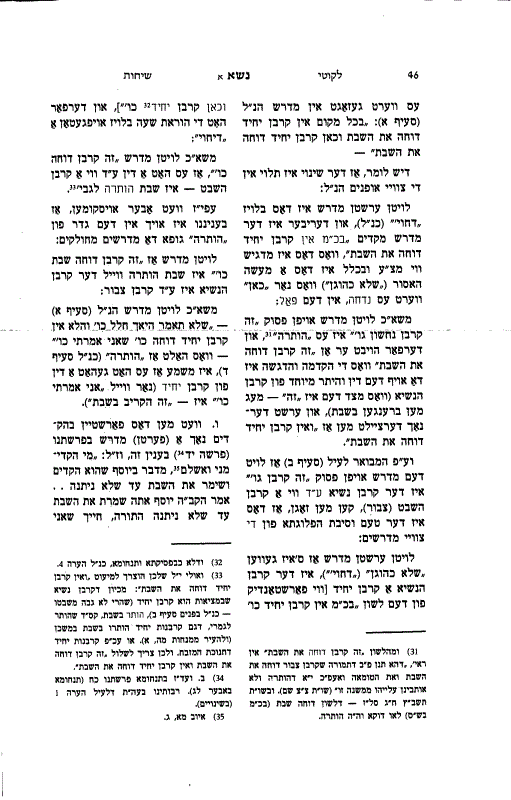
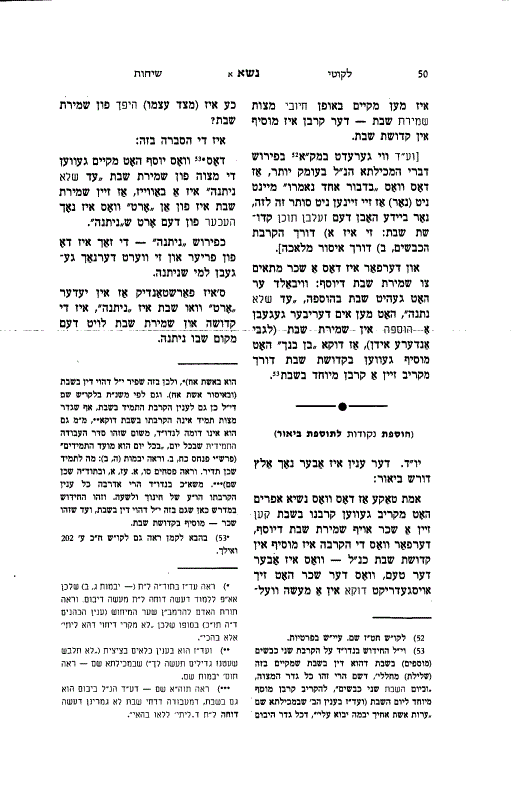
In this review, we will study a sicha from Likkutei Sichos, Chelek Chof-Gimel (volume 23), the first sicha on Parshas Naso. This is a complex and multifaceted sicha, rich with nuances and filled with discussions of various midrashim. The Rebbe analyzes four different midrashic sources, explores the differences between them, and brings in relevant passages from the Gemara. He also addresses how to resolve apparent contradictions or tensions that arise from these sources.
The central topic of the sicha is the story of the twelve nesi’im—the leaders of each tribe—who brought offerings for the dedication of the altar. Each nasi brought his offering on a separate day. On the seventh day, which was Shabbos, it was the turn of the nasi from shevet Ephraim to bring his korban. This raises an important question: How was it permitted for the nasi of Ephraim to bring his korban on Shabbos? Was this a unique allowance just for this occasion, or did it require a special commandment? Was there something about this offering that made it different from other private offerings, which are generally not brought on Shabbos?
The Rebbe examines whether this event was an exception or if there was a broader principle at play. He considers whether bringing this korban on Shabbos was only allowed because of a specific directive or if there is an underlying halachic reasoning that applies more generally.
To address these questions, the Rebbe turns to several midrashim found in Parshas Naso—specifically in sections Yud-Gimmel (13) and Yud-Daled (14) of Midrash Rabbah. In section 13, there are two distinct midrashim; likewise, in section 14, there are two more. The sicha will analyze all four and compare their approaches.
We begin by focusing on Midrash Rabbah, Parsha Yud-Gimmel—the first midrash in that section. This midrash states that there were three things which the nesi’im did improperly or not according to protocol, yet Hashem accepted their actions regardless. The midrash lists these three things but highlights that we will focus specifically on one: bringing an individual korban on Shabbos.
Normally, individual offerings are not brought on Shabbos; only communal offerings override Shabbos restrictions. Yet here, with the korban of Ephraim’s nasi falling on Shabbos—the seventh day—it was nevertheless accepted by Hashem. This anomaly is noted explicitly in Midrash Rabbah.
This sets up our main question: What is unique about these offerings of the nesi’im that allowed them to be brought even on Shabbos? Was this a one-time exception due to special circumstances or instructions? Or does it reveal something deeper about their status?
Throughout this sicha, we will see how the Rebbe uses these various midrashic sources to clarify what happened and why—and what lessons can be drawn for our understanding of halacha and divine service.
Saif Aleph
The discussion begins with the unique status of the korbanos—the offerings—brought by the nesiim, the tribal leaders, during the inauguration of the Mishkan. Normally, an individual cannot bring a personal offering on Shabbos if it involves a transgression, and certainly not if it is improper. Yet here, we see that the nesiim brought their offerings even though, according to the language of the Midrash, what they did was not entirely proper. The Midrash lists three things that were done improperly by the nesiim, and this is one of them: they brought their korban on Shabbos.
From the wording of the Midrash, it appears that what they did was not permitted—something that should not have been done. Nevertheless, Hashem accepted their offering. This is clear from how the Midrash presents it: normally, such an act would not be allowed at all, but in this case Hashem accepted it anyway. However, in another place in the Midrash (specifically Parsha 14), there is a different perspective.
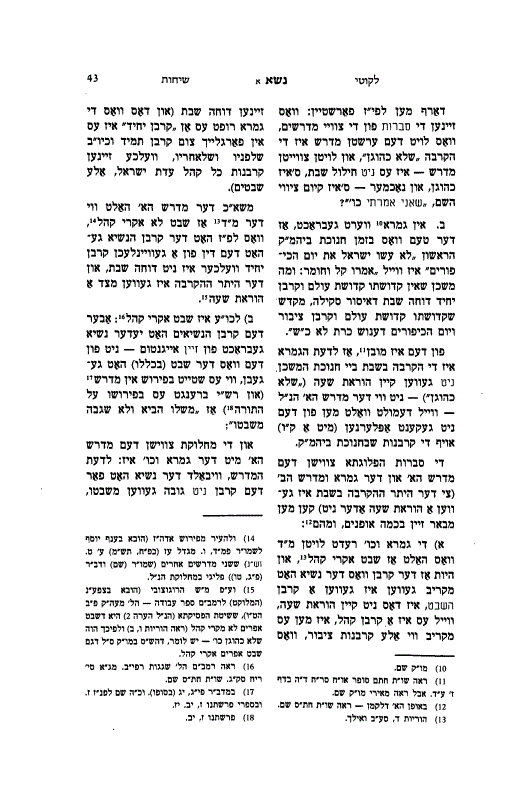
The later Midrash says: do not think that Ephraim’s nasi brought his korban on Shabbos on his own initiative. Rather, Hashem told Moshe to instruct them to do so. In other words, it was a direct command from Hashem to Moshe that allowed this exception. This seems to be a contradiction between two Midrashim: one implies that the nesiim acted on their own and did something improper which was only accepted after the fact; while the other says explicitly that Hashem commanded Moshe to have them bring these offerings on Shabbos.
According to Rashi in Bamidbar 7:48 (Parshas Naso), it sounds like Ephraim’s nasi brought his korban on his own initiative—not just after being told by Hashem—while another source says it was only after Hashem’s explicit instruction. This raises a question: was this act truly improper? Was it really something that should not have been done? And if so, what about all those present—Moshe Rabbeinu himself and all the kohanim and others involved? Would they have allowed something truly forbidden?
This line of questioning leads us to consider whether there is another way to reconcile these two approaches in the Midrash. Perhaps there is a distinction between “not permitted” and “not initiated,” or between acting independently versus following Hashem’s directive.
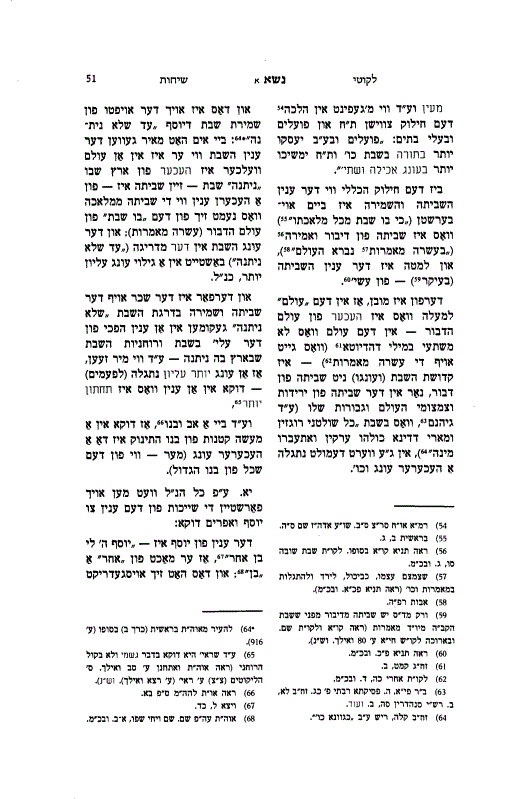
The Rebbe points out that in Gemara Moed Katan (9a), there is a different approach entirely. There, we learn about another case where an offering overrode a prohibition—in this case during Chanukas Beis HaMikdash HaRishon (the inauguration of the First Temple), which took place during Yom Kippur. The people did not fast or keep Yom Kippur as usual because they had to bring offerings for seven days straight as part of the dedication ceremony.
The Gemara explains how this was justified: they learned through a kal vachomer—a fortiori argument—from what happened at the inauguration of the Mishkan. The Mishkan’s sanctity was temporary; it only lasted while Bnei Yisrael traveled in the desert until they reached Eretz Yisrael and built a permanent Beis HaMikdash. Even so, at its inauguration—which involved individual offerings like those from Ephraim’s nasi—they overrode Shabbos for these sacrifices.
If so, argues the Gemara: if temporary sanctity and individual offerings could override Shabbos—a day whose violation carries kareis (spiritual excision)—then certainly when inaugurating the Beis HaMikdash itself (which has eternal sanctity) with communal offerings for all Israel (korban tzibbur), this could override even Yom Kippur (whose violation carries only karet). Thus, they learned from Mishkan to Mikdash via kal vachomer.
In summary, while both Midrashim seem to suggest that bringing these korbanos on Shabbos was not halachically permitted without special instruction from Hashem (“ani omarti”—I said so), the Gemara takes a different approach altogether. According to halacha as derived in Moed Katan, there are circumstances where communal or even individual offerings can override prohibitions like Shabbos or Yom Kippur due to their unique status during times of dedication or inauguration.
Saif Beis
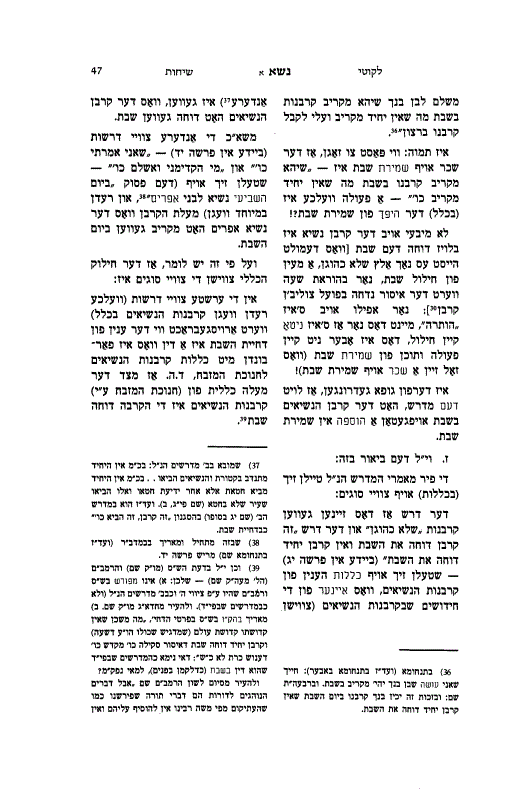
The discussion continues by analyzing whether the korbanos brought during the inauguration of the Mishkan could override Yom Kippur. The logic is that if these offerings could override Shabbos, then certainly they could override Yom Kippur, to the extent that there was no observance of Yom Kippur at all during those days. This leads to a deeper understanding of the view in the Gemara regarding bringing korbanos on Shabbos during the Chanukas HaMishkan.
The Rebbe clarifies that, according to the Gemara, the fact that korbanos were brought on Shabbos at the time of the Mishkan’s dedication was not merely a temporary instruction—a hora’as sha’ah, a one-time directive from Hashem. If it had been only a temporary exception, we would not be able to derive any halachic principles from it for future cases. The Rebbe emphasizes that this cannot be compared to an isolated event where Hashem tells us to do something just once; rather, it must have been done properly and in accordance with halacha.
This approach stands in contrast to the first midrash mentioned earlier, which claims that what was done was improper—shelo ke’hogen—and only permitted because Hashem specifically commanded it for that occasion. If we followed this view, we could not learn any general rules from what happened at the Chanukas HaMishkan, since it would have been an exception rather than a precedent.
However, even when considering the second midrash—which holds that bringing these korbanos on Shabbos was proper—the Rebbe points out there are still nuances. The second midrash also mentions “tzivui Hashem,” implying there was a special command from Hashem for this situation. For now, though, we focus on reconciling these sources: one side (the first midrash) says it was improper; the other side (the second midrash and the Gemara) says it was proper and can serve as a precedent.
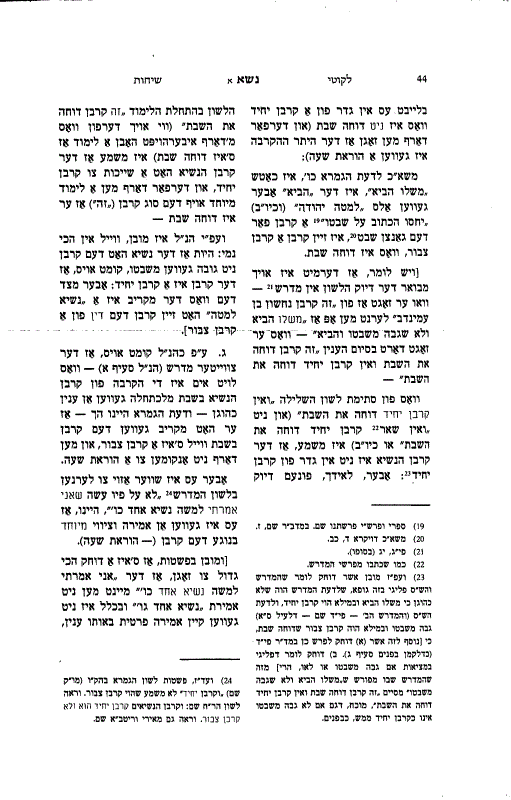
The Rebbe now seeks to explain why, according to the Gemara and this second midrash, there was nothing wrong with Ephraim’s nasi bringing his korban on Shabbos—it was entirely proper (ke’hogen). The key is how we define this offering: perhaps when a nasi brings a korban as head of his tribe, it is not considered an individual offering (korban yachid) but rather a communal offering (korban tzibur). Communal offerings are allowed to override Shabbos.
This distinction hinges on whether a shevet (tribe) is considered equivalent to a community (tzibur). According to the Gemara’s view—and those who agree—a tribe is indeed called a community. Therefore, when Ephraim’s nasi brought his korban, it was as if he brought it for an entire community. This makes it permissible on Shabbos just like any other communal sacrifice.
The Gemara refers to this as a kal vachomer: if communal offerings can override Shabbos in other contexts (such as in the Beis Hamikdash), then so too here. However, there is still some nuance: relative to regular communal offerings like the daily tamid sacrifice—which represents all of Israel—the nasi’s korban is called an individual offering because it represents only one tribe rather than all twelve.
This explains why the Gemara sometimes calls it a korban yachid: not because it is truly individual in nature, but because compared to sacrifices offered for all tribes together (like the tamid), this one is more limited in scope. Still, since each shevet can be seen as its own community, their nasi’s offering qualifies as communal enough to override Shabbos.
In contrast, according to the first midrash—which holds that what happened was improper—a shevet does not count as a full community for these purposes. Thus, their nasi’s offering remains classified as an individual sacrifice and would not normally be allowed on Shabbos except by special divine instruction.
The Rebbe notes that even though both sides agree Hashem gave some form of command regarding these offerings, only according to those who see each shevet as its own community can we derive general halachic principles from what occurred at Chanukas HaMishkan. Otherwise, if viewed as merely an exceptional case (hora’as sha’ah), no such lessons could be drawn for future practice.
Saif Gimmel
There are two main ways to understand the status of the korbanos brought by the Nesiim—the tribal leaders—during the dedication of the Mishkan. One approach is that each Nasi brought his offering as an individual, and it was only permitted to bring it on Shabbos because Hashem gave a special, temporary instruction for that time. In this view, even though the Nasi is a representative of his tribe, he is still fundamentally an individual, and the korban is not considered a communal offering in the usual sense that would override Shabbos.
The second approach is that even if everyone agrees these offerings are called a korban tzibbur—a communal sacrifice—the question remains: was each Nasi acting as an individual or as a representative of his entire tribe? If he brought it on behalf of the whole tribe, then it acquires the status of a communal offering, which has different halachic implications regarding overriding Shabbos.
To clarify this debate, we look at how different Midrashim and sources in Chazal describe these korbanos. The first Midrash in Parshas Naso (Parshi Dalet) seems to hold that each Nasi’s korban was personal and individual. Therefore, when his korban did not override Shabbos by default, it was only allowed because Hashem gave a special instruction for that occasion. This is why it’s called sh’loi kehoigen—not in the regular manner.
On the other hand, another Midrash (which we’ll call “the second Midrash” in Parshas Naso) and also the Gemara seem to treat these offerings as communal sacrifices. According to this view, since each Nasi brought his korban on behalf of his entire shevet (tribe), it is considered a korban tzibbur, which normally does override Shabbos without any special instruction.
This leads to two possible explanations: either we need to say there was something irregular about these offerings (as per the first Midrash), or we follow the second Midrash and Gemara that see them as regular communal offerings which naturally override Shabbos. The distinction hinges on whether these were truly individual or communal sacrifices.
The Rebbe points out that even within these approaches, there are nuances. For example, even if you say it’s a korban tzibbur, there’s still discussion about whether it required a special instruction from Hashem or not. The language used in some sources suggests that although technically communal, there was something unique about these offerings—they weren’t exactly like other communal sacrifices brought throughout generations.
The Rebbe brings another Midrash to further clarify this point. In one place, it says explicitly: “משלו הביא ולא משבטו”—he brought from his own funds and not from those collected by his tribe. This would indicate an individual aspect to the offering. Yet elsewhere it’s clear that even though he paid for it himself, he did so as a representative of his shevet; thus, halachically it takes on aspects of both an individual and communal offering.
This duality creates complexity: on one hand, since he paid for it himself, you might think it’s an individual sacrifice; but since he brought it for his whole shevet, it functions as a communal one—especially regarding its ability to override Shabbos.
The Rebbe notes that this tension is reflected in how Chazal phrase things: sometimes they emphasize its uniqueness (“שלא כהלכה” or “שלא כהוגן”—not according to normal practice), while other times they treat it as part of standard halachic categories (korban yachid vs. korban tzibbur). The upshot is that these korbanos occupy a borderline status—individual in some respects but communal in others.
This explains why some sources require a special instruction from Hashem for these offerings to be brought on Shabbos (since they’re not fully communal), while others see no need for such an instruction (since their function is essentially communal).
The Rebbe concludes that according to the Gemara’s perspective, what allowed these korbanos to be brought on Shabbos was their status as tribal offerings—a kind of collective act by each shevet—which gives them enough of a communal character to override Shabbos without needing anything extraordinary. However, according to certain Midrashim, there was indeed something exceptional about them; they required explicit divine permission because they didn’t fit neatly into either category.
In summary: The debate among Chazal about whether the Nesiim’s offerings were individual or communal reflects deeper questions about their halachic status and what allowed them to be brought on Shabbos. Some see them as unique cases requiring special dispensation; others view them as legitimate examples of korban tzibbur, with all attendant halachic privileges.
Saif Daled
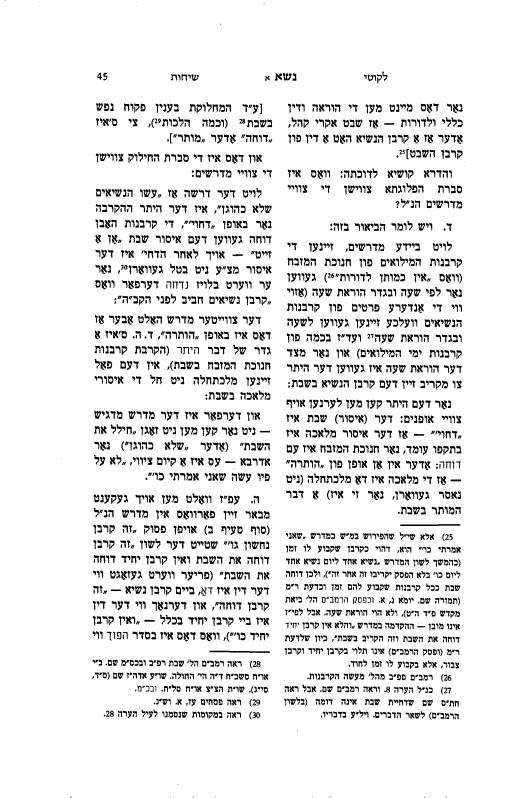
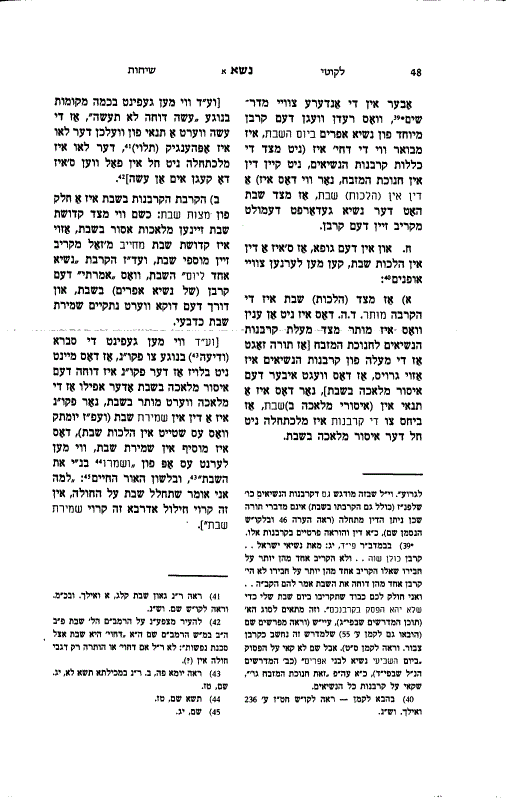
The Rebbe now returns to analyze the language differences between the two midrashim discussed earlier—one in Parsha Yud Gimel and one in Parsha Yud Dalet. He points out that these midrashim use different expressions when describing whether the korban of the Nessiim overrides Shabbos, and this reflects a deeper conceptual distinction.
In the first midrash of Parsha Yud Gimel, which was cited at the beginning of the sicha, the approach is to first state the negative: that an individual’s korban does not usually override Shabbos. Only afterwards does it explain that in this particular case, Hashem made an exception and allowed it to override Shabbos. This reflects a view that overriding Shabbos here is an exception—something permitted only due to a special circumstance.
By contrast, in the second midrash of Parsha Yud Gimel (which was brought earlier as a side point), the language is more positive: it begins by stating that this korban does override Shabbos, and only then notes that normally such offerings would not be allowed. This suggests a different logic—that here, it is not just an exception but rather a new status: hutra—it has become entirely permitted in this context.
The Rebbe explains that these two approaches reflect two ways of understanding how the korbanos of the Nessiim relate to Shabbos. According to one view, overriding Shabbos is a unique allowance for this case; according to the other, it is as if there is no prohibition at all—the korban becomes fully permitted on Shabbos due to its special status.
The Rebbe then addresses another issue: what problem might arise from these differing approaches? Specifically, how do we understand whether bringing the korban of the Nessiim on Shabbos constitutes a violation of Shabbos or not? Is it simply an exception (where normally it would be forbidden but here Hashem allows it), or does it actually transform into something permissible?
This leads into a broader discussion about how these midrashim categorize the korbanos of the Nessiim. The first two droshes in Parsha Yud Gimel discuss the general rule regarding all Nessiim—the collective offering during Hanukkas HaMizbeach—and focus on whether this communal act overrides Shabbos as part of its general significance.
On the other hand, both droshes in Parsha Yud Dalet are based on specific verses about Ephraim’s offering on “the seventh day”—that is, when Ephraim’s Nossi brought his korban specifically on Shabbos. These midrashim focus on what was unique about Ephraim’s offering and why Hashem allowed (or even wanted) it to take place on Shabbos.
The Rebbe clarifies that there are thus two categories: Parsha Yud Gimel deals with all Nessiim and their collective role in Hanukkas HaMizbeach; Parsha Yud Dalet focuses specifically on Ephraim’s tribe and their unique connection to bringing their korban on Shabbos itself.
From here, we can understand a fundamental difference between these two sets of midrashim. In Parsha Yud Gimel, overriding Shabbos is presented as a function of Hanukkas HaMizbeach—the inauguration itself gives power for this act to override normal restrictions. The greatness and communal nature of Hanukkas HaMizbeach justifies setting aside regular laws for its sake.
In contrast, in Parsha Yud Dalet, where we discuss Ephraim’s specific offering on Shabbos, the focus shifts. Here, overriding Shabbos is not merely because of Hanukkas HaMizbeach but because there was a need for Ephraim’s Nossi to bring his korban precisely then—even though it was Shabbos. The law here relates directly to Shabbos itself: within its framework, there is room for this particular korban due to its unique circumstances.
This distinction helps clarify why each set of midrashim uses different language and emphasizes different aspects—whether they see overriding Shabbos as an exceptional allowance tied to Hanukkas HaMizbeach or as something fundamentally permitted for Ephraim’s tribe within the laws of Shabbos itself.
Saif Hei
The discussion here revolves around the question of why it is permitted to bring certain korbanos—offerings—on Shabbos. There are two ways to understand this allowance. One approach is that Hashem made an exception to the laws of Shabbos, permitting these specific offerings despite the usual prohibitions. In this view, the act is not inherently a mitzvah of Shabbos itself, but rather an allowance: the Torah suspends the prohibition for this case.
Alternatively, we can say that bringing these korbanos on Shabbos is not just permitted, but actually a mitzvah that becomes part of the essence of Shabbos. In this approach, offering the korban on Shabbos is itself a fulfillment of the sanctity and mitzvah of Shabbos, not merely an override or exception to its restrictions.
To clarify further: in the first approach, it’s not that there’s a special advantage or virtue in bringing this korban on Shabbos; rather, it’s simply allowed because the Torah says so. The prohibition of melachah—creative labor—on Shabbos does not apply in this case. It’s as if, from the outset, the restriction never existed for these offerings.
This concept can be compared to how a positive commandment sometimes overrides a negative one. For example, when a positive mitzvah comes into conflict with a prohibition, it’s not that the prohibition remains and is pushed aside; rather, in such cases, the prohibition never takes effect at all. The Torah never intended for that restriction to apply where there is an opposing positive commandment.
Similarly here: when there is a mitzvah to bring a korban on Shabbos, the prohibition against offering sacrifices does not exist in that context. The Torah never placed that restriction where there is an obligation to bring this particular korban.
The second approach goes even further. Here, bringing the korban on Shabbos becomes part and parcel of observing Shabbos itself. Just as certain aspects of Shabbos sanctity require refraining from work, other aspects require actively performing specific mitzvos—like offering these sacrifices—which are themselves expressions of Shabbos holiness.
This means that fulfilling these offerings is not merely permitted; it’s integral to keeping Shabbos properly. By bringing these korbanos, we are actually enhancing and completing our observance of Shabbos.
A similar idea appears regarding pikuach nefesh—saving a life on Shabbos. Some authorities explain that saving a life does not simply override or push aside the prohibitions of Shabbos; rather, in such circumstances, those prohibitions do not apply at all. The sanctity of life becomes part of what it means to keep Shabbos properly.
In halachic sources such as Hilchos Shabbos (the laws of Shabbos), we find language emphasizing that saving a life on Shabbos is called “guarding” or “preserving” Shabbos—not violating it. When we save lives or bring certain offerings as required by Hashem's commandment on Shabbos, we are fulfilling—not neglecting—the true spirit and law of Shabbos.
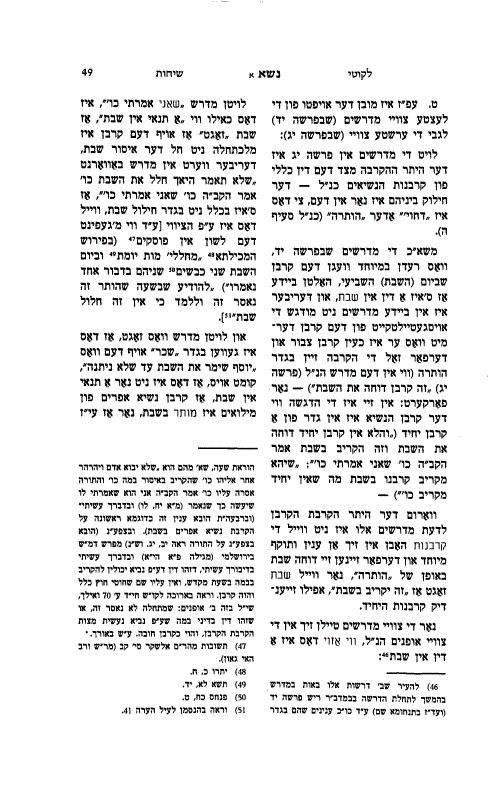
Based on all this, we can now appreciate what distinguishes the last two midrashim discussed in Parshas Naso (section 14) from those brought earlier (section 13). According to those earlier midrashim, permission to bring these offerings stems from their great importance—they are so significant they override even the laws of Shabbos. The only difference between those two earlier midrashim is whether they see this as “docheh”—the mitzvah pushes aside the prohibition—or “hutra”—the prohibition was never present for these cases at all because they are considered communal offerings.
However, in section 14’s midrashim, both agree that bringing these offerings on Shabbos is itself part of observing and sanctifying Shabbos—they focus specifically on how these acts relate directly to the laws and essence of Shabbos itself.
In both approaches found in section 14’s midrashim, there isn’t an emphasis on communal versus individual sacrifice status; instead, they stress that for these korbanos—the ones brought by each nasi (prince)—the Torah defines them as permissible because Hashem instructed so regarding their relationship with Shabbos law.
The distinction between these two approaches boils down to whether bringing such an offering is simply allowed (“hutra”) because Hashem removed any restriction for it—or whether doing so actually constitutes fulfillment (“shemira”) and enhancement of keeping holy what makes up true observance of Shabbos itself.
This explains why halachic sources use phrases like “those who desecrate shall die” yet still instruct us to perform certain acts—such as bringing communal offerings or saving lives—on Shabbos itself: because in those situations, far from violating or pushing aside holiness, we are truly upholding and expressing its deepest meaning.
Saif Vov
The Rebbe discusses the unique aspect of the korbanos brought by the Nasi of Ephraim, which included two sheep that were offered together. The question arises: when was it permitted to bring these offerings on Shabbos? According to one perspective, this was a special allowance, and therefore it was not considered a desecration of Shabbos. However, the Midrash explains that this was actually a reward for Yosef, who kept Shabbos even before it was given as a mitzvah.
This means that not only was it permitted to bring the korban of the prince of Ephraim on Shabbos, but through this act, one actually fulfilled the mitzvah of shemiras Shabbos—guarding and sanctifying Shabbos. The korban itself added to the holiness of Shabbos. The Rebbe references a similar explanation found elsewhere in Chassidus regarding the words of the Mechilta, which states that “they said it at once.” This does not mean they could not precede one another, but rather that both ideas share a common theme: enhancing the sanctity of Shabbos through the offering of these sheep.
Based on this, we see that Yosef’s reward for keeping Shabbos before it was commanded was an additional opportunity to increase in kedushas Shabbos—holiness of Shabbos—by bringing a special korban on that day. This addition is unique to Yosef and his descendants; while other Jews kept Shabbos as required, only Yosef’s descendant had this extra merit.
Nevertheless, the Rebbe points out that this idea still requires further explanation. Even if we accept that bringing this korban on Shabbos is a fitting reward for Yosef’s observance—since it adds to kedushas Shabbos and does not desecrate it—why did the reward have to manifest specifically in an act which appears, on its surface, to be contrary to the spirit of Shabbos? Why express such a reward through something so paradoxical?
The explanation lies in understanding what it means for Yosef to have kept Shabbos before it was given. This demonstrates that his observance came from a place higher than where the mitzvah had been formally commanded. Since he observed Shabbos before its official giving, his connection to Shabbos stemmed from a deeper source—a level above where mitzvos are given and defined.
To illustrate this point further, Chassidus distinguishes between different levels of resting on Shabbos as they exist above. In Hashem’s own “resting,” there are levels: in some places, resting means ceasing from speech (the creative utterances with which Hashem made the world), while in higher realms it means ceasing even from descent or limitation altogether. On Har HaBayis—the Temple Mount—the resting is from speech; above that level is an even greater cessation.
This concept is mirrored in Gan Eden and Gehinnom: on Shabbos in Gehinnom, all forces of judgment are suspended; there is rest even from anger and harshness. In Gan Eden, there is an even higher delight experienced on Shabbos. Similarly, Yosef’s observance reflected a level of delight and rest associated with a realm higher than where mitzvos are formally given—a delight not just from refraining from work but from connecting with Hashem’s essence beyond creation.
Therefore, when someone keeps Shabbos at such an elevated level—before its formal giving—their reward must also reflect this transcendence. The paradox is that specifically through an act which appears as chilul (desecration) in one context (bringing a korban on Shabbos), there emerges an even greater expression of kedusha (holiness) and delight. Just as sometimes a father experiences more pleasure from his young child’s simple actions than from his older child’s intellect, so too here: supreme delight can be revealed specifically through what seems lower or lacking.
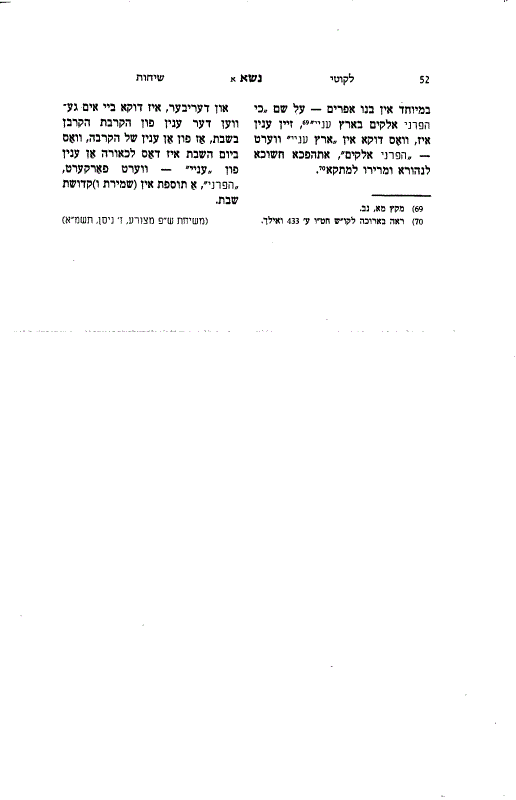
This idea connects deeply with Yosef and Ephraim themselves. The name “Yosef” implies adding another son—transforming someone who is “other” into family. Ephraim’s name comes from “ki hifrani Elokim b’eretz oni”—“for God has made me fruitful in the land of my affliction.” His greatness lies not just in spiritual heights but specifically in transforming darkness into light and bitterness into sweetness—in being fruitful precisely within affliction.
Thus, it is fitting that specifically Ephraim would bring a korban on Shabbos—a day when such an act would normally seem forbidden or out-of-place—because he embodies turning challenge into holiness and increasing kedushas Shabbos precisely where others might see only restriction.
This concludes the Rebbe’s analysis as delivered in Sichas Parshas Metzora, 7 Nissan 5741 (1981).
Key Points
1. The central issue of the sicha is the permissibility of the nasi of Ephraim bringing his korban on Shabbos during the inauguration of the Mishkan, and whether this was a unique exception or reflected a broader halachic principle.
2. The Rebbe contrasts two approaches in Midrash Rabbah: one that views the act as improper but accepted by Hashem due to a special directive, and another that sees it as permitted because Hashem explicitly commanded it, raising questions about its halachic status.
3. The Gemara in Moed Katan introduces a different perspective, deriving from the Mishkan’s inauguration that certain communal offerings can override even severe prohibitions like Shabbos or Yom Kippur, suggesting a precedent rather than a one-time exception.
4. The debate centers on whether the korbanos of the nesiim are considered individual or communal offerings; if viewed as communal (korban tzibur), they can override Shabbos according to halacha, while if individual, they require special divine instruction.
5. The dual nature of these offerings is highlighted: although funded personally by each nasi, they were brought on behalf of their entire tribe, creating a borderline status between individual and communal sacrifices with nuanced halachic implications.
6. Differences in midrashic language reflect deeper conceptual distinctions—whether overriding Shabbos is an exceptional allowance tied to Hanukkas HaMizbeach or an inherent permission for these korbanos due to their unique status and purpose.
7. Two models emerge regarding bringing offerings on Shabbos: either it is simply permitted because Hashem suspends the prohibition (“hutra”), or it becomes an integral mitzvah and fulfillment of Shabbos itself (“shemira”), enhancing its sanctity rather than merely overriding restrictions.
8. The case of Ephraim’s korban is uniquely connected to Yosef’s merit for keeping Shabbos before it was commanded; thus, bringing this offering on Shabbos not only does not desecrate it but actually increases its holiness as a reward for Yosef’s devotion.
9. Chassidus explains that higher forms of divine delight and rest are revealed specifically through acts that seem paradoxical—such as bringing a korban on Shabbos—mirroring Yosef and Ephraim’s ability to transform challenge into holiness and darkness into light.
10. Ultimately, the Rebbe teaches that these discussions illuminate profound lessons about how exceptions in Torah law can reveal deeper dimensions of kedusha, showing that true sanctity sometimes emerges precisely through actions that transcend conventional boundaries.