
Introduction
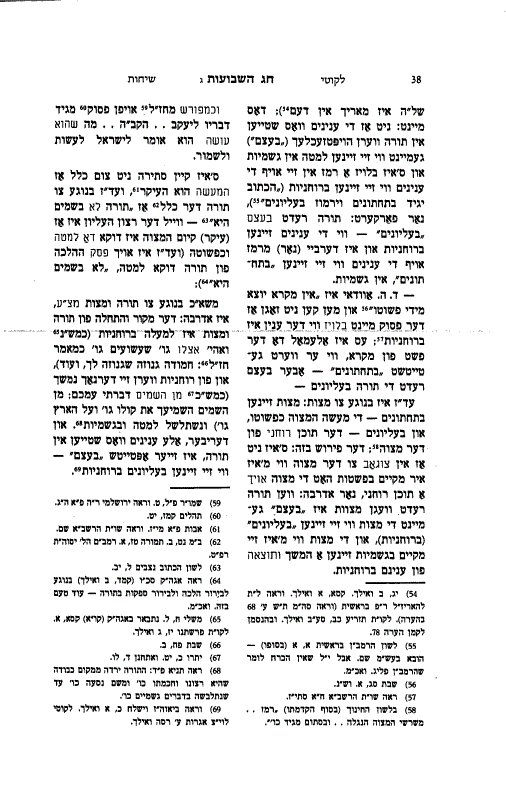
In this review, we will study a sicha from Likkutei Sichos, Chelek Chof-Gimel (volume 23), the sicha for Shavuos. In this sicha, the Rebbe discusses a fascinating idea found in the words of Chazal: that “nature has not changed,” and that success is determined by a fixed decree. We see in various places—sometimes with things that seem strange or outdated to people today—that Chazal still say, “the decree remains.”
Similarly, the Rambam in Hilchos Deos brings certain examples where he describes specific foods or behaviors as healthy or unhealthy for people. Yet, even though these recommendations may not seem applicable today, the Rambam’s language is that “the decree remains.” The question arises: how can we say about nature itself that it is fixed? Even if we say “the decree remains,” shouldn’t nature be something real and observable for the Rambam to legislate about it and to apply his rulings to specific cases?
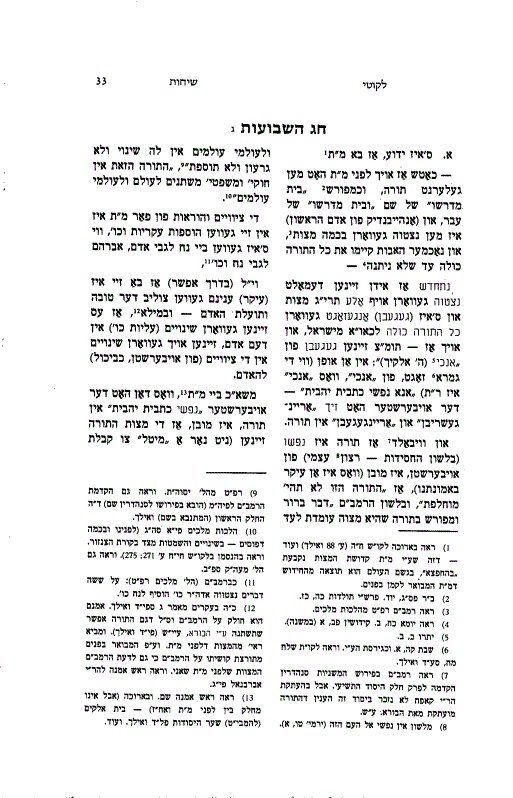
We will go step by step through this discussion. The sicha begins with Shavuos—known as Zman Matan Torah, the time of the giving of the Torah. What happened at Matan Torah? At Matan Torah, all of the mitzvos were given and their study was established.
However, Matan Torah was not literally the first time Torah was learned. We know that there was Torah before Matan Torah; there were those who studied and practiced it even earlier. For example, there were yeshivos such as Beis Midrash of Shem and Beis Midrash of Ever, as mentioned in Bereishis Rabbah. These were places where people studied Torah before it was formally given.
This concept goes back even further—even to the earliest generations. If we look at our forefathers—Avraham, Yitzchak, and Yaakov—they observed the entire Torah before it was given. There were mitzvos, there was Torah study, and there were ideas of Torah long before Sinai.
But what changed at Matan Torah? The unique aspect introduced then was that mitzvos became obligatory for every Jew. Before Matan Torah, mitzvos were not commanded upon every Jew; they were more like voluntary practices or personal commitments.
Additionally, what else changed with the giving of the Torah? The central mitzvah became Anochi Hashem Elokecha—“I am Hashem your God.” The giving of the Torah is defined by this declaration: Anochi Hashem Elokecha. This phrase is special; when the Torah says Anochi (“I”), it carries a deeper meaning.
The word Anochi itself is an acronym explained in various sources such as Nedarim 35a and Shabbos 105a. It stands for “Ana Nafshi Ksavis Yehavis”—“I Myself wrote and gave [the Torah].” This highlights that at Sinai, Hashem gave His very essence through the giving of the Torah.
Saif Aleph
The Rebbe begins by emphasizing the unique quality of Torah, as expressed in the phrase "Anochi Hashem"—I am Hashem. At Matan Torah, Hashem placed Himself into the Torah and gave it to us. This was something entirely new; before Matan Torah, this level of connection did not exist.
This means that Torah is Elokus—divinity—because Hashem invested Himself into it. Not only is this true for the written Torah, but also for the entire body of Torah: all the teachings of the sages, the Gemara, and as the Ramban writes, everything that is part of Torah is included in this divine investment.
The idea here is that Torah is not just wisdom or a set of instructions; it is Hashem’s very essence. The concept of “atzmus”—the essence—is central: Torah contains within it the essence of Hashem. Even though this is a lofty idea, it can be understood on some level. When something is essential to our being—part of our very identity—it cannot be changed or replaced.
This leads to a fundamental principle: Torah cannot be exchanged or altered. It will always remain as it was given at Sinai. As the Rambam puts it, “This Torah will never be changed; its laws and statutes will never be replaced.” The mitzvos are eternal—they do not change over time or circumstance.
Before Matan Torah, there were commandments given to Adam and Noach, and later to Avraham. However, those mitzvos were not eternal in nature; they could change depending on circumstances or individual decisions. For example, Rabba explains that before Matan Torah, mitzvos depended on a person’s own commitment—if a person decided to keep them, they applied; if not, they did not have lasting force.
After Matan Torah, however, everything changed. The giving of the Torah established an unbreakable bond between Hashem and the Jewish people through His commandments. From then on, mitzvos became absolute—they are no longer dependent on human decision but are rooted in Hashem’s will and essence.
This means that mitzvos are not just practical instructions or rituals; they are expressions of Hashem’s soul—His “nafshi.” Just as there can be no change in Hashem’s essence (God forbid), so too there can be no change in His mitzvos.
Therefore, from Matan Torah onward, we have reached a state where there is no possibility for change or interruption in the mitzvos. They are continuous and eternal—the very definition of “netzach”—eternity.
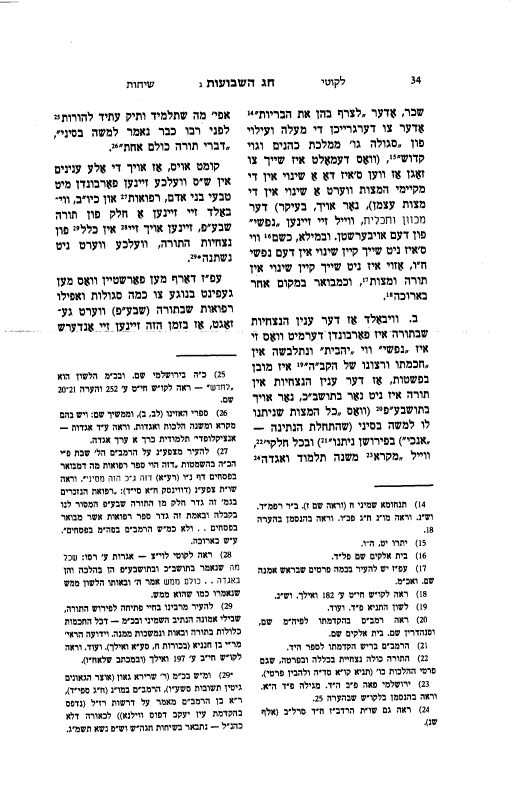
The Rebbe points out that this raises questions: What about cases where it seems like there was a change in nature or in certain mitzvos? Doesn’t this contradict the principle of eternity?
In Section Beis (the next section), these questions will be addressed directly. But first, we must clarify that since at Matan Torah Hashem invested Himself into all aspects of Torah—including both written and oral law—all parts of Torah share this quality of eternity.
This includes not only Chumash but also Mishnah, Talmud, Aggadah—even novel insights that a diligent student may one day discover were already included at Sinai. As our sages say: “Everything that an experienced student will innovate was already said to Moshe at Sinai.”
Thus, every part of Torah—whether it deals with spiritual matters or practical issues like medicine—is equally eternal because all are part of what was given at Sinai.
Saif Beis
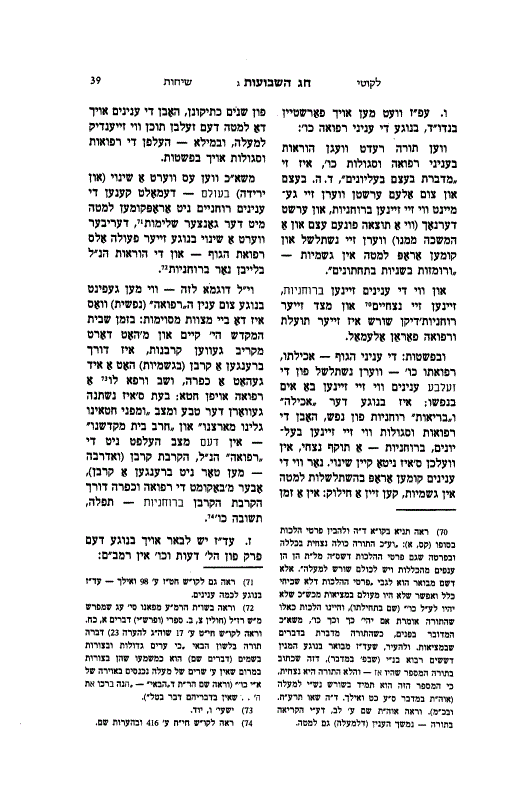
The oral Torah is also included in the eternity of Torah—nitzchiyus haTorah—which does not change. However, we need to understand something: we find, regarding many different types of segulos (omens) and even medicines mentioned in the oral Torah, that it is said their effectiveness or relevance has changed over time. The Gemara itself sometimes states that these things were different in those days—bayamim hahem—because nature has changed since then. How can this be reconciled with the principle that Torah is eternal?
When it comes to certain prohibitions whose reason the sages explained was due to a specific danger, this makes sense. For example, the law of mayim megulim—water left uncovered—the sages prohibited its use because perhaps a snake drank from it and left venom behind. In such a case, it is understood that if there are no snakes present, or if the situation changes so that this concern no longer applies, then the prohibition does not apply. It is as if the Torah itself says explicitly that this prohibition is only relevant in places and times where snakes are common. Therefore, nowadays, when snakes are not found among us, it is permissible to drink such water.
This logic applies similarly to other cases where the reason for a prohibition is given together with the law itself and depends on a specific circumstance. If that circumstance no longer exists, there is no contradiction to Torah’s eternity; rather, this was always part of the law’s definition.
This is also not a contradiction to Torah’s eternity when we find many mitzvos and laws whose obligation depends on time or place—for example, mitzvos performed only during the day, or only when the Beis HaMikdash exists, or only in Eretz Yisrael. We do not say these mitzvos are not eternal just because they do not apply at all times or in all places; rather, Torah itself established them as conditional upon certain circumstances. That limitation is part of their very definition.
The same applies to positive time-bound mitzvos (mitzvos asei shehazman grama): their obligation is inherently tied to specific times. This presents no challenge to their eternal status.
However, when it comes to matters like medicines or segulos mentioned in Torah—where Torah did not tie them explicitly to any particular time or place—they are stated plainly and without conditions. For example: “If you do such-and-such, it brings about healing,” or “If you act in a certain way, it brings about danger.” How can we say these are not eternal? How can we claim they do not apply today—to the extent that some authorities say one should not use these remedies from Chazal because nature has changed?
This question becomes even stronger considering that several commentators argue: since these prohibitions or instructions come from tradition (halacha leMoshe miSinai) they cannot be subject to change simply because nature has changed. As it says: “The word of our God shall stand forever.” So how can we say regarding these medicines or segulos found in Torah that they no longer apply?
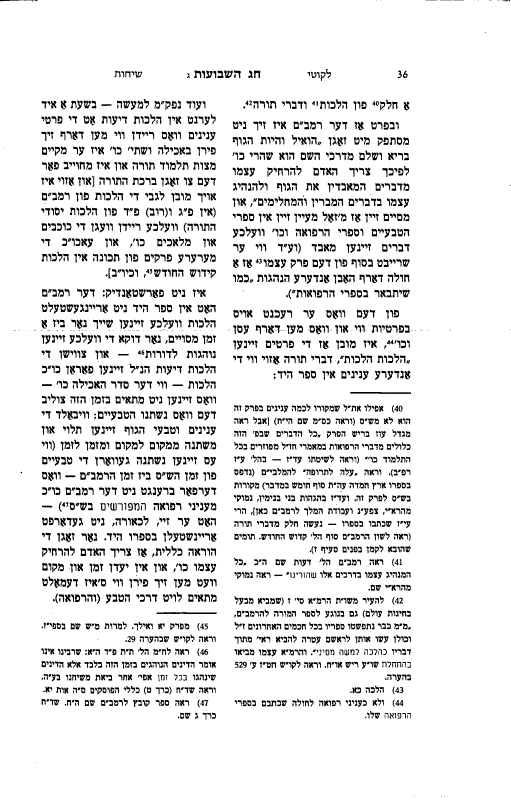
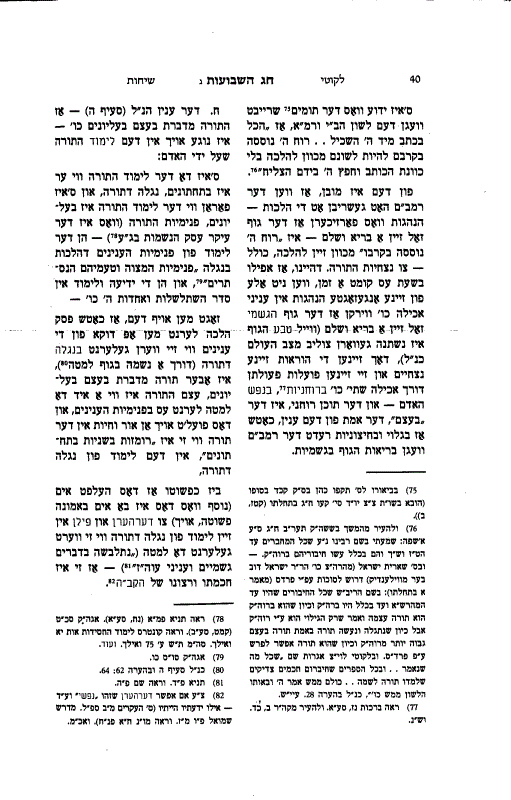
The Rebbe extends this question further by pointing out what Rambam writes about health and medicine. In Hilchos Deos (Laws of Character Traits), Rambam devotes an entire chapter detailing how a person should conduct himself regarding eating and drinking for health reasons. He writes that maintaining a healthy body is part of serving Hashem.
The fact that Rambam includes these instructions as part of his halachic code shows they are more than just medical advice—they are Torah laws. This differs from following a doctor’s orders simply because one must guard one’s health; here, Rambam codifies them as halacha itself.
If Rambam’s intent was merely practical advice for health based on contemporary science or medicine books, he would have directed us to consult those sources directly—to look into medical texts and determine what foods are healthy or harmful according to current knowledge. But Rambam does not do this; instead, he specifies within his halachic work exactly what one should eat and how one should behave for good health.
This raises an important question: If these instructions are part of halacha—eternal words of Torah—how can it be that nowadays doctors may recommend differently? Why would Rambam codify specific medical advice as halacha if its validity could change with time?
The Rebbe notes that at the end of this chapter Rambam himself acknowledges that some details may depend on local custom or individual constitution—but still presents much practical guidance as halacha. This makes clear he saw them as more than just temporary advice; they were meant as enduring directives within Torah law.
Saif Gimmel
The Rambam discusses many topics in his works, including what and how a person should eat, astronomy, the nature of life, angels, and more. He addresses the details of the lunar cycle and the laws of sanctifying the new month—kiddush hachodesh—and explains how these relate to Hashem’s calculations and the counting of time. The Rambam includes these topics even though they are not mitzvos that apply at all times or in all places.
When it comes to mitzvos that are only relevant in certain periods, such as those dependent on the Beis Hamikdash or specific historical circumstances, the Rambam still records their laws. For example, he writes about kiddush hachodesh even though its practical application is limited to certain eras. He does this because these mitzvos may become relevant again when conditions change.
However, when it comes to health-related guidance—such as what foods to eat or avoid—the Rambam gives very specific instructions. This raises a question: since these health recommendations are based on the science and medicine of his time, why does he present them as if they are eternal halachah? Shouldn’t he instead give a general rule: maintain your health according to the best medical knowledge available in each generation?
The Rebbe suggests, perhaps in a lighter tone, that this approach highlights how precious Jewish health is. Even if these guidelines only benefit people for a few generations, their inclusion underscores how much Torah values our well-being. Still, this explanation is not fully satisfying. If these health rules are not universally applicable for all times and places, why does the Rambam codify them as permanent halachah?
Ideally, the Rambam should have clarified that his health advice was based on the nature and medical understanding of his era. He could have noted that future generations should adapt their practices according to contemporary knowledge rather than treating his words as eternally binding law.
This leads to a broader question about Torah’s eternity: how do we reconcile the Rambam’s inclusion of time-bound or nature-dependent laws with Torah’s claim to be eternal? Why does he present these health guidelines as if they apply for all generations?
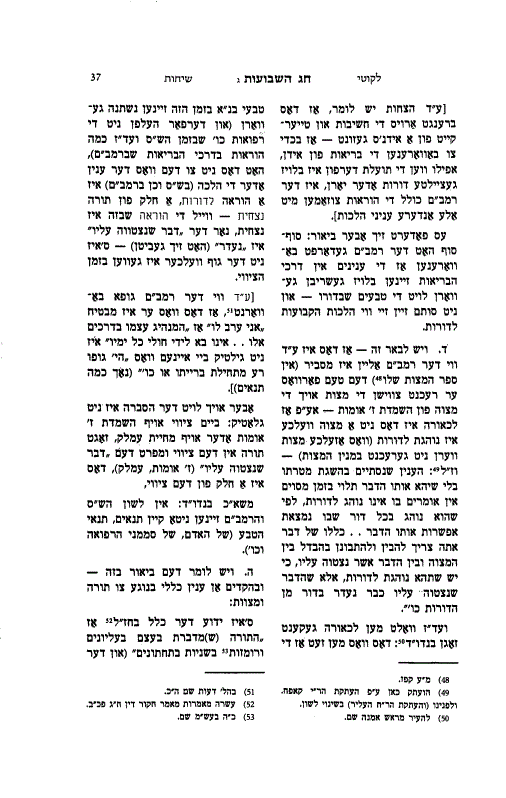
In Section 4 (Ois Dalet), the Rebbe begins to address this by comparing it to other mitzvos whose fulfillment depends on external conditions. For example, destroying the seven Canaanite nations is counted as a mitzvah even though it cannot always be fulfilled—sometimes those nations simply do not exist. The mitzvah itself remains; it just cannot be performed until circumstances allow.
The Rebbe explains that there is a difference between a mitzvah that is inherently time-bound and one whose fulfillment depends on whether its object exists. In cases like destroying the seven nations or erasing Amalek, the Torah specifies exactly what must be done and under what conditions. The mitzvah remains eternal; it simply awaits its opportunity.
Applying this logic to our case: perhaps when human nature changes—when people’s bodies respond differently to food or medicine—the specific health advice in Rambam no longer applies practically. However, this does not mean that Torah’s guidance has lost its eternity; rather, it means that the object of instruction has changed.
The Rambam himself acknowledges this nuance: he promises that following his health regimen will keep one healthy unless their constitution was already weak from birth or creation—in which case it may not help. This shows that even in his own words, these laws depend on individual nature and circumstance.
The upshot is that while Torah’s principles remain eternal, their practical application may shift when reality changes—just as with mitzvos dependent on historical circumstances like destroying certain nations. The law itself endures; only its immediate relevance fluctuates with changing conditions.
Nevertheless, this answer is not entirely smooth. When Torah commands about destroying specific nations or erasing Amalek, it explicitly ties those mitzvos to particular objects—the seven nations or Amalek—which become part of the command itself. In contrast, with health guidance in Rambam and Gemara, there is no explicit condition attached; they are presented as universal rules without qualification.
Saif Daled
The Rebbe begins by addressing a question: if the Torah’s discussion of certain laws or realities—such as the status of the tribe of Levi—is presented as an absolute, how can it be that these do not always manifest in the physical world? The answer is that, indeed, sometimes the Torah’s statements are eternally true on a spiritual level, even if they do not always translate into practical, physical reality. This is because Torah primarily speaks about spiritual truths; when those truths are permanent in the spiritual realm, that itself constitutes the mitzvah, even if it does not always filter down to action.
To explain this further, the Rebbe introduces a general principle regarding Torah and mitzvos. The sages teach that Torah is first and foremost speaking about realities in the upper worlds—the spiritual realms—and only secondarily about matters in our physical world. The Shaloh elaborates on this idea: it is not that Torah primarily discusses physical matters and only hints at their spiritual counterparts. Rather, it is the opposite—Torah’s essence is about spiritual realities, and only incidentally does it hint at their manifestations below.
This does not mean we can ignore the simple meaning of verses or mitzvos. Every passage retains its literal sense as applied in this world. However, fundamentally, Torah speaks about upper worlds; its primary subject is spiritual truth. The same applies to mitzvos: while we perform them physically, their inner content exists above in a spiritual form.
What does this mean for our understanding of mitzvos? In addition to fulfilling a mitzvah through action here below, every mitzvah has an inner, spiritual dimension. In fact, when Torah discusses mitzvos at their root, it refers to them as they exist spiritually; our physical fulfillment is an extension and result of their higher reality.
This idea is reflected in the words of our sages regarding Yaakov Avinu: what he accomplished spiritually above (“he says”) translates into what his descendants do physically below (“he tells them to do”). There is no contradiction between emphasizing action—since “the deed is primary”—and recognizing that the source and essence of mitzvos are spiritual. Hashem’s desire is for mitzvos to be performed here below; nevertheless, their true being remains above.
Thus, while halachic rulings must be determined here on earth—“Torah is not in heaven”—the inner reality of Torah and mitzvos remains rooted in higher realms. Hashem wants us to act and decide below, but what are Torah and mitzvah in themselves? Their core remains spiritual.
זאת אומרת, הסורס, ואיפה מתחיל את הטויר המצוין, ישלמאי לבירוך, זו בואה משפטית. כמו שנאמר, אז הפוסטיק אומר, ואה יעצלי גוי מרשה שויים.
That means: the source and beginning point of Torah and mitzvos are above—in supernal realms. As it says in the verse: “And He was with me as a craftsman.”
אני הייתי בשביל השם, אינסטרומנט של השם... כמו שאמרו חז"ל: חמודו גנוזו שגנוזה לך.
“I was for Hashem like an instrument,” as our sages say: “The precious treasure [Torah] that is hidden away for You.” This refers to Torah as Hashem’s own delight.
The Rebbe continues by explaining that from this supernal source flows everything else—even what eventually manifests below. As another verse states: מן השמיים דברתי עמכם—“From heaven I spoke with you.” The voice begins above and then descends below; it starts from heaven and enters man.
There are times when these supernal realities do not fully manifest physically; sometimes they remain only on a spiritual plane. For example, when Torah discusses matters such as priestly gifts or sacrifices—it speaks primarily about their essential form above. Only afterward do these ideas descend into practical observance below.
In earlier times—such as during the era of sacrifices—the physical act was present alongside its spiritual effect. When a Jew brought a korban (sacrifice), he performed a physical act which also effected atonement spiritually. However, after the destruction of the Beis Hamikdash (Temple), we can no longer bring actual sacrifices; instead we achieve atonement through prayer and teshuvah (repentance), which correspond spiritually to korbanos.
Similarly regarding other commandments whose practical observance depends on circumstances—such as purity laws or certain agricultural laws—their essential existence persists spiritually even when we cannot fulfill them physically today.
This concept helps explain why Rambam codifies laws even for practices that cannot currently be fulfilled. As cited by Beis Yosef and Rema (and discussed by Rebbetzin Tamim), Rambam includes these halachos because their root remains relevant on a spiritual level—they are still part of Torah’s eternal truth.
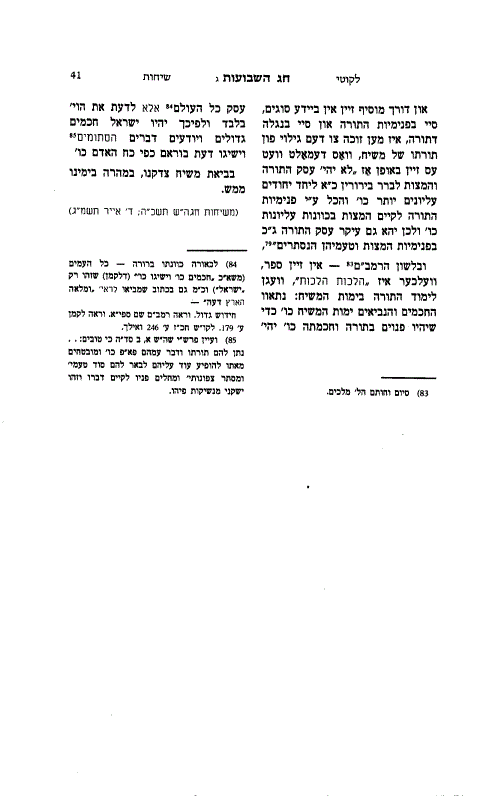
The Rebbe notes that through learning these laws—even those not presently actionable—we connect with their inner meaning and draw down their influence into our lives. This process will be fully realized with the coming of Moshiach when all aspects will once again be fulfilled both spiritually and physically.
Key Points
1. At Matan Torah, Hashem invested His very essence—His "atzmus"—into the Torah, making it not just a body of wisdom or law but an eternal expression of divinity that cannot be exchanged or altered.
2. The eternity of Torah applies to all its parts: written Torah, oral Torah, and even future insights by diligent students. Every aspect was included at Sinai and shares in this unchanging quality.
3. While some mitzvos or prohibitions are conditional—dependent on time, place, or circumstance—their limitations are built into their definition and do not contradict the eternal nature of Torah.
4. Questions arise regarding medical advice and segulos in the Gemara and Rambam that seem outdated or ineffective today. If these are part of eternal Torah law, how can their practical relevance change?
5. The Rambam codifies health-related guidance as halacha, not merely as practical advice. This raises the issue of why such laws are presented as eternally binding if their effectiveness depends on changing human nature or medical knowledge.
6. The Rebbe explains that mitzvos whose fulfillment depends on external conditions—such as the existence of certain nations—remain eternally valid even if they cannot always be performed. Similarly, health laws remain part of Torah even if their practical application changes with circumstances.
7. Fundamentally, Torah speaks primarily about spiritual realities in the upper worlds; its truths are eternal above, even when they do not always manifest physically below. The physical observance is an extension of these higher realities.
8. Learning about mitzvos—even those not currently actionable—connects us to their spiritual essence and draws down their influence. With the coming of Moshiach, all aspects will once again be fulfilled both spiritually and physically.