Introduction
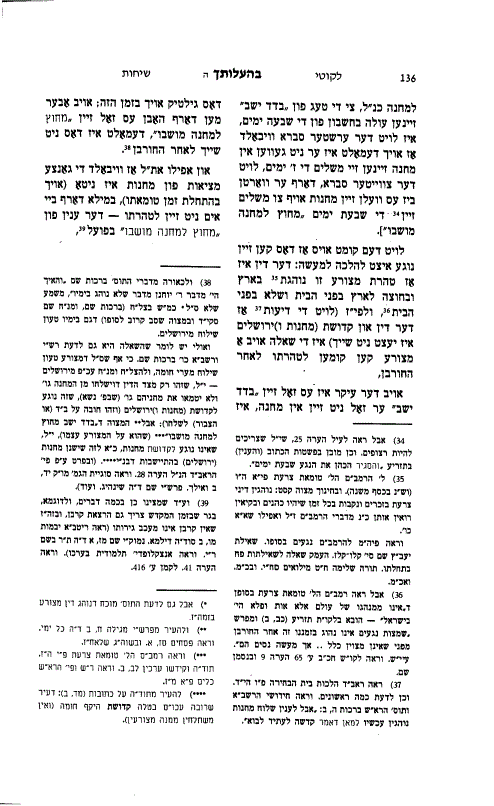
This sicha, from Likkutei Sichos volume 18, is the final sicha on Parshas Beha'aloscha. It is a unique and foundational talk in which the Rebbe discusses the episode of Miriam and the lessons that emerge from it. The focus is on the narrative where Miriam was afflicted with tzaraas and had to remain outside the camp for seven days. The Rebbe examines this episode in depth, raising several questions about what happened and what would have occurred if the Jewish people had traveled during those seven days.
The central issue is that Miriam needed to be outside the camp for a full week. If the community had traveled during that time, she would have had to travel together with them, but she could not be outside the camp if they were not stationary—if they were not camping in one place. This leads to an interesting insight: it seems that her seven days of isolation were only counted when Bnei Yisrael were encamped, not while traveling. Therefore, her period of separation was effectively extended until there was a full seven-day period during which she could be outside the camp, as will be explained further in the sicha.
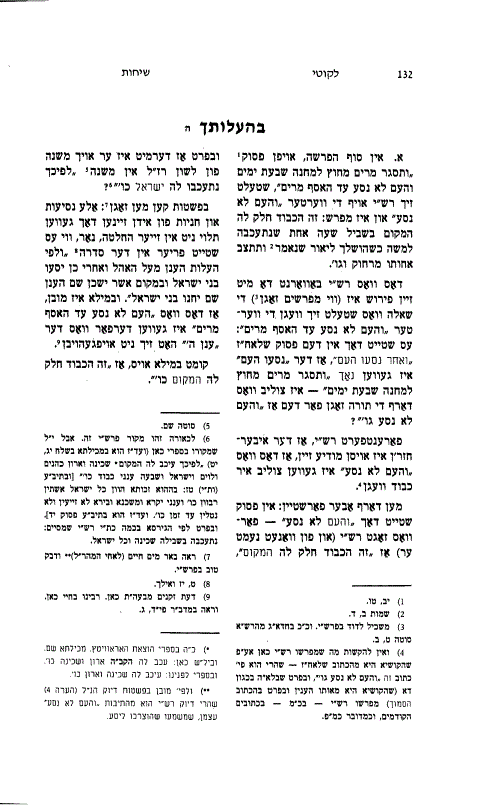
The Torah states regarding this episode:
ותסגר מרים מחוץ למחנה שבעת ימים והעם לא נסע עד האסף מרים.
"And Miriam was shut out of the camp for seven days; and the people did not travel until Miriam was brought back."
This verse indicates that Miriam had to remain outside for seven days and that Bnei Yisrael did not travel until she returned. Rashi addresses several questions raised by this verse—specifically, why did the nation wait for her? What was so significant about this event?
Rashi explains that Hashem honored Miriam by causing all of Israel to wait for her. This honor was given to her as a reward for waiting for Moshe when he was placed in the river as a baby. In that moment, she stood watch over him, as it says: "And his sister stood from afar to know what would be done to him." Because she waited for Moshe, Hashem arranged that all of Israel would wait for her.
The Rebbe asks: What exactly is Rashi coming to clarify here? As some commentators point out, there are questions about the phrase "the people did not travel until Miriam returned." Why does the Torah emphasize that they waited? What is being taught by this detail?
Thus, Rashi brings his commentary to address these questions and highlight the deeper meaning behind Bnei Yisrael's decision to wait for Miriam’s return before continuing their journey.
Saif Aleph
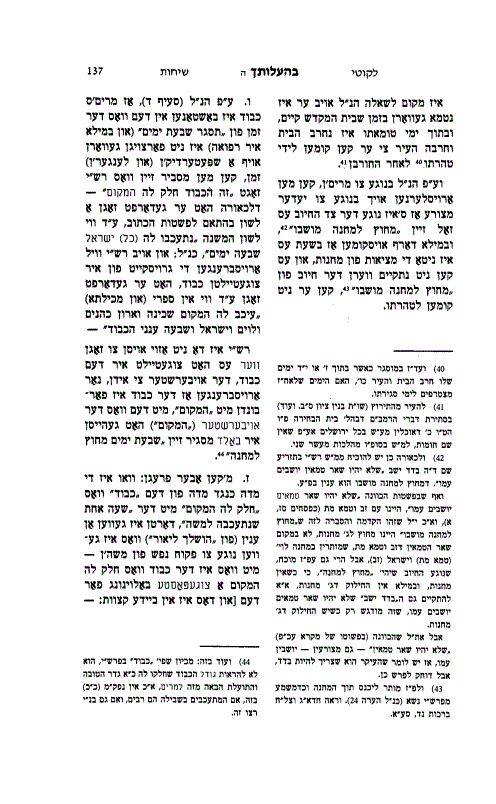
The Rebbe begins by questioning why the verse needs to state explicitly that the people did not travel while Miriam was isolated. Since the Torah already describes that they traveled only afterward, it should be obvious that during Miriam’s isolation, they remained in place. Why does the verse go out of its way to tell us this detail?
Rashi picks up on this nuance. He notes that the Torah is emphasizing something specific: when the leaders traveled, the people did not move until Miriam returned. The Torah wants us to know that their delay was directly connected to Miriam’s situation.
The Rebbe asks: why does Rashi say that this honor was given to “her,” meaning Miriam, and not to “the people”? The verse itself says “the people did not travel,” which could imply a collective experience or merit. Yet Rashi singles out Miriam as the recipient of this honor.
Furthermore, Rashi brings a teaching from the Mishnah in Sotah, which explains why the Jewish people waited for Miriam. According to the Mishnah, it was a reward for her having waited for Moshe when he was placed in the river as a baby. However, Rashi seems to shift focus from what appears in the plain text—where it says “the people did not travel”—to highlight specifically Miriam’s merit.
The Rebbe points out that throughout their journeys in the desert, Bnei Yisrael did not travel on their own initiative. They moved only according to Hashem’s command, as indicated by the movement of the cloud over the Mishkan. When the cloud lifted, they traveled; when it rested, they encamped. This is stated earlier in the parsha: wherever the cloud rested, there they camped; when it moved, they journeyed.
Therefore, if Bnei Yisrael did not travel while Miriam was isolated, it must have been because Hashem’s cloud did not move. The delay wasn’t merely a human decision—it was divinely orchestrated. This is what Rashi means when he says that Hashem gave her this honor “in that place.” It wasn’t just a general honor or reward; it was specifically expressed through Hashem causing them all to remain encamped until she rejoined them.
The Mishnah also understands that Bnei Yisrael’s delay was due to Hashem’s intervention—the cloud didn’t move until Miriam returned. Still, there is an added dimension: even though Bnei Yisrael might have wanted to continue traveling (and perhaps even felt ready), they remained because Hashem willed it so as an honor for Miriam.
This leads to a subtle point: while technically no one could move without Hashem’s signal (the movement of the cloud), there is still significance in how this pause is described as an act of honor toward Miriam. It highlights her unique merit and how Hashem orchestrated events for her sake.
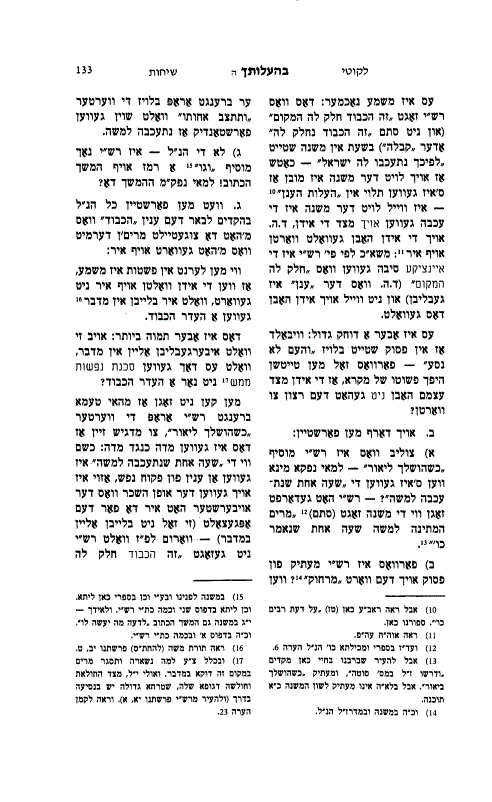
The Rebbe then raises another question about Rashi’s wording. Why does Rashi quote from the verse about Miriam waiting for Moshe—“vatitatzev achoso”—and add extra words like “mi’rochok” (“from a distance”)? Why doesn’t he simply quote what is necessary? And why does he add “begomer” (“etc.”), hinting at more of the verse? What difference does it make for us if we know only part or all of that verse?
Finally, there is a practical question: what does it mean that Bnei Yisrael gave honor to Miriam by waiting? Wasn’t this simply necessary for her survival? If they had left her alone in the desert, it would have been life-threatening—a matter of pikuach nefesh (saving a life). So how can we call this an act of honor rather than just basic decency or necessity?
To answer all these questions and clarify Rashi’s intent, we need first to understand what true honor (kovod) means in this context and how it applies specifically to Miriam’s situation.
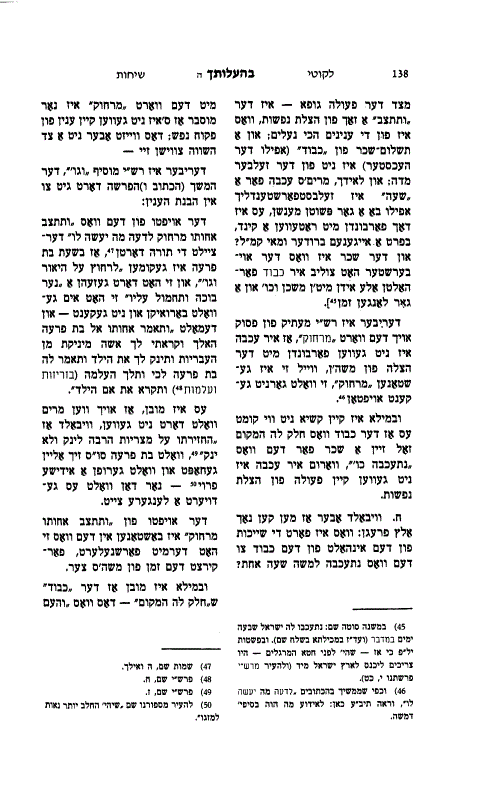
Saif Beis
When we look at the story of Miriam and the way the Jewish people waited for her, the simple reading suggests that if they had not waited, she would have been left alone in the desert. This would not only have been a lack of honor for her, but it would have left her isolated while everyone else moved on.
The Rebbe points out that this is more than just a matter of honor. If Miriam had actually been left alone in the desert, it would have posed a real danger to her life—sakones nefashos, an actual risk to her safety. It's not just about giving her respect; it's about protecting her from harm.
One might think to compare this to what Rashi says regarding Moshe Rabbeinu: when he was thrown into the river (kishu hushlach lioyer), Miriam watched over him and saved his life. Perhaps, then, when Miriam was in danger by being left alone in the desert, the Jewish people waited for her as a measure-for-measure reward—just as she saved Moshe's life, so too they saved hers.
However, if this were truly the case—if the main point was saving Miriam's life—then Rashi should not have emphasized honor (kovod) here. If it was about saving her life, why does Rashi frame it as an act of honor?
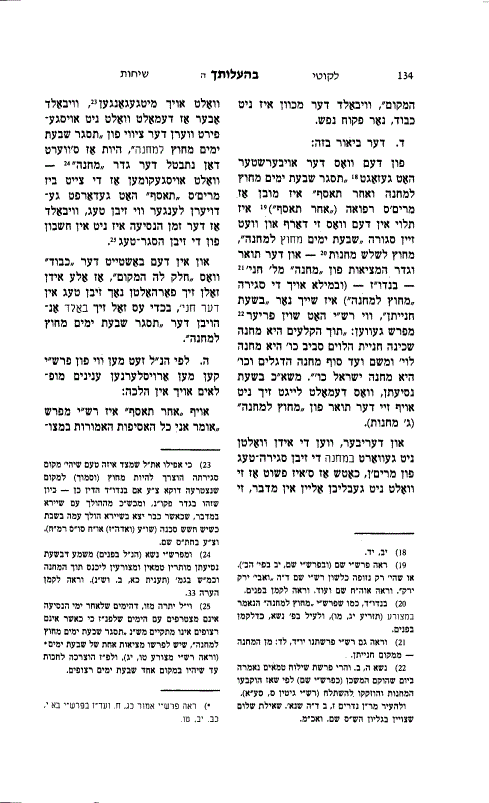
The Rebbe explains further (as will be elaborated in Section 4) that for Miriam to be healed from her tzaraas, she needed to remain outside the camp for seven days. This requirement could only be fulfilled while the camp was stationary. If Bnei Yisrael had traveled during those seven days, any time spent traveling would not count toward her period of isolation; only days spent outside a stationary camp would count.
This means that if they had not waited for Miriam and instead continued their journey, she would have had to wait even longer to complete her seven days outside the camp. The time spent traveling would not be counted toward her healing process.
Therefore, even though she wouldn't have literally been left behind—she would have traveled along with them—the process of her healing would have been delayed significantly. She needed seven full days outside of a stationary camp to fulfill the Torah’s command and receive her refuah.
This is why Hashem gave Miriam this special honor: all of Bnei Yisrael delayed their journey for seven days so that she could immediately begin and complete her period of isolation and healing without any unnecessary delay.
The Rebbe notes that this arrangement demonstrates true honor from Hashem toward Miriam. It wasn’t merely about saving her from physical danger; it was about ensuring that she could fulfill the requirements for healing in the most dignified and respectful way possible.
This sets up an important halachic insight: since being "outside of the camp" can only occur when there is an actual encampment (i.e., when Bnei Yisrael are stationary), any time spent traveling does not count toward such periods mandated by Torah law. The definition of "camp" applies only when they are resting—not while on the move.
This detail becomes significant in understanding how certain Torah laws are applied during times when Bnei Yisrael are traveling versus when they are encamped—a point which will be further developed as we continue learning.
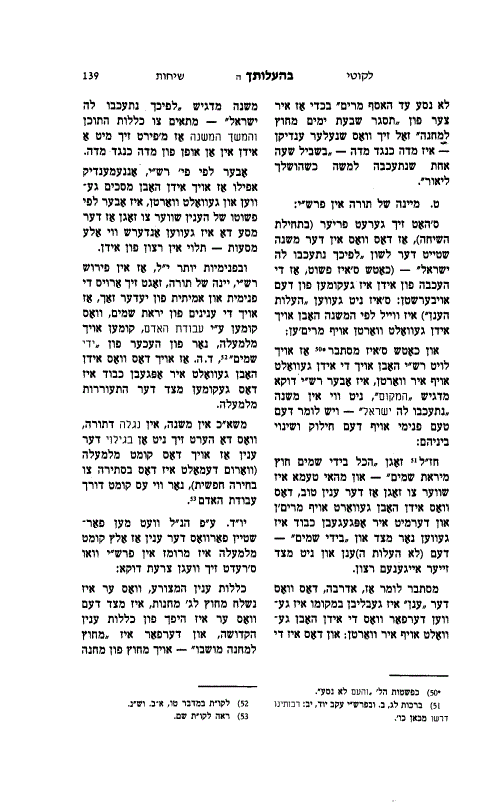
Saif Gimmel
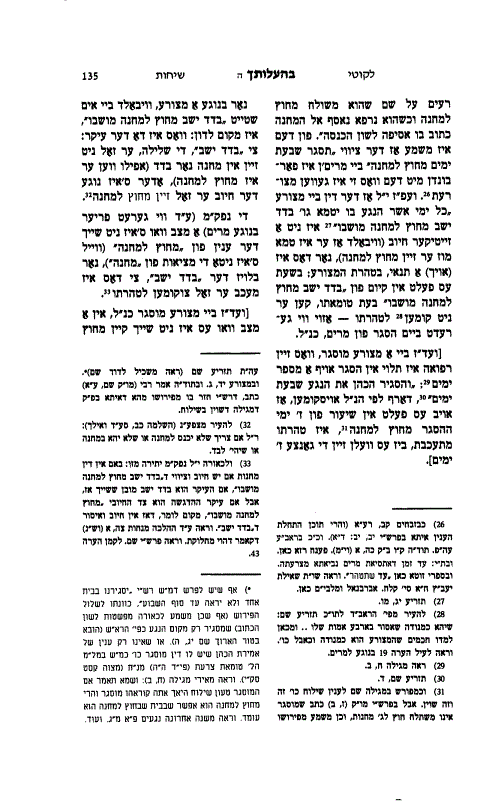
The Rebbe explains that in order for the seven days of separation to count for someone with tzaraas, there must be an actual camp from which the person is excluded. This is why, in the case of Miriam, Hashem gave her honor by having the entire nation wait for her, so that her seven days outside the camp would be consecutive and meaningful. Had this not happened, she would have had to accumulate seven days whenever the people were stationary, which could have stretched over a much longer period.
The Rebbe then applies this principle to a regular metzora. He questions whether the requirement of seven days outside the camp is simply because the person is tamei (impure), or if it is an independent condition necessary for their purification. In other words, is it just that a metzora cannot be inside the camp due to impurity, or does he specifically need to spend seven days outside as part of his process of becoming tahor (pure)?
He notes that even when someone is only suspected of being a metzora and is locked up for observation (a metzora muzgor), those days themselves must total seven. This period of isolation is not just incidental; it is essential to the process.
The Rebbe explores whether this requirement applies even today. Although we do not have actual cases of tzaraas now—since it was a miraculous phenomenon—he considers what would happen if there were a metzora but no camp. Could such a person become purified without fulfilling this requirement? The Rebbe suggests that these details will be explained further.
Based on all this, he points out that from Rashi’s commentary we can derive significant halachic insights. Rashi says regarding Miriam’s return, “then she shall be gathered in,” and explains that every mention of gathering in with regard to tzaraas refers to reentry after being sent outside the camp. When healed, one is gathered back into the camp—hence the use of “gathered in” as an expression of reentry.
Rashi thus connects Miriam’s story to all cases of metzora: being sent out and then gathered back in upon healing. From here it appears that Miriam’s command to remain outside for seven days was directly tied to her status as a metzora—as described after she spoke against Moshe Rabbeinu and was stricken with tzaraas.
The Rebbe now seeks to learn from this for all cases of metzora: As long as one has tzaraas, he remains tamei and must sit alone outside the camp. This isn’t merely a side effect of impurity—it’s an essential part of his purification process. Only by spending seven full days outside can he become pure; if this condition isn’t fulfilled—even if his symptoms disappear—he cannot yet be declared clean.
This principle also applies when someone is under observation (hesger) for possible tzaraas: The Torah requires him to be isolated for seven days before any further determination can be made about his status. If those seven days are not completed properly outside the camp, his purification cannot proceed.
Thus, just as with Miriam—where it was clear she needed exactly seven consecutive days outside—the same logic applies to any metzora or suspected case: The full period must be completed before reentry or purification can occur.
However, when examining the wording used by the Torah regarding a regular metzora (“bodod yeshev mechutz la-machaneh moshavo”—he shall dwell alone; his dwelling shall be outside the camp), there remains room for discussion about what exactly is required. Is the main point that he must simply be alone—not among others—or does he specifically need to be physically outside the camp?
This distinction has practical implications: If being “alone” suffices, perhaps any form of isolation fulfills the requirement; but if “outside the camp” is essential, then only physical exclusion from an actual encampment counts toward his purification process.
The Rebbe concludes that this question mirrors what was discussed regarding Miriam: Is it enough simply not to be among others (the negative aspect), or does there need to be a positive state of being outside? This subtlety affects how we understand both her case and those of other metzoraim throughout Jewish law.
Saif Daled
The discussion here revolves around a scenario where someone is in a situation where it is impossible to be “outside of the camp” because such a camp does not exist. The question arises: if the main requirement is for the person to be isolated and not mingle with others, does this suffice for the purification process, even though there is no actual camp to be outside of? Or, does the absence of a camp mean that the person cannot fulfill the necessary condition of being “outside the camp” for seven days?
This same question applies to a metzora musgar—someone who is quarantined due to suspected tzaraas. If there is no camp, but he remains isolated, do his days of isolation count toward the required seven days? According to one view, since the primary concern is that he should not intermingle and should remain alone, his isolation would count even without an actual camp. Thus, these days would fulfill his obligation.
However, according to another opinion, he must wait until there are actual camps established in order to complete his seven-day period outside of them. In other words, only when there are defined camps can he fulfill the requirement of being “outside the camp.”
The Rebbe notes that while this may seem theoretical today—since we do not have metzora in practice—the laws themselves still apply in principle. The halachos of metzora are relevant both in Eretz Yisroel and outside of it, whether or not the Beis Hamikdash stands. The question becomes: if someone were to become a metzora today, how could he fulfill this requirement when there are no camps?
If we follow the view that being alone suffices, then even nowadays this aspect could theoretically apply. But if being physically outside defined camps is essential, then after the destruction of the Beis Hamikdash—when there are no camps—the mitzvah cannot be fulfilled.
The Rebbe further explores whether perhaps today, since there never was a camp established in our time or place, there is no need for purification outside of it. But what if someone became a metzora during Temple times and only later sought purification after its destruction? Would he still require seven days outside a non-existent camp?
This leads back to Miriam’s case. Based on what we learn from Miriam—who was also considered a metzora, as Rashi explains—the Torah emphasizes that her seven days had to be spent outside the camp. This shows that being physically separated from the community was crucial for her purification process.
The Torah describes how Bnei Yisroel waited for Miriam so she could complete her period outside the camp before they traveled on. This demonstrates that her honor consisted specifically in remaining at that location for seven days so she could undergo her purification properly.
The implication is clear: just as by Miriam they waited so she could fulfill her seven days outside an actual camp, so too in any case where there are no camps (according to those opinions), one cannot fulfill this obligation and thus cannot achieve purification as prescribed by Torah law.
The Rebbe clarifies again that practically speaking this does not apply today because we do not have metzora or defined camps. However, conceptually and halachically, these distinctions remain significant.
Finally, Rashi’s use of language is highlighted: Rashi says “that place,” emphasizing that it was specifically at that location where Miriam’s honor was demonstrated by waiting out her seven days. It was not merely about delaying travel but about remaining at that spot so her period of isolation would begin and end right there.
This underscores how Miriam’s honor lay in allowing her full period of separation and healing to take place without interruption or displacement.
Saif Hei
When we consider the honor given to Miriam, we see that it was not simply delayed or stretched out over a longer period of time. Rather, as Rashi explains, this was a unique form of honor—zeh hakavod shechilek lah haMakom, “this is the honor that the Makom (the Omnipresent) gave her.”
It’s important to notice Rashi’s choice of words. Instead of using a phrase that matches the simple meaning of the verse, or echoing the language of the Mishnah—which says that all of Israel was delayed for seven days—Rashi chooses to emphasize the honor itself. If Rashi wanted to highlight how great this honor was, he could have quoted from Sifri or Mechilta, which describe how Hashem held back not only all of Israel but also the Divine Presence, the Kohanim, Leviim, Yisraelim, and even the clouds of glory. Yet Rashi does not do this.
The reason is that Rashi’s focus is not on who gave Miriam this honor or how many were involved. Rather, he wants us to understand that the essence of this honor is its immediacy—it was tied to haMakom, meaning both “the place” and “the Omnipresent.” Hashem Himself commanded that Miriam be honored right away; there was no delay.
This leads to a question: Is this truly measure for measure (midah keneged midah)? Miriam waited by the river to save Moshe’s life—a matter of life and death. In contrast, her reward seems to be merely an act of honor: everyone waited for her for seven days. How can these two acts be compared?
On one hand, saving a life is one of the greatest possible deeds. To reward such an act with mere honor—even if it is great—doesn’t seem like an equal exchange. On the other hand, Miriam’s waiting by the river was something any person would do in such circumstances, especially for their own sibling. Why does this merit such extraordinary recognition?
That’s why Rashi adds another detail: Miriam stood “from a distance.” This means her waiting did not directly save Moshe’s life; she could not intervene physically if something had happened. Her act was more about concern and watchfulness than direct action.
This helps explain why her reward is also somewhat indirect: everyone waited for her—not because she saved Moshe’s life directly, but because she showed care and concern from afar. The Torah emphasizes this by quoting “from a distance,” showing that her involvement was limited.
Still, there remains a gap between what she did and what she received. That’s why Rashi adds “etc.”—to point us to the rest of the story in the Torah portion. The full narrative explains what happened as a result of Miriam standing at a distance: when Pharaoh’s daughter came to bathe in the river and found Moshe crying, she had compassion on him but could not calm him down. At that moment, it was Miriam—standing from afar—who stepped forward and suggested bringing a Hebrew nursemaid for Moshe.
This detail ties everything together: although Miriam’s initial act seemed small—just waiting from afar—it ultimately led to Moshe being saved and cared for properly. Thus, her reward is fitting: just as she waited for Moshe in his time of need (even if only from a distance), so too did all Israel wait for her when she needed healing.
Saif Vov
The story continues with Pharaoh’s daughter asking, “Shall I go and call you a nursing woman from the Hebrews?” She offers to find someone who can nurse the baby Moshe.
Rashi explains that Moshe’s sister acted quickly and with zeal. She immediately went and called the mother of the baby—Moshe’s own mother—to nurse him. This haste was significant, as it shortened the time Moshe would have suffered without anyone to nurse him.
If not for this intervention, eventually Pharaoh’s daughter would have realized she needed a Jewish woman to nurse Moshe, but it would have taken much longer. The pain Moshe experienced in the meantime would have been prolonged.
Therefore, what did Miriam accomplish by standing at a distance? She was able to speed up the process and minimize her brother’s suffering. In this way, she brought about a great benefit for Moshe by ensuring he was nursed right away by his own mother.
This act of compassion is directly connected to the honor Hashem later gave Miriam. The Torah tells us that when Miriam was afflicted with tzaraas and had to be outside the camp for seven days, the entire nation waited for her before journeying on. Her pain was not extended unnecessarily; rather, her suffering was completed as quickly as possible.
This is measure for measure—midah keneged midah. Just as Miriam helped to shorten Moshe’s pain, Hashem honored her by ensuring her own pain was not drawn out. Because she delayed herself for Moshe’s sake, making sure he received immediate care, Hashem arranged that her period of isolation would also be completed promptly and that all of Israel would wait for her return.
The Rebbe now turns to Rashi’s commentary on this episode. Rashi uses the phrase that “the people did not journey until Miriam was gathered in,” echoing the language of the Mishnah which says “the people were delayed.” The Rebbe analyzes whether this delay was solely due to Hashem’s will or if it reflected the will of the people as well.
According to Rashi, everything depends on Hashem—if He wants them to wait, they wait. However, perhaps Hashem actually responded to the desire of Bnei Yisrael themselves; maybe they wanted to honor Miriam and therefore did not travel until she returned.
The Mishnah says “the people were delayed,” which could imply it was their choice. But in truth, they stayed because the cloud—the sign of Hashem’s presence—did not move. So ultimately, it was Hashem who determined when they could travel.
Still, there is logic in saying that Bnei Yisrael wanted to wait for Miriam out of respect and gratitude for what she had done. Rashi emphasizes that it was Hamokim—Hashem—who caused them to wait, while the Mishnah highlights the role of the people themselves.
The difference between Rashi and the Mishnah may reflect a broader principle: everything comes from Hashem except for fear of Heaven (yiras Shamayim), which is up to each person. Good deeds must originate from human initiative; thus, when Bnei Yisrael waited for Miriam, it wasn’t only because Hashem kept them there—it also reflected their own will and gratitude toward her.
This fits with the general theme found throughout Chazal: Hashem conducts Himself with us measure for measure. Because Bnei Yisrael wanted to delay their journey out of respect for Miriam—just as she had once delayed herself on behalf of Moshe—their honor toward her became part of their collective merit and experience.
Saif Zayin
Even if we were to say that Rashi agrees the Jewish people wanted to wait—that they themselves desired to remain at this encampment—the simple reading makes it difficult to claim that this journey was fundamentally different from all other journeys. It would be unusual to say that here, uniquely, the decision was left up to the will of the people, as if their desire alone determined the outcome.
We can explain, even within Rashi’s commentary—which always expresses both the inner and essential truth of every matter—that even those aspects of Judaism which seem to depend on human initiative, on the service of the Jewish people themselves, ultimately originate from above. It is not that these things are merely “left up to” people; rather, they are rooted in a higher source. The very fact that the Jews wanted to give honor in this case also stemmed from an awakening from above.
This is why Rashi does not state that it came solely from them. Everything comes from Hashem—it originates from a level higher than human initiative. In contrast, in the Mishnah—which represents the revealed dimension of Torah—this idea is not openly expressed. There, you cannot say explicitly that even higher levels of service come from above, because doing so would contradict the principle of free choice and personal effort in serving Hashem.
Therefore, in the Mishnah it is stated simply: it was up to the people. This preserves the emphasis on human agency and free will in avodas Hashem.
Now, based on all of this, we can understand why everything fits with Rashi’s approach—both his clarity and his allusions. When Rashi chooses to use the term “Hamokim”—the Omnipresent—even though one might think it was also due to the Jews’ own desire, he is hinting at a deeper truth.
The general idea behind a metzora—a person afflicted with tzaraas who is sent outside all three camps—is that he stands in opposition to holiness. That is why he must sit outside: he does not belong within any level of sanctity, not even within the lowest camp of Israel. This demonstrates just how distant he is—even from those on the lowest rung within Israel’s encampment.
This provides an inner explanation for why those who are outside must be placed there—not just left alone somewhere undefined. If there were no camp at all, you could not see what it means to be “outside” holiness; there would be no boundary or contrast. Therefore, one must be put outside specifically so that his distance from holiness becomes apparent.
Similarly, even fear of Heaven—yiras shamayim—ultimately comes from above. This idea is hinted at in relation to the metzora, especially regarding his encouragement and hastening toward purification. Generally speaking, for someone as spiritually distant as a metzora, true purification can only come through an arousal from above—as explained elsewhere.
This is why it says regarding him that he must be brought before the King—dragged there against his will if necessary. For someone who has fallen so low spiritually, it is extremely difficult for him to arouse himself willingly toward repentance and return; left on his own, such an awakening may never occur.
The Torah therefore instructs: he must be brought forcibly before Hashem—the King—because only an arousal from above can reach someone at such a low point. This stems from Hashem’s promise that no one will ever be pushed away entirely; everyone retains access to return and connection with Hashem.
This divine assistance gives a person strength—Hashem helps him along this path—and this is what we mean by “mesaye’a,” heavenly help. That is why we find a hint here: everything ultimately comes from Hamokim—even attaining fear of Heaven itself requires divine assistance.
That requires yiras shamayim, yet it still comes entirely as a gift from above: דן אסין אסקאיחה קדישברכו איזרעדיסו מסיחס שבס פרשס בהעלותך תפשין חפאי (Dan asin askaycha Kadosh Baruch Hu izraddisu mesichas Shabbos Parshas Beha’aloscha 5725).
Key Points
1. The episode of Miriam’s tzaraas and her seven-day isolation outside the camp highlights a unique honor given to her by Hashem: all of Bnei Yisrael delayed their journey until she was healed and returned, demonstrating the Torah’s emphasis on her merit and the significance of this event.
2. Rashi explains that this honor was a direct reward for Miriam’s earlier act of waiting for Moshe as a baby by the river. The delay was not merely practical or necessary, but an explicit act of respect orchestrated by Hashem, underscoring the value of Miriam’s concern for Moshe.
3. The Rebbe clarifies that Miriam’s period of isolation could only be fulfilled while Bnei Yisrael were encamped; time spent traveling would not count toward her seven days. Thus, waiting in place allowed her healing process to proceed without unnecessary delay, reflecting true honor rather than just safeguarding her well-being.
4. This principle applies to all cases of metzora: the requirement to be “outside the camp” for seven days is an essential part of purification, not just a consequence of impurity. Only days spent outside an actual encampment count toward this process, raising important halachic implications for both historical and theoretical cases.
5. The discussion extends to situations where there is no camp—such as after the destruction of the Beis Hamikdash—questioning whether isolation alone suffices or if physical separation from a defined camp is indispensable for purification. The case of Miriam serves as a model for understanding these laws in all generations.
6. Rashi’s language emphasizes that the honor given to Miriam was immediate and divinely commanded, not simply a result of collective decision or necessity. This distinction highlights how Hashem Himself orchestrated events to bestow kavod upon Miriam in direct response to her earlier actions.
7. The measure-for-measure nature of Miriam’s reward is nuanced: although she waited “from a distance” and did not directly save Moshe’s life, her concern led to his salvation. Similarly, Hashem ensured that her suffering was not prolonged, mirroring her compassion with timely honor and care from all Israel.
8. The interplay between divine will and human initiative is explored: while Bnei Yisrael may have desired to wait for Miriam out of gratitude, ultimately it was Hashem’s command—signaled by the cloud—that determined their actions. This reflects a broader theme that even human-driven mitzvos are rooted in an awakening from above.
9. The concept of being “outside the camp” serves as both a physical and spiritual boundary, illustrating how distance from holiness is made manifest through exclusion. For those spiritually distant like a metzora, true return and purification require divine assistance—an arousal from above that enables even those farthest away to reconnect with Hashem.
10. Ultimately, the story teaches that every Jew retains access to teshuvah and connection with Hashem; even when one cannot arouse themselves spiritually, Hashem provides help from above. This assurance underlies both the laws discussed and their deeper spiritual message about divine compassion and support for every individual.