Introduction
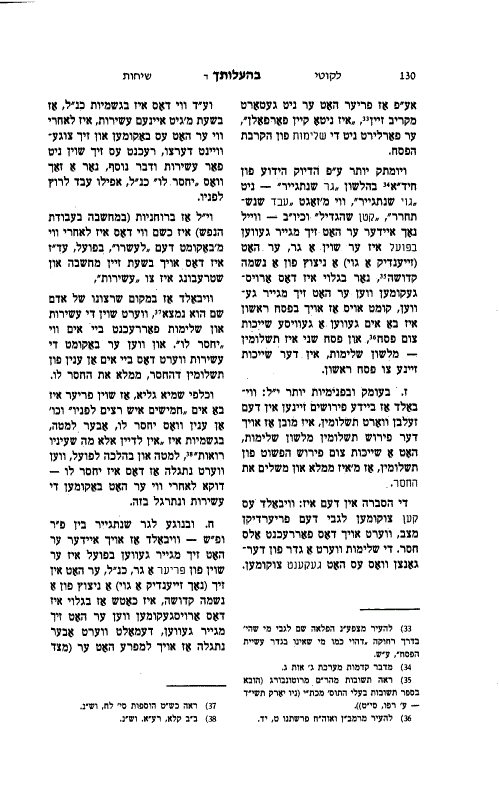
This sicha, from Likkutei Sichos volume 18, is the fourth sicha on Parshas Beha'aloscha. It builds directly on the previous sicha in the same volume—Beha'aloscha Gimel—where the Rebbe discussed Pesach Sheni and its significance from a different angle. The focus here is to further explore the nature of Pesach Sheni, especially through the lens of halacha and its spiritual implications.
The Previous Rebbe often emphasized that Pesach Sheni teaches us a powerful lesson: it is never too late. There is always an opportunity to make up for what was missed in the past. This theme resonates throughout the discussion, as the Rebbe examines various opinions regarding what Pesach Sheni truly represents.
In particular, there are three main views about the nature of Pesach Sheni, as discussed in the earlier sicha. One prominent view is that of Rabbi Yehuda HaNasi (Rebbe), which is also how the Rambam rules in halacha: Pesach Sheni is considered a yom tov in its own right—a regel bifnei atzmo. According to this opinion, if someone becomes obligated after Pesach Rishon—such as a convert or a minor who comes of age—they are still required to bring the korban Pesach on Pesach Sheni, even though they were not obligated for Pesach Rishon.
This raises an important question: If someone was never obligated in Pesach Rishon—because they were not Jewish yet or were still a child—how does the idea of “nishtokim farfalin,” that nothing is ever lost, apply? In such cases, Pesach Sheni isn’t simply making up for something missed; rather, it stands as an independent obligation.
If we say that Pesach Sheni is a regel bifnei atzmo—a festival with its own status—it’s not just about compensating for missing out on Pesach Rishon. Instead, it introduces its own unique mitzvah and obligation at this later time. Of course, if someone already brought the korban on Pesach Rishon, they do not bring it again on Pesach Sheni. The Rebbe will address these distinctions and clarify how each opinion shapes our understanding of what “making up” truly means in this context.
In fact, as will be explained further in the sicha, according to Rebbe’s view there is an even deeper fulfillment of tashlumim—making up for what was missed—in that Hashem provides not just another chance but an entirely new designated time (yudaled Iyar) for this mitzvah. This unique approach highlights both practical halachic ramifications and profound spiritual lessons about opportunity and renewal.
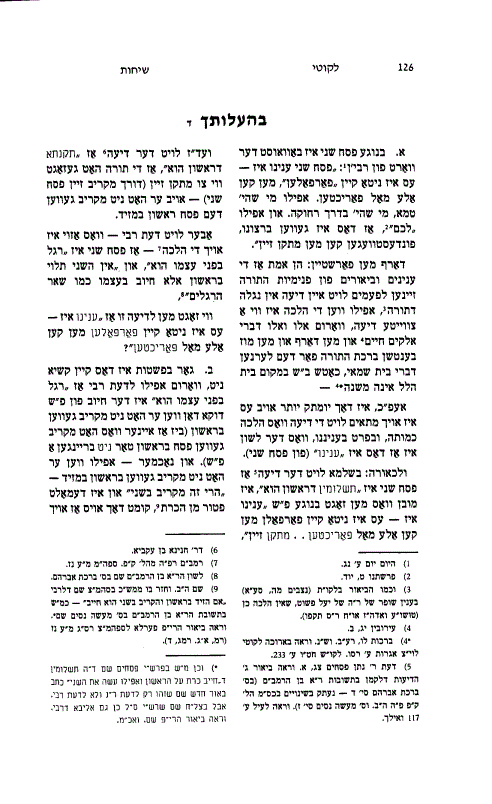
Saif Aleph
The concept of Pesach Sheni is famously summarized by the Rebbe with the phrase: “It’s never too late; you can always fix.” Even someone who was impure, or on a distant road, or even if their situation was intentional—meaning they deliberately made themselves unavailable for the first Pesach—still has the opportunity to correct and bring the offering on Pesach Sheni.
This idea, that there is always a chance to repair and make up for what was missed, is powerful. However, we must ask: does this teaching fit with all halachic opinions about what Pesach Sheni actually is? Not necessarily. Sometimes, a spiritual explanation may align with only one view among several in halacha. Even if the law follows a different opinion, it’s still valid to explain a concept according to any authentic Torah perspective, since “these and those are the words of the living God.”
For example, when studying the words of Beit Shammai—even though their rulings are not accepted as halacha—one still recites the blessing over Torah study. Their teachings remain part of Torah and have value. So, it’s legitimate to interpret Pesach Sheni’s message according to one opinion even if it doesn’t match the final halacha.
Nevertheless, it is especially satisfying when a deeper explanation also fits with the actual halacha. Since the Rebbe’s phrase describes what Pesach Sheni is at its core, it would be ideal if this message could be understood in line with how Pesach Sheni functions according to Jewish law.
Let’s examine how this works in practice. According to one opinion—that Pesach Sheni serves as a make-up for missing the first Korban Pesach—the idea that “it’s never too late” fits perfectly. If someone missed out on bringing the first offering, they have another chance; they can correct their situation by bringing it on Pesach Sheni.
There is another view that goes further: not only does Pesach Sheni allow you to make up for what you missed, but from the outset, Torah provides a second opportunity. The Torah itself establishes that if you don’t bring the first offering, you are given an alternative time—the second Pesach—to fulfill your obligation. This isn’t just about making up for a violation; it’s about having an inherent path to correction built into the system.
The practical difference between these two opinions becomes clear in cases where someone misses both opportunities due to accident (shogeg). If Pesach Sheni is merely a make-up (tashlumim), then failing to bring either offering—even unintentionally—results in liability for karet (spiritual excision) because you missed your chance entirely. But if Torah originally provided two options from the outset (takana), then missing both due to accident would not incur karet; you were never fully obligated at any single moment without recourse.
This distinction is discussed at length in previous sichos and in Chalik Yud Ches (volume 18) of Likkutei Sichos on Parashas Beha’aloscha. Both opinions agree that Pesach Sheni offers some form of correction for missing out on bringing Korban Pesach during its original time.
According to Rebbe’s preferred view—which also aligns with halacha—Pesach Sheni represents not just a technical make-up but an intrinsic second chance embedded within Torah itself.
Saif Beis
The first opinion discussed is that Pesach Sheini is considered a regel bifnei atzmo—its own independent festival. According to this view, even if a person was not obligated in Pesach Rishon, he would still be required to bring the Korban Pesach on Pesach Sheini. The obligation of the second festival does not depend on the first; it stands alone, just like any other holiday. This means that even if someone was not required to bring the first Korban Pesach, he still has an obligation for the second.
This leads to a question about the oft-quoted idea that Pesach Sheini teaches us “it’s never too late”—that one can always repair or make up for what was missed. If someone was never obligated in the first place, there is nothing to fix! In such cases, Pesach Sheini is not about making up for a missed opportunity but rather about fulfilling its own unique mitzvah.
The Rebbe points out that even according to this opinion, if someone already brought the first Korban Pesach, he does not bring a second one on Pesach Sheini. The mitzvah of Pesach Sheini only applies when the first offering was not brought. In fact, if someone did bring the first Korban Pesach, he is not allowed to bring another on Pesach Sheini.
Furthermore, even if a person intentionally did not bring the first Korban Pesach (b’meizid), he can still fulfill his obligation by bringing it on Pesach Sheini. Doing so exempts him from the severe punishment of kares. This demonstrates that even according to the view that Pesach Sheini is an independent festival, it still serves as a form of rectification for missing out on Pesach Rishon—it’s “not too late.”
This is reflected in the actual story behind the institution of Pesach Sheini. The Torah introduces it as a solution for those who were unable to bring the Korban Pesach at its proper time due to impurity or distance:
איש איש כי יהיה טמא לנפש או בדרך רחוקה לכם או לדורותיכם ועשה פסח לה׳ בחודש השני בארבעה עשר יום בין הערבים יעשו אותו על מצות ומרורים יאכלוהו.
"If any man shall be impure by reason of a soul or be on a distant journey, whether you or your generations after you, he shall offer a Passover-offering to Hashem in the second month, on the fourteenth day in the afternoon; they shall eat it with matzos and bitter herbs."
Peshuto shel mikra (the plain meaning) shows that Pesach Sheini was given as a make-up opportunity for those who missed out on bringing Korban Pesach at its proper time. Even if we call it an independent festival (regel bifnei atzmo), its origin and function are clearly tied to making up what was missed during Pesach Rishon.
This raises an important question: If it's truly an independent festival, why does it function as a make-up? And why is one only liable for kares (spiritual excision) if he fails to bring both offerings? The answer is that while it has its own status and obligations—for example, one who misses both is liable for kares—its primary role remains as compensation for missing out on the original mitzvah.
The Rambam rules that even someone who converts between Pesach Rishon and Pesach Sheini or a minor who becomes bar mitzvah during this period must bring Korban Pesach on Pesach Sheini. This seems difficult: how can we say “it’s never too late” for these individuals when they were never obligated in the first place?
The Rebbe addresses this by distinguishing between different cases. For a minor who becomes an adult between the two festivals, there is some connection: minors can be included in their family’s Korban Pesach offering during their childhood. The Torah requires each family unit to participate together in bringing and eating from their sheep, which includes minors as part of that group.
The Rambam actually rules that if a minor was included with his family in bringing Korban Pesach during his childhood and then became bar mitzvah before Pesach Sheini, he would be exempt from bringing another offering on Pesach Sheini. This demonstrates that there remains some link between his earlier participation and his new obligation as an adult.
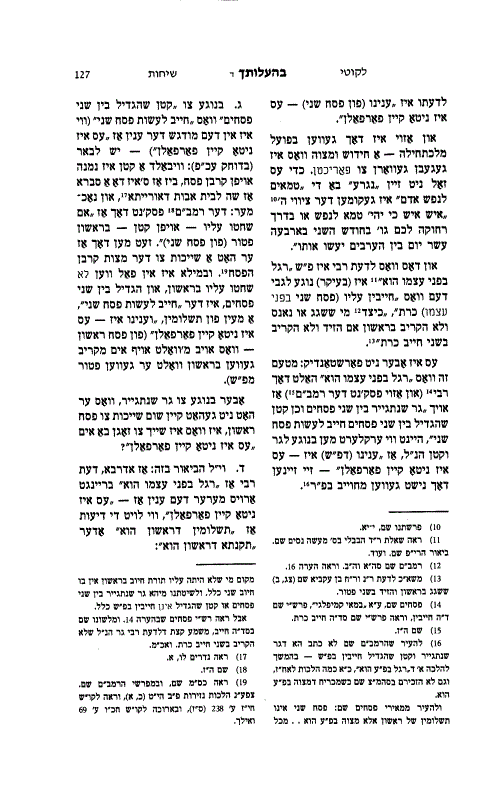
Saif Gimmel
When it comes to a minor who was not included in the original Korban Pesach, but then becomes an adult between the first and second Pesach, there is a unique situation. Since he had some association with the first Korban Pesach—he could have been included if others had chosen to do so—his obligation for Pesach Sheni is seen as a makeup for what was missed. If they had included him originally, he would have been exempt from bringing the second offering. Because they did not, he now has the opportunity to fulfill his obligation through Pesach Sheni.
This concept highlights that Pesach Sheni is not simply about making up for something missed; it’s about the idea that “it’s never too late.” Even though he wasn’t counted in the first Korban Pesach, he now has a chance to participate through Pesach Sheni. The Torah provides this opportunity as a form of rectification for what was lacking during Pesach Rishon.
However, when considering a convert who became Jewish between the two Pesachs, the situation is different. He had no connection whatsoever to the first Korban Pesach—he wasn’t Jewish at that time and therefore had no obligation. The question arises: how does the idea of “it’s never too late” apply here? There was nothing for him to make up since he wasn’t obligated in the first place.
The Rebbe explains that, according to Rebbe’s opinion—that Pesach Sheni is its own independent festival—this actually emphasizes even more strongly that “it’s never too late.” It’s not just about making up for something missed; rather, there is an entirely new opportunity and obligation created by the Torah. This new time frame allows anyone who qualifies at this point—including converts and those who became adults—to bring their own Korban Pesach.
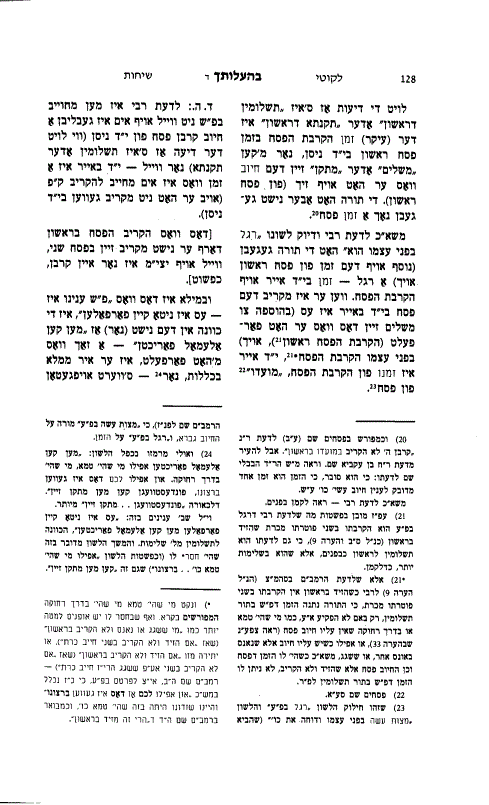
According to opinions that view Pesach Sheni as merely a makeup or rectification for missing the first one, the main time for fulfilling this mitzvah remains with Pesach Rishon on the 14th of Nisan. If someone missed it, they are given a personal opportunity to make up what they lost—but only because of their previous obligation. The Torah did not establish another official time; it simply allowed individuals to fulfill what they missed.
In contrast, Rebbe holds that there are two distinct times: one on the 14th of Nisan and another on the 14th of Iyar. The Torah established both as legitimate times for bringing a Korban Pesach. If someone didn’t bring it on Nisan 14th, there is now a new period—the 14th of Iyar—when this mitzvah can be fulfilled. This isn’t just about making up; it’s about having a new designated time for this mitzvah.
This means that according to Rebbe, your obligation to bring Korban Pesach on Pesach Sheni isn’t because you still carry an unfulfilled responsibility from Nisan—it’s because there is now a new time when you are obligated to bring it. The Torah created an additional period specifically for this purpose.
If someone already brought their offering on Nisan 14th, they don’t bring another one on Iyar 14th because you can only bring one Korban per year. But if you didn’t participate in Nisan, then Iyar becomes your new opportunity—the Torah gave you another official time slot.
This idea—that “nothing is ever lost”—is not just about fixing something in general terms or filling in what was missing before. Rather, it means that you can achieve complete fulfillment of the mitzvah in all its details during this new period. The act performed on Pesach Sheni stands as its own complete fulfillment—not merely as compensation for something lacking earlier.
Therefore, both converts who converted between the two dates and minors who became adults are included in this new obligation. Even though they weren’t previously obligated or didn’t miss anything (since their status changed after Nisan), once Iyar arrives and they are now eligible, they become fully obligated like anyone else.
The Torah thus gives them—not just an opportunity to fix something from before—but an entirely new obligation and chance to perform this mitzvah at its proper time for them.
The Rebbe further notes that while Rebbe’s view emphasizes this new timeframe and independent obligation, there remains an aspect of tashlumim—making up or completing—involved here as well. Tashlumim can mean both making up what was missing and achieving wholeness or completeness in fulfilling the mitzvah.
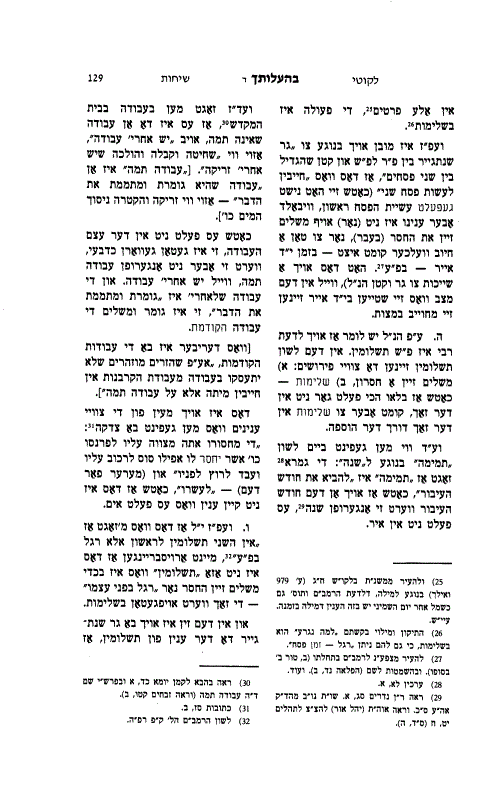
Saif Daled
The concept of shleimus—wholesomeness or completeness—applies even in situations where nothing is lacking in the item itself. Sometimes, an addition brings about a new level of completeness. For example, when the Torah refers to a “shana temimah”—a complete year—it includes the leap month. Even though a regular twelve-month year is not lacking anything, adding the extra month makes it “temimah,” fully complete.
A similar idea appears in the service of the Beis Hamikdash. There are certain services that are not considered “complete” (avodah she’eina temimah)—not because they are missing something essential, but because another service follows them. For instance, shechitah, kabbalah, and holachah (slaughtering, receiving, and bringing the blood) are not called complete services since they are followed by zerikah, the sprinkling of blood on the altar.
A “complete service” (avodah temimah) is one that finishes and perfects the matter at hand. Examples include zerikah (sprinkling), haktarah (burning on the altar), or pouring water on the altar during Sukkos. After these acts, there is nothing further required for that particular offering—they bring closure and completion.
This means that even if an earlier stage was performed properly and nothing was lacking in its execution, it is not called a “complete avodah” if another step follows. Only when there is no subsequent service does it achieve full status as an avodah temimah.
This distinction has halachic consequences: although non-kohanim (zarim) are warned not to perform any part of the sacrificial service, they are only liable for death if they perform a “complete avodah.” The earlier steps do not carry this penalty because they do not constitute completion.
This idea of completeness—temimus—is also found in the mitzvah of tzedakah. The Torah says to give a person what he lacks (“dai machsoro asher yechsar lo”), meaning you must provide for his needs. But then it adds that even if he needs a horse to ride on or a servant to run before him, you must provide those too if that’s what he’s accustomed to. This goes beyond filling what’s lacking; it elevates him to his previous standard or even higher.
So there are two levels: one is filling what’s missing—basic shleimus—and another is adding an extra dimension of completeness beyond mere necessity.
The Rebbe explains that this second interpretation—tashlumim, meaning bringing about wholesomeness—fits with Pesach Sheini as well. Even though Pesach Sheini is not simply a makeup for Pesach Rishon but stands as its own festival (regel bifnei atzmo), it still brings about a form of completion or perfection.
This helps us understand why we say Pesach Sheini is not just a makeup for what was missed at Pesach Rishon, but rather it is its own holiday that brings about its own unique shleimus—not just filling in what was lacking, but adding something new and whole.
This concept also applies to converts (ger she’nitgayer). Even though before conversion he could not bring the Korban Pesach, nothing is lost; he does not lose out on shleimus regarding bringing his offering. The opportunity for wholeness remains available through Pesach Sheini.
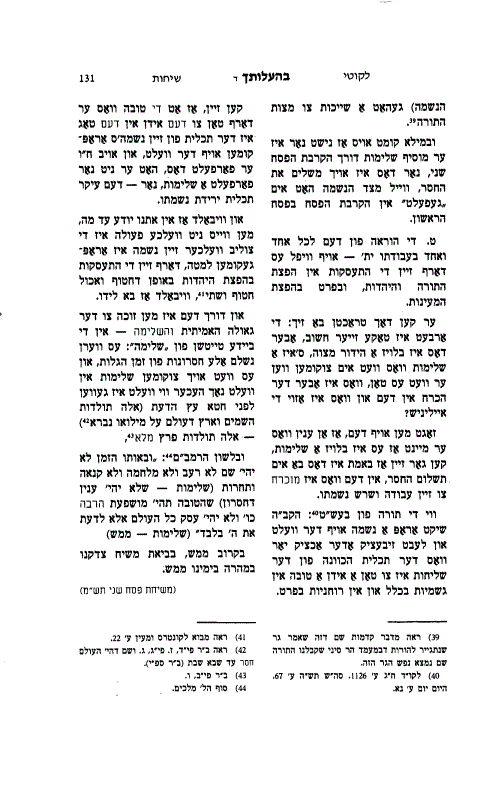
This idea becomes clearer based on the precise language used by Chida: The Mishnah says “ger she’nitgayer”—a convert who converted—not “a non-Jew who converted.” This implies that even before conversion, he already possessed some connection—a spark of holiness within his soul—which becomes revealed upon conversion.
This means that even before converting, due to this inner spark, he had some connection to Pesach Rishon. When he brings his offering on Pesach Sheini, it completes and perfects this latent connection in a revealed way.
The Rebbe adds that since both interpretations—makeup and completion—are included in the word tashlumim, we see that even when tashlumim means bringing about wholeness (not just making up for something missed), it still relates back to fulfilling and perfecting what came before.
Saif Hei
The idea of tashlumim—making up for what was missed—is deeply connected to the simple meaning of the term: fulfilling and completing that which was lacking. Since it is possible to add to one’s previous state, anything less than that higher state is now considered a deficiency. The new level of completeness redefines what “wholeness” means for the person, and anything less is now seen as lacking.
For example, when someone is given wealth, after he receives it and becomes accustomed to it, that wealth no longer feels like an extra or a luxury—it becomes his new standard of need. If he loses it, he feels its absence acutely. This is true even if, objectively, he lived without it before; once accustomed, its lack is felt as a real deficiency.
This concept applies not only in physical matters but also in spiritual ones. In the realm of thought and the service of the soul, a person can feel lacking even before actually attaining something. If his mind and heart are striving for a higher level, then not having reached it yet already feels like a deficiency. The desire itself creates a sense of lack.
When he finally attains that spiritual “wealth,” it fills what was missing in his life. In his thoughts and aspirations, he already needed it; so when he achieves it, it’s not just an improvement but truly fills an existing void.
Before Hashem, everything is revealed—even what a person could have reached but did not. Spiritually, this means that what one could have achieved is counted as something missing if he does not reach it. However, in practical terms down here in the world, we can only judge based on what we see; only after someone has actually experienced something and become used to it do we say its absence is truly lacking.
In halacha as well, this distinction appears: only after someone has reached a certain level does failing to maintain it count as a loss or deficiency. But in thought and aspiration, even before reaching that level, the yearning itself makes its absence felt.
This idea also applies to the case of a ger—a convert who converted between Pesach Rishon and Pesach Sheni. Even before his actual conversion, there was already within him a spark from a holy soul. While this spark became revealed at the time of conversion, retroactively we see that his soul always had some connection to Torah and mitzvos.
Therefore, when such a ger brings the Pesach Sheni offering after converting, he’s not just adding completeness by performing this mitzvah now; he’s also making up for what was lacking previously because his soul always had an essential connection to these mitzvos but lacked the opportunity to fulfill them until now.
This teaches us an important lesson in our own service of Hashem: One might think that spreading Torah and Judaism—especially disseminating the inner teachings—is simply an enhancement or perfection of one’s mitzvah observance. He may ask himself: Why rush? Why treat this work with urgency? Isn’t it just an extra?
The answer is that these opportunities are not merely enhancements—they are essential! They fill a real need rooted in your soul’s purpose. As taught by the Baal Shem Tov: God sends each soul into this world for 70 or 80 years with a specific mission—often to do another Jew a favor physically or spiritually. It’s possible that helping another person on a particular day fulfills your soul’s entire purpose for descending into this world.
If you miss such an opportunity, you haven’t just lost out on some extra credit—you’ve missed out on your main mission! And since we don’t know which act will fulfill our unique purpose, we must seize every opportunity (“grab and eat! grab and drink!”) because maybe this one is your moment.
This approach prepares us for redemption: In Messianic times all deficiencies from exile will be filled and completed. Not only will all lacks be made whole (tashlumim), but there will also be new levels of wholesomeness never seen before—a world more complete than even before Adam’s sin.
The world will be built on true completeness (shleimus). As described regarding Peretz (ancestor of Moshiach), “Eile Toldos Peretz Moleh”—a fullness like “Eile Toldos HaShamayim,” indicating absolute completeness.
The Rambam describes two aspects of redemption: First, there will be no hunger or war—lacking will be filled everywhere. Second, there will be an abundance of goodness—a flow beyond mere sufficiency. The whole occupation of humanity will be knowing Hashem alone: true spiritual wholeness realized in actuality.
May we merit very soon to experience this ultimate completeness with the coming of Moshiach now!
Key Points
1. Pesach Sheni teaches the powerful lesson that it is never too late to make up for missed opportunities, a theme explored through various halachic perspectives and spiritual implications in this sicha.
2. While some opinions see Pesach Sheni as a technical make-up for missing the first Korban Pesach, others—especially Rebbe’s view, which aligns with halacha—understand it as an intrinsic second chance embedded within Torah itself, not merely a rectification but a new opportunity established from the outset.
3. According to the opinion that Pesach Sheni is a regel bifnei atzmo (an independent festival), its obligation stands alone and applies even to those who were not obligated in Pesach Rishon, such as converts or minors who become adults between the two dates; yet, its origin and function remain tied to making up what was missed.
4. For minors who become adults between Pesach Rishon and Pesach Sheni, if they were included in their family’s original offering, they are exempt from bringing another; if not, Pesach Sheni provides them with a new opportunity for fulfillment, highlighting the Torah’s provision for rectification and completeness.
5. Converts who join the Jewish people between the two festivals have no prior obligation to make up; nevertheless, according to Rebbe’s view, Pesach Sheni offers them an entirely new mitzvah opportunity—demonstrating that “it’s never too late” means more than just fixing the past but also embracing new obligations as they arise.
6. The concept of shleimus (completeness) is illustrated through examples in Torah law and mitzvos: sometimes wholeness is achieved not by filling a lack but by adding an extra dimension or reaching a higher standard, as seen in both sacrificial service and tzedakah.
7. Even when nothing was previously lacking—such as with converts or those newly obligated—the opportunity provided by Pesach Sheni brings about a new level of wholeness and perfection in their service of Hashem, revealing latent spiritual connections that existed all along.
8. Spiritually and practically, once a person attains or becomes accustomed to a higher level—whether materially or spiritually—anything less becomes perceived as lacking; thus, striving for greater completeness is essential in both personal growth and mitzvah observance.
9. The lesson extends to our mission in this world: every opportunity to help another Jew or spread Torah may be our soul’s unique purpose. Missing such chances means missing out on our essential mission—not just an enhancement but something vital to our existence.
10. Ultimately, this approach prepares us for redemption, when all deficiencies will be filled and surpassed with unprecedented completeness—both materially and spiritually—with the coming of Moshiach.