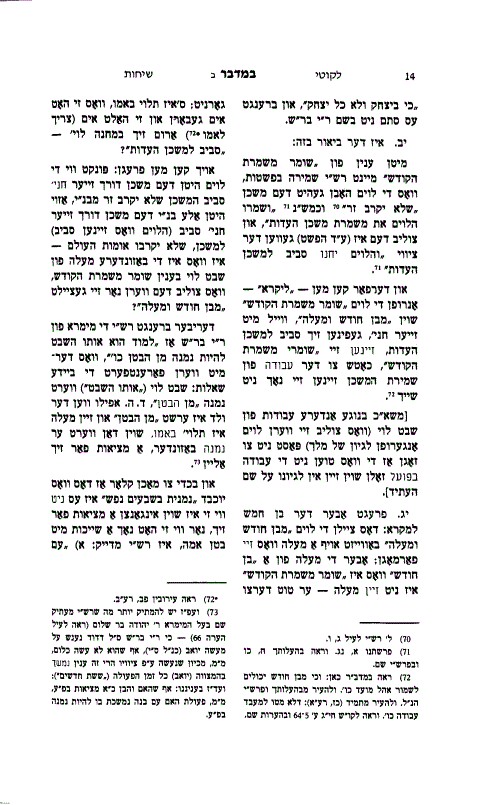
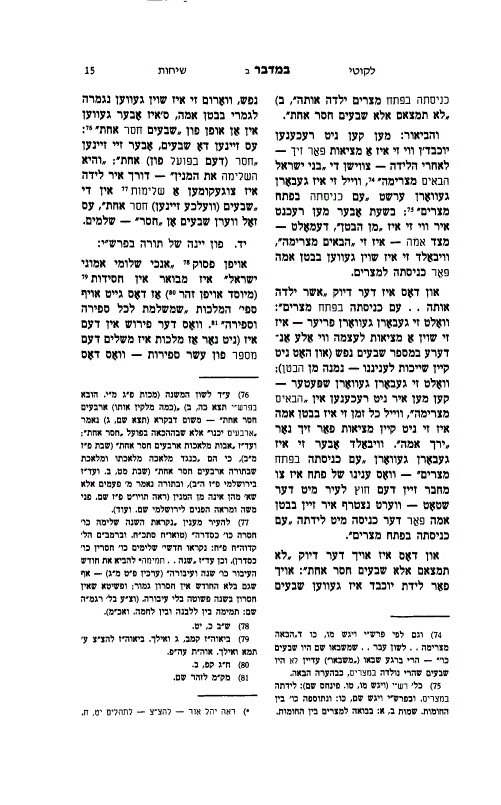
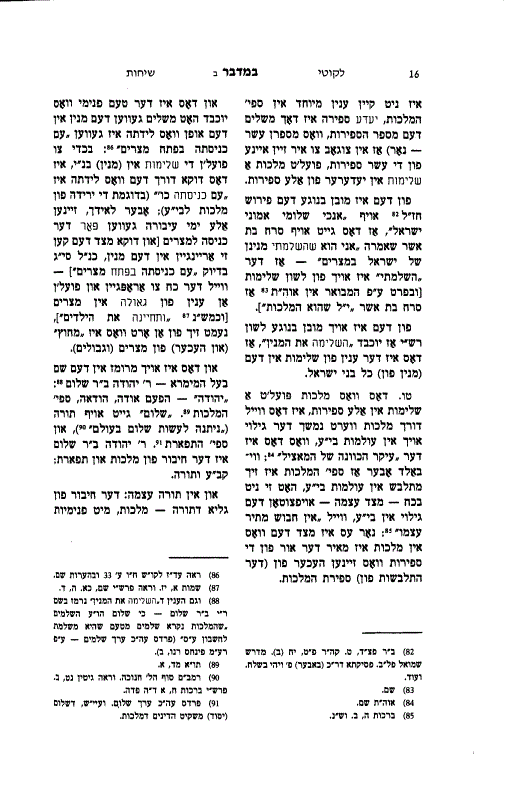

מבוא
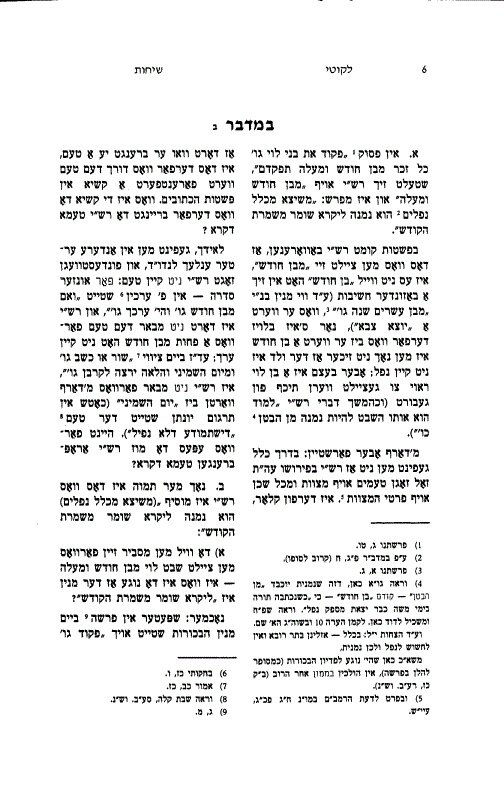
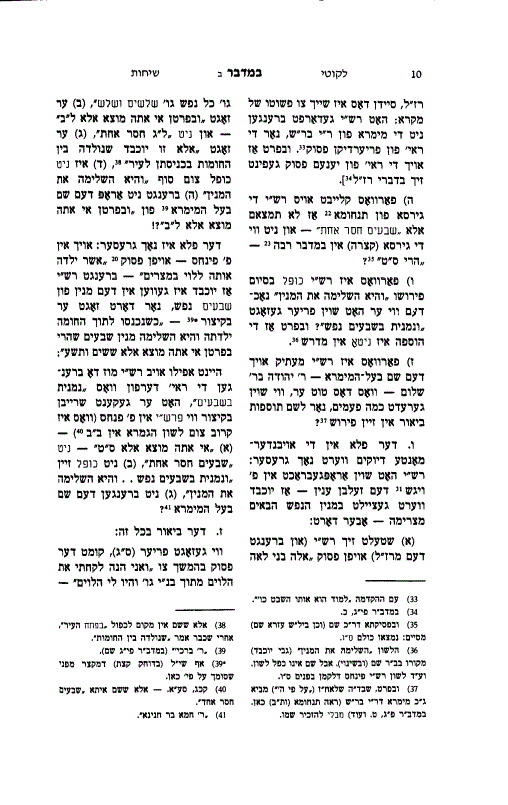
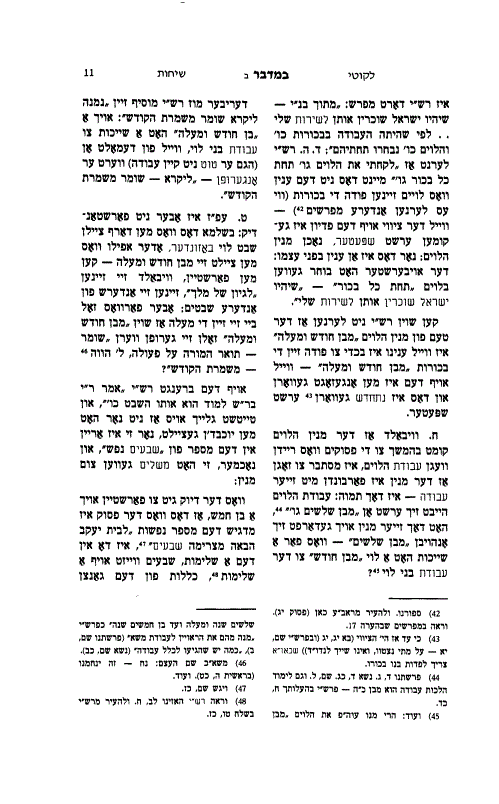
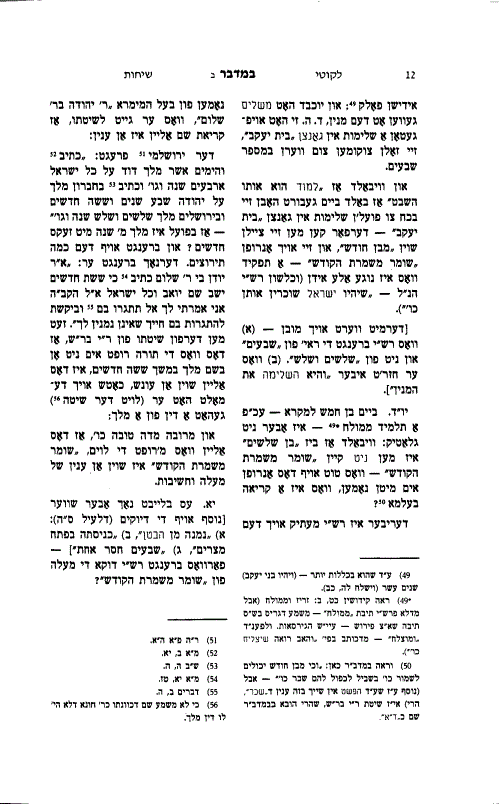
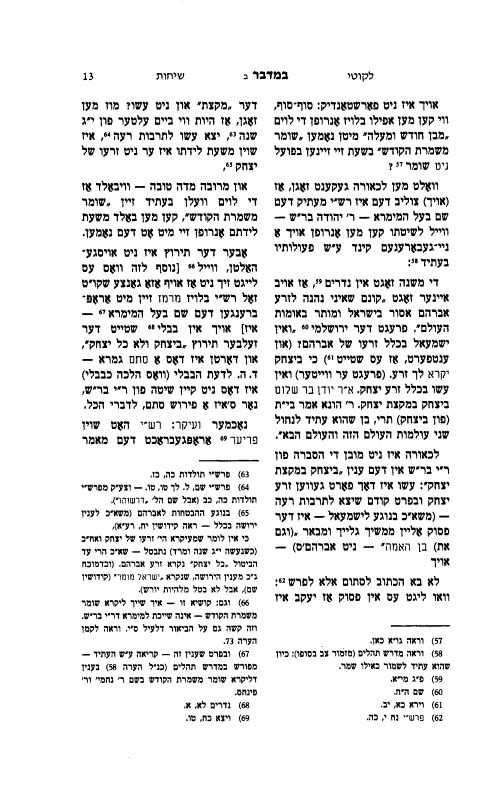
In this sicha, we will review Lekutei Sichos, Chelek Yud Ches, the second sicha for Parshas Bamidbar. This is a Rashi sicha in which the Rebbe raises a series of questions—really piling them up—and analyzes the entire Rashi from every angle. Unusually, the Rebbe devotes six separate sections just to asking questions, and only in the seventh section does he begin to provide answers.
Typically, when the Rebbe presents many questions on a Rashi and then arrives at a single solution that addresses all of them, it demonstrates the strength of that answer. It shows that by shifting our perspective or approach, we can resolve all the difficulties with one unified explanation, rather than needing a different answer for each question. Of course, there are always details to clarify each specific point, but fundamentally, this method reveals a deeper understanding.
In this particular Rashi, the focus is on why the sons of Levi who were counted in the census were counted from one month old (ben chodesh). At first glance, many commentators assume that Rashi is simply explaining why they were counted from a month and not from birth. Rashi’s answer is that up to 30 days, there is uncertainty whether an infant will survive; therefore, only after a month do we begin counting.
However, as the Rebbe demonstrates through various arguments and textual proofs, if this was truly Rashi’s intent—just to explain why not from birth—there would be several unresolved questions. The Rebbe will ultimately show that there is much more to Rashi’s explanation.
The deeper answer is that since the census of Bnei Levi was in preparation for their service (avodah) in the Beis Hamikdash—a service which actually began at age thirty—the real question is: why count them at one month old? The issue isn’t simply “why not before a month,” but rather “why so early—why not wait until they are closer to serving?” This shift in perspective opens up an entirely new understanding of both Rashi and the verses themselves.
סעיף א׳
The Rebbe begins by addressing the approach that will clarify many of the difficulties we encounter in Rashi’s commentary. He notes that in the verse, פקוד את בני לוי גו׳, the Torah instructs to count the tribe of Levi, specifying that all males from one month and up should be counted.
Rashi comments on the words “from one month and up,” explaining that once a child is past the stage of being considered a nefel—a miscarriage, which is up to thirty days—we can be sure he is viable and may be counted. Rashi adds that at this point, he is called one who “guards the holy guard”—מִשְׁמֶרֶת הַקֹּדֶשׁ—referring to the Levites’ role in protecting the Mishkan by camping around it and preventing outsiders from entering.
Thus, as soon as a Levi is thirty days old, he is already included among those who guard the Mishkan. Rashi’s intent here is to clarify that counting from thirty days does not reflect any special significance attached to that age itself. It’s not like counting Bnei Yisroel from twenty years old, where twenty marks entry into military service and thus has inherent importance.
Rather, Rashi teaches that thirty days is simply when we can be certain the child is not a nefel. In principle, a Levi could be counted immediately from birth; it’s only due to this uncertainty before thirty days that we wait. Rashi later elaborates (as the Rebbe will discuss further) that Leviim are accustomed to being counted even earlier—such as Yocheved, who was included among the seventy souls who went down to Egypt while still in utero.
The Rebbe focuses first on this initial part of Rashi: once a baby passes thirty days and is no longer considered a nefel, he joins those who guard the holy service. However, this raises a question: why does Rashi feel compelled to give a reason for why Leviim are counted from one month? Generally, Rashi does not explain reasons for mitzvos or their specific details in his Torah commentary.
We rarely find Rashi providing rationales for mitzvos at all—certainly not for technical details such as age requirements. This indicates that whenever Rashi does offer an explanation, it must be because there’s something in the plain meaning of the verse (peshat) that demands clarification; otherwise, he would remain silent.
The Rebbe therefore asks: what difficulty in our verse prompts Rashi to explain why counting begins at one month? Why doesn’t he simply accept it as stated? Furthermore, we see other places where similar age distinctions appear and Rashi offers no explanation. For example, when someone pledges their value (erech) starting from one month old—the Torah assigns values based on age groups—but Rashi does not explain why under one month has no value.
Likewise with korbanos: an animal can only be brought as an offering after its eighth day. The Torah says so explicitly but gives no reason; although Targum Yonasan explains it’s so we know it isn’t a nefel, Rashi himself does not mention this rationale.
This pattern suggests that if Rashi wanted us to know why under one month isn’t counted (because survival isn’t assured), or why animals must wait until day eight (to ensure viability), he could have said so elsewhere—but he doesn’t. So why here does he feel compelled to comment?
The Rebbe concludes this section by noting that while it makes sense for Rashi to clarify there’s nothing inherently significant about thirty days—it’s just about certainty of survival—it remains puzzling why he needs to address this at all. The Torah could have set any age without explanation; yet here, Rashi intervenes with reasoning. The Rebbe will continue exploring this question and also address why Rashi connects passing thirty days with being counted among those who guard the Mishkan.
סעיף ב׳
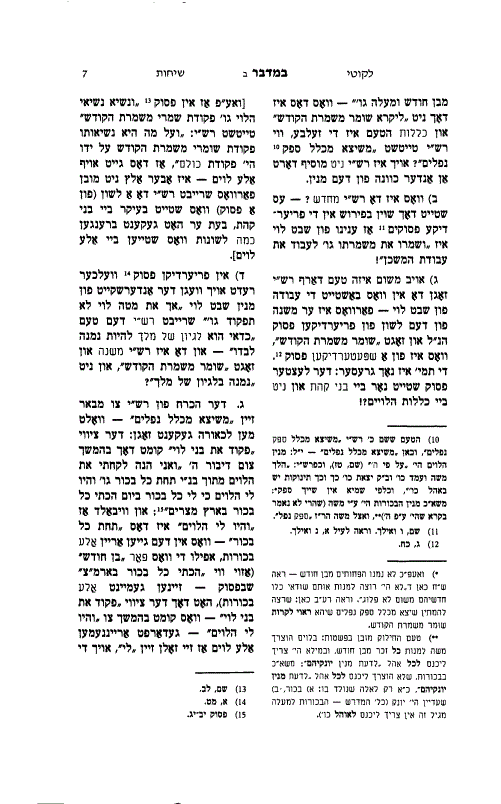
The Rebbe begins by questioning why Rashi feels the need to specify what the Levi is being counted for. If the point is simply that a baby can be counted after thirty days because he is no longer a safek nefel—a possible stillborn—why does Rashi add the words about being counted “to be called one who guards the Holy Guard” (shomer mishmeres hakodesh)?
The Rebbe notes that in other places, we find that counting begins at thirty days, and it is not connected to this idea of guarding the sanctuary. For example, when other groups are counted from a month and up, it is simply because they are no longer in doubt as to their viability—not because of any special role or title.
Furthermore, Rashi brings a verse here that is not the same as the one we already learned earlier. The language Rashi uses—shomer mishmeres hakodesh—is found specifically by the family of Kehos, not by all Leviim. Rashi could have used a more general verse that applies to all Leviim.
The Rebbe summarizes three main questions: First, if we are explaining why Leviim are counted from one month and up, why does it matter that their counting is “to be called shomer mishmeres hakodesh”? Isn’t it enough to say they are counted once they are viable? Second, there are cases where people are counted from thirty days and it has nothing to do with guarding the sanctuary. Third, even in those cases, Rashi explains that counting starts once there is no longer a doubt about viability; he doesn’t add any additional purpose for the count.
So why here does Rashi add this extra detail—that they are counted “to be called shomer mishmeres hakodesh”? The job of the Leviim has already been stated clearly in previous verses: their role is to guard and serve in the Mishkan. There seems to be no need for Rashi to repeat or elaborate on this point.
The Rebbe points out another surprise: Rashi doesn’t use the earlier verse that refers to all Leviim but instead quotes a verse found only by Bnei Kehos. The phrase shomer mishmeres hakodesh appears only at the end of the section about Bnei Kehos—not about all Leviim in general.
This raises an obvious question: Why would Rashi use a verse specific to Bnei Kehos when discussing all Leviim—including Gershon and Merari? If we’re talking about all three families of Leviim, why quote a verse that applies only to one?
The Rebbe acknowledges that even though this verse appears by Bnei Kehos, they were considered leaders among the Leviim and thus represented their collective service. Still, if there are verses that refer explicitly to all Leviim, why not use those instead?
In brackets, the Rebbe elaborates: Even though Bnei Kehos were leaders (“nisi nasi haLevi”), and through them came appointments for all Leviim regarding guarding duties, it still seems odd for Rashi to choose wording unique to Bnei Kehos when more inclusive language exists elsewhere.
The question remains: Why does Rashi write his explanation using language from a verse whose primary context is Bnei Kehos? He could have chosen from several verses that speak about all Leviim collectively.
The Rebbe concludes this section by indicating that he will soon offer an explanation for why Rashi chooses this particular wording and approach.
סעיף ג׳
The Rebbe points out that if the reason for counting the Leviim from one month old is simply because they are no longer considered a neifel—a nonviable infant—then Rashi’s explanation here becomes difficult. What compels Rashi to explain that the count begins “mishiotzu miklal nefolim”—from when they are no longer in doubt of being a miscarriage? Rashi does not usually provide reasons for the Torah’s commands, so why does he do so here?
One might suggest that Rashi needs to explain this because the command to count the sons of Levi comes immediately after Hashem says:
“ואני הנה לקחתי את הלויים מתוך בני ישראל תחת כל בכור וגו׳ והיו לי הלויים.”
This means that Hashem took the Leviim instead of all the firstborn of Israel. The Torah explains that all firstborn belong to Hashem because, on the day He struck down all the Egyptian firstborn, He spared the Jewish firstborn. Therefore, Hashem claims ownership over them and substitutes them with the Leviim.
If so, all firstborn are included in this exchange—even those less than a month old. The verse in Egypt refers to “כל בכור,” meaning every firstborn, regardless of age. So if the Leviim are taking their place, it would seem logical that all Leviim—even those younger than thirty days—should be counted as well.
This leads to a question: Why does the Torah instruct us to count only those Leviim who are at least a month old? Since their role is to substitute for all firstborn—including infants—the count should include even newborns. This is what prompts Rashi to address why we start counting from one month.
Rashi explains that really, we would count them from birth, but we wait until they are no longer in doubt of being a neifel. Only after thirty days can we be sure they are viable and not miscarriages. That is why we begin counting from then.
If this is indeed Rashi’s reasoning, then some earlier questions become even stronger. Once we understand that counting the Leviim is directly tied to their role as substitutes for the firstborn—and since the firstborn themselves were counted from one month and up—the reason for counting Leviim from one month should simply be because that’s how we counted the bechorim.
The Torah later describes how the numbers of bechorim and Leviim were matched up for redemption purposes:
“פדה תיפדה את בכור האדם ואת בכור הבהמה הטמאה.”
This process was done only for those a month old or older. Thus, just as only bechorim from a month and up were counted and redeemed with Leviim, so too only such Leviim should be counted.
This makes it difficult to understand why Rashi gives an additional reason—that at one month they are no longer considered nefolim. Several commentaries (such as Midrash Rabbah) say explicitly: since Leviim substitute for bechorim, and bechorim are counted from one month, so too with Leviim.
The underlying reason why bechorim are counted from one month is indeed because before then there is still doubt if they are viable. But for Leviim, their count should follow that of bechorim, regardless of this detail.
The Rebbe emphasizes: while it’s true that with bechorim, we wait until after thirty days due to concern about viability (safek nefel)—as Rashi explains elsewhere—for Leviim, it’s not about their own status as viable children but about mirroring the redemption process of bechorim.
This makes Rashi’s statement—that once a child is past thirty days he can be called “mishmeres hakodesh”—even more puzzling. The main reason for counting at this stage should be because this matches how we count and redeem bechorim, not merely due to viability concerns.
The Torah itself states explicitly that they are counted in order to substitute for the firstborn:
“והיו לי הלויים תחת כל בכור.”
This suggests that our focus should be on their role as substitutes rather than on whether they have left behind any doubt about being a miscarriage.
סעיף ה׳
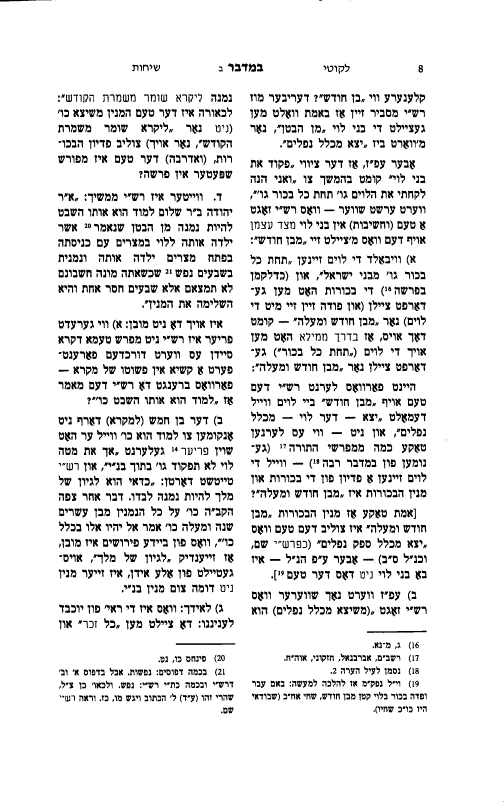
In footnote 7, the Rebbe asks: why does Rashi also quote the name of the author of the statement? As has been explained many times, Rashi only brings the name of the author when it adds an additional layer of explanation to his commentary.
Now, in point 6, the Rebbe compares this Rashi to a similar Rashi earlier in Parshas Vayigash. There, Rashi already discussed the idea that Yocheved is counted among those who came down to Egypt. By comparing the two Rashis, we can see differences that make our parsha’s case even more surprising.
In Vayigash, Rashi brings the statement of Chazal on the verse “these are the children of Leah” (which lists 33), and explains that really there were only 32; Yocheved made up the 33rd. Over there, Rashi says “when you count you find 32,” not “70 minus 1” as he does here. In Bamidbar, instead of simply saying “69,” he says “70 minus 1.” In Vayigash, he describes Yocheved as being born “between the walls” (i.e., at the border), but doesn’t use the term “Pesach Mitzrayim” as he does here.
And this is not like the earlier approach, where one might think that the verses are simply repeating the same idea in duplicate form. Rather, here the Torah is presenting a precise accounting, and Rashi is not merely restating the verses.
Rashi does not simply quote the statement in a mechanical way, nor does he say that there is a duplication in the count (neither 32 nor 33 in a casual sense). Instead, Rashi is addressing a specific difficulty in the verses themselves and resolving it according to peshat.
Therefore, Rashi does not present the matter as a simple repetition or stylistic duplication of the Torah’s language. Rather, he is explaining why the Torah’s count appears inconsistent and how it is in fact precise.
The question then is: why does Rashi choose this particular explanation and not another possible approach? Why does he emphasize this resolution specifically, rather than saying there is simply a repetition in the text?
The answer is that Rashi is not dealing with a textual “duplicate statement,” but with a real difficulty in the count itself, and therefore he must explain it in a way that resolves the exact numerical issue rather than treating it as stylistic repetition.
The Rebbe notes that in Vayigash, Rashi is brief: when they entered Egypt, Yocheved completed the count of seventy. He doesn’t mention who authored this statement or elaborate on how to reach seventy—he simply states that Yocheved was born at that moment and thus completed the number. So why does Rashi elaborate so much more in Bamidbar?
Furthermore, in Parshas Pinchas, Rashi could have written this even more concisely. Instead, he quotes almost verbatim from Gemara Bava Basra. What are these differences? First: in Vayigash he says “when you count you find 32,” while here he says “70 minus 1.” Second: there’s no need for duplication—he could have just said she completed seventy without repeating details or mentioning authorship.
So why does Rashi choose to elaborate here? The Rebbe explains that in Bamidbar, it appears that Rashi is following a different approach entirely.
Now, in section Zayin (7), the Rebbe begins to resolve all these questions by focusing on why specifically here Rashi elaborates about Leviim being counted from one month old. The reason for counting Leviim from one month is because their role as substitutes for Israel’s firstborn began only after Hashem designated them as such—not immediately at birth.
This means we cannot apply what happens later (when Leviim begin their service at age thirty) to our context; at this point in Bamidbar they are being counted as representatives of Israel’s firstborn. That’s why Rashi cannot explain based on later chapters about their service beginning at thirty years old—their current status is as replacements for Israel’s firstborn.
ואני הנה לקחתי את הלויים מתוך בני ישראל גו' והיו לי הלויים
The Torah says: “And I have taken the Leviim from among Bnei Yisrael… and they shall be Mine.” Here it states explicitly that Hashem took them from Israel and designated them for Himself.
The Leviim were taken as a substitute for the firstborn of Bnei Yisrael. Hashem designated the Leviim for His service and sanctified them in place of the firstborn.
Since the firstborn originally had a special sanctity and role, the Leviim were chosen to take their place. This was done in order to redeem the firstborn of Israel and replace their service in the Mishkan.
Thus, the Leviim were given in exchange for the firstborn: they became the ones who serve in the Mikdash in place of the bechorim, who were originally meant for that role.Rashi explains: these are those whom Hashem took for Himself from among Israel because originally it was supposed to be the firstborn who served; now Leviim take their place. The Leviim are counted instead of Israel’s firstborn.
This isn’t merely a technical replacement; it’s a special status for Leviim—they are uniquely designated by Hashem to serve in place of all firstborns. This designation begins with their counting from one month old—even though their actual service starts later at age thirty.
The question then arises: if their active service begins at thirty years old, why do we start counting them from one month? The answer is that their unique status as Hashem’s legion begins with their designation—not with their practical service. That’s why we count them from infancy; their potential and identity as Leviim starts then.
This also explains why Yocheved is counted among those who went down to Egypt—her birth completed not just a headcount but symbolized wholeness for Bnei Yaakov. Even a newborn can complete and impact the entire house of Yaakov because every individual has inherent potential and importance within Klal Yisrael.
And this is not like the family of Yaakov, where there is a need to come to a precise count of the Shevatim. Rashi brings from the Midrash of Rabbi Yehuda bar Shalom to show that even a young child from the womb was able to be counted as part of the tribe.
Even a very small child was capable of completing the number of a Shevet. This demonstrates that from birth, the members of the tribe possess an inherent completeness and identity as part of Klal Yisrael.
The idea is that the Shevet is not only defined by fully grown individuals, but already from the moment of birth there is a connection and belonging to the tribe. Even a newborn has the potential and power to contribute to the wholeness of the entire “house of Yaakov.”
Thus, the counting of Yocheved teaches that the structure of Bnei Yisrael is such that even the smallest member is משמעותי (significant) in completing the full count of Klal Yisrael.This is why even a baby—just born—can be counted among those who complete Bnei Yaakov. Every Jew has an innate ability to bring completeness and holiness to all of Klal Yisrael simply by virtue of being part of Am Yisrael.
The Rebbe further clarifies: this is also why Rashi brings proof specifically from seventy (the total number who went down to Egypt) rather than thirty-three (the children of Leah). Seventy represents completeness for all Israel—not just one family or subgroup—and thus highlights how even a newborn can complete something so significant.
By quoting Rabbi Yehuda and Rabbi Shimon by name regarding Yocheved’s birth between the walls and her inclusion in seventy souls, Rashi emphasizes how even someone so young can fulfill such an essential role within Klal Yisrael. This teaches us about every Jew’s potential—even those who seem insignificant or too young—their presence alone brings wholeness and sanctity to our people.
סעיף ו׳
The Rebbe begins by addressing the question of how long King David reigned. The Torah states that David was king for forty years, but it does not specify which years. Rashi notes that in Chevron, David ruled for seven years and in Yerushalayim for thirty-three years, totaling forty. However, there is also mention of six additional years, raising the question: why are these six years not counted in the total?
Rashi explains that the verse says David reigned “about six years” with Edom, during which Yoav led a war and defeated all the adversaries there. These six years are not included in the official count of David’s reign because Hashem told David not to wage war against Edom, yet he did so anyway. As a result, Hashem said that those six years would not be counted as part of his reign.
This leads to a broader discussion about titles and roles. Even though David was king during those six years, we do not refer to him as such for that period. Similarly, when discussing the Levi’im and their role as guardians of the holy service—שומרי משמרת הקודש—we see a distinction between being called by a title and actually fulfilling its function.
רש"י שואל: למה לא נמנים הלויים כמלכים בשש השנים הללו? הרי בפועל הם היו שומרי משמרת הקודש, אך עדיין לא עסקו בפועל בעבודה עצמה.
The Rebbe points out that this is similar to calling someone a kohen before he actually performs avodah. Technically, he is a kohen by lineage, but until he serves in the Beis Hamikdash, he has not fulfilled his function as a kohen. The same applies to Levi’im: they are called guardians even before they actively serve because their status is inherent—they are destined for this role.
To further illustrate this point, the Rebbe brings an example from Yerushalmi regarding vows: if someone makes a neder (vow) not to benefit from זרע אברהם—the seed of Avraham—he is prohibited from benefiting from any Jew but permitted to benefit from non-Jews. The Yerushalmi asks: what about Yishmael? He is also Avraham’s seed! The answer given is based on the pasuk: כי ביצחק יקרא לך זרע—only through Yitzchak will your seed be called. Thus, Yishmael is excluded.
The Yerushalmi continues: what about Esav? He too is a descendant of Yitzchak! Here Rav Yudan bar Shalom explains that the Torah says “ביצחק”—meaning only part of Yitzchak’s descendants are considered Avraham’s seed; Esav is excluded.
The Rebbe questions this explanation: how can we say Esav is not considered Yitzchak’s seed? Biologically he certainly is! Especially before Esav went off the derech (strayed), he was still Yitzchak’s son and heir.
In contrast to Yishmael—where explicit verses exclude him from Avraham’s legacy—Esav’s exclusion seems less clear-cut. The Torah does not state outright that only Yaakov counts as Yitzchak’s true seed; it simply says “ביצחק,” which requires interpretation.
The Rebbe suggests that perhaps this ambiguity reflects a deeper truth: at some level, even before one fulfills their potential or actualizes their role (as with Esav before his negative choices), their essential status remains intact. This parallels how we refer to Levi’im as guardians even before they serve—they possess an inherent connection to their future role.
Returning to Rashi’s citation of Rav Yudan bar Shalom, the Rebbe notes that Rashi brings his name specifically here because his teaching clarifies why we can call someone by a title based on future potential rather than current action. Just as Esav loses his status due to later choices, so too do Levi’im gain theirs in anticipation of their eventual service.
However, the Rebbe acknowledges some difficulty with this approach. In Bavli as well, we find interpretations excluding Esav from “ביצחק,” so why does Rashi need Rav Yudan bar Shalom specifically? Perhaps it is because Rav Yudan bar Shalom emphasizes the idea of partial inclusion—some descendants are included by virtue of their destiny or potential rather than immediate reality.
The Rebbe concludes that when Rashi refers to Levi’im as שומרי משמרת הקודש—even before they begin serving—it reflects this principle: titles can be assigned based on inherent status or future function. This helps explain why certain individuals or groups are described by roles they have yet to fully realize—their identity and destiny are intertwined even before actualization.
סעיף ז׳
The Rebbe begins by addressing the unique status of the tribe of Levi. Rashi emphasizes that the Levites are counted from one month old and up, which points to a special advantage they possess. However, when we consider the idea that a one-month-old child is already called a שומר משמרת הקודש—a guardian of the holy charge—this does not seem to be an advantage of the child himself. The child does nothing to earn this status; rather, it is entirely dependent on his mother, who cares for him and carries him in the camp of Levi around the Mishkan.
So why do we refer to the child as a guardian? It is really the mother who is watching over and protecting her baby. This raises a question: what is the true advantage of calling even an infant a שומר משמרת הקודש? Is it meaningful if it is not something accomplished by the child himself?
Furthermore, just as the Levites guard the Mishkan by camping around it so that no outsider approaches, all Jews also serve as a protective barrier by encamping around the Levites. In this way, every Jew contributes to guarding the Mishkan. If so, what makes the tribe of Levi’s role as guardians distinct and worthy of being counted from such an early age?
Because of this unique quality, Rashi brings in the statement from Rabbi Yehuda and Rabbi Shimon: למוד הוא עושה חשיבת להיות נמנה מן הבטן—this tribe is accustomed to being considered significant enough to be counted from within the womb. This answers both questions: how can we count someone from within their mother’s womb, and how can their advantage be tied to their mother? The answer is that even while still dependent on their mother, they are already counted as a separate entity.
To clarify further, when we count Yocheved among the seventy souls who descended into Egypt, we do not count her as an entirely independent existence. Rather, she is counted while still connected to her mother’s womb. This is why Rashi uses two specific expressions: אם כניסוסו בפסח מצרים י' איסוי—as she entered at Pesach Mitzrayim—and לֹא תִּמְצוֹי מְלְשִׁים חָסֵר אַחַד—you will only find seventy minus one.
These two expressions highlight that Yocheved was included in the count because she was present in her mother’s womb at the entrance to Egypt. Had she been born earlier, she would have been an independent entity like all others in the count; had she been born later, she could not have been counted as entering Egypt at all.
The doorway (Pesach) symbolizes transition—it connects outside with inside. By being born at this threshold moment, Yocheved unites both realities: present in her mother’s womb before entry and born at entry itself. This allows us to count her as part of those who entered Egypt.
This also explains Rashi’s precision in saying לֹא תִּמְצוֹי מְלְשִׁים חָסֵר אַחַד—not 69 but 70 minus one—because even before Yocheved’s birth there were already 70 souls present in potential; yet something was missing until her actual birth completed and perfected the number.
Thus, through Yocheved’s birth at Pesach Mitzrayim, she completed and brought wholeness (שלימות) to those seventy souls. This completion could only occur because she was both present in her mother’s womb prior to entry and born at that critical moment.
This entire discussion relates back to our topic: just as with Yocheved we see counting from within the womb—even though it depends on her mother—so too with Leviim we count them from infancy or even earlier stages due to their unique association with their mothers.
סעיף ח׳
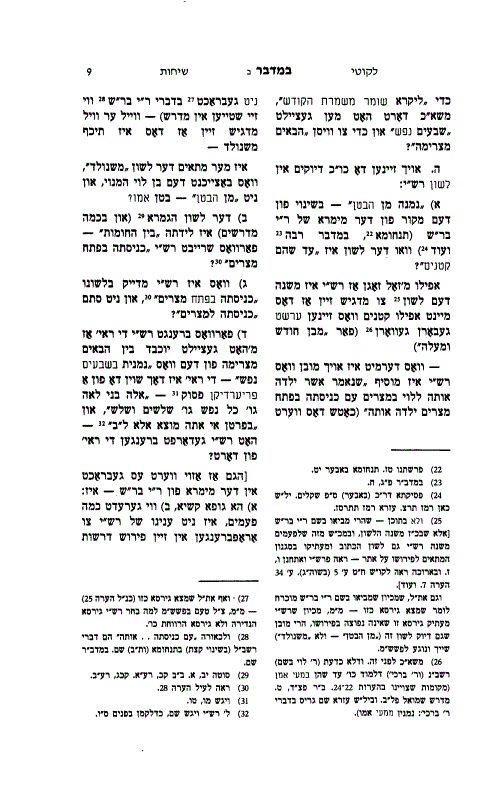
The discussion begins with the language used regarding Serach bas Asher, particularly the statement that she was “Mashlim haMinyan”—she completed the count. The question arises: since Serach bas Asher is explicitly counted in the verse, what does it mean that she was Mashlim haMinyan? The Rebbe points out that in this context, “Mashlim” means bringing about a state of completeness—shleimus.
Similarly, when speaking about Yocheved, the term “Mashlim” also refers to shleimus. In the deeper dimension of Torah—the “wine of Torah”—Rashi comments on a verse where Serach speaks to Yoav and convinces him not to destroy the city. She says, “Anochi shleimei emunei Yisrael”—I am the one who completes the faith of Israel. This hints at her role in completing the number seventy for those who descended to Egypt.
ואנכי שלומי אמוני ישראל.
Based on the Zohar, “Anochi” means “I am,” and “Mashlim” refers to someone who brings completion—not just as one among ten sfiros, but as one who brings wholeness to each sfira. The explanation is that within each sfira, Malchus is what brings it to completion. This doesn’t simply mean Malchus completes the count of ten; rather, Malchus adds a unique quality of shleimus to all other sfiros.
The meaning here is not just that Malchus is one of ten sfiros—every sfira is part of ten—but that Malchus has an additional role: it impacts and perfects each of the other sfiros. Thus, Malchus isn’t just a separate entity; it brings completion and wholeness throughout.
Chazal interpret this idea regarding Serach bas Asher: she says she completed the number of Bnei Yisrael in Egypt. Although Yocheved is also counted as number seventy, perhaps Serach’s role was also essential in making up that number. The term “Yishlamti” here also means shleimus—she made the number whole.
Serach bas Asher corresponds to Malchus; just as Malchus brings shleimus, so too does Serach bas Asher. The same terminology is used for Yocheved, indicating her similar role.
This helps us understand Rashi’s wording about Yocheved: “Yishlamti haMinyan”—she completed the count. This means not only did she fill out the number numerically, but she brought a sense of wholeness—shleimus—to Bnei Yisrael’s count.
This fits with what was explained earlier: Yocheved represents number seventy, which itself signifies completeness. Her birth at the entrance to Egypt enabled her to make Bnei Yisrael whole at precisely that moment—when they entered exile.
The Rebbe explains further (in section Vav) that this concept of shleimus as expressed by Malchus applies equally to Yocheved. Both descend into lower realms (Biyah), and in order for them to have an impact there, they must draw strength from above—from a higher source than their own level.
כי אין חבוש מתיר את עצמו מבית האסורים.
Malchus alone cannot effect change in Biyah; it needs empowerment from above—light from higher sfiros enclothes itself within Malchus and enables it to illuminate Biyah. This is how Atzilus achieves its purpose through Malchus descending into Biyah.
This explains why Yocheved’s birth at Pesach Mitzrayim (the entrance to Egypt) was crucial: only by entering could she bring wholeness and impact Mitzrayim itself. Her pregnancy occurred before entering Egypt; thus, she could be counted among those who descended there.
The entrance—the Pesach—serves as a connection between inside and outside; by passing through it, Yocheved could bring her unique influence into Egypt and help sustain Jewish children there together with Miriam (Shifra) and Pua.
נוטלין כח ממקום שהוא למעלה ממדידה והגבלה.
This power comes from a place beyond limitation—a preparation before entering boundaries—which allowed them to bring redemption even within exile.
This idea is hinted at in the name of Reb Yehudah bar Reb Sholem, who authored these teachings. Yehudah refers to admission or submission (Hapam Odeh)—the quality of Malchus—while Sholem refers to peace (Tiferes). Tiferes stands between Chesed and Gevurah and represents harmony.
Thus, Reb Yehudah bar Reb Sholem embodies a fusion of Malchus (submission) and Tiferes (beauty/peace)—a combination essential for true wholeness. In Torah itself, this fusion unites revealed Torah with its inner dimension; there are no arguments or contradictions there—only peace.
Through this connection comes the ultimate completion—the arrival of Moshiach speedily in our days.
Translation
1. In this sicha, the Rebbe analyzes Rashi’s commentary on the census of the tribe of Levi in Parshas Bamidbar, focusing on why Leviim are counted from one month old. While many assume Rashi is simply explaining why not from birth—since viability is only certain after thirty days—the Rebbe demonstrates that this explanation alone leaves several questions unresolved. The real issue is not just “why not before a month,” but “why so early—why not wait until they are closer to serving?” This shift in perspective reveals a deeper understanding of both Rashi and the verses.
2. The Rebbe begins by questioning why Rashi feels compelled to provide a reason for counting Leviim from one month old, noting that Rashi rarely gives rationales for mitzvos or their details. He points out that in other contexts where age distinctions are made—such as erech values or korbanos—Rashi does not explain the reasoning. This suggests there must be something unique in our verse’s plain meaning that demands clarification, particularly regarding why passing thirty days is linked to being called a guardian of the Mishkan.
3. The Rebbe further asks why Rashi specifies that Leviim are counted “to be called shomer mishmeres hakodesh,” when elsewhere counting from thirty days is unrelated to such titles. He notes that Rashi uses language found only by Bnei Kehos, not all Leviim, raising the question of why this specific wording and verse are chosen when more general ones exist. The Rebbe concludes that an explanation for these choices will follow.
4. Delving deeper, the Rebbe observes that since Leviim serve as substitutes for all firstborns—including infants—it would seem logical to count even newborns among them. Yet the Torah limits the count to those at least a month old. While with bechorim we wait until after thirty days due to viability concerns, for Leviim it should suffice that their count mirrors that of bechorim. Thus, Rashi’s emphasis on leaving behind nefel status appears puzzling when the main reason should be their role as substitutes for firstborns.
5. The Rebbe examines Rashi’s continuation about counting Leviim even from within their mother’s womb, citing Yocheved’s inclusion among those who went down to Egypt as proof. He raises several questions about the necessity and wording of this proof: Why bring evidence from Yocheved? Why use “counted from the womb” rather than “from birth”? Why emphasize her birth at Egypt’s entrance? And why does Rashi repeat both her being less than a month old and completing seventy? These nuances point toward a deeper intent in Rashi’s commentary.
6. Comparing this passage with earlier Rashis (such as in Vayigash), the Rebbe notes differences: there, Rashi is brief and does not mention authorship or elaborate on how seventy is reached; here he does. The reason for this elaboration is that in Bamidbar, Leviim are being counted as representatives of Israel’s firstborn—a status beginning with their designation by Hashem, not with practical service at age thirty. Thus, even infants possess inherent potential and importance within Klal Yisrael, as demonstrated by Yocheved completing the seventy souls upon entering Egypt.
7. Addressing how long King David reigned, the Rebbe draws an analogy between titles and roles: just as David’s six years warring with Edom are excluded from his official reign because they did not fulfill Hashem’s intent, so too can someone be called a guardian (or kohen) based on inherent status rather than actual service. This principle explains why Leviim are called shomrei mishmeres hakodesh even before serving—their identity and destiny precede actualization. Citing Rav Yudan bar Shalom clarifies how titles can reflect future potential rather than current action.
8. The Rebbe explores whether calling an infant a guardian reflects any advantage of his own when it depends entirely on his mother’s care. He explains that Leviim are accustomed to being counted even from within the womb; thus, their significance exists even while dependent on their mothers. This is illustrated by Yocheved being counted among those entering Egypt precisely because she was born at its threshold—her presence completed and perfected the number seventy through her unique connection to both inside and outside realities.
9. Finally, discussing Serach bas Asher and Yocheved as “Mashlim haMinyan”—those who complete the count—the Rebbe explains that “completion” here means bringing shleimus (wholeness). Drawing on Zoharic concepts, he shows how Malchus (kingship) brings completion not just numerically but by perfecting all other sfiros; similarly, Yocheved’s birth at Pesach Mitzrayim enabled her to bring wholeness to Bnei Yisrael at a critical moment. This power derives from a place beyond limitation and is embodied in figures like Reb Yehudah bar Reb Sholem—a fusion of Malchus (submission) and Tiferes (peace)—which ultimately leads to true completion and redemption for all Israel.