מבוא
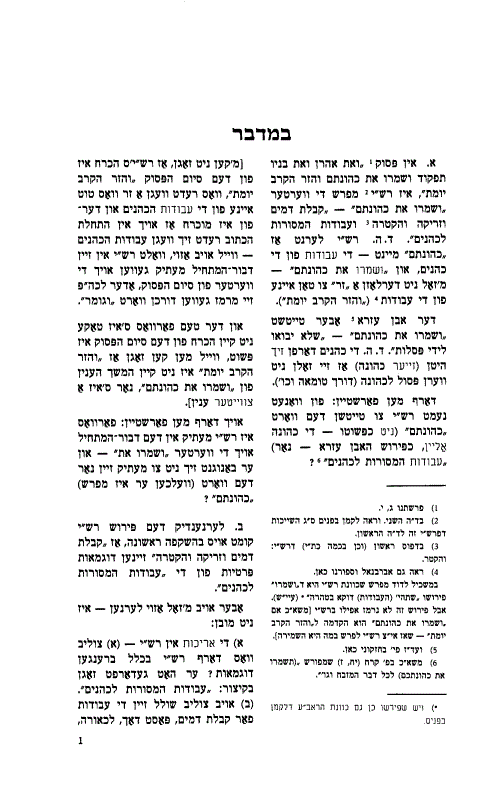
In this sicha, we will study the first Rashi on Parshas Bamidbar. This is a Rashi sicha, and the Rebbe analyzes not only the process of how Rashi arrives at his explanation, but also raises a fascinating question: why does the verse address the kohanim in this way, and what is unique about their role compared to the levi’im? As we will see, this touches on a deeper understanding of the verses in our parsha.
The verse states that you must “guard their priesthood,” so that you will be kohanim. What exactly does this mean? Rashi explains that the kohanim are required to guard something specific. But if priesthood comes automatically—if one is born a kohen—what does it mean to “guard” it?
Rashi clarifies that “guarding their priesthood” refers to specific tasks: receiving the blood of a korban after it is slaughtered, and placing that blood on the mizbe’ach. These are particular avodos (services) that only kohanim may perform; others are not permitted to do them.
Rashi emphasizes that all these acts involving blood are reserved for the kohanim. The phrase “guarding their priesthood” means they must ensure these services are done properly and not invalidated. If performed incorrectly or by someone unqualified, the korban could become disqualified.
So when Rashi says “guarding their priesthood,” he is referring specifically to these services with the blood—receiving it, carrying it, and placing it on the altar—to prevent any possibility of invalidation.
This does not mean simply guarding in a literal sense; rather, Rashi interprets it as safeguarding these sacred tasks so they are not performed improperly.
Some might suggest that “guarding” here means simply watching over or protecting something physically. However, as Rabbi Aronsohn points out, this cannot be the case here—it refers instead to safeguarding through proper performance of these avodos.
The Rebbe notes that if Rashi’s intent was merely physical protection or general vigilance, he would have said so explicitly. Instead, Rashi focuses on these specific avodos with the blood as central to what it means for kohanim to “guard their priesthood.”
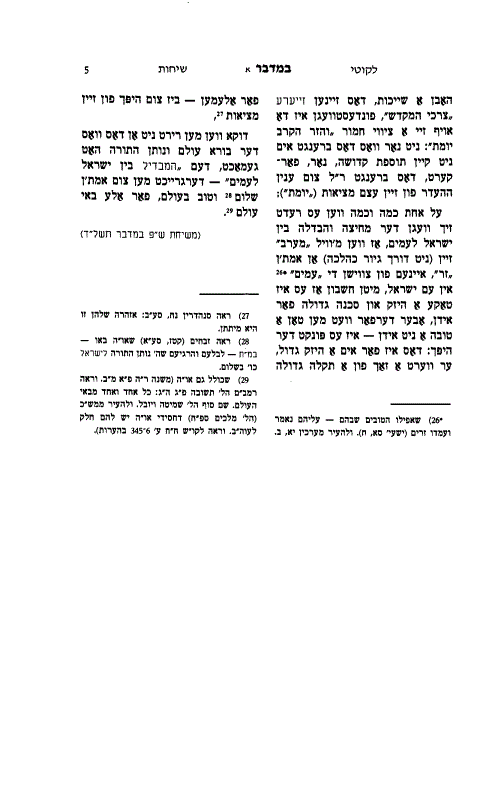
סעיף א׳
In this section, the Rebbe addresses a question that arises from Rashi’s commentary on the verse regarding the appointment and duties of the Kohanim. The discussion begins by noting that Rashi does not simply refer to the general concept of priesthood (kehunah), but rather specifies certain services—such as Kabbalah (receiving the blood), Zerikah (sprinkling), and Haktarah (offering on the altar)—as examples of tasks given exclusively to the Kohanim.
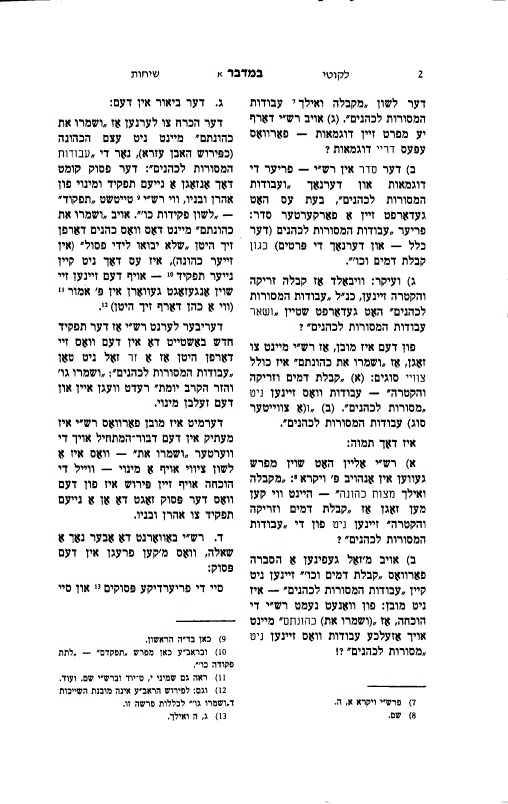
The Rebbe points out that these are not just random examples, but rather represent two distinct categories of service. Rashi’s choice to mention both types is deliberate, and understanding this distinction is key to grasping his intent. The question then becomes: why does Rashi need to provide these specific examples, and what is he teaching us by doing so?
To answer this, the Rebbe examines how these services were performed during the Korban Pesach. There, we find that Kabbalah, Zerikah, and Haktarah were actually performed by ordinary Jews themselves—not by Kohanim. This historical precedent could lead one to think that these services are not exclusive to Kohanim and perhaps could be performed by Levites as well.
This possibility is strengthened by the context of the Torah’s discussion about the Levites. Since the Levites act as agents for all of Israel in matters related to the Mishkan, it would seem logical that they might also be eligible to perform those services which were once done by all Jews—especially now that regular Israelites are no longer directly involved in Mishkan service.
However, Rashi clarifies that this is not so. The Torah introduces a new command specifically for Aaron and his sons—the Kohanim—that they alone are responsible for these particular services. The phrase “ושמרו את כהונתכם” (“they shall guard your priesthood”) is interpreted as an instruction for a new appointment or responsibility: ensuring that only Kohanim perform those tasks which have been given over exclusively to them.
The Rebbe emphasizes that if this verse were merely instructing Kohanim to guard their own status or avoid disqualification, it would not be introducing anything new; such instructions already appear elsewhere in the Torah. Instead, this verse establishes a unique charge: Kohanim must actively prevent non-Kohanim—including Levites—from performing those sacred services reserved for them.
This explains why Rashi quotes from “ושמרו את”—to highlight that it is a command regarding an active appointment or duty. The placement of this command within a section discussing Levite service further underscores its purpose: even though Levites serve as agents for Israel in many respects, when it comes to these specific avodos (services), only Kohanim may perform them.
Rashi’s detailed listing of both categories—the avodos previously performed by all Jews (like Kabbalah, Zerikah, Haktarah) and those always reserved for Kohanim—serves to preclude any misunderstanding. Even though there might be reason to think Levites could take over certain roles as agents for Israel, especially those once open to all Jews, the Torah insists otherwise: these are now exclusively under the jurisdiction of Aaron and his sons.
This careful analysis resolves potential confusion arising from both context and precedent. It also demonstrates how Rashi’s commentary is rooted in close textual reading and sensitivity to both historical practice and legal innovation introduced at this point in Torah law.
סעיף ב׳
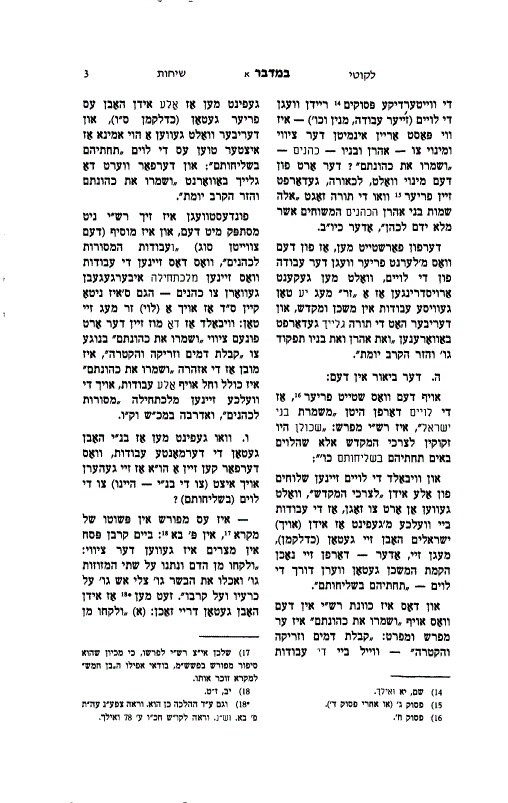
The discussion continues by clarifying that the earlier point about guarding the service applies not only to those tasks that were once performed by non-Kohanim, but also—how much more so—to those services that were always reserved exclusively for the Kohanim. These are never permitted to non-Kohanim, so the need for vigilance is even greater.
This raises a question: where do we find that B’nei Yisrael themselves performed these services? The answer is found in the Torah’s account of the Korban Pesach in Egypt. There, Hashem commanded the Jews to take the blood from their sacrifice and place it on the doorposts. The Torah describes how they roasted the entire animal, including its knees and insides, all together over fire.
From this, we see that B’nei Yisrael performed three key acts: they took the blood (which Rashi explains means they received it, akin to kabbalas hadam—receiving the blood), and then applied it as commanded. These acts parallel certain aspects of later Temple service.
Therefore, one might think that in subsequent generations, when offering the Korban Pesach or similar sacrifices, these services could also be performed by B’nei Yisrael—or at least by the Levites acting as their agents. After all, many laws of Pesach for future generations are derived from what was done at Pesach Mitzrayim, as Rashi notes in various places regarding blood application and other details.
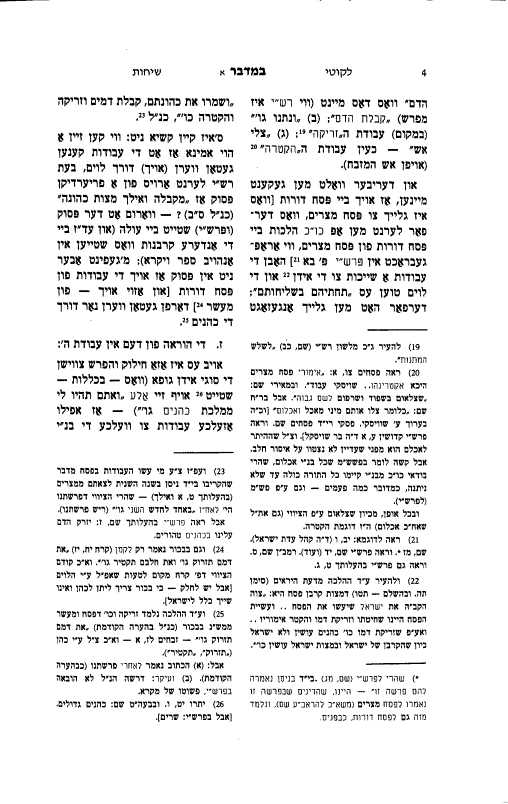
However, the Torah is explicit: even though these three acts were once done by all Jews, now they must be performed only by those designated for Temple service. Rashi already makes clear that from kabbalah (receiving) and onward—meaning from receiving the blood through sprinkling—the mitzvah applies specifically to Kohanim. This is learned from verses in Vayikra (Leviticus), where Rashi explains that these services are reserved for Kohanim alone.
Thus, even if a Levi or a non-Kohen previously participated in such acts during Pesach Mitzrayim, now they are excluded. The separation between roles is absolute; only those whom Hashem designated may perform these sacred tasks.
This principle extends beyond Temple service. It underscores how vital it is to maintain proper boundaries—not just between Kohanim and other Jews, but also between Jews and non-Jews regarding spiritual roles and identity. Even though all Jews are called “a nation of priests,” there remain distinctions within Am Yisrael itself regarding who may perform certain services.
The Torah warns: “A stranger who comes close shall be put to death.” Not only does unauthorized participation not bring extra holiness—it brings spiritual harm and diminishes one’s own existence within holiness.
This lesson applies with even greater force when considering boundaries between Jews and non-Jews. If someone tries to blur this separation—by mixing in a non-Jew without proper halachic conversion—they endanger both themselves and others spiritually. Such mixing does not benefit anyone; on the contrary, it causes great harm and confusion for all involved.
The true path to peace among all people is to respect the distinctions established by Hashem—the Creator who separated Israel from among the nations. Only by maintaining these divinely ordained boundaries can each group fulfill its unique purpose and contribute harmoniously to creation.
Translation
1. In this sicha, the Rebbe analyzes Rashi’s commentary on the first verse of Parshas Bamidbar, focusing on the phrase “guard their priesthood.” The discussion centers on what it means for kohanim to “guard” their priesthood if kehunah is inherited by birth. Rashi explains that this guarding refers to specific avodos—receiving the blood of a korban, carrying it, and placing it on the mizbe’ach—which are reserved exclusively for kohanim. The Rebbe emphasizes that Rashi interprets “guarding” not as physical protection but as ensuring these sacred tasks are performed properly and not invalidated by unqualified individuals.
2. The Rebbe addresses why Rashi specifies particular services—Kabbalah (receiving the blood), Zerikah (sprinkling), and Haktarah (offering)—rather than referring generally to kehunah. These examples represent two categories of service, and Rashi’s deliberate mention of both clarifies that only kohanim may perform them, even though in the past, such as at Korban Pesach in Egypt, ordinary Jews performed these acts. Despite Levites serving as agents for Israel in Mishkan matters, Rashi teaches that these avodos are now exclusively assigned to Aaron and his sons. The verse “ושמרו את כהונתכם” introduces a new charge: kohanim must actively prevent non-kohanim—including Levites—from performing these sacred services. This careful analysis resolves potential confusion from historical precedent and underscores how Rashi’s commentary is rooted in close textual reading and legal innovation.
3. The discussion continues by clarifying that the obligation to guard these services applies even more so to those tasks always reserved for kohanim. The Torah recounts that B’nei Yisrael themselves performed certain avodos during Pesach Mitzrayim—receiving and applying the blood—which parallels later Temple service. One might think that such acts could continue to be performed by all Jews or at least by Levites as their agents. However, the Torah now restricts these acts exclusively to kohanim from kabbalah onward, as learned from verses in Vayikra and explained by Rashi. This separation is absolute: only those designated by Hashem may perform these sacred tasks. The principle extends beyond Temple service, emphasizing the importance of maintaining boundaries within Am Yisrael and between Jews and non-Jews regarding spiritual roles. Unauthorized participation brings spiritual harm rather than holiness; true peace comes from respecting Hashem’s distinctions among peoples, allowing each group to fulfill its unique purpose in creation.