The Paradox of the Broken Tablets: A Study in Humility and Infinite Wisdom
Based on Likkutei Sichos, Vol. 26, Ki Sisa (Sicha 3)
I. The Question: Why Praise the Destruction?
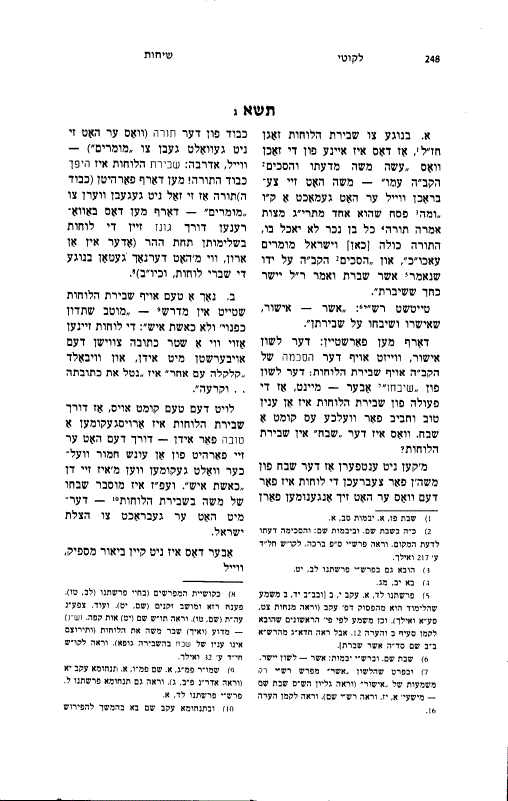
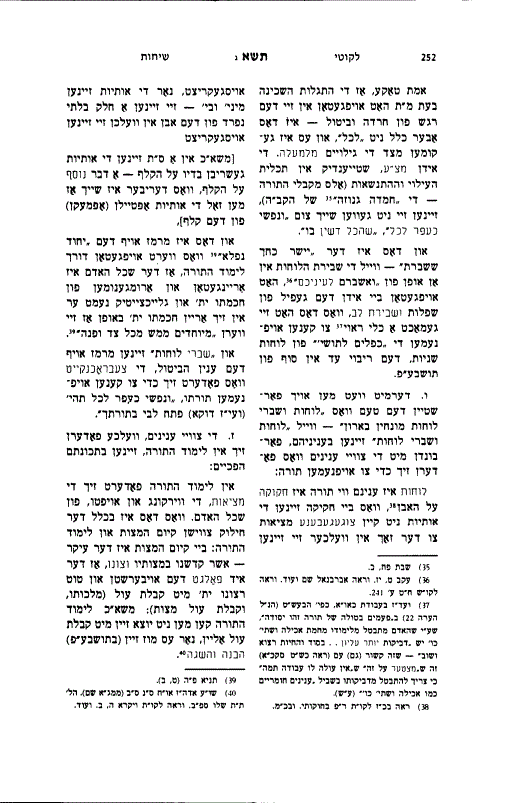
The Gemara (Menachos 99a) teaches that the breaking of the Luchos (Tablets) was one of three things Moshe Rabbeinu did of his own volition, to which Hashem later expressed His agreement. As Moshe descended Mount Sinai and witnessed the Jewish people celebrating the Golden Calf, he made an a fortiori (kal v'chomer) argument: If the Torah forbids a single individual who has strayed to partake in the Paschal lamb, how much more so is an entire nation of "apostates" unworthy of receiving the entire Torah?
The Torah confirms Hashem's approval in the words: "...asher shibarta"—"...which you broke." Our Sages interpret this as "Yasher Kochacha she-shibarta"—"May your strength be true because you broke them."
Rashi, however, adds a crucial nuance: Hashem didn't just confirm the act (ishur); He praised it (shivcho). This presents a difficulty. We can understand why Hashem would agree that the Tablets should be withheld, but why praise the act of breaking them? Breaking the holy Tablets—the "work of G‑d"—seems inherently disrespectful. If the goal was simply to withhold the Torah from the unworthy, Moshe could have hidden or buried the Tablets. Why is the act of shvirah (breaking) itself considered a "dear and good thing"?
II. Beyond Protection: The Necessity of the Break
One might suggest that Moshe broke the Tablets to protect the Jewish people. By destroying the "marriage contract" (Kesubah) between G‑d and Israel, Moshe ensured they would be judged as "unmarried" rather than as a faithless wife—a far less severe judgment.
While this explains the benefit of the act, it doesn't explain the praise for the breaking itself. If protection was the only goal, hiding the Tablets would have achieved the same legal result without the physical destruction of a holy object. Furthermore, the Rishonim point out that the broken Tablets were placed in the Ark (Aron) for all generations. If the breaking was merely a "emergency measure" to hide a sin, it would be a "prosecutor" (katreig)—a constant reminder of Israel's failure. We do not place a prosecutor in the Holy of Holies.
Therefore, we must conclude that the breaking of the Tablets contains a permanent, essential advantage for the Torah itself.
III. The Foundation of the Oral Torah
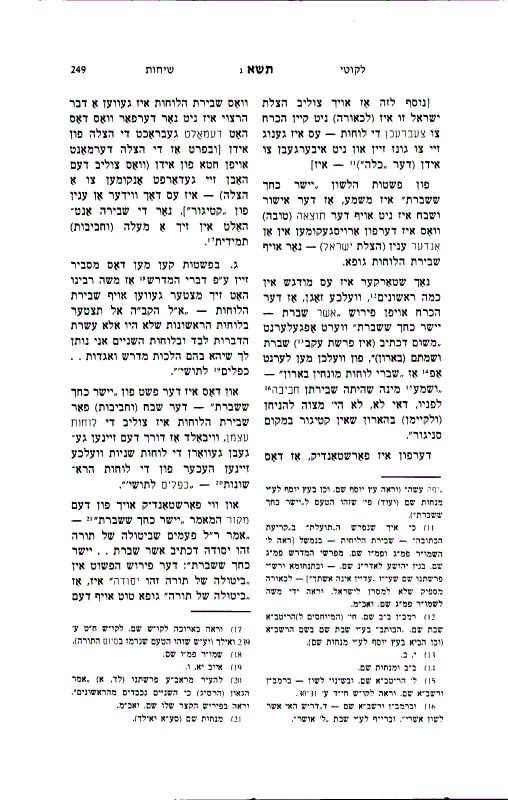
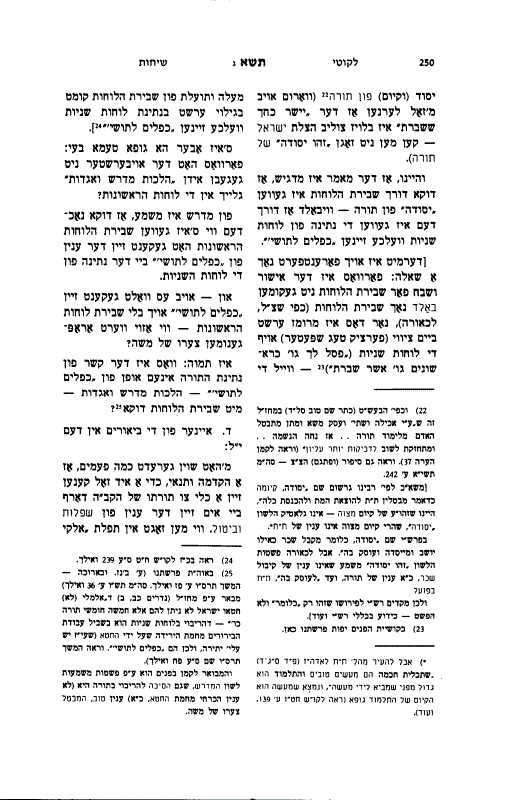
The Midrash tells us that when Moshe grieved over the broken Tablets, Hashem comforted him: "Do not be distressed. In the first Tablets, there were only the Ten Commandments. In the second Tablets, I am giving you Halachos, Midrash, and Aggados—double for salvation."
This reveals the "Yasher Koach": It was specifically through the breaking of the first Tablets that the "infinite" dimension of Torah—the Oral Torah—was unleashed. The Gemara says: "Sometimes the cancellation of Torah is its foundation." By negating the first set, Moshe established a new foundation that allowed for a much greater revelation.
Why was the "shattering" a prerequisite for this expansion?
IV. Humility: The Vessel for Divine Intellect
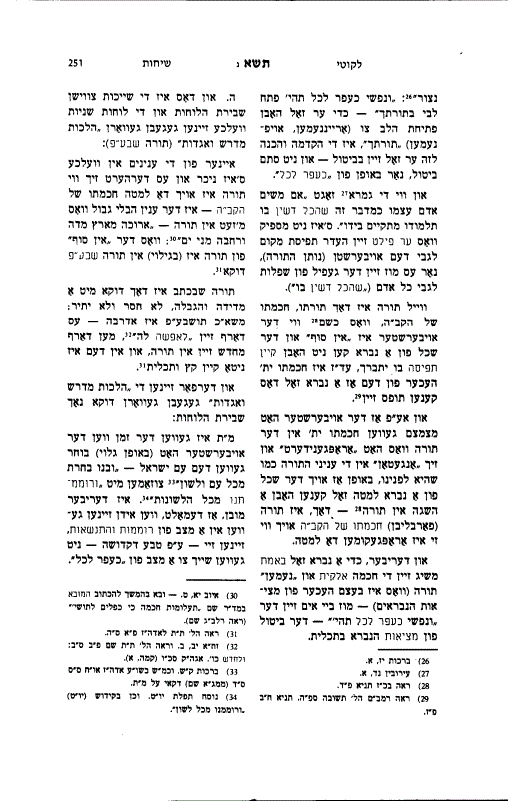
To truly "capture" G‑dly wisdom, a human being requires a specific internal state. In our daily prayers, we say: "Let my soul be like dust to all; open my heart to Your Torah." To have an open heart for Torah (psichas ha-lev), one must first achieve a state of total self-nullification (bittul).
Torah is G‑d’s infinite wisdom. Even though Hashem "contracted" this wisdom into human language and logic, it remains essentially G‑dly. For a finite human mind to grasp an infinite G‑dly truth, the person must transcend their own ego.
-
The First Tablets: Represented a time of exaltation. The Jews had been "lifted above all tongues" and felt the "hidden treasure" of G‑d. In this state of spiritual high, it is difficult to achieve the "soul like dust" required for the infinite expansion of the Oral Torah.
-
The Broken Tablets: The sight of the shattered holy letters created a profound sense of brokenness and humility in the hearts of the Jews. This shiflus (lowliness) made them a "fitting vessel" to receive the second Tablets, which contained the endless depths of the Oral Torah (Torah She-ba’al Peh).
V. The Union of Opposites in the Aron
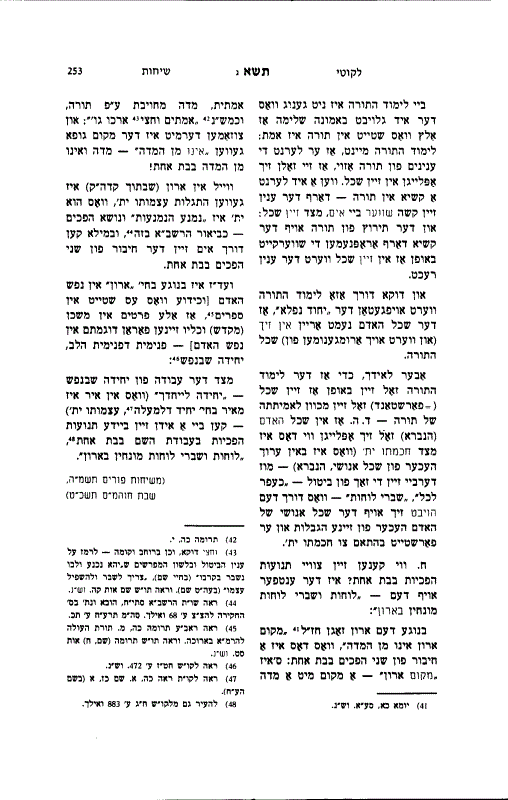
We are left with a paradox. To learn Torah, you need a powerful, active intellect (the Luchos—engraved and structured). But to ensure that your intellect is actually grasping G‑d’s truth and not just your own projection, you need total humility (the Broken Luchos).
How can a person be a metzius (an entity with a sharp mind) and a bittul (a non-entity) at the same time?
The answer lies in the Aron (the Ark). The Sages teach that "the space of the Ark took up no measurement." Although the Ark had physical dimensions (two and a half cubits long, etc.), it did not take up space in the Holy of Holies. It was a place where "measure" and "non-measure" existed simultaneously.
In the human soul, the "Aron" is the Yechida—the essence of the heart. In this deepest part of the soul, a Jew connects to G‑d’s Essence (Atzmus), where all opposites are reconciled. In the "Aron" of our hearts, we can carry both the whole Tablets and the broken ones. We can use our full intellectual vigor to understand a "sensible answer" in Torah, while simultaneously remaining utterly subjugated to the fact that this is G‑d’s infinite wisdom.
Only by holding the "Broken Tablets" of humility can we ensure that our "Whole Tablets" of intellect are directed toward the Divine Truth.
Quick-Reference: The Two Dimensions of Torah
| Feature | Whole Tablets (Luchos) | Broken Tablets (Shivrei Luchos) |
| Soul State | Intellectual Exaltation (Metzius) | Spiritual Lowliness (Bittul) |
| Torah Level | Written Torah (Measured/Finite) | Oral Torah (Unmeasured/Infinite) |
| Function | Mastering the logic and text | Becoming a vessel for G‑dly Truth |
| Location | The Aron (Ark) | The Aron (Ark) |