
Parshas Ki Sisa
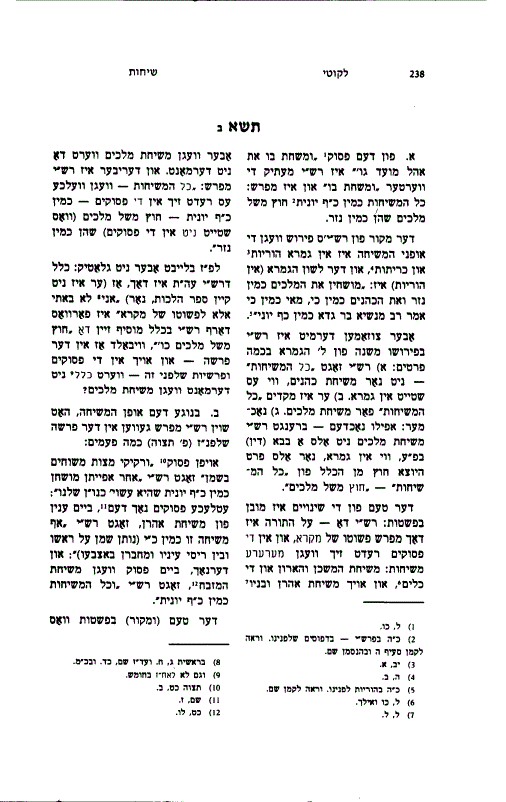
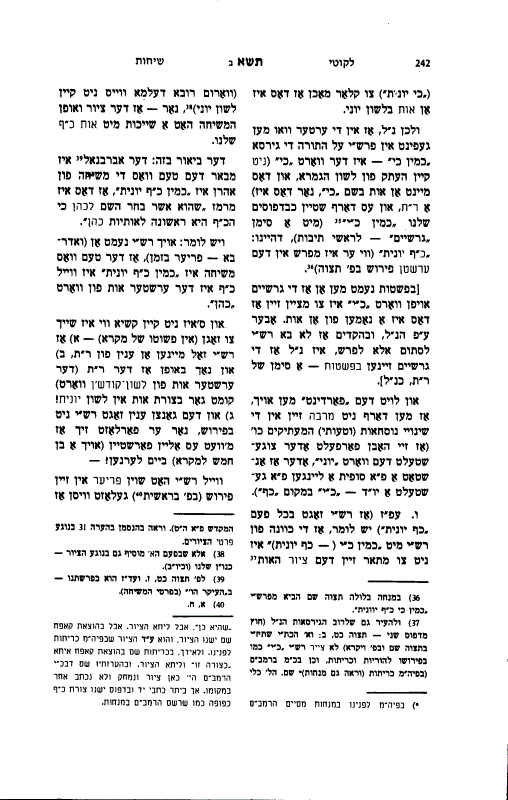
1. On the verse "ומשחת בו את אהל מועד גו'" ("And you shall anoint with it the Tent of Meeting…"),1 Rashi quotes the words "ומשחת בו" ("and you shall anoint with it") and explains: "כל המשיחות כמין כ"ף יונית2 חוץ משל מלכים שהן כמין נזר" ("All the anointings are in the form of a Greek kaf, except for those of kings, which are in the form of a crown").
The source of Rashi's explanation regarding the manners of anointing is in the Gemara, Horayos3 and Kerisos,4 and the wording of the Gemara (in Horayos) is: "מושחין את המלכים כמין נזר ואת הכהנים כמין כי, מאי כמין כי אמר רב מנשיא בר גדא כמין כף יוני" ("Kings are anointed in the form of a crown, and kohanim in the form of a chi. What is 'in the form of a chi'? Rav Menashya bar Gada said: In the form of a Greek kaf").5
However, together with this, Rashi in his commentary departs from the wording of the Gemara in several details: a) Rashi says "all the anointings" — not only the anointing of kohanim, as stated in the Gemara. b) He places "all the anointings" before the anointing of kings. c) Furthermore: even afterwards, Rashi brings the anointing of kings not as a clause (law) in its own right, as in the Gemara, but as a detail that is an exception to the general rule of "all the anointings" — "except for those of kings."
The reason for these changes is understood simply: Rashi here, on the Torah, explains the plain meaning of Scripture, and the verses speak of several anointings: the anointing of the Mishkan, the Ark and the vessels,6 and also the anointing of Aharon and his sons;7 but the anointing of kings is not mentioned here. Therefore Rashi explains: "All the anointings — those the verses speak of — are in the form of a Greek kaf — except for those of kings (which are not stated in the verses), which are in the form of a crown."
According to this, however, it is still not smooth: the rule of Rashi on the Torah is that (he is not a book of halachos9, but) "אני לא באתי אלא לפשוטו של מקרא" ("I have come only for the plain meaning of Scripture").8 So why does Rashi need to add here at all "except for those of kings etc.," since in this section — and also in the verses and sections preceding it — the anointing of kings is not mentioned at all?
2. Regarding the manner of the anointing, Rashi had already explained several times in the preceding parsha (Parshas Tetzaveh):
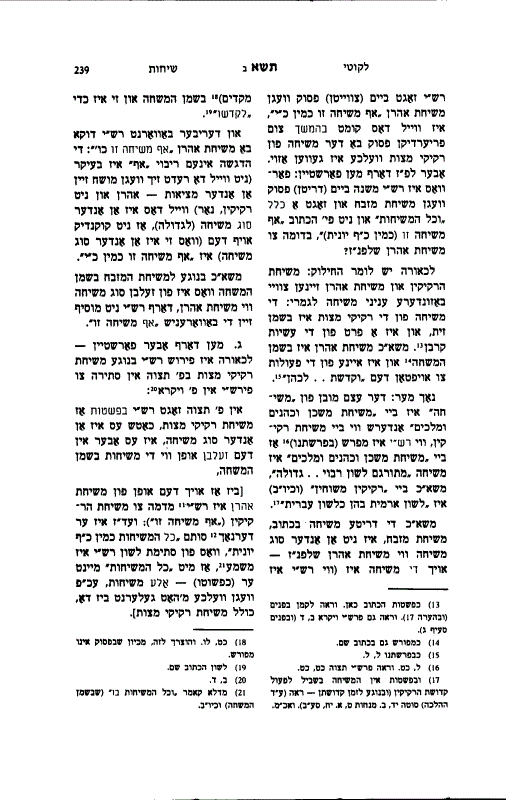
On the verse10 "ורקיקי מצות משוחים בשמן" ("and unleavened wafers anointed with oil"), Rashi says: "אחר אפייתן מושחן כמין כ"ף יונית שהיא עשוי' כנו"ן שלנו" ("After they are baked, he anoints them in the form of a Greek kaf, which is made like our nun"); several verses later,11 regarding the anointing of Aharon, Rashi says: "אף משיחה זו כמין כ' (נותן שמן על ראשו ובין ריסי עיניו ומחברן באצבעו)" ("This anointing too is in the form of a kaf (he puts oil on his head and between his eyelashes and joins them with his finger)"); and afterwards, on the verse regarding the anointing of the altar,12 Rashi says: "וכל המשיחות כמין כ"ף יונית" ("And all the anointings are in the form of a Greek kaf").
The simple reason (and source) why Rashi says at the (second) verse, regarding the anointing of Aharon, "this anointing too is in the form of a כ"י," is because this comes in continuation of the preceding verse, regarding the anointing of the unleavened wafers, which was done in this way. But according to this, one must understand: why does Rashi change at the (third) verse, regarding the anointing of the altar, and state a general rule, "and all the anointings," rather than explain the verse as "this anointing too (is in the form of a Greek kaf)," similar to the anointing of Aharon that precedes it?
Seemingly, one could say the distinction is this: the anointing of the wafers and the anointing of Aharon are two entirely separate matters of anointing. The anointing of the unleavened wafers is with olive oil, and is a detail of the preparation of the offering;13 whereas the anointing of Aharon is with the anointing oil,14 and is one of the actions to accomplish "וקדשת . . לכהן" ("and you shall sanctify . . to serve as kohen").15
Furthermore: the very meaning of "anointing" with regard to "the anointing of the Mishkan, kohanim and kings" is different than with the anointing of wafers, as Rashi explains (in our parsha)16 that with "the anointing of the Mishkan, kohanim and kings," anointing "is rendered [in Aramaic] as an expression of elevation . . greatness," whereas with "anointed wafers" (and the like), "the Aramaic for them is like the Hebrew."17
The third anointing in the verse, however — the anointing of the altar — is not a different type of anointing than the anointing of Aharon that precedes it: this anointing too is (as Rashi explains)18 with the anointing oil, and it is in order "לקדשו" ("to sanctify it").19
Therefore Rashi makes the qualification specifically at the anointing of Aharon, "this anointing too etc.": the emphasis in the inclusive word "too" is mainly (not because here it speaks of anointing a different entity — Aharon and not wafers, but) because this is a different type of anointing (for greatness); so that notwithstanding this (that it is a different type of anointing), "this anointing too is in the form of a כ"י."
Whereas regarding the anointing of the altar with the anointing oil, which is the same type of anointing as the anointing of Aharon, Rashi does not need to add the qualification "this anointing too."
3. One must understand, however: seemingly, Rashi's explanation regarding the anointing of the unleavened wafers in Parshas Tetzaveh contradicts Rashi's explanation in Parshas Vayikra:20
In Parshas Tetzaveh, Rashi says simply that the anointing of the unleavened wafers, although it is a different type of anointing, is nevertheless done in the same manner as the anointings with the anointing oil,
[to the extent that Rashi even compares the manner of the anointing of Aharon to the anointing of the wafers ("this anointing too"); and moreover, afterwards he states without qualification, "all the anointings are in the form of a Greek kaf" — and from the unqualified wording of Rashi it is implied21 that by "all the anointings" he means (literally) all anointings, at least those we have learned about until here, including the anointing of the unleavened wafers].
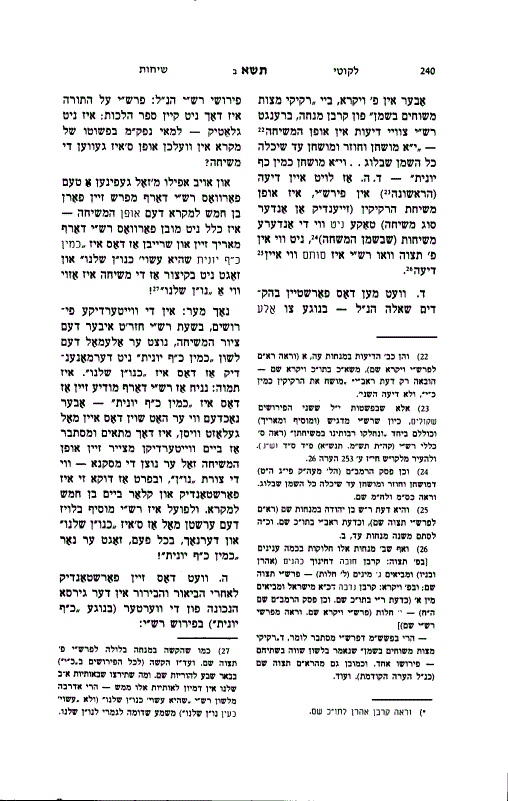
But in Parshas Vayikra, regarding "רקיקי מצות משוחים בשמן" of the meal-offering, Rashi brings two opinions on the manner of the anointing22 — "י"א מושחן וחוזר ומושחן עד שיכלה כל השמן שבלוג . . וי"א מושחן כמין כף יונית" ("Some say he anoints them and anoints them again until all the oil in the log is used up . . and some say he anoints them in the form of a Greek kaf"). That is, according to one opinion (the first23) in Rashi's commentary, the manner of anointing the wafers (being a different type of anointing) is indeed not like the other anointings (with the anointing oil)24 — unlike Parshas Tetzaveh, where Rashi states without qualification like one25 opinion.26
4. This will be understood by first raising the question mentioned above regarding all the above explanations of Rashi: Rashi's commentary on the Torah is not a book of halachos; so it is not smooth — what difference does it make, in the plain meaning of Scripture, in what manner the anointing was done?
And even if one were to find a reason why Rashi needs to explain the manner of the anointing to the five-year-old beginning Scripture — it is not at all understood why Rashi needs to elaborate and write that it is "in the form of a Greek kaf, which is made like our nun," rather than say briefly that the anointing is like "our nun"!27
Furthermore: in the subsequent explanations, when Rashi repeats the depiction of the anointing, he always uses the wording "in the form of a Greek kaf," without mentioning that it is "like our nun." This is puzzling: granted that Rashi needs to inform us that it is "in the form of a Greek kaf" — but once he has already let this be known once, it would be fitting and reasonable that when describing the manner of the anointing further on, he should use the conclusion — like the shape of a nun — especially since precisely this is understandable and clear to the five-year-old beginning Scripture. Yet in actuality, Rashi adds only the first time that it is "like our nun," and afterwards, each time, he says only "in the form of a Greek kaf"!
5. This will be understood after explaining and clarifying the correct reading of the words (regarding "Greek kaf") in Rashi's commentary:
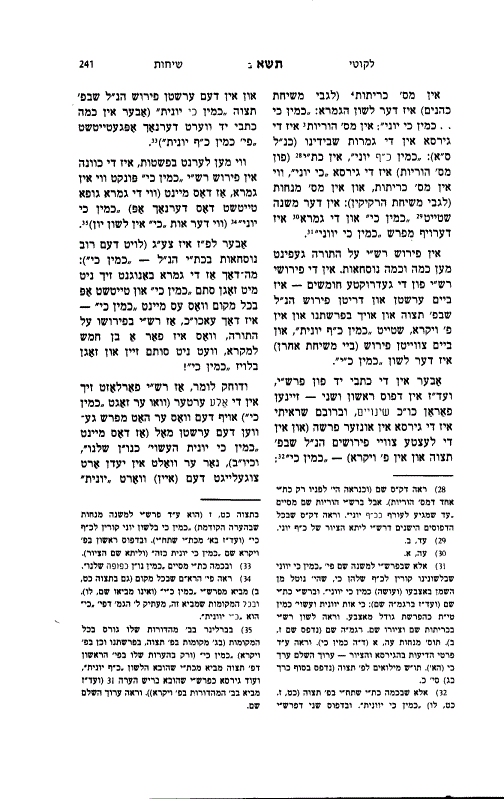
In tractate Kerisos (regarding the anointing of kohanim), the wording of the Gemara is: "כמין כי . . כמין כי יוני" ("in the form of a chi . . in the form of a Greek chi"). In tractate Horayos, the reading in the editions of the Gemara we have (as mentioned in section 1) is "in the form of a Greek kaf"; in a manuscript28 (of tractate Horayos) the reading is "a Greek chi," as in tractate Kerisos. And in tractate Menachos (regarding the anointing of the wafers), the Mishnah states29 "in the form of a chi," and the Gemara30 explains this as "in the form of a Greek chi."31
In Rashi's commentary on the Torah one finds very many versions. In the Rashi of the printed Chumashim — in the first and third explanations mentioned above in Parshas Tetzaveh, and also in our parsha and in Parshas Vayikra — it says "in the form of a Greek kaf," and in the second explanation (regarding the anointing of Aharon) the wording is "כמין כי."
But in the manuscripts of Rashi's commentary, and similarly in the first and second printings, there are very many variations; and in most of them that I have seen, the reading in our parsha (and in the last two explanations mentioned above in Parshas Tetzaveh, and in Parshas Vayikra) is "כמין כי";32 and in the first explanation mentioned above in Parshas Tetzaveh, "כמין כי יונית" (though in several manuscripts it is then explained, "meaning, in the form of a Greek kaf").33
As commonly learned, the intent of Rashi's words "כמין כי" is exactly as in the Gemara: that it means (as the Gemara itself afterwards explains) "in the form of a Greek chi"34 (like the letter "chi" in the Greek language).35
But according to this, it is greatly puzzling (according to the majority of the manuscript versions mentioned above — "כמין כי"): since the Gemara does not suffice with merely saying "in the form of a chi," and everywhere explains what "in the form of a chi" means — then all the more so would Rashi, in his commentary on the Torah, which is for a five-year-old beginning Scripture, not leave it unqualified and say merely "in the form of a chi"!
And it is strained to say that in all these places (where he says "in the form of a chi") Rashi relies on what he explained the first time (that it means "in the form of a Greek chi, which is made like our nun," and the like). Rather, in each place he would have added the (one) word "Greek" ("a Greek chi") to make clear that it is a letter in the Greek language.
Therefore it seems to me that in the places where one finds the reading "כמין כי" in Rashi's commentary on the Torah, the word "כי" is (not a copy of the Gemara's wording, meaning a letter named "chi," but rather) an acronym, and it should read, as in our printed editions, "כמין כ"י" (with the sign of "gershayim" — for acronyms), namely: "כ"ף יונית" ("Greek kaf") (as he explains in the first explanation in Parshas Tetzaveh).36
[It is commonly assumed that the gershayim on the word "כ"י" are to indicate that it is the name of a letter. But according to the above, and prefacing that Rashi does not come to leave things unqualified but to explain, it seems to me that the gershayim are simply a sign of an acronym, as above.]
And according to this, one also "gains" that there is no need to multiply variant readings (and errors) of the copyists etc. (that they omitted or added the word "Greek," or that instead of a final pei — a long pei — they put a yud: "כ"י" instead of "כף").
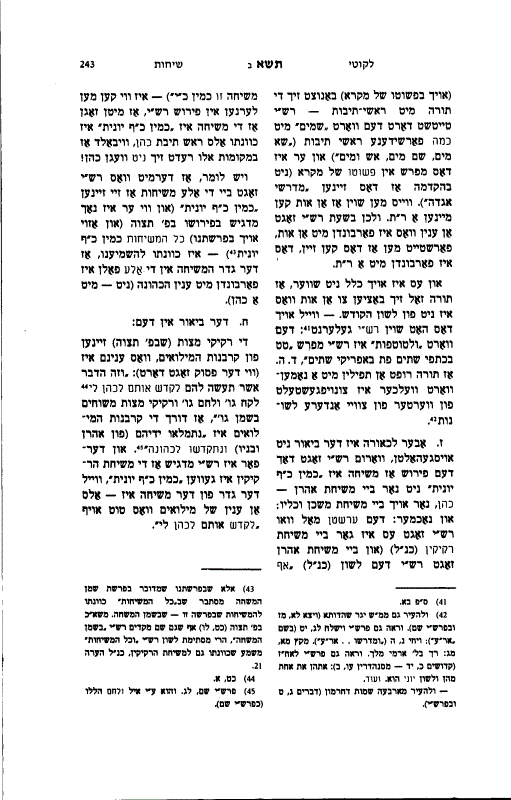
6. Accordingly (that Rashi each time says "Greek kaf"), it can be said that Rashi's intention with "כמין כי" (— Greek kaf) is not to describe the shape of the letter37 (for most people do not know the Greek language)38, but rather that the shape and manner of the anointing has a connection with our letter kaf.
The explanation of this: The Abarbanel39 explains the reason why the anointing of Aharon is "in the form of a Greek kaf": that it alludes to "שהוא אשר בחר השם לכהן כי הכ"ף היא ראשונה לאותיות כהן" ("that he is the one whom Hashem chose to be kohen, for the kaf is the first of the letters of 'kohen'").
And it can be said that Rashi too holds (and on the contrary — he is earlier in time) that the reason the anointing is "in the form of a Greek kaf" is because kaf is the first letter of the word "kohen."
And there is no difficulty as to how it is possible to say (in the plain meaning of Scripture) — a) that Rashi should intend a matter of an acronym; b) and moreover in such a way that the acronym (the first letter of a word in the Holy Tongue) comes in the form of a letter in the Greek language! c) and that Rashi does not state the entire matter explicitly, but relies on the fact that one will understand it on one's own (even a five-year-old beginning Scripture) while learning! —
For Rashi has already let it be known earlier in his commentary (in Parshas Bereishis40) that (even in the plain meaning of Scripture) the Torah makes use of acronyms: Rashi there explains the word "שמים" ("heavens") with several different acronyms ("שא מים, שם מים, אש ומים" — "carry water," "there is water," "fire and water"), and he explains this in the plain meaning of Scripture (without prefacing that these are "Midrashei Aggadah"). So one already knows that a letter can signify an acronym. Therefore, when Rashi states a matter connected with a letter, one understands that it may be connected with an acronym.
And it is also not at all difficult that the Torah should relate to a letter that is not from the Holy Tongue — for this too Rashi has already taught:41 the word "ולטוטפות" ("and for totafos") Rashi explains: "טט בכתפי שתים פת באפריקי שתים" ("'tat' in Katfi means two, 'pas' in Afriki means two") — that is, the Torah calls tefillin by a noun composed of words from two other languages.42
7. But seemingly this explanation does not hold up. For Rashi gives the explanation that the anointing is "in the form of a Greek kaf" not only regarding the anointing of Aharon — a kohen — but also regarding the anointing of the Mishkan and its vessels; and furthermore: the first time Rashi says it is actually regarding the anointing of the wafers (as above) (while regarding the anointing of Aharon, Rashi uses the wording (as above) "this anointing too is in the form of a כ"י"). So how can one learn in Rashi's commentary that by saying the anointing is "in the form of a Greek kaf," he intends it as the initial of "kohen," since in these places it is not speaking of a kohen!
And it can be said that by Rashi saying regarding all these anointings that they are "in the form of a Greek kaf" (and as he further emphasizes in his commentary in Parshas Tetzaveh (and so too in our parsha), "all the anointings are in the form of a Greek kaf"43), his intent is to inform us that the definition of the anointing in all these cases is connected with the matter of kehunah (the priesthood) — not with a kohen.
8. The explanation of this:
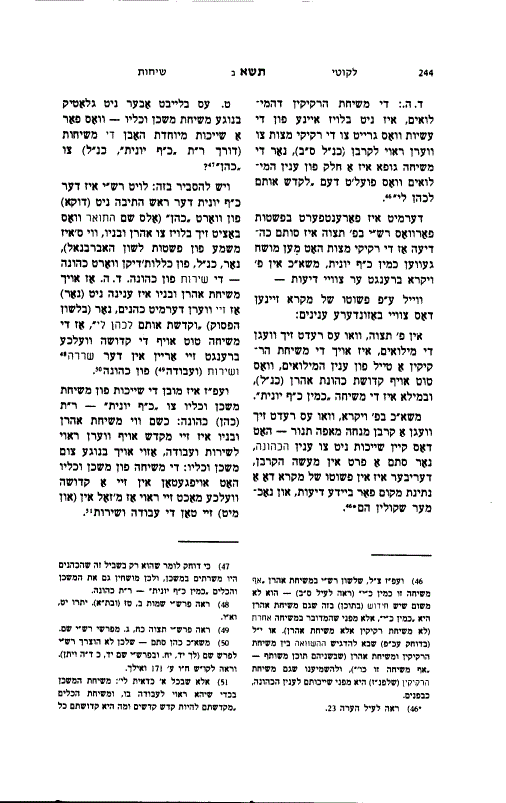
The unleavened wafers (of Parshas Tetzaveh) are among the inauguration offerings, whose purpose is (as the verse says there): "וזה הדבר אשר תעשה להם לקדש אותם לכהן לי44 לקח גו' ולחם גו' ורקיקי מצות משוחים בשמן גו'" ("And this is the thing that you shall do to them to sanctify them to serve Me as kohanim: take… and bread… and unleavened wafers anointed with oil…") — that through the inauguration offerings "נתמלאו ידיהם (of Aharon and his sons) ונתקדשו לכהונה" ("their hands were filled… and they were sanctified for the kehunah").45 Therefore Rashi emphasizes that the anointing of the wafers was "in the form of a Greek kaf," because the definition of this anointing is that of a matter of the inauguration, which accomplishes "to sanctify them to serve Me as kohanim."
That is: the anointing of the wafers of the inauguration is not merely one of the actions that prepare the unleavened wafers to become fit for an offering (as above, section 2); rather, the anointing itself is part of the matter of the inauguration, which effects "to sanctify them to serve Me as kohanim."46
With this it is simply resolved why Rashi in Parshas Tetzaveh states without qualification like the opinion that the unleavened wafers were anointed in the form of a Greek kaf, whereas in Parshas Vayikra he brings two opinions —
because according to the plain meaning of Scripture these are two separate matters:
In Parshas Tetzaveh, where it speaks of the inauguration, the anointing of the wafers too is part of the matter of the inauguration, which accomplishes the sanctity of Aharon's kehunah (as above); consequently, the anointing is "in the form of a Greek kaf."
Whereas in Parshas Vayikra, where it speaks of a meal-offering baked in an oven, this has no connection to the matter of kehunah, but is simply a detail in the making of the offering. Therefore, in the plain meaning of Scripture there is room for both opinions, and moreover, they are of equal weight.*46
9. However, it remains unsmooth regarding the anointing of the Mishkan and its vessels: what special connection do these anointings have (through the acronym "Greek kaf," as above) to "kohen"?47
This can be explained as follows: according to Rashi, the Greek kaf is the initial not (necessarily) of the word "kohen" (as a descriptive title, which relates only to Aharon and his sons, as is implied by the plain wording of the Abarbanel), but, as above, of the general word kehunah — the service of kehunah. That is, the anointing of Aharon and his sons too is not (only) about their becoming kohanim thereby, but (in the words of the verse) "וקדשת אותם לכהן לי" ("and you shall sanctify them to serve Me as kohanim") — that the anointing effects the holiness which brings them into the rank48 and service (and avodah49) of kehunah.50
Accordingly, the connection of the anointing of the Mishkan and its vessels to "Greek kaf" — the acronym of (kohen) kehunah — is understood: just as the anointing of Aharon and his sons sanctifies them to become fit for service and avodah, so too regarding the Mishkan and its vessels: the anointing of the Mishkan and its vessels effected in them a holiness that makes them fit for the avodah and service to be performed in (and with) them.51
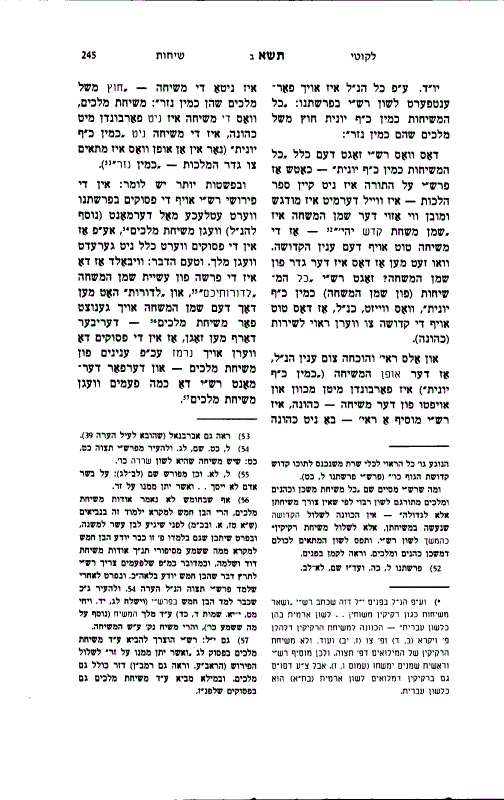
10. According to all the above, Rashi's wording in our parsha is also resolved: "All the anointings are in the form of a Greek kaf, except for those of kings, which are in the form of a crown":
That Rashi states the rule "all the anointings are in the form of a Greek kaf" — although Rashi's commentary on the Torah is not a book of halachos — is because thereby it is emphasized and understood how the anointing oil is "שמן משחת קדש יהי'" ("it shall be holy anointing oil"):52 that the anointing effects the matter of holiness. Where does one see that this is the definition of the anointing oil? Rashi says: "All the anointings (with the anointing oil) are in the form of a Greek kaf," which shows, as above, that it effects the holiness to become fit for service (kehunah).
And as a proof and demonstration of the above matter — that the manner of the anointing ("in the form of a Greek kaf") is connected with the intent and the effect of the anointing, kehunah — Rashi adds a proof: where there is no kehunah, this anointing is absent — "except for those of kings, which are in the form of a crown." The anointing of kings, which is not connected with kehunah, is not "in the form of a Greek kaf" (but in a manner that suits the definition of kingship — "in the form of a crown"53).
More simply it can be said: in Rashi's commentary on the verses in our parsha, the anointing of kings is mentioned several times (in addition to the above),54 although the verses do not speak at all of a king. The reason for this: since this is the section of making the anointing oil "לדורותיכם" ("for your generations"),55 and "for generations" the anointing oil was also used for anointing kings,56 one must therefore say that matters of the anointing of kings are also at least alluded to in the verses here — and therefore Rashi mentions the anointing of kings here several times.57
And similarly in this commentary of Rashi: when Rashi says "all the anointings are in the form of a Greek kaf" in order to bring out that the manner of the anointing is suited to the effect of the anointing, he already notes along with it that the anointing of kings too is done in a manner suited to the definition of kingship: "except for those of kings, which are in the form of a crown," as above.58
11. From the "wine of Torah" in Rashi's commentary:
Seemingly, it is not smooth: true indeed, even a letter of the Greek language can be used in the Torah as an acronym of a word in the Holy Tongue, as above — but what is the reason that the Greek language is used specifically in this matter?
The (inner) explanation of this: The inner meaning is known59 of the statement of our Sages60 that "the Greeks . . defiled all the oils in the Sanctuary": the oils in the Sanctuary allude to the Chochmah of holiness (for oil is the level of Chochmah61), and the Greeks — the Chochmah of the opposite side — oppose the Chochmah of holiness; they brought impurity, G‑d forbid, into the oil in the Sanctuary.
And the nullification of the kelipah of Greece is through the "cruse of oil" that was sealed "with the seal of the High Priest": the "cruse of oil" is the level of "שמן משחת קדש" ("holy anointing oil"),62 which is the level of "holy" that is higher than (Chochmah and than) the world of the order of hishtalshelus.63 Therefore, not only can the kelipah of Greece not overcome the oil, but on the contrary, the "holy anointing oil" overcomes and nullifies the kelipah of Greece entirely.
And this is also the reason why the anointing with the anointing oil is "in the form of a Greek kaf" — to allude that the anointing oil gives the power to nullify the kelipah of Greece, to the extent that not only does Greece not oppose holiness, but on the contrary: the Greek language itself is used, transformed to holiness — the Greek kaf describes and determines the manner of the anointing, the drawing down of holiness, as above. And furthermore — the cure (the anointing) is prepared before the affliction (the decrees of the wicked kingdom of Greece). And furthermore: "יפת אלקים ליפת . . יהא באהלי שם" ("May G‑d extend Yefes . . he shall dwell in the tents of Shem") — the language (and letters) of Greece, which is the choicest, is to be written in the holy books of Jews.64
12. According to this explanation, one will also understand the (inner) reason why it is "in the form of a Greek kaf" specifically: because the letter kaf alludes to the sefirah of Kesser (as is known65), for the power to refine the Greek language and to transform it comes (as above) from the level (of Kesser) that is above hishtalshelus.
And this matter — how the "holy anointing oil" refines the Greek language — will be revealed in completeness in the Time to Come, when the Chochmah, Binah and Daas of kelipah too will be refined.66
As is also alluded to in the fact that the anointing oil was made "for your generations,"67 including "the Time to Come" — "forever,"68 and furthermore, in such a way that "כולו קיים לעתיד לבא" ("all of it remains intact for the Time to Come")69 — because the content of the anointing oil will be accomplished in its completeness and entirety "in the Time to Come."
(From the sichos of Shabbos Parshas Ki Sisa, 5741)
Notes
1) 30:26.
2) So it reads in Rashi's commentary in the editions before us. And see below, section 5, and the sources cited there.
3) 12a.
4) 5b.
5) So it reads in Horayos before us. And see below, there.
6) 30:26ff.
7) 30:30.
8) Bereishis 3:8. And similarly there, 3:24. And in many places.
9) And also not [to cite] the statements of our Sages in Chumash.
10) Tetzaveh 29:2.
11) There, 29:7.
12) 29:36.
13) As is the plain meaning of the verse here. And see below in the text (and in note 17). And see also Rashi on Vayikra 2:4 (and in the text, section 3).
14) As is also stated explicitly in the verse there.
15) As in our parsha, 30:30.
16) 30:29. And see Rashi on Tetzaveh 29:29.
17) And plainly, the anointing is not in order to effect the holiness of the wafers (and regarding the time of their sanctification, see (in terms of halachah) Sotah 14b; Menachos 60a; 18b, end). And this is not the place to elaborate.
18) 29:36. He needed [to say] this, since in the verse it is not explicit.
19) The wording of the verse there.
20) 2:4.
21) Since he did not say "all the anointings etc." (with the anointing oil), or the like.
22) These are like the two opinions in Menachos 75a (and see the Re'em on Rashi, Vayikra there). Whereas in Toras Kohanim on Vayikra there, only the opinion of Rabbi Eliezer ben Yaakov is cited — "he anoints the wafers in the form of a כ"י" — and not the second opinion.
23) However, plainly it can be said that the two explanations are of equal weight, since Rashi emphasizes (and adds and elaborates) and includes them together: "and our Rabbis disagreed regarding their anointing" (see Sefer Klalei Rashi (Kehot 5740, 5751), section 4, [OCR unclear], and the sources cited there). Note also Likkutei Sichos vol. 7, p. 253, note 26.
24) And so ruled the Rambam (Laws of Maaseh HaKorbanos 3:9): that he anoints them and anoints them again until all the oil in the log is used up. And see Kesef Mishneh and Lechem Mishneh there.
25) This is the opinion of Rabbi Shimon ben Yehudah in Menachos there (Re'em on Rashi, Tetzaveh there), and like the opinion of Rabbi Eliezer ben Yaakov in Toras Kohanim there. And so it is in the unattributed Mishnah, Menachos 74b.
26) And although these two meal-offerings differ in several respects [in Parshas Tetzaveh: an obligatory offering for the inauguration of the kohanim (Aharon and his sons), and three kinds are brought (30 loaves) — Rashi, Tetzaveh there; and in Parshas Vayikra: a voluntary offering of any Jew, and one kind is brought (according to the opinion of Rabbi Yehudah in Toras Kohanim there; and so ruled the Rambam there, halachah 8) — 10 loaves (Rashi, Vayikra there; and see the commentators on Rashi there)] — nevertheless, in the plain meaning of Rashi's commentary it is reasonable to say that "רקיקי מצות משוחים בשמן" ("unleavened wafers anointed with oil"), which is stated in identical wording in both, has one meaning. And as is also understood from the Re'em on Tetzaveh there (as in the previous note), and elsewhere.
*) And see Korban Aharon on Toras Kohanim there.
27) As the Minchah Belulah asked on Rashi, Parshas Tetzaveh there. And the Be'er Sheva on Horayos there also asked (according to all the interpretations of "כ"י"). And as for what they answered — that in our alphabet there is no resemblance to these exact letters — on the contrary, from Rashi's wording "שהיא עשוי' כנו"ן שלנו" ("which is made like our nun") (and not "made somewhat like our nun") it is implied that it is entirely similar to our nun.
28) See Dikdukei Soferim there (and apparently he had before him only one manuscript of tractate Horayos). But Rashi on Horayos there concludes: "until it reaches the nape of the neck, like a Greek kaf." And see Dikdukei Soferim, that in all the old printings of Rashi the drawing of the Greek kaf is absent.
29) 74b.
30) 75a.
31) However, in Rashi's commentary on the Mishnah there he explains: "כמין כי יווני — for in our language we call their kaf 'chi'; for he would take some of the oil with his finger (and make) a kind of Greek chi." And in a manuscript of Rashi there (and similarly in Rabbeinu Gershom there): "Chi is a Greek letter, and it is made like a tes, like the spreading of the thumb from the finger." And see Rashi's wording in Kerisos there and his drawing there; Rabbeinu Gershom there (printed there, 6b); Tosafos, Menachos 75a (s.v. "kemin chi"). And regarding the details of the opinions on the reading and the drawing, see Aruch HaShalem, entry "Chi" (the first); Torah Shleimah, Miluim to Parshas Tetzaveh (printed at the end of vol. 23), section 20.
32) However, in several manuscripts in my possession, in Parshas Tetzaveh (29:7; 29:36): "כמין כי יוונית." And in the second printing of Rashi on Tetzaveh 29:7 (which resembles Rashi on the Mishnah in Menachos cited in the previous note): "כמין כי — in the Greek language they call kaf 'chi'" (and similarly in one of the manuscripts in my possession). And in the first printing, in Parshas Vayikra there: "כמין כי יונית, like this" (and the drawing is absent there).
33) And several manuscripts conclude: "like our bent nun."
34) See the commentary of the Rosh, who everywhere (also on Tetzaveh 29:2) cites from Rashi "כמין כ"י" (and he does not cite it there, verse 36). And in all the places where he cites this, he copies the Gemara, that the meaning of "כי" is "a Greek כ"י."
35) Berliner, in both of his editions, reads in all the places (in the three places in Parshas Tetzaveh, in our parsha, and likewise in Parshas Vayikra) "כמין כי" (and only in his notes on the first explanation in Parshas Tetzaveh does he cite from a manuscript the wording "כ"ף יונית," and another reading like Rashi's commentary cited at the beginning of note 31 (and similarly he cites in both editions in Parshas Vayikra)). And see Aruch HaShalem there.
36) The Minchah Belulah on Tetzaveh there cites from Rashi: "כמין כי — כ"ף יונית."
37) Note also that according to most of the readings mentioned above (except the second printing — Tetzaveh 29:2; and one of the manuscripts in my possession, in Tetzaveh there and in Parshas Vayikra), Rashi did not draw the "כ"י" as he did in his commentary on Horayos and Kerisos; and likewise in several places in the Rambam (in the Commentary on the Mishnah, Kerisos (and see also Menachos)* there; Laws of the Temple Vessels, [OCR unclear]). And see the sources cited in note 31 regarding the details of the drawings.
*) In the Commentary on the Mishnah before us, in Menachos, the Rambam concludes "שהיא כנ" [OCR unclear], but the drawing is absent. However, in the Kafih edition there the drawing is present, and it resembles the drawing in the Commentary on the Mishnah on Kerisos before us. On the other hand, in Kerisos there, the Kafih edition reads "in this form," and the drawing is absent; and in his notes there [he writes] that in the Rambam's manuscript there was a drawing here which was erased, and nothing else was written in its place. But in the other manuscripts and in print there is the form of a bent kaf, as the Rambam drew it in Menachos.
38) Except that in the first [explanation] he also adds, regarding the shape, "like our nun" (or the like).
39) On Tetzaveh 29:7. And similarly in our parsha — [OCR unclear] (regarding the details of the anointing).
40) 1:8.
41) End of Parshas Bo.
42) Note also what is written, "יגר שהדותא" ("Yegar Sahadusa") (Vayeitzei 31:47, and Rashi there). And see also Rashi on Vayishlach 33:19 (citing "Aramaic"); Vayechi [OCR unclear] ("and its Midrashic interpretation . . Aramaic"); Mikeitz 41:43: "'rach' in Aramaic is king." And see also Rashi further on (Kedoshim 20:14 — Sanhedrin 76b): "'Es'hen' — one of them, and it is Greek." And elsewhere. Note also the four names of Chermon (Devarim 3:9, and Rashi there).
43) Except that in our parsha, which deals with the section of the anointing oil, it is reasonable that by "all the anointings" he means the anointings in this section — those with the anointing oil. Whereas in Parshas Tetzaveh (29:36), although there too Rashi first says "with the anointing oil," nevertheless, from the unqualified wording of Rashi, "and all the anointings," it is implied that he also means the anointing of the wafers, as above, note 21.
44) 29:1.
45) Rashi there, 29:33. And this is through the ram and this bread (as Rashi there).
46) Accordingly, it must be said that Rashi's wording regarding the anointing of Aharon, "אף משיחה זו כמין כ"י" ("this anointing too is in the form of a כ"י") (see above, section 2), is not because there is a novelty (in itself) in the fact that the anointing of Aharon too is in the form of a כ"י, but because it is speaking of a different anointing (not the anointing of the wafers, but the anointing of Aharon). Or it can be said (at least in a strained way) that he comes to emphasize the comparison between the anointing of the wafers and the anointing of Aharon (that both share a common content — "this anointing too is a כ"י"), and to inform us that the anointing of the wafers too (which precedes it) is because of their connection to the matter of kehunah, as in the text.
*46) See above, note 23.
47) For it is strained to say that it is only because the kohanim served in the Mishkan that the Mishkan and the vessels are also anointed "in the form of a Greek kaf" — the acronym of kehunah.
48) See Rashi on Shemos 2:16 (and [OCR unclear]); Yisro 19:[OCR unclear].
49) See Rashi on Tetzaveh 28:3, and the commentators on Rashi there.
50) As opposed to "kohen" alone — which is why Rashi did not need to explain there (Lech Lecha 14:18; and in Rashi there, 14:20, s.v. "Vayiten"). And see Likkutei Sichos vol. 6, p. 171ff.
51) Except that each one according to its nature: the anointing of the Mishkan, so that it be fit for the service in it; and the anointing of the vessels sanctifies them to be holy of holies, "and what is their holiness? 'Whatever touches…' — whatever is fit for a sacred vessel, once it enters it, becomes sanctified with intrinsic holiness etc." (Rashi on our parsha, 30:29). And as for Rashi's concluding there, "Every anointing of the Mishkan, kohanim and kings is rendered [in Aramaic] as an expression of elevation, because their anointing is needed only for greatness" — the intention is not to exclude the holiness that is effected by their anointing, but to exclude the anointing of wafers, in keeping with the continuation of Rashi's wording. And he used a wording that fits all of them — Mishkan, kohanim and kings. And see below in the text.
52) Our parsha, 30:25. And similarly there, 30:31-32.
*) According to what was said in the text, it can be said that what Rashi wrote, "and other anointings, such as anointed wafers . . the Aramaic for them is like the Hebrew," refers to the anointing of the wafers further on, in Parshas Vayikra (2:4) and Parshas Tzav (7:12) and elsewhere, and not to the anointing of the wafers of the inauguration in Parshas Tetzaveh. Therefore Rashi adds "וראשית שמנים ימשחו" ("and they anoint themselves with the choicest oils") (Amos 6:6). But this requires further study, since ultimately, regarding the wafers of the inauguration too, the Aramaic ([OCR unclear]) is like the Hebrew.
53) See also the Abarbanel (cited above, note 39).
54) 30:29; there, 30:32. And note Rashi on Tetzaveh 29:29: that there is an anointing which is an expression of authority etc.
55) 30:31. And so it is stated explicitly there (30:32-33): "על בשר אדם לא ייסך . . ואשר יתן ממנו על זר" ("It shall not be poured upon human flesh . . and whoever puts any of it upon a stranger").
56) Although the Chumash does not speak of the anointing of kings, the five-year-old beginning Scripture will learn this in the Prophets (I Shmuel 16:1, and in many places) before he reaches the age of ten for Mishnah. Especially since it is possible that already when learning this parsha, the five-year-old beginning Scripture knows of it from what he has heard of the stories of Tanach about the anointing of David and Shlomo — and as has been discussed many times, sometimes Rashi needs to resolve something that the five-year-old knows in any case. And especially after he has learned Rashi on Tetzaveh, mentioned above in note 54. Note also that the five-year-old has already learned in Rashi (Vayishlach 33:14; Vayechi 49:10-11; Shemos 4:24) about King Moshiach (in addition to what he has heard etc.), and Moshiach is so called because of the anointing.
57) It can also be said: Rashi needed to mention the anointing of kings on verse 33, "ואשר יתן ממנו על זר" ("and whoever puts any of it upon a stranger"), to exclude the interpretation (of Ibn Ezra; and see also Ramban) that "stranger" includes kings as well. Consequently he mentions the anointing of kings in the preceding verses too.
58) Accordingly, it can be said that according to Rashi the anointing of kings is also included in the section of the anointing oil, and the commandment to make it is also for the sake of anointing kings. Note the wording of the Rambam in the Commentary on the Mishnah, beginning of Kerisos: "Only High Priests are anointed with it . . and only the kings of the House of David may be anointed with the anointing oil." And in Sefer HaMitzvos (positive commandment 35): oil etc. prepared to anoint with it the High Priest etc., and from it some of the kings are anointed. And similarly in the Chinuch, mitzvah 107. This somewhat implies that it is primarily for the anointing of kohanim. But see the wording of the Rambam, Laws of the Temple Vessels, beginning of ch. 1, and there, halachah 7. And this is not the place to elaborate.
59) Torah Or 41a; there, 41c (and see also there, 34a). Shaarei Orah, discourse beginning "כתיב כי אתה נרי," ch. 16ff. And in many places.
60) Shabbos 21b.
*) Note Rashi on Terumah (25:6), on the words "בשמים לשמן המשחה" ("spices for the anointing oil"): "which was made to anoint the vessels of the Mishkan and the Mishkan, to sanctify it." And he did not mention the anointing of the kohanim.
61) Me'orei Or, under its entry. Torah Or 21b; 39a. And in many places. And see Menachos 85b: "Since they are accustomed to olive oil, wisdom is common among them."
62) Shaarei Orah there, ch. 17. Tanya, ch. 53 (75a): "in Chochmah, which is called the holy anointing oil." But see Likkutei Torah, Naso (22d), that oil is the level of Chochmah, and he cites the words of the Ramaz that the anointing oil is from Mocha Stima'ah. And see also Likkutei Torah, Behaaloscha 31a, beginning; Korach 54d. And in many places.
63) See Shaarei Orah there, that it is the level of "the good oil upon the head" of the High Priest, which is higher than the light of Chochmah, where the external forces cannot reach (and see also Torah Or, in the places cited in note 59, regarding the level of the High Priest) — as opposed to plain "holy oil" (see there, ch. 15).
64) Megillah [OCR unclear] (and Rashi there). And in the Jerusalem Talmud there, 1:9: "They examined and found that the Torah could not be translated adequately except into Greek." And according to several commentators (see Torah Shleimah vol. 7, Miluim, section 23, par. 9, and the sources cited there), the continuation there — that Akilas the convert was praised — refers to his translation into Greek.
65) [OCR unclear] 35, end of column c. And in many places (see Sefer HaErchim Chabad, section "Letters," entry "Letters of the Torah" — kaf (section 2), and the sources cited there).
66) See at length the discourse beginning "אל תצר את מואב" of the Mitteler Rebbe (Kehot [OCR unclear]; Maamarei Admur HaEmtza'i, Devarim vol. 1, at the beginning).
67) Our parsha, 30:31.
68) Beshalach 15:18, and Rashi there.
69) Rashi on our parsha there. And see Rashi on Behaaloscha 11:17.
Key Lesson
Rashi teaches that the anointing oil was applied in the shape of a Greek kaf, the first letter of "kohen," because its whole purpose was to bring holiness and make people and vessels fit for the service of G‑d. That a Greek letter is used for this shows that the holiness of the anointing oil, which comes from a level above the world's natural order, can overpower the "kelipah of Greece" and even turn it to holiness. A Jew who draws on this power can transform even worldly wisdom and culture into something used in the service of G‑d, as will be fully revealed in the Time to Come.