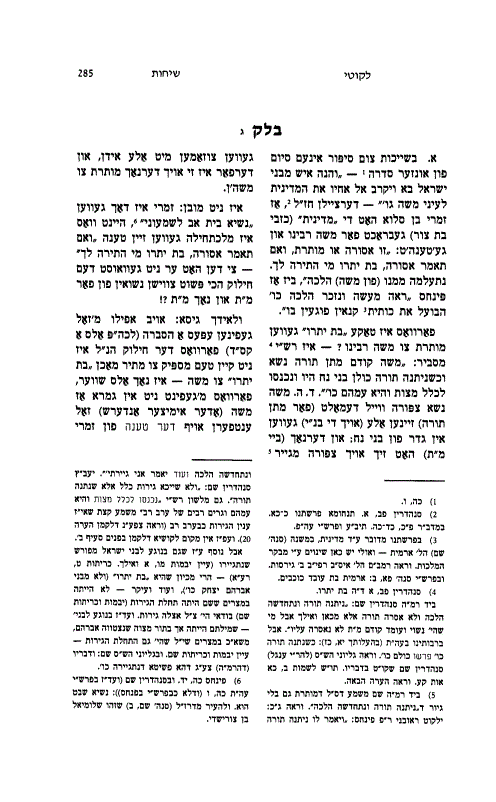
On the verse, “And behold, a man from among the children of Israel came and brought the Midianite woman before his brethren...,” Rashi explains that Zimri challenged Moshe:
“Is this woman forbidden or permitted? If you say she is forbidden, who permitted the daughter of Yisro to you?”
At first glance this is difficult to understand. Moshe married Tzipporah before the giving of the Torah, when everyone still had the status of Bnei Noach, and they all entered the covenant together at Sinai. Zimri’s act, by contrast, took place after the giving of the Torah. How could Zimri fail to recognize such an obvious distinction?
Furthermore, why did Moshe not answer him?
This can be understood by first addressing another question.
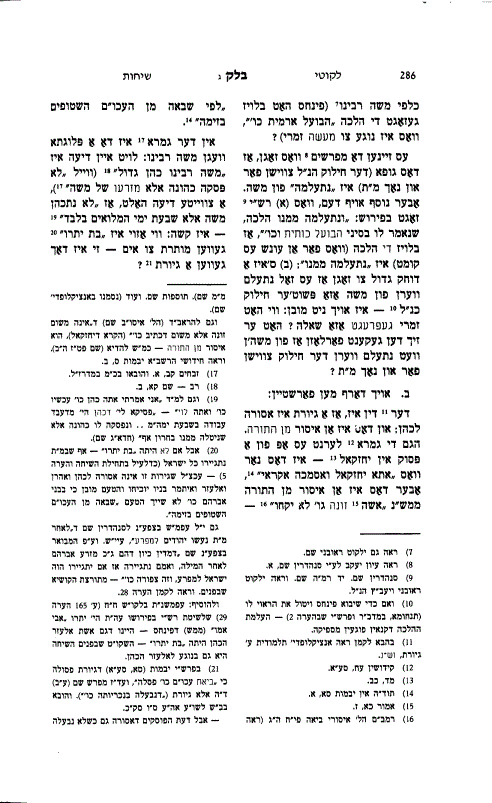
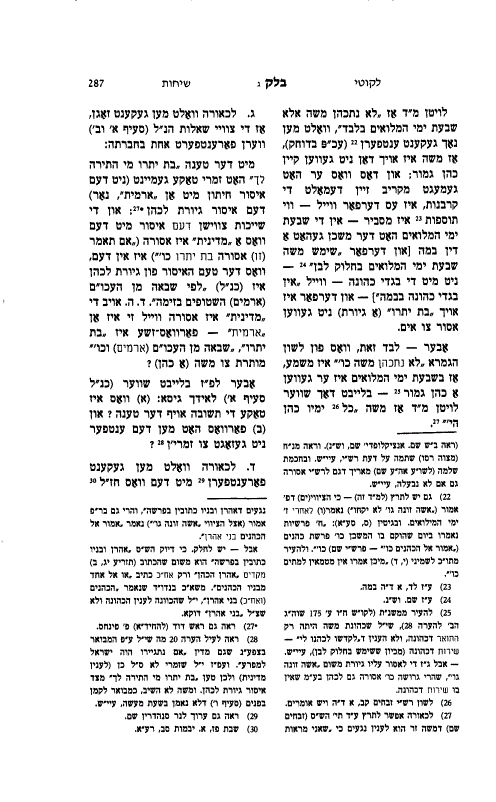
Moshe had the status of a kohen. Even according to the opinion that he served as a kohen only during the seven days of inauguration (shiv‘as yemei ha-milu’im), it is clear that during that period he possessed the full status of a kohen. If so, how was he permitted to remain married to Tzipporah, who was a convert?
The explanation is based on a teaching of the Oral Torah derived from the verse “he shall take a wife.” The law is that if a regular kohen was already married to a widow and was later elevated to the position of Kohen Gadol, he may remain with her. Since the marriage existed before the new status took effect, it is permitted to continue.
Certainly the same principle applies here. Moshe had already married Tzipporah before the giving of the Torah, and therefore she remained permitted to him.
(Indeed, from Rashi’s comment that Amram took Yocheved in a “second marriage,” it appears that marriages before Sinai already possessed a status that continued after the giving of the Torah. Therefore there was no need for the Jewish people to remarry after Matan Torah, which explains why the Torah immediately says, “Return to your tents,” without requiring a new marriage ceremony.)
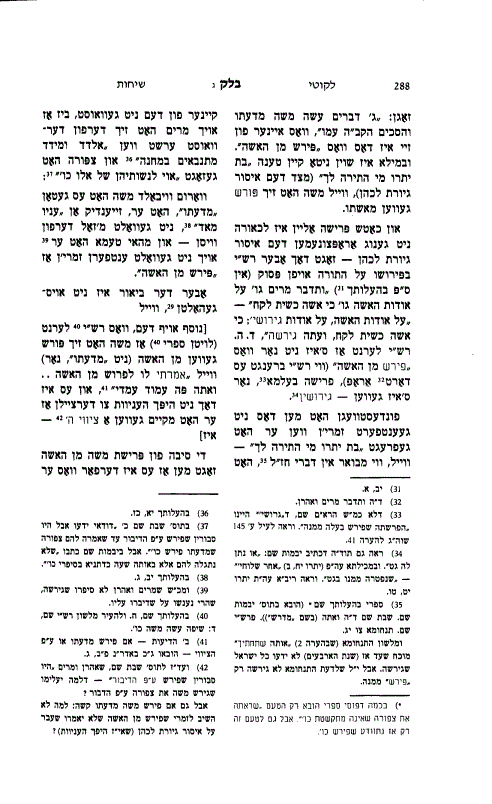
This, however, was Zimri’s argument. Since Moshe was a kohen and Tzipporah had come from a non-Jewish background, while the Midianite woman also came from a people immersed in immorality, Zimri claimed that there was no essential difference between the two cases.
Moshe could not answer this argument on the basis of the Oral Torah’s legal derivation, because he himself was personally involved in the matter. Since the proof concerned his own marriage, he could not serve as the one to adjudicate the issue.
The Lesson
When a person asks a question not because he genuinely seeks the truth, but because he wishes to justify improper behavior, there is no obligation to engage him in debate.
Similarly, when the evil inclination approaches a person with clever arguments and rationalizations, one should not become entangled in endless discussion. Instead, one should follow the directive of the Sages:
“Draw him into the Beis HaMidrash.”
The response must come from a place that transcends argument and calculation—a commitment that is higher than reason itself.
This parallels the conduct of the Rebbe Rayatz, the Baal HaGeulah of Yud-Beis Tammuz. His self-sacrifice was in the spirit of “when he zealously avenged My zeal,” extending even beyond what was strictly required by halachah. Yet this self-sacrifice was expressed not through harshness but through kindness and compassion, reflected in his request that his liberation come about through Divine kindness and mercy.
The lesson is that true dedication to Torah is not merely a matter of winning arguments. It is a matter of unwavering commitment that stands firm even when challenged by seemingly persuasive reasoning.