Likutei Sichos vol. 27 – Shemimi 3 - When Holiness Attracts Challenge: A Chassidic Insight into Tuma

The Rebbe explains the halachos of Tumas Ochalin as a guide for Avodas Hashem: true holiness—Torah, mitzvos, and the neshama—attracts challenge. Through connection to one’s essence and reaching outward to others, one remains protected and transforms that challenge into growth.

We will do a review on the Likkutei Sichos, Chelek Chof Zayin, Volume 27, the third sicha on Parshas Shemini. In this sicha, the Rebbe takes a very direct halacha from the Rambam and explains how it applies to us in our avodas Hashem.

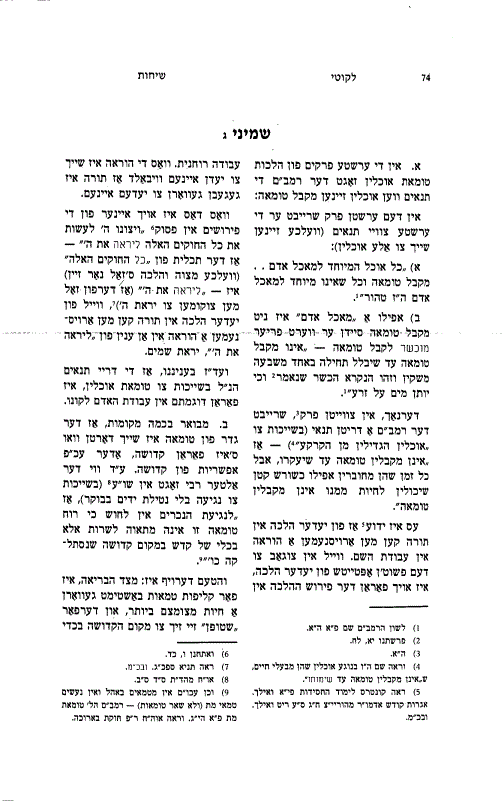
The halacha we are discussing is: when can something become mekabel tumah, able to receive impurity.

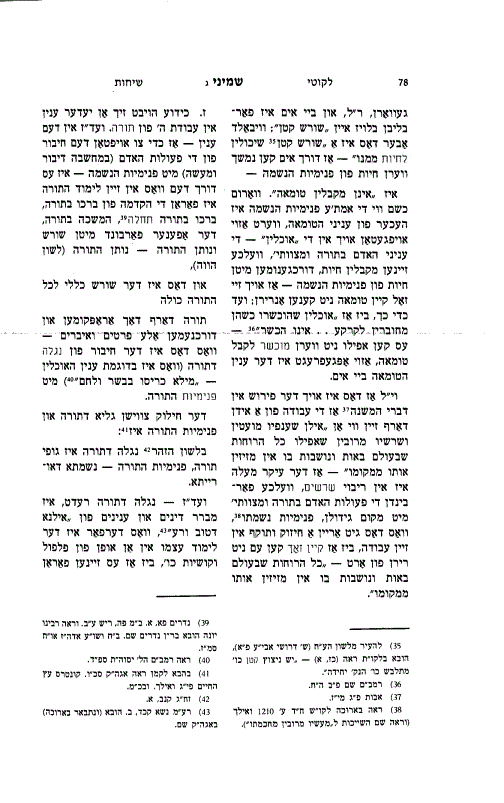
The Rambam explains that in order for food to become tamei, it must meet certain conditions. First, it has to be food that a human being eats. Second, it must have come into contact with water, one of the seven liquids, which prepares it to receive tumah. And third, if the food grows from the ground, as long as it remains connected to the ground—even by a small root—it cannot become tamei. Only once it is detached can it receive tumah.

The Rebbe explains that from these halachos we learn a powerful lesson in avodas Hashem. Tumah seeks out kedushah. Where there is greater holiness, there is a greater effort from the side of impurity to attach itself.

Kedushah is represented by “ma’achal adam”—food fit for a human being. A human being, “adam,” represents “adameh l’Elyon,” one who is compared to the Divine. This refers to a Jew, whose neshama is connected to Hashem. Therefore, anything that is connected to Torah and mitzvos, which are the nourishment of the neshama, is considered “food for man” in the deepest sense.

Because Torah and mitzvos carry such strong kedushah, tumah is drawn there. It seeks to draw from that holiness and gain additional vitality. But where there is no kedushah—where something is not connected to the neshama, not connected to Torah and mitzvos—there is no interest from tumah, because there is nothing for it to gain.

This idea is also reflected in halacha. For example, the Alter Rebbe explains regarding netilas yadayim that the רוח רעה rests specifically on the hands of a Jew, not a non-Jew. This is because tumah seeks a place of kedushah. A Jew, whose body is a vessel for holiness, attracts that impurity, whereas a non-Jew does not in the same way.

The reason for this is that the forces of impurity have only a very limited source of vitality. Therefore, they seek to draw energy from kedushah. Their strategy is to attempt to bring a person down, so they can receive nurture from the holiness within him. This only applies where there is kedushah to begin with.

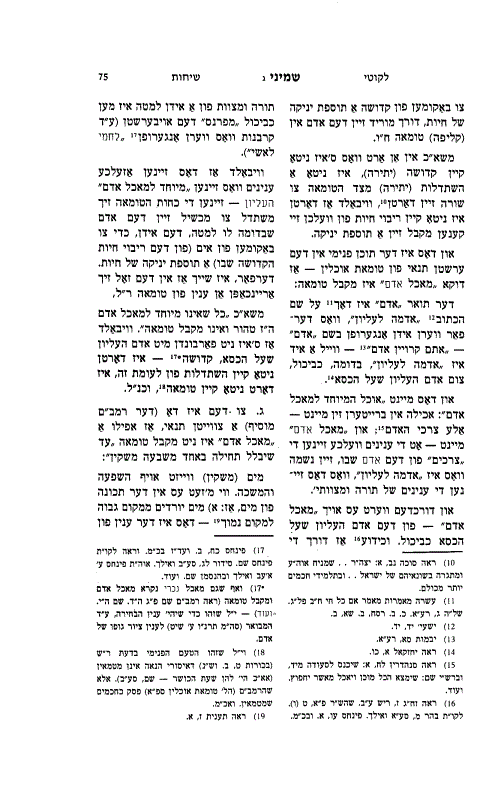
This is the deeper meaning of the Rambam’s first condition: only “ma’achal adam” can become tamei. Only something that is connected to the level of “adam,” to the neshama and to kedushah, is a target for tumah. But something that is not designated for human consumption—something not connected to the neshama—remains tahor, because tumah has no interest in it.

The Rebbe expands this further. “Food” does not only mean physical food, but all the needs of a person. The true needs of a person—of the neshama—are Torah and mitzvos. Through engaging in Torah and mitzvos, a Jew is not only sustaining himself, but כביכול also providing “nourishment” Above, as it says regarding korbanos, “לחמי לאישי”—My bread for My fire.

Because of this great level of kedushah, there is a greater effort from tumah to interfere and to attach itself. Specifically in those areas where a Jew is involved in Torah and mitzvos, where there is the greatest connection to Hashem, that is where the greatest challenge can appear.


However, this itself reveals the greatness of those actions. The fact that there is opposition is not a sign of weakness, but a sign of strength. It shows that this is a place of true kedushah, a place that carries real spiritual vitality.


The Rebbe continues and explains the second condition brought by the Rambam—that even if something is considered food for a person, it will not become tamei unless it has been moistened with one of the seven liquids.

Water represents movement, flow, and giving. By its very nature, water descends from a higher place to a lower place. This expresses the idea of chessed—reaching downward to give to another. Water also has the quality of distributing nourishment; it enables food to spread throughout the body. Without water, the sages tell us, eating lacks proper function, because the nourishment is not properly carried through the body. In addition, water has the ability to connect and bind. Moisture causes separate elements to adhere and become one.

In avodas Hashem, this represents a deeper level of service. When a person’s “food”—his Torah and mitzvos—is not dry and self-contained, but infused with “water,” it means that it flows outward. It does not remain only within the individual, but extends to others. A person lowers himself, reaching even those on a lower level, in order to share and give. This spreads the light of kedushah further and increases it.

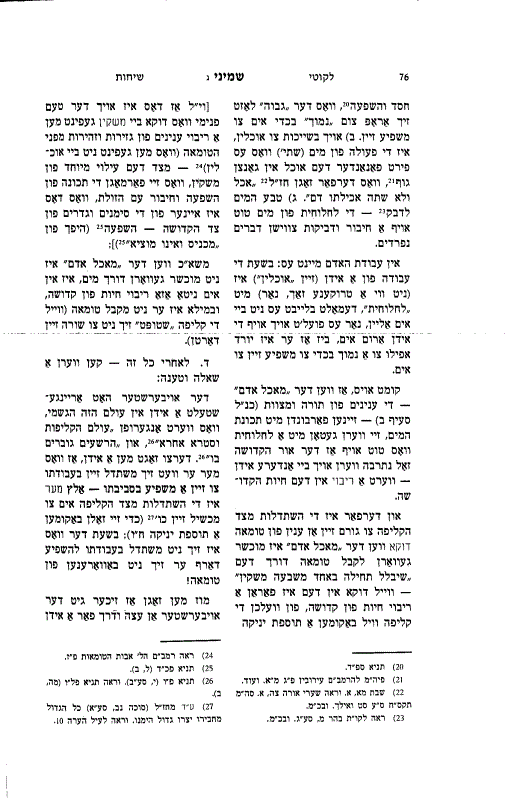
When Torah and mitzvos are performed in this way—with warmth, vitality, and influence—they create a far greater level of holiness. And precisely because of this increased light, the forces of tumah make a greater effort to attach themselves there, seeking to draw nourishment from that heightened kedushah.

This explains why the Rambam requires moisture as a condition for tumah. Only when the food has been prepared with liquid—when it has the quality of flow, connection, and expansion—does it reach a level where tumah is drawn to it. Without that added vitality, there is less interest from the side of impurity, because the level of kedushah is not as great.

This also explains why we find many additional stringencies specifically regarding liquids in halacha. Liquids carry a unique quality: they represent giving, connection, and expansion—core attributes of kedushah. In contrast, klipah is characterized by taking without giving. Kedushah gives; klipah withholds. Therefore, when Torah and mitzvos are expressed with the quality of water—flowing outward and connecting—they reach a higher level of kedushah, and thus attract greater opposition.

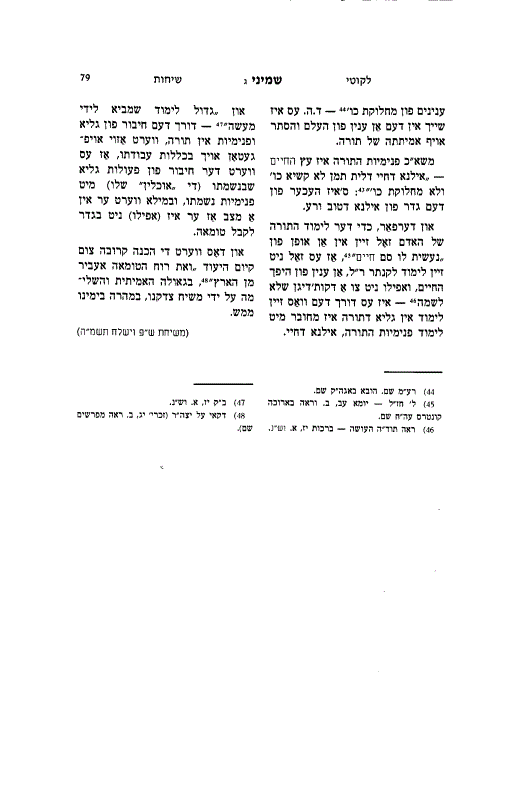
This leads to the third condition of the Rambam, which provides both clarity and comfort. Food that grows from the ground does not become tamei as long as it remains connected to its source, even by a small root from which it can still draw life.

In avodas Hashem, this teaches a powerful lesson. A person may ask: if greater involvement in Torah and mitzvos, especially influencing others, brings greater challenge, would it not be safer to limit oneself? The answer is that Hashem provides the means to remain protected.

The key is connection to the source.

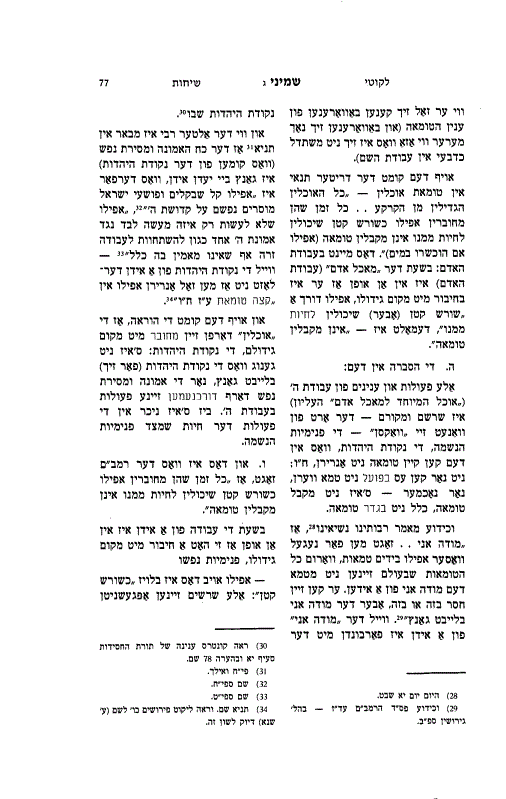
When a person’s service remains connected to its root—the essence of the soul—then tumah has no hold over it. Even if the person is active in the world, even if he is influencing others and thereby increasing the level of kedushah, as long as he remains connected to that inner source, he is not susceptible to tumah.

All Torah and mitzvos ultimately grow from the inner point of the soul, the core of Jewish identity. At that level, there is no possibility of impurity at all. As we say in Modeh Ani upon awakening, even before washing the hands, the essence of the soul remains untouched. All forms of impurity cannot defile that inner acknowledgment of a Jew.

As explained in Tanya, every Jew possesses a point of emunah and mesiras nefesh that is complete and unchangeable. Even a Jew who is otherwise distant will give up everything rather than act in contradiction to his essential connection to Hashem. That point is beyond tumah entirely.

The lesson is that one’s avodah must be connected to that root. It is not enough that the essence of the soul remains intact on its own; that inner vitality must permeate all aspects of one’s Torah and mitzvos. Even if the connection is only like a small root, as long as it provides life, it is sufficient to protect completely.

When one’s actions are infused with this connection to the essence, then not only does tumah not take hold—it is not relevant at all. Even if all other connections seem weakened, as long as there is that essential root, the person remains firmly anchored and protected.

This is reflected in the teaching of the Mishnah that a person should be like a tree with few branches but many roots. When the roots are strong, no winds in the world can uproot it. The strength of a person lies not in external expression alone, but in the depth of his connection to his source.

This connection is primarily achieved through Torah. By beginning with a blessing on the Torah, one connects not only to the learning itself, but to the Giver of the Torah. This establishes a root that extends into all areas of life.

There is also a connection between the revealed part of Torah and the inner dimension of Torah. The revealed Torah is compared to the body, while the inner Torah is the soul. The revealed Torah involves analysis, questions, and debate. The inner Torah, however, is called the Tree of Life—above all conflict and concealment.

When one connects the revealed Torah to the inner Torah, the learning becomes truly life-giving. It is no longer merely intellectual, nor for personal gain, but rooted in a deeper truth. This connection then extends to all of one’s service, uniting the external actions with the inner essence.

Through this, a person reaches a level where tumah is not applicable at all, because he is connected to the core of his soul.

May this lead very soon to the fulfillment of the promise, “I will remove the spirit of impurity from the land,” with the coming of Moshiach, speedily in our days.


Leave Feedback