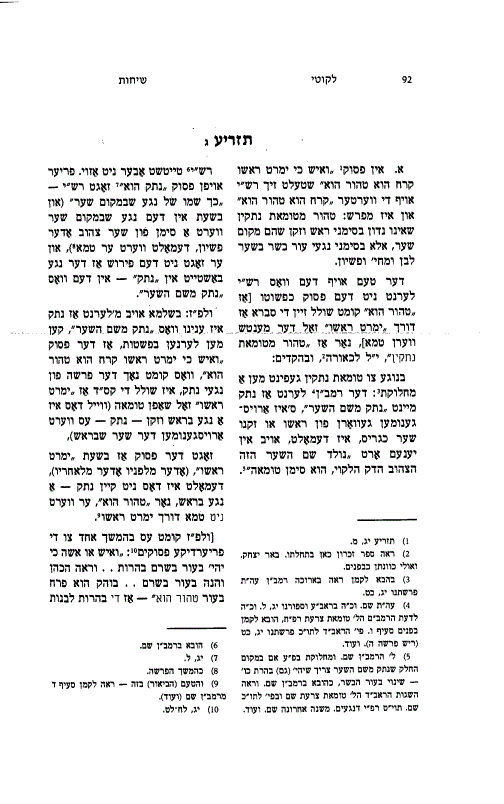
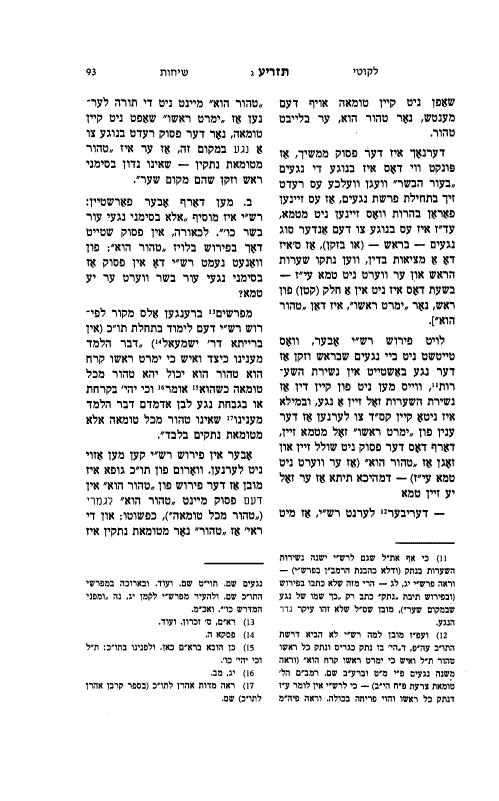
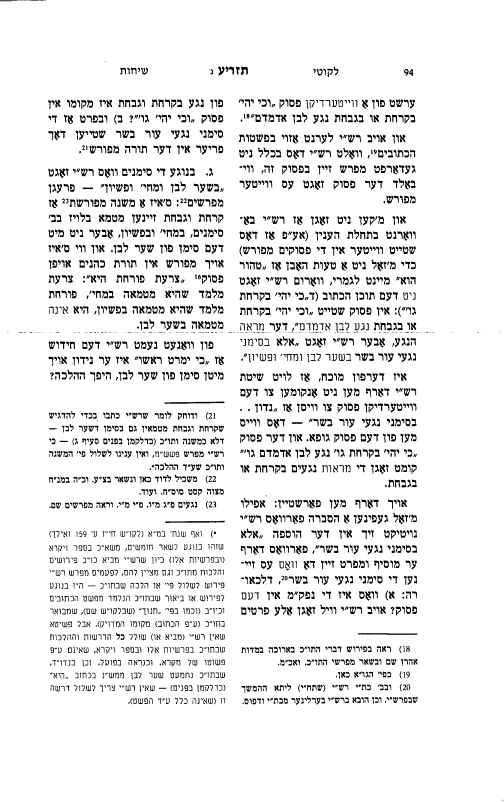
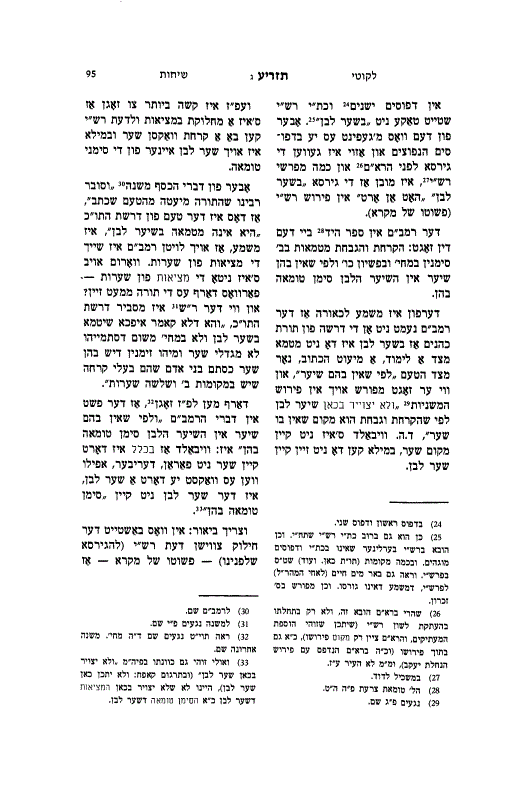
We will review a sicha from Likkutei Sichos, Chelek Chaf-Zayin, Volume 27. This is the third sicha on Parshas Tazria. It is a Rashi sicha, very detailed, with many clarifications on the subject of tumah v’taharah, the various negaim, and the different types of plagues.
The Rebbe brings tremendous clarity and powerful chidushim in understanding a very difficult Rashi—how to reconcile Rashi with the Ramban, and how both relate to the Rambam in halacha. At first glance, Rashi even appears to contradict halacha. There is a great deal of detail in this sicha, requiring careful attention, as the distinctions between the various halachos are very fine.
We will go step by step, and be’ezras Hashem, we will understand the Rebbe’s sicha to the extent possible.
The Rebbe begins (Tazria Gimmel, Aleph) with the verse:
"V’ish ki yimaret rosho, kere’ach hu, tahor hu."
The Torah discusses different signs of tzara’as that render a person tamei. Here, the verse states that if a person’s head becomes bald—yimaret rosho, meaning his hair falls out naturally—this is called kere’ach, and tahor hu, he is pure.
As we will see, the Rebbe explains this according to Rashi and contrasts it with the Ramban.
Rashi comments on the words “kere’ach hu, tahor hu.” What does it mean that he is tahor?
Rashi explains: “tahor mitumas n’sakim.”
Previously, we learned that there are two general categories of tzara’as:
One appears on the skin (nega tzara’as), and another appears in areas where hair grows—on the head or beard. These are called n’sakim.
Thus, when the verse says “tahor hu”, Rashi explains that it means he is tahor from the tumah of n’sakim. If a sign of tumah that would normally apply to n’sakim—such as a yellow hair—appears in this bald area, it does not render him tamei.
Why? Because n’sakim apply specifically to areas of hair—the head and beard. But here, since the person has a bald spot (kere’ach), that area is no longer considered a place of hair. Therefore, it is not judged with the laws of n’sakim.
Instead, the bald area is treated like regular skin (or habasar). If a nega develops there, it is evaluated according to the laws of negai or basar—which include signs such as:
- Se’ar lavan (white hair)
- Michyah (healthy flesh appearing within the lesion)
- Pisyon (spreading of the lesion)
These are the standard criteria for tzara’as on skin, not the criteria of n’sakim, which involve yellow hair (se’ar tzahov).
So once there is yimaret rosho—a bald spot—the area is no longer treated as a place of hair. It is no longer subject to the laws of n’sakim, but instead to the laws of negai or basar.
The Rebbe now asks:
Why doesn’t Rashi explain the verse in a simpler way, as the Ramban does?
The Ramban explains that the verse is simply teaching that becoming bald is not itself a nega. The loss of hair does not make a person tamei. The Torah is just clarifying that baldness is not a sign of tzara’as.
So why doesn’t Rashi learn this way?
The Rebbe explains that Rashi cannot interpret the verse this way due to his fundamental understanding of what n’sakim are.
According to the Ramban, nesek refers to hair that has become detached or uprooted, and replaced with a yellow hair—a sign of tumah. Thus, nesek is connected to hair loss.
Based on that, one might think that extensive hair loss—like baldness—should also be a sign of tumah. Therefore, the Torah must clarify that yimaret rosho is tahor.
However, Rashi does not define nesek this way.
Rashi explains that nesek is simply the name of a type of nega that appears in areas of hair—on the head or beard. It is not defined by hair being uprooted or detached.
Rather, the criteria for nesek are:
- The presence of yellow hair (se’ar tzahov)
- Or spreading of the lesion (pasyon)
Thus, according to Rashi, nesek has nothing to do with hair falling out.
This leads to a critical conclusion:
If nesek is not about hair loss, then there is no reason to think that baldness would cause tumah. So why would the Torah need to tell us that yimaret rosho is tahor?
According to Rashi, the verse cannot be coming to say that baldness is not tamei, because we would never have thought it is tamei to begin with.
Therefore, Rashi must interpret the verse differently.
The verse is not addressing the baldness itself, but rather a nega that develops in the bald area.
Since there is no hair there anymore, that area is no longer considered a place of hair. Therefore, it cannot have the laws of n’sakim.
Instead, it is treated like regular skin.
That is why Rashi explains: “tahor mitumas n’sakim”—it is not subject to the laws of n’sakim.
The Rebbe continues to clarify:
According to the Ramban, everything flows smoothly. The Torah discusses negai or basar—some signs render tamei, others do not. Then it moves to n’sakim—again, some cases are tamei, others are not.
So too, baldness would be another case within n’sakim: sometimes hair loss is a sign of tumah, but in the case of full baldness (kere’ach), it is not.
But according to Rashi, this approach does not work.
Since nesek has nothing to do with hair loss, there is no reason to think baldness would be tamei. Therefore, the verse cannot be addressing that.
Instead, it must be teaching that a nega appearing in a bald area is not judged as n’sakim, but rather as negai or basar.
The Rebbe now raises a deeper question:
Even if Rashi explains that the bald area is not subject to n’sakim, why does Rashi add that it is judged like regular skin?
The verse only says “tahor hu.” It does not say that the area now becomes subject to the laws of negai or basar.
So where does Rashi get this from?
Why not simply say: it is tahor, meaning it does not have tum’as n’sakim—and leave it at that?
Furthermore, how do we know that a nega in this area can make the person tamei through the laws of or basar?
Perhaps it is completely exempt from all forms of tumah?
Some commentators explain that Rashi derives this from a later verse, based on the principle of davar halamed me’inyano—a concept learned from its context.
Later, the Torah discusses karachas and gabachas, where hair is lost and a nega appears, and there it clearly states that there can be tumah.
So perhaps Rashi learns from there that here as well, the bald area is treated like skin.
However, the Rebbe points out that Rashi does not quote this later verse. That suggests this is not Rashi’s source.
In fact, the Toras Kohanim explicitly entertains the possibility that “tahor hu” might mean completely exempt from all tumah. Only later does it clarify otherwise.
So the question remains:
How does Rashi know, from this verse itself, that the bald area is treated like or basar and can become tamei through those laws?
From the continuation of the discussion, we now see from another verse that:
"V’chi yihyeh bakarachas o bagabachas nega lavan adamdam…"
This teaches that in the area of karachas and gabachas (baldness), there can indeed be a nega—a white-reddish affliction.
From here, the Toras Kohanim derives that when our verse says “tahor hu”, it does not mean completely pure from all forms of tumah. Rather, it means:
tahor mitumas n’sakim bilvad—pure only from the specific tumah of n’sakim.
This is the halachic conclusion according to Toras Kohanim.
However, the Rebbe emphasizes that in Rashi’s peshat, we cannot explain it this way.
Why not?
Because relying on the later verse (“v’chi yihyeh bakarachas…”) to reinterpret our verse would mean that the simple meaning of “tahor hu” initially implies complete purity—tahor legamri. Only afterward would we limit it.
But Rashi does not follow that method.
The proof is clear:
The Toras Kohanim itself indicates that the simple reading of “tahor hu” would suggest complete purity—tahor mikol tumah. Only the later verse teaches otherwise.
So if Rashi were following that approach, he would not need to explain anything here. He would leave the verse alone, and we would later learn from the subsequent verse that the person is not entirely pure.
So why does Rashi intervene here?
Rashi should have simply said:
The verse leaves it unclear, and later we will learn that it is only tahor from n’sakim but not from other types of tumah.
Yet Rashi does not do that.
Instead, Rashi explicitly explains that this area is judged according to the signs of negai or basar.
One might suggest that Rashi is trying to prevent a misunderstanding.
If the verse says “tahor hu”, a person might mistakenly think that the individual is completely pure—free from all tumah. So Rashi clarifies immediately: do not make this mistake.
However, the Rebbe rejects this explanation.
Why?
Because if Rashi were merely warning us not to misunderstand, he would reference the later verse explicitly. He would say: don’t think he is completely tahor, because later the Torah explains otherwise.
But Rashi does not do that.
Furthermore, Rashi does not even explain the later verse in terms of halacha here.
The later verse (“v’chi yihyeh bakarachas…”) describes the appearance of the nega—a white-reddish discoloration. It tells us the mareh ha’nega.
But Rashi here is not discussing appearance. He is discussing the halachic criteria—the simanim:
- Se’ar lavan (white hair)
- Michyah (healthy flesh within the lesion)
- Pisyon (spreading)
These are not stated in that later verse.
Therefore, it is clear that according to Rashi, we do not need the later verse to establish that a bald area is judged like negai or basar.
We must derive this directly from our verse itself.
The Rebbe now sharpens the question:
Even if we understand why Rashi adds that this area is judged by negai or basar, why does Rashi need to list all the details?
Why does Rashi explicitly enumerate the signs:
- Se’ar lavan
- Michyah
- Pisyon
What is gained by listing all of them here?
Seemingly, if Rashi wants to tell us the laws of negai or basar, these were already explained earlier in the Torah. There is no need to repeat them here.
And if Rashi wants to explain the laws of baldness specifically, there is a later verse that describes the nega in bald areas.
So why bring all the details here?
The Rebbe now brings the Rambam into the discussion.
The Rambam writes that karachas and gabachas become tamei through two signs:
- Michyah
- Pisyon
But not through se’ar lavan.
Why not?
Because, as the Rambam explains, bald areas do not grow hair. Therefore, se’ar lavan cannot apply there.
He writes explicitly:
"Since there is no hair there, white hair cannot be a sign of tumah."
He similarly explains in his Pirush HaMishnayos that it is impossible for white hair to exist in a bald area.
From this, it appears that the Rambam does not rely on a drasha to exclude se’ar lavan, but rather on a simple factual reality:
There is no hair there—so this sign simply cannot exist.
However, Rashi explicitly includes se’ar lavan as one of the signs.
This raises a major question:
Does Rashi disagree with the reality? Does Rashi hold that hair can grow in a bald area?
Or is there a deeper reason why Rashi includes se’ar lavan, even though practically it may not apply?
This becomes the central issue that the Rebbe will address:
Why does Rashi list all three signs—including se’ar lavan—when, according to the Rambam, it is not even possible?
Is this a disagreement in physical reality, or is it a deeper textual necessity within Rashi’s approach to peshat?
The Rebbe now develops the concept further.
The Torah teaches that there are two types of negaim, distinguished by their defining signs.
In a place of flesh, the sign of tumah is se’ar lavan—white hair.
In a place of hair, the sign is se’ar tzahov—yellow hair.
This helps us understand the term nesek.
Why is the plague in the head or beard called nesek?
Rashi explains: “kach shemo shel nega”—this is simply the name of the plague. It is not a fundamentally different category; it is merely a designation for a nega that appears in a place of hair.
It is not a change in essence—just a change in location and therefore in its identifying signs.
Based on this, we can now understand the verse:
"Kere’ach hu, tahor hu."
The Torah is not only telling us that the bald area is free from the tumah of n’sakim.
It is also teaching that this area must now be judged according to the laws of negai or basar.
Why?
Because once the area becomes bald, it is no longer a makom se’ar—a place of hair.
And automatically, it assumes the status of or basar.
Rashi is therefore not describing two separate systems.
He is teaching that this is a natural transition:
When the defining characteristic of the area (hair) is no longer present, the halachic category shifts accordingly.
What was once judged as a nesek now becomes judged as negai or basar.
However, the Rambam takes a different approach.
According to the Rambam, nesek is not merely a name, but a distinct category of nega.
When the hair falls out, creating an empty space, that itself defines the condition of nesek.
Thus, negai ha’rosh v’ha’zakan—plagues of the head and beard—are fundamentally different from negai or basar.
This distinction also carries deeper meaning.
The Gemara teaches that negaim come as a result of spiritual failings—particularly:
- Lashon hara (evil speech)
- Gasus haruach (arrogance)
These correspond to different dimensions of the person.
Lashon hara is associated with speech—an external faculty.
Gasus haruach, however, relates to the inner essence of a person—their inner sense of self.
According to the Rambam’s framework, negai ha’rosh—plagues of the head—reflect a deeper spiritual deficiency.
They are associated with a form of denial or distortion at the level of core belief—kefirah b’ikar.
Thus, they represent an entirely different category from negai or basar, which are more external in nature.
From here comes an important lesson.
A person must be vigilant in these matters—to refine both their speech and their inner character.
One’s conversation should reflect “sichasan shel k’sheirei Yisrael”—the speech of upright Jews—consisting of words of Torah and wisdom.