Introduction
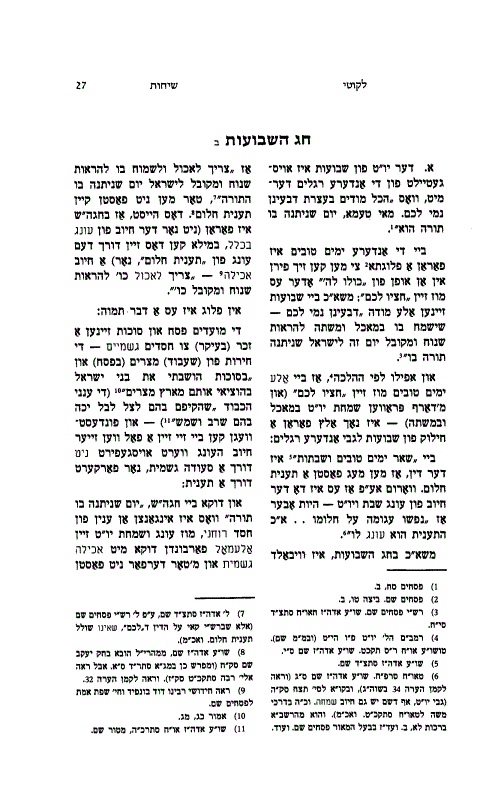
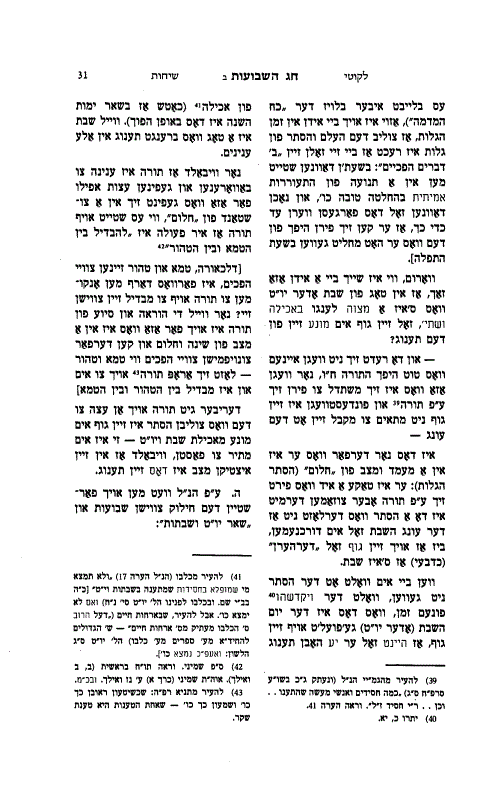
In this review, we will study a sicha from Likkutei Sichos, Chelek Chof-Gimel (volume 23), the second sicha for Chag HaShavuos. In this sicha, the Rebbe highlights a unique aspect of the Yom Tov of Shavuos: it is forbidden to fast on Shavuos—one must eat and enjoy physical food on this holiday.
The Rebbe points out that on other Yamim Tovim and even on Shabbos, there can be situations where a person does not eat, such as when fasting is required for reasons of peace or other circumstances. However, this exception does not apply to Shavuos; eating is an absolute requirement.
This leads to the Rebbe’s central question: Shavuos is associated with Matan Torah—the giving of the Torah—which is fundamentally a spiritual event. Why then is there such an emphasis on physical enjoyment and eating during Shavuos?
When we look at other holidays like Pesach and Sukkos, their commemorations are tied to physical events and benefits. On Pesach, Hashem took us out of Egypt—a very tangible salvation. On Sukkos, Hashem provided protective clouds or actual sukkot for Bnei Yisrael in the desert so they would not suffer from the sun or cold—again, a physical benefit. Yet, even on those holidays, there can be situations where one does not eat.
In contrast, with Shavuos—whose commemoration is entirely spiritual—the requirement is that it must also reach the physical level. The body itself must experience pleasure and enjoyment through eating on this Yom Tov.
Saif Aleph
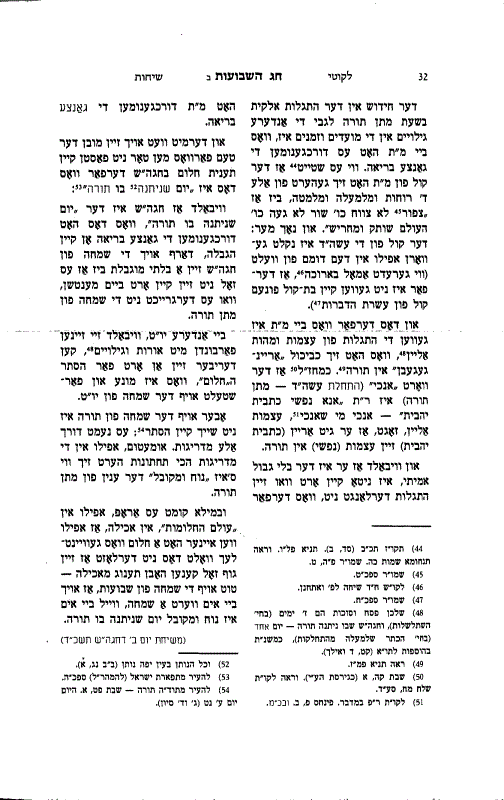
Although Shavuos is a holiday with a deeply spiritual reason—celebrating Matan Torah, the giving of the Torah—the Rebbe explains that because Matan Torah was a revelation of Atzmus, the very Essence of Hashem, this revelation must penetrate every aspect of existence. Physicality should not be seen as a limitation; we cannot say that we cannot reach or affect the physical world on this day. Instead, the holiness of Shavuos must come down even to the most physical level, as will be explained in detail step by step.
The Yom Tov of Shavuos is distinguished from the other festivals in a unique way. In the Gemara, there is a disagreement regarding whether one must enjoy oneself physically—through eating and drinking—on Yom Tov. With regard to Shavuos, however, all opinions agree that it requires Lachem—that there must be enjoyment for the person’s body.
While there is debate about the other Yomim Tovim as to whether they require Lachem (for you) or can be entirely LaHashem (for Hashem), with some opinions holding that one can devote the entire day to Hashem without any physical celebration, by Shavuos everyone agrees that Lachem is necessary. The reason given in the Gemara is that Shavuos is “the day that the Torah was given,” and it is important to demonstrate joy—that receiving the Torah is not a burden but something we are happy about.
On other holidays, there exists a disagreement: some verses say Lachem, others say LaHashem. Some opinions allow for “Kulu LaHashem”—devoting the entire day to spiritual pursuits without eating or drinking—while others require “Chatzi Lachem v’Chatzi LaHashem”—half for you and half for Hashem. This debate applies only to those holidays.
By contrast, when it comes to Shavuos, everyone agrees: “Zayin Ale Moideh Devayinu Nami Lachem”—even our teachers agree that we need Lachem. One cannot devote Shavuos exclusively to Hashem; there must also be physical enjoyment. The person should rejoice through eating and drinking in order to show comfort and acceptance of this day—the day on which the Torah was given.
This idea is reflected in Rashi’s language in Gemara Pesachim: it should be clear and accepted among Jews that on this day—the day of Matan Torah—they must have Lachem. Thus, by Shavuos, Lachem is required by all opinions; this distinguishes it from other holidays where some hold it is not necessary.
This distinction holds true even according to Halacha. Although by all Yomim Tovim there must be at least half for you (Lachem)—meaning on Pesach and Sukkos as well—Shavuos remains unique. Even though one must celebrate all Yomim Tovim with joy through eating and drinking, there still exists a special distinction regarding Shavuos compared to other holidays.
Saif Beis
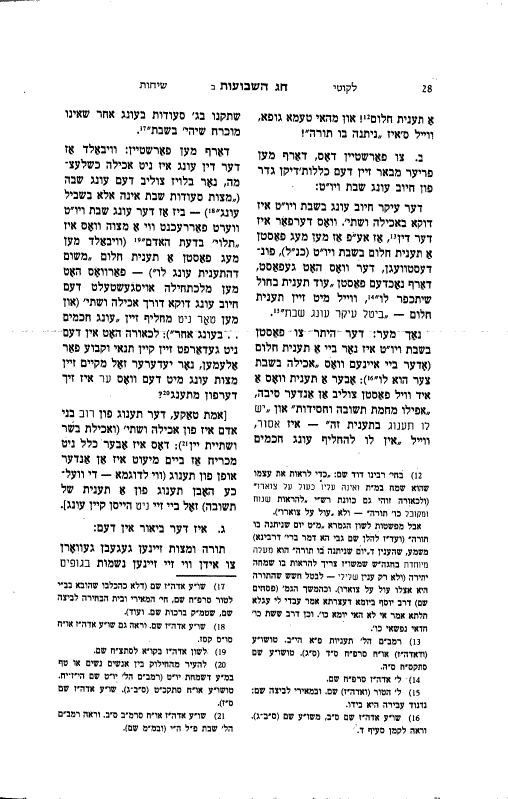
Even according to the opinion that on all holidays there is a requirement of lachem—personal enjoyment—there is still a distinction when it comes to Shavuos. On other Yomim Tovim and Shabbos, it is permitted to fast a taanis chalom, a fast in response to a troubling dream. Although there is an obligation of delighting in Shabbos and Yom Tov, if someone feels distressed because of a dream, fasting actually brings them pleasure and peace of mind. Therefore, fasting for a dream is allowed even on these days, since for this person, the fast itself is their delight.
However, when it comes to Shavuos, the situation is different. On Shavuos, there is an added obligation: not only must one refrain from fasting, but one must actively eat and drink to demonstrate that the day is pleasant and acceptable. The Alter Rebbe writes that on Shavuos, eating is required specifically to show joy and comfort with the day that the Torah was given. This means that even if someone would otherwise fulfill their delight through fasting (as with a taanis chalom), on Shavuos they are obligated to eat and drink.
This highlights that Shavuos is uniquely associated with eating and drinking. The Gemara states that on Shavuos everyone needs lachem—actual physical enjoyment through food and drink. Yet when we consider the reason for celebrating Shavuos—the giving of the Torah—it seems surprising. Pesach and Sukkos commemorate physical miracles: freedom from slavery in Egypt or protection in the desert with clouds of glory. In those cases, one might expect physical celebration through meals. But on Pesach or Sukkos, there can be situations where delighting in the festival does not require eating; sometimes even fasting fulfills one's obligation if that's their personal delight.
In contrast, Shavuos celebrates something entirely spiritual—the giving of the Torah. Nevertheless, it is precisely this spiritual event that demands physical celebration through eating and drinking. This seems counterintuitive: for festivals commemorating physical kindnesses, sometimes you don't need food; but for a festival marking a spiritual gift, eating becomes essential.
A similar idea appears regarding Purim and Chanukah (though not discussed here at length). On Purim, which commemorates a physical salvation, there is an obligation to have a meal. On Chanukah, which marks a more spiritual miracle, there isn't such an emphasis on having a festive meal.
The Rebbe points out how surprising this arrangement seems: Pesach and Sukkos recall primarily physical acts of kindness—freedom from Egypt's slavery or protection from discomfort in the desert—yet sometimes their celebration does not require physical meals. On the other hand, Shavuos commemorates the giving of Torah—a purely spiritual benefit—and yet its celebration must be expressed through actual eating and drinking.
The reason for this distinction requires deeper understanding. To approach it properly, we first need to clarify what constitutes oneg—delight—on Shabbos and Yom Tov in general.
The main obligation of oneg on Shabbos and Yom Tov is specifically fulfilled through eating and drinking. One cannot claim to fulfill oneg by other means alone; food and drink are central to this mitzvah.
This principle holds true even in cases where halacha permits fasting for a dream (taanis chalom) on these days. The halacha still requires that such a person later fast again during the week as atonement (kaparah) for having missed out on true oneg. Why? Because although he found personal pleasure in fasting due to his distress over the dream, he has nevertheless negated the main aspect of oneg, which comes through eating and drinking.
This shows how important eating and drinking are for fulfilling oneg. The only time one may be excused from this requirement is when fasting for a dream or if eating itself causes pain or distress (such as due to illness). But if someone wants to fast for another reason—even if it's for repentance (teshuvah) or because they find pleasure in fasting—it remains prohibited.
The Alter Rebbe writes explicitly: one should not change or substitute the enactment of the sages regarding how to fulfill delight on these days. The sages instituted that delight comes specifically through three meals (shalosh seudos) on Shabbos. One should not exchange this for some other form of pleasure unrelated to food or drink.
Saif Gimmel
The chachomim instituted that the delight of Shabbos should specifically be through eating and drinking. This is why there are limitations regarding fasting on Shabbos—even for a fast like a taanis chalom—a fast in response to a disturbing dream. If someone does fast, they must make up for it, and even then, it's only permitted in very specific cases.
But the question arises: if the whole point is to experience delight on Shabbos, why do we care how that delight is achieved? Why did the sages insist that it must be through eating and drinking? Shouldn’t any form of pleasure suffice?
The answer lies in the purpose of mitzvos and the nature of the Jewish soul within the body. The soul itself is inherently spiritual, but Hashem wants not only the soul but also the body to become refined and permeated with holiness through mitzvos. The goal is that even the physical body of a Jew should be transformed by kedushah—sanctity.
Therefore, when Torah instructs us that Shabbos or Yom Tov should be a time of delight—lachem, “for you”—it does not mean only spiritual pleasure for the soul. Rather, it means that also the body should feel delight from Shabbos or Yom Tov. The main aspect of this mitzvah is specifically to refine and elevate the body itself.
Since the natural way for a person’s body to experience pleasure is through eating and drinking, Torah says that oneg—delight—on Shabbos must come specifically through these physical acts. Only in this way does one accomplish that the delight of Shabbos penetrates and refines the actual physical body.
By contrast, fasting or engaging in teshuvah (repentance) on Shabbos does not provide bodily pleasure; rather, it brings spiritual delight to the soul. Even if someone has reached such a level that their body no longer feels pain from fasting—or even more so, if their body actually enjoys what their soul enjoys—this is still not true bodily delight. It’s either because their soul dominates their body or because they have worked so hard spiritually that their body now follows their soul’s lead. But this is not what Torah wants for Shabbos: Torah wants that the physical body itself should experience pleasure in its own right.
This explains why it is forbidden to fast on Shabbos or Yom Tov—even for reasons of teshuvah—except in very rare cases like taanis chalom. Even if someone claims to derive pleasure from fasting, Torah insists that one must experience bodily delight on Shabbos specifically through eating and drinking.
This also clarifies why, even when a taanis chalom (a fast for a troubling dream) is permitted on Shabbos or Yom Tov, atonement is still required afterwards. Although halachah allows such a fast under certain circumstances, one must still make up for having missed out on true bodily delight—the main aspect of oneg Shabbos.
The Rebbe points out that while there are other rare cases brought in halachah where not eating might be considered pleasurable (such as when eating would cause harm or when someone habitually fasts every day), these are exceptions. The Gemara itself only explicitly mentions taanis chalom as an allowance for fasting on Shabbos.
Saif Daled
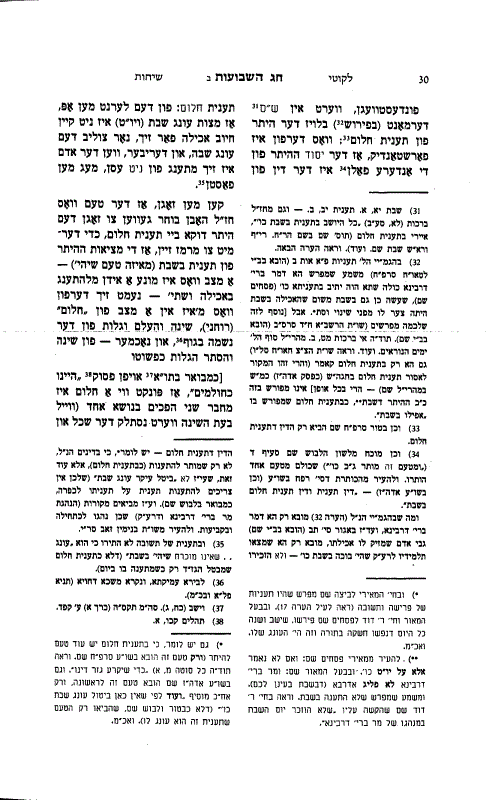
The allowance for fasting on Shabbos, as seen in the case of a taanis chalom—a fast in response to a troubling dream—teaches us an important principle. The mitzvah is not strictly to eat on Shabbos, but rather to experience delight and pleasure. Sometimes, that delight can be achieved in ways other than eating. In certain circumstances, such as when fasting brings a person greater peace or relief, the act of fasting itself becomes the means of delighting in Shabbos.
From the law of taanis chalom, we learn that there is no absolute obligation to eat; the obligation is to delight. If a person can achieve that delight through other means, then under specific conditions, it is permissible to substitute one form of pleasure for another.
The Rebbe explains that our sages specifically allowed this exception by taanis chalom to hint at a deeper reality. The very existence of such an allowance points to a spiritual condition: sometimes, a Jew finds himself unable to delight in eating and drinking because he is in a state akin to spiritual sleep or exile. The soul feels blocked within the body; there is separation and obscurity, like being trapped in a dream.
This is not just an individual struggle but reflects a general condition brought about by exile. Exile causes people to be spiritually asleep and obscured from true awareness. In this state, it becomes possible for two contradictory realities to exist together within a person—for example, during prayer he may feel genuine inspiration and resolve, but once he finishes davening, he forgets it entirely and acts contrary to his earlier intentions.
This paradox is like the nature of dreams themselves: they can combine opposites and carry together things that make no sense in waking life. The verse says, "we were like dreamers," highlighting how exile creates this confusion and contradiction within us.
But how does this idea apply even on Shabbos or Yom Tov—days when there is a mitzvah to delight through eating and drinking? Sometimes, even someone who sincerely strives to live according to Torah finds that his body simply cannot receive pleasure from food due to illness or distress. He does not want to fast out of disregard for Torah; rather, his physical state prevents him from experiencing the intended delight.
This person puts effort into living by Torah’s guidance but still faces an internal blockage. The light of Shabbos cannot penetrate fully so that his body also senses its holiness and joy. If not for this blockage—if not for the spiritual obscurity—the sanctity of Shabbos would impact him so deeply that even his body would experience delight on this day, regardless of his usual tendencies during the week.
So why does Torah allow him to fast? Because Torah’s purpose is not only idealistic but also practical: it protects and cares for every Jew’s real situation. Torah provides advice and support even for those who find themselves spiritually asleep or blocked—in a state of cholem, dreaming.
This inclusiveness is reflected in Torah’s role as described: "to distinguish between tamei (impure) and tahor (pure)." Torah recognizes both states and provides guidance for each. Tamei and tahor are opposites; yet Torah addresses both because it must offer direction even when opposites are mixed together within one person due to spiritual sleep or confusion.
Saif Hei
The Torah is able to descend even to a person who is in a state of spiritual sleep or confusion, where he might mix up what is pure (tohir) and what is impure (tomeh). In such a state, it becomes difficult for him to distinguish between the two. The Torah, in its compassion, provides guidance even for this person, offering advice on how to live according to his current condition.
For someone whose physical state blocks him from enjoying Shabbos or Yom Tov through eating and drinking, the Torah allows him to fast if that is truly his delight. The Torah recognizes his unique situation and permits this exception, showing its ability to reach even those who are spiritually “asleep.” If fasting brings him pleasure in his present condition, the Torah accommodates that need.
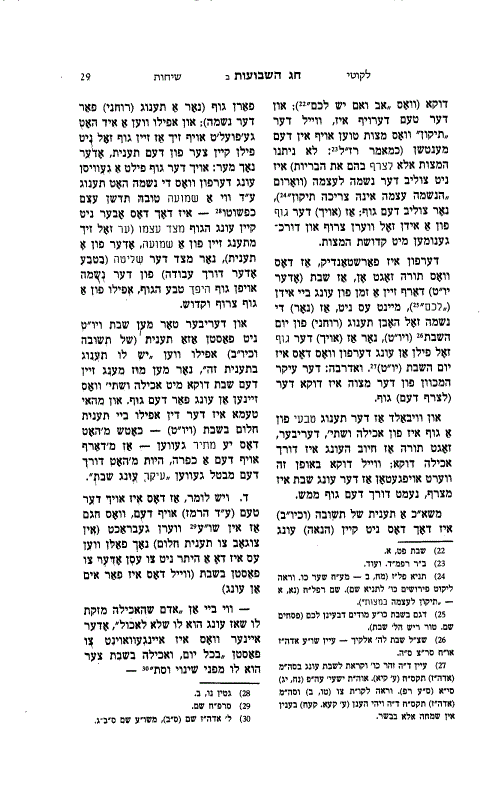
With this understanding, we can appreciate the difference between Shavuos and other festivals like Shabbos and Yom Tov. The revelation of Shavuos is so powerful that it does not allow for any concealment or blockage. On Shavuos, one must experience delight in a physical way—the way it was intended.
The novelty of the godly revelation at Matan Torah compared to other times is that it penetrated all of creation. As it is written, the sound of Matan Torah was heard from all directions—from all four corners of the world, from above and below. During Matan Torah, even birds did not chirp and oxen did not make noise; the entire world was silent and still.
This demonstrates that at Matan Torah, the revelation reached every aspect of creation. The voice of Hashem at Sinai was absorbed even by the inanimate world—by domem, things without life. As discussed at length elsewhere, this was not just an echo; rather, the voice entered into the very essence of creation itself.
The reason for this is that at Matan Torah there was a revelation from Hashem’s very essence—atzmus. Hashem Himself gave the Torah and invested Himself within it. Our sages teach that the word “Anochi” (the first word of the Ten Commandments) stands for “Ana Nafshi Ksovis Yehovis”—“I Myself wrote and gave Myself into [the Torah].” This means Hashem’s very essence is present within Torah.
“Anochi” refers to Hashem’s highest level—His very self beyond any name or description. At Matan Torah, Hashem gave Himself over into Torah; He placed His essence within it. Since Hashem is truly infinite and unlimited, there is no place where this revelation cannot reach.
This explains why Matan Torah penetrated all of existence without limitation. There was no aspect of creation untouched by this revelation—it permeated everything completely.
With this in mind, we can understand why on Shavuos one may not fast—not even a “dream fast,” which would be permitted on other festivals under certain circumstances. Since Shavuos marks the day when the Torah was given—a day when divine revelation filled all creation—there can be no room for any limitation or blockage that would prevent joy from reaching every part of a person.
The joy of Shavuos must be complete and unrestricted; there should be no area within a person where the joy of Matan Torah does not penetrate. Unlike other festivals where some individuals might have an excuse due to their spiritual “dreaminess,” on Shavuos there can be no such blockages—the light reaches everywhere.
This means that even someone who finds himself confused or spiritually asleep must experience joy on Shavuos. The body itself participates in this joy; physical delight through eating and drinking becomes possible for everyone because the infinite nature of Matan Torah’s joy reaches every Jew—even those on the lowest level.
On other Yomim Tovim there may be reasons why certain individuals are exempt from physical celebration due to their unique circumstances. But these reasons do not apply on Shavuos because its revelation leaves no room for exclusion—the joy must reach everyone equally.
This concludes section five as discussed in Sicha Beis of Chag HaShavuos 5724 (1964).
Key Points
1. Shavuos is unique among the festivals in that it absolutely forbids fasting and requires physical enjoyment through eating and drinking, even though it commemorates the spiritual event of Matan Torah—the giving of the Torah.
2. While other Yomim Tovim and Shabbos permit fasting in certain cases, such as a taanis chalom (fast for a troubling dream), on Shavuos there is an added obligation to eat and drink specifically to demonstrate joy and acceptance of the Torah.
3. The mitzvah of oneg (delight) on Shabbos and Yom Tov is primarily fulfilled through eating and drinking, as this ensures that the body itself experiences pleasure and becomes refined by holiness, not just the soul.
4. The allowance for fasting on Shabbos or Yom Tov in rare cases like taanis chalom teaches that the core obligation is delight; if delight can only be achieved through fasting due to personal distress, halacha accommodates this, reflecting Torah’s sensitivity to individual circumstances.
5. This flexibility acknowledges that spiritual “sleep” or exile can block a person from experiencing physical delight, but Torah still provides guidance and support for such situations, recognizing both pure and impure states within a Jew.
6. The revelation at Matan Torah was so powerful and all-encompassing that it penetrated every level of creation, leaving no room for concealment or limitation; Hashem’s essence became present within Torah itself.
7. Because of this unlimited revelation on Shavuos, there can be no exceptions or blockages—every Jew must experience joy in a physical way, making eating and drinking obligatory for all without exception on this festival.
8. Unlike other festivals where unique circumstances may exempt individuals from physical celebration, on Shavuos the divine light reaches everyone equally, ensuring that the joy of Matan Torah permeates every aspect of each Jew’s being—body and soul alike.