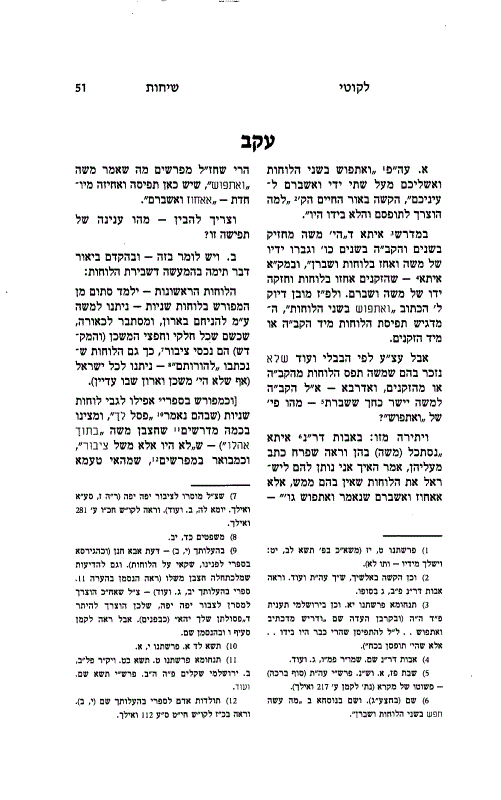
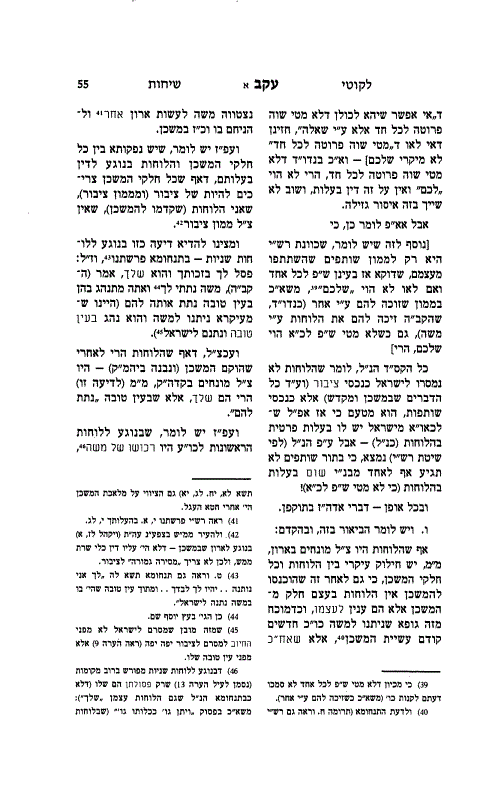
Moses said, "And I took hold of the two tablets and cast them out of my two hands and broke them before your eyes." The Ohr HaChaim asks, "Why did he need to take hold of them, were they not already in his hands?"
The Midrash states that "Moses was holding two and the Holy One, blessed be He, was holding two, and Moses' hands prevailed, and he took hold of the tablets and broke them." In another place, it is stated that the elders were holding the tablets, and Moses' hand prevailed, and he broke them. According to this, the wording of the verse "And I took hold of the two tablets" emphasizes the act of taking the tablets from the hands of the Holy One, blessed be He, or from the elders.
However, this is difficult according to the Babylonian Talmud and others, where it is not mentioned that Moses took the tablets from the Holy One, blessed be He, or from the elders. On the contrary, the Holy One, blessed be He, said to Moses, "Well done for breaking them." What then is the meaning of "And I took hold"?
Moreover, in Avos d'Rabbi Nosson it is stated, "Moses looked at them and saw that the writing had flown off them. He said, 'How can I give the Israelites the tablets that have no substance? Rather, I will take hold and break them,' as it is said, 'And I took hold...'" Thus, the Sages interpret Moses' statement "And I took hold" as indicating a specific act of grasping and holding — "I will take hold and break them."
We need to understand — what is the significance of this act of taking hold?
We can explain this by first addressing a puzzling aspect of the incident of breaking the tablets:
The first tablets — we can learn from the explicit statement regarding the second tablets — were given to Moses to be placed in the Ark. It seems logical that just as all parts and objects of the Mishkan (and the Temple) are communal property, so too the tablets, which were written "to teach them," were given to all of Israel (even though there was no Mishkan and Ark yet).
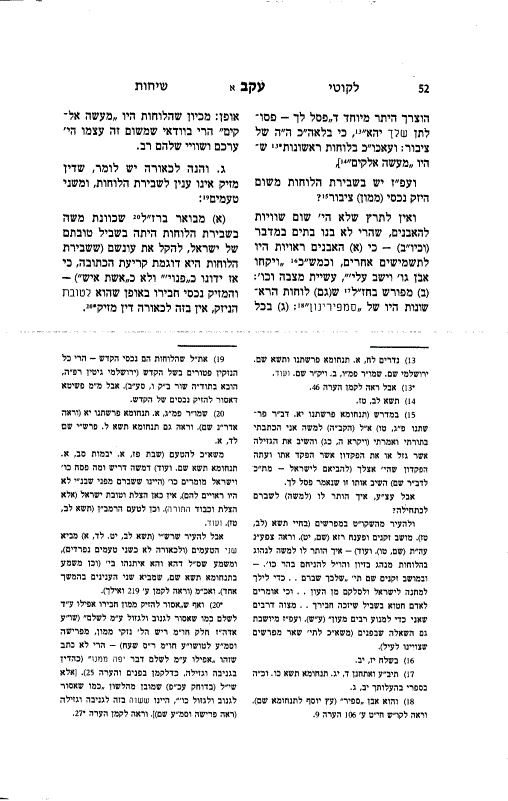
[As explicitly stated in the Sifrei, even regarding the second tablets — that "they were only communal property," and as explained by the commentators, that for this reason, a special permission was needed, "Carve for yourself — the shavings shall be yours," because otherwise, they would belong to the community; and certainly regarding the first tablets, which were "the work of G‑d"],
Based on this, breaking the tablets would constitute damage to communal property?
One cannot argue that the stones had no value because they did not build houses in the desert (and the like) — because (a) the stones were suitable for other uses, as it is written, "And they took a stone... and he sat on it," making a monument, etc.; (b) it is explicitly stated in the Sages that (also) the first tablets were made of "sapphire"; (c) in any case, since the tablets were "the work of G‑d," they certainly had great value and worth because of this alone.
It seems that the law of a damager does not apply to the breaking of the tablets, for two reasons:
(a) The Sages explain that Moses' intention in breaking the tablets was for the benefit of Israel, to lighten their punishment (as breaking the tablets is analogous to tearing a marriage contract, for then they would be judged as "unmarried" and not as "married") — and one who damages another's property in a way that benefits the damaged party is apparently not considered a damager.
[Note the prohibition of "do not destroy," for although a person "must be very careful not to lose, spoil, or damage it" — this is only "when done destructively and ruinously, but if done to improve, it is permissible to spoil"].
(b) Since the tablets were given to be placed in the Ark, Israel had no possibility of deriving benefit or use from them (not even like a Torah scroll, which at least can be read from, and on the contrary, "it is meant for hearing," from which "one benefits and fulfills by hearing"), and it is obvious that they were not given to be sold — thus, Israel had no ownership of the tablets (worse than ownership of items forbidden for benefit), and therefore, the law of a damager does not apply.
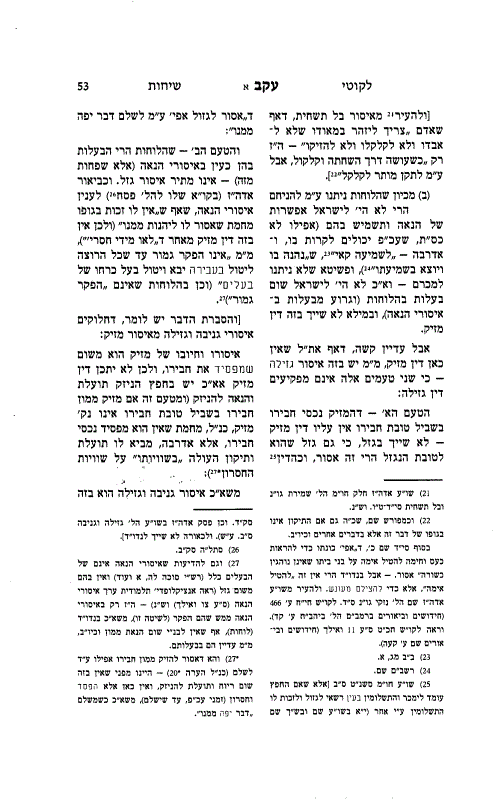
However, it is still difficult, for even if we say there is no law of a damager here, there is still the prohibition of theft — because these two reasons do not negate the law of theft:
The first reason — that one who damages another's property for the other's benefit is not considered a damager — does not apply to theft, because even theft for the benefit of the one stolen from is forbidden, as in the law "It is forbidden to steal even with the intention of paying back something better."
The second reason — that the ownership of the tablets is akin to items forbidden for benefit (though to a lesser degree) — does not permit the prohibition of theft. As explained by the Alter Rebbe (in his glosses to the laws of Passover) regarding items forbidden for benefit, even though "one has no rights to the object itself because it is forbidden to derive benefit from it" (and therefore there is no law of a damager since "nothing is lacking"), nevertheless, "it is not completely ownerless to the extent that anyone who wishes to take it in violation can do so against the owner's will" (similarly, the tablets are not "completely ownerless").
The explanation for this can be given as follows: the prohibitions of theft and robbery differ from the prohibition of causing damage:
The prohibition and obligation of a damager are because he causes loss to his fellow, and therefore the law of a damager cannot apply unless the damaged object provides benefit and enjoyment to the one damaged (for this reason, if one damages another's property for the other's benefit, he is not considered a damager, as mentioned above, because he does not cause a loss to the other's property, but on the contrary, brings him benefit and improvement that exceeds the value of the loss).
In contrast, the prohibition of theft and robbery is in taking an object from another's domain and bringing it into one's own domain, and this is not dependent on the object's value (its benefit and use), but on the very ownership of the other person.
Moreover, and primarily — the tablets were given "to teach them" — and this is a great benefit, even though the mitzvos themselves were not given for enjoyment.
According to the above, the question returns to its place: even if we say that in the breaking of the tablets there is no law of a damager — nevertheless, there is still the prohibition of theft.
One cannot argue that there is no obligation of theft until an acquisition is made on the stolen item — for in our case, it is explicitly stated in the verse (as mentioned above), "And I took hold of the two tablets and cast them... and broke them..." meaning that before breaking the tablets, there was a (special) grasp on them with the intention to break them [and indeed, one who steals with the intention to destroy the object is considered a thief, like one who takes his fellow's coin with the intention to throw it into the sea, who is immediately considered a thief and obligated to return it].
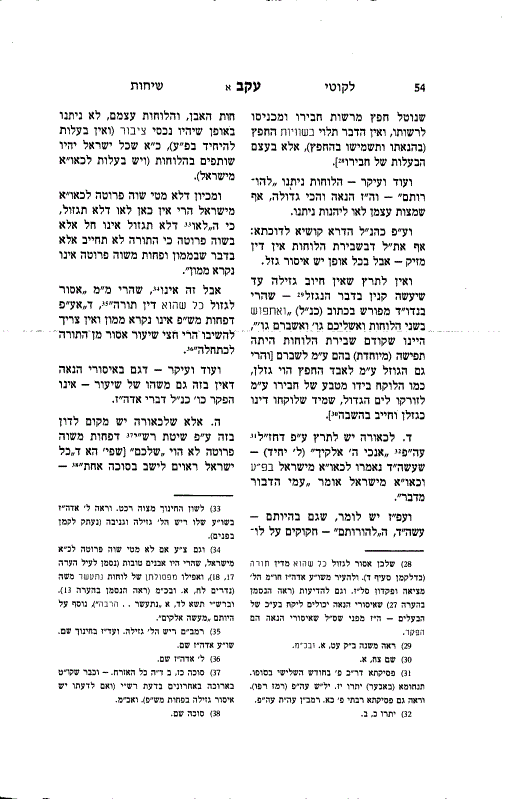
It might seem that it could be resolved based on the teaching of our Sages on the verse "I am the L‑rd your G‑d" (in singular form) — that the Ten Commandments were spoken to each individual Jew separately, and each Jew says, "The speech is directed at me."
Based on this, it could be said that even when they — the Ten Commandments, the "to teach them" — were engraved on the stone tablets, and the tablets themselves, were not given in a manner that they would be communal property (with no individual ownership), but rather that all of Israel would be partners in the tablets (and each Jew would have ownership).
And since the value of a perutah does not reach each individual Jew, there is no prohibition of "do not steal," because the prohibition of theft does not apply unless the value of a perutah is involved, as the Torah only obligates in matters of monetary value, and less than a perutah is not considered monetary.
But this is not so, for nevertheless, "it is forbidden to steal even the smallest amount according to Torah law," for "although less than a perutah is not considered monetary and does not need to be returned, half a measure is forbidden by Torah law from the outset."
Moreover, and primarily — even in items forbidden for benefit where there is not even a minimal measure — they are not ownerless, as explained above in the words of the Alter Rebbe.
However, it might seem that there is room to discuss this based on Rashi's view that less than the value of a perutah is not considered "yours" [as he explains regarding "all of Israel can sit in one sukkah" —
that "it is impossible for it to belong to all of them unless the value of a perutah reaches each one, except through borrowing," we see that if the value of a perutah does not reach each one, it is not called "yours"], and therefore, in our case, where the value of a perutah does not reach each one, it is not "yours" and there is no ownership law, and thus the prohibition of theft does not apply.
But it is impossible to say this, because
[in addition to the fact that it can be said that Rashi's intention is only regarding partners' money that they joined voluntarily, where only then do we need a perutah for each one, and if not, it is not "yours," whereas in money that is granted to them by another (as in our case, where G‑d granted them the tablets through Moses), even when the value of a perutah does not reach each one, it is considered "yours," therefore]
All the aforementioned assumption, that the tablets were not given to Israel as communal property (similar to all the items in the Mishkan and the Temple) but rather as partnership property, is based on the idea that then it could be said that each individual Jew has private ownership in the tablets (as mentioned above). However, according to the above, it turns out that as partners, no individual among the children of Israel would have any ownership in the tablets (since the value of a perutah does not reach each one)!
In any case, the words of the Alter Rebbe remain in full force.
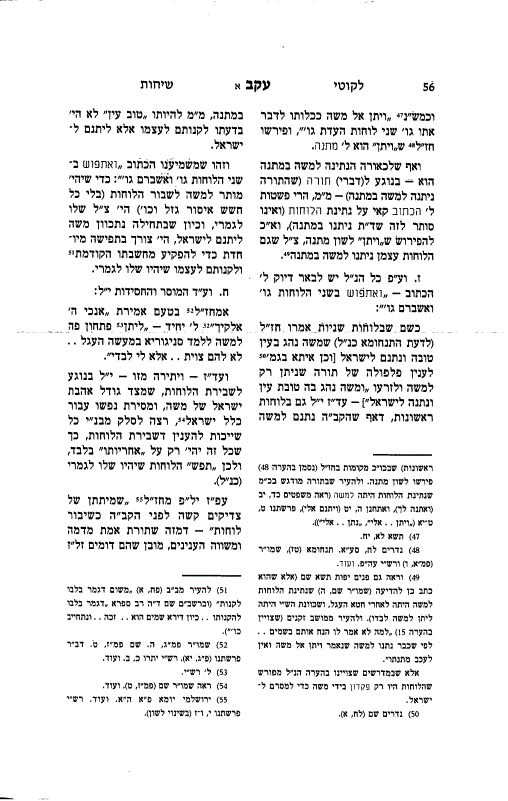
We can explain this by first introducing the following:
Although the tablets were meant to be placed in the Ark, there is a fundamental difference between the tablets and all the parts of the Mishkan. Even after they were placed in the Mishkan, the tablets are not inherently part of the Mishkan but are an independent entity. This is evident from the fact that they were given to Moses several months before the construction of the Mishkan. Later, Moses was commanded to make another Ark and place them in it, all within the Mishkan.
Based on this, we can say that there is a distinction between all the parts of the Mishkan and the tablets regarding their ownership. While all parts of the Mishkan need to be communal property (and from communal funds), the tablets, which preceded the Mishkan, do not need to be communal property.
We find explicitly such an opinion regarding the second tablets in the Tanchuma on our parsha, which states: "Carve for yourself in your merit, and it is yours," said the Holy One, blessed be He, to Moses. "I gave them to you, and you, acting generously, gave them to them" (meaning that initially, they were given to Moses, and he generously gave them to Israel).
Thus, it must be said that even though the tablets, after the Mishkan was erected (and the Temple was built), were to be placed in the Holy of Holies, according to this opinion, they are still considered "yours," but with a generous eye, "you gave them to them."
Based on this, we can say that regarding the first tablets, according to all opinions, they were Moses' property, as it is written, "And He gave to Moses, when He had finished speaking with him, the two tablets of the testimony," and the sages interpret "And He gave" as a term of gift.
Even though it might seem that the giving to Moses as a gift pertains to the words of Torah (that the Torah was given to Moses as a gift), nevertheless, the simple meaning of the verse refers to the giving of the tablets (and this does not contradict the fact that the words of Torah were given as a gift). Therefore, according to the interpretation that "And He gave" is a term of gift, it must be that the tablets themselves were given to Moses as a gift.
Based on all the above, we can explain the precision of the verse's language — "And I took hold of the two tablets and broke them":
Just as with the second tablets, the sages said (according to the Tanchuma as mentioned above) that Moses acted generously and gave them to Israel [and similarly, it is stated in the Gemara regarding the intricacies of Torah study that it was given only to Moses and his descendants, "and Moses acted generously and gave it to Israel"], so too can be said regarding the first tablets. Even though the Holy One, blessed be He, gave them to Moses as a gift, nevertheless, being "generous of eye," he did not intend to keep them for himself but to give them to Israel.
This is what the verse informs us: "And I took hold of the two tablets and broke them": In order for it to be permissible for Moses to break the tablets (without any concern of theft, etc.), they had to be entirely his. Since initially, Moses intended to give them to Israel, there was a need for a specific act of taking hold to nullify his previous intention and acquire them for himself so that they would be entirely his.
Regarding the moral and chassidic lesson, it can be said:
The sages said regarding the reason for the singular language of "I am the L‑rd your G‑d" — "to give Moses an opening to advocate on behalf of Israel during the incident of the Golden Calf... it was not to them that You commanded... but to me alone."
Similarly — and even more so — it can be said regarding the breaking of the tablets, that due to Moses' great love for Israel and his self-sacrifice for the entirety of Israel, he wanted to remove from the children of Israel any connection to the matter of the breaking of the tablets, so that all of it would be solely on "his responsibility." Therefore, he "took hold" of the tablets so that they would be entirely his (as mentioned above).
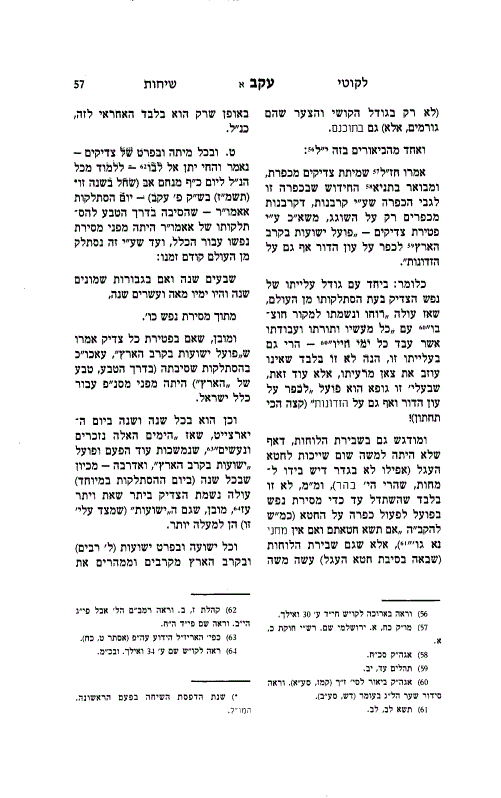
Based on this, we can explain the sages' statement that "the death of the righteous is as difficult before the Holy One, blessed be He, as the breaking of the tablets" — from the fact that the Torah of truth compares and equates these matters, it is understood that they are similar to each other.
(Not only in the magnitude of the difficulty and sorrow they cause, but) also in their content.
One of the explanations for this can be said:
The sages said that the death of the righteous atones, and it is explained in Tanya the novelty of this atonement compared to the atonement through sacrifices. Sacrifices atone only for unintentional sins, whereas the passing of the righteous "effects salvations in the midst of the earth to atone for the sins of the generation, even for intentional sins."
This means: Along with the great ascent of the soul of the righteous at the time of their departure from the world, when "their spirit and soul ascend to their source" along with "all their deeds, Torah, and service which they performed all their life" — even in this ascent, not only do they not abandon their flock, but moreover, through this very ascent, they effect "atonement for the sins of the generation, even for intentional sins" (the lowest level of sin).
This is also emphasized in the breaking of the tablets. Even though Moses had no connection to the sin of the Golden Calf (not even in the sense of having the ability to protest, as he was on the mountain), nevertheless, not only did he strive to the point of actual self-sacrifice to effect atonement for the sin (as he said to G‑d, "If You forgive their sin... but if not, erase me"), but also the breaking of the tablets (which came as a result of the sin of the Golden Calf) was done by Moses in such a way that he alone was responsible for it, as mentioned above.
In every death, and particularly that of the righteous, it is said, "and the living shall take it to heart" — to learn from all the above for the 20th of Menachem Av (which in this year [5747] falls on Shabbat Parshat Eikev) — the day of the passing of my father. The natural reason for my father's passing was due to his self-sacrifice for the community, to the extent that because of this, he departed from the world before his time:
"Seventy years, and if with strength, eighty years," and his days were one hundred and twenty years, through self-sacrifice, etc.
It is understood that if regarding the passing of any righteous person it is said that "he effects salvations in the midst of the earth," how much more so regarding a passing whose cause was due to self-sacrifice for the entirety of Israel.
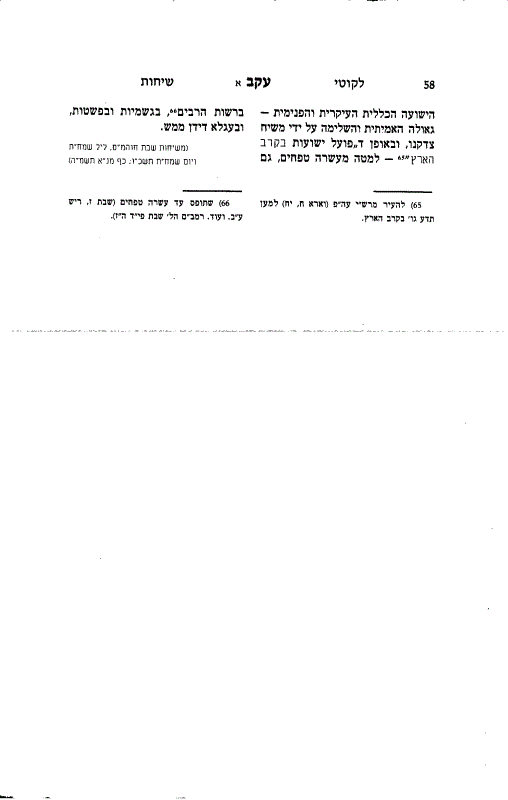
And so it is every year on the day of the yahrzeit, when "these days are remembered and made," that they are drawn down once again and effect "salvations in the midst of the earth." Moreover, since every year (especially on the day of the passing) the soul of the righteous ascends with greater strength and vigor, it is understood that the "salvations" (which result from this ascent) are even higher.
And every salvation, especially multiple salvations, in the midst of the earth, brings closer and hastens the ultimate and inner general salvation — the true and complete redemption through our righteous Moshiach, in a manner of "effecting salvations in the midst of the earth" — below ten handbreadths, even in the public domain, in physicality and simplicity, and imminently in our days.