Introduction
False Measures and the Exodus from Egypt
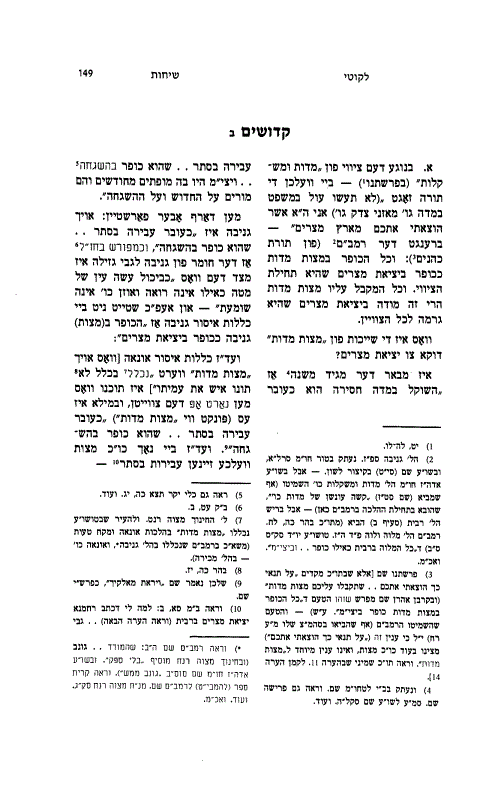
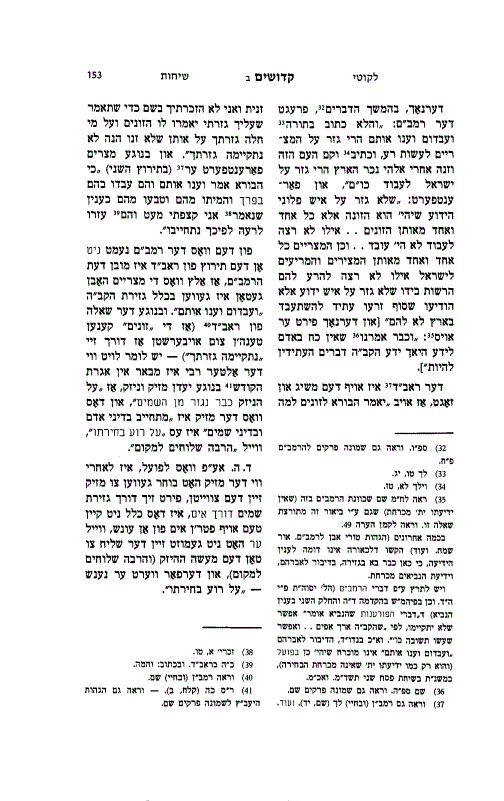
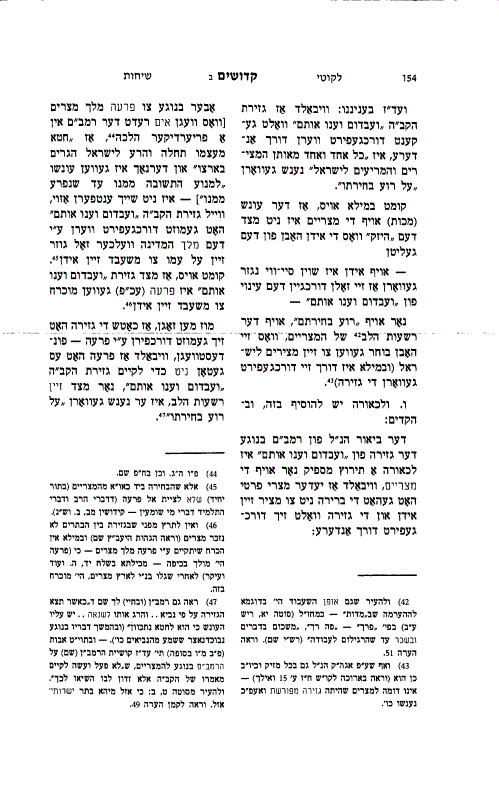
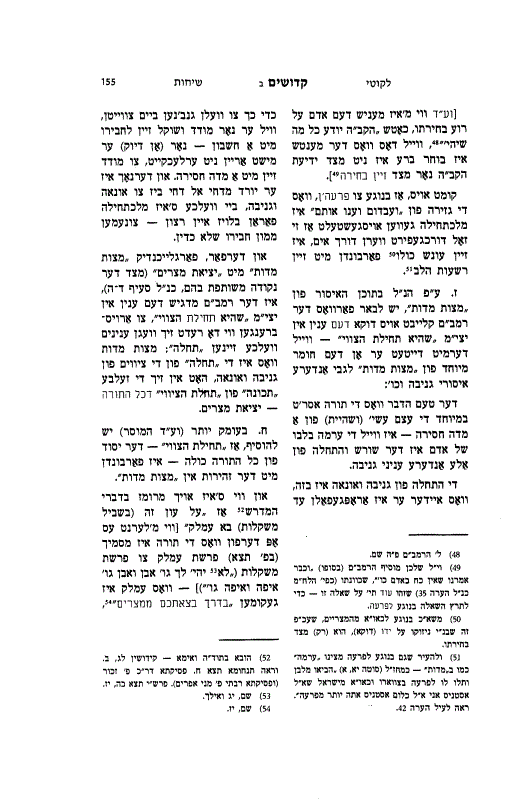
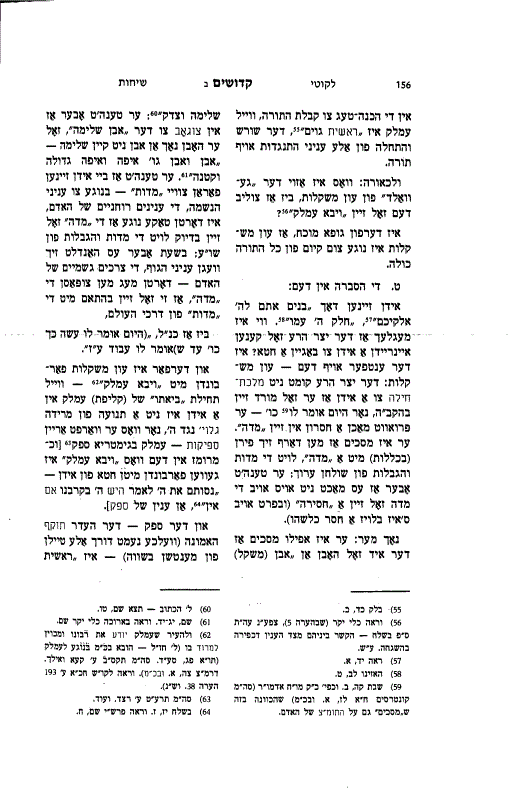
We will be reviewing Likkutei Sichos, Chelek Chof-Zayin, the second sicha for Parshas Kedoshim.
The Rebbe examines the statement of the Rambam and the Toras Kohanim that one who cheats with measures—using a false measuring tool in order to deceive others—is considered as if he denies the Exodus from Egypt.
At first glance, this requires explanation. What is the specific connection between dishonest measures and Yetzias Mitzrayim? The Exodus revealed the Eibershter’s wonders and His direct supervision over the world. It showed that Hashem is in charge and that He sees everything. If so, any form of dishonesty should contradict that awareness. Why, then, is this comparison made specifically about one who cheats with scales or measures? Why not say the same about stealing or other forms of deception?
The Rebbe explains a very interesting idea. When a person cheats with a scale, he is acting in a particularly crooked way. On the surface, he presents himself as honest. He says, “I am weighing the item properly. There is a scale here.” But in truth, the scale itself is false. The deception is built into the measuring tool.
The Rebbe explains that this is the beginning of a person’s descent. The Torah does not only forbid actually cheating another person. It even forbids a person to possess false measuring tools in his home. Even if he is not using them, and even if he has not cheated anyone, he is already transgressing by keeping them.
Why is this so serious? Because possessing such a tool means that a person has prepared an instrument of deception. He has something in his possession whose entire purpose is to trick and cheat another person. That itself is already the beginning of the descent.
This is why dishonest measures are connected specifically to the Exodus from Egypt, as the Rebbe will explain step by step throughout the sicha.
Part 1 – Ois Aleph
Why Are False Measures Uniquely Linked to the Exodus from Egypt?
Regarding the mitzvah of honest measures and weights, the Torah commands in our parshah that a person must use proper and accurate standards in business. The verse states: “Lo sa’asu avel bamishpat, bamiddah…”—do not commit injustice in judgment, in measurement. This includes whether one uses an inaccurate dry measure or places false weights upon a scale.
The Torah introduces this commandment with the words: “Ani Hashem Elokeichem asher hotzeisi eschem mei’eretz Mitzrayim”—I am Hashem your G‑d Who took you out of the land of Egypt. Only afterward does it warn against cheating in measures and weights. This requires explanation. What is the connection between the Exodus from Egypt and honest business standards? Why does the Torah say, “I took you out of Egypt,” and then continue, “Do not cheat in your measurements”?
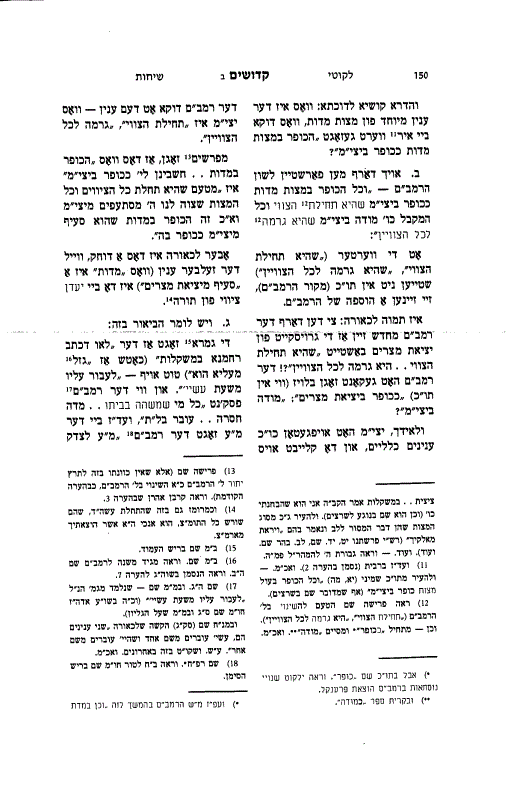
The Rambam, citing the Toras Kohanim, explains that one who denies the mitzvah of honest measurement is considered as though he denies the Exodus from Egypt. The Rambam’s wording is exact. He does not merely say one who is careless in measurement, but one who denies the mitzvah of measurement. Such a person is compared to one who denies Yetzias Mitzrayim itself.
The Rambam adds further that Yetzias Mitzrayim was “the beginning of the command.” The Rebbe will later explain this phrase in detail, but on a simple level it means that the Exodus marked the beginning of the Jewish people’s mission of mitzvos. Through the redemption from Egypt, we became Hashem’s nation and were later given the Torah. Therefore, one who accepts the mitzvah of honest measurement affirms the very foundation that began with the Exodus.
Still, the question remains: if Yetzias Mitzrayim is the beginning of all mitzvos, why is dishonest measurement singled out more than any other commandment? What is the unique connection between false weights and the Exodus from Egypt?
The Maggid Mishneh explains that one who cheats with weights and measures sins in secret. He presents a stone as weighing one pound when in truth it weighs less. No one around him realizes the deception. He appears honest, while hidden dishonesty lies inside the measure itself. By behaving this way, he acts as though Hashem does not see what he is doing. He denies Divine supervision.
This explains the link to Yetzias Mitzrayim, for the Exodus openly demonstrated that Hashem guides the world, performs miracles, and watches over all events. The plagues and the redemption revealed clearly that nothing is hidden from Him. Therefore, one who cheats secretly with false measures behaves contrary to the truth that was revealed in Egypt.
However, the Rebbe asks that this explanation is still difficult. Hidden wrongdoing is not limited to dishonest scales. The same concept applies to ordinary theft. Chazal distinguish between robbery and theft: a robber steals openly, while a thief acts secretly. A thief must pay double, because he fears people but behaves as though Hashem does not see.
The Gemara expresses this sharply: the thief treats the “Eye Above” as though it does not see, and the “Ear Above” as though it does not hear. If so, theft in general also reflects denial of Divine supervision. Why then do we not say that one who denies the prohibition of theft is like one who denies the Exodus from Egypt? Why is this statement reserved specifically for false measures and weights?
The same question applies to all forms of deception. There is a general prohibition of ona’ah—cheating and misleading another person. Many sins can be committed secretly, and many dishonest acts imply that a person thinks he can escape Divine notice. Why, then, does the Torah connect Yetzias Mitzrayim specifically to dishonest measures?
This is the Rebbe’s opening question in the sicha: if the issue is hidden wrongdoing and denial of Hashem’s supervision, then many other transgressions should carry the same association. What is the unique feature of false weights and measures that caused the Torah, the Rambam, and Chazal to connect them specifically with the Exodus from Egypt?
Part 2 – Ois Beis
Why Does the Rambam Add That the Exodus Is the Beginning and Cause of All Mitzvos?
We must also understand the precise language of the Rambam.
The Rambam writes that anyone who denies the mitzvah of honest measures is considered as though he denies Yetzias Mitzrayim. He then adds the words: “for this is the beginning of the command.” He continues further: one who accepts the mitzvah of measures affirms Yetzias Mitzrayim, “which caused all the commandments.”
These phrases require explanation. What exactly is the Rambam teaching us by adding that the Exodus is “the beginning of the command” and “the cause of all the commandments”?
These words do not appear in the Toras Kohanim, which is the source of the Rambam’s ruling. They are additions of the Rambam himself. Why did the Rambam feel it necessary to introduce this further explanation?
At first glance, it would seem enough for the Rambam to quote the essential point found in the Toras Kohanim: one who denies honest measures is like one who denies the Exodus from Egypt, and one who accepts them affirms the Exodus. Why does he go further and emphasize the greatness of Yetzias Mitzrayim—that it was the beginning of all mitzvos and the cause of every commandment?
It almost sounds as though the Rambam is expanding the significance of the Exodus in order to magnify the severity of dishonest measures. But why is that necessary? Why does he need to “build up” what Yetzias Mitzrayim accomplished?
Moreover, Yetzias Mitzrayim contains many broad and fundamental themes: faith in Hashem, Divine providence, miracles, redemption, and the formation of the Jewish people. Why does the Rambam choose specifically this theme—that it is the beginning of the command and the cause of all mitzvos?
The commentaries explain, as the Rebbe brings, that the Rambam is not merely praising the greatness of Yetzias Mitzrayim. Rather, he is identifying a direct relationship. Since the mitzvah of honest measures came to us through the Torah that followed the Exodus, denying this mitzvah means denying the source from which it emerged.
In other words, all mitzvos branch forth from Yetzias Mitzrayim. Hashem redeemed us from Egypt, made us His nation, and then gave us the Torah. Therefore, one who rejects the mitzvah of measures is rejecting something that flows from the Exodus itself.
However, the Rebbe points out that this explanation is still insufficient.
If every mitzvah comes from Yetzias Mitzrayim, then the same reasoning should apply equally to all mitzvos. Whenever a person rejects any commandment, he would be denying that same source. Whenever he accepts any mitzvah, he would be affirming Yetzias Mitzrayim. If so, there is still nothing unique about the mitzvah of honest measures.
We therefore return to the original question: what is the special connection between Yetzias Mitzrayim and false measures?
The Rebbe explains that the halachah of scales and measures differs fundamentally from many other prohibitions. In most cases, the Torah forbids the act of stealing or cheating another person. But in the case of false weights and measures, the Torah prohibits something even before any dishonest act has taken place: one may not even keep such instruments in his possession.
Why is that so? The answer to that distinction will reveal the unique nature of false measures—and why they are specifically connected to Yetzias Mitzrayim.
Part 3 – Ois Gimmel
Why Is It Forbidden Even to Own False Weights and Measures?
The Gemara teaches regarding the prohibition of dishonest scales that the Torah is addressing something deeper than ordinary theft. At first glance, cheating with a scale is simply another form of stealing. By giving less than what was paid for, one is robbing another person. Why, then, does the Torah establish a separate prohibition concerning false weights and measures?
The answer is that one violates this prohibition even before any theft takes place. The wrongdoing begins not only when a person uses false measures, but already when he creates them or keeps them in his possession.
So too the Rambam rules: anyone who keeps in his home a deficient measure—one that is not the true and proper standard—transgresses a Lo Saaseh, a negative commandment. Even though he has not yet stolen from anyone, and no money has changed hands, the very possession of such a measure is already forbidden.
Similarly, regarding the positive commandment, the Rambam writes that one is obligated to ensure that his scales are correct and properly calibrated at the time they are made. The mitzvah is not merely to avoid cheating in practice, but to establish honest standards from the outset.
We therefore see that both aspects of the law begin long before any actual transaction. The prohibition is not only against taking another person’s money. It begins with making or retaining an inaccurate measuring instrument, while the positive command is to ensure that one’s tools are precise and just.
This understanding also explains another halachah of the Rambam.
Ordinarily, when the Torah forbids theft, there must be some minimum value involved. If one takes less than a prutah—an amount too small to be considered significant—there is no formal prohibition of theft in the usual sense. Since the issue is monetary loss, the loss must be of some recognizable value.
But when it comes to false measures, the Rambam rules differently. Even the slightest inaccuracy, a kol shehu, violates the law. Here the issue is not primarily the amount of money lost by the other person. Rather, the issue is the measure itself. It must be exact. The Torah was exceptionally strict regarding scales and weights.
Why is that so?
If no one has yet been cheated, why is it forbidden to keep such a scale in one’s house? One might say simply that if a person owns a false scale, he may eventually come to use it. But the Rebbe explains that the matter runs deeper than concern for future misuse.
There is something inherently wrong with the very existence of an unjust weight or deficient measure. The prohibition is not only because it may later cause harm to another person. The false measure itself is already a serious offense.
The Rebbe explains the distinction between dishonest measures and other forms of theft.
In ordinary theft, the thief has one clear intention: to take what belongs to someone else. But in the case of false weights and measures, two opposite ideas exist simultaneously.
On the one hand, the act of weighing and measuring appears to be an act of fairness and consideration. The seller presents himself as honest. He says, in effect: “I am measuring this properly for you. I want to be exact.”
Yet at the very same time, hidden inside that act of fairness is deception. The measure itself has been falsified so that the very process meant to guarantee honesty becomes the instrument of theft.
This is why the Torah forbids even the making and possession of a deficient measure, even when no one has yet been harmed. The essence of the mitzvah of measures is not only to prevent monetary loss. It is to uproot trickery, deceit, and calculated dishonesty from the person himself.
A false measure is not merely a tool that may be used for sin. It is itself an embodiment of dishonesty. Therefore, the Torah prohibits its creation and possession even before it is ever used.
Part 4 – Ois Daled
Denying the Mitzvah Means Denying the Deceit Itself
Based on this explanation of the seriousness of the mitzvah of midos, the Rambam’s language becomes clear.
The Rambam does not say, “Anyone who is not careful with the mitzvah of measures.” Rather, he says: “Anyone who denies the mitzvah of measures.” What does it mean to deny this mitzvah?
The Rebbe explains that denying the mitzvah of midos means denying its special and unique point. The person may believe that Hashem forbids stealing another person’s money. That is not the issue. He accepts that actual theft is forbidden.
What he denies is that Hashem also prohibited the making or keeping of false scales and deficient measures, even before they are used. He argues: if no one has lost money, and no one has actually been cheated, why should it be forbidden to keep such a measure? He does not accept that the deceit itself—the crookedness contained in preparing or possessing such a tool—is already prohibited.
This is the meaning of denying the mitzvah of measures. He denies that the Torah is concerned not only with the other person’s loss, but also with the dishonest character and deceitful intent that lie behind the false measure.
On this the Rambam says: one who denies the mitzvah of measures is like one who denies the Exodus from Egypt.
The Rebbe now begins to explain the connection. What does Yetzias Mitzrayim teach us, particularly according to the Rambam?
As the Rebbe will explain at length, Yetzias Mitzrayim shows that Hashem punishes wrongdoing between one person and another not only because of the damage caused to the victim, but also because of the evil intention and corrupt heart of the one who caused the harm.
This is seen in the punishment of the Egyptians and Pharaoh. True, Hashem had decreed that the Jewish people would be enslaved in Egypt. The Egyptians could have argued that the Jewish people were destined to be there, and Pharaoh could have claimed that as king he had no choice but to carry out that decree.
Nevertheless, they were punished. Why? Because they did it with cruelty, hatred, and wickedness of heart. Their actions were not merely the fulfillment of a Divine decree; they revealed the evil within them.
This is the connection to false measures. If a person denies that Hashem forbids even the possession of dishonest scales—when no one has yet been cheated—he is denying the lesson of Yetzias Mitzrayim. The Exodus teaches that Hashem judges not only the external result, but also the inner deceit, cruelty, and corruption behind the act.
The Rebbe now turns to a broader discussion in the Rambam: every person has free choice regarding what he will do. Yet Hashem had already said that the Jewish people would be enslaved and afflicted in Egypt. If so, it almost seems that the Egyptians had no choice. Were they not fulfilling what Hashem had foretold?
And what about Pharaoh himself? Did he have a choice?
The Rebbe now begins to analyze this question inside the Rambam.
Part 5 – Ois Hei
Why Were the Egyptians Punished If the Exile Had Already Been Decreed?
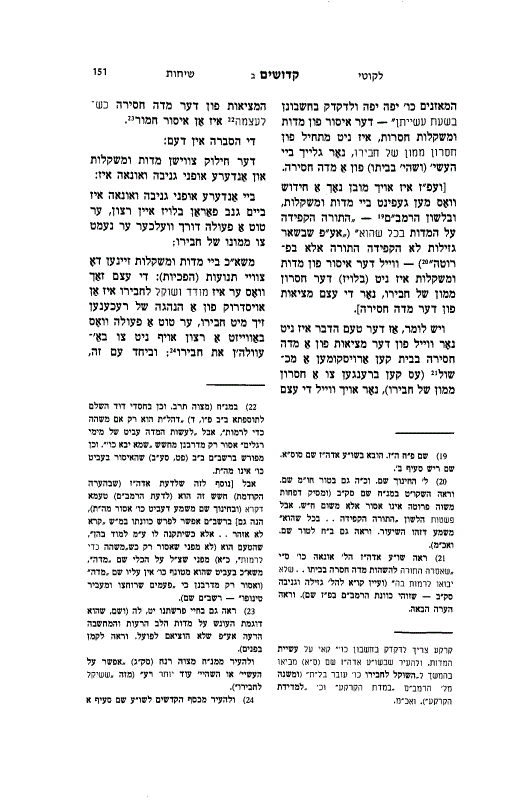
In Hilchos Teshuvah, the Rambam discusses at length one of the great foundations of Torah: the Creator does not force a person to be righteous or wicked, nor does He decree that any individual must choose good or evil. Every human being possesses free choice and is able to decide how he will act.
The Rambam further explains that Hashem’s knowledge of the future does not compel a person’s decisions. The fact that Hashem knows what a person will choose does not force that choice. The individual still acts freely; Hashem simply knows in advance what will be chosen.
The Rambam then raises a powerful question. If every person has free choice, how can the Torah say to Avraham that his descendants will be enslaved and afflicted in a foreign land? It would seem that Hashem decreed upon the Egyptians to oppress the Jewish people. If so, where was their freedom of choice?
The Rambam adds another example. The Torah says that the Jewish people would eventually rise and follow the false gods of the land. If Hashem foretold that they would turn to idolatry, does that not mean their actions were predetermined?
The Rambam answers that no decree was made upon any specific individual. Hashem did not say that this particular person must sin or that this particular Egyptian must enslave the Jews. Rather, every individual retained full freedom. Had any of them chosen differently, they could have acted differently.
So too regarding Egypt: each Egyptian who harmed the Jewish people did so by his own choice. Hashem informed Avraham that his descendants would be enslaved, but He did not decree that any specific Egyptian must be the one to carry it out. Each person independently chose to participate in the oppression.
The Rambam concludes that human beings cannot fully grasp the way Hashem knows future events while still preserving man’s freedom. Although Hashem knows what will occur, His knowledge does not force those events to happen.
The Raavad challenges the Rambam’s explanation. He argues: if those who sinned were to say, “Why are we blamed? Your decree had to be fulfilled by someone,” what answer could be given? If the prophecy had to come true, then someone necessarily had to be the sinner or oppressor. Why should that person be punished?
Regarding Egypt, the Raavad offers another answer: the Egyptians were punished because they went beyond what had been decreed. Not only did they enslave the Jews, but they imposed crushing labor, murdered children, and intensified the suffering beyond measure. As the verse says, “I was only slightly angry, and they helped toward evil.”
However, from the fact that the Rambam does not adopt the Raavad’s explanation, it is clear that the Rambam holds differently. In the Rambam’s view, everything the Egyptians did was included in the decree that the Jews would be enslaved and afflicted. Their punishment was not because they exceeded the decree, but for another reason.
The Rebbe explains this further based on the teaching of the Alter Rebbe in Iggeres HaKodesh. Sometimes a person suffers harm because it was decreed from Heaven that he should experience that loss. Yet the one who caused the damage is still fully guilty and liable. Why? Because although the victim was meant to suffer, the aggressor did not have to be the one chosen to inflict it. Hashem has many agents through whom His purposes can be fulfilled.
Thus, even if after the fact it is clear that the Heavenly decree was carried out through this person, that does not excuse him. He chose evil. He chose to become the instrument of harm, when he could have chosen otherwise. For that bad choice, he is punished.
The same applies to Egypt. The claim that “we merely fulfilled the Divine decree” is no defense. The decree could have been fulfilled through others. Every Egyptian who oppressed the Jews is punished because he chose cruelty and wickedness of his own free will.
Accordingly, the Egyptians were not punished simply because suffering came upon the Jews, for that suffering had already been foretold. They were punished because of the evil within themselves—the corrupt heart that chose to become the oppressor. Their guilt lay in their decision to participate in injustice and affliction.
This, the Rebbe explains, is the Rambam’s true approach. He does not accept that their punishment came merely because they did “more” than was decreed. Rather, they were punished because they freely chose to be the ones who carried out evil.
Part 6 – Ois Vav
Why Was Pharaoh Punished If He Had to Be the One to Enslave Them?
The Rebbe raises a further question: what about Pharaoh himself?
The explanation given regarding the Egyptians in general is that each individual had free choice. Any Egyptian could have chosen not to oppress the Jewish people, and the Divine decree could have been fulfilled through others. Therefore, each one was punished for choosing evil.
But Pharaoh appears different.
Pharaoh was the king of Egypt. As ruler of the nation, he was the one through whom the enslavement was organized and enforced. It would seem that the decree of exile had to be carried out through him. If so, how could Pharaoh be punished? One cannot simply say that someone else could have done it, for Pharaoh was the king and the central authority of the land.
The Rebbe explains that Pharaoh was not acting in order to fulfill the will of Hashem. He did not enslave the Jews out of obedience to a Divine plan. He acted because of the evil within his own heart.
This is the crucial point the Rebbe wishes to establish: the issue is not only the outward deed, but the inner corruption that motivates it.
Just as with false scales, the Torah’s concern is not only that another person is cheated. It is also the deceit, crookedness, and trickery that exist within the person himself. So too in Egypt: Pharaoh’s guilt was rooted not merely in what he did, but in the wickedness that drove him to do it.
The Rebbe develops this by first restating the Rambam’s explanation.
The answer that “someone else could have done it” is sufficient regarding the Egyptian people as individuals. Every Egyptian retained the option not to participate in making Jewish life bitter. Had one refused, the decree could have been fulfilled through another.
But regarding Pharaoh, the Rambam elsewhere writes that Pharaoh initially chose on his own to do evil to the Jews dwelling in his land. Because of that deliberate wickedness, he was later punished by having the path of teshuvah withheld from him until justice was carried out.
This shows that Pharaoh’s punishment requires a deeper explanation.
For in Pharaoh’s case, it would seem that the decree itself had to pass through the king of the country, the one with authority to command the nation and impose slavery upon the Jews. Since the oppression needed royal power behind it, Pharaoh appears indispensable to the process.
If so, why was he punished?
The answer is that even if the decree had to be carried out through Pharaoh’s position as king, the reason Pharaoh chose to do it was not because he sought to fulfill Hashem’s decree. He did it מתוך רשעות לבבו—with the evilness of his heart.
Therefore, he was punished for that choice.
This follows the same principle that applies to all human actions. Although Hashem knows what a person will choose, His knowledge does not cause the person to choose evil. The act remains the person’s own decision, flowing from his own character and will.
So too with Pharaoh: even if his role was foreseen within the Divine plan, the cruelty and oppression were still his own chosen expression of wickedness.
This reveals a deeper lesson. The punishment here is not only for the external act that was done. It is for the inner evil that the act revealed.
And that is precisely the connection to false weights and measures: the Torah condemns not only the loss caused to another person, but the dishonest heart that creates and holds an instrument of deception.
Part 7 – Ois Zayin
False Measures Are the Beginning of All Theft and Deception
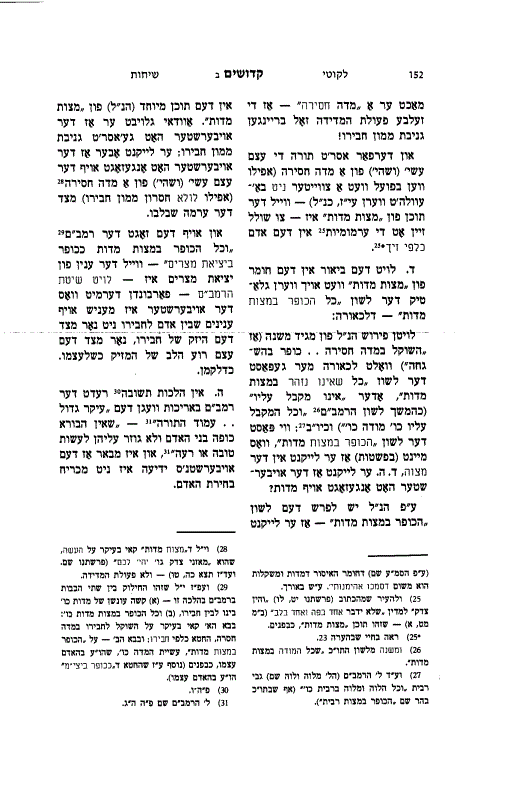
Based on all that was explained earlier regarding the inner content of the mitzvah of measures, we can now understand why the Rambam specifically chooses this expression concerning Yetzias Mitzrayim—that it is the beginning of the command.
The Rambam is emphasizing the unique seriousness of the mitzvah of honest measures in comparison with other prohibitions such as theft and cheating.
Why does the Torah specifically forbid not only cheating with a false measure, but even making it or keeping it in one’s possession?
Because the essence of this prohibition lies in the deceit that exists within the heart of the person. That inner crookedness is the root and beginning of all later forms of dishonesty.
Before a person descends to the level of openly stealing from another, something more subtle has already begun within him. He is still willing to weigh and measure for his customer. He still wants to appear fair and orderly. He is even ready to make an accounting.
But he no longer wants that accounting to be truthful.
Into the process of fairness he introduces a lack of honesty, a hidden distortion, a willingness to deceive. He uses a deficient measure or an inaccurate weight. Outwardly, everything appears proper. Inwardly, dishonesty has already taken hold.
That is where the descent begins.
From there, a person moves from one level to the next. At first, it is only a small readiness to bend the truth and gain unfairly through deception. But once that inner dishonesty has been accepted, it can eventually lead to open theft and direct cheating of another person’s money.
Thus, false measures are not merely one form of wrongdoing among many. They are the starting point of a broader moral decline.
This is why the mitzvah of measures is compared to Yetzias Mitzrayim.
The Rebbe explains that both share the same defining feature: they concern beginnings.
The mitzvah of measures addresses the earliest stage of dishonesty—the moment when corruption first enters the heart, even before any actual theft has occurred.
Likewise, the Exodus from Egypt was the beginning of all mitzvos. It was the first stage that led to everything that followed in the Jewish people’s relationship with Hashem.
And just as the Rebbe explained regarding Pharaoh and the Egyptians, the issue there too was not only the external oppression, but the evil in the heart from which it sprang.
This is why the Rambam stresses that Yetzias Mitzrayim was the beginning of the command. He is teaching that false measures represent the beginning of the downward path in matters of theft and cheating.
The mitzvah of measures, which stands at the beginning of dishonest conduct, parallels the Exodus from Egypt, which stood at the beginning of the commandments. Both reveal that beginnings matter greatly—for within the first small step lies everything that may follow.
Part 8 – Ois Ches
The Mitzvah of Honest Measures Is a Foundation of the Entire Torah
Taking the idea even deeper, the Rebbe explains that the concept of the beginning of the command carries an additional lesson.
Not only is the mitzvah of honest measures the beginning of theft and cheating when neglected, but in a positive sense, being careful with this mitzvah is a foundation for the entire Torah.
This is hinted to in the words of the Midrash, which states: because of faulty weights and measures, Amalek came.
The Midrash derives this from the order of the verses in Parshas Ki Seitzei. First, the Torah warns: do not possess differing stones and differing measures—false weights and dishonest standards. Immediately afterward, the Torah commands us to remember what Amalek did on the road after we left Egypt.
The juxtaposition teaches that there is a connection between the two.
But this is difficult to understand. Why should the sin of dishonest measures be so severe that it leads to confrontation with Amalek?
The Rebbe explains that Amalek is not merely one enemy among many. Amalek is described as “reishis goyim”—the first of nations. In Chassidus, Amalek represents the root and beginning of all forces that oppose holiness, Torah, and Divine service.
Amalek attacks the foundation.
If so, the Midrash is revealing a profound principle: when there is weakness in the area of honest measures, it affects more than one isolated mitzvah. It touches a root issue that impacts the entire structure of Torah life.
Why? Because the mitzvah of measures deals with truthfulness, integrity, and inner honesty. It addresses the earliest stage of moral behavior—the place where a person decides whether he will be straight or crooked, truthful or deceptive.
When that foundation is weakened, it creates vulnerability in all areas of Torah.
This is why the Torah places the section of Amalek next to the section of weights and measures. The battle with Amalek is the battle over foundations. And the mitzvah of honest measures is itself a foundational mitzvah, shaping the honesty and uprightness upon which all Torah observance depends.
Thus, the Midrash teaches that the matter of measures is not a minor detail of commerce. It reaches to the very basis of Torah itself.
Part 9 – Ois Tes
The Yetzer Hara Begins With a “Small Deficiency”
The Rebbe concludes with a powerful lesson in personal avodah.
Yidden are children of Hashem. If so, how is it possible for the Yetzer Hara to persuade a Jew to sin?
The answer is learned from the sin of weights and measures.
The Yetzer Hara does not begin by telling a Jew to rebel openly against the Eibeshter. He does not come at first with open denial or open transgression. Instead, he begins with something subtle: he suggests a small deficiency in the measure.
He agrees that in general a Jew should live according to proper standards. He accepts that there must be measures, limits, and guidelines—the measures of Torah and the boundaries of Shulchan Aruch. But he argues that it is not so serious if the measure is lacking just a little.
Especially if the deficiency is tiny, almost unnoticeable.
He even agrees that a Jew should possess one complete and righteous stone—a true and proper standard. But alongside that, he suggests keeping another stone as well: an additional measure that is not complete, one standard for some situations and another for others.
In this way, he introduces the idea of two measures.
When it comes to spiritual matters—prayer, learning, mitzvos, and holiness—then, he says, one should indeed be exact and careful according to the Torah’s standards.
But when it comes to physical matters, personal comfort, worldly interests, or bodily desires, then one may adjust the standard and follow the measures of the surrounding world.
This is how decline begins.
Today he says, “Do only this.” Tomorrow he suggests something more. Step by step, one descends until eventually he says, “Go and serve idols.”
Everything began with a slight deficiency in the measure.
This is why the sin of weights is connected with the coming of Amalek.
The power of Amalek does not begin with open rebellion against Hashem. Amalek first introduces doubt, coldness, and uncertainty. Chazal note that Amalek has the same numerical value as safek—doubt.
So too the Torah says that Amalek came when the Jews asked: “Is Hashem among us or not?” Once doubt enters, the strength of faith begins to weaken.
That weakening can spread through every part of a person’s life.
This is the root and beginning of all spiritual decline.
Therefore, the rectification is to be careful with one’s measures and weights—to have one complete, righteous, and honest standard for every area of life.
Not one measure for holiness and another for worldly matters. Not one standard in public and another in private. But one truthful measure in all things.
This brings a person to the observance of the entire Torah.
In the words of the Rambam: Whoever accepts the mitzvah of measures affirms the Exodus from Egypt, which is the cause and source of all the commandments.