Introduction
Likkutei Sichos, Volume 27
Parshas Kedoshim – First Sicha
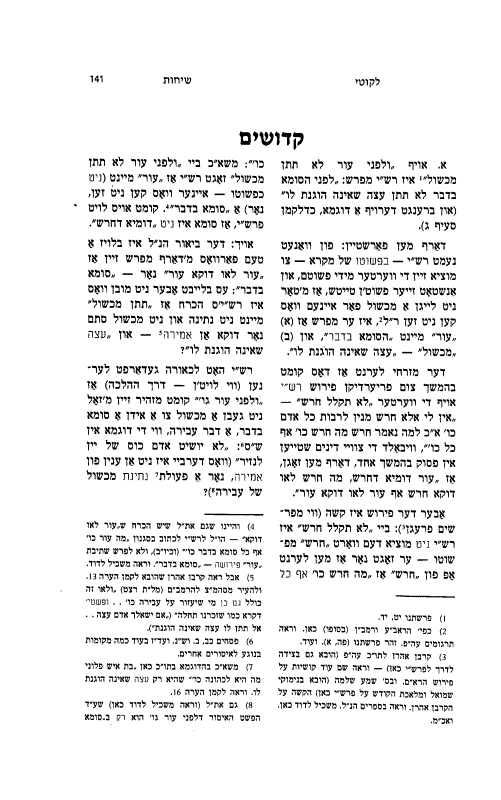
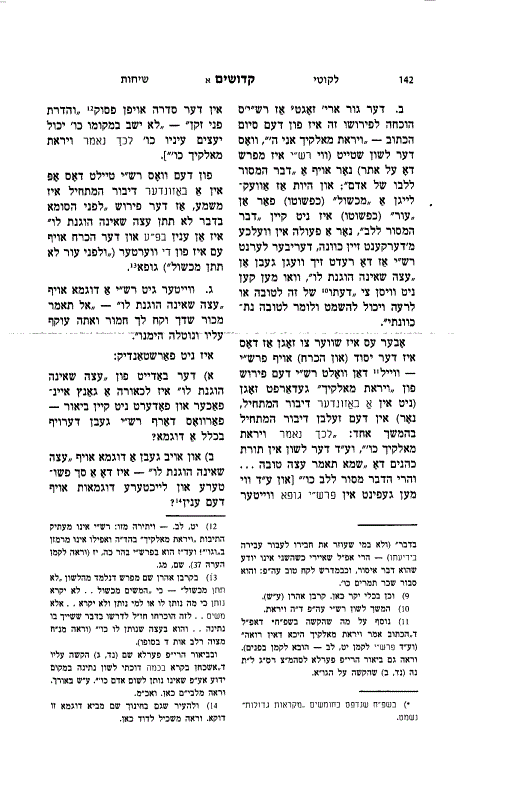
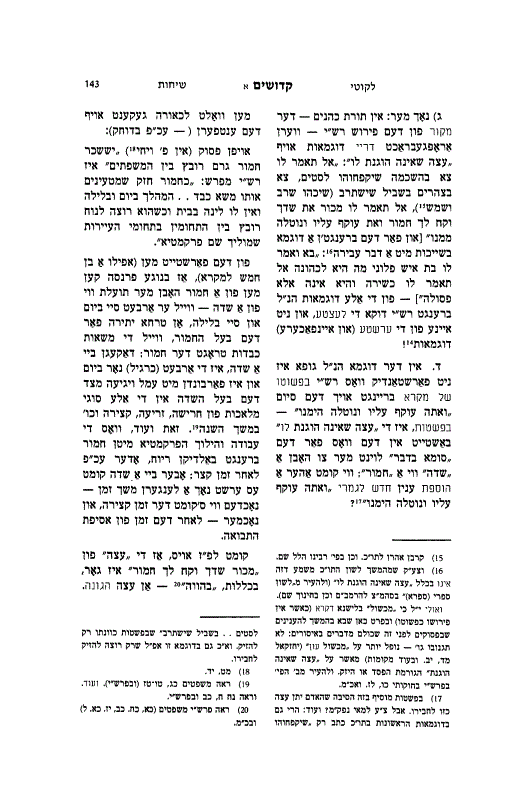
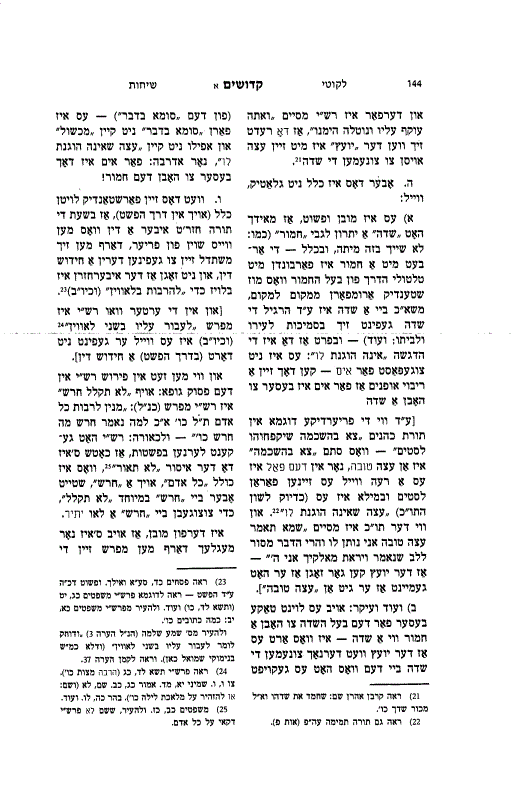
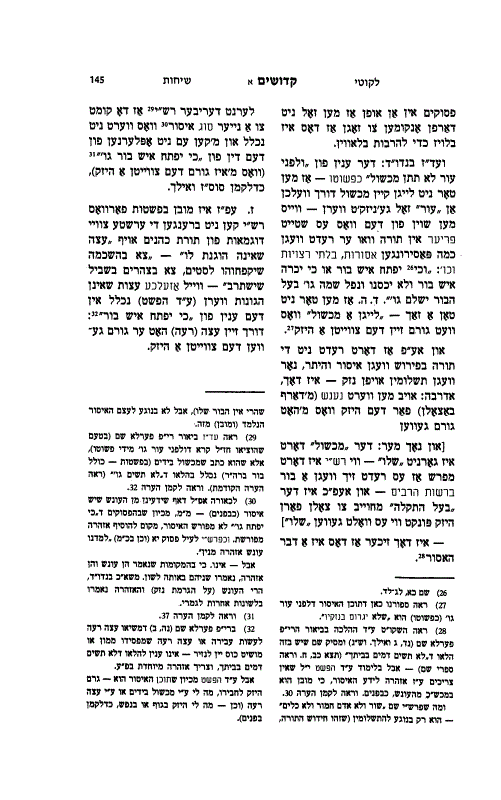
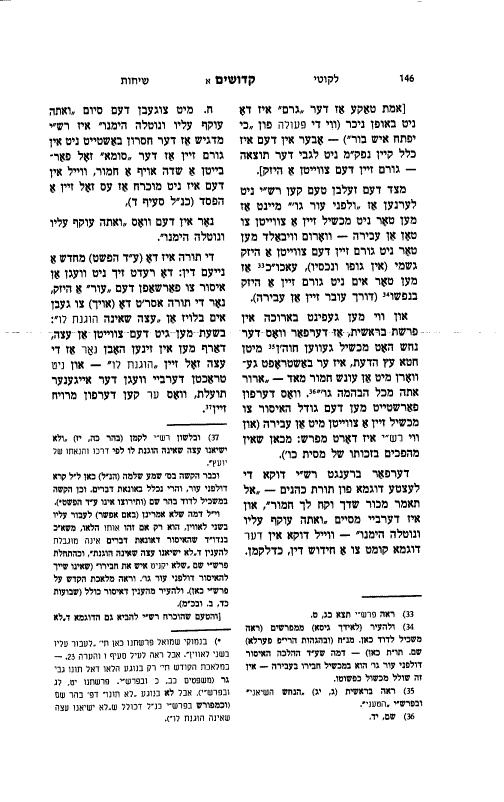
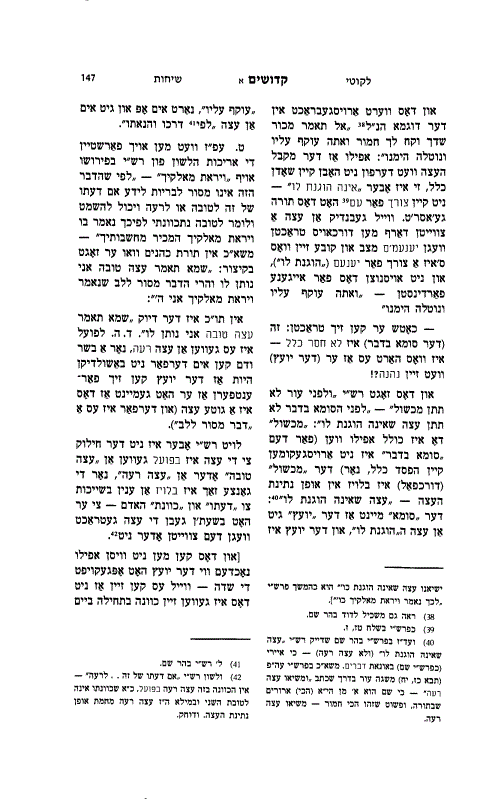
A Rashi Sicha on “Lifnei Iver Lo Sisein Michshol”
We begin a review of the first Sicha on Parshas Kedoshim from Likkutei Sichos, Volume 27. This is a classic Rashi Sicha, in which the Rebbe asks a seemingly simple question on Rashi and, through careful analysis, uncovers a profound Torah principle.
The verse states:
Lifnei iver lo sisein michshol
“Do not place a stumbling block before the blind.”
On the literal level, the meaning appears straightforward: one may not place an obstacle in front of a blind person that could cause him to trip and be harmed.
Yet Rashi explains the verse differently. He writes that the Torah is not speaking only of someone who is physically blind. Rather, it refers to a person who is “blind” in a matter—someone lacking clarity or proper understanding. The Torah is teaching: do not give such a person harmful or misleading advice.
This raises the Rebbe’s central question:
Why does Rashi move away from the simple meaning of the verse?
Why not explain it literally as a prohibition against causing physical harm to a blind person?
The Rebbe explains that the Torah is not merely repeating another law about damages. We already know that one may not create hazards that injure others, such as digging or leaving open a pit in the public domain. If a person causes harm in that way, he is liable. Certainly such behavior is forbidden.
Therefore, this verse must be teaching an additional chidush—a new concept.
The Rebbe reveals that the Torah here is addressing something deeper than physical damage. It teaches that when someone turns to you for guidance, you may not advise him in a way that is not truly for his benefit. Even if no direct loss results, if your advice is motivated by self-interest rather than concern for the other person, you have violated the spirit of the verse.
That is why Rashi gives the example of advising someone to sell his field, only so that you can later acquire it for yourself. The issue is not only the outcome, but the hidden motive behind the advice.
By the end of the Sicha, the Rebbe shows that this verse is not only a law of honesty—it is a lesson in how deeply one Jew must care for another Jew.
Part One
The Rebbe’s Opening Questions on Rashi
Let us begin inside the text of the parshah.
The Torah states:
Lifnei iver lo sisein michshol
“Do not place a stumbling block before the blind.”
At first glance, the meaning seems simple: one may not place an obstacle in front of a blind person that could cause him to trip and be harmed.
Yet Rashi explains the verse differently. He writes:
Lifnei hasuma bedavar – before one who is blind in a matter.
Lo sisein eitzah she’einah hogenes lo – do not give him advice that is not fitting for him.
According to Rashi:
- “Blind” does not mean physically blind.
- It means someone lacking clarity in a certain matter.
- “Stumbling block” does not mean a physical object.
- It means misleading or harmful advice.
The First Fundamental Question
The Rebbe begins with a basic question:
Why does Rashi not explain the verse according to its straightforward meaning?
Why not say simply:
- A blind person cannot see.
- If you place an obstacle before him, he may fall.
- Therefore the Torah forbids causing such harm.
Why does Rashi depart from the literal meaning of the words?
Rashi Changes Both Parts of the Verse
The Rebbe notes that Rashi is not changing only one detail. He reinterprets both parts of the verse:
1. “Iver” – Blind
Rashi says this means not physical blindness, but confusion or lack of understanding.
2. “Michshol” – Stumbling Block
Rashi says this means not a physical obstacle, but advice that is not proper for the person.
This requires explanation. What in the simple reading of the verse compelled Rashi to reinterpret both words?
The Mizrachi’s Suggested Explanation
The Rebbe brings a possible explanation from the Mizrachi.
The previous verse says:
Lo sekallel cheresh
“Do not curse a deaf person.”
Rashi there asks: Is only a deaf person included? Surely one may not curse anyone.
He explains that the Torah mentions a deaf person to teach an additional detail, but the law applies more broadly.
Based on this, the Mizrachi suggests that our verse follows the same pattern:
Just as “cheresh” is not limited only to the literal case, so too “iver” may also include more than physical blindness. It can refer to one who is “blind” in understanding.
Why the Rebbe Rejects This Comparison
The Rebbe explains that the two cases are fundamentally different.
In the Case of “Cheresh”
Rashi does not remove the word from its literal meaning.
A cheresh still means a deaf person. Rashi only teaches that the law extends further.
In the Case of “Iver”
Rashi does something else entirely.
He does not merely broaden the category—he changes the meaning itself.
According to Rashi here:
- “Iver” does not mean physically blind.
- It means one who lacks clarity in a matter.
That is not an expansion of the literal meaning. It is a reinterpretation.
Therefore, the comparison to “cheresh” does not fully explain Rashi.
A Second Question: Why Advice?
Even if we accept that “iver” can mean someone confused or unaware, another question remains.
Why does Rashi interpret “michshol” as bad advice?
Why not understand it in a more direct halachic sense?
For example, the Gemara teaches that one may not hand wine to a Nazir, since the Nazir is forbidden to drink wine.
That would fit naturally:
- The Nazir is “blind” to the spiritual danger.
- The wine is the “stumbling block.”
- “Do not give” would mean literally do not give him the prohibited item.
Why then does Rashi choose to explain the verse as speech and advice rather than as giving a physical object that causes spiritual failure?
The Rebbe’s Two Core Questions
At this stage, the Rebbe has established two major questions:
1. Why not explain the verse literally?
Why not say it refers to causing a blind person to trip?
2. Even if “blind” means confused, why redefine “stumbling block” as bad advice?
Why not explain it as giving someone something prohibited, such as wine to a Nazir?
What Lies Ahead
These questions will lead to the Rebbe’s central insight:
The Torah is not merely repeating a prohibition against causing damage. It is teaching a new and deeper category of responsibility—how one must think about another person’s welfare when offering guidance.
That profound chidush will unfold in the coming sections.
Part Two
The Proof from “Veyareisa Mei’Elokecha”
After raising the opening questions, the Rebbe presents another possible explanation for Rashi’s interpretation—this time from the Gur Aryeh.
The End of the Verse
The Torah does not stop with the words:
Lifnei iver lo sisein michshol
“Do not place a stumbling block before the blind.”
It continues:
Veyareisa mei’Elokecha, Ani Hashem
“You shall fear your G‑d; I am Hashem.”
The question is obvious:
Why does the Torah add the phrase “Fear your G‑d” specifically here?
The Gur Aryeh’s Explanation
Rashi often explains that whenever the Torah says “Veyareisa mei’Elokecha”, it refers to something hidden in a person’s heart—something others cannot judge, but Hashem knows.
Accordingly, the Gur Aryeh explains:
If the verse were speaking literally about placing an obstacle before a blind person, then the wrongdoing is open and visible.
Everyone can see:
- there is a blind person,
- there is an obstacle,
- and someone placed it there.
There is no room for excuses. No one can claim innocence.
So why would the Torah need to add:
“Fear your G‑d”?
That phrase is unnecessary when the wrongdoing is obvious.
Hidden Motives Require “Fear G‑d”
But if the verse is speaking about advice, everything changes.
A person can always say:
- “I meant well.”
- “I thought it was good advice.”
- “I made an honest mistake.”
- “I did not realize it would harm him.”
In such a case, no one truly knows what was in the adviser’s heart.
Only Hashem knows whether the advice was sincere or self-serving.
That is why the Torah says:
Veyareisa mei’Elokecha
“Fear your G‑d.”
Why This Is Strong—but Not Yet Complete
The Rebbe explains that although this approach is compelling, it still cannot be the full explanation of Rashi.
Why not?
Because if the phrase “Veyareisa mei’Elokecha” were the actual source that forced Rashi to interpret the verse as bad advice, then Rashi should have written the two comments together as one continuous explanation.
He should have said:
- Do not give harmful advice.
- Therefore it says “Fear your G‑d,” because only Hashem knows your true intentions.
That would be the natural structure.
Yet Rashi does not do that.
Rashi Separates the Two Comments
Instead, Rashi gives two separate comments:
- On Lifnei iver lo sisein michshol
- On Veyareisa mei’Elokecha
This separation is highly significant.
It implies that Rashi understands the meaning of “Lifnei iver lo sisein michshol” from the words of the verse themselves.
The phrase “Veyareisa mei’Elokecha” supports the idea—but it is not the primary proof.
A Parallel Example in Rashi
The Rebbe brings another example from later in the parshah.
The Torah says:
Vehadarta pnei zakein
“You shall honor the face of the elder.”
Rashi explains practical applications of this mitzvah, such as not sitting in an elder’s designated place.
Then Rashi adds:
A person may close his eyes and claim:
- “I didn’t see him.”
- “I didn’t notice.”
Therefore the Torah says:
Veyareisa mei’Elokecha
“Fear your G‑d.”
There, Rashi clearly links the hidden excuse to the phrase “Fear your G‑d.”
If that were the same method here, Rashi should have written it the same way.
The Rebbe’s Conclusion
Since Rashi does not combine the two explanations, we must conclude:
The phrase “Do not place a stumbling block before the blind” itself already indicates that the verse is referring to misleading advice.
The ending phrase “Fear your G‑d” then teaches that Hashem alone knows the adviser’s true intention.
So the search continues:
What is it in the words of the verse itself that led Rashi to this interpretation?
What Comes Next
The Rebbe will now turn to a new question:
If Rashi is correct that the verse refers to bad advice, why does he choose the unusual example of selling a field and buying a donkey?
That example will open the door to the deeper chidush of the entire Sicha.
Part Three
Why Does Rashi Choose This Example?
After explaining the words of the verse, Rashi does not stop there. He adds a detailed example of what it means to give “advice that is not fitting for him.”
Rashi writes:
Do not say to him:
“Sell your field and buy a donkey.”
Then, after he sells the field, you circumvent him and take it from him.
In other words:
- You advise someone to sell his land.
- He follows your advice.
- You then arrange to acquire that very field for yourself.
At first glance, it appears that the problem is your hidden self-interest. You are presenting yourself as an adviser, while really seeking your own benefit.
The Rebbe’s New Questions
The Rebbe now asks several powerful questions on this Rashi.
Question One: Why Give an Example at All?
The phrase:
Eitzah she’einah hogenes lo
“Advice that is not fitting for him”
seems self-explanatory.
Why does Rashi need to give any example at all?
The idea of bad advice appears simple enough without further illustration.
Question Two: Why Choose a Complicated Example?
Even if Rashi wishes to provide an example, there are many simpler ones.
The Toras Kohanim, the source of Rashi’s interpretation, gives easier and more obvious examples of harmful advice. Why does Rashi ignore those and choose this more complex case?
The Simpler Examples in Toras Kohanim
Example 1: Robbers in the Morning
Tell a person:
“Go out early in the morning,”
while knowing that robbers are waiting and will attack him.
Example 2: Dangerous Heat
Tell him:
“Travel in the afternoon,”
while knowing the scorching heat will harm him.
Example 3: False Advice in Marriage Law
A person asks whether a certain woman is fit to marry a Kohen. You knowingly tell him she is fit, when in truth she is disqualified.
All of these are clear examples of advice that harms another person.
Why Does Rashi Skip These Cases?
These examples seem far simpler than the case of the field and donkey.
Why then does Rashi select specifically:
Sell your field and buy a donkey.
This is not as immediately obvious as the other examples. It requires more thought and raises more questions.
Why did Rashi choose the most difficult example instead of the easiest one?
The Hidden Message in Rashi’s Choice
The Rebbe explains that Rashi’s choice is deliberate.
Rashi is not merely trying to illustrate the concept of bad advice. He is selecting the exact example that will reveal the deeper meaning of the verse.
The simpler cases involve obvious harm:
- robbery,
- physical danger,
- or spiritual failure.
But the field-and-donkey case is different.
At first glance, it is not obvious that the person was harmed at all.
That is precisely why Rashi chooses it.
What Comes Next
The Rebbe will now analyze whether selling a field and buying a donkey is truly bad advice.
That discussion will uncover the central chidush of the verse:
The Torah is not speaking only about advice that causes loss—but about something much deeper.
Part Four
Is Selling a Field for a Donkey Really Bad Advice?
The Rebbe now turns to a deeper question within Rashi’s example itself.
Rashi says:
Tell him: “Sell your field and buy a donkey,”
and then you circumvent him and take the field.
The Rebbe asks:
Why does Rashi need to add the final detail—that you later take the field for yourself?
Would it not already be considered bad advice simply to tell someone to sell his field and buy a donkey?
Why the Extra Detail Seems Unnecessary
At first glance, one could say the advice itself is the problem.
Perhaps a field is more valuable than a donkey. If so, then telling him to exchange land for a donkey is already harmful advice.
If that is true, why does Rashi continue:
“And you circumvent him and take it from him”?
That sounds like a second issue entirely.
A New Possibility: Maybe the Advice Is Good
The Rebbe suggests that perhaps this is exactly why Rashi adds that final phrase.
Maybe selling a field and buying a donkey is not obviously bad advice at all.
Perhaps it could even be a wise business move.
The Advantage of a Donkey
The Torah describes Yissachar as:
Yissachar chamor garem
“Yissachar is a strong-boned donkey.”
Rashi explains that a donkey carries heavy loads, travels by day and by night, and rests only briefly between journeys.
The donkey becomes a symbol of constant labor and productivity.
From this, even a young student can understand that a donkey may be a profitable asset.
A donkey can:
- carry merchandise,
- travel constantly,
- generate income quickly,
- and do much of the physical labor itself.
For the owner, that may mean less effort and faster returns.
The Challenge of Owning a Field
A field, by contrast, requires great labor from its owner:
- plowing,
- sowing,
- maintaining,
- harvesting,
- gathering produce.
And all of this takes time.
The profits of a field often come only after a long process of work and waiting.
Immediate Profit vs Delayed Profit
The Rebbe adds another point.
With a donkey used for transport or commerce, earnings may come quickly—sometimes immediately.
With a field, one must wait through an entire agricultural cycle before seeing results.
So from a practical perspective, advising someone to sell a field and buy a donkey may actually sound reasonable.
Why Rashi Adds the Hidden Scheme
If so, we now understand why Rashi adds:
“And you circumvent him and take the field.”
The problem may not be the transaction itself.
The issue may be that the adviser is using the suggestion as a cover for his own agenda.
He is not truly thinking about the other person’s welfare. He wants the field for himself.
But the Rebbe Is Not Finished
The Rebbe then notes that this explanation is still incomplete.
Even though a donkey has advantages, the matter is not so simple. A field also has clear benefits and lasting value.
So the question remains:
What exactly makes this advice prohibited?
Is it the bad business advice?
Is it the hidden motive?
Or is the Torah teaching something even deeper?
That is the next stage of the Sicha.
Part Five
The Real Question: Why Do We Need This Verse at All?
The Rebbe now deepens the discussion.
Even if we suggested that selling a field for a donkey might sometimes be beneficial, the matter is still far from settled. A field also has clear advantages over a donkey.
A Field Has Its Own Advantages
A donkey may work hard and produce quick income, but a field has lasting strengths:
1. A Field Endures
A donkey can die.
A field remains.
2. A Field Is Stable
Land is permanent property, while an animal is vulnerable and temporary.
3. A Field Is Usually Nearby
A person’s field is generally close to his city and home.
4. A Donkey Requires Travel
The owner of a donkey may need to travel constantly from place to place in order to earn a living. That can involve strain, distance, and difficulty.
So it is certainly possible that for many people, keeping the field is better than buying a donkey.
“Not Fitting for Him”
The Rebbe emphasizes Rashi’s exact wording:
Eitzah she’einah hogenes lo
“Advice that is not fitting for him.”
The focus is not whether advice is always good or always bad in general.
The question is:
Is it right for this particular person in his present situation?
This is similar to the earlier example from the Toras Kohanim:
Telling someone to go out in the morning is usually fine advice. But if robbers are waiting outside, then for him, today, under these circumstances, it is harmful advice.
So too, there can easily be cases where selling the field is not right for this person.
A Stronger Question
The Rebbe now sharpens the issue.
Suppose we say that in this case owning the donkey truly is better for him than owning the field.
If so, then why should it matter that the adviser later acquires the field?
From the perspective of the one receiving the advice:
- he benefited,
- he got what was best for him,
- and he lost nothing.
If that is true, then where is the stumbling block? Where is the wrongdoing?
Therefore the Earlier Explanations Are Not Enough
This shows that none of the earlier answers fully resolve Rashi.
The issue cannot simply be:
- that the advice was economically poor, or
- that the adviser later benefited.
There must be a deeper principle at work.
The Rebbe’s Breakthrough
The Rebbe now introduces the key question that unlocks the entire Sicha:
Why does the Torah need this verse at all?
If the Torah already teaches that one may not harm another person, then what new teaching is added here by saying:
Lifnei iver lo sisein michshol
“Do not place a stumbling block before the blind”?
We Already Know One May Not Cause Harm
The Torah has already taught us laws such as:
- Do not create hazards.
- Do not leave dangerous obstacles.
- If someone causes damage, he is responsible.
For example, if a person opens or digs a pit and leaves it uncovered, he is liable for the harm that results.
So if placing an obstacle before a blind person simply means causing physical damage, that concept is already known.
A Principle in Learning Rashi
The Rebbe explains an important rule:
When the Torah repeats a law already taught elsewhere, we first seek a new chidush—a new lesson or category.
We do not immediately say that the Torah is merely repeating itself in order to add another prohibition.
Only when no new explanation is possible do we say the repetition adds another warning.
The Turning Point
Therefore, this verse must be teaching something beyond ordinary damage.
It is introducing a new type of responsibility—something not already included in the laws of physical harm.
That is why Rashi was forced to move away from the literal reading.
The next section will reveal what that entirely new category is.
Part Six
A Fundamental Rule in Rashi: Seek the New Chidush
The Rebbe now lays down a major principle in learning Rashi.
When the Torah repeats a law that has already been taught earlier, we should first search for a new chidush—a new detail, category, or lesson contained in the second verse.
We do not immediately assume that the Torah is simply repeating itself in order to add another prohibition.
Only when no new explanation can be found does Rashi sometimes explain that the repetition serves merely to strengthen the warning or create an additional negative commandment.
Proof from Rashi in This Very Parshah
The Rebbe brings an example from the nearby verse:
Lo sekallel cheresh
“Do not curse a deaf person.”
But another verse already says:
Be’amcha lo sa’or
“Do not curse among your people.”
Since the Torah already prohibited cursing others, why mention the deaf person specifically?
Rashi does not say that it is merely an extra warning.
Instead, he explains that the verse teaches a new point: just as a deaf person is alive, so too the law applies to the living and not after death.
This demonstrates the rule: when possible, Rashi seeks a fresh teaching rather than treating a verse as repetition alone.
Applying This Rule to Our Verse
Now we return to:
Lifnei iver lo sisein michshol
“Do not place a stumbling block before the blind.”
If this meant only:
- do not place an obstacle before a blind person,
- do not cause him to fall,
- do not injure him,
then the Torah would merely be repeating something we already know from earlier laws.
The Law of the Pit
Earlier in the Torah we learn:
If a person opens or digs a pit and leaves it uncovered, and an animal falls in, the owner of the pit must pay.
The Torah there teaches responsibility for creating hazards that cause damage.
Even though the verse discusses financial liability, the implication is clear:
One may not create dangerous obstacles that harm others.
If So, Why Repeat It Here?
If we already know that creating hazards is forbidden, then why would the Torah need to say again:
“Do not place a stumbling block before the blind”?
Placing a stone before a blind person seems no different in principle from leaving an open pit in the public domain.
In both cases:
- you created a danger,
- another person is harmed,
- and you are responsible.
So this verse must be teaching something beyond ordinary damages.
The Rebbe’s Core Insight
This is why Rashi was forced away from the literal explanation.
The Torah is not repeating the prohibition of physical harm.
It is introducing a new category—one that cannot be learned from the law of the pit.
The verse speaks of a stumbling block even when no visible physical damage occurs.
That is the chidush of the verse.
Why This Matters
Once we understand this, Rashi’s choice becomes precise.
He must explain the verse in a way that reveals something entirely new:
- not just injury,
- not just financial damage,
- but another form of wrongdoing altogether.
The next section will show how the examples of the Toras Kohanim help clarify exactly what that new category is.
Part Seven
Why Rashi Rejects the Other Examples
Based on the Rebbe’s principle, we can now understand why Rashi does not choose the first two examples brought in the Toras Kohanim.
Those examples were:
- “Go out in the morning,” when robbers are waiting.
- “Go out in the afternoon,” when the heat will harm him.
Both are cases of harmful advice.
Yet Rashi omits them. Why?
They Are Still Ordinary Damage
Although the damage comes through words rather than through a physical obstacle, the result is the same:
- the person is harmed,
- the adviser caused that harm,
- and the injury is real.
The method may be different, but the category remains the same.
It is still a case of causing damage to another person—similar in principle to digging a pit or creating a hazard.
So these examples do not reveal the special chidush of our verse.
Why Not Explain It as Causing Sin?
This also explains why Rashi does not interpret the verse merely as causing someone else to sin.
For example:
- handing wine to a Nazir,
- helping another person violate a prohibition,
- or placing spiritual temptation before someone.
Why not?
Because if the Torah already forbids causing physical harm, then certainly it forbids causing spiritual harm.
Hurting another person’s soul is no less serious than hurting his body or property.
Proof from Bereishit
The Torah itself demonstrates the severity of causing another person to sin in the story of the serpent in Bereishit.
The serpent persuaded Eve to eat from the Tree of Knowledge and was severely punished:
“Cursed are you from all the animals…”
This teaches how grave it is to lead another person into wrongdoing.
Rashi there also notes that we do not seek excuses for one who causes another to sin.
So once again, we do not need a separate verse here merely to prohibit causing spiritual stumbling.
Why Rashi Chooses the Final Example
This is why Rashi specifically chooses the last example:
Tell him to sell his field and buy a donkey,
and then you circumvent him and acquire the field yourself.
Only here do we encounter something fundamentally new.
A New Category of Wrongdoing
In this case, the issue is not necessarily that the other person suffered a measurable loss.
The problem is deeper:
You are giving advice not for his benefit, but for your own.
You present yourself as a helper, but your hidden motive is self-interest.
That is a different kind of stumbling block entirely.
It is not just damage.
It is betrayal of trust.
It is using another person’s dependence for personal gain.
That is the chidush of the verse.
Part Eight
The New Definition of a Stumbling Block
The Rebbe now reveals the heart of the Sicha.
When Rashi adds the words:
“And you circumvent him and take it from him,”
he is emphasizing that the problem is not simply the exchange of a field for a donkey.
That transaction may not involve any loss at all. In some cases, it may even be beneficial.
The real issue lies elsewhere.
Not Damage—But Dishonest Guidance
The Torah is introducing a new concept.
The verse is not speaking only about causing another person harm.
It teaches that even when no measurable damage occurs, there can still be a prohibition in the very way advice is given.
When someone turns to you for guidance, your only concern must be:
- What is best for him?
- What does he need?
- What is fitting for his situation?
That must be your entire focus.
Hidden Self-Interest Is Forbidden
What is forbidden?
To advise another person while also thinking:
- “What will I gain from this?”
- “How can this benefit me?”
- “How can I use this opportunity for myself?”
Even if the other person loses nothing, advice driven by self-interest is not the Torah’s standard of honest counsel.
That is why Rashi’s example centers on the adviser later acquiring the field for himself.
Even Without Any Loss
A person might argue:
- “He did not lose anything.”
- “The deal worked out.”
- “He benefited too.”
- “Why should it matter if I gained as well?”
The Torah answers:
That itself is the stumbling block.
The failure is not only in the result—it is in the misuse of trust.
What the Blind Person Believes
The person seeking advice assumes:
- the adviser cares about him,
- the advice is being given for his benefit,
- and the recommendation is sincere.
But in truth, the adviser is steering the situation for his own interests.
He appears helpful while acting selfishly.
That hidden manipulation is the michshol—the stumbling block.
The Torah’s Standard of Advice
The Torah teaches that giving advice is a sacred responsibility.
When another person places trust in you, you may not exploit that trust—even subtly, even profitably, even without causing loss.
Advice must be clean, sincere, and centered entirely on the good of the one asking.
Part Nine
“Fear Your G‑d” — The Test of Inner Motive
The Rebbe now explains why the verse concludes:
Veyareisa mei’Elokecha
“You shall fear your G‑d.”
This phrase now becomes exact and necessary.
Why Human Beings Cannot Judge This Case
Rashi does not frame the issue simply as:
- Was the advice objectively good?
- Or was it objectively bad?
Because in many cases, people cannot know.
The adviser can always defend himself and say:
- “I meant well.”
- “I truly thought it was good for him.”
- “I was sincere.”
- “Only later did an opportunity arise for me.”
From the outside, no one can prove otherwise.
The Real Question Is Intention
According to the Rebbe’s reading of Rashi, the central issue is not merely the quality of the advice, but the intention behind it.
When you gave the advice, what were you thinking?
Were you focused on:
- what is best for the other person,
- what he needs,
- what would truly help him?
Or were you focused on:
- your own gain,
- your own opportunity,
- your own advantage?
That inner difference is the true dividing line.
Why “Fear Your G‑d” Is Essential
Since no human court can fully know what was in the adviser’s heart, the Torah says:
You shall fear your G‑d.
Hashem knows:
- what you intended,
- what motivated your words,
- whether your concern was genuine,
- and whether you used another person’s trust for yourself.
Even After the Fact
Even if the adviser later buys the field, that still does not prove his original motive.
He can claim:
- “At first I meant only to help.”
- “Later the chance came up, so I bought it.”
- “That was not my original plan.”
And perhaps no one can disprove him.
But Hashem knows the truth from the beginning.
The True Stumbling Block
The stumbling block, then, is this:
You gave advice while the other person trusted you—but your heart was not centered on his good.
Even if he lost nothing, even if the advice worked, even if no one can expose you—the Torah still calls that a michshol.
That is why the verse ends with the warning:
Fear your G‑d.
Because the essence of this mitzvah lives in the hidden world of intention.
Part Ten
The Deeper Lesson: True Love for Another Jew
The Rebbe concludes with a wondrous lesson in the meaning of loving one’s fellow Jew.
This verse is not only teaching a law about advice. It is revealing how deeply one Jew must care for another.
More Than Helping in Practice
It is not enough merely to act in a way that benefits another person.
A person may do something helpful, give assistance, or offer guidance that brings practical benefit.
Yet the Torah teaches that this alone is not the full ideal.
The inner approach matters as well:
- What is your intention?
- What is motivating you?
- What is your goal?
Remove Self from the Center
When doing a favor for someone else, one must strive to be free of self-centered motives.
The focus should not be:
- What will I gain?
- How do I appear?
- What comes back to me?
Instead, one should think entirely about the other person:
- What does he need?
- What will truly help him?
- What is best for his situation?
That is the Torah’s standard of kindness.
Pure Concern Leaves No Room for Ego
When concern for the other person is genuine and complete, personal interests do not interfere.
There is no hidden agenda.
No subtle self-benefit.
No divided intention.
The mind and heart are fully directed toward the good of the other person.
The Meaning of Ahavas Yisrael
This is a living expression of Ahavas Yisrael:
To care for another not only through actions, but through inner sincerity.
To help another not only effectively, but purely.
To place another person’s welfare at the center of your concern.
That is the deeper message of:
Lifnei iver lo sisein michshol
“Do not place a stumbling block before the blind.”